Chemotherapy Induced Nausea
and Vomiting (CINV)
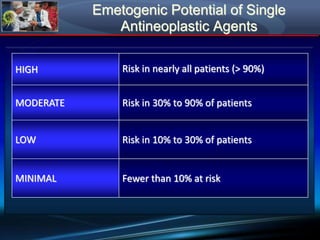
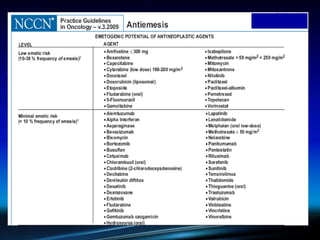
Emetogenic Potential of Single
Antineoplastic Agents
HIGH Risk in nearly all patients (> 90%)
MODERATE Risk in 30% to 90% of patients
LOW Risk in 10% to 30% of patients
MINIMAL Fewer than 10% at risk
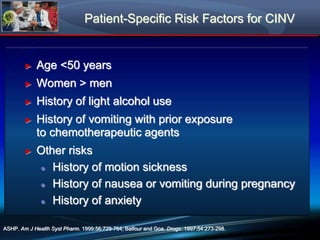
Patient-Specific Risk Factors for CINV
► Age <50 years
► Women > men
► History of light alcohol use
► History of vomiting with prior exposure
to chemotherapeutic agents
► Other risks
● History of motion sickness
● History of nausea or vomiting during pregnancy
● History of anxiety
ASHP. Am J Health Syst Pharm. 1999:56:729-764; Balfour and Goa. Drugs. 1997:54:273-298.
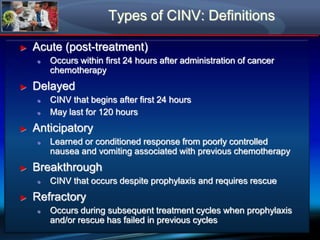
Types of CINV: Definitions
► Acute (post-treatment)
● Occurs within first 24 hours after administration of cancer
chemotherapy
► Delayed
● CINV that begins after first 24 hours
● May last for 120 hours
► Anticipatory
● Learned or conditioned response from poorly controlled
nausea and vomiting associated with previous chemotherapy
► Breakthrough
● CINV that occurs despite prophylaxis and requires rescue
► Refractory
● Occurs during subsequent treatment cycles when prophylaxis
and/or rescue has failed in previous cycles
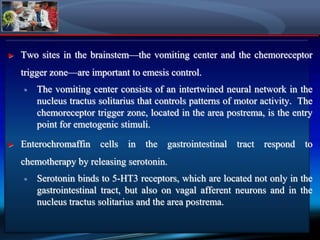
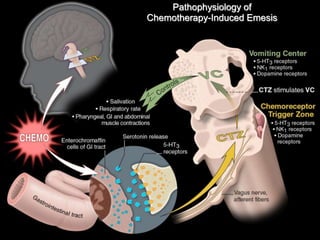
► Two sites in the brainstem—the vomiting center and the chemoreceptor
trigger zone—are important to emesis control.
 The vomiting center consists of an intertwined neural network in the
nucleus tractus solitarius that controls patterns of motor activity. The
chemoreceptor trigger zone, located in the area postrema, is the entry
point for emetogenic stimuli.
► Enterochromaffin cells in the gastrointestinal tract respond to
chemotherapy by releasing serotonin.
 Serotonin binds to 5-HT3 receptors, which are located not only in the
gastrointestinal tract, but also on vagal afferent neurons and in the
nucleus tractus solitarius and the area postrema.
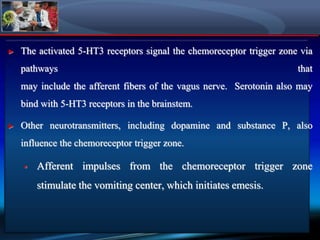
► The activated 5-HT3 receptors signal the chemoreceptor trigger zone via
pathways that
may include the afferent fibers of the vagus nerve. Serotonin also may
bind with 5-HT3 receptors in the brainstem.
► Other neurotransmitters, including dopamine and substance P, also
influence the chemoreceptor trigger zone.
 Afferent impulses from the chemoreceptor trigger zone
stimulate the vomiting center, which initiates emesis.
Pathophysiology of
Chemotherapy-Induced Emesis
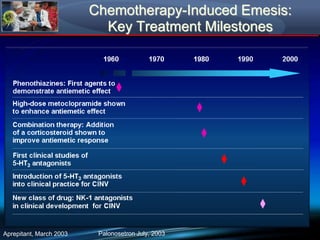
Chemotherapy-Induced Emesis:
Key Treatment Milestones
Palonosetron July, 2003
Aprepitant, March 2003
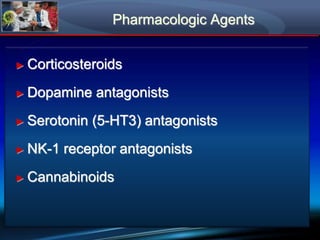
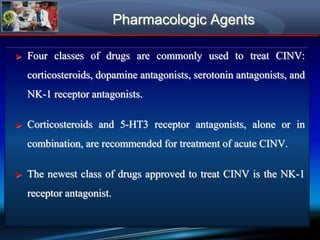
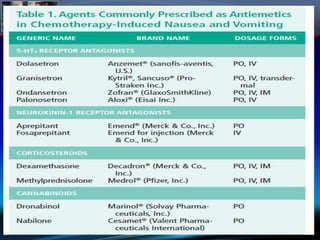
Pharmacologic Agents
► Corticosteroids
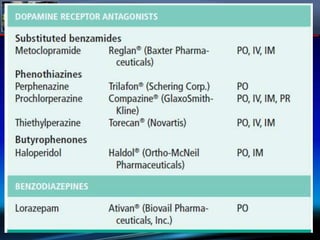
► Dopamine antagonists
► Serotonin (5-HT3) antagonists
► NK-1 receptor antagonists
► Cannabinoids
Pharmacologic Agents
► Four classes of drugs are commonly used to treat CINV:
corticosteroids, dopamine antagonists, serotonin antagonists, and
NK-1 receptor antagonists.
► Corticosteroids and 5-HT3 receptor antagonists, alone or in
combination, are recommended for treatment of acute CINV.
► The newest class of drugs approved to treat CINV is the NK-1
receptor antagonist.
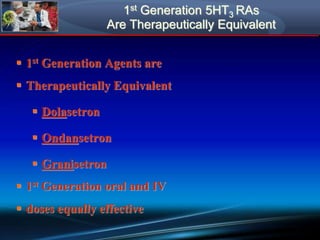
1st Generation 5HT3 RAs
Are Therapeutically Equivalent
 1st Generation Agents are
 Therapeutically Equivalent
 Dolasetron
 Ondansetron
 Granisetron
 1st Generation oral and IV
 doses equally effective
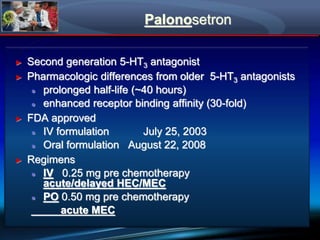
Palonosetron
► Second generation 5-HT3 antagonist
► Pharmacologic differences from older 5-HT3 antagonists
● prolonged half-life (~40 hours)
● enhanced receptor binding affinity (30-fold)
► FDA approved
● IV formulation July 25, 2003
● Oral formulation August 22, 2008
► Regimens
● IV 0.25 mg pre chemotherapy
acute/delayed HEC/MEC
● PO 0.50 mg pre chemotherapy
acute MEC
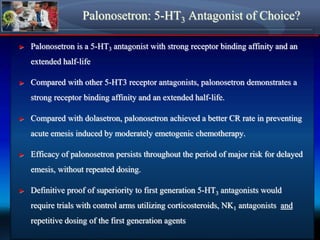
Palonosetron: 5-HT3 Antagonist of Choice?
► Palonosetron is a 5-HT3 antagonist with strong receptor binding affinity and an
extended half-life
► Compared with other 5-HT3 receptor antagonists, palonosetron demonstrates a
strong receptor binding affinity and an extended half-life.
► Compared with dolasetron, palonosetron achieved a better CR rate in preventing
acute emesis induced by moderately emetogenic chemotherapy.
► Efficacy of palonosetron persists throughout the period of major risk for delayed
emesis, without repeated dosing.
► Definitive proof of superiority to first generation 5-HT3 antagonists would
require trials with control arms utilizing corticosteroids, NK1 antagonists and
repetitive dosing of the first generation agents
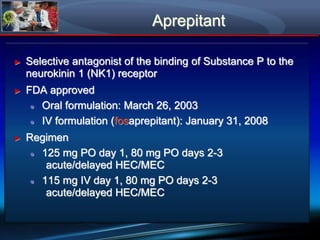
Aprepitant
► Selective antagonist of the binding of Substance P to the
neurokinin 1 (NK1) receptor
► FDA approved
● Oral formulation: March 26, 2003
● IV formulation (fosaprepitant): January 31, 2008
► Regimen
● 125 mg PO day 1, 80 mg PO days 2-3
acute/delayed HEC/MEC
● 115 mg IV day 1, 80 mg PO days 2-3
acute/delayed HEC/MEC
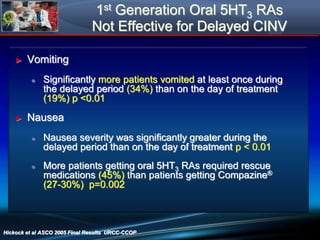
1st Generation Oral 5HT3 RAs
Not Effective for Delayed CINV
► Vomiting
● Significantly more patients vomited at least once during
the delayed period (34%) than on the day of treatment
(19%) p <0.01
► Nausea
● Nausea severity was significantly greater during the
delayed period than on the day of treatment p < 0.01
● More patients getting oral 5HT3 RAs required rescue
medications (45%) than patients getting Compazine®
(27-30%) p=0.002
Hickock et al ASCO 2005 Final Results URCC-CCOP
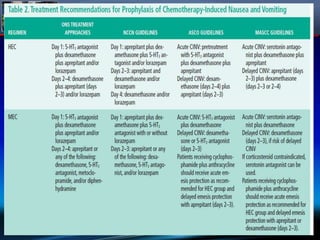
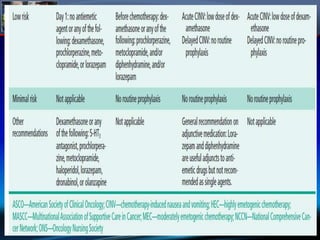
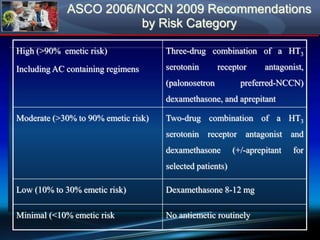
ASCO 2006/NCCN 2009 Recommendations
by Risk Category
High (>90% emetic risk)
Including AC containing regimens
Three-drug combination of a HT3
serotonin receptor antagonist,
(palonosetron preferred-NCCN)
dexamethasone, and aprepitant
Moderate (>30% to 90% emetic risk) Two-drug combination of a HT3
serotonin receptor antagonist and
dexamethasone (+/-aprepitant for
selected patients)
Low (10% to 30% emetic risk) Dexamethasone 8-12 mg
Minimal (<10% emetic risk No antiemetic routinely
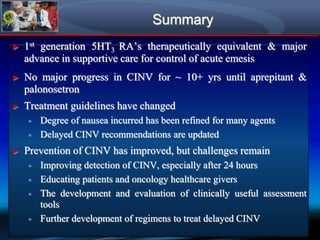
Summary
► 1st generation 5HT3 RA’s therapeutically equivalent & major
advance in supportive care for control of acute emesis
► No major progress in CINV for ~ 10+ yrs until aprepitant &
palonosetron
► Treatment guidelines have changed
 Degree of nausea incurred has been refined for many agents
 Delayed CINV recommendations are updated
► Prevention of CINV has improved, but challenges remain
 Improving detection of CINV, especially after 24 hours
 Educating patients and oncology healthcare givers
 The development and evaluation of clinically useful assessment
tools
 Further development of regimens to treat delayed CINV

CINV correctly navigation and navigation.pptx

  • 1.
  • 2.
    Emetogenic Potential ofSingle Antineoplastic Agents HIGH Risk in nearly all patients (> 90%) MODERATE Risk in 30% to 90% of patients LOW Risk in 10% to 30% of patients MINIMAL Fewer than 10% at risk
  • 5.
    Patient-Specific Risk Factorsfor CINV ► Age <50 years ► Women > men ► History of light alcohol use ► History of vomiting with prior exposure to chemotherapeutic agents ► Other risks ● History of motion sickness ● History of nausea or vomiting during pregnancy ● History of anxiety ASHP. Am J Health Syst Pharm. 1999:56:729-764; Balfour and Goa. Drugs. 1997:54:273-298.
  • 6.
    Types of CINV:Definitions ► Acute (post-treatment) ● Occurs within first 24 hours after administration of cancer chemotherapy ► Delayed ● CINV that begins after first 24 hours ● May last for 120 hours ► Anticipatory ● Learned or conditioned response from poorly controlled nausea and vomiting associated with previous chemotherapy ► Breakthrough ● CINV that occurs despite prophylaxis and requires rescue ► Refractory ● Occurs during subsequent treatment cycles when prophylaxis and/or rescue has failed in previous cycles
  • 7.
    ► Two sitesin the brainstem—the vomiting center and the chemoreceptor trigger zone—are important to emesis control.  The vomiting center consists of an intertwined neural network in the nucleus tractus solitarius that controls patterns of motor activity. The chemoreceptor trigger zone, located in the area postrema, is the entry point for emetogenic stimuli. ► Enterochromaffin cells in the gastrointestinal tract respond to chemotherapy by releasing serotonin.  Serotonin binds to 5-HT3 receptors, which are located not only in the gastrointestinal tract, but also on vagal afferent neurons and in the nucleus tractus solitarius and the area postrema.
  • 8.
    ► The activated5-HT3 receptors signal the chemoreceptor trigger zone via pathways that may include the afferent fibers of the vagus nerve. Serotonin also may bind with 5-HT3 receptors in the brainstem. ► Other neurotransmitters, including dopamine and substance P, also influence the chemoreceptor trigger zone.  Afferent impulses from the chemoreceptor trigger zone stimulate the vomiting center, which initiates emesis.
  • 9.
  • 10.
    Chemotherapy-Induced Emesis: Key TreatmentMilestones Palonosetron July, 2003 Aprepitant, March 2003
  • 11.
    Pharmacologic Agents ► Corticosteroids ►Dopamine antagonists ► Serotonin (5-HT3) antagonists ► NK-1 receptor antagonists ► Cannabinoids
  • 12.
    Pharmacologic Agents ► Fourclasses of drugs are commonly used to treat CINV: corticosteroids, dopamine antagonists, serotonin antagonists, and NK-1 receptor antagonists. ► Corticosteroids and 5-HT3 receptor antagonists, alone or in combination, are recommended for treatment of acute CINV. ► The newest class of drugs approved to treat CINV is the NK-1 receptor antagonist.
  • 17.
    1st Generation 5HT3RAs Are Therapeutically Equivalent  1st Generation Agents are  Therapeutically Equivalent  Dolasetron  Ondansetron  Granisetron  1st Generation oral and IV  doses equally effective
  • 18.
    Palonosetron ► Second generation5-HT3 antagonist ► Pharmacologic differences from older 5-HT3 antagonists ● prolonged half-life (~40 hours) ● enhanced receptor binding affinity (30-fold) ► FDA approved ● IV formulation July 25, 2003 ● Oral formulation August 22, 2008 ► Regimens ● IV 0.25 mg pre chemotherapy acute/delayed HEC/MEC ● PO 0.50 mg pre chemotherapy acute MEC
  • 19.
    Palonosetron: 5-HT3 Antagonistof Choice? ► Palonosetron is a 5-HT3 antagonist with strong receptor binding affinity and an extended half-life ► Compared with other 5-HT3 receptor antagonists, palonosetron demonstrates a strong receptor binding affinity and an extended half-life. ► Compared with dolasetron, palonosetron achieved a better CR rate in preventing acute emesis induced by moderately emetogenic chemotherapy. ► Efficacy of palonosetron persists throughout the period of major risk for delayed emesis, without repeated dosing. ► Definitive proof of superiority to first generation 5-HT3 antagonists would require trials with control arms utilizing corticosteroids, NK1 antagonists and repetitive dosing of the first generation agents
  • 20.
    Aprepitant ► Selective antagonistof the binding of Substance P to the neurokinin 1 (NK1) receptor ► FDA approved ● Oral formulation: March 26, 2003 ● IV formulation (fosaprepitant): January 31, 2008 ► Regimen ● 125 mg PO day 1, 80 mg PO days 2-3 acute/delayed HEC/MEC ● 115 mg IV day 1, 80 mg PO days 2-3 acute/delayed HEC/MEC
  • 21.
    1st Generation Oral5HT3 RAs Not Effective for Delayed CINV ► Vomiting ● Significantly more patients vomited at least once during the delayed period (34%) than on the day of treatment (19%) p <0.01 ► Nausea ● Nausea severity was significantly greater during the delayed period than on the day of treatment p < 0.01 ● More patients getting oral 5HT3 RAs required rescue medications (45%) than patients getting Compazine® (27-30%) p=0.002 Hickock et al ASCO 2005 Final Results URCC-CCOP
  • 22.
    ASCO 2006/NCCN 2009Recommendations by Risk Category High (>90% emetic risk) Including AC containing regimens Three-drug combination of a HT3 serotonin receptor antagonist, (palonosetron preferred-NCCN) dexamethasone, and aprepitant Moderate (>30% to 90% emetic risk) Two-drug combination of a HT3 serotonin receptor antagonist and dexamethasone (+/-aprepitant for selected patients) Low (10% to 30% emetic risk) Dexamethasone 8-12 mg Minimal (<10% emetic risk No antiemetic routinely
  • 23.
    Summary ► 1st generation5HT3 RA’s therapeutically equivalent & major advance in supportive care for control of acute emesis ► No major progress in CINV for ~ 10+ yrs until aprepitant & palonosetron ► Treatment guidelines have changed  Degree of nausea incurred has been refined for many agents  Delayed CINV recommendations are updated ► Prevention of CINV has improved, but challenges remain  Improving detection of CINV, especially after 24 hours  Educating patients and oncology healthcare givers  The development and evaluation of clinically useful assessment tools  Further development of regimens to treat delayed CINV