Mapping for Results
Enhance Transparency and Citizen Engagement for Better Results
Soren Gigler
Innovation Practice
World Bank Institute
bgigler@worldbank.org
www. openaidmap.org
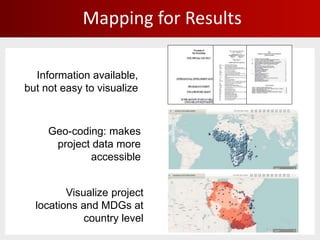
Mapping for Results
Geo-coding: makes
project data more
accessible
Visualize project
locations and MDGs at
country level
Information available,
but not easy to visualize
Main Objectives
• Enhance Monitoring of Results: to better monitor,
track and report results
• Improve targeting of WB Operations: to address
MDGs
• Improve Transparency and Social Accountability:
to increase accessibility to WB operations and their
outcomes
• Establish Feedback Loop: to empower citizens and
CSOs to provide direct feedback on development
outcomes
Poverty Concentration & Geo-mapping
Regions Countries
Sectors Projects
Mapping at Various Levels
maps.worldbank.org
Are health projects in areas with the highest infant
mortality?
Progress so far
• Maps for all 143 IBRD and IDA countries developed
• More than 30,000 project locations mapped
combined with sub-national MDG indictors (poverty,
infant mortality, malnutrition)
• Visualized geographic locations for 2,500 active Bank
projects
• Provided quick graphic overview of how the WB is
doing in terms of reaching its development
objectives
• Initiated Open Aid Pilots for Malawi, Moldova and
Haiti
September 2011
All IBRD – IDA
Challenges
• Institutional culture change towards transparency &
openness needed
• Cross-WB collaboration required (OPCS, DEC, EXT, ISG,
WBI and the Regions)
• Limited access to sub-national data
• Scale-up from innovation pilot to global coverage
• Geo-coding considered too complicated & expensive
• Small core team (limited budget)
• Institutionalize geo-coding across WB
• Long- term sustainability
Institutionalize across the WB Group
Switch to map view to show the
project locations on a map of
Africa.
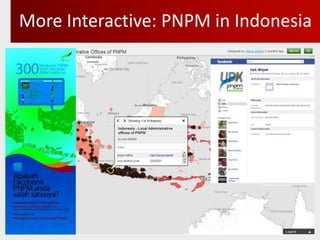
More Interactive: PNPM in Indonesia
Citizen Feedback Loop
Empowering Citizens to provide feedback
OnTrack Citizen Feedback
Open Aid Partnership
• Open Aid Map to show
locations of donor
activities
• Country Platforms for
open geographic data of
public service delivery
• Citizen Feedback Loop
• Capacity Building for civil
society and citizens
openaidmap.org

Mapping for Results

  • 1.
    Mapping for Results EnhanceTransparency and Citizen Engagement for Better Results Soren Gigler Innovation Practice World Bank Institute bgigler@worldbank.org www. openaidmap.org
  • 2.
    Mapping for Results Geo-coding:makes project data more accessible Visualize project locations and MDGs at country level Information available, but not easy to visualize
  • 3.
    Main Objectives • EnhanceMonitoring of Results: to better monitor, track and report results • Improve targeting of WB Operations: to address MDGs • Improve Transparency and Social Accountability: to increase accessibility to WB operations and their outcomes • Establish Feedback Loop: to empower citizens and CSOs to provide direct feedback on development outcomes
  • 4.
  • 5.
    Regions Countries Sectors Projects Mappingat Various Levels maps.worldbank.org
  • 6.
    Are health projectsin areas with the highest infant mortality?
  • 7.
    Progress so far •Maps for all 143 IBRD and IDA countries developed • More than 30,000 project locations mapped combined with sub-national MDG indictors (poverty, infant mortality, malnutrition) • Visualized geographic locations for 2,500 active Bank projects • Provided quick graphic overview of how the WB is doing in terms of reaching its development objectives • Initiated Open Aid Pilots for Malawi, Moldova and Haiti
  • 8.
  • 9.
    Challenges • Institutional culturechange towards transparency & openness needed • Cross-WB collaboration required (OPCS, DEC, EXT, ISG, WBI and the Regions) • Limited access to sub-national data • Scale-up from innovation pilot to global coverage • Geo-coding considered too complicated & expensive • Small core team (limited budget) • Institutionalize geo-coding across WB • Long- term sustainability
  • 10.
    Institutionalize across theWB Group Switch to map view to show the project locations on a map of Africa.
  • 11.
  • 12.
    Citizen Feedback Loop EmpoweringCitizens to provide feedback OnTrack Citizen Feedback
  • 13.
    Open Aid Partnership •Open Aid Map to show locations of donor activities • Country Platforms for open geographic data of public service delivery • Citizen Feedback Loop • Capacity Building for civil society and citizens
  • 14.

Editor's Notes

  • #4 Better monitor how specific projects contribute to specific MDGs Joining the dots- to make development data accessible to a much broader audience
  • #7 Sector level
  • #8 All Bank-financed projects are mapped
  • #9 144 countries (ID+IBRD) More than 30,000 locations mapped for over 2,500 active Bank projects Indicator data on infant mortality, maternal health, malnutrition for 43 countries; Sub-national poverty data for 30 countries Population density data for 107 countries
  • #10 (changes in business process and WB information systems needed) Lack of (trust) Skepticism about the effects of transparency Costs and - On how we are doing reaching our objectives (IDA) Visualization tool- Graphic picture of how the Bank is reaching its objectives
  • #11 Integrated into the ISR > Results section
  • #12 The slide shows the power of combining inter-active mapping with social media (facebook) and mobile phones. The project team together with WBIIN is currently piloting to empowercitizens to provide direct feedback on project results in their communities using facebook, SMS and mapping. The slide shows that the team has developed a specific project map visualizing the 30,000 communities where this CDD project works. The inter-active maps serves as an entry point to the social context (pictures, results stories) of the project and allows beneficiaries to provide their comments on project results for a specific location through the facebook pages of the local project implementation offices (10,000 offices at the sub-district level).
  • #13 Community Driven Development – CDD Fadama –Nigeria Complements existing consultation mechanisms between government, citizens and CSOs