
Digital4Climate – Leveraging digital
innovations & data for climate action
Bjorn-Soren Gigler, Head of Data Economy Program
Digital Transformation Cluster
bjorn-soren.gigler@giz.de
UN Climate Change Global Innovation Hub Pavillon @COP28
Digital readiness of developing countries: how it can accelerate climate action
December, 6, 2023
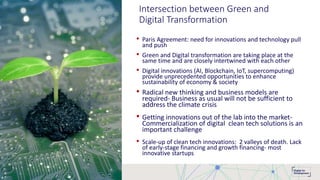
Intersection between Green and
Digital Transformation
• Paris Agreement: need for innovations and technology pull
and push
• Green and Digital transformation are taking place at the
same time and are closely intertwined with each other
• Digital innovations (AI, Blockchain, IoT, supercomputing)
provide unprecedented opportunities to enhance
sustainability of economy & society
• Radical new thinking and business models are
required- Business as usual will not be sufficient to
address the climate crisis
• Getting innovations out of the lab into the market-
Commercialization of digital clean tech solutions is an
important challenge
• Scale-up of clean tech innovations: 2 valleys of death. Lack
of early-stage financing and growth financing- most
innovative startups
04.12.2023 Enabling a Twin Transition
3
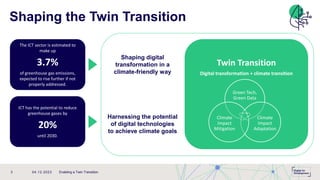
Shaping the Twin Transition
The ICT sector is estimated to
make up
3.7%
of greenhouse gas emissions,
expected to rise further if not
properly addressed.
ICT has the potential to reduce
greenhouse gases by
20%
until 2030.
Shaping digital
transformation in a
climate-friendly way
Harnessing the potential
of digital technologies
to achieve climate goals
Twin Transition
Digital transformation + climate transition
Green Tech,
Green Data
Climate
Impact
Adaptation
Climate
Impact
Mitigation
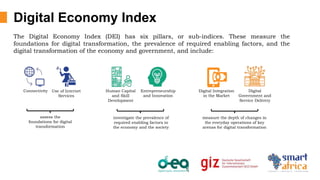
The Digital Economy Index (DEI) has six pillars, or sub-indices. These measure the
foundations for digital transformation, the prevalence of required enabling factors, and the
digital transformation of the economy and government, and include:
Connectivity Use of Internet
Services
Human Capital
and Skill
Development
Entrepreneurship
and Innovation
Digital Integration
in the Market
Digital
Government and
Service Delivery
assess the
foundations for digital
transformation
investigate the prevalence of
required enabling factors in
the economy and the society
measure the depth of changes in
the everyday operations of key
arenas for digital transformation
Digital Economy Index
04.12.2023
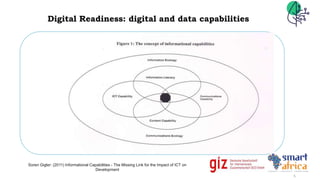
Soren Gigler: (2011) Informational Capabilities - The Missing Link for the Impact of ICT on
Development
5
Digital Readiness: digital and data capabilities
04.12.20
23
Titel der Präsentation
6
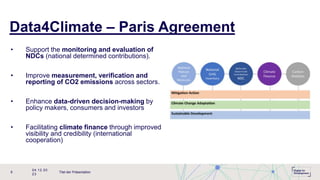
• Support the monitoring and evaluation of
NDCs (national determined contributions).
• Improve measurement, verification and
reporting of CO2 emissions across sectors.
• Enhance data-driven decision-making by
policy makers, consumers and investors
• Facilitating climate finance through improved
visibility and credibility (international
cooperation)
Data4Climate – Paris Agreement
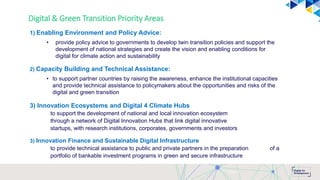
Digital & Green Transition Priority Areas
1) Enabling Environment and Policy Advice:
• provide policy advice to governments to develop twin transition policies and support the
development of national strategies and create the vision and enabling conditions for
digital for climate action and sustainability
2) Capacity Building and Technical Assistance:
• to support partner countries by raising the awareness, enhance the institutional capacities
and provide technical assistance to policymakers about the opportunities and risks of the
digital and green transition
3) Innovation Ecosystems and Digital 4 Climate Hubs
to support the development of national and local innovation ecosystem
through a network of Digital Innovation Hubs that link digital innovative
startups, with research institutions, corporates, governments and investors
3) Innovation Finance and Sustainable Digital Infrastructure
to provide technical assistance to public and private partners in the preparation of a
portfolio of bankable investment programs in green and secure infrastructure
Page 7
04.12.2023
8 Enabling a Twin Transition
Data Economy Program
04/12/2023
9
• First draft of guidelines for developing
climate friendly data infrastructure
have been developed through DDP
• Support of analytical work on Catalyzing
the Green Digital Transformation Report
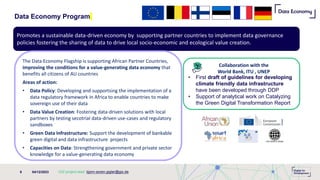
Promotes a sustainable data-driven economy by supporting partner countries to implement data governance
policies fostering the sharing of data to drive local socio-economic and ecological value creation.
The Data Economy Flagship is supporting African Partner Countries​,
improving the conditions for a value-generating data economy that
benefits all citizens of AU countries
Areas of action:
• Data Policy: Developing and supportsing the implementation of a
data regulatory framework in Africa to enable countries to make
sovereign use of their data
• Data Value Creation: Fostering data-driven solutions with local
partners by testing secotrial data-driven use-cases and regulatory
sandboxes
• Green Data Infrastructure: Support the development of bankable
green digital and data infrastructure projects
• Capacities on Data: Strengthening government and private sector
knowledge for a value-generating data economy
GIZ project lead: bjorn-soren.gigler@giz.de
Collaboration with the
World Bank, ITU , UNEP
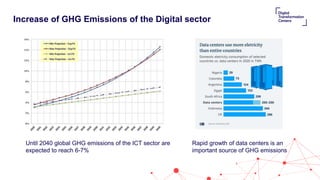
Increase of GHG Emissions of the Digital sector
Until 2040 global GHG emissions of the ICT sector are
expected to reach 6-7%
Rapid growth of data centers is an
important source of GHG emissions
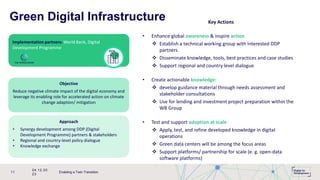
Implementation partners: World Bank, Digital
Development Programme
Key Actions
• Enhance global awareness & inspire action
 Establish a technical working group with interested DDP
partners
 Disseminate knowledge, tools, best practices and case studies
 Support regional and country level dialogue
• Create actionable knowledge:
 develop guidance material through needs assessment and
stakeholder consultations
 Use for lending and investment project preparation within the
WB Group
• Test and support adoption at scale
 Apply, test, and refine developed knowledge in digital
operations
 Green data centers will be among the focus areas
 Support platforms/ partnership for scale (e. g. open-data
software platforms)
Green Digital Infrastructure
Objective
Reduce negative climate impact of the digital economy and
leverage its enabling role for accelerated action on climate
change adaption/ mitigation
Approach
• Synergy development among DDP (Digital
Development Programme) partners & stakeholders
• Regional and country-level policy dialogue
• Knowledge exchange
04.12.20
23
Enabling a Twin Transition
11
04.12.2023
12 Enabling a Twin Transition
Implementation partners: GSMA
Key Actions
• Mapping of the Indonesian climate-tech ecosystem:
exploring the role that digital technology is (or could be)
playing to support climate mitigation, adaptation, and
resilience
• Public-private sector dialogues, strategic partnerships, and
capacity building
• Advise for government & existing initiatives on data-driven
approaches
• Showcasing and publicising results and learnings of the hub
• Tailored support for local innovators to improve and
implement their solutions
• Drive sustainable energy access and green economic
development in rural areas
• Support and scale digital approaches on waste management
and circular economy
Digital Transformation Centers- Mobile Innovation Hub
Indonesia
Objective
Support Indonesia unlocking the potential of digital
technology to achieve sustainable, low-carbon and climate-
resilient development outcomes
Approach
Focus on:
• Sustainable energy and green economic development
• Digitalisation of waste management
• Natural resource management (NRM)
04.12.20
23
Enabling a Twin Transition
13
04.12.2023
14 Enabling a Twin Transition
Implementation partners: Lacuna Fund
(Rockefeller Foundation, Wellcome Trust etc.)
Lacuna Fund – Accessible data for local climate action
Objective
• Improve planning for and response to climate impacts
through open AI innovation
• Promote green development and better understand
climate harms on health and livelihoods
Approach
• Address gaps in climate data in partner
countries
• Focus on the promising sectors of renewable
energies & agriculture/ forestry
04.12.20
23
Enabling a Twin Transition
15
Key Actions
• Support the creation, aggregation, and maintenance for
training and valuation of machine learning models by and
for local communities
• Promote sharing of data, best practices, AI models:
establish a global exchange on AI innovation and climate
protection
• Applications:
 Open local training data from the Global South
 Earth observation data for food security (e. g.
automated crop survey for department of agriculture)
 Satellite data for climate-friendly energy supply (e. g.
identify locations for green solar-based mini grids)
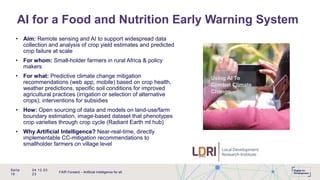
• Aim: Remote sensing and AI to support widespread data
collection and analysis of crop yield estimates and predicted
crop failure at scale
• For whom: Small-holder farmers in rural Africa & policy
makers
• For what: Predictive climate change mitigation
recommendations (web app, mobile) based on crop health,
weather predictions, specific soil conditions for improved
agricultural practices (irrigation or selection of alternative
crops); interventions for subsidies
• How: Open sourcing of data and models on land-use/farm
boundary estimation, image-based dataset that phenotypes
crop varieties through crop cycle (Radiant Earth ml hub)
• Why Artificial Intelligence? Near-real-time, directly
implementable CC-mitigation recommendations to
smallholder farmers on village level
AI for a Food and Nutrition Early Warning System
FAIR Forward – Artificial Intelligence for all.
04.12.20
23
Seite
16
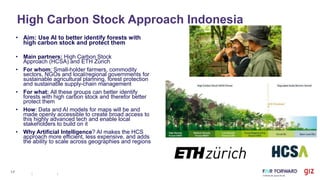
• Aim: Use AI to better identify forests with
high carbon stock and protect them
• Main partners: High Carbon Stock
Approach (HCSA) and ETH Zürich
• For whom: Small-holder farmers, commodity
sectors, NGOs and local/regional governments for
sustainable agricultural planning, forest protection
and sustainable supply-chain management
• For what: All these groups can better identify
forests with high carbon stock and therefor better
protect them
• How: Data and AI models for maps will be and
made openly accessible to create broad access to
this highly advanced tech and enable local
stakeholders to build on it
• Why Artificial Intelligence? AI makes the HCS
approach more efficient, less expensive, and adds
the ability to scale across geographies and regions
High Carbon Stock Approach Indonesia
17

Digital4Climate-Leveraging Digital innovations & data for climate action

  • 1.
    Digital4Climate – Leveragingdigital innovations & data for climate action Bjorn-Soren Gigler, Head of Data Economy Program Digital Transformation Cluster bjorn-soren.gigler@giz.de UN Climate Change Global Innovation Hub Pavillon @COP28 Digital readiness of developing countries: how it can accelerate climate action December, 6, 2023
  • 2.
    Intersection between Greenand Digital Transformation • Paris Agreement: need for innovations and technology pull and push • Green and Digital transformation are taking place at the same time and are closely intertwined with each other • Digital innovations (AI, Blockchain, IoT, supercomputing) provide unprecedented opportunities to enhance sustainability of economy & society • Radical new thinking and business models are required- Business as usual will not be sufficient to address the climate crisis • Getting innovations out of the lab into the market- Commercialization of digital clean tech solutions is an important challenge • Scale-up of clean tech innovations: 2 valleys of death. Lack of early-stage financing and growth financing- most innovative startups
  • 3.
    04.12.2023 Enabling aTwin Transition 3 Shaping the Twin Transition The ICT sector is estimated to make up 3.7% of greenhouse gas emissions, expected to rise further if not properly addressed. ICT has the potential to reduce greenhouse gases by 20% until 2030. Shaping digital transformation in a climate-friendly way Harnessing the potential of digital technologies to achieve climate goals Twin Transition Digital transformation + climate transition Green Tech, Green Data Climate Impact Adaptation Climate Impact Mitigation
  • 4.
    The Digital EconomyIndex (DEI) has six pillars, or sub-indices. These measure the foundations for digital transformation, the prevalence of required enabling factors, and the digital transformation of the economy and government, and include: Connectivity Use of Internet Services Human Capital and Skill Development Entrepreneurship and Innovation Digital Integration in the Market Digital Government and Service Delivery assess the foundations for digital transformation investigate the prevalence of required enabling factors in the economy and the society measure the depth of changes in the everyday operations of key arenas for digital transformation Digital Economy Index
  • 5.
    04.12.2023 Soren Gigler: (2011)Informational Capabilities - The Missing Link for the Impact of ICT on Development 5 Digital Readiness: digital and data capabilities
  • 6.
    04.12.20 23 Titel der Präsentation 6 •Support the monitoring and evaluation of NDCs (national determined contributions). • Improve measurement, verification and reporting of CO2 emissions across sectors. • Enhance data-driven decision-making by policy makers, consumers and investors • Facilitating climate finance through improved visibility and credibility (international cooperation) Data4Climate – Paris Agreement
  • 7.
    Digital & GreenTransition Priority Areas 1) Enabling Environment and Policy Advice: • provide policy advice to governments to develop twin transition policies and support the development of national strategies and create the vision and enabling conditions for digital for climate action and sustainability 2) Capacity Building and Technical Assistance: • to support partner countries by raising the awareness, enhance the institutional capacities and provide technical assistance to policymakers about the opportunities and risks of the digital and green transition 3) Innovation Ecosystems and Digital 4 Climate Hubs to support the development of national and local innovation ecosystem through a network of Digital Innovation Hubs that link digital innovative startups, with research institutions, corporates, governments and investors 3) Innovation Finance and Sustainable Digital Infrastructure to provide technical assistance to public and private partners in the preparation of a portfolio of bankable investment programs in green and secure infrastructure Page 7
  • 8.
    04.12.2023 8 Enabling aTwin Transition
  • 9.
    Data Economy Program 04/12/2023 9 •First draft of guidelines for developing climate friendly data infrastructure have been developed through DDP • Support of analytical work on Catalyzing the Green Digital Transformation Report Promotes a sustainable data-driven economy by supporting partner countries to implement data governance policies fostering the sharing of data to drive local socio-economic and ecological value creation. The Data Economy Flagship is supporting African Partner Countries​, improving the conditions for a value-generating data economy that benefits all citizens of AU countries Areas of action: • Data Policy: Developing and supportsing the implementation of a data regulatory framework in Africa to enable countries to make sovereign use of their data • Data Value Creation: Fostering data-driven solutions with local partners by testing secotrial data-driven use-cases and regulatory sandboxes • Green Data Infrastructure: Support the development of bankable green digital and data infrastructure projects • Capacities on Data: Strengthening government and private sector knowledge for a value-generating data economy GIZ project lead: bjorn-soren.gigler@giz.de Collaboration with the World Bank, ITU , UNEP
  • 10.
    Increase of GHGEmissions of the Digital sector Until 2040 global GHG emissions of the ICT sector are expected to reach 6-7% Rapid growth of data centers is an important source of GHG emissions
  • 11.
    Implementation partners: WorldBank, Digital Development Programme Key Actions • Enhance global awareness & inspire action  Establish a technical working group with interested DDP partners  Disseminate knowledge, tools, best practices and case studies  Support regional and country level dialogue • Create actionable knowledge:  develop guidance material through needs assessment and stakeholder consultations  Use for lending and investment project preparation within the WB Group • Test and support adoption at scale  Apply, test, and refine developed knowledge in digital operations  Green data centers will be among the focus areas  Support platforms/ partnership for scale (e. g. open-data software platforms) Green Digital Infrastructure Objective Reduce negative climate impact of the digital economy and leverage its enabling role for accelerated action on climate change adaption/ mitigation Approach • Synergy development among DDP (Digital Development Programme) partners & stakeholders • Regional and country-level policy dialogue • Knowledge exchange 04.12.20 23 Enabling a Twin Transition 11
  • 12.
    04.12.2023 12 Enabling aTwin Transition
  • 13.
    Implementation partners: GSMA KeyActions • Mapping of the Indonesian climate-tech ecosystem: exploring the role that digital technology is (or could be) playing to support climate mitigation, adaptation, and resilience • Public-private sector dialogues, strategic partnerships, and capacity building • Advise for government & existing initiatives on data-driven approaches • Showcasing and publicising results and learnings of the hub • Tailored support for local innovators to improve and implement their solutions • Drive sustainable energy access and green economic development in rural areas • Support and scale digital approaches on waste management and circular economy Digital Transformation Centers- Mobile Innovation Hub Indonesia Objective Support Indonesia unlocking the potential of digital technology to achieve sustainable, low-carbon and climate- resilient development outcomes Approach Focus on: • Sustainable energy and green economic development • Digitalisation of waste management • Natural resource management (NRM) 04.12.20 23 Enabling a Twin Transition 13
  • 14.
    04.12.2023 14 Enabling aTwin Transition
  • 15.
    Implementation partners: LacunaFund (Rockefeller Foundation, Wellcome Trust etc.) Lacuna Fund – Accessible data for local climate action Objective • Improve planning for and response to climate impacts through open AI innovation • Promote green development and better understand climate harms on health and livelihoods Approach • Address gaps in climate data in partner countries • Focus on the promising sectors of renewable energies & agriculture/ forestry 04.12.20 23 Enabling a Twin Transition 15 Key Actions • Support the creation, aggregation, and maintenance for training and valuation of machine learning models by and for local communities • Promote sharing of data, best practices, AI models: establish a global exchange on AI innovation and climate protection • Applications:  Open local training data from the Global South  Earth observation data for food security (e. g. automated crop survey for department of agriculture)  Satellite data for climate-friendly energy supply (e. g. identify locations for green solar-based mini grids)
  • 16.
    • Aim: Remotesensing and AI to support widespread data collection and analysis of crop yield estimates and predicted crop failure at scale • For whom: Small-holder farmers in rural Africa & policy makers • For what: Predictive climate change mitigation recommendations (web app, mobile) based on crop health, weather predictions, specific soil conditions for improved agricultural practices (irrigation or selection of alternative crops); interventions for subsidies • How: Open sourcing of data and models on land-use/farm boundary estimation, image-based dataset that phenotypes crop varieties through crop cycle (Radiant Earth ml hub) • Why Artificial Intelligence? Near-real-time, directly implementable CC-mitigation recommendations to smallholder farmers on village level AI for a Food and Nutrition Early Warning System FAIR Forward – Artificial Intelligence for all. 04.12.20 23 Seite 16
  • 17.
    • Aim: UseAI to better identify forests with high carbon stock and protect them • Main partners: High Carbon Stock Approach (HCSA) and ETH Zürich • For whom: Small-holder farmers, commodity sectors, NGOs and local/regional governments for sustainable agricultural planning, forest protection and sustainable supply-chain management • For what: All these groups can better identify forests with high carbon stock and therefor better protect them • How: Data and AI models for maps will be and made openly accessible to create broad access to this highly advanced tech and enable local stakeholders to build on it • Why Artificial Intelligence? AI makes the HCS approach more efficient, less expensive, and adds the ability to scale across geographies and regions High Carbon Stock Approach Indonesia 17