Transparency of development assistance, public budgets and service delivery
is critical for citizen engagement. Innovative technologies, such as mapping,
provide powerful new tools for strategic planning and for greater transparency
and accountability. Recognizing the significant impact that these innovations
and an empowered civil society can have on improving development
effectiveness, the World Bank Institute (WBI) and bilateral donor partners,
foundations and civil society have formed an Open Aid Partnership (OAP).
The Partnership will be working in close collaboration with the International
Aid Transparency Initiative (IATI) and the Open Government Partnership
(OGP). The partnership brings development partners together to enhance the
openness and effectiveness of development assistance.
Road Constructed
Teachers Trained
Open Local Data
for Better Aid
Coordination
Using geographic data for increased aid transparency,
citizen engagement, and better results to:
•	 Improve aid transparency and coordination by developing and Open Aid Map
that visualizes the location of donor-financed programs at the local level.
•	 Better monitor the impact of development programs on citizen well being.
•	 Enhance the targeting of development programs.
•	 Foster accountability by empowering citizens to provide direct feedback on
project results.
•	 Strengthen capacity of civil society and citizens to use open aid data.
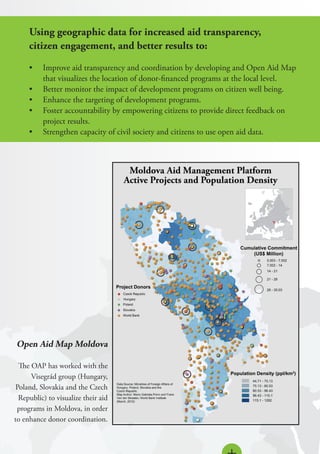
Open Aid Map Moldova
The OAP has worked with the
Visegrád group (Hungary,
Poland, Slovakia and the Czech
Republic) to visualize their aid
programs in Moldova, in order
to enhance donor coordination.
The Open Aid Partnership builds on the success of the Mapping for Results
initiative (maps.worldbank.org) that has visualized all locations of active
World Bank projects. Mapping for Results overlays disaggregated poverty
and human development data with World Bank projects at the sub-national
level. This contributes to:
•	 Better monitoring of project results.
•	 Enhancing aid coordination and transparency.
•	 Increasing social accountability.
•	 Better targeting donor activities.
•	 Enabling citizens to provide feedback on project results.
Mapping Aid for
Better Results
Bednets Provided
Solar Panel Installed
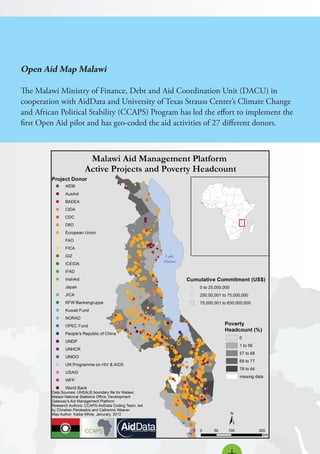
Open Aid Map Malawi
The Malawi Ministry of Finance, Debt and Aid Coordination Unit (DACU) in
cooperation with AidData and University of Texas Strauss Center’s Climate Change
and African Political Stability (CCAPS) Program has led the effort to implement the
first Open Aid pilot and has geo-coded the aid activities of 27 different donors.
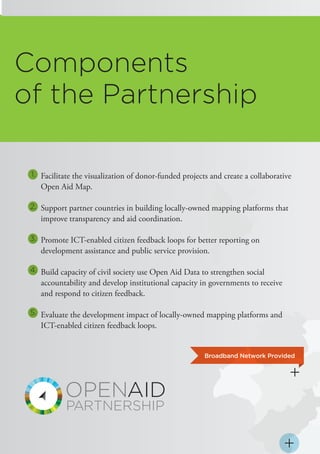
Components
of the Partnership
Facilitate the visualization of donor-funded projects and create a collaborative
Open Aid Map.
Support partner countries in building locally-owned mapping platforms that
improve transparency and aid coordination.
Promote ICT-enabled citizen feedback loops for better reporting on
development assistance and public service provision.
Build capacity of civil society use Open Aid Data to strengthen social
accountability and develop institutional capacity in governments to receive
and respond to citizen feedback.
Evaluate the development impact of locally-owned mapping platforms and
ICT-enabled citizen feedback loops.
1.
2.
3.
4.
5.
Broadband Network Provided
“The idea behind this partnership is to make our development cooperation
more participatory also in our partner countries, building systems that can be
used for citizens and civil society to exercise accountability.”
—Gunilla Carlsson, Minister
The Swedish Ministry for Development
“When the beneficiaries of development efforts are empowered with the right
information, the accountability chain improves.  Especially when such
information is timely, easily understandable, and readily accessible, and even
more so when poor people can voice their opinions and provide feedback. The
Open Aid Partnership offers a vision for making this happen on a large scale for
the many stakeholders of the development process. And by helping to give voice
to the poor, it can have a transformative impact on results.” 
 —Jean-Louis Sarbib, CEO
Development Gateway and former Senior Vice President, World Bank
“The Open Aid Partnership aims to establish a feedback loop between citizens
and governments concerning effectiveness of aid programs and the quality of
public services. This requires improved access to information and open data on
project locations.”
Czech Development Agency
Vaccines Delivered
Sanitation Program Provided
“Imagine this: A health care worker or parent in a village, with a laptop or mobile
device, can access development knowledge in real time through geocoding and
geomapping. She can see which schools have feeding programs and which go
without, and what is happening to local health. She can access 20 years of data
on infant mortality for her country and its neighbors. She can dig deeply and
compare her village with others. She can upload her own data, throw light on the
likely effect of new interventions, and mobilize the community to demand better
or more targeted health programs.”
—Robert Zoellick, President
The World Bank
For more information, please contact
Bjorn-Soren Gigler
Open Aid Partnership
World Bank Institute
bgigler@worldbank.org
Seth Ayers
Open Aid Partnership
World Bank Institute
sayers@worldbank.org
openaidmap.org

Open Aid Partnership

  • 2.
    Transparency of developmentassistance, public budgets and service delivery is critical for citizen engagement. Innovative technologies, such as mapping, provide powerful new tools for strategic planning and for greater transparency and accountability. Recognizing the significant impact that these innovations and an empowered civil society can have on improving development effectiveness, the World Bank Institute (WBI) and bilateral donor partners, foundations and civil society have formed an Open Aid Partnership (OAP). The Partnership will be working in close collaboration with the International Aid Transparency Initiative (IATI) and the Open Government Partnership (OGP). The partnership brings development partners together to enhance the openness and effectiveness of development assistance. Road Constructed Teachers Trained Open Local Data for Better Aid Coordination
  • 3.
    Using geographic datafor increased aid transparency, citizen engagement, and better results to: • Improve aid transparency and coordination by developing and Open Aid Map that visualizes the location of donor-financed programs at the local level. • Better monitor the impact of development programs on citizen well being. • Enhance the targeting of development programs. • Foster accountability by empowering citizens to provide direct feedback on project results. • Strengthen capacity of civil society and citizens to use open aid data. Open Aid Map Moldova The OAP has worked with the Visegrád group (Hungary, Poland, Slovakia and the Czech Republic) to visualize their aid programs in Moldova, in order to enhance donor coordination.
  • 4.
    The Open AidPartnership builds on the success of the Mapping for Results initiative (maps.worldbank.org) that has visualized all locations of active World Bank projects. Mapping for Results overlays disaggregated poverty and human development data with World Bank projects at the sub-national level. This contributes to: • Better monitoring of project results. • Enhancing aid coordination and transparency. • Increasing social accountability. • Better targeting donor activities. • Enabling citizens to provide feedback on project results. Mapping Aid for Better Results Bednets Provided Solar Panel Installed
  • 5.
    Open Aid MapMalawi The Malawi Ministry of Finance, Debt and Aid Coordination Unit (DACU) in cooperation with AidData and University of Texas Strauss Center’s Climate Change and African Political Stability (CCAPS) Program has led the effort to implement the first Open Aid pilot and has geo-coded the aid activities of 27 different donors.
  • 6.
    Components of the Partnership Facilitatethe visualization of donor-funded projects and create a collaborative Open Aid Map. Support partner countries in building locally-owned mapping platforms that improve transparency and aid coordination. Promote ICT-enabled citizen feedback loops for better reporting on development assistance and public service provision. Build capacity of civil society use Open Aid Data to strengthen social accountability and develop institutional capacity in governments to receive and respond to citizen feedback. Evaluate the development impact of locally-owned mapping platforms and ICT-enabled citizen feedback loops. 1. 2. 3. 4. 5. Broadband Network Provided
  • 7.
    “The idea behindthis partnership is to make our development cooperation more participatory also in our partner countries, building systems that can be used for citizens and civil society to exercise accountability.” —Gunilla Carlsson, Minister The Swedish Ministry for Development “When the beneficiaries of development efforts are empowered with the right information, the accountability chain improves.  Especially when such information is timely, easily understandable, and readily accessible, and even more so when poor people can voice their opinions and provide feedback. The Open Aid Partnership offers a vision for making this happen on a large scale for the many stakeholders of the development process. And by helping to give voice to the poor, it can have a transformative impact on results.”   —Jean-Louis Sarbib, CEO Development Gateway and former Senior Vice President, World Bank “The Open Aid Partnership aims to establish a feedback loop between citizens and governments concerning effectiveness of aid programs and the quality of public services. This requires improved access to information and open data on project locations.” Czech Development Agency Vaccines Delivered Sanitation Program Provided
  • 8.
    “Imagine this: Ahealth care worker or parent in a village, with a laptop or mobile device, can access development knowledge in real time through geocoding and geomapping. She can see which schools have feeding programs and which go without, and what is happening to local health. She can access 20 years of data on infant mortality for her country and its neighbors. She can dig deeply and compare her village with others. She can upload her own data, throw light on the likely effect of new interventions, and mobilize the community to demand better or more targeted health programs.” —Robert Zoellick, President The World Bank For more information, please contact Bjorn-Soren Gigler Open Aid Partnership World Bank Institute bgigler@worldbank.org Seth Ayers Open Aid Partnership World Bank Institute sayers@worldbank.org openaidmap.org