ON BECOMING A
TRANSFORMATIONAL
LEADER:
WHAT IS AND WHAT NOT?
Alaman, Jerimae M.
Abejuela, Sheina
TRANSFORMATIONAL
LEADER
TRANSFORMATIONAL
LEADERSHIP
“Leaders and followers make each
other to advance to a higher level of
moral and motivation” – James
Mcgregor Burns 1978
“A type of leadership style that leads to
positive changes in those who follow” –
Bernard M. Bass
TRANSACTIONAL
LEADERSHIP
TRANSACTIONAL
LEADERSHIP
Sometimes called “Bartering”
Exchange of services
The leaders-follower exchanges
necessary for achieving agreed-upon
performance goals between leaders
and followers.
TRANSFORMATIONAL
LEADER
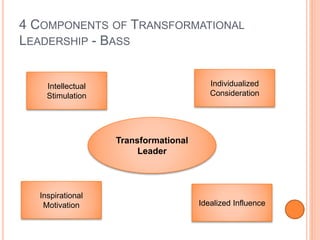
4 COMPONENTS OF TRANSFORMATIONAL
LEADERSHIP - BASS
Transformational
Leader
Intellectual
Stimulation
Idealized Influence
Inspirational
Motivation
Individualized
Consideration
INTELLECTUAL
STIMULATION
Transformational Leaders not only
challenge the status quo; they
also encourage creativity among
followers.
INDIVIDUALIZED
CONSIDERATION
Transformational Leadership also
involves offering support and
encouragement to individual
followers.
Open line of communication.
INSPIRATIONAL MOTIVATION
Transformational Leaders have a
clear vision that they are able to
articulate to followers.
IDEALIZED INFLUENCE
Transformational Leaders
serves as a Role Model for
followers.
3 GOALS OF TRANSFROMATIONAL
LEADERSHIP
Helping staff develop and maintain a
collaborative, professional school
culture.
Fostering teacher development.
Helping teachers solve problem more
effectively.
Leithwood, 1999
8 DIMENSION OF
TRANSFORMATIONAL LEADERSHIP
 Building school vision
 Establishing school goals
 Providing intellectual stimulation
 Offering individualized support
8 DIMENSION OF
TRANSFORMATIONAL LEADERSHIP
 Modelling best practices and values
 Demonstrating high performance
expectations
 Creating a productive school culture
 Participation in school decision
Leithwood 1994
EXAMPLES OF
TRANSFORMATIONAL
LEADERSHIP
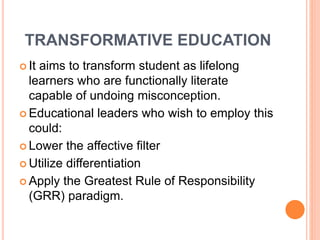
TRANSFORMATIVE EDUCATION
 It aims to transform student as lifelong
learners who are functionally literate
capable of undoing misconception.
 Educational leaders who wish to employ this
could:
 Lower the affective filter
 Utilize differentiation
 Apply the Greatest Rule of Responsibility
(GRR) paradigm.
TRANSFORMATIONAL
LEADERS ARE:
AS A FUTURE TEACHER, HOW CAN
YOU BE A TRANSFORMATIVE
LEADER?
THE END 
THANK YOU!

On becoming a transformational leader