Jeanna Nikolov-Ramirez
Mei:CogSci
Comenius University Bratislava
Supervisor: Igor Farkaš
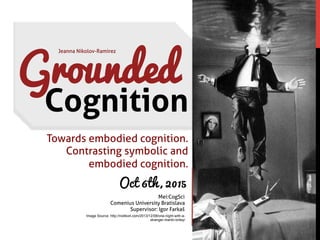
Grounded
Cognition
Oct 6th, 2015
Image Source: http://no4ko4.com/2013/12/08/one-night-with-a-
stranger-martin-briley/
Towards embodied cognition.
Contrasting symbolic and
embodied cognition.
OUTLINE
•  The Text
•  The Author
•  What is Grounded
Cognition?
2
•  The Key Points
•  Open Questions
•  Discussion Time
THE TEXT
Barsalou L. (2008). Grounded cognition.
Annual Reviews of Psychology, 59:
617-45.
https://www.google.at/webhp?sourceid=chrome-
instant&ion=1&espv=2&ie=UTF-8#safe=off&q=l%20barsalouhttp://dai.fmph.uniba.sk/courses/GC/
3
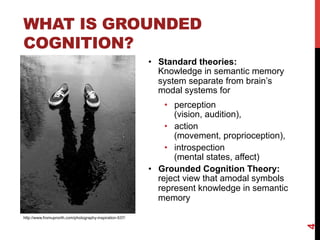
WHAT IS GROUNDED
COGNITION?
•  Standard theories:
Knowledge in semantic memory
system separate from brain’s
modal systems for
•  perception
(vision, audition),
•  action
(movement, proprioception),
•  introspection
(mental states, affect)
•  Grounded Cognition Theory:
reject view that amodal symbols
represent knowledge in semantic
memory
4
http://www.fromupnorth.com/photography-inspiration-537/
GROUNDED COGNITION:
FOCUS
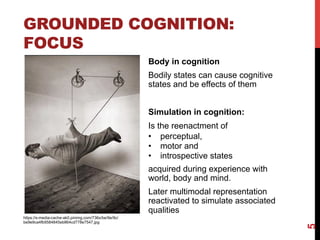
Body in cognition
Bodily states can cause cognitive
states and be effects of them
Simulation in cognition:
Is the reenactment of
•  perceptual,
•  motor and
•  introspective states
acquired during experience with
world, body and mind.
Later multimodal representation
reactivated to simulate associated
qualities
5
https://s-media-cache-ak0.pinimg.com/736x/be/9e/9c/
be9e9ca4fb9584845eb864cd778e7547.jpg
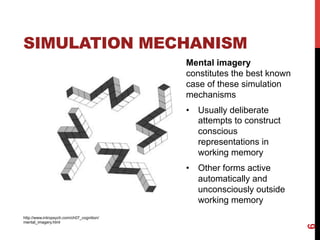
SIMULATION MECHANISM
Mental imagery
constitutes the best known
case of these simulation
mechanisms
•  Usually deliberate
attempts to construct
conscious
representations in
working memory
•  Other forms active
automatically and
unconsciously outside
working memory
6
http://www.intropsych.com/ch07_cognition/
mental_imagery.html
KOSSLYN, 1980
http://plato.stanford.edu/entries/mental-imagery/quasi-pictorial.html
SOCIAL INTERACTION
Cognitive system
evolved to support
action in specific
situations, including
social interactions.
Embodied IS NOT
just bodily states
https://s-media-cache-ak0.pinimg.com/736x/ad/4e/30/
ad4e3089491ce1b17a04a86f35db7447.jpg
GROUNDED IN
MULTIPLE WAYS
•  Simulations
•  Situated
actions
•  Bodily states
https://s-media-cache-ak0.pinimg.com/736x/68/ea/
a4/68eaa47f29411ecb8b109dedc7ccfad4.jpg
ORIGINS AND
IMAGERY
Watson (1913)
criticism on imagery
as not being
sufficiently scientific
http://
psychclassics.yorku.
ca/Watson/views.htm
Behavioral and
neural evidence for
imagery eventually
became so
overwhelming that
imagery is now
accepted as a basic
cognitive
mechanism
(Kosslyn et al,
2006)
http://www.biography.com/people/john-b-watson-37049
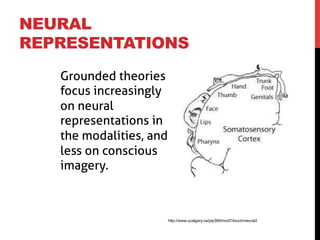
NEURAL
REPRESENTATIONS
Grounded theories
focus increasingly
on neural
representations in
the modalities, and
less on conscious
imagery.
http://www.ucalgary.ca/pip369/mod7/touch/neural2
MISPERCEPTIONS OF
GROUNDED COGNITION
•  Completely empiricist
(some simulation
having genetic basis?)
•  Recording systems
that only capture
images but unable to
interpret them
conceptually
•  Only using sensory-
motor representations
of external world to
represent knowledge.
Claim: cannot
represent abstract
concepts not grounded
externally
Internal states no less
important than external
experience.
Knowledge acquired
from introspection
central to
representation of
abstract concepts.
Simulations partial
recreations of
experience that can
contain bias and error.
https://ronanwills.files.wordpress.com/2015/07/inside-out-5492d0c4e3912.jpg
THEORIES
•  Cognitive Linguistics
(Metaphors)
•  Situated Action
(Robotics, Dynamic
systems)
•  Cognitive Simulation
(PSS, Convergence Zone
Architecture, Dual Code
Theory, Basic Systems
Theory)
•  Social Simulation
(Mental states of others,
Mirror Circuits)
13
https://s-media-cache-ak0.pinimg.com/736x/ea/b6/50/
eab650b9675fc841ba2505b7d16dbe54.jpg
“Nonhumans have roughly the same
simulation system as humans but lack
linguistic system to control it.”
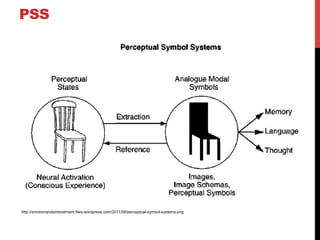
PSS
http://emotionandembodiment.files.wordpress.com/2011/08/perceptual-symbol-systems.png
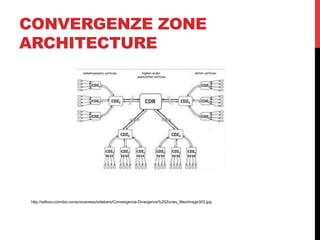
CONVERGENZE ZONE
ARCHITECTURE
http://willcov.com/bio-consciousness/sidebars/Convergence-Divergence%20Zones_files/image303.jpg
EVIDENCE
•  Perceptual inference
(similar stimuli trigger
memories, associations
between shape and
color)
•  Perception-action
coordination:
Perceived grasp,
judging weight
•  Perception of space:
Shaped by the body,
individual body
differences arm length
•  Memory:
Retrieval simulates
operations performed
at encoding
•  Knowledge and
processing: switching
cost between
modalities
(property verification
task)
•  Lesions
•  Neuroimaging
16
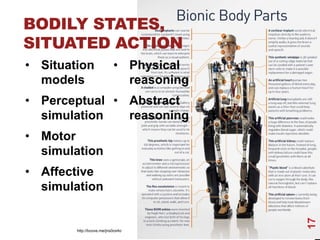
BODILY STATES,
SITUATED ACTION
•  Situation
models
•  Perceptual
simulation
•  Motor
simulation
•  Affective
simulation
•  Physical
reasoning
•  Abstract
reasoning
17
http://bcove.me/jns0ox4o
SOCIAL COGNITION
•  Embodiment
effects
(walking like
the elderly,
religious
cognition)
•  Social
mirroring
(Joint attention
and timing)
•  Development:
Imitation
18
http://www.animhut.com/photography/50-best-vadim-stein-exotic-fashion-photography-inspiration/
THEORETICAL, EMPIRICAL
ISSUES
•  Brain contain
amodal
symbols?
•  Simulation
implement
classic symbolic
operations?
•  Simulation and
embodiment
causal or
epiphenomenal?
(TMS over motor
areas)
•  Statistical
representations?
•  Grounding of
language?
•  Single
Representation
System in Brain?
•  Representation of
abstract concepts?
•  Mirror neurons and
Social cognition?
19
METHODOLOGICAL ISSUES
•  Computational,
formal theories
•  Integrating
disciplines
•  Integrating
levels of
explanation
KEY POINTS AND OPEN
QUESTIONS
•  Modal simulations, bodily states and situated action
underlie cognition.
•  How to ground classic research paradigms (e.g.
recognition memory)? Making them compatible?
•  Grounded perspective: Association between
perception and action
•  Potential to integrate cognitive, social, and
developmental processes. > Robotics and AI?
•  What levels of explanation are necessary?
21
PLENUM TIME
22
REFERENCES
Barsalou L. (2008). Grounded cognition. Annual Reviews of
Psychology, 59: 617-45.
Wilson M. (2002) Six views of embodied cognition. Psychonomics
Bulletin Review, 9(4), 625-636.
Ziemke T. (2003) What's that thing called embodiment? Proc. of
the 25th Annual Conf. of the Cog. Sci. Society, 1134-1139.
Borghi A.M. & Cimatti, F. (2010) Embodied cognition and beyond:
Acting and sensing the body. Neuropsychologia 48.
24
THANK YOU!
http://psychsciencenotes.blogspot.co.at/2013/07/grounded-vs-embodied-cognition.html

On Barsalou's Grounded Cognition

  • 1.
    Jeanna Nikolov-Ramirez Mei:CogSci Comenius UniversityBratislava Supervisor: Igor Farkaš Grounded Cognition Oct 6th, 2015 Image Source: http://no4ko4.com/2013/12/08/one-night-with-a- stranger-martin-briley/ Towards embodied cognition. Contrasting symbolic and embodied cognition.
  • 2.
    OUTLINE •  The Text • The Author •  What is Grounded Cognition? 2 •  The Key Points •  Open Questions •  Discussion Time
  • 3.
    THE TEXT Barsalou L.(2008). Grounded cognition. Annual Reviews of Psychology, 59: 617-45. https://www.google.at/webhp?sourceid=chrome- instant&ion=1&espv=2&ie=UTF-8#safe=off&q=l%20barsalouhttp://dai.fmph.uniba.sk/courses/GC/ 3
  • 4.
    WHAT IS GROUNDED COGNITION? • Standard theories: Knowledge in semantic memory system separate from brain’s modal systems for •  perception (vision, audition), •  action (movement, proprioception), •  introspection (mental states, affect) •  Grounded Cognition Theory: reject view that amodal symbols represent knowledge in semantic memory 4 http://www.fromupnorth.com/photography-inspiration-537/
  • 5.
    GROUNDED COGNITION: FOCUS Body incognition Bodily states can cause cognitive states and be effects of them Simulation in cognition: Is the reenactment of •  perceptual, •  motor and •  introspective states acquired during experience with world, body and mind. Later multimodal representation reactivated to simulate associated qualities 5 https://s-media-cache-ak0.pinimg.com/736x/be/9e/9c/ be9e9ca4fb9584845eb864cd778e7547.jpg
  • 6.
    SIMULATION MECHANISM Mental imagery constitutesthe best known case of these simulation mechanisms •  Usually deliberate attempts to construct conscious representations in working memory •  Other forms active automatically and unconsciously outside working memory 6 http://www.intropsych.com/ch07_cognition/ mental_imagery.html
  • 7.
  • 8.
    SOCIAL INTERACTION Cognitive system evolvedto support action in specific situations, including social interactions. Embodied IS NOT just bodily states https://s-media-cache-ak0.pinimg.com/736x/ad/4e/30/ ad4e3089491ce1b17a04a86f35db7447.jpg
  • 9.
    GROUNDED IN MULTIPLE WAYS • Simulations •  Situated actions •  Bodily states https://s-media-cache-ak0.pinimg.com/736x/68/ea/ a4/68eaa47f29411ecb8b109dedc7ccfad4.jpg
  • 10.
    ORIGINS AND IMAGERY Watson (1913) criticismon imagery as not being sufficiently scientific http:// psychclassics.yorku. ca/Watson/views.htm Behavioral and neural evidence for imagery eventually became so overwhelming that imagery is now accepted as a basic cognitive mechanism (Kosslyn et al, 2006) http://www.biography.com/people/john-b-watson-37049
  • 11.
    NEURAL REPRESENTATIONS Grounded theories focus increasingly onneural representations in the modalities, and less on conscious imagery. http://www.ucalgary.ca/pip369/mod7/touch/neural2
  • 12.
    MISPERCEPTIONS OF GROUNDED COGNITION • Completely empiricist (some simulation having genetic basis?) •  Recording systems that only capture images but unable to interpret them conceptually •  Only using sensory- motor representations of external world to represent knowledge. Claim: cannot represent abstract concepts not grounded externally Internal states no less important than external experience. Knowledge acquired from introspection central to representation of abstract concepts. Simulations partial recreations of experience that can contain bias and error. https://ronanwills.files.wordpress.com/2015/07/inside-out-5492d0c4e3912.jpg
  • 13.
    THEORIES •  Cognitive Linguistics (Metaphors) • Situated Action (Robotics, Dynamic systems) •  Cognitive Simulation (PSS, Convergence Zone Architecture, Dual Code Theory, Basic Systems Theory) •  Social Simulation (Mental states of others, Mirror Circuits) 13 https://s-media-cache-ak0.pinimg.com/736x/ea/b6/50/ eab650b9675fc841ba2505b7d16dbe54.jpg “Nonhumans have roughly the same simulation system as humans but lack linguistic system to control it.”
  • 14.
  • 15.
  • 16.
    EVIDENCE •  Perceptual inference (similarstimuli trigger memories, associations between shape and color) •  Perception-action coordination: Perceived grasp, judging weight •  Perception of space: Shaped by the body, individual body differences arm length •  Memory: Retrieval simulates operations performed at encoding •  Knowledge and processing: switching cost between modalities (property verification task) •  Lesions •  Neuroimaging 16
  • 17.
    BODILY STATES, SITUATED ACTION • Situation models •  Perceptual simulation •  Motor simulation •  Affective simulation •  Physical reasoning •  Abstract reasoning 17 http://bcove.me/jns0ox4o
  • 18.
    SOCIAL COGNITION •  Embodiment effects (walkinglike the elderly, religious cognition) •  Social mirroring (Joint attention and timing) •  Development: Imitation 18 http://www.animhut.com/photography/50-best-vadim-stein-exotic-fashion-photography-inspiration/
  • 19.
    THEORETICAL, EMPIRICAL ISSUES •  Braincontain amodal symbols? •  Simulation implement classic symbolic operations? •  Simulation and embodiment causal or epiphenomenal? (TMS over motor areas) •  Statistical representations? •  Grounding of language? •  Single Representation System in Brain? •  Representation of abstract concepts? •  Mirror neurons and Social cognition? 19
  • 20.
    METHODOLOGICAL ISSUES •  Computational, formaltheories •  Integrating disciplines •  Integrating levels of explanation
  • 21.
    KEY POINTS ANDOPEN QUESTIONS •  Modal simulations, bodily states and situated action underlie cognition. •  How to ground classic research paradigms (e.g. recognition memory)? Making them compatible? •  Grounded perspective: Association between perception and action •  Potential to integrate cognitive, social, and developmental processes. > Robotics and AI? •  What levels of explanation are necessary? 21
  • 22.
  • 23.
    REFERENCES Barsalou L. (2008).Grounded cognition. Annual Reviews of Psychology, 59: 617-45. Wilson M. (2002) Six views of embodied cognition. Psychonomics Bulletin Review, 9(4), 625-636. Ziemke T. (2003) What's that thing called embodiment? Proc. of the 25th Annual Conf. of the Cog. Sci. Society, 1134-1139. Borghi A.M. & Cimatti, F. (2010) Embodied cognition and beyond: Acting and sensing the body. Neuropsychologia 48.
  • 24.