Cognitive Psychology
Lesson 5 - Spring 2019
The acting brain
Professor Valentina Bazzarin
USAC Reggio Emilia
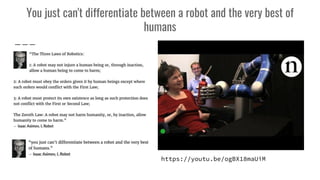
You just can't differentiate between a robot and the very best of
humans
https://youtu.be/ogBX18maUiM
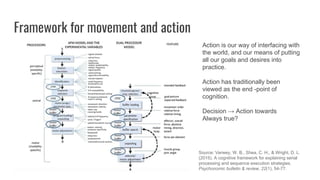
Framework for movement and action
Source: Verwey, W. B., Shea, C. H., & Wright, D. L.
(2015). A cognitive framework for explaining serial
processing and sequence execution strategies.
Psychonomic bulletin & review, 22(1), 54-77.
Action is our way of interfacing with
the world, and our means of putting
all our goals and desires into
practice.
Action has traditionally been
viewed as the end -point of
cognition.
Decision → Action towards
Always true?
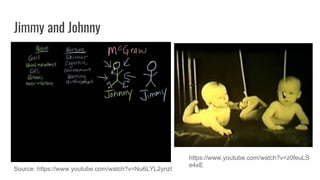
Jimmy and Johnny
Source: https://www.youtube.com/watch?v=Nu6LYL2ynzI
https://www.youtube.com/watch?v=z0feuLS
e4xE
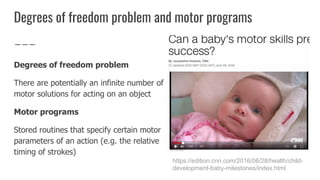
Degrees of freedom problem and motor programs
Degrees of freedom problem
There are potentially an infinite number of
motor solutions for acting on an object
Motor programs
Stored routines that specify certain motor
parameters of an action (e.g. the relative
timing of strokes)
https://edition.cnn.com/2016/06/28/health/child-
development-baby-milestones/index.html
Proprioception and sensory-motor transformation
Somatosensation:
A cluster of perceptual processes that relate
to the skin and the body, an include touch,
pain, thermal sensation and limb position.
Proprioception:
Knowledge of the position of the limbs in
space.
Sensory-motor transformation:
Linking together of perceptual knowledge of objects in space and knowledge of
the position of one’s body to enable objects to be acted on.
The homunculus problem
The problem of explaining volitional acts without assuming a
cognitive process that is itself volitional (a man within a
man”)
“homunculus is essentially ‘a little man’ inside you, the agent
behind your actions, the decider behind your decisions, the
see-er behind your sight. Think of the so-called Cartesian
theater inside your mind. All of your thoughts enter stage
right, perform, and exit stage left. But who’s doing the
seeing, considering, evaluating, etc. of these thoughts if
they’re inside you? Not you!”
https://www.psychologytoday.com/blog/the-metaphorical-mi
nd/200807/i-finally-got-be-homunculus-part-i
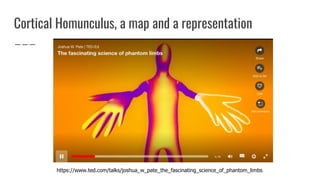
Cortical Homunculus, a map and a representation
https://www.ted.com/talks/joshua_w_pate_the_fascinating_science_of_phantom_limbs
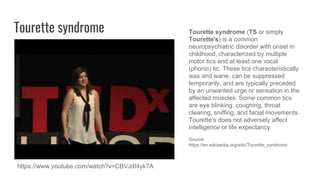
Tourette syndrome
https://www.youtube.com/watch?v=CBVJdI4yk7A
Tourette syndrome (TS or simply
Tourette's) is a common
neuropsychiatric disorder with onset in
childhood, characterized by multiple
motor tics and at least one vocal
(phonic) tic. These tics characteristically
wax and wane, can be suppressed
temporarily, and are typically preceded
by an unwanted urge or sensation in the
affected muscles. Some common tics
are eye blinking, coughing, throat
clearing, sniffing, and facial movements.
Tourette's does not adversely affect
intelligence or life expectancy.
Source:
https://en.wikipedia.org/wiki/Tourette_syndrome
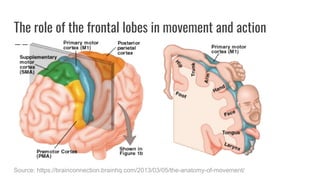
The role of the frontal lobes in movement and action
Source: https://brainconnection.brainhq.com/2013/03/05/the-anatomy-of-movement/
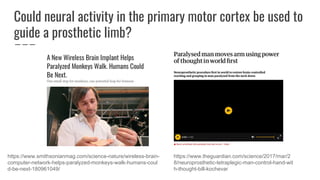
Could neural activity in the primary motor cortex be used to
guide a prosthetic limb?
https://www.smithsonianmag.com/science-nature/wireless-brain-
computer-network-helps-paralyzed-monkeys-walk-humans-coul
d-be-next-180961049/
https://www.theguardian.com/science/2017/mar/2
8/neuroprosthetic-tetraplegic-man-control-hand-wit
h-thought-bill-kochevar
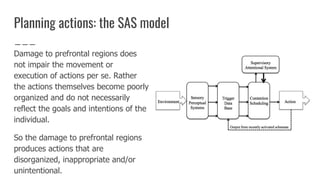
Planning actions: the SAS model
Damage to prefrontal regions does
not impair the movement or
execution of actions per se. Rather
the actions themselves become poorly
organized and do not necessarily
reflect the goals and intentions of the
individual.
So the damage to prefrontal regions
produces actions that are
disorganized, inappropriate and/or
unintentional.
Ownership and awareness of actions
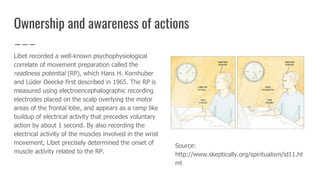
Libet recorded a well-known psychophysiological
correlate of movement preparation called the
readiness potential (RP), which Hans H. Kornhuber
and Lüder Deecke first described in 1965. The RP is
measured using electroencephalographic recording
electrodes placed on the scalp overlying the motor
areas of the frontal lobe, and appears as a ramp like
buildup of electrical activity that precedes voluntary
action by about 1 second. By also recording the
electrical activity of the muscles involved in the wrist
movement, Libet precisely determined the onset of
muscle activity related to the RP.
Source:
http://www.skeptically.org/spiritualism/id11.ht
ml
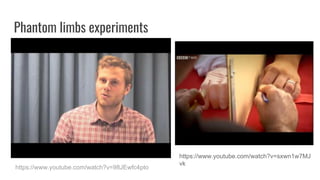
Phantom limbs experiments
https://www.youtube.com/watch?v=98JEwfc4pto
https://www.youtube.com/watch?v=sxwn1w7MJ
vk
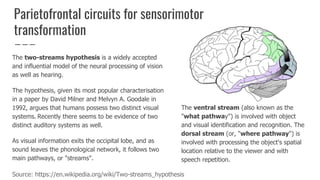
The two-streams hypothesis is a widely accepted
and influential model of the neural processing of vision
as well as hearing.
The hypothesis, given its most popular characterisation
in a paper by David Milner and Melvyn A. Goodale in
1992, argues that humans possess two distinct visual
systems. Recently there seems to be evidence of two
distinct auditory systems as well.
As visual information exits the occipital lobe, and as
sound leaves the phonological network, it follows two
main pathways, or "streams".
Parietofrontal circuits for sensorimotor
transformation
The ventral stream (also known as the
"what pathway") is involved with object
and visual identification and recognition. The
dorsal stream (or, "where pathway") is
involved with processing the object's spatial
location relative to the viewer and with
speech repetition.
Source: https://en.wikipedia.org/wiki/Two-streams_hypothesis
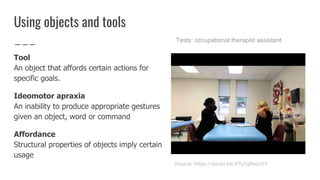
Tool
An object that affords certain actions for
specific goals.
Ideomotor apraxia
An inability to produce appropriate gestures
given an object, word or command
Affordance
Structural properties of objects imply certain
usage
Using objects and tools
Source: https://youtu.be/47y3q8nocXY
Tests: occupational therapist assistant
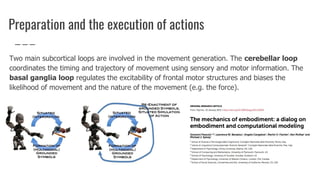
Preparation and the execution of actions
Two main subcortical loops are involved in the movement generation. The cerebellar loop
coordinates the timing and trajectory of movement using sensory and motor information. The
basal ganglia loop regulates the excitability of frontal motor structures and biases the
likelihood of movement and the nature of the movement (e.g. the force).
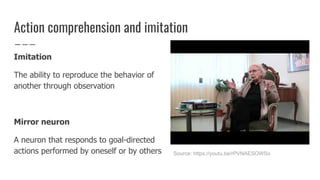
Action comprehension and imitation
Imitation
The ability to reproduce the behavior of
another through observation
Mirror neuron
A neuron that responds to goal-directed
actions performed by oneself or by others Source: https://youtu.be/rPVNAESOWSo
Wider implications of the mirror neuron system
● Did human language evolve from hand gestures?
(Rizzolatti & Arbib 1998)
● Are mirror neurons important for being able to empathize with others?
(Gallese 2001)
● Do individuals with particular difficulties in understanding others have
impaired mirror neuron system?
(Dapretto et. al 2006)
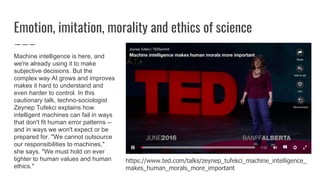
Emotion, imitation, morality and ethics of science
https://www.ted.com/talks/zeynep_tufekci_machine_intelligence_
makes_human_morals_more_important
Machine intelligence is here, and
we're already using it to make
subjective decisions. But the
complex way AI grows and improves
makes it hard to understand and
even harder to control. In this
cautionary talk, techno-sociologist
Zeynep Tufekci explains how
intelligent machines can fail in ways
that don't fit human error patterns --
and in ways we won't expect or be
prepared for. "We cannot outsource
our responsibilities to machines,"
she says. "We must hold on ever
tighter to human values and human
ethics."

Cognitive psychology l5 spring2019

  • 1.
    Cognitive Psychology Lesson 5- Spring 2019 The acting brain Professor Valentina Bazzarin USAC Reggio Emilia
  • 2.
    You just can'tdifferentiate between a robot and the very best of humans https://youtu.be/ogBX18maUiM
  • 3.
    Framework for movementand action Source: Verwey, W. B., Shea, C. H., & Wright, D. L. (2015). A cognitive framework for explaining serial processing and sequence execution strategies. Psychonomic bulletin & review, 22(1), 54-77. Action is our way of interfacing with the world, and our means of putting all our goals and desires into practice. Action has traditionally been viewed as the end -point of cognition. Decision → Action towards Always true?
  • 4.
    Jimmy and Johnny Source:https://www.youtube.com/watch?v=Nu6LYL2ynzI https://www.youtube.com/watch?v=z0feuLS e4xE
  • 5.
    Degrees of freedomproblem and motor programs Degrees of freedom problem There are potentially an infinite number of motor solutions for acting on an object Motor programs Stored routines that specify certain motor parameters of an action (e.g. the relative timing of strokes) https://edition.cnn.com/2016/06/28/health/child- development-baby-milestones/index.html
  • 6.
    Proprioception and sensory-motortransformation Somatosensation: A cluster of perceptual processes that relate to the skin and the body, an include touch, pain, thermal sensation and limb position. Proprioception: Knowledge of the position of the limbs in space. Sensory-motor transformation: Linking together of perceptual knowledge of objects in space and knowledge of the position of one’s body to enable objects to be acted on.
  • 7.
    The homunculus problem Theproblem of explaining volitional acts without assuming a cognitive process that is itself volitional (a man within a man”) “homunculus is essentially ‘a little man’ inside you, the agent behind your actions, the decider behind your decisions, the see-er behind your sight. Think of the so-called Cartesian theater inside your mind. All of your thoughts enter stage right, perform, and exit stage left. But who’s doing the seeing, considering, evaluating, etc. of these thoughts if they’re inside you? Not you!” https://www.psychologytoday.com/blog/the-metaphorical-mi nd/200807/i-finally-got-be-homunculus-part-i
  • 8.
    Cortical Homunculus, amap and a representation https://www.ted.com/talks/joshua_w_pate_the_fascinating_science_of_phantom_limbs
  • 9.
    Tourette syndrome https://www.youtube.com/watch?v=CBVJdI4yk7A Tourette syndrome(TS or simply Tourette's) is a common neuropsychiatric disorder with onset in childhood, characterized by multiple motor tics and at least one vocal (phonic) tic. These tics characteristically wax and wane, can be suppressed temporarily, and are typically preceded by an unwanted urge or sensation in the affected muscles. Some common tics are eye blinking, coughing, throat clearing, sniffing, and facial movements. Tourette's does not adversely affect intelligence or life expectancy. Source: https://en.wikipedia.org/wiki/Tourette_syndrome
  • 10.
    The role ofthe frontal lobes in movement and action Source: https://brainconnection.brainhq.com/2013/03/05/the-anatomy-of-movement/
  • 11.
    Could neural activityin the primary motor cortex be used to guide a prosthetic limb? https://www.smithsonianmag.com/science-nature/wireless-brain- computer-network-helps-paralyzed-monkeys-walk-humans-coul d-be-next-180961049/ https://www.theguardian.com/science/2017/mar/2 8/neuroprosthetic-tetraplegic-man-control-hand-wit h-thought-bill-kochevar
  • 12.
    Planning actions: theSAS model Damage to prefrontal regions does not impair the movement or execution of actions per se. Rather the actions themselves become poorly organized and do not necessarily reflect the goals and intentions of the individual. So the damage to prefrontal regions produces actions that are disorganized, inappropriate and/or unintentional.
  • 13.
    Ownership and awarenessof actions Libet recorded a well-known psychophysiological correlate of movement preparation called the readiness potential (RP), which Hans H. Kornhuber and Lüder Deecke first described in 1965. The RP is measured using electroencephalographic recording electrodes placed on the scalp overlying the motor areas of the frontal lobe, and appears as a ramp like buildup of electrical activity that precedes voluntary action by about 1 second. By also recording the electrical activity of the muscles involved in the wrist movement, Libet precisely determined the onset of muscle activity related to the RP. Source: http://www.skeptically.org/spiritualism/id11.ht ml
  • 14.
  • 15.
    The two-streams hypothesisis a widely accepted and influential model of the neural processing of vision as well as hearing. The hypothesis, given its most popular characterisation in a paper by David Milner and Melvyn A. Goodale in 1992, argues that humans possess two distinct visual systems. Recently there seems to be evidence of two distinct auditory systems as well. As visual information exits the occipital lobe, and as sound leaves the phonological network, it follows two main pathways, or "streams". Parietofrontal circuits for sensorimotor transformation The ventral stream (also known as the "what pathway") is involved with object and visual identification and recognition. The dorsal stream (or, "where pathway") is involved with processing the object's spatial location relative to the viewer and with speech repetition. Source: https://en.wikipedia.org/wiki/Two-streams_hypothesis
  • 16.
    Tool An object thataffords certain actions for specific goals. Ideomotor apraxia An inability to produce appropriate gestures given an object, word or command Affordance Structural properties of objects imply certain usage Using objects and tools Source: https://youtu.be/47y3q8nocXY Tests: occupational therapist assistant
  • 17.
    Preparation and theexecution of actions Two main subcortical loops are involved in the movement generation. The cerebellar loop coordinates the timing and trajectory of movement using sensory and motor information. The basal ganglia loop regulates the excitability of frontal motor structures and biases the likelihood of movement and the nature of the movement (e.g. the force).
  • 18.
    Action comprehension andimitation Imitation The ability to reproduce the behavior of another through observation Mirror neuron A neuron that responds to goal-directed actions performed by oneself or by others Source: https://youtu.be/rPVNAESOWSo
  • 19.
    Wider implications ofthe mirror neuron system ● Did human language evolve from hand gestures? (Rizzolatti & Arbib 1998) ● Are mirror neurons important for being able to empathize with others? (Gallese 2001) ● Do individuals with particular difficulties in understanding others have impaired mirror neuron system? (Dapretto et. al 2006)
  • 20.
    Emotion, imitation, moralityand ethics of science https://www.ted.com/talks/zeynep_tufekci_machine_intelligence_ makes_human_morals_more_important Machine intelligence is here, and we're already using it to make subjective decisions. But the complex way AI grows and improves makes it hard to understand and even harder to control. In this cautionary talk, techno-sociologist Zeynep Tufekci explains how intelligent machines can fail in ways that don't fit human error patterns -- and in ways we won't expect or be prepared for. "We cannot outsource our responsibilities to machines," she says. "We must hold on ever tighter to human values and human ethics."