OMAP 35xx Family
Introduction and beyond…
- Bhavishya Goel
Presentation Outline
 OMAP History
 OMAP 35xx Family Introduction
 OMAP 35xx Details
 What’s in for us!
Need for OMAP
 With the boom in mobile industry, the
expectations of cell phone users increased
 Customers wanted more and better multimedia
experience on their cell phones without losing
battery life
 Processors were required that can bridge these
paradoxical features by combining performance
and power management
Birth of OMAP
 Introduced by TI in 1999 as Open Multimedia
Application PlatformTM
 OMAP brought software applications to cell
phones
 Began shipping in year 2000
 Revolutionized the cell phone feature list by
providing all-in-one multimedia interfaces at low
power and operating system capability
OMAP Introduction
 Low power high performance multimedia
application processor offerings from TI for
wireless solutions
 Started out as single core solution with ARM7
and ARM9 as driving engine
 Later brought C55x DSP core to complement
ARM core
 Continuous enhancements made to enrich
multimedia experience and reduce power
OMAP Line of Processors
“Open Architecture”
 Fully programmable architecture – no need to
re-spin ASIC for upgrades, software upgrades
possible
 Standardized interfaces – greater software
compatibility
 Underlying code readily available to OEM
developers
 Increases software reusability
Market for OMAP
 OMAP is present in more than half of the cell
phones being sold today
 Nokia, Motorola, BenQ, NEC, HTC, LG,
FOMA, Samsung, Sharp, Sony Ericsson, Sprint,
etc all use OMAP technology
 Also used in gaming consoles, modems, PDA,
telematics, biometrics, etc
OMAP 35xx Family
 Based on OMAP3 Architecture
 First OMAP family available through
distributors
 Intends to upgrade the mobile handsets to the
next level of multimedia experience
 Targeted at wireless applications in general, apart
from mobiles
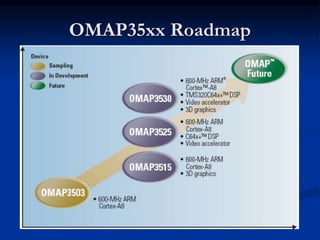
OMAP35xx Roadmap
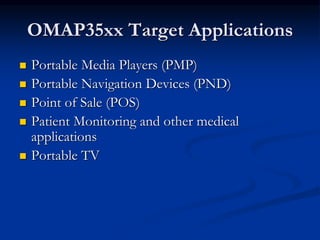
OMAP35xx Target Applications
 Portable Media Players (PMP)
 Portable Navigation Devices (PND)
 Point of Sale (POS)
 Patient Monitoring and other medical
applications
 Portable TV
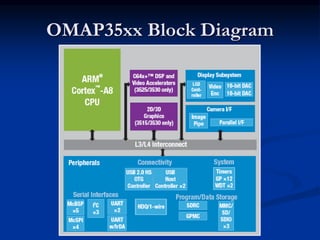
OMAP35xx Block Diagram
ARM Cortex-A8 Features
 ARMv7 Architecture running at 600 MHz
 ARM’s first superscalar architecture
 Neon Media Engine
 Thumb-2 Technology
 Jazelle RCT Technology
 TrustZone Technology
 High Frequency Operation
 Low Power Operation
C64x+ DSP Module
 Same as in DaVinci processors
 Running at 430 MHz
 Available in 3525 and 3530 only
OMAP35xx Peripherals
 External Memory Inerface
 SDRAM Controller
 16/32-bit Interface
 2G Byte address space
 Only LPDDR support, no DDR2
 General purpose Memory Controller
 16-bit Multiplexed address/data Bus
 8 chip selects, 129 M-byte per chip select (multiplexed
mode)
 NOR, NAND and asynchronous memory support
OMAP35xx Peripherals…
 Camera Interface
 CCD/CMOS
 Raw, BT.601/BT.656 8/16-bit
 Supports serial and parallel sensors
 Pixel clock up to 150 Mhz in 8-bit mode
OMAP35xx Peripherals…
 Display Subsystem
 Parallel digital: up to 24-bit RGB, Max Resolution of
1024 x 768
 Support for 2 LCD panels
 2 10-bit DACs to support both CVBS and S-Video,
max pixel clock of 54 MHz
 Serial Display Interface – TI FlatLink 3G Protocol
 3 MMC/SDIO Interfaces
OMAP35xx Peripherals…
 5 McBSPs
 512 byte buffer for McBSP1/3/4/5
 5k buffer for McBSP2
 I2S and PCM device interface supported
 4 master/slave multi-channel SPI
 USB 2.0 OTG support
 3-port USB 2.0 host controller
OMAP35xx Peripherals…
 One HDQ/1-wire interface
 Three UARTs
 Three master/slave high speed I2C (3.4 Mbps)
OMAP35xx Peripheral Mux
 Mode Dependent – Mode 0 to Mode 7 defines
the pin functionality!
 GPIO – GPMC, DSS, ISP, McBSP2, I2C
 McBSP4 – GPMC Chip selects 4/5/6/7
 UART1 – DSS
 UART3 – DSS
 McSPI3 – DSS
 Etc…
OMAP 35xx Supply Voltage
 Core Supply
 0.8V to 1.8V
 IO Supply
 1.8V, 3.3V
 Operating Temperature Range
 0 to 90degC
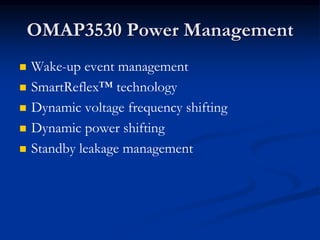
OMAP3530 Power Management
 Wake-up event management
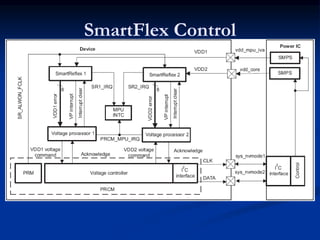
 SmartReflex™ technology
 Dynamic voltage frequency shifting
 Dynamic power shifting
 Standby leakage management
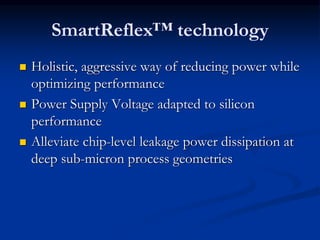
SmartReflex™ technology
 Holistic, aggressive way of reducing power while
optimizing performance
 Power Supply Voltage adapted to silicon
performance
 Alleviate chip-level leakage power dissipation at
deep sub-micron process geometries
SmartFlex Control
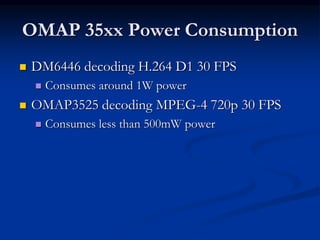
OMAP 35xx Power Consumption
 DM6446 decoding H.264 D1 30 FPS
 Consumes around 1W power
 OMAP3525 decoding MPEG-4 720p 30 FPS
 Consumes less than 500mW power
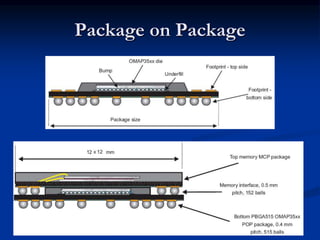
OMAP 35xx Package
 515-pin PBGA Package (CBB Suffix)
 0.5mm Ball Pitch (Top)
 0.4mm Ball pitch (Bottom)
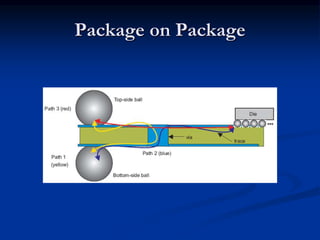
 Package on package configuration
 Used only by handset OEMs to stack processor and
memory chips to save real estate
 423-pin PBGA (CUS Suffix)
 0.65mm
Package on Package
Package on Package
OMAP35xx OS Support
 Windows CE
 Symbian OS
 Linux
 Palm OS
 And others…
OMAP35xx Video Applications
 Streaming Video
 2D/3D mobile gaming
 Video conferencing
 High-resolution still image
 Video capture in mobile handsets and PDAs
OMAP35xx Security Applications
 Protection against malicious attacks
 M-commerce
 Content protection for recordable media
(CPRM)
 Digital rights management (DRM)
Current OMAP35x Developers
 Aricent
 BSQUARE
 Ingenient
 Ittiam
 Logic
 Mistral
 Lauterbach
 PacketVideo
 GreenHills
 Code Sourcery
 Microsoft
What’s in for us?
 Visibility over the latest TI offering
 Better solution for handheld devices like
Biometrics
 Gain in expertise over OMAP family
 Direct and indirect revenue growth
Thank you
Courtesy: Google and God (in the
same order)

Introduction to OMAP 35x Platform engineering topic

  • 1.
    OMAP 35xx Family Introductionand beyond… - Bhavishya Goel
  • 2.
    Presentation Outline  OMAPHistory  OMAP 35xx Family Introduction  OMAP 35xx Details  What’s in for us!
  • 3.
    Need for OMAP With the boom in mobile industry, the expectations of cell phone users increased  Customers wanted more and better multimedia experience on their cell phones without losing battery life  Processors were required that can bridge these paradoxical features by combining performance and power management
  • 4.
    Birth of OMAP Introduced by TI in 1999 as Open Multimedia Application PlatformTM  OMAP brought software applications to cell phones  Began shipping in year 2000  Revolutionized the cell phone feature list by providing all-in-one multimedia interfaces at low power and operating system capability
  • 5.
    OMAP Introduction  Lowpower high performance multimedia application processor offerings from TI for wireless solutions  Started out as single core solution with ARM7 and ARM9 as driving engine  Later brought C55x DSP core to complement ARM core  Continuous enhancements made to enrich multimedia experience and reduce power
  • 6.
    OMAP Line ofProcessors
  • 7.
    “Open Architecture”  Fullyprogrammable architecture – no need to re-spin ASIC for upgrades, software upgrades possible  Standardized interfaces – greater software compatibility  Underlying code readily available to OEM developers  Increases software reusability
  • 8.
    Market for OMAP OMAP is present in more than half of the cell phones being sold today  Nokia, Motorola, BenQ, NEC, HTC, LG, FOMA, Samsung, Sharp, Sony Ericsson, Sprint, etc all use OMAP technology  Also used in gaming consoles, modems, PDA, telematics, biometrics, etc
  • 9.
    OMAP 35xx Family Based on OMAP3 Architecture  First OMAP family available through distributors  Intends to upgrade the mobile handsets to the next level of multimedia experience  Targeted at wireless applications in general, apart from mobiles
  • 10.
  • 11.
    OMAP35xx Target Applications Portable Media Players (PMP)  Portable Navigation Devices (PND)  Point of Sale (POS)  Patient Monitoring and other medical applications  Portable TV
  • 12.
  • 13.
    ARM Cortex-A8 Features ARMv7 Architecture running at 600 MHz  ARM’s first superscalar architecture  Neon Media Engine  Thumb-2 Technology  Jazelle RCT Technology  TrustZone Technology  High Frequency Operation  Low Power Operation
  • 14.
    C64x+ DSP Module Same as in DaVinci processors  Running at 430 MHz  Available in 3525 and 3530 only
  • 15.
    OMAP35xx Peripherals  ExternalMemory Inerface  SDRAM Controller  16/32-bit Interface  2G Byte address space  Only LPDDR support, no DDR2  General purpose Memory Controller  16-bit Multiplexed address/data Bus  8 chip selects, 129 M-byte per chip select (multiplexed mode)  NOR, NAND and asynchronous memory support
  • 16.
    OMAP35xx Peripherals…  CameraInterface  CCD/CMOS  Raw, BT.601/BT.656 8/16-bit  Supports serial and parallel sensors  Pixel clock up to 150 Mhz in 8-bit mode
  • 17.
    OMAP35xx Peripherals…  DisplaySubsystem  Parallel digital: up to 24-bit RGB, Max Resolution of 1024 x 768  Support for 2 LCD panels  2 10-bit DACs to support both CVBS and S-Video, max pixel clock of 54 MHz  Serial Display Interface – TI FlatLink 3G Protocol  3 MMC/SDIO Interfaces
  • 18.
    OMAP35xx Peripherals…  5McBSPs  512 byte buffer for McBSP1/3/4/5  5k buffer for McBSP2  I2S and PCM device interface supported  4 master/slave multi-channel SPI  USB 2.0 OTG support  3-port USB 2.0 host controller
  • 19.
    OMAP35xx Peripherals…  OneHDQ/1-wire interface  Three UARTs  Three master/slave high speed I2C (3.4 Mbps)
  • 20.
    OMAP35xx Peripheral Mux Mode Dependent – Mode 0 to Mode 7 defines the pin functionality!  GPIO – GPMC, DSS, ISP, McBSP2, I2C  McBSP4 – GPMC Chip selects 4/5/6/7  UART1 – DSS  UART3 – DSS  McSPI3 – DSS  Etc…
  • 21.
    OMAP 35xx SupplyVoltage  Core Supply  0.8V to 1.8V  IO Supply  1.8V, 3.3V  Operating Temperature Range  0 to 90degC
  • 22.
    OMAP3530 Power Management Wake-up event management  SmartReflex™ technology  Dynamic voltage frequency shifting  Dynamic power shifting  Standby leakage management
  • 23.
    SmartReflex™ technology  Holistic,aggressive way of reducing power while optimizing performance  Power Supply Voltage adapted to silicon performance  Alleviate chip-level leakage power dissipation at deep sub-micron process geometries
  • 24.
  • 25.
    OMAP 35xx PowerConsumption  DM6446 decoding H.264 D1 30 FPS  Consumes around 1W power  OMAP3525 decoding MPEG-4 720p 30 FPS  Consumes less than 500mW power
  • 26.
    OMAP 35xx Package 515-pin PBGA Package (CBB Suffix)  0.5mm Ball Pitch (Top)  0.4mm Ball pitch (Bottom)  Package on package configuration  Used only by handset OEMs to stack processor and memory chips to save real estate  423-pin PBGA (CUS Suffix)  0.65mm
  • 27.
  • 28.
  • 29.
    OMAP35xx OS Support Windows CE  Symbian OS  Linux  Palm OS  And others…
  • 30.
    OMAP35xx Video Applications Streaming Video  2D/3D mobile gaming  Video conferencing  High-resolution still image  Video capture in mobile handsets and PDAs
  • 31.
    OMAP35xx Security Applications Protection against malicious attacks  M-commerce  Content protection for recordable media (CPRM)  Digital rights management (DRM)
  • 32.
    Current OMAP35x Developers Aricent  BSQUARE  Ingenient  Ittiam  Logic  Mistral  Lauterbach  PacketVideo  GreenHills  Code Sourcery  Microsoft
  • 33.
    What’s in forus?  Visibility over the latest TI offering  Better solution for handheld devices like Biometrics  Gain in expertise over OMAP family  Direct and indirect revenue growth
  • 34.
    Thank you Courtesy: Googleand God (in the same order)