Reporter: Jane H. Basto
BEED
English
Literatur
e
Introduction
to
English
Literature
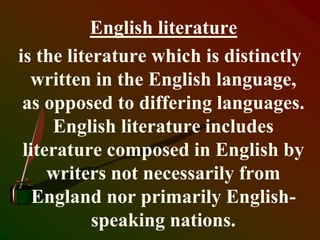
English literature
is the literature which is distinctly
written in the English language,
as opposed to differing languages.
English literature includes
literature composed in English by
writers not necessarily from
England nor primarily English-
speaking nations.
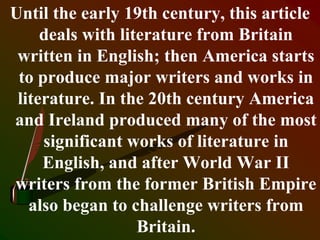
Until the early 19th century, this article
deals with literature from Britain
written in English; then America starts
to produce major writers and works in
literature. In the 20th century America
and Ireland produced many of the most
significant works of literature in
English, and after World War II
writers from the former British Empire
also began to challenge writers from
Britain.
Geographical
Background
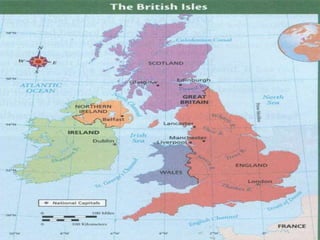
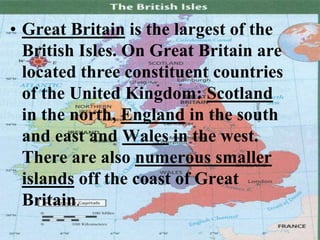
• Great Britain is the largest of the
British Isles. On Great Britain are
located three constituent countries
of the United Kingdom: Scotland
in the north, England in the south
and east and Wales in the west.
There are also numerous smaller
islands off the coast of Great
Britain.
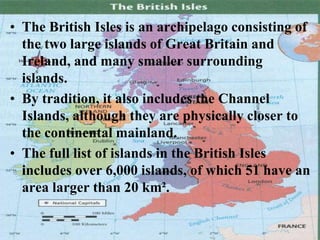
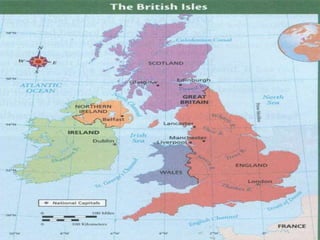
• The British Isles is an archipelago consisting of
the two large islands of Great Britain and
Ireland, and many smaller surrounding
islands.
• By tradition, it also includes the Channel
Islands, although they are physically closer to
the continental mainland.
• The full list of islands in the British Isles
includes over 6,000 islands, of which 51 have an
area larger than 20 km².
History Of English
Literature
The
Anglo-Saxon
Period
(449-1066
BC)
The Anglo-Saxons
• “Anglo-Saxon” is the term applied to the English-
speaking inhabitants of Britain from around the
middle of the fifth century until the time of the
Norman Conquest, when the Anglo-Saxon line of
English kings came to an end.
The Anglo-Saxons
• Bede tells us that the Anglo-Saxons came from
Germania.
• The languages spoken by the inhabitants of
Germania were a branch of the Indo-European
family of languages, which linguists believe
developed from a single language spoken some
five thousand years ago in an area that has
never been identified—perhaps, some say, the
Caucasus.
Old English dialects
The language spoken by the Anglo-Saxons at the
time of their migration to Britain was probably
more or less uniform. Over time, however, Old
English developed into four major dialects:
1. Northumbrian, spoken north of the river
Humber
2. Mercian, spoken in the midlands
3. Kentish, spoken in Kent (in the far southeastern
part of the island);
4. West Saxon, spoken in the southwest.
Old English literature, or Anglo-
Saxon literature, encompasses
literature written in Old English in
Anglo-Saxon England, in the
period after the settlement of the
Saxons and other Germanic tribes
in England after the withdrawal of
the Romans and "ending soon after
the Norman Conquest" in 1066.
The Anglo-Saxon influenced English
Literature when they brought with them
a rich tradition of oral literature steeped
in their customs, pagan beliefs and
rituals.
 The lyric and epic poetry they wrote told
of the hardships of survival and the
importance of courage in performing
heroic deeds. It dignified the difficulties
and dangers faced by the warriors before
they succeeded in their heroic feats.
Some significant literary work in
this period:1. Ecclesiastical History of the English
People and Caedmon Hymn by Bede
2. Anglo-Saxon Chronicle by Alfred the Great
3. The Wonderer
4. Deor’s Lament
5. A Dream of the Rood
6. The Battle of Maldon
7. Beowulf (Lone Surviving Epic of English
Literature)
The significant literary genres were:
Chronicle
Formulaic Poetry
Epic Poem (Tribal Scop)
Some significant literary
work in this period are
came from
ANONYMOUS
WRITERS
The Medieval Period
(1066 B.C.-1485
A.D.)
The Medieval Period (1066 B.C.-
1485 A.D.)
Celtic fancy, Anglo-Saxon solidity, and
Norman vivacity-these were the original
ingredients of English life and letters. The
third of these was brought into England from
northern France by William the Conqueror
and his Norman knights and churchmen.
Castles and feudalism, joust and duels,
cathedral and monasteries, chivalry and
adventure were the contributions of these
aristocratic newcomers.
Middle English lasts up until the 1470s, when
the Chancery Standard, a form of London-
based English, became widespread and the
printing press regularized the language. The
prolific Geoffrey Chaucer, whose works were
written in Chancery Standard, was the first
poet to have been buried in Poet's Corner of
Westminster Abbey. Among his many works,
which include The Book of the Duchess, the
House of Fame, the Legend of Good Women
and Troilus and Criseyde, Chaucer is best
known today for The Canterbury Tales.
Some Significant literary
Works of this period were:
1. Sir Gawain and the Green Knight
2. Morte D’Arthur by Sir Thomas Malory
3. The Vision of the Piers Plowman by
William Langland
4. The Owl and the Nightingale
5. Canterbury Tales by Geoffrey Chaucer
The Significant Literary Genres
were:
1. Elegy
2. Religious Liturgy
3. Narrative Romance
4. Lay or Lais
5. Arthurian Romance
6. Fabliau
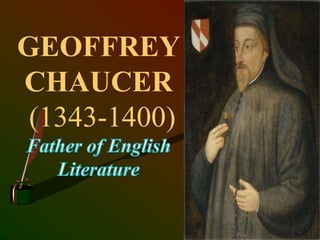
GEOFFREY
CHAUCER
(1343-1400)
Geoffrey Chaucer
Outstanding in English Poet before William
Shakespeare whose Canterbury Tales ranks
as one of the greatest poetic works in
English.
Born in the middle class family. He was said
to be fluent in French, Latin and Italian.
His first important poem The Book of
Duchess a dream vision of elegy for
Blanche, Duchess of Lancaster who died for
a plague.
Geoffrey
Chaucer
Literary
Works
 The Canterbury Tales,
 Troilus and Criseyde
 Book of the Duchess.
Other Major Poems
 The House of Fame
 The Parliament of Fowles
 The Legend of Good
Women
Prose
 Treatises
 Treatise on the astrolabe
Short Poems
 The Complaint of
Chaucer to His Purse
 Truth
 Gentilesse
 Merciles Beaute
 Lak of Stedfastnesse
 Against Women
Unconstant.
English
Renaissance
or
The Elizabethan
Period
(1485-1625)
The Elizabethan Period (1485-
1625)
The most splendid in the history of English
literature. Literary works were characterized by
immense vitality and richness.
The flowering of poetry and the golden age of
drama. The most noted poet of the period was
William Shakespeare.
The Elizabethan Period (1485-
1625)
Queen Elizabeth the most regal monarch at the age
of monarchy was the key figure in influencing the
life of her constituents. She was a great advocate
of peace and order.
The high age of aristocracy.
The golden age of English literature.
Significant Dates
1492 – The discovery of America; an
opening of entirely new world.
1534 – The Act of Supremacy; the
sundering of the English Church from
Rome
1558 – The accession of Elizabeth I; the
beginning of an age of comparative
toleration.
Gradual Appearance of several
literary features
1. There was an increase in the number of
translation. Such as the North’s translation of
Plutarch’s Lives (1579); Phaers (Virgil 1588);
Golding’s Bird (1565) and Chapman’s Homer
(1595). These translation opened out new realms
of wonder and romance and provided models for
the creative writing of Englishmen.
2. A lyrical impulse, strong and sweet, began o
pervade English literature. Most of the greater
poets contributed to poetry of time.
Gradual Appearance of several
literary features
3. The drama assumed a commanding
position in the writing of the day. William
Shakespeare roll to fame and honor.
4.The technique of poetry–the skill in the
management of meter show great
advancement.
5. The rise of prose writing. There was a vast
travel of body of travel literature. There
was even an approach to prose fiction.
Some significant literary works
in this period were:
1. Faerie Queene, Shepher’s Calendar by Edmund
Spenser
2. Laws of Ecclesiastical Polity by Richard Hooker
3. Book of Martyrs by John Foxe
4. Musophilus by Samuel Daniel
5. The Nymph’s Replied to the Shepherd by Sir
Walter Raleigh
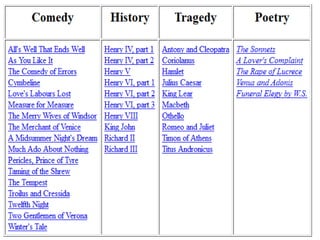
6. William Shakespeare Works
William Shakespeare
• Born: Baptised 26 April
1564 (birth date unknown)
Stratford-upon-Avon,
Warwickshire, England
• Died: 23 April 1616 (aged
52)
Stratford-upon-Avon,
Warwickshire, England
• Occupation; Playwright,
poet, actor
• Signature:
William
Shakespeare’s
Works
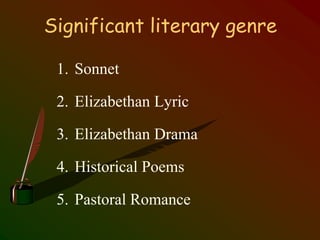
Significant literary genre
1. Sonnet
2. Elizabethan Lyric
3. Elizabethan Drama
4. Historical Poems
5. Pastoral Romance
The 17th Century
or the
Puritan Period
(1625-1700)
The 17th Century or the Puritan
Period
(1625-1700)
Catastrophe struck Britain. The Civil
War, the Black Plague and the great fire
of London disrupted the otherwise orderly
existence of the English people. Literature
was permeated by the light hearted
cavalier of the solemn Puritans.
The Period of Dissension and Calamity
Significant literary works during
this period
1. Areopaitica by John Milton
2. Devotions by John Done
3. Religio Medici by Thomas Brown
4. History of Henry VII by Francis Bacon
5. Works by Ben Johnson
6. The garden by Andrew Marvell
Significant literary genre:
1. Restoration Comedy and Tragedy
2. Metaphysical Poetry
3. False Pindaric or Irregular Ode
4. Light Prose
The 18th
Century
or the
Period of
Classism
The 18th Century or the Period of
Classism (1700-1800)
Dawning of the age of reason
The London become the the center of of the
bustling city life.
Literary mastered have their crafts and have
written with sophistication and finesse.
Prose writing become popular.
The periodical and novel gained popularity and
public acceptance.
The periodical became the origin of what we call
now as clarity and public acceptance.
Significant literary works during
this period
1. The London Merchant by George Lillo
2. Conscious Lovers by Richard Steels
3. The Fair Penitent: The Tragedy of Jane Shore:
The tragedy of Lady Grey by Nicholas Rowe
4. The Distressed Mother by Ambrose Philip
5. Cato by Joseph Addison
6. The West Indian by Richard Cumberland
7. The Stoops to Conquer by Oliver Goldsmith
8. The Rivals: School for Scandals by Richard
Brinsley Sheridan
Significant literary genre:
Opera
Ballad Opera
Pantomime
Prose Tragedy
The Romantic
Period
(1800-1837)
The Romantic Period (1800-
1837)
The Golden age of the lyric poetry belongs to the
youth.
A literature of vigor and courage, love and
wisdom, despair and hope.
Romantic poets pointed to the wild, unfathomable
beauties of nature, the elusive, supernatural vision
of mystics and the mysterious atmosphere of
religion that had east such celestial light about the
middle ages.
The Romantic Period (1800-
1837)
• Queen Victoria came to the throne, this
romantic fever had somewhat burned itself
out.
• Men had turned their attention to the far
reaching implications of the industrial
revolution which was at last transforming
the entire surface and structure of England.
Significant literary works during
this period
1. Society: Castle by Thomas W. Robertson
2. Widowers’ Houses by George Bernard Shaw
3. Lady Windermere’s Fan by Oscar Wilde
4. The Second Mrs. Tanqueray by Arthur Wind
Pinero
5. Song of Innocence and of Experience by
William Blake
6. Lyrical Ballads by William Wordsworth and
Samuel Taylor Coleridge
Significant literary works during
this period
7. Prometheus Unbound by Percy Bysshe
Shelley
8. To Psyche; On a Grecian Ura; To a
Nightingale by John Keats
9. Childe Harold; Don Juan by Lord Byron
10. Sense and the Sensibility; Pride and
Prejudice; Mansfield Park;Persuasion by
Jane Austen
Significant literary genre:
• Heroic Couplet
• Historical Novel
The Victorian
Period
(1837-1900
The Victorian Period (1837-
1900)
Victoria I became a Queen of England in
1817, 3 years after the death of Coleridge
and thirteen years before the death of
Wordsworth.
She reigned until her own death in 1901.
The reign in England of comparable length
is that of Elizabeth I (1558-1603) and like
Elizabeth Victoria had not only a political
but a literary epoch named for her.
The Victorian Period (1837-
1900)
The keynote of the age was the 1851
Great Exhibition to London, a
triumphant display intended to illustrate
the superiority of England’s scientific,
social and technological achievements.
Significant literary works during
this period
1. The Pickwick Papers; Oliver Twist: David
Copperfield: A Tale of Two Cities: Great
Expectations by Charles Dickens
2. Vanity Fair by William Makepeace Thackeray
3. Pilgrim’s Progress by John Bunyan
4. The Last Chronicle of Barset; Barchester
Towers; The Warden by Anthony Trollope
5. Wuthering Heights by Emily Bront
Significant literary works during
this period
6. Agnes Grey by Anne Bronte
7. Jane Eyre by Charlotte Bronte
8. Silas Marner; Scenes of Clerical Life; The Mill
on the Floss Middlemach by George Elliot
9. The Lotos Eater; Ulysses; Lockley Hall; Idylle of
the Kings; In Memoriam by Alfred Lord
10. The Cry of the Children by Elizabeth Barrett
Browning
Significant literary works during
this period
11.The Bishop Orders His Tome at St. Fraxed’s
Church; The Ring and the Book by Robert
Browning
12. Culture and Anarchy by Matthw Arnold
13. Confession of an English Opium-Eater; On
Knocking in the Gate of Macbeth by Thomas
DeQuincy
14. History of England by Thomas Babington
Macaulay
Significant literary works during
this period
15. Sartor Resartus; The French Revolution;
Heroes and Hero-Worship; Past and Present by
Thomas Carlyle
16. The Stones of Venice by John Ruskin
17. The Development of Christian Doctrine; The
Idea of a University; Grammar Assent by John
Henry Newman
18. On Liberty; The Subjection of Women by John
Stuart Mill
Significant literary genre:
Novels
Magazine Serial
Dramatic Dialogue
The 20th Century
or
The Modern
Period
(1900 up to
Present)
The 20th Century or The Modern
Period
(1900 up to Present)
Literature of this periods exemplifies the
improved crafts of masters. The novel has
flourished and writers have risen not only to
popularity but to distinction as well.
The emerging values of the modern times
are embodied in the works of authors who
defy the conventions of the old world.
The 20th Century or The Modern
Period
(1900 up to Present)
Science and technology became the basis for
advancement. While Orthodox beliefs are
considered standard criteria for excellence,
the emerging needs for radical changes
became the order of the day.
Significant literary works of
this period
1. Jude, the Obscure; Far From Maddening
crowd; The Dynasts; The Return of Native
by Thomas Hardy
2. The Tower; The Winding Stair by W.B.
Yeats
3. The Lyrical Ballads by William
Wordsworth and Samuel Taylor Coleridge
4. The Almayer’s Folly; The Nigger of the
“Narcissus” by Joseph Conrad
Significant literary works of
this period
5. Howard End; A Passage to India by E.M.
Foster
6. The Voyage Out; Night and Day; Mrs.
Dalloway; To the Lighthouse by Virginia
Woolf
7. A Portrait of the Artist as a Young Man by
James Joyce
8. Sons and Lovers; The Rainbow; Lady
Chatterley’s Lover by D. H. Lawrence
Significant literary works of
this period
9. Modern Comedy; Swan Song; The Man of
Property
10. The White Monkey; The Silver Spoon by
John Galsworthy
11. The Egoist; Beauchamp’s Career by
George Meredith
12. Captain Courageous; Jungle Book by
Rudyard Kipling
Significant literary genre:
Novel
Blank Verse

English Lliterature

  • 1.
    Reporter: Jane H.Basto BEED English Literatur e
  • 3.
  • 4.
    English literature is theliterature which is distinctly written in the English language, as opposed to differing languages. English literature includes literature composed in English by writers not necessarily from England nor primarily English- speaking nations.
  • 5.
    Until the early19th century, this article deals with literature from Britain written in English; then America starts to produce major writers and works in literature. In the 20th century America and Ireland produced many of the most significant works of literature in English, and after World War II writers from the former British Empire also began to challenge writers from Britain.
  • 6.
  • 8.
    • Great Britainis the largest of the British Isles. On Great Britain are located three constituent countries of the United Kingdom: Scotland in the north, England in the south and east and Wales in the west. There are also numerous smaller islands off the coast of Great Britain.
  • 9.
    • The BritishIsles is an archipelago consisting of the two large islands of Great Britain and Ireland, and many smaller surrounding islands. • By tradition, it also includes the Channel Islands, although they are physically closer to the continental mainland. • The full list of islands in the British Isles includes over 6,000 islands, of which 51 have an area larger than 20 km².
  • 11.
  • 12.
  • 13.
    The Anglo-Saxons • “Anglo-Saxon”is the term applied to the English- speaking inhabitants of Britain from around the middle of the fifth century until the time of the Norman Conquest, when the Anglo-Saxon line of English kings came to an end.
  • 14.
    The Anglo-Saxons • Bedetells us that the Anglo-Saxons came from Germania. • The languages spoken by the inhabitants of Germania were a branch of the Indo-European family of languages, which linguists believe developed from a single language spoken some five thousand years ago in an area that has never been identified—perhaps, some say, the Caucasus.
  • 15.
    Old English dialects Thelanguage spoken by the Anglo-Saxons at the time of their migration to Britain was probably more or less uniform. Over time, however, Old English developed into four major dialects: 1. Northumbrian, spoken north of the river Humber 2. Mercian, spoken in the midlands 3. Kentish, spoken in Kent (in the far southeastern part of the island); 4. West Saxon, spoken in the southwest.
  • 16.
    Old English literature,or Anglo- Saxon literature, encompasses literature written in Old English in Anglo-Saxon England, in the period after the settlement of the Saxons and other Germanic tribes in England after the withdrawal of the Romans and "ending soon after the Norman Conquest" in 1066.
  • 17.
    The Anglo-Saxon influencedEnglish Literature when they brought with them a rich tradition of oral literature steeped in their customs, pagan beliefs and rituals.  The lyric and epic poetry they wrote told of the hardships of survival and the importance of courage in performing heroic deeds. It dignified the difficulties and dangers faced by the warriors before they succeeded in their heroic feats.
  • 18.
    Some significant literarywork in this period:1. Ecclesiastical History of the English People and Caedmon Hymn by Bede 2. Anglo-Saxon Chronicle by Alfred the Great 3. The Wonderer 4. Deor’s Lament 5. A Dream of the Rood 6. The Battle of Maldon 7. Beowulf (Lone Surviving Epic of English Literature)
  • 19.
    The significant literarygenres were: Chronicle Formulaic Poetry Epic Poem (Tribal Scop)
  • 20.
    Some significant literary workin this period are came from ANONYMOUS WRITERS
  • 21.
  • 22.
    The Medieval Period(1066 B.C.- 1485 A.D.) Celtic fancy, Anglo-Saxon solidity, and Norman vivacity-these were the original ingredients of English life and letters. The third of these was brought into England from northern France by William the Conqueror and his Norman knights and churchmen. Castles and feudalism, joust and duels, cathedral and monasteries, chivalry and adventure were the contributions of these aristocratic newcomers.
  • 23.
    Middle English lastsup until the 1470s, when the Chancery Standard, a form of London- based English, became widespread and the printing press regularized the language. The prolific Geoffrey Chaucer, whose works were written in Chancery Standard, was the first poet to have been buried in Poet's Corner of Westminster Abbey. Among his many works, which include The Book of the Duchess, the House of Fame, the Legend of Good Women and Troilus and Criseyde, Chaucer is best known today for The Canterbury Tales.
  • 24.
    Some Significant literary Worksof this period were: 1. Sir Gawain and the Green Knight 2. Morte D’Arthur by Sir Thomas Malory 3. The Vision of the Piers Plowman by William Langland 4. The Owl and the Nightingale 5. Canterbury Tales by Geoffrey Chaucer
  • 25.
    The Significant LiteraryGenres were: 1. Elegy 2. Religious Liturgy 3. Narrative Romance 4. Lay or Lais 5. Arthurian Romance 6. Fabliau
  • 26.
  • 27.
    Geoffrey Chaucer Outstanding inEnglish Poet before William Shakespeare whose Canterbury Tales ranks as one of the greatest poetic works in English. Born in the middle class family. He was said to be fluent in French, Latin and Italian. His first important poem The Book of Duchess a dream vision of elegy for Blanche, Duchess of Lancaster who died for a plague.
  • 28.
  • 29.
     The CanterburyTales,  Troilus and Criseyde  Book of the Duchess. Other Major Poems  The House of Fame  The Parliament of Fowles  The Legend of Good Women Prose  Treatises  Treatise on the astrolabe Short Poems  The Complaint of Chaucer to His Purse  Truth  Gentilesse  Merciles Beaute  Lak of Stedfastnesse  Against Women Unconstant.
  • 30.
  • 31.
    The Elizabethan Period(1485- 1625) The most splendid in the history of English literature. Literary works were characterized by immense vitality and richness. The flowering of poetry and the golden age of drama. The most noted poet of the period was William Shakespeare.
  • 32.
    The Elizabethan Period(1485- 1625) Queen Elizabeth the most regal monarch at the age of monarchy was the key figure in influencing the life of her constituents. She was a great advocate of peace and order. The high age of aristocracy. The golden age of English literature.
  • 33.
    Significant Dates 1492 –The discovery of America; an opening of entirely new world. 1534 – The Act of Supremacy; the sundering of the English Church from Rome 1558 – The accession of Elizabeth I; the beginning of an age of comparative toleration.
  • 34.
    Gradual Appearance ofseveral literary features 1. There was an increase in the number of translation. Such as the North’s translation of Plutarch’s Lives (1579); Phaers (Virgil 1588); Golding’s Bird (1565) and Chapman’s Homer (1595). These translation opened out new realms of wonder and romance and provided models for the creative writing of Englishmen. 2. A lyrical impulse, strong and sweet, began o pervade English literature. Most of the greater poets contributed to poetry of time.
  • 35.
    Gradual Appearance ofseveral literary features 3. The drama assumed a commanding position in the writing of the day. William Shakespeare roll to fame and honor. 4.The technique of poetry–the skill in the management of meter show great advancement. 5. The rise of prose writing. There was a vast travel of body of travel literature. There was even an approach to prose fiction.
  • 36.
    Some significant literaryworks in this period were: 1. Faerie Queene, Shepher’s Calendar by Edmund Spenser 2. Laws of Ecclesiastical Polity by Richard Hooker 3. Book of Martyrs by John Foxe 4. Musophilus by Samuel Daniel 5. The Nymph’s Replied to the Shepherd by Sir Walter Raleigh 6. William Shakespeare Works
  • 37.
    William Shakespeare • Born:Baptised 26 April 1564 (birth date unknown) Stratford-upon-Avon, Warwickshire, England • Died: 23 April 1616 (aged 52) Stratford-upon-Avon, Warwickshire, England • Occupation; Playwright, poet, actor • Signature:
  • 38.
  • 40.
    Significant literary genre 1.Sonnet 2. Elizabethan Lyric 3. Elizabethan Drama 4. Historical Poems 5. Pastoral Romance
  • 41.
    The 17th Century orthe Puritan Period (1625-1700)
  • 42.
    The 17th Centuryor the Puritan Period (1625-1700) Catastrophe struck Britain. The Civil War, the Black Plague and the great fire of London disrupted the otherwise orderly existence of the English people. Literature was permeated by the light hearted cavalier of the solemn Puritans. The Period of Dissension and Calamity
  • 43.
    Significant literary worksduring this period 1. Areopaitica by John Milton 2. Devotions by John Done 3. Religio Medici by Thomas Brown 4. History of Henry VII by Francis Bacon 5. Works by Ben Johnson 6. The garden by Andrew Marvell
  • 44.
    Significant literary genre: 1.Restoration Comedy and Tragedy 2. Metaphysical Poetry 3. False Pindaric or Irregular Ode 4. Light Prose
  • 45.
  • 46.
    The 18th Centuryor the Period of Classism (1700-1800) Dawning of the age of reason The London become the the center of of the bustling city life. Literary mastered have their crafts and have written with sophistication and finesse. Prose writing become popular. The periodical and novel gained popularity and public acceptance. The periodical became the origin of what we call now as clarity and public acceptance.
  • 47.
    Significant literary worksduring this period 1. The London Merchant by George Lillo 2. Conscious Lovers by Richard Steels 3. The Fair Penitent: The Tragedy of Jane Shore: The tragedy of Lady Grey by Nicholas Rowe 4. The Distressed Mother by Ambrose Philip 5. Cato by Joseph Addison 6. The West Indian by Richard Cumberland 7. The Stoops to Conquer by Oliver Goldsmith 8. The Rivals: School for Scandals by Richard Brinsley Sheridan
  • 48.
    Significant literary genre: Opera BalladOpera Pantomime Prose Tragedy
  • 49.
  • 50.
    The Romantic Period(1800- 1837) The Golden age of the lyric poetry belongs to the youth. A literature of vigor and courage, love and wisdom, despair and hope. Romantic poets pointed to the wild, unfathomable beauties of nature, the elusive, supernatural vision of mystics and the mysterious atmosphere of religion that had east such celestial light about the middle ages.
  • 51.
    The Romantic Period(1800- 1837) • Queen Victoria came to the throne, this romantic fever had somewhat burned itself out. • Men had turned their attention to the far reaching implications of the industrial revolution which was at last transforming the entire surface and structure of England.
  • 52.
    Significant literary worksduring this period 1. Society: Castle by Thomas W. Robertson 2. Widowers’ Houses by George Bernard Shaw 3. Lady Windermere’s Fan by Oscar Wilde 4. The Second Mrs. Tanqueray by Arthur Wind Pinero 5. Song of Innocence and of Experience by William Blake 6. Lyrical Ballads by William Wordsworth and Samuel Taylor Coleridge
  • 53.
    Significant literary worksduring this period 7. Prometheus Unbound by Percy Bysshe Shelley 8. To Psyche; On a Grecian Ura; To a Nightingale by John Keats 9. Childe Harold; Don Juan by Lord Byron 10. Sense and the Sensibility; Pride and Prejudice; Mansfield Park;Persuasion by Jane Austen
  • 54.
    Significant literary genre: •Heroic Couplet • Historical Novel
  • 55.
  • 56.
    The Victorian Period(1837- 1900) Victoria I became a Queen of England in 1817, 3 years after the death of Coleridge and thirteen years before the death of Wordsworth. She reigned until her own death in 1901. The reign in England of comparable length is that of Elizabeth I (1558-1603) and like Elizabeth Victoria had not only a political but a literary epoch named for her.
  • 57.
    The Victorian Period(1837- 1900) The keynote of the age was the 1851 Great Exhibition to London, a triumphant display intended to illustrate the superiority of England’s scientific, social and technological achievements.
  • 58.
    Significant literary worksduring this period 1. The Pickwick Papers; Oliver Twist: David Copperfield: A Tale of Two Cities: Great Expectations by Charles Dickens 2. Vanity Fair by William Makepeace Thackeray 3. Pilgrim’s Progress by John Bunyan 4. The Last Chronicle of Barset; Barchester Towers; The Warden by Anthony Trollope 5. Wuthering Heights by Emily Bront
  • 59.
    Significant literary worksduring this period 6. Agnes Grey by Anne Bronte 7. Jane Eyre by Charlotte Bronte 8. Silas Marner; Scenes of Clerical Life; The Mill on the Floss Middlemach by George Elliot 9. The Lotos Eater; Ulysses; Lockley Hall; Idylle of the Kings; In Memoriam by Alfred Lord 10. The Cry of the Children by Elizabeth Barrett Browning
  • 60.
    Significant literary worksduring this period 11.The Bishop Orders His Tome at St. Fraxed’s Church; The Ring and the Book by Robert Browning 12. Culture and Anarchy by Matthw Arnold 13. Confession of an English Opium-Eater; On Knocking in the Gate of Macbeth by Thomas DeQuincy 14. History of England by Thomas Babington Macaulay
  • 61.
    Significant literary worksduring this period 15. Sartor Resartus; The French Revolution; Heroes and Hero-Worship; Past and Present by Thomas Carlyle 16. The Stones of Venice by John Ruskin 17. The Development of Christian Doctrine; The Idea of a University; Grammar Assent by John Henry Newman 18. On Liberty; The Subjection of Women by John Stuart Mill
  • 62.
  • 63.
    The 20th Century or TheModern Period (1900 up to Present)
  • 64.
    The 20th Centuryor The Modern Period (1900 up to Present) Literature of this periods exemplifies the improved crafts of masters. The novel has flourished and writers have risen not only to popularity but to distinction as well. The emerging values of the modern times are embodied in the works of authors who defy the conventions of the old world.
  • 65.
    The 20th Centuryor The Modern Period (1900 up to Present) Science and technology became the basis for advancement. While Orthodox beliefs are considered standard criteria for excellence, the emerging needs for radical changes became the order of the day.
  • 66.
    Significant literary worksof this period 1. Jude, the Obscure; Far From Maddening crowd; The Dynasts; The Return of Native by Thomas Hardy 2. The Tower; The Winding Stair by W.B. Yeats 3. The Lyrical Ballads by William Wordsworth and Samuel Taylor Coleridge 4. The Almayer’s Folly; The Nigger of the “Narcissus” by Joseph Conrad
  • 67.
    Significant literary worksof this period 5. Howard End; A Passage to India by E.M. Foster 6. The Voyage Out; Night and Day; Mrs. Dalloway; To the Lighthouse by Virginia Woolf 7. A Portrait of the Artist as a Young Man by James Joyce 8. Sons and Lovers; The Rainbow; Lady Chatterley’s Lover by D. H. Lawrence
  • 68.
    Significant literary worksof this period 9. Modern Comedy; Swan Song; The Man of Property 10. The White Monkey; The Silver Spoon by John Galsworthy 11. The Egoist; Beauchamp’s Career by George Meredith 12. Captain Courageous; Jungle Book by Rudyard Kipling
  • 69.