Case Study
The Problem
2
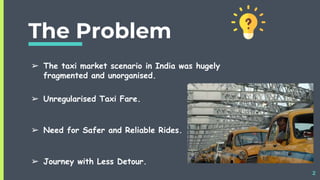
➢ The taxi market scenario in India was hugely
fragmented and unorganised.
➢ Unregularised Taxi Fare.
➢ Need for Safer and Reliable Rides.
➢ Journey with Less Detour.
‘’
3
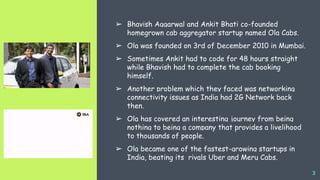
➢ Bhavish Aggarwal and Ankit Bhati co-founded
homegrown cab aggregator startup named Ola Cabs.
➢ Ola was founded on 3rd of December 2010 in Mumbai.
➢ Sometimes Ankit had to code for 48 hours straight
while Bhavish had to complete the cab booking
himself.
➢ Another problem which they faced was networking
connectivity issues as India had 2G Network back
then.
➢ Ola has covered an interesting journey from being
nothing to being a company that provides a livelihood
to thousands of people.
➢ Ola became one of the fastest-growing startups in
India, beating its rivals Uber and Meru Cabs.
Business Model
Bring the attention of your audience over a
key concept using icons or illustrations
4
➢ Ola is a taxi aggregator business. They act as
an intermediary between taxi drivers and
customers.
➢ The company partners with private taxi
owners, provide them process and technical
equipment for booking through the Ola app.
➢ They follow the ‘Asset Light Model’ where a
business owns few capital assets in
comparison to the value of its operations.
➢ Ola charges a 15% commission on every
ride. and the remaining amount will go
in the pockets of the driver.
➢ Ola has introduced a ‘Minimum
Business Guarantee’ model which
ensures every driver earns Rs.1300
daily.
➢ If unable to do so, Ola adds money to
the driver’s account linked to Ola
after deducting it’s 15% commission.
Revenue Model
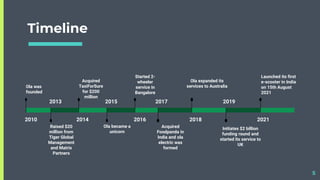
Timeline
5
2010
Ola was
founded
2013
Raised $20
million from
Tiger Global
Management
and Matrix
Partners
2014
Acquired
TaxiForSure
for $200
million
2015
Ola became a
unicorn
2016
Started 2-
wheeler
service in
Bangalore
2017
Acquired
Foodpanda in
India and ola
electric was
formed
2018
Ola expanded its
services to Australia
2019
Initiates $2 billion
funding round and
started its service to
UK
2021
Launched its first
e-scooter in India
on 15th August
2021
Expansion and Diversification
Services
● Food Delivery
(Acquired Foodpanda
for $1.1 billion in 2017)
● Ola Money (Wallet)
● Ola Drive (Car Rental
Service)
● Ola Select
(Membership Program)
Ridesharing
● Acquired TaxiForSure
for $200m
● 2-wheeler Service
● Ola Pedals in Campuses
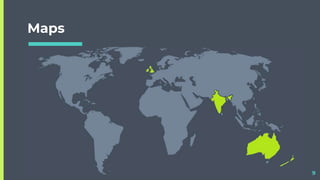
● Expands Globally
Australia, NZ - 2018
UK - 2019
Electric Mobility
● Started Ola Electric
Mobility in 2017.
● Acquire Etergo BV in
2020.
● Constructing World’s
largest 2-W EV
factory.
● Lunched 2 Electric
Scooter in India
6
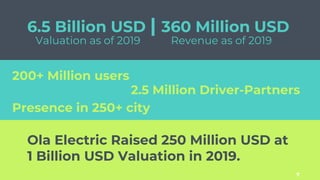
6.5 Billion USD | 360 Million USD
Valuation as of 2019 Revenue as of 2019
Ola Electric Raised 250 Million USD at
1 Billion USD Valuation in 2019.
200+ Million users
2.5 Million Driver-Partners
7
Presence in 250+ city
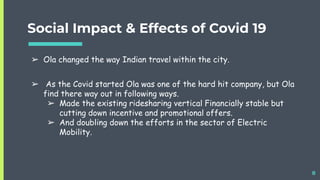
Social Impact & Effects of Covid 19
➢ Ola changed the way Indian travel within the city.
➢ As the Covid started Ola was one of the hard hit company, but Ola
find there way out in following ways.
➢ Made the existing ridesharing vertical Financially stable but
cutting down incentive and promotional offers.
➢ And doubling down the efforts in the sector of Electric
Mobility.
8
Maps
9
Thanks!
Any questions?
Ritik Bompilwar Sandeep Sharma
Yashasva Raj Sherke
10

Ola case study

  • 1.
  • 2.
    The Problem 2 ➢ Thetaxi market scenario in India was hugely fragmented and unorganised. ➢ Unregularised Taxi Fare. ➢ Need for Safer and Reliable Rides. ➢ Journey with Less Detour.
  • 3.
    ‘’ 3 ➢ Bhavish Aggarwaland Ankit Bhati co-founded homegrown cab aggregator startup named Ola Cabs. ➢ Ola was founded on 3rd of December 2010 in Mumbai. ➢ Sometimes Ankit had to code for 48 hours straight while Bhavish had to complete the cab booking himself. ➢ Another problem which they faced was networking connectivity issues as India had 2G Network back then. ➢ Ola has covered an interesting journey from being nothing to being a company that provides a livelihood to thousands of people. ➢ Ola became one of the fastest-growing startups in India, beating its rivals Uber and Meru Cabs.
  • 4.
    Business Model Bring theattention of your audience over a key concept using icons or illustrations 4 ➢ Ola is a taxi aggregator business. They act as an intermediary between taxi drivers and customers. ➢ The company partners with private taxi owners, provide them process and technical equipment for booking through the Ola app. ➢ They follow the ‘Asset Light Model’ where a business owns few capital assets in comparison to the value of its operations. ➢ Ola charges a 15% commission on every ride. and the remaining amount will go in the pockets of the driver. ➢ Ola has introduced a ‘Minimum Business Guarantee’ model which ensures every driver earns Rs.1300 daily. ➢ If unable to do so, Ola adds money to the driver’s account linked to Ola after deducting it’s 15% commission. Revenue Model
  • 5.
    Timeline 5 2010 Ola was founded 2013 Raised $20 millionfrom Tiger Global Management and Matrix Partners 2014 Acquired TaxiForSure for $200 million 2015 Ola became a unicorn 2016 Started 2- wheeler service in Bangalore 2017 Acquired Foodpanda in India and ola electric was formed 2018 Ola expanded its services to Australia 2019 Initiates $2 billion funding round and started its service to UK 2021 Launched its first e-scooter in India on 15th August 2021
  • 6.
    Expansion and Diversification Services ●Food Delivery (Acquired Foodpanda for $1.1 billion in 2017) ● Ola Money (Wallet) ● Ola Drive (Car Rental Service) ● Ola Select (Membership Program) Ridesharing ● Acquired TaxiForSure for $200m ● 2-wheeler Service ● Ola Pedals in Campuses ● Expands Globally Australia, NZ - 2018 UK - 2019 Electric Mobility ● Started Ola Electric Mobility in 2017. ● Acquire Etergo BV in 2020. ● Constructing World’s largest 2-W EV factory. ● Lunched 2 Electric Scooter in India 6
  • 7.
    6.5 Billion USD| 360 Million USD Valuation as of 2019 Revenue as of 2019 Ola Electric Raised 250 Million USD at 1 Billion USD Valuation in 2019. 200+ Million users 2.5 Million Driver-Partners 7 Presence in 250+ city
  • 8.
    Social Impact &Effects of Covid 19 ➢ Ola changed the way Indian travel within the city. ➢ As the Covid started Ola was one of the hard hit company, but Ola find there way out in following ways. ➢ Made the existing ridesharing vertical Financially stable but cutting down incentive and promotional offers. ➢ And doubling down the efforts in the sector of Electric Mobility. 8
  • 9.
  • 10.
    Thanks! Any questions? Ritik BompilwarSandeep Sharma Yashasva Raj Sherke 10

Editor's Notes

  • #3 Problem/opportunity identified
  • #4 Founder's role in the success Founding team's role in the succes Time of launch
  • #5 Market Product Fit Business Model
  • #7 Mergers, Acquisitions, Partnerships