Introduction to the
Company
UpGrad Product Management
Competitor Analysis
Student Name: DATTATREY KULKARNI
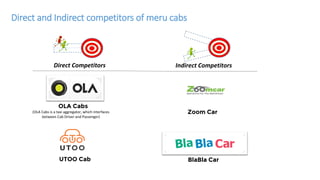
Direct and Indirect competitors of meru cabs
Direct Competitors Indirect Competitors
OLA Cabs
UTOO Cab
Zoom Car
BlaBla Car
(OLA Cabs is a taxi aggregator, which interfaces
between Cab Driver and Passenger)
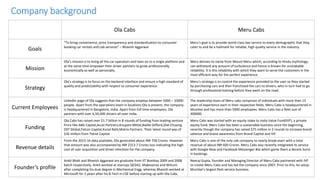
Company background
Ola Cabs Meru Cabs
Goals
“To bring convenience, price transparency and standardization to consumer
booking car rentals and cab services” – Bhavish Aggarwal
Meru’s goal is to provide world class taxi service to every demographic that they
cater to and be a hallmark for reliable, high quality service in the industry.
Mission
Ola’s mission is to bring all the car operators and taxis on to a single platform and
at the same time empower their driver partners to grow professionally,
economically as well as personally.
Meru derives its name from Mount Meru which, according to Hindu mythology,
can withstand any amount of turbulence and hence is known for unshakable
reliability. It is this reliability with which they want to serve the customers in the
most efficient way for the perfect experience.
Strategy
Ola’s strategy is to focus on the backend interface and ensure a high standard of
quality and predictability with respect to consumer experience.
Meru’s strategy is to control the experience provided to the user so they started
by purchasing cars and then franchised the cars to drivers, who in turn had to go
through professional training before they went on the road.
Current Employees
LinkedIn page of Ola suggests that the company employs between 5000 – 10000
people. Apart from the operations team in locations Ola is present, the company
is headquartered in Bangalore, India. Apart from full time employees, Ola
partners with over 6,50,000 drivers all over India.
The leadership team of Meru cabs comprises of individuals with more than 15
years of experience each in their respective fields. Meru Cabs is headquartered in
Mumbai and has more than 5000 employees. Meru Cabs has a fleet size of
300000.
Funding
Ola Cabs has raised over $1.7 billion in 8 rounds of funding from leading venture
firms like ABG Capital,Accel Partners,Anupam Mittal,Baillie Gifford,Didi Chuxing
DST Global,Falcon Capital,Kunal Bahl,Matrix Partners. Their latest round was of
$36 million from Tekne Capital.
Meru Cabs was started with an equity stake to India Value Fund(IVF), a private
equity fund. Meru Cabs has been a sustainable business since the beginning,
recently though the company has raised $75 million in 2 rounds to increase brand
salience and brand awareness from Brand Capital and IVF.
Revenue details
From the 2015-16 data available, Ola generated about INR 758 Crores. However
that amount was also accompanied by INR 2313.7 Crores loss indicating the high
cost of user acquisition and driver retention for the company.
Meru Cabs is one of the only cab company to nearly break-even with a total
revenue of about INR 600 Crores. Meru Cabs also recently integrated its service
with Google Now and Facebook Messenger Bot which game them a decent burst
in bookings.
Founder’s profile
Ankit Bhati and Bhavish Aggarwal are graduate from IIT Bombay 2009 and 2008
batch respectively. Ankit worked at startups QED42, Makesense and Wilcom
after completing his dual degree in Mechanical Engg. whereas Bhavish worked at
Microsoft for 2 years after his B.Tech in CSE before starting up with Ola Cabs.
Neeraj Gupta, founder and Managing Director of Meru Cabs partnered with IVF
to create Meru Cabs and has led the company since 2007. Prior to this, he setup
Mumbai’s largest fleet service business.
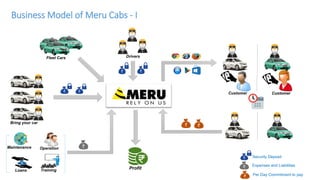
Business Model of Meru Cabs - I
Fleet Cars Drivers
Bring your car
Maintenance Operation
Loans Training
Security Deposit
Expenses and Liabilities
Per Day Commitment to pay
Customer Customer
Profit
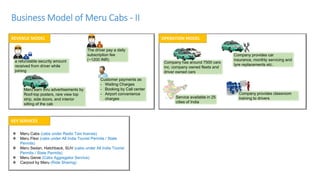
Business Model of Meru Cabs - II
REVENUE MODEL
a refundable security amount
received from driver while
joining
The driver pay a daily
subscription fee
(~1200 INR)
Meru earn thru advertisements by
Roof-top posters, rare view top
strip, side doors, and interior
sitting of the cab
OPERATION MODEL
Company has around 7500 cars
inc. company owned fleets and
driver owned cars
Service available in 25
cities of India
Company provides car
insurance, monthly servicing and
tyre replacements etc.
Company provides classroom
training to drivers
Customer payments as
- Waiting Charges
- Booking by Call center
- Airport convenience
charges
KEY SERVICES
 Meru Cabs (cabs under Radio Taxi license)
 Meru Flexi (cabs under All India Tourist Permits / State
Permits)
 Meru Sedan, Hatchback, SUV (cabs under All India Tourist
Permits / State Permits)
 Meru Genie (Cabs Aggregator Service)
 Carpool by Meru (Ride Sharing)
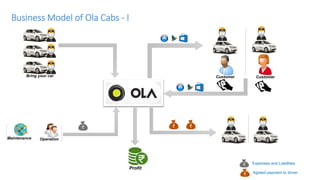
Business Model of Ola Cabs - I
Bring your car
Maintenance Operation
Expenses and Liabilities
Agreed payment to driver
Customer Customer
Profit
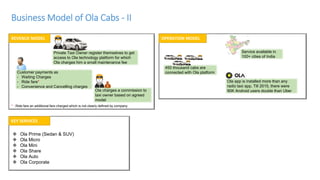
Business Model of Ola Cabs - II
REVENUE MODEL
Ola charges a commission to
taxi owner based on agreed
model
OPERATION MODEL
450 thousand cabs are
connected with Ola platform
Service available in
100+ cities of India
Customer payments as
- Waiting Charges
- Ride fare*
- Convenience and Cancelling charges
KEY SERVICES
 Ola Prime (Sedan & SUV)
 Ola Micro
 Ola Mini
 Ola Share
 Ola Auto
 Ola Corporate
Private Taxi Owner register themselves to get
access to Ola technology platform for which
Ola charges him a small maintenance fee
* : Ride fare an additional fare charged which is not clearly defined by company
Ola app is installed more than any
radio taxi app. Till 2015, there were
90K Android users double than Uber
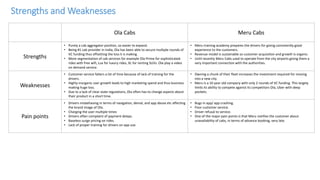
Strengths and Weaknesses
Ola Cabs Meru Cabs
Strengths
• Purely a cab aggregator position, so easier to expand.
• Being #1 cab provider in India, Ola has been able to secure multiple rounds of
VC funding thus offsetting the loss it is making.
• More segmentation of cab services for example Ola Prime for sophisticated
rides with free wifi, Lux for luxury rides, XL for renting SUVs. Ola play a video
on demand service.
• Meru training academy prepares the drivers for giving consistently good
experience to the customers.
• Revenue model is sustainable so customer acquisition and growth is organic.
• Until recently Meru Cabs used to operate from the city airports giving them a
very important connection with the authorities.
Weaknesses
• Customer service falters a lot of time because of lack of training for the
drivers.
• Highly inorganic user growth leads to high marketing spend and thus business
making huge loss.
• Due to a lack of clear state regulations, Ola often has to change aspects about
their product in a short time.
• Owning a chunk of their fleet increases the investment required for moving
into a new city.
• Meru is a 10 year old company with only 2 rounds of VC funding. This largely
limits its ability to compete against its competitors Ola, Uber with deep
pockets.
Pain points
• Drivers misbehaving in terms of navigation, denial, and app abuse etc affecting
the brand image of Ola.
• Charging the user multiple times
• Drivers often complaint of payment delays.
• Baseless surge pricing on rides.
• Lack of proper training for drivers on app use.
• Bugs in app/ app crashing.
• Poor customer service.
• Driver refusal to service.
• One of the major pain points is that Meru notifies the customer about
unavailability of cabs, in terms of advance booking, very late.
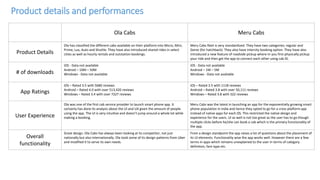
Product details and performances
Ola Cabs Meru Cabs
Product Details
Ola has classified the different cabs available on their platform into Micro, Mini,
Prime, Lux, Auto and Shuttle. They have also introduced shared rides in select
cities as well as hourly rentals and outstation bookings.
Meru Cabs fleet is very standardized. They have two categories; regular and
Genie (for hatchback). They also have intercity booking option. They have also
introduced a new feature of roadside pickup where-in you first physically pickup
your ride and then get the app to connect each other using cab ID.
# of downloads
iOS - Data not available
Android – 10M – 50M
Windows - Data not available
iOS - Data not available
Android – 1M – 5M
Windows - Data not available
App Ratings
iOS – Rated 3.5 with 5680 reviews
Android – Rated 4.0 with over 513,420 reviews
Windows – Rated 3.4 with over 7227 reviews
iOS – Rated 3.5 with 1118 reviews
Android – Rated 3.8 with over 50,111 reviews
Windows – Rated 3.8 with 322 reviews
User Experience
Ola was one of the first cab service provider to launch smart phone app. It
certainly has done its analysis about the UI and UX given the amount of people
using the app. The UI is very intuitive and doesn’t jump around a whole lot while
making a booking.
Meru Cabs was the latest in launching an app for the exponentially growing smart
phone population in India and hence they opted to go for a cross platform app
instead of native apps for each OS. This restricted the native design and
experience for the users. UI as well is not too great as the user has to go though
multiple clicks before he/she can book a cab which is the primary functionality of
the app.
Overall
functionality
Great design. Ola Cabs has always been looking at its competitor, not just
nationally but also internationally. Ola took some of its design patterns from Uber
and modified it to serve its own needs.
From a design standpoint the app raises a lot of questions about the placement of
its UI elements. Functionality wise the app works well. However there are a few
terms in apps which remains unexplained to the user in terms of category
definition, fare type etc.
Future initiatives and steps to mitigate
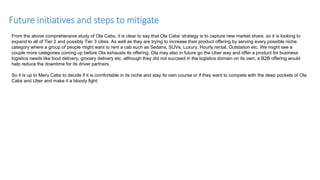
From the above comprehensive study of Ola Cabs, it is clear to say that Ola Cabs’ strategy is to capture new market share, so it is looking to
expand to all of Tier 2 and possibly Tier 3 cities. As well as they are trying to increase their product offering by serving every possible niche
category where a group of people might want to rent a cab such as Sedans, SUVs, Luxury, Hourly rental, Outstation etc. We might see a
couple more categories coming up before Ola exhausts its offering. Ola may also in future go the Uber way and offer a product for business
logistics needs like food delivery, grocery delivery etc. although they did not succeed in the logistics domain on its own, a B2B offering would
help reduce the downtime for its driver partners.
So it is up to Meru Cabs to decide if it is comfortable in its niche and stay its own course or if they want to compete with the deep pockets of Ola
Cabs and Uber and make it a bloody fight.
References
http://www.livemint.com/Companies/JNZ62LTm96hTej2STtAprK/Ola-losses-tripled-to-Rs-2313-during-201516-Tofler-report.html
https://www.crunchbase.com/organization/meru-cabs
https://in.linkedin.com/company/meru-cab-company-pvt--ltd-
https://www.linkedin.com/company-beta/2580522/
www.olacabs.com
www.merucabs.com
https://www.slideshare.net/MithunBhowmick/competitor-analysis-ola-vs-meru-cabs
https://www.slideshare.net/zwittor/competitor-analysis-ola-cabs-and-meru-cabs
THANK YOU

Cab competitor analysis

  • 1.
    Introduction to the Company UpGradProduct Management Competitor Analysis Student Name: DATTATREY KULKARNI
  • 2.
    Direct and Indirectcompetitors of meru cabs Direct Competitors Indirect Competitors OLA Cabs UTOO Cab Zoom Car BlaBla Car (OLA Cabs is a taxi aggregator, which interfaces between Cab Driver and Passenger)
  • 3.
    Company background Ola CabsMeru Cabs Goals “To bring convenience, price transparency and standardization to consumer booking car rentals and cab services” – Bhavish Aggarwal Meru’s goal is to provide world class taxi service to every demographic that they cater to and be a hallmark for reliable, high quality service in the industry. Mission Ola’s mission is to bring all the car operators and taxis on to a single platform and at the same time empower their driver partners to grow professionally, economically as well as personally. Meru derives its name from Mount Meru which, according to Hindu mythology, can withstand any amount of turbulence and hence is known for unshakable reliability. It is this reliability with which they want to serve the customers in the most efficient way for the perfect experience. Strategy Ola’s strategy is to focus on the backend interface and ensure a high standard of quality and predictability with respect to consumer experience. Meru’s strategy is to control the experience provided to the user so they started by purchasing cars and then franchised the cars to drivers, who in turn had to go through professional training before they went on the road. Current Employees LinkedIn page of Ola suggests that the company employs between 5000 – 10000 people. Apart from the operations team in locations Ola is present, the company is headquartered in Bangalore, India. Apart from full time employees, Ola partners with over 6,50,000 drivers all over India. The leadership team of Meru cabs comprises of individuals with more than 15 years of experience each in their respective fields. Meru Cabs is headquartered in Mumbai and has more than 5000 employees. Meru Cabs has a fleet size of 300000. Funding Ola Cabs has raised over $1.7 billion in 8 rounds of funding from leading venture firms like ABG Capital,Accel Partners,Anupam Mittal,Baillie Gifford,Didi Chuxing DST Global,Falcon Capital,Kunal Bahl,Matrix Partners. Their latest round was of $36 million from Tekne Capital. Meru Cabs was started with an equity stake to India Value Fund(IVF), a private equity fund. Meru Cabs has been a sustainable business since the beginning, recently though the company has raised $75 million in 2 rounds to increase brand salience and brand awareness from Brand Capital and IVF. Revenue details From the 2015-16 data available, Ola generated about INR 758 Crores. However that amount was also accompanied by INR 2313.7 Crores loss indicating the high cost of user acquisition and driver retention for the company. Meru Cabs is one of the only cab company to nearly break-even with a total revenue of about INR 600 Crores. Meru Cabs also recently integrated its service with Google Now and Facebook Messenger Bot which game them a decent burst in bookings. Founder’s profile Ankit Bhati and Bhavish Aggarwal are graduate from IIT Bombay 2009 and 2008 batch respectively. Ankit worked at startups QED42, Makesense and Wilcom after completing his dual degree in Mechanical Engg. whereas Bhavish worked at Microsoft for 2 years after his B.Tech in CSE before starting up with Ola Cabs. Neeraj Gupta, founder and Managing Director of Meru Cabs partnered with IVF to create Meru Cabs and has led the company since 2007. Prior to this, he setup Mumbai’s largest fleet service business.
  • 4.
    Business Model ofMeru Cabs - I Fleet Cars Drivers Bring your car Maintenance Operation Loans Training Security Deposit Expenses and Liabilities Per Day Commitment to pay Customer Customer Profit
  • 5.
    Business Model ofMeru Cabs - II REVENUE MODEL a refundable security amount received from driver while joining The driver pay a daily subscription fee (~1200 INR) Meru earn thru advertisements by Roof-top posters, rare view top strip, side doors, and interior sitting of the cab OPERATION MODEL Company has around 7500 cars inc. company owned fleets and driver owned cars Service available in 25 cities of India Company provides car insurance, monthly servicing and tyre replacements etc. Company provides classroom training to drivers Customer payments as - Waiting Charges - Booking by Call center - Airport convenience charges KEY SERVICES  Meru Cabs (cabs under Radio Taxi license)  Meru Flexi (cabs under All India Tourist Permits / State Permits)  Meru Sedan, Hatchback, SUV (cabs under All India Tourist Permits / State Permits)  Meru Genie (Cabs Aggregator Service)  Carpool by Meru (Ride Sharing)
  • 6.
    Business Model ofOla Cabs - I Bring your car Maintenance Operation Expenses and Liabilities Agreed payment to driver Customer Customer Profit
  • 7.
    Business Model ofOla Cabs - II REVENUE MODEL Ola charges a commission to taxi owner based on agreed model OPERATION MODEL 450 thousand cabs are connected with Ola platform Service available in 100+ cities of India Customer payments as - Waiting Charges - Ride fare* - Convenience and Cancelling charges KEY SERVICES  Ola Prime (Sedan & SUV)  Ola Micro  Ola Mini  Ola Share  Ola Auto  Ola Corporate Private Taxi Owner register themselves to get access to Ola technology platform for which Ola charges him a small maintenance fee * : Ride fare an additional fare charged which is not clearly defined by company Ola app is installed more than any radio taxi app. Till 2015, there were 90K Android users double than Uber
  • 8.
    Strengths and Weaknesses OlaCabs Meru Cabs Strengths • Purely a cab aggregator position, so easier to expand. • Being #1 cab provider in India, Ola has been able to secure multiple rounds of VC funding thus offsetting the loss it is making. • More segmentation of cab services for example Ola Prime for sophisticated rides with free wifi, Lux for luxury rides, XL for renting SUVs. Ola play a video on demand service. • Meru training academy prepares the drivers for giving consistently good experience to the customers. • Revenue model is sustainable so customer acquisition and growth is organic. • Until recently Meru Cabs used to operate from the city airports giving them a very important connection with the authorities. Weaknesses • Customer service falters a lot of time because of lack of training for the drivers. • Highly inorganic user growth leads to high marketing spend and thus business making huge loss. • Due to a lack of clear state regulations, Ola often has to change aspects about their product in a short time. • Owning a chunk of their fleet increases the investment required for moving into a new city. • Meru is a 10 year old company with only 2 rounds of VC funding. This largely limits its ability to compete against its competitors Ola, Uber with deep pockets. Pain points • Drivers misbehaving in terms of navigation, denial, and app abuse etc affecting the brand image of Ola. • Charging the user multiple times • Drivers often complaint of payment delays. • Baseless surge pricing on rides. • Lack of proper training for drivers on app use. • Bugs in app/ app crashing. • Poor customer service. • Driver refusal to service. • One of the major pain points is that Meru notifies the customer about unavailability of cabs, in terms of advance booking, very late.
  • 9.
    Product details andperformances Ola Cabs Meru Cabs Product Details Ola has classified the different cabs available on their platform into Micro, Mini, Prime, Lux, Auto and Shuttle. They have also introduced shared rides in select cities as well as hourly rentals and outstation bookings. Meru Cabs fleet is very standardized. They have two categories; regular and Genie (for hatchback). They also have intercity booking option. They have also introduced a new feature of roadside pickup where-in you first physically pickup your ride and then get the app to connect each other using cab ID. # of downloads iOS - Data not available Android – 10M – 50M Windows - Data not available iOS - Data not available Android – 1M – 5M Windows - Data not available App Ratings iOS – Rated 3.5 with 5680 reviews Android – Rated 4.0 with over 513,420 reviews Windows – Rated 3.4 with over 7227 reviews iOS – Rated 3.5 with 1118 reviews Android – Rated 3.8 with over 50,111 reviews Windows – Rated 3.8 with 322 reviews User Experience Ola was one of the first cab service provider to launch smart phone app. It certainly has done its analysis about the UI and UX given the amount of people using the app. The UI is very intuitive and doesn’t jump around a whole lot while making a booking. Meru Cabs was the latest in launching an app for the exponentially growing smart phone population in India and hence they opted to go for a cross platform app instead of native apps for each OS. This restricted the native design and experience for the users. UI as well is not too great as the user has to go though multiple clicks before he/she can book a cab which is the primary functionality of the app. Overall functionality Great design. Ola Cabs has always been looking at its competitor, not just nationally but also internationally. Ola took some of its design patterns from Uber and modified it to serve its own needs. From a design standpoint the app raises a lot of questions about the placement of its UI elements. Functionality wise the app works well. However there are a few terms in apps which remains unexplained to the user in terms of category definition, fare type etc.
  • 10.
    Future initiatives andsteps to mitigate From the above comprehensive study of Ola Cabs, it is clear to say that Ola Cabs’ strategy is to capture new market share, so it is looking to expand to all of Tier 2 and possibly Tier 3 cities. As well as they are trying to increase their product offering by serving every possible niche category where a group of people might want to rent a cab such as Sedans, SUVs, Luxury, Hourly rental, Outstation etc. We might see a couple more categories coming up before Ola exhausts its offering. Ola may also in future go the Uber way and offer a product for business logistics needs like food delivery, grocery delivery etc. although they did not succeed in the logistics domain on its own, a B2B offering would help reduce the downtime for its driver partners. So it is up to Meru Cabs to decide if it is comfortable in its niche and stay its own course or if they want to compete with the deep pockets of Ola Cabs and Uber and make it a bloody fight.
  • 11.
  • 12.