•
TYPE OF SCHOOL
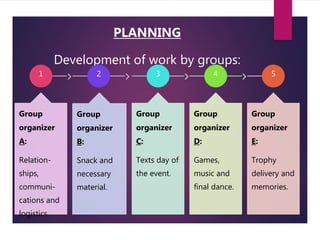
PLANNING
Development of work by groups:
1
Group
organizer
A:
Relation-
ships,
communi-
cations and
logistics.
2
Group
organizer
B:
Snack and
necessary
material.
3
Group
organizer
C:
Texts day of
the event.
4
Group
organizer
D:
Games,
music and
final dance.
5
Group
organizer
E:
Trophy
delivery and
memories.
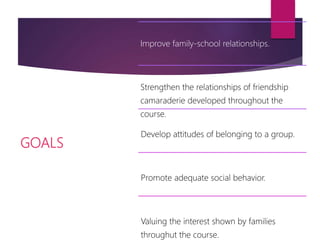
GOALS
Improve family-school relationships.
Strengthen the relationships of friendship
camaraderie developed throughout the
course.
Develop attitudes of belonging to a group.
Promote adequate social behavior.
Valuing the interest shown by families
throughut the course.
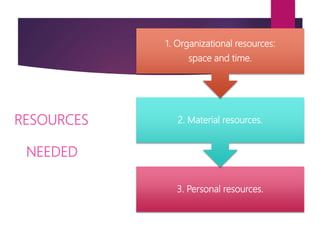
RESOURCES
NEEDED
3. Personal resources.
2. Material resources.
1. Organizational resources:
space and time.
1. Organizational resources:
space and time
 Space:
Choose open or closed place according to capacity, possible weather
conditions, etc.
 Time:
Set time for maximum assistance.
2. Material resources:
 Furniture: tablels, chairs, etc.
 Speakers, projectors, screens, etc.
 Paper, cardboard, markers, scissors, rope, shells, etc.
 Food and drink (plates, glasses, etc.).
3. Personal resources:
 School professionals:
 Teachers.
 Support staff.
 Management.
 Cleaning team, etc.
 Students.
 Families.
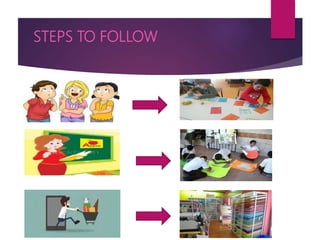
STEPS TO FOLLOW
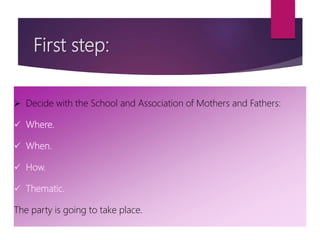
First step:
 Decide with the School and Association of Mothers and Fathers:
 Where.
 When.
 How.
 Thematic.
The party is going to take place.
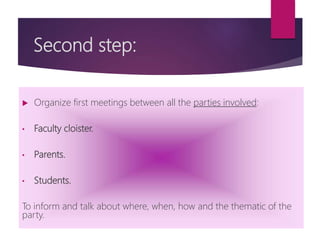
Second step:
 Organize first meetings between all the parties involved:
• Faculty cloister.
• Parents.
• Students.
To inform and talk about where, when, how and the thematic of the
party.
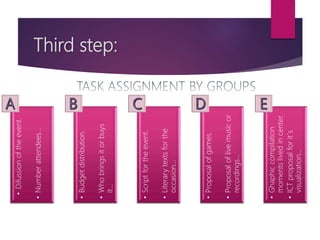
Third step:
•Difussionoftheevent.
•Numberattendees...
•Budgetdistribution.
•Whobringsitorbuys
it...
•Scriptfortheevent.
•Literarytextsforthe
occasion…
•Proposalofgames.
•Proposaloflivemusicor
recordings…
•Ghaphiccompilation
momentslivedincenter.
•ICTproposalforit´s
visualization…
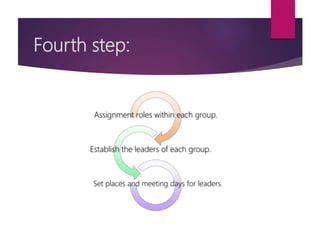
Fourth step:
Assignment roles within each group.
Establish the leaders of each group.
Set places and meeting days for leaders.
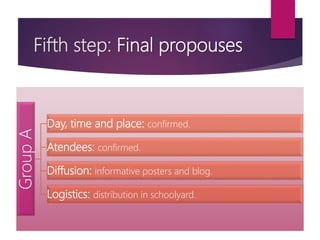
Fifth step: Final propouses
GroupA
Day, time and place: confirmed.
Atendees: confirmed.
Diffusion: informative posters and blog.
Logistics: distribution in schoolyard.
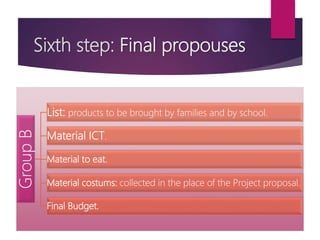
Sixth step: Final propouses
GroupB
List: products to be brought by families and by school.
Material ICT.
Material to eat.
Material costums: collected in the place of the Project proposal.
Final Budget.
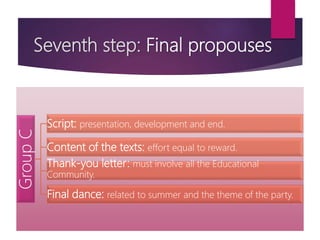
Seventh step: Final propouses
GroupC
Script: presentation, development and end.
Content of the texts: effort equal to reward.
Thank-you letter: must involve all the Educational
Community.
Final dance: related to summer and the theme of the party.
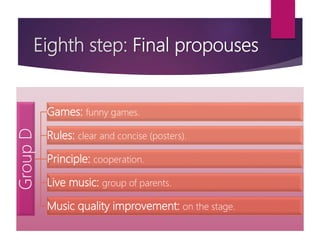
Eighth step: Final propouses
GroupD
Games: funny games.
Rules: clear and concise (posters).
Principle: cooperation.
Live music: group of parents.
Music quality improvement: on the stage.
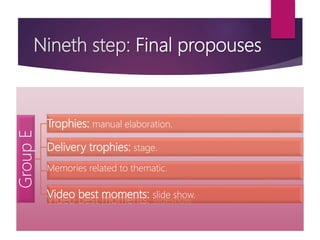
Nineth step: Final propouses
GroupE
Trophies: manual elaboration.
Delivery trophies: stage.
Video best moments: slideshow.
Memories related to thematic.
Video best moments: slide show.
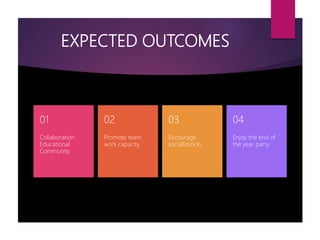
EXPECTED OUTCOMES
Collaboration
Educational
Community.
01
Promote team
work capacity.
02
Encourage
sociallization.
03
Enjoy the end of
the year party.
04
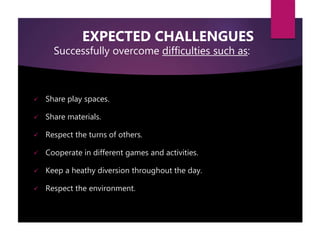
EXPECTED CHALLENGUES
Successfully overcome difficulties such as:
 Share play spaces.
 Share materials.
 Respect the turns of others.
 Cooperate in different games and activities.
 Keep a heathy diversion throughout the day.
 Respect the environment.
Bibliography:
 Insertar imágenes
 Para el segundo paso, se debe
construir a referencia (se pone
en la lista de referencias) con la
siguiente información:
 “Nombre”, “año”, “Titulo”,
“Tipo”, “Recuperado de”.
 El formato para referenciarlas
es el siguiente:
 Apellido, Inicial. (año). Título del
trabajo [Tipo]. Recuperado de
http://www.www.www.
 Ejemplo.
 Gutierrez, M. (2016). Ilustración
de los sistemas difusos. [Figura].
Recuperado de
http://normasapa.com
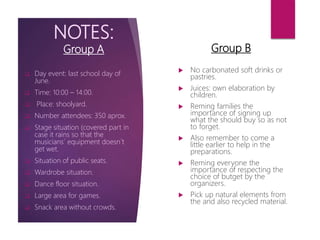
NOTES:
Group A
 No carbonated soft drinks or
pastries.
 Juices: own elaboration by
children.
 Reming families the
importance of signing up
what the should buy so as not
to forget.
 Also remember to come a
little earlier to help in the
preparations.
 Reming everyone the
importance of respecting the
choice of butget by the
organizers.
 Pick up natural elements from
the and also recycled material.
 Day event: last school day of
June.
 Time: 10:00 – 14:00.
 Place: shoolyard.
 Number attendees: 350 aprox.
 Stage situation (covered part in
case it rains so that the
musicians´ equipment doesn´t
get wet.
 Situation of public seats.
 Wardrobe situation.
 Dance floor situation.
 Large area for games.
 Snack area without crowds.
Group B
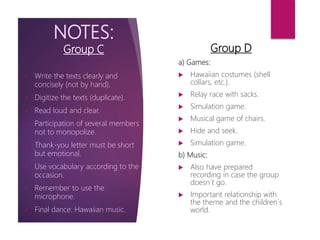
NOTES:
Group C
a) Games:
 Hawaiian costumes (shell
collars, etc.).
 Relay race with sacks.
 Simulation game.
 Musical game of chairs.
 Hide and seek.
 Simulation game.
b) Music:
 Also have prepared
recording in case the group
doesn´t go.
 Important relationship with
the theme and the children´s
world.
 Write the texts clearly and
concisely (not by hand).
 Digitize the texts (duplicate).
 Read loud and clear.
 Participation of several members
not to monopolize.
 Thank-you letter must be short
but emotional.
 Use vocabulary according to the
occasion.
 Remember to use the
microphone.
 Final dance: Hawaiian music.
Group D
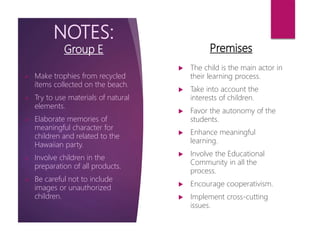
NOTES:
Group E
 The child is the main actor in
their learning process.
 Take into account the
interests of children.
 Favor the autonomy of the
students.
 Enhance meaningful
learning.
 Involve the Educational
Community in all the
process.
 Encourage cooperativism.
 Implement cross-cutting
issues.
 Make trophies from recycled
ítems collected on the beach.
 Try to use materials of natural
elements.
 Elaborate memories of
meaningful character for
children and related to the
Hawaiian party.
 Involve children in the
preparation of all products.
 Be careful not to include
images or unauthorized
children.
Premises

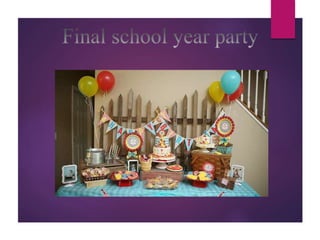
Ok final school year party collaborative work ut4

  • 2.
  • 4.
    PLANNING Development of workby groups: 1 Group organizer A: Relation- ships, communi- cations and logistics. 2 Group organizer B: Snack and necessary material. 3 Group organizer C: Texts day of the event. 4 Group organizer D: Games, music and final dance. 5 Group organizer E: Trophy delivery and memories.
  • 5.
    GOALS Improve family-school relationships. Strengthenthe relationships of friendship camaraderie developed throughout the course. Develop attitudes of belonging to a group. Promote adequate social behavior. Valuing the interest shown by families throughut the course.
  • 6.
    RESOURCES NEEDED 3. Personal resources. 2.Material resources. 1. Organizational resources: space and time.
  • 7.
    1. Organizational resources: spaceand time  Space: Choose open or closed place according to capacity, possible weather conditions, etc.  Time: Set time for maximum assistance.
  • 8.
    2. Material resources: Furniture: tablels, chairs, etc.  Speakers, projectors, screens, etc.  Paper, cardboard, markers, scissors, rope, shells, etc.  Food and drink (plates, glasses, etc.).
  • 9.
    3. Personal resources: School professionals:  Teachers.  Support staff.  Management.  Cleaning team, etc.  Students.  Families.
  • 10.
  • 11.
    First step:  Decidewith the School and Association of Mothers and Fathers:  Where.  When.  How.  Thematic. The party is going to take place.
  • 12.
    Second step:  Organizefirst meetings between all the parties involved: • Faculty cloister. • Parents. • Students. To inform and talk about where, when, how and the thematic of the party.
  • 13.
  • 14.
    Fourth step: Assignment roleswithin each group. Establish the leaders of each group. Set places and meeting days for leaders.
  • 15.
    Fifth step: Finalpropouses GroupA Day, time and place: confirmed. Atendees: confirmed. Diffusion: informative posters and blog. Logistics: distribution in schoolyard.
  • 16.
    Sixth step: Finalpropouses GroupB List: products to be brought by families and by school. Material ICT. Material to eat. Material costums: collected in the place of the Project proposal. Final Budget.
  • 17.
    Seventh step: Finalpropouses GroupC Script: presentation, development and end. Content of the texts: effort equal to reward. Thank-you letter: must involve all the Educational Community. Final dance: related to summer and the theme of the party.
  • 18.
    Eighth step: Finalpropouses GroupD Games: funny games. Rules: clear and concise (posters). Principle: cooperation. Live music: group of parents. Music quality improvement: on the stage.
  • 19.
    Nineth step: Finalpropouses GroupE Trophies: manual elaboration. Delivery trophies: stage. Video best moments: slideshow. Memories related to thematic. Video best moments: slide show.
  • 20.
    EXPECTED OUTCOMES Collaboration Educational Community. 01 Promote team workcapacity. 02 Encourage sociallization. 03 Enjoy the end of the year party. 04
  • 21.
    EXPECTED CHALLENGUES Successfully overcomedifficulties such as:  Share play spaces.  Share materials.  Respect the turns of others.  Cooperate in different games and activities.  Keep a heathy diversion throughout the day.  Respect the environment.
  • 22.
    Bibliography:  Insertar imágenes Para el segundo paso, se debe construir a referencia (se pone en la lista de referencias) con la siguiente información:  “Nombre”, “año”, “Titulo”, “Tipo”, “Recuperado de”.  El formato para referenciarlas es el siguiente:  Apellido, Inicial. (año). Título del trabajo [Tipo]. Recuperado de http://www.www.www.  Ejemplo.  Gutierrez, M. (2016). Ilustración de los sistemas difusos. [Figura]. Recuperado de http://normasapa.com
  • 23.
    NOTES: Group A  Nocarbonated soft drinks or pastries.  Juices: own elaboration by children.  Reming families the importance of signing up what the should buy so as not to forget.  Also remember to come a little earlier to help in the preparations.  Reming everyone the importance of respecting the choice of butget by the organizers.  Pick up natural elements from the and also recycled material.  Day event: last school day of June.  Time: 10:00 – 14:00.  Place: shoolyard.  Number attendees: 350 aprox.  Stage situation (covered part in case it rains so that the musicians´ equipment doesn´t get wet.  Situation of public seats.  Wardrobe situation.  Dance floor situation.  Large area for games.  Snack area without crowds. Group B
  • 24.
    NOTES: Group C a) Games: Hawaiian costumes (shell collars, etc.).  Relay race with sacks.  Simulation game.  Musical game of chairs.  Hide and seek.  Simulation game. b) Music:  Also have prepared recording in case the group doesn´t go.  Important relationship with the theme and the children´s world.  Write the texts clearly and concisely (not by hand).  Digitize the texts (duplicate).  Read loud and clear.  Participation of several members not to monopolize.  Thank-you letter must be short but emotional.  Use vocabulary according to the occasion.  Remember to use the microphone.  Final dance: Hawaiian music. Group D
  • 25.
    NOTES: Group E  Thechild is the main actor in their learning process.  Take into account the interests of children.  Favor the autonomy of the students.  Enhance meaningful learning.  Involve the Educational Community in all the process.  Encourage cooperativism.  Implement cross-cutting issues.  Make trophies from recycled ítems collected on the beach.  Try to use materials of natural elements.  Elaborate memories of meaningful character for children and related to the Hawaiian party.  Involve children in the preparation of all products.  Be careful not to include images or unauthorized children. Premises