
Technology 
Oil and gas fields 
get smart 
“WE USED TECHNOLOGY 
to change what we do, 
rather than op timise 
what we have always 
done.” —Jim Williams, Chevron manager. 
Oil and gas companies are applying the 
latest automation technologies not only to 
enhance exploration and production 
capabilities, but also to diminish risks to 
employees, preserve the environment and 
optimise daily operational methodologies. 
Present technologies have redefined how 
companies manage real-time data, 
automated workflows, analytical decision-making 
and corporate key performance 
indicators (KPI) tracking. 
With the advent of smart wells and real-time 
automation technologies, oil and gas 
companies are looking at assets in a new 
light, which helps in making informed 
decisions while reducing risks. Such 
methodologies will not only improve overall 
operations, but will also allow companies to 
adapt data-driven operating models. 
However, the big question remains: how will 
these real-time data-driven models and new 
technologies shape the future of the oil and 
gas business? 
The present 
Developments in informational and operational 
technologies have been groundbreaking in the 
past decade. Our generation has witnessed 
this, with the average human easily adapting 
to the newest, state-of-the-art smart phones. 
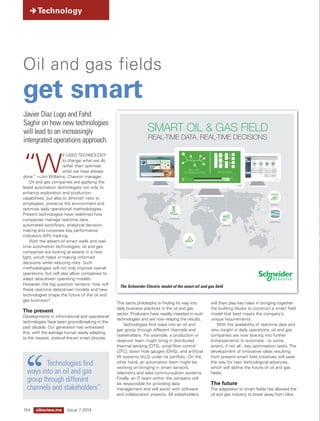
The Schneider Electric model of the smart oil and gas field 
This same philosophy is finding its way into 
daily business practices in the oil and gas 
sector. Producers have readily invested in such 
technologies and are now reaping the results. 
Technologies find ways into an oil and 
gas group through different channels and 
stakeholders. For example, a production or 
reservoir team might bring in distributed 
thermal sensing (DTS), zonal flow control 
(ZFC), down hole gauges (DHG), and artificial 
lift systems (ALS) under its portfolio. On the 
other hand, an automation team might be 
working on bringing in smart sensors, 
telemetry and data communication systems. 
Finally, an IT team within the company will 
be responsible for providing data 
management and will assist with software 
and collaboration projects. All stakeholders 
will then play key roles in bringing together 
the building blocks to construct a smart field 
model that best meets the company’s 
unique requirements. 
With the availability of real-time data and 
new insight in daily operations, oil and gas 
companies are now looking into further 
enhancements to automate - to some 
extent, if not all - key optimisation tasks. The 
development of innovative ideas resulting 
from present smart field initiatives will pave 
the way for new technological advances, 
which will define the future of oil and gas 
fields. 
The future 
The adaptation to smart fields has allowed the 
oil and gas industry to break away from silos 
Javier Díaz Lugo and Fahd 
Saghir on how new technologies 
will lead to an increasingly 
intergrated operations approach. 
Technologies find 
ways into an oil and gas 
group through different 
channels and stakeholders” 
154 oilreview.me Issue 7 2014
Technology 
and adopt an integrated operations approach. 
The outcome is new ideas that can be 
converted into future technologies specifically 
developed for the smart oil and gas field. 
Some technologies are already knocking at the 
door. Here is a look at what the future holds: 
Internet of Things (IoT) 
Recently, we have seen IoT being discussed 
in numerous papers and it is currently a buzz 
word among technology enthusiasts. Simply 
put, it is the idea of allowing inter-machine 
communication through embedded 
communication devices. It is an exciting 
prospect, as it will allow machines to provide 
detailed diagnostics and data while sharing 
key information about processes in real-time. 
Preventive maintenance reporting capabilities 
will be embedded directly at the source, 
allowing for immediate corrective responses, 
and thus minimising production loss. This will 
be particularly advantageous in scenarios 
where resources are scarce and assets are 
located in remote facilities. Adaptation of IoT 
in the oil and gas industry alone could improve 
maintenance, safety and optimisation. 
However, as is the case with any internet 
service, cyber security becomes a key 
building block for IoT. It is imperative that 
while companies become more open to data 
connectivity, they also pay attention to cyber 
security infrastructure by following sound 
and proven industrial practices. 
Robotics 
Remotely operated vehicles (ROVs) have been 
used for many years at offshore production 
facilities. However, given that exploration is 
now being done in further inaccessible areas, 
using robots for conducting routine 
maintenance and inspection activities is 
becoming more attractive. Robots provide a 
24/7 surveillance option to operators at 
remote offshore facilities. ROV tasks could 
range from running a routing visual inspection 
routine to conducting minor maintenance 
tasks. This would allow operating companies 
to save on travel and reduce exposure to 
health, safety and environmental factors. 
Drones, on the other hand, are already a 
popular method for surveillance. In 
hazardous locations, such as flares and oil 
storage tanks, drones can be useful in 
providing real-time surveillance in hard-to-reach 
areas. Equip a drone with an infra-red 
camera and you have a real-time, mobile 
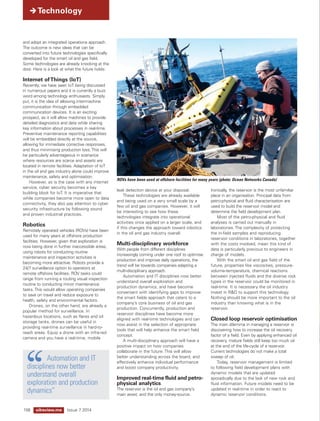
ROVs have been used at offshore facilities for many years (photo: Ocean Networks Canada) 
leak detection device at your disposal. 
These technologies are already available 
and being used on a very small scale by a 
few oil and gas companies. However, it will 
be interesting to see how these 
technologies integrate into operational 
activities once applied on a larger scale, and 
if this changes the approach toward robotics 
in the oil and gas industry overall. 
Multi-disciplinary workforce 
With people from different disciplines 
increasingly coming under one roof to optimise 
production and improve daily operations, the 
trend will be towards companies adapting a 
multi-disciplinary approach. 
Automation and IT disciplines now better 
understand overall exploration and 
production dynamics, and have become 
conversant with identifying gaps to improve 
the smart fields approach that caters to a 
company’s core business of oil and gas 
production. Concurrently, production and 
reservoir disciplines have become more 
aligned with real-time technologies and can 
now assist in the selection of appropriate 
tools that will help enhance the smart field 
concept. 
A multi-disciplinary approach will have a 
positive impact on how companies 
collaborate in the future. This will allow 
better understanding across the board, and 
effectively enhance individual performance 
and boost company productivity. 
Improved real-time fluid and petro-physical 
analytics 
The reservoir is the oil and gas company’s 
main asset, and the only money-source. 
Ironically, the reservoir is the most unfamiliar 
place in an organisation. Principal data from 
petro-physical and fluid characterisation are 
used to build the reservoir model and 
determine the field development plan. 
Most of the petro-physical and fluid 
analyses is carried out manually in 
laboratories. The complexity of protecting 
the in-field samples and reproducing 
reservoir conditions in laboratories, together 
with the costs involved, mean this kind of 
data is particularly precious to engineers in 
charge of models. 
With the smart oil and gas field of the 
future, properties like viscosities, pressure-volume- 
temperature, chemical reactions 
between injected fluids and the diverse rock 
types in the reservoir could be monitored in 
real-time. It is necessary the oil industry 
invest in R&D to support this technology. 
Nothing should be more important to the oil 
industry than knowing what is in the 
reservoir. 
Closed loop reservoir optimisation 
The main dilemma in managing a reservoir is 
discovering how to increase the oil recovery 
factor of a field. Even by applying enhanced oil 
recovery, mature fields still keep too much oil 
at the end of the life-cycle of a reservoir. 
Current technologies do not make a total 
sweep of oil. 
Today, reservoir management is limited 
to following field development plans with 
dynamic models that are updated 
sporadically due to the lack of new rock and 
fluid information. Future models need to be 
updated in real-time in order to react to 
dynamic reservoir conditions. 
Automation and IT 
disciplines now better 
understand overall 
exploration and production 
dynamics” 
156 oilreview.me Issue 7 2014
In addition to enhancing dynamic 
reservoir simulation, there is a large gap in 
how production technologies interact with 
automation technologies. With the number of 
smart completions increasing steadily, not all 
oil and gas operators are able to reap the full 
benefits from multiple smart well 
technologies. DTS, ZFC and DHGs are 
working independently from surface-based 
automation systems. The value of these 
smart well technologies will increase 
exponentially if they are used as part of a 
closed-loop control with surface automation 
technology. The ability to manage water 
Technology  
The number of 
combinations is countless 
and requires an out-of-the-box 
approach” 
injection by controlling motor-operated valves 
based on real-time DTS data can improve the 
injection regime throughout the reservoir. 
Tying in multi-phase flow meters with ZFC 
can allow operators to maximise production 
by optimising flow from each zone. 
The number of combinations is countless 
and requires an out-of-the-box approach to 
merge production and automation 
technologies. Additionally, by combining real-time 
models with the above-mentioned 
approach, IoT will not only optimise the way 
we produce, but will radically change the 
way we operate an oilfield, thus really 
optimising the field development plan. n 
Javier Díaz Lugo is an upstream oil and gas 
solution architect and Fahd Saghir is a system 
and architecture expert at Schneider Electric. 
IoT will not only optimise the way we produce, but will also radically change the way we operate 
an oilfield 
Issue 7 2014 oilreview.me 159

Oil & Gas Fields Get Smart

  • 1.
    Technology Oil andgas fields get smart “WE USED TECHNOLOGY to change what we do, rather than op timise what we have always done.” —Jim Williams, Chevron manager. Oil and gas companies are applying the latest automation technologies not only to enhance exploration and production capabilities, but also to diminish risks to employees, preserve the environment and optimise daily operational methodologies. Present technologies have redefined how companies manage real-time data, automated workflows, analytical decision-making and corporate key performance indicators (KPI) tracking. With the advent of smart wells and real-time automation technologies, oil and gas companies are looking at assets in a new light, which helps in making informed decisions while reducing risks. Such methodologies will not only improve overall operations, but will also allow companies to adapt data-driven operating models. However, the big question remains: how will these real-time data-driven models and new technologies shape the future of the oil and gas business? The present Developments in informational and operational technologies have been groundbreaking in the past decade. Our generation has witnessed this, with the average human easily adapting to the newest, state-of-the-art smart phones. The Schneider Electric model of the smart oil and gas field This same philosophy is finding its way into daily business practices in the oil and gas sector. Producers have readily invested in such technologies and are now reaping the results. Technologies find ways into an oil and gas group through different channels and stakeholders. For example, a production or reservoir team might bring in distributed thermal sensing (DTS), zonal flow control (ZFC), down hole gauges (DHG), and artificial lift systems (ALS) under its portfolio. On the other hand, an automation team might be working on bringing in smart sensors, telemetry and data communication systems. Finally, an IT team within the company will be responsible for providing data management and will assist with software and collaboration projects. All stakeholders will then play key roles in bringing together the building blocks to construct a smart field model that best meets the company’s unique requirements. With the availability of real-time data and new insight in daily operations, oil and gas companies are now looking into further enhancements to automate - to some extent, if not all - key optimisation tasks. The development of innovative ideas resulting from present smart field initiatives will pave the way for new technological advances, which will define the future of oil and gas fields. The future The adaptation to smart fields has allowed the oil and gas industry to break away from silos Javier Díaz Lugo and Fahd Saghir on how new technologies will lead to an increasingly intergrated operations approach. Technologies find ways into an oil and gas group through different channels and stakeholders” 154 oilreview.me Issue 7 2014
  • 2.
    Technology and adoptan integrated operations approach. The outcome is new ideas that can be converted into future technologies specifically developed for the smart oil and gas field. Some technologies are already knocking at the door. Here is a look at what the future holds: Internet of Things (IoT) Recently, we have seen IoT being discussed in numerous papers and it is currently a buzz word among technology enthusiasts. Simply put, it is the idea of allowing inter-machine communication through embedded communication devices. It is an exciting prospect, as it will allow machines to provide detailed diagnostics and data while sharing key information about processes in real-time. Preventive maintenance reporting capabilities will be embedded directly at the source, allowing for immediate corrective responses, and thus minimising production loss. This will be particularly advantageous in scenarios where resources are scarce and assets are located in remote facilities. Adaptation of IoT in the oil and gas industry alone could improve maintenance, safety and optimisation. However, as is the case with any internet service, cyber security becomes a key building block for IoT. It is imperative that while companies become more open to data connectivity, they also pay attention to cyber security infrastructure by following sound and proven industrial practices. Robotics Remotely operated vehicles (ROVs) have been used for many years at offshore production facilities. However, given that exploration is now being done in further inaccessible areas, using robots for conducting routine maintenance and inspection activities is becoming more attractive. Robots provide a 24/7 surveillance option to operators at remote offshore facilities. ROV tasks could range from running a routing visual inspection routine to conducting minor maintenance tasks. This would allow operating companies to save on travel and reduce exposure to health, safety and environmental factors. Drones, on the other hand, are already a popular method for surveillance. In hazardous locations, such as flares and oil storage tanks, drones can be useful in providing real-time surveillance in hard-to-reach areas. Equip a drone with an infra-red camera and you have a real-time, mobile ROVs have been used at offshore facilities for many years (photo: Ocean Networks Canada) leak detection device at your disposal. These technologies are already available and being used on a very small scale by a few oil and gas companies. However, it will be interesting to see how these technologies integrate into operational activities once applied on a larger scale, and if this changes the approach toward robotics in the oil and gas industry overall. Multi-disciplinary workforce With people from different disciplines increasingly coming under one roof to optimise production and improve daily operations, the trend will be towards companies adapting a multi-disciplinary approach. Automation and IT disciplines now better understand overall exploration and production dynamics, and have become conversant with identifying gaps to improve the smart fields approach that caters to a company’s core business of oil and gas production. Concurrently, production and reservoir disciplines have become more aligned with real-time technologies and can now assist in the selection of appropriate tools that will help enhance the smart field concept. A multi-disciplinary approach will have a positive impact on how companies collaborate in the future. This will allow better understanding across the board, and effectively enhance individual performance and boost company productivity. Improved real-time fluid and petro-physical analytics The reservoir is the oil and gas company’s main asset, and the only money-source. Ironically, the reservoir is the most unfamiliar place in an organisation. Principal data from petro-physical and fluid characterisation are used to build the reservoir model and determine the field development plan. Most of the petro-physical and fluid analyses is carried out manually in laboratories. The complexity of protecting the in-field samples and reproducing reservoir conditions in laboratories, together with the costs involved, mean this kind of data is particularly precious to engineers in charge of models. With the smart oil and gas field of the future, properties like viscosities, pressure-volume- temperature, chemical reactions between injected fluids and the diverse rock types in the reservoir could be monitored in real-time. It is necessary the oil industry invest in R&D to support this technology. Nothing should be more important to the oil industry than knowing what is in the reservoir. Closed loop reservoir optimisation The main dilemma in managing a reservoir is discovering how to increase the oil recovery factor of a field. Even by applying enhanced oil recovery, mature fields still keep too much oil at the end of the life-cycle of a reservoir. Current technologies do not make a total sweep of oil. Today, reservoir management is limited to following field development plans with dynamic models that are updated sporadically due to the lack of new rock and fluid information. Future models need to be updated in real-time in order to react to dynamic reservoir conditions. Automation and IT disciplines now better understand overall exploration and production dynamics” 156 oilreview.me Issue 7 2014
  • 3.
    In addition toenhancing dynamic reservoir simulation, there is a large gap in how production technologies interact with automation technologies. With the number of smart completions increasing steadily, not all oil and gas operators are able to reap the full benefits from multiple smart well technologies. DTS, ZFC and DHGs are working independently from surface-based automation systems. The value of these smart well technologies will increase exponentially if they are used as part of a closed-loop control with surface automation technology. The ability to manage water Technology  The number of combinations is countless and requires an out-of-the-box approach” injection by controlling motor-operated valves based on real-time DTS data can improve the injection regime throughout the reservoir. Tying in multi-phase flow meters with ZFC can allow operators to maximise production by optimising flow from each zone. The number of combinations is countless and requires an out-of-the-box approach to merge production and automation technologies. Additionally, by combining real-time models with the above-mentioned approach, IoT will not only optimise the way we produce, but will radically change the way we operate an oilfield, thus really optimising the field development plan. n Javier Díaz Lugo is an upstream oil and gas solution architect and Fahd Saghir is a system and architecture expert at Schneider Electric. IoT will not only optimise the way we produce, but will also radically change the way we operate an oilfield Issue 7 2014 oilreview.me 159