Table of Content:
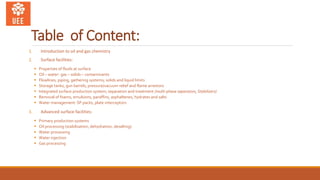
1. Introduction to oil and gas chemistry
2. Surface facilities:
 Properties of fluids at surface
 Oil – water- gas – solids – contaminants
 Flowlines, piping, gathering systems; solids and liquid limits
 Storage tanks, gun barrels, pressure/vacuum relief and flame arrestors
 Integrated surface production system; separation and treatment (multi-phase separators, Stabilizers)
 Removal of foams, emulsions, paraffins, asphaltenes, hydrates and salts
 Water management: SP packs, plate interceptors
3. Advanced surface facilities:
 Primary production systems
 Oil processing (stabilisation, dehydration, desalting)
 Water processing
 Water injection
 Gas processing
Table of Content:
4. Offshore Production Systems
 Offshore structures
 Floating systems
 Basics of flow assurance
 Subsea engineering
5. Onshore Systems and Project Development
 Onshore plants
 Export systems Pipelines
 Export terminals
 Tankers
 Project development Health safety & environment
 Handling uncertainties
 Managing risk
 Introduction to operations & maintenance
 Introduction to well & reservoir management
`
Table of Content:
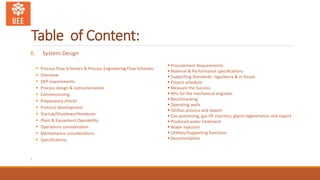
6. System Design
 Process Flow Schemes & Process Engineering Flow Schemes
 Overview
 DEP requirements
 Process design & instrumentation
 Commissioning
 Preparatory checks
 Protocol development
 Startup/Shutdown/Handover
 Plant & Equipment Operability
 Operations consideration
 Maintenance considerations
 Specifications
`
 Procurement Requirements
 Material & Performance specifications
 Supporting Standards: regulatory & in-house
 Project schedule
 Measure the Success
 KPIs for the mechanical engineer
 Benchmarking
 Operating wells
 Oil/Gas process and export
 Gas processing, gas lift injection, glycol regeneration and export
 Produced water treatment
 Water injection
 Utilities/Supporting functions
 Documentation
Table of Content:
6. Production Assurance - Troubleshooting and Guidelines in Oil & Gas
Operations
 Elimination of organic precipitates in oil production
 Inhibitor and tracer screening and its application
 Water quality and impact on re-injection systems
 Main causes of non-effective treatment plants
 Impact of retention time on separation processes
 Methods for getting reliable samples for further analyses
 SRB’s activity and MIC in oil and gas production
 Evaluation of different gas dehydration processes
 Rules of sulphate, carbonate and NORM scale formation
 Overview of scale calculating programs
 How to control corrosion in production operation
 Production operation in the tail-end phase of oil fields
 Troubleshooting in gas dehydration systems
 Formation of halite scale in gas production and storage
 Troubleshooting in treatment plants for tail-end production
 Modern aspects in screening corrosion inhibitors
`
Table of Content:
7. Static Plant
 Piping, Pipelines & Pressure Vessels
 ASME B31 codes for piping
 ASME BPVC VIII for pressure vessels
 Pressure relieving devices
 Above Ground Storage Tanks
 API 650 for ASTs
 AST construction
 General Construction Considerations
 Fabrication techniques
 Resource logistics
 Working with contractor
`
Table of Content:
8. Rotating Equipment
 Pumps & Compressors
 Positive displacement
 Centrifugal action
 Pump & Compressor Performance
 Pump curves
 Compressor maps
 System curves
 Selection & Specification
 Fulfilling process requirements
 System integration
`
Table of Content:
8. Cargo Properties
 Seminar Overview and Introductions
 Dangerous Cargos
 Toxicity
 Confined spaces
 Breathable atmospheres
 Hydrocarbon properties
 Crude oil
 Liquified Petroleum Gas
 Liquified Natural Gas
 Fires & Explosions
 UEL & LEL
`
 BLEVE
 Pancake cloud explosions
 Storage Tanks
 Atmospheric aboveground storage tanks
 Floating roof, fixed roof, variable vapor space and pressurized tanks
 Tank inspections & cleaning
 Transfer Systems
 Centrifugal pumps design and operation
 Piping systems
 Flow and pressure matching
 Ship-shore Transfers
 Marine Loading Arms
 Lightering
 The Ship/Shore Safety Checklist
`
Table of Content:
9. Safety and Risk
 Ignition sources
 Electrostatic charge
 Hazardous zone classification
 Intrinsically safe equipment
 Fire fighting & protection
 Fire detection systems
 Shipboard firefighting systems
 Risk assessments
 Qualitative and quantitative risk assessment techniques
`

TOC.pptx

  • 1.
    Table of Content: 1.Introduction to oil and gas chemistry 2. Surface facilities:  Properties of fluids at surface  Oil – water- gas – solids – contaminants  Flowlines, piping, gathering systems; solids and liquid limits  Storage tanks, gun barrels, pressure/vacuum relief and flame arrestors  Integrated surface production system; separation and treatment (multi-phase separators, Stabilizers)  Removal of foams, emulsions, paraffins, asphaltenes, hydrates and salts  Water management: SP packs, plate interceptors 3. Advanced surface facilities:  Primary production systems  Oil processing (stabilisation, dehydration, desalting)  Water processing  Water injection  Gas processing
  • 2.
    Table of Content: 4.Offshore Production Systems  Offshore structures  Floating systems  Basics of flow assurance  Subsea engineering 5. Onshore Systems and Project Development  Onshore plants  Export systems Pipelines  Export terminals  Tankers  Project development Health safety & environment  Handling uncertainties  Managing risk  Introduction to operations & maintenance  Introduction to well & reservoir management `
  • 3.
    Table of Content: 6.System Design  Process Flow Schemes & Process Engineering Flow Schemes  Overview  DEP requirements  Process design & instrumentation  Commissioning  Preparatory checks  Protocol development  Startup/Shutdown/Handover  Plant & Equipment Operability  Operations consideration  Maintenance considerations  Specifications `  Procurement Requirements  Material & Performance specifications  Supporting Standards: regulatory & in-house  Project schedule  Measure the Success  KPIs for the mechanical engineer  Benchmarking  Operating wells  Oil/Gas process and export  Gas processing, gas lift injection, glycol regeneration and export  Produced water treatment  Water injection  Utilities/Supporting functions  Documentation
  • 4.
    Table of Content: 6.Production Assurance - Troubleshooting and Guidelines in Oil & Gas Operations  Elimination of organic precipitates in oil production  Inhibitor and tracer screening and its application  Water quality and impact on re-injection systems  Main causes of non-effective treatment plants  Impact of retention time on separation processes  Methods for getting reliable samples for further analyses  SRB’s activity and MIC in oil and gas production  Evaluation of different gas dehydration processes  Rules of sulphate, carbonate and NORM scale formation  Overview of scale calculating programs  How to control corrosion in production operation  Production operation in the tail-end phase of oil fields  Troubleshooting in gas dehydration systems  Formation of halite scale in gas production and storage  Troubleshooting in treatment plants for tail-end production  Modern aspects in screening corrosion inhibitors `
  • 5.
    Table of Content: 7.Static Plant  Piping, Pipelines & Pressure Vessels  ASME B31 codes for piping  ASME BPVC VIII for pressure vessels  Pressure relieving devices  Above Ground Storage Tanks  API 650 for ASTs  AST construction  General Construction Considerations  Fabrication techniques  Resource logistics  Working with contractor `
  • 6.
    Table of Content: 8.Rotating Equipment  Pumps & Compressors  Positive displacement  Centrifugal action  Pump & Compressor Performance  Pump curves  Compressor maps  System curves  Selection & Specification  Fulfilling process requirements  System integration `
  • 7.
    Table of Content: 8.Cargo Properties  Seminar Overview and Introductions  Dangerous Cargos  Toxicity  Confined spaces  Breathable atmospheres  Hydrocarbon properties  Crude oil  Liquified Petroleum Gas  Liquified Natural Gas  Fires & Explosions  UEL & LEL `  BLEVE  Pancake cloud explosions  Storage Tanks  Atmospheric aboveground storage tanks  Floating roof, fixed roof, variable vapor space and pressurized tanks  Tank inspections & cleaning  Transfer Systems  Centrifugal pumps design and operation  Piping systems  Flow and pressure matching  Ship-shore Transfers  Marine Loading Arms  Lightering  The Ship/Shore Safety Checklist `
  • 8.
    Table of Content: 9.Safety and Risk  Ignition sources  Electrostatic charge  Hazardous zone classification  Intrinsically safe equipment  Fire fighting & protection  Fire detection systems  Shipboard firefighting systems  Risk assessments  Qualitative and quantitative risk assessment techniques `