Housekeeping:
“There is no such thing
as a stupid question,
only stupid answers”.
Colin Powell
Break Time.
Course End
Course Objectives:
• To explain the development and structure of ISO 45001
(including Annex SL).
• To highlight the key changes between OHSAS 18001 and ISO
45001 and their impact on the organizations.
• To provide the basic information required for individuals in
implementing a safety management system.
Introduction to
ISO 45001:2018
OH&S has evolved over time:
Time
Safety
Awareness
Annual ILO figures:
• 270 million accidents
• 160 million diseases
• 2 million fatalities
Last 25 years
OH&S has evolved over time:
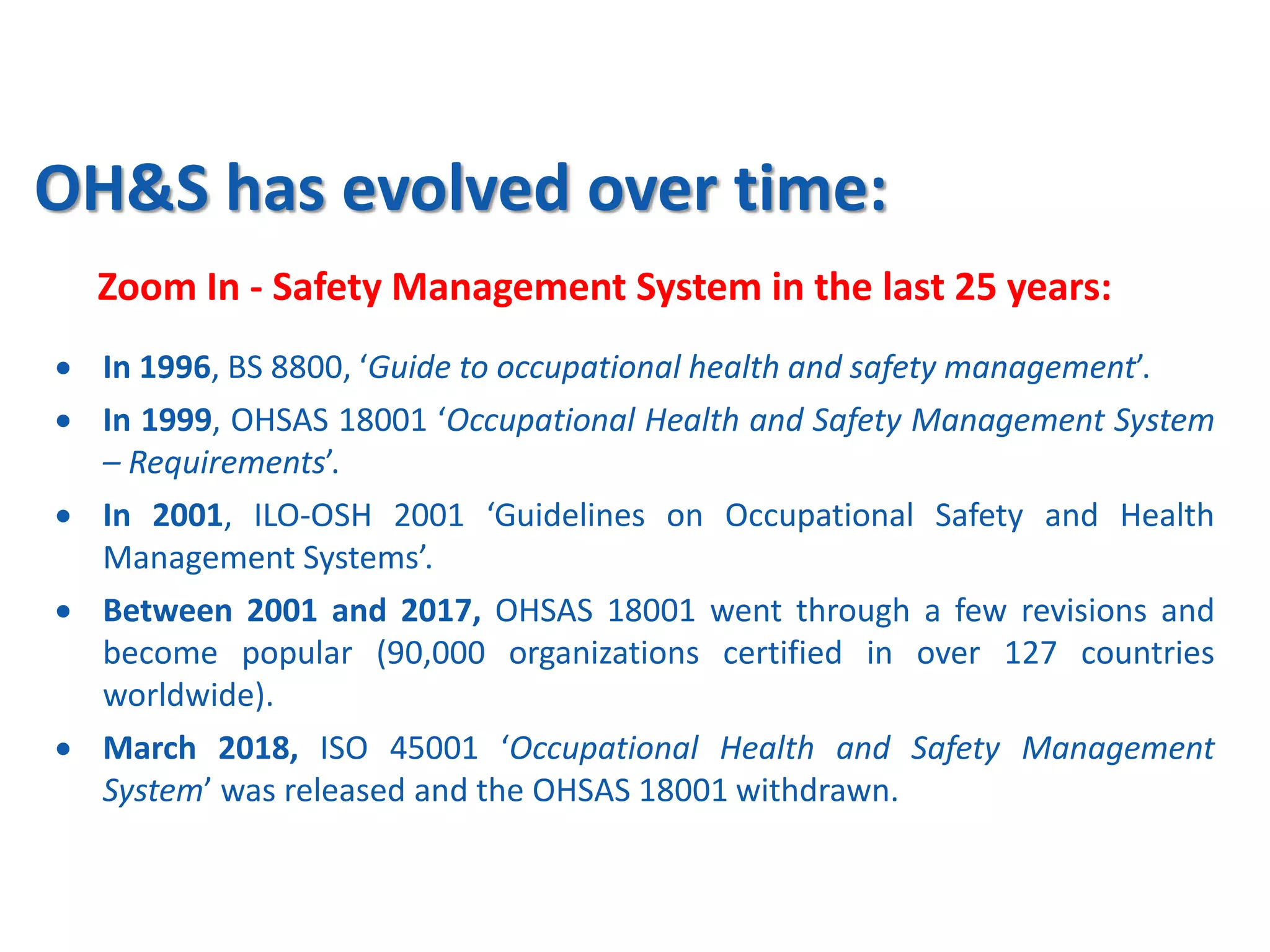
Zoom In - Safety Management System in the last 25 years:
 In 1996, BS 8800, ‘Guide to occupational health and safety management’.
 In 1999, OHSAS 18001 ‘Occupational Health and Safety Management System
– Requirements’.
 In 2001, ILO-OSH 2001 ‘Guidelines on Occupational Safety and Health
Management Systems’.
 Between 2001 and 2017, OHSAS 18001 went through a few revisions and
become popular (90,000 organizations certified in over 127 countries
worldwide).
 March 2018, ISO 45001 ‘Occupational Health and Safety Management
System’ was released and the OHSAS 18001 withdrawn.
How was ISO 45001 developed?
Technical committee ISO/PC 283 chaired by David Smith from the UK and had 70
countries as participating members and 17 countries as observing members.
Zoom In – ISO 45001:
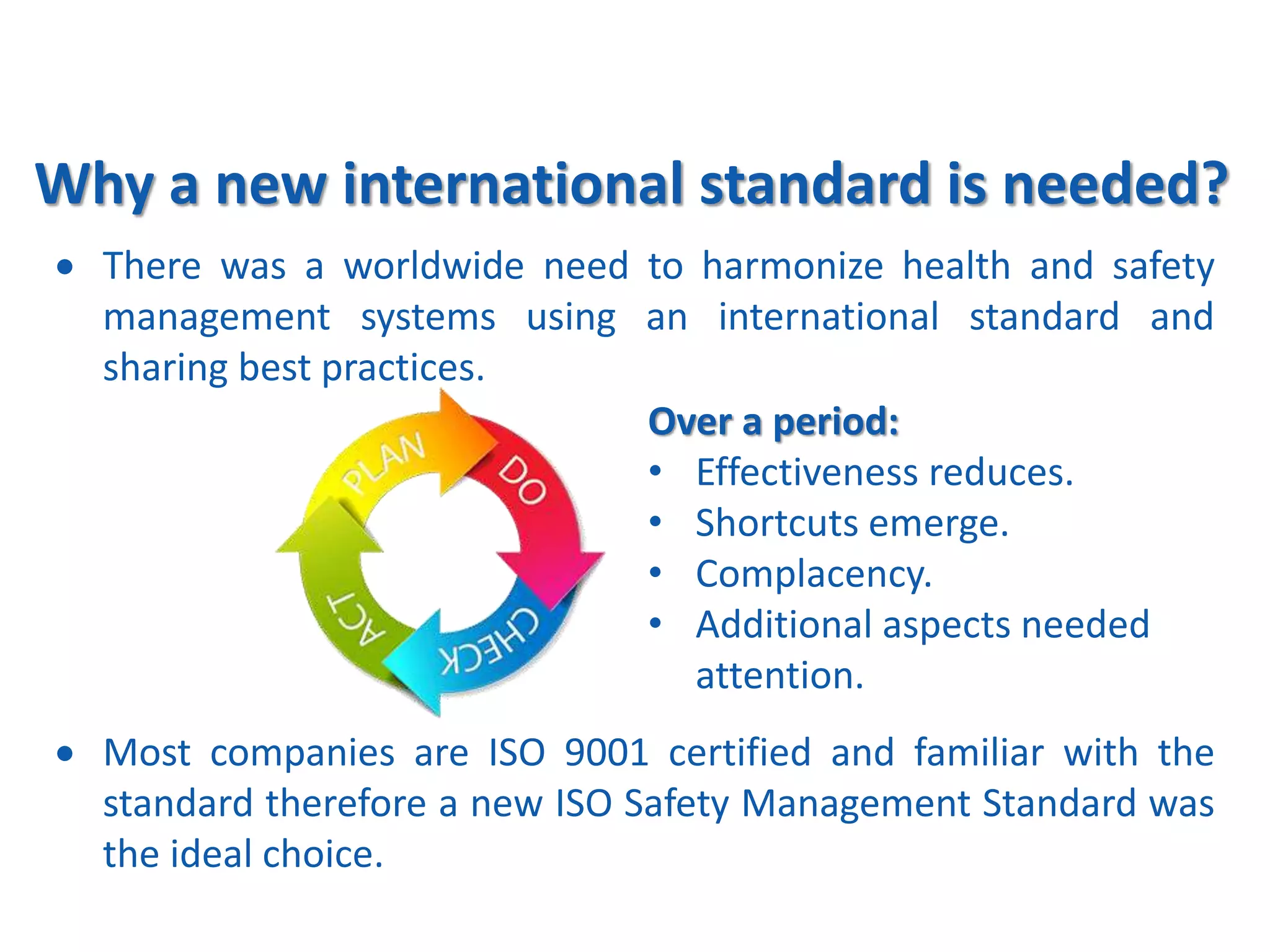
Why a new international standard is needed?
 There was a worldwide need to harmonize health and safety
management systems using an international standard and
sharing best practices.
Over a period:
• Effectiveness reduces.
• Shortcuts emerge.
• Complacency.
• Additional aspects needed
attention.
 Most companies are ISO 9001 certified and familiar with the
standard therefore a new ISO Safety Management Standard was
the ideal choice.
Overview of
ISO 45001:2018.
What is Annex SL?
Brainstorming Session
• Who has worked with different
management systems?
• What are the problems faced?
• Why are organizations considering
(some implemented) an Integrated
management systems?
What is Annex SL?
Meaning:
In simple terms then, Annex SL is a
high level structure for all future
development of ISO standards to
follow. It applies to every ISO
standard, meaning that they will
all have the same structure.
The revised ISO 9001 and ISO
14001, as well as the new ISO
45001 is based on Annex SL’s high
level structure.
Purpose:
• Standardize terms and
requirements hence
reducing confusion
between ISO standards.
• Cut down on repeat
processes.
• Reduce bureaucracy
• Improve efficiency.
What is Annex SL?
Common Clauses:
ISO 45001 Standard:
ISO 45001 Clauses overview and their interaction:
ISO 45001:2018 vs OHSAS 18001:
ISO 45001 OHSAS 18001
Process based. Procedure based.
Considers risks and
opportunities.
Deals with risk only.
Includes views of interested
parties.
Interested parties are mentioned
in the scope only.
Is dynamic in all clauses. Is not.
Overall comparison between ISO 45001 & OHSAS 18001:
New Requirements of
ISO 45001:2018.
45001
Clause 3
“Terms and definitions”
Summary (key changes):
• Some definitions made clearer.
• New definitions added.
• Some definitions removed or combined.
Terms and Definitions:
Who is a Worker?
Brainstorming Session
“Person performing work or work-
related activities that are under the
control of the organization”.
Examples:
• Worker could be paid or unpaid,
temporarily, etc.
• Workers include top management.
• Workers include contractors, individuals,
agency workers, and by other persons.
Terms and Definitions:
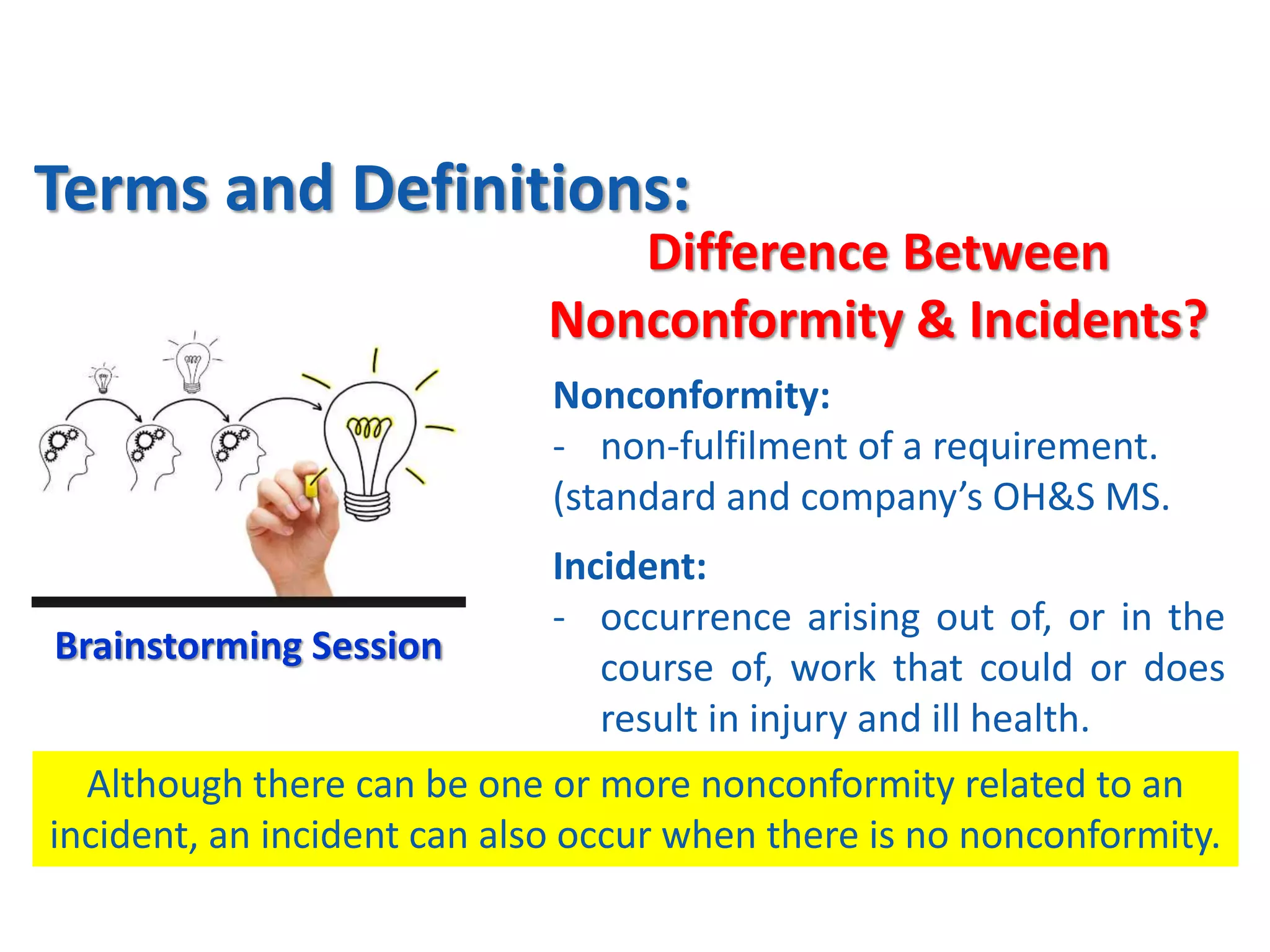
Difference Between
Nonconformity & Incidents?
Brainstorming Session
Nonconformity:
- non-fulfilment of a requirement.
(standard and company’s OH&S MS.
Although there can be one or more nonconformity related to an
incident, an incident can also occur when there is no nonconformity.
Incident:
- occurrence arising out of, or in the
course of, work that could or does
result in injury and ill health.
Terms and Definitions:
Difference Between
Participation & Consultation?
Brainstorming Session
Participation:
- Involvement in decision making.
Workers must be involved. How would you demonstrate it?
Consultation:
- Seeking views before making a
decision.
45001
Clause 4
“Context of the Organization”
Summary (key changes):
• Not part of OHSAS 18001.
Context of the organization:
Brainstorming Session
Who has worked on ISO 9001:2015 or
ISO 14001:2015?
Is your OH&S Policy appropriate to the
nature of your business?
Any MBA student here?
Context of the organization:
The Goal of this clause is to:
• Determine why the organization exists;
• Identify any internal and externa influences that will
affect desired outcomes.
• Document the scope of the management system that’s
implemented.
45001
Clause 5
“Leadership and Worker
Participation”
Summary (key changes):
• Similar requirements were in OHSAS
18001; however there is a much greater
emphasizes on Management and
employees involvement in all aspects of
the management system.
Leadership and Worker Participation:
• Top management is expected to be more involved at all major
OH&S aspects.
• Lead and promote safety culture.
• Protecting workers from reprisals when reporting incidents,
hazards, risks and opportunities.
5.1. Leadership and commitment
Leadership and Worker Participation:
• Two new commitments added:
o To eliminate hazards and reduce OH&S risks.
o To consultation and participation of workers, and, where
they exist workers’ representatives.
• Minor changes in the wording e.g. fulfill used instead of at least
comply with for legal and other requirements.
5.2. OH&S Policy
Leadership and Worker Participation:
• This clause is not found in the standard Annex SL format — it
has been specifically added to ISO 45001.
• The organization shall provide mechanisms, time, training and
resources necessary for consultation and participation.
• The organization shall emphasize the consultation and
participation of nonmanagerial workers.
5.4. Consultation and Participation of workers
45001
Clause 6
“Planning”
Summary (key changes):
• This is an area where organizations with OHSAS 18001
certification will see major differences.
• OHSAS 18001 emphasizes prevention, with corrective
action taken as needed. ISO 45001 emphasizes a more
proactive approach.
Planning:
What are the organization’s OH&S risks and opportunities?
How are they addressed?
Documented Information to be maintained.
6.1. Actions to address risks and opportunities
Hazard identification:
• Social factors
• Potential emergency scenarios
• Visitors
• External impacts
• Effectiveness of controls
• Proactive methodology
and criteria.
• Opportunities
Planning:
Actions Plans needed for:
• Addressing opportunities and risks.
• Addressing legal and other requirements.
• Emergency response.
6.1. Actions to address risks and opportunities
Planning:
Brainstorming Session
Identify controls based on the hierarchy
for a given hazard?
6.1.2. Hazard Identification and assessment of
risks and opportunities.
45001
Clause 7
“Support”
Summary (key changes):
• The terms “document” and “record” have
both been replaced with the term
“documented information” in ISO 45001.
Support:
7.5. Documented Information
The terms “document” and “record” have both been
replaced with the term “documented information” in ISO
45001.
The standard also states that documented information must
be maintained to the extent necessary to have confidence
that the processes have been carried out as planned.
Support:
7.5. Documented Information
Documents needed for ISO 45001:
• Scope of the OH&SMS (clause 4.3), OH&S Policy (clause 5.2)
• Roles and responsibilities (clause 5.3)
• OH&S risks and OH&S opportunities (clause 6.1.1)
• Processes needed to address risks and opportunities (clause 6.1.1)
• Methodology and criteria for assessment of OH&S risks (clause 6.1.2)
• OH&S objectives and plans (clause 6.2.2)
• Communication (clause 7.4)
• Operational controls (clause 8.1.1)
• Emergency preparedness and response process (clause 8.6).
Support:
7.5. Documented Information
Mandatory Records:
• Applicable legal and other requirements (clause 6.1.3).
• Records of training, skills, experience and qualifications (clause 7.2).
• Monitoring and measurement results (clause 9.1).
• Calibration & verification of monitoring & measuring eqt. (clause 9.1).
• Evaluation of compliance obligations (clause 9.1.2).
• Internal audit program (clause 9.2.2).
• Results of internal audits (clause 9.2.2), management review (clause
9.3), corrective actions (clause 10.1).
• Incidents and nonconformities (clause 10.1).
Support:
7.5. Documented Information
Non-mandatory Records:
• Procedure for determining context of the organization and interested
parties (clauses 4.1 and 4.2).
• Procedure for identification and evaluation of OH&S management
system risks and opportunities (clauses 6.1.1 and 6.1.2).
• Competence, training and awareness procedure (clauses 7.2 and 7.3).
• Procedure for communication (clause 7.4), document and record
control (clause 7.5), internal audit (clause 9.2), management review
(clause 9.3), management of nonconformities and corrective actions
(clause 10.2).
45001
Clause 8
“Operation”
Summary (key changes):
• The majority of the requirements for the management system are
found in this section. Organizations transitioning from OHSAS
18001 will find that this section contains most of the new
requirements.
• This section has seven clauses. Six of these clauses are unique
to ISO 45001.
Operation:
All clauses (key differences):
ISO 45001 OHSAS 18001
Separate clause for
“Management of Change”.
Part of hazard identification and
operational control.
Brainstorming
Session
Discuss examples:
• Changes in process, product, service etc.
• Changes in legal and other requirements.
• Changes in information, hazards, risks, knowledge,
technology etc.
Operation:
All clauses (key differences):
ISO 45001 OHSAS 18001
Control of Procurement: Requires control measures.
Discuss:
• Controlled Process.
• Contractors.
• Outsourcing.
Brainstorming
Session
45001
Clause 9 & 10
“Performance Evaluation”
and “Improvement”
Summary (key changes):
• Monitoring must yield valid results..
• Term “culture” is new and it is the responsibility of the Top
Management.
• New clause “Improvement“ is added.
9.1. Monitoring, measurement, analysis and
performance evaluation:
What is Monitoring?
- determining the status of a system, a process or an
activity.
What is Measurement?
- Process to determine a value.
What is Analysis?
- techniques for examining trends and output.
What is Evaluation?
- Comparing output against a criteria.
Performance Evaluation & Improvements:
Brainstorming
Session
9.1. Monitoring, measurement, analysis and
performance evaluation:
Brainstorming Session
Performance Evaluation & Improvements:
What, when and why something
needs to be monitored, measured,
analyzed?
9.1.2 Evaluation of Compliance:
The organization shall maintain knowledge and
understanding of its compliance status.
Performance Evaluation & Improvements:
The term ‘compliance status’ is new. It is considered to be the presence of
an overall view of the state of affairs regarding compliance with legal and
other requirements. OHSAS 18001 included the obligation to conduct an
internal evaluation of compliance. This made it possible to delegate the
evaluation and handling of any nonconformities to the departments or
other levels, without acquiring an overview of the organization as a whole.
Under ISO 45001, the organization must have an up-to-date view of its
compliance.
10.2 Incident, Non conformity and Corrective
Action:
When an incident or a non conformity occurs:
Performance Evaluation & Improvements:
• Take immediate action.
• Evaluate, determine the corrective action to eliminate root cause(s) in
order that it doe not recur or occur elsewhere.
• Review risk assessment.
• Take action in accordance with hierarchy of controls and change
management.
• Assess hazards due to the changes prior to taking action.
• Review effectiveness.
• Update documents.
Implementing
ISO 45001:2018.
Step 01:
Purchase a copy of ISO 45001:2018.
Implementing ISO 45001:2018:
Train employees:
• Internal Auditors;
• HSEQ Instructors;
• Select a team and train them accordingly.
Step 02:
Implementing ISO 45001:2018:
Develop “Context of the Organization”
• Use SWOT and PESTLE analysis.
• Identify stakeholders and level of involvement, their
needs and expectations;
• Company risks and opportunities.
Conduct a gap analysis.
Step 03:
Implementing ISO 45001:2018:
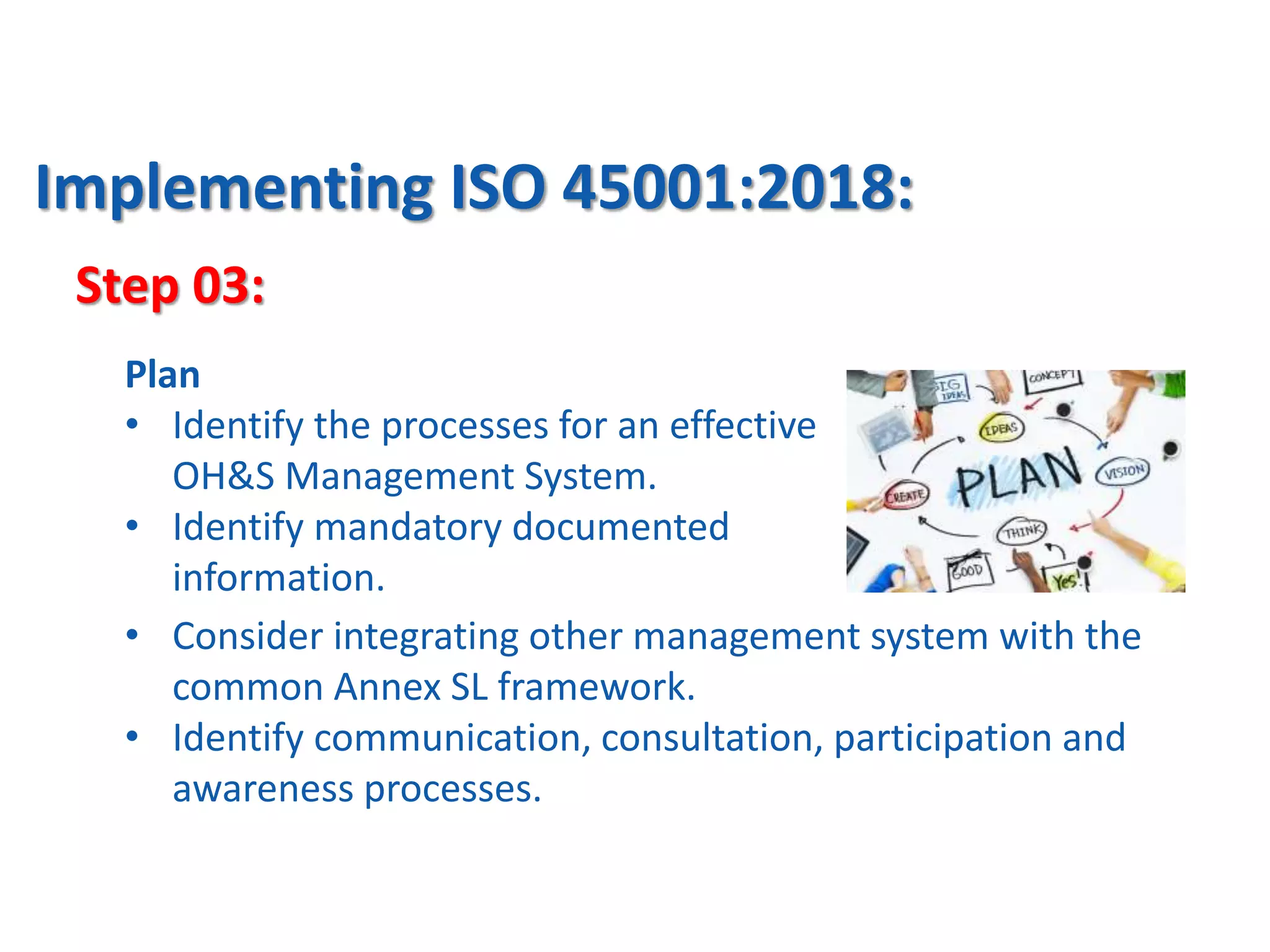
Plan
• Identify the processes for an effective
OH&S Management System.
• Identify mandatory documented
information.
• Consider integrating other management system with the
common Annex SL framework.
• Identify communication, consultation, participation and
awareness processes.
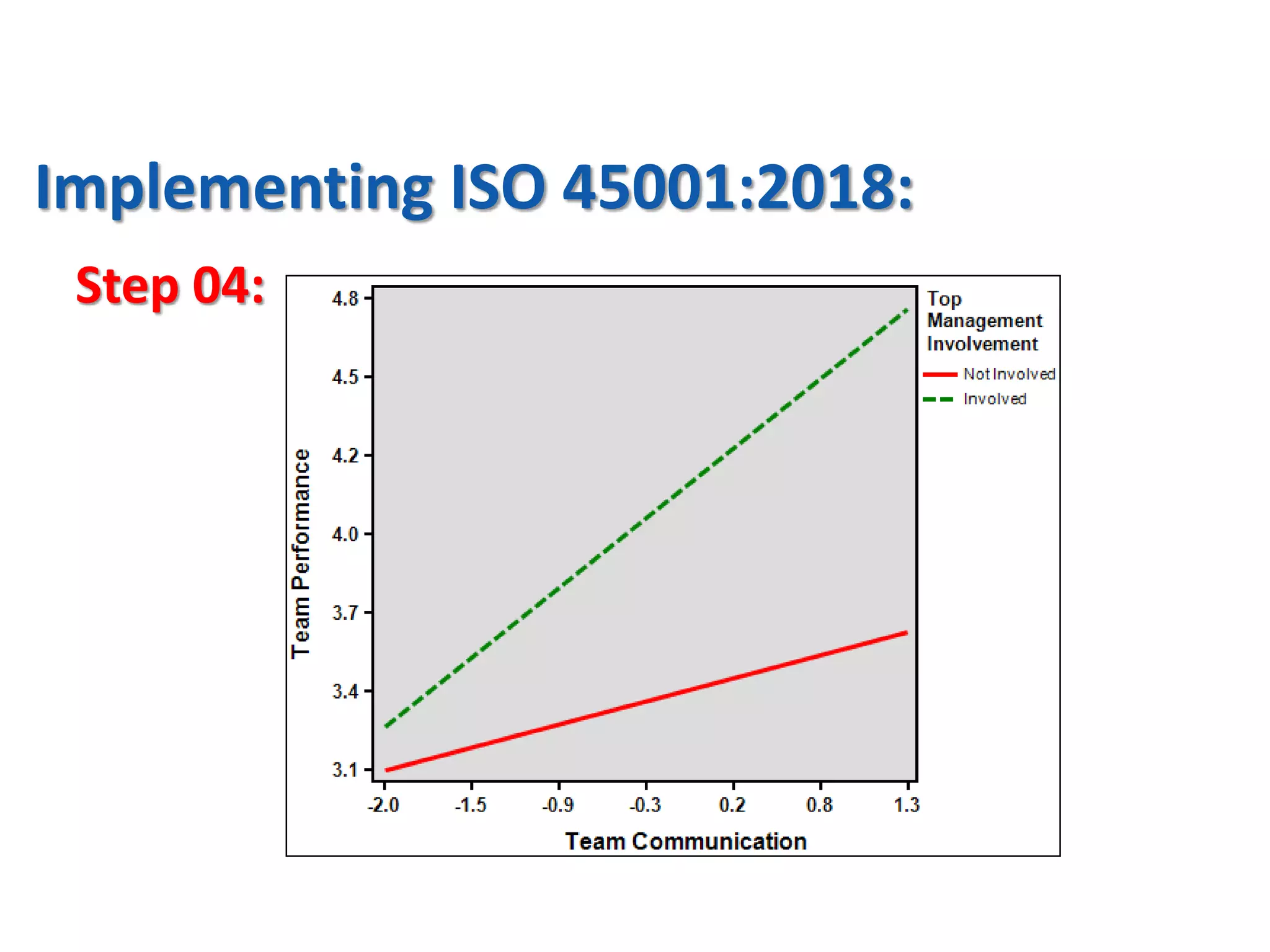
Step 04:
Implementing ISO 45001:2018:
Step 05:
Implementing ISO 45001:2018:
Implement changes as per plan.
Conduct a management review meeting.
The final
“Take Away”.
Take Away
ISO 45001 standard
focuses on the need
for a management
system, not the
management of
specific types of
hazards and risks.
OH&S is no longer
treated as a “stand
alone” but must be
viewed within the
perspective of running
a sound and sustainable
organization.
Health and Safety
Manager is NOT the
only one responsible
for health and safety.
The standard expects
OH&S aspects to be
integrated into the
structure of an
organization, ensuring
buy-in from top
management and
greater employee
contribution
Employee participation
& knowledge is the key
because OH&S
systems are most
effective when people
throughout the
organization are
engaged.
ISO 45001 does focus
on risk management,
but it also focuses on
the role that OH&S
management can have
in driving a positive
cultural change within
an organization.
Thank You

ISO 45001 Workshop.pptx

  • 2.
    Housekeeping: “There is nosuch thing as a stupid question, only stupid answers”. Colin Powell Break Time. Course End
  • 3.
    Course Objectives: • Toexplain the development and structure of ISO 45001 (including Annex SL). • To highlight the key changes between OHSAS 18001 and ISO 45001 and their impact on the organizations. • To provide the basic information required for individuals in implementing a safety management system.
  • 4.
  • 5.
    OH&S has evolvedover time: Time Safety Awareness Annual ILO figures: • 270 million accidents • 160 million diseases • 2 million fatalities Last 25 years
  • 6.
    OH&S has evolvedover time: Zoom In - Safety Management System in the last 25 years:  In 1996, BS 8800, ‘Guide to occupational health and safety management’.  In 1999, OHSAS 18001 ‘Occupational Health and Safety Management System – Requirements’.  In 2001, ILO-OSH 2001 ‘Guidelines on Occupational Safety and Health Management Systems’.  Between 2001 and 2017, OHSAS 18001 went through a few revisions and become popular (90,000 organizations certified in over 127 countries worldwide).  March 2018, ISO 45001 ‘Occupational Health and Safety Management System’ was released and the OHSAS 18001 withdrawn.
  • 7.
    How was ISO45001 developed? Technical committee ISO/PC 283 chaired by David Smith from the UK and had 70 countries as participating members and 17 countries as observing members. Zoom In – ISO 45001:
  • 8.
    Why a newinternational standard is needed?  There was a worldwide need to harmonize health and safety management systems using an international standard and sharing best practices. Over a period: • Effectiveness reduces. • Shortcuts emerge. • Complacency. • Additional aspects needed attention.  Most companies are ISO 9001 certified and familiar with the standard therefore a new ISO Safety Management Standard was the ideal choice.
  • 9.
  • 10.
    What is AnnexSL? Brainstorming Session • Who has worked with different management systems? • What are the problems faced? • Why are organizations considering (some implemented) an Integrated management systems?
  • 11.
    What is AnnexSL? Meaning: In simple terms then, Annex SL is a high level structure for all future development of ISO standards to follow. It applies to every ISO standard, meaning that they will all have the same structure. The revised ISO 9001 and ISO 14001, as well as the new ISO 45001 is based on Annex SL’s high level structure. Purpose: • Standardize terms and requirements hence reducing confusion between ISO standards. • Cut down on repeat processes. • Reduce bureaucracy • Improve efficiency.
  • 12.
    What is AnnexSL? Common Clauses:
  • 13.
    ISO 45001 Standard: ISO45001 Clauses overview and their interaction:
  • 14.
    ISO 45001:2018 vsOHSAS 18001: ISO 45001 OHSAS 18001 Process based. Procedure based. Considers risks and opportunities. Deals with risk only. Includes views of interested parties. Interested parties are mentioned in the scope only. Is dynamic in all clauses. Is not. Overall comparison between ISO 45001 & OHSAS 18001:
  • 15.
  • 16.
    45001 Clause 3 “Terms anddefinitions” Summary (key changes): • Some definitions made clearer. • New definitions added. • Some definitions removed or combined.
  • 17.
    Terms and Definitions: Whois a Worker? Brainstorming Session “Person performing work or work- related activities that are under the control of the organization”. Examples: • Worker could be paid or unpaid, temporarily, etc. • Workers include top management. • Workers include contractors, individuals, agency workers, and by other persons.
  • 18.
    Terms and Definitions: DifferenceBetween Nonconformity & Incidents? Brainstorming Session Nonconformity: - non-fulfilment of a requirement. (standard and company’s OH&S MS. Although there can be one or more nonconformity related to an incident, an incident can also occur when there is no nonconformity. Incident: - occurrence arising out of, or in the course of, work that could or does result in injury and ill health.
  • 19.
    Terms and Definitions: DifferenceBetween Participation & Consultation? Brainstorming Session Participation: - Involvement in decision making. Workers must be involved. How would you demonstrate it? Consultation: - Seeking views before making a decision.
  • 20.
    45001 Clause 4 “Context ofthe Organization” Summary (key changes): • Not part of OHSAS 18001.
  • 21.
    Context of theorganization: Brainstorming Session Who has worked on ISO 9001:2015 or ISO 14001:2015? Is your OH&S Policy appropriate to the nature of your business? Any MBA student here?
  • 22.
    Context of theorganization: The Goal of this clause is to: • Determine why the organization exists; • Identify any internal and externa influences that will affect desired outcomes. • Document the scope of the management system that’s implemented.
  • 23.
    45001 Clause 5 “Leadership andWorker Participation” Summary (key changes): • Similar requirements were in OHSAS 18001; however there is a much greater emphasizes on Management and employees involvement in all aspects of the management system.
  • 24.
    Leadership and WorkerParticipation: • Top management is expected to be more involved at all major OH&S aspects. • Lead and promote safety culture. • Protecting workers from reprisals when reporting incidents, hazards, risks and opportunities. 5.1. Leadership and commitment
  • 25.
    Leadership and WorkerParticipation: • Two new commitments added: o To eliminate hazards and reduce OH&S risks. o To consultation and participation of workers, and, where they exist workers’ representatives. • Minor changes in the wording e.g. fulfill used instead of at least comply with for legal and other requirements. 5.2. OH&S Policy
  • 26.
    Leadership and WorkerParticipation: • This clause is not found in the standard Annex SL format — it has been specifically added to ISO 45001. • The organization shall provide mechanisms, time, training and resources necessary for consultation and participation. • The organization shall emphasize the consultation and participation of nonmanagerial workers. 5.4. Consultation and Participation of workers
  • 27.
    45001 Clause 6 “Planning” Summary (keychanges): • This is an area where organizations with OHSAS 18001 certification will see major differences. • OHSAS 18001 emphasizes prevention, with corrective action taken as needed. ISO 45001 emphasizes a more proactive approach.
  • 28.
    Planning: What are theorganization’s OH&S risks and opportunities? How are they addressed? Documented Information to be maintained. 6.1. Actions to address risks and opportunities Hazard identification: • Social factors • Potential emergency scenarios • Visitors • External impacts • Effectiveness of controls • Proactive methodology and criteria. • Opportunities
  • 29.
    Planning: Actions Plans neededfor: • Addressing opportunities and risks. • Addressing legal and other requirements. • Emergency response. 6.1. Actions to address risks and opportunities
  • 30.
    Planning: Brainstorming Session Identify controlsbased on the hierarchy for a given hazard? 6.1.2. Hazard Identification and assessment of risks and opportunities.
  • 31.
    45001 Clause 7 “Support” Summary (keychanges): • The terms “document” and “record” have both been replaced with the term “documented information” in ISO 45001.
  • 32.
    Support: 7.5. Documented Information Theterms “document” and “record” have both been replaced with the term “documented information” in ISO 45001. The standard also states that documented information must be maintained to the extent necessary to have confidence that the processes have been carried out as planned.
  • 33.
    Support: 7.5. Documented Information Documentsneeded for ISO 45001: • Scope of the OH&SMS (clause 4.3), OH&S Policy (clause 5.2) • Roles and responsibilities (clause 5.3) • OH&S risks and OH&S opportunities (clause 6.1.1) • Processes needed to address risks and opportunities (clause 6.1.1) • Methodology and criteria for assessment of OH&S risks (clause 6.1.2) • OH&S objectives and plans (clause 6.2.2) • Communication (clause 7.4) • Operational controls (clause 8.1.1) • Emergency preparedness and response process (clause 8.6).
  • 34.
    Support: 7.5. Documented Information MandatoryRecords: • Applicable legal and other requirements (clause 6.1.3). • Records of training, skills, experience and qualifications (clause 7.2). • Monitoring and measurement results (clause 9.1). • Calibration & verification of monitoring & measuring eqt. (clause 9.1). • Evaluation of compliance obligations (clause 9.1.2). • Internal audit program (clause 9.2.2). • Results of internal audits (clause 9.2.2), management review (clause 9.3), corrective actions (clause 10.1). • Incidents and nonconformities (clause 10.1).
  • 35.
    Support: 7.5. Documented Information Non-mandatoryRecords: • Procedure for determining context of the organization and interested parties (clauses 4.1 and 4.2). • Procedure for identification and evaluation of OH&S management system risks and opportunities (clauses 6.1.1 and 6.1.2). • Competence, training and awareness procedure (clauses 7.2 and 7.3). • Procedure for communication (clause 7.4), document and record control (clause 7.5), internal audit (clause 9.2), management review (clause 9.3), management of nonconformities and corrective actions (clause 10.2).
  • 36.
    45001 Clause 8 “Operation” Summary (keychanges): • The majority of the requirements for the management system are found in this section. Organizations transitioning from OHSAS 18001 will find that this section contains most of the new requirements. • This section has seven clauses. Six of these clauses are unique to ISO 45001.
  • 37.
    Operation: All clauses (keydifferences): ISO 45001 OHSAS 18001 Separate clause for “Management of Change”. Part of hazard identification and operational control. Brainstorming Session Discuss examples: • Changes in process, product, service etc. • Changes in legal and other requirements. • Changes in information, hazards, risks, knowledge, technology etc.
  • 38.
    Operation: All clauses (keydifferences): ISO 45001 OHSAS 18001 Control of Procurement: Requires control measures. Discuss: • Controlled Process. • Contractors. • Outsourcing. Brainstorming Session
  • 39.
    45001 Clause 9 &10 “Performance Evaluation” and “Improvement” Summary (key changes): • Monitoring must yield valid results.. • Term “culture” is new and it is the responsibility of the Top Management. • New clause “Improvement“ is added.
  • 40.
    9.1. Monitoring, measurement,analysis and performance evaluation: What is Monitoring? - determining the status of a system, a process or an activity. What is Measurement? - Process to determine a value. What is Analysis? - techniques for examining trends and output. What is Evaluation? - Comparing output against a criteria. Performance Evaluation & Improvements: Brainstorming Session
  • 41.
    9.1. Monitoring, measurement,analysis and performance evaluation: Brainstorming Session Performance Evaluation & Improvements: What, when and why something needs to be monitored, measured, analyzed?
  • 42.
    9.1.2 Evaluation ofCompliance: The organization shall maintain knowledge and understanding of its compliance status. Performance Evaluation & Improvements: The term ‘compliance status’ is new. It is considered to be the presence of an overall view of the state of affairs regarding compliance with legal and other requirements. OHSAS 18001 included the obligation to conduct an internal evaluation of compliance. This made it possible to delegate the evaluation and handling of any nonconformities to the departments or other levels, without acquiring an overview of the organization as a whole. Under ISO 45001, the organization must have an up-to-date view of its compliance.
  • 43.
    10.2 Incident, Nonconformity and Corrective Action: When an incident or a non conformity occurs: Performance Evaluation & Improvements: • Take immediate action. • Evaluate, determine the corrective action to eliminate root cause(s) in order that it doe not recur or occur elsewhere. • Review risk assessment. • Take action in accordance with hierarchy of controls and change management. • Assess hazards due to the changes prior to taking action. • Review effectiveness. • Update documents.
  • 44.
  • 45.
    Step 01: Purchase acopy of ISO 45001:2018. Implementing ISO 45001:2018: Train employees: • Internal Auditors; • HSEQ Instructors; • Select a team and train them accordingly.
  • 46.
    Step 02: Implementing ISO45001:2018: Develop “Context of the Organization” • Use SWOT and PESTLE analysis. • Identify stakeholders and level of involvement, their needs and expectations; • Company risks and opportunities. Conduct a gap analysis.
  • 47.
    Step 03: Implementing ISO45001:2018: Plan • Identify the processes for an effective OH&S Management System. • Identify mandatory documented information. • Consider integrating other management system with the common Annex SL framework. • Identify communication, consultation, participation and awareness processes.
  • 48.
  • 49.
    Step 05: Implementing ISO45001:2018: Implement changes as per plan. Conduct a management review meeting.
  • 50.
  • 51.
    Take Away ISO 45001standard focuses on the need for a management system, not the management of specific types of hazards and risks. OH&S is no longer treated as a “stand alone” but must be viewed within the perspective of running a sound and sustainable organization. Health and Safety Manager is NOT the only one responsible for health and safety. The standard expects OH&S aspects to be integrated into the structure of an organization, ensuring buy-in from top management and greater employee contribution Employee participation & knowledge is the key because OH&S systems are most effective when people throughout the organization are engaged. ISO 45001 does focus on risk management, but it also focuses on the role that OH&S management can have in driving a positive cultural change within an organization.
  • 52.