SEMINAR PRESENTATION
JAMIA MILIA ISLAMIA
Dyspnea scales in PR
Submitted by
Nitish aggarwal
20MPT018
•Dyspnea is the main symptom perceived by patients affected by
chronic respiratory diseases. It derives from a complex interaction
of signals arising in the central nervous system, which is connected
through afferent pathway receptors to the peripheral respiratory
system.
•The main goal of rehabilitation is to improve dyspnea; hence,
quantifying dyspnea through specific tools (scales) is essential in
order to describe the level of chronic disability and to assess
eventual changes after intervention.
•In the field of cardiopulmonary disease, the five descriptive
clusters in the language of dyspnea most frequently selected are:
1. chest tightness
2. increased effort of breathing
3. unsatisfied inspiratory effort
4.rapid or superficial breathing
5.breathlessness
•The sensation of 'chest tightness', frequently reported by asthmatic
patients during acute bronchial obstruction, may derive from the
stimulation of the pulmonary sensory receptors through vagal and
autonomous pathways these slow adapting receptors, excited by the
contraction of the airway muscle fibers, together with receptors from
irritation (fast adapting) and C fibers could respond to the local
airways inflammation.
•The cluster 'increased work or effort of breathing' includes instead
descriptors often selected in conditions of increased mechanical load,
such as occurs in COPD and in interstitial or neuromuscular diseases.
The work/effort element, inadequate due to respiratory muscle fatigue
or such as occurs during physical exercise, provokes an increase of
the 'corollary discharge' (central motor command to the sensitive
cortex through small, highly localized interneurones in the central
nervous system, that function as sensory receptors).
•Unsatisfied inspiratory effort' is a cluster that refers to conditions in
which there is a disparity between central respiratory output and
mechanical response of the respiratory system and it is considered to
play a fundamental role in the increased perception of dyspnea during
physical exercise in patients affected by COPD and interstitial
diseases
•Rapid or shallow breathing' is the respiratory cluster referred as a
transitory experience by normal subjects during intense physical
exercise or in the presence of external chest restriction ; it
characterizes, in pathological terms, the response to exercise of
patients with interstitial diseases.
•'Breathlessness', is a cluster that tends often to be associated to
patients affected by congestive heart failure or other
pathophysiological conditions (pregnancy, physical exercise, COPD).
This dyspnea cluster is characterized by an increased respiratory
drive, usually associated to increased ventilation
Borg scale OR rate of perceived exertion(PRE)
•a widely used and reliable indicator to monitor and guide
exercise intensity
•allows individuals to subjectively rate their level of
exertion during exercise or exercise testing (American
College of Sports Medicine, 2010)
•Developed by Gunnar Borg, it is often also referred to as
the Borg Scale(1998)
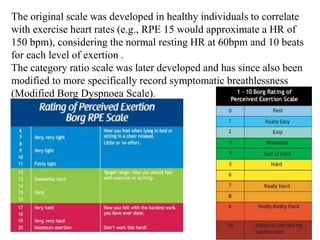
•Consists of 2 categories
1. the original Borg scale or category scale (6 to 20 scale),
and
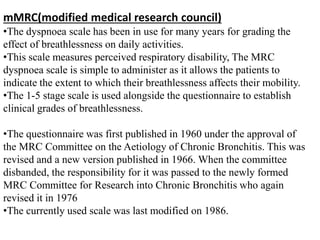
2. the revised category-ratio scale (0 to 10 scale). Also
called modified borg scale
The original scale was developed in healthy individuals to correlate
with exercise heart rates (e.g., RPE 15 would approximate a HR of
150 bpm), considering the normal resting HR at 60bpm and 10 beats
for each level of exertion .
The category ratio scale was later developed and has since also been
modified to more specifically record symptomatic breathlessness
(Modified Borg Dyspnoea Scale).
mMRC(modified medical research council)
•The dyspnoea scale has been in use for many years for grading the
effect of breathlessness on daily activities.
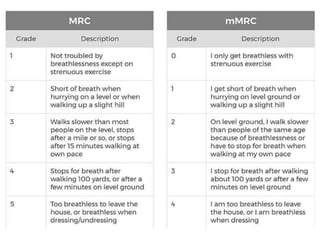
•This scale measures perceived respiratory disability, The MRC
dyspnoea scale is simple to administer as it allows the patients to
indicate the extent to which their breathlessness affects their mobility.
•The 1-5 stage scale is used alongside the questionnaire to establish
clinical grades of breathlessness.
•The questionnaire was first published in 1960 under the approval of
the MRC Committee on the Aetiology of Chronic Bronchitis. This was
revised and a new version published in 1966. When the committee
disbanded, the responsibility for it was passed to the newly formed
MRC Committee for Research into Chronic Bronchitis who again
revised it in 1976
•The currently used scale was last modified on 1986.
Usefulness of mMRC
•Researchers such as Bestall et al. have explored its validity in this
context. They found that the scale was a simple and valid method
which could be used to categorize patients with chronic obstructive
pulmonary disease (COPD) in terms of their disability and it could
be used to complement forced expiratory volume in 1 s (FEV1) in
the classification of the severity of disease.
•While much of the recent use of the MRC dyspnoea scale is in
COPD patients, its performance in patients with idiopathic
pulmonary fibrosis and sarcoidosis has also been documented.
• The original MRC breathlessness scale is currently recommended
for use in the diagnosis of patients with COPD by government
bodies such as NICE (National Institute for Health and Care
Excellence in England) and the modified version is a key feature of
the GOLD 2011 (Global Initiative for Chronic Obstructive Airways
Disease) recommend ations on assessment.
PR and reduction of dyspnea :
Various mechanisms why which PR reduce the dyspnea
•Reduce metablic load and improve overall muscle function
•Reduce Ventilatory Impedance by
Reducing/counterbalance hyperinflation
Reducing resistive load
•Decrease central drive and desensitization effect
According to ATS guidelines MCID value for modified
borg scale is 1 unit in case of COPD patient

Dyspnea

  • 1.
    SEMINAR PRESENTATION JAMIA MILIAISLAMIA Dyspnea scales in PR Submitted by Nitish aggarwal 20MPT018
  • 2.
    •Dyspnea is themain symptom perceived by patients affected by chronic respiratory diseases. It derives from a complex interaction of signals arising in the central nervous system, which is connected through afferent pathway receptors to the peripheral respiratory system. •The main goal of rehabilitation is to improve dyspnea; hence, quantifying dyspnea through specific tools (scales) is essential in order to describe the level of chronic disability and to assess eventual changes after intervention. •In the field of cardiopulmonary disease, the five descriptive clusters in the language of dyspnea most frequently selected are: 1. chest tightness 2. increased effort of breathing 3. unsatisfied inspiratory effort 4.rapid or superficial breathing 5.breathlessness
  • 3.
    •The sensation of'chest tightness', frequently reported by asthmatic patients during acute bronchial obstruction, may derive from the stimulation of the pulmonary sensory receptors through vagal and autonomous pathways these slow adapting receptors, excited by the contraction of the airway muscle fibers, together with receptors from irritation (fast adapting) and C fibers could respond to the local airways inflammation. •The cluster 'increased work or effort of breathing' includes instead descriptors often selected in conditions of increased mechanical load, such as occurs in COPD and in interstitial or neuromuscular diseases. The work/effort element, inadequate due to respiratory muscle fatigue or such as occurs during physical exercise, provokes an increase of the 'corollary discharge' (central motor command to the sensitive cortex through small, highly localized interneurones in the central nervous system, that function as sensory receptors).
  • 4.
    •Unsatisfied inspiratory effort'is a cluster that refers to conditions in which there is a disparity between central respiratory output and mechanical response of the respiratory system and it is considered to play a fundamental role in the increased perception of dyspnea during physical exercise in patients affected by COPD and interstitial diseases •Rapid or shallow breathing' is the respiratory cluster referred as a transitory experience by normal subjects during intense physical exercise or in the presence of external chest restriction ; it characterizes, in pathological terms, the response to exercise of patients with interstitial diseases. •'Breathlessness', is a cluster that tends often to be associated to patients affected by congestive heart failure or other pathophysiological conditions (pregnancy, physical exercise, COPD). This dyspnea cluster is characterized by an increased respiratory drive, usually associated to increased ventilation
  • 5.
    Borg scale ORrate of perceived exertion(PRE) •a widely used and reliable indicator to monitor and guide exercise intensity •allows individuals to subjectively rate their level of exertion during exercise or exercise testing (American College of Sports Medicine, 2010) •Developed by Gunnar Borg, it is often also referred to as the Borg Scale(1998) •Consists of 2 categories 1. the original Borg scale or category scale (6 to 20 scale), and 2. the revised category-ratio scale (0 to 10 scale). Also called modified borg scale
  • 6.
    The original scalewas developed in healthy individuals to correlate with exercise heart rates (e.g., RPE 15 would approximate a HR of 150 bpm), considering the normal resting HR at 60bpm and 10 beats for each level of exertion . The category ratio scale was later developed and has since also been modified to more specifically record symptomatic breathlessness (Modified Borg Dyspnoea Scale).
  • 7.
    mMRC(modified medical researchcouncil) •The dyspnoea scale has been in use for many years for grading the effect of breathlessness on daily activities. •This scale measures perceived respiratory disability, The MRC dyspnoea scale is simple to administer as it allows the patients to indicate the extent to which their breathlessness affects their mobility. •The 1-5 stage scale is used alongside the questionnaire to establish clinical grades of breathlessness. •The questionnaire was first published in 1960 under the approval of the MRC Committee on the Aetiology of Chronic Bronchitis. This was revised and a new version published in 1966. When the committee disbanded, the responsibility for it was passed to the newly formed MRC Committee for Research into Chronic Bronchitis who again revised it in 1976 •The currently used scale was last modified on 1986.
  • 9.
    Usefulness of mMRC •Researcherssuch as Bestall et al. have explored its validity in this context. They found that the scale was a simple and valid method which could be used to categorize patients with chronic obstructive pulmonary disease (COPD) in terms of their disability and it could be used to complement forced expiratory volume in 1 s (FEV1) in the classification of the severity of disease. •While much of the recent use of the MRC dyspnoea scale is in COPD patients, its performance in patients with idiopathic pulmonary fibrosis and sarcoidosis has also been documented. • The original MRC breathlessness scale is currently recommended for use in the diagnosis of patients with COPD by government bodies such as NICE (National Institute for Health and Care Excellence in England) and the modified version is a key feature of the GOLD 2011 (Global Initiative for Chronic Obstructive Airways Disease) recommend ations on assessment.
  • 10.
    PR and reductionof dyspnea : Various mechanisms why which PR reduce the dyspnea •Reduce metablic load and improve overall muscle function •Reduce Ventilatory Impedance by Reducing/counterbalance hyperinflation Reducing resistive load •Decrease central drive and desensitization effect According to ATS guidelines MCID value for modified borg scale is 1 unit in case of COPD patient