Khyrun Nahar Zoma
2015135006
Oceanography
Some basic info. about
oceanography
• Founder of Oceanography is unknown.
• Can also referred as “oceanology” and “marine
science”.
• In short, oceanography is a science that deals with
the ocean.
• It is a science that deals with the oceans and
includes the delimitation of their extent and depth,
the physics and chemistry of their waters, marine
biology, and the exploitation of their resources.
World land and water
bodies
World land and water bodies
• Earth is referred as “Blue planet” of the galaxy.
• 71 percent of the Earth's surface is covered with
water (known as ocean, Sea, rivers, ponds, lakes,
etc.)
• the land has its contribution of 29% (including
islands, continents, etc.)
Earth land
• referred as dry land
• support agriculture, habitat, and various natural
resources
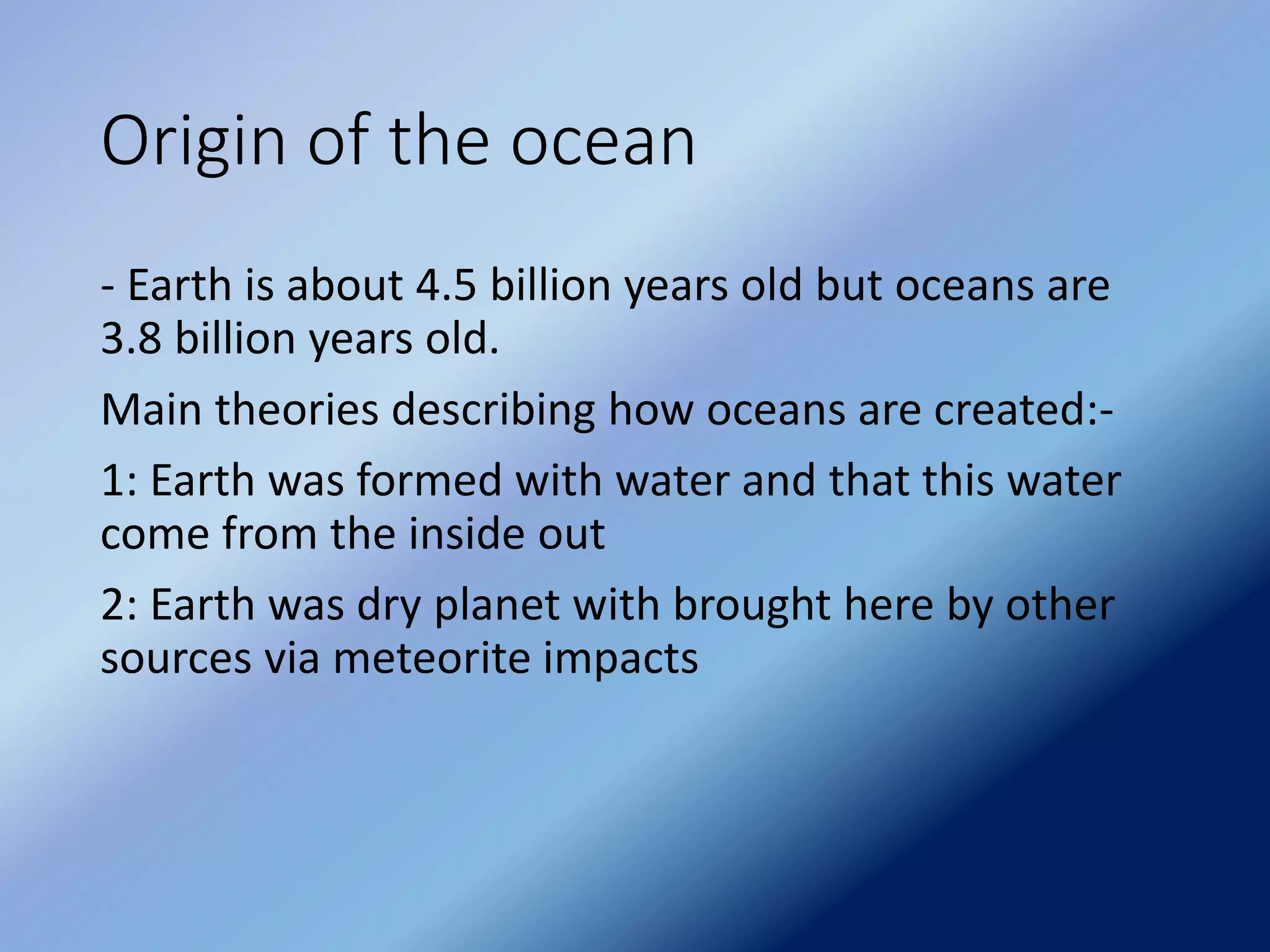
Water bodies
• any significant accumulation of water, generally on
a planet's surface.
• often refers to oceans, seas, and lakes
• Most are naturally occurring geographical features
(e.g, ocean,sea,river etc)
• some are artificial (e.g, canal, ponds, lakes etc)
Origin of the ocean
Origin of the ocean
- Earth is about 4.5 billion years old but oceans are
3.8 billion years old.
Main theories describing how oceans are created:-
1: Earth was formed with water and that this water
come from the inside out
2: Earth was dry planet with brought here by other
sources via meteorite impacts
Formation of ocean goes from 3
phases
-initially there was only water vapor in atmosphere
-Air and ground surface too hot for liquid
-Cooling of atmosphere led to condensation and rain
-Ground surface still too hot for pooling
-Further cooling of the ground surface finally led to
accumulation of liquid water on surface
Present ocean
Types of ocean
Name of the ocean
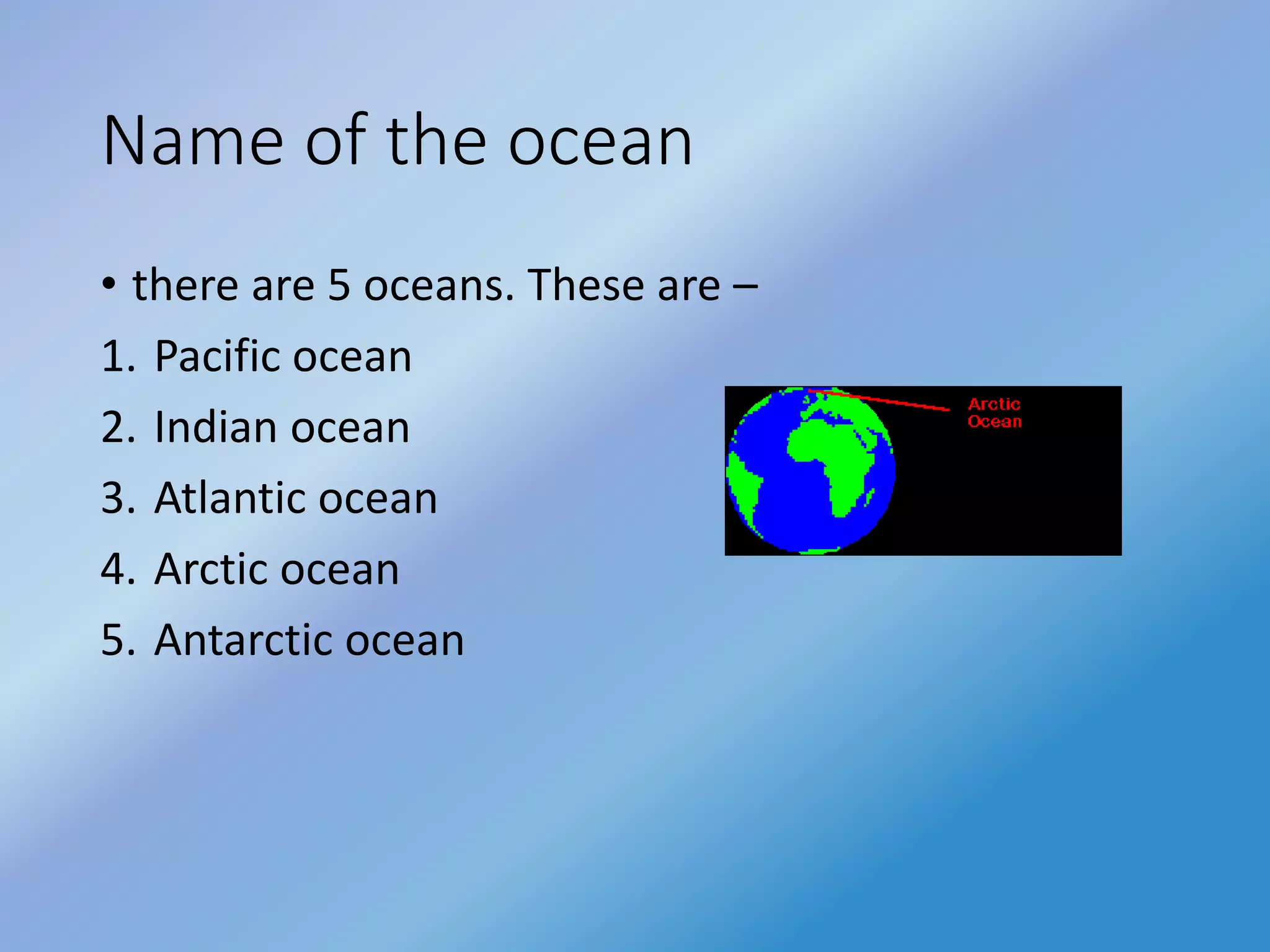
• there are 5 oceans. These are –
1. Pacific ocean
2. Indian ocean
3. Atlantic ocean
4. Arctic ocean
5. Antarctic ocean
Pacific ocean
• Name was coined by Portuguese explorer fardinand
magellan
• Came from “mar pacifico” means peaceful sea
• Largest ocean
• Covers one-third of the earth surface
• Area 161.2×10⁶ km2
• Mean depth 4280 meters
• The deepest point Mariana trench
• Equator subdivides into north Pacific Ocean and South
Pacific Ocean
Pacific ocean
Atlantic ocean
• 2nd largest ocean
• area 106.5×10⁶ km2
• Atlantis thalassa 'the Atlantis sea’ where the name
refers to "the sea beyond the pillars of Heracles" which
is said to be part of the ocean that surrounds all land.
• the Age of Discovery, the Atlantic was also known to
English cartographers as the Great Western basin
• Mean depth 3646 m where maximum depth 8486m
• S-shaped basin extending longitudinally
between Eurasia and Africa to the east, and the
Americas to the west
Atlantic ocean
Indian ocean
• Third largest ocean
• Named after india
• known as Ratnākara
• Area 7.056×10⁶km2
• bounded by Asia on the north, on the west
by Africa, on the east by Australia, and on the south
by the Southern Ocean
• Mean depth is 3,741 m and maximum depth is
7906 m
Indian ocean
Southern ocean
• Known as the Antarctic ocean or the austral ocean
• Generally taken to the 60˚S latitude
• Fourth largest ocean
• Southern Ocean encompasses the South Pole.
• Average depth 3962 meters to 4999 meters
• Deepest part is south sandwich trench that is 7235 meters
• home to 90% of the world's ice.
• the windiest, driest and coldest continent in the world.
• area 20.33×10⁶ sq. km.
Southern ocean
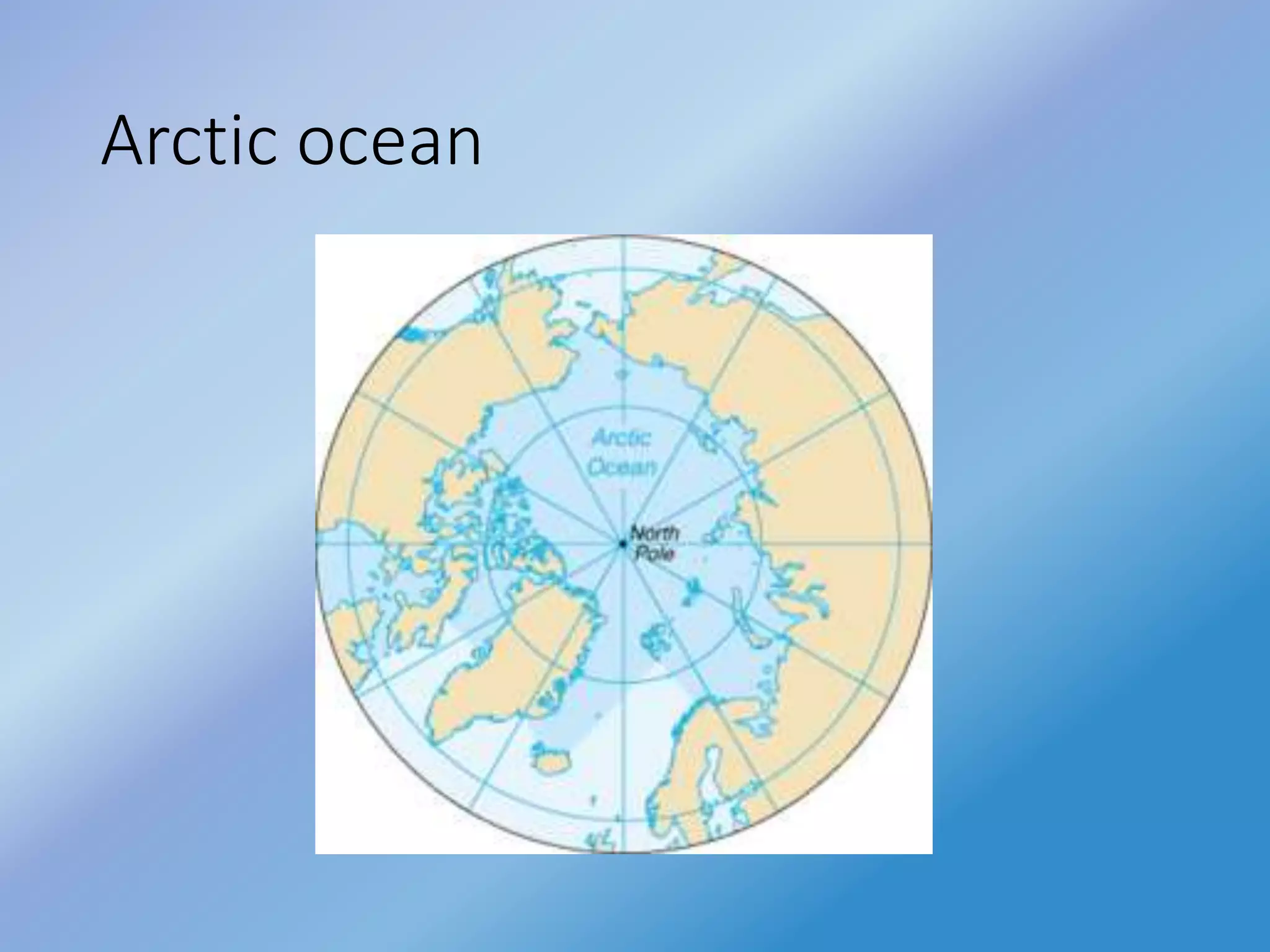
Arctic ocean
• Some oceanographers call it the Arctic
Mediterranean Sea, classifying it a mediterranean
sea or an estuary of the Atlantic Ocean
• Smallest and shallowest ocean of the world
• Also called Arctic Mediterranean sea
• Located ate mostly in the northern hemisphere
• Area 14×106 sq. km
• Mean depth 1038m
• salinity is the lowest on average of the five major
oceans
Arctic ocean
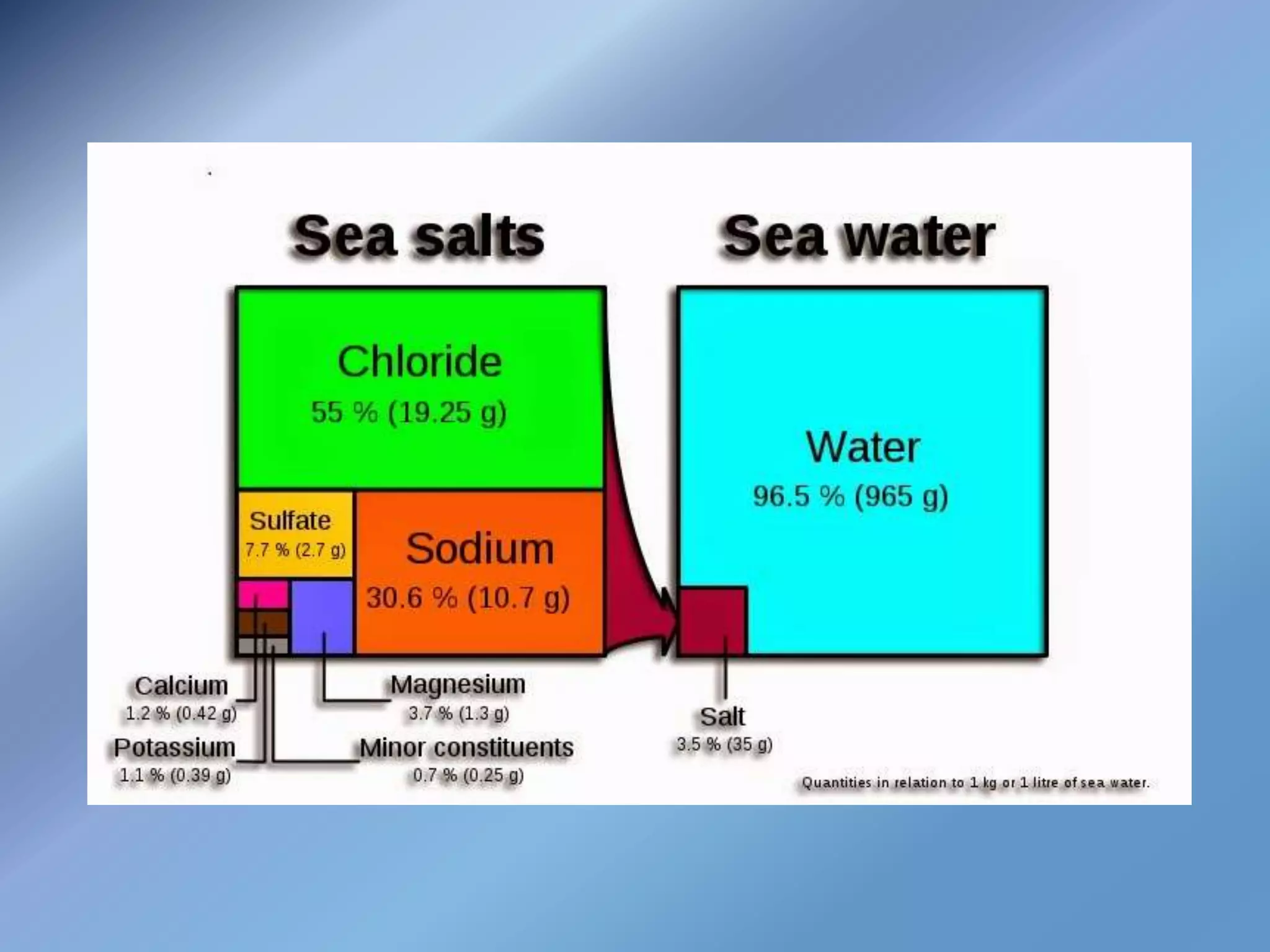
Composition of ocean water
Components of ocean water
Manly divided into two types:
1)Water
2) Salts
The other components are:-
• Solids
• Colloids
• Dissolved solutes
• gases
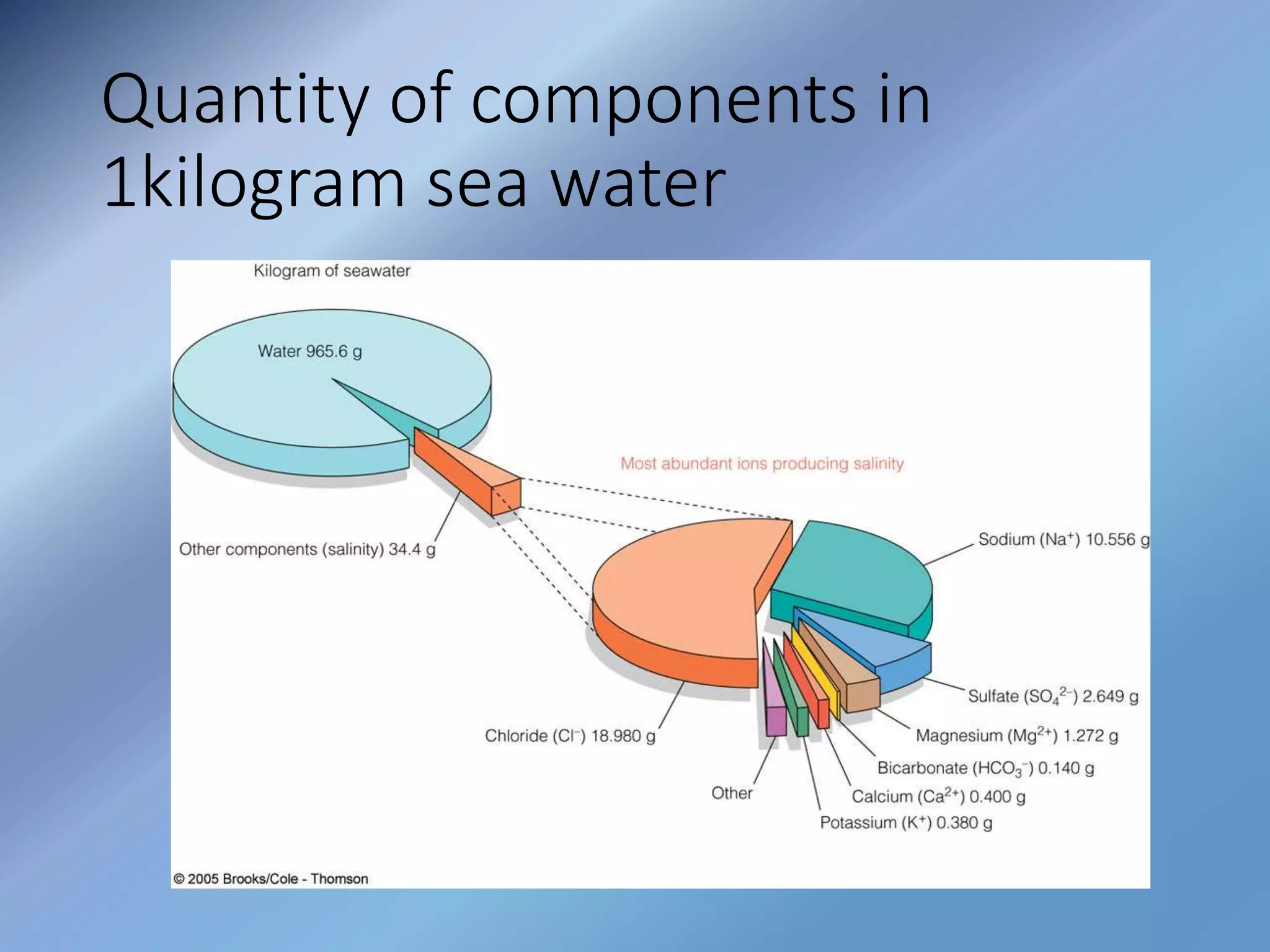
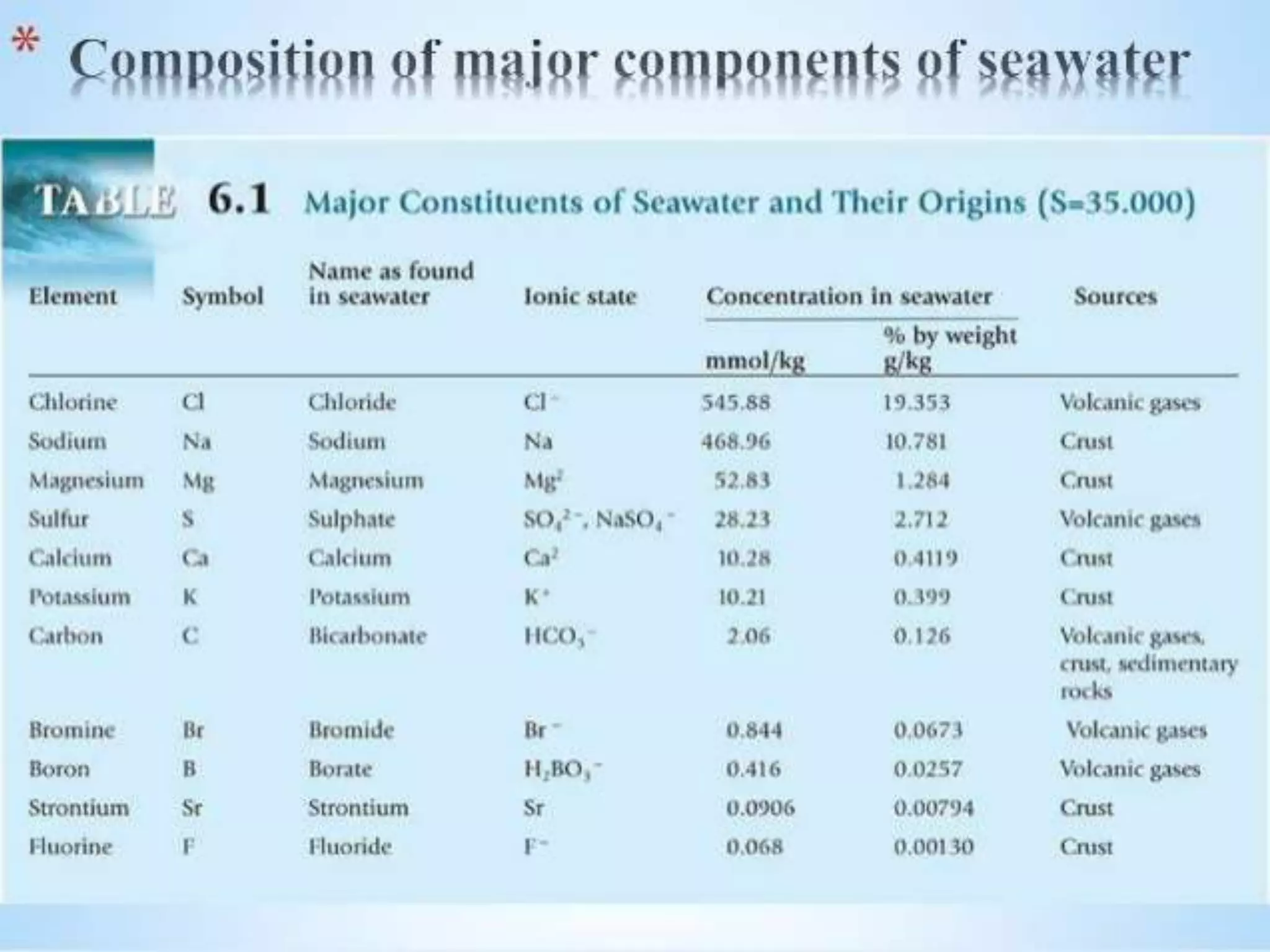
Quantity of components in
1kilogram sea water
Thank you
water
• transparent and nearly colorless chemical
substance.
• main constituent of Earth's streams, lakes, and
oceans.
• fluids of most living organisms.
• chemical formula is H2O.

oceanography: waterland, oceans and water, composition of ocean water

  • 1.
  • 2.
  • 3.
    Some basic info.about oceanography • Founder of Oceanography is unknown. • Can also referred as “oceanology” and “marine science”. • In short, oceanography is a science that deals with the ocean. • It is a science that deals with the oceans and includes the delimitation of their extent and depth, the physics and chemistry of their waters, marine biology, and the exploitation of their resources.
  • 4.
    World land andwater bodies
  • 5.
    World land andwater bodies • Earth is referred as “Blue planet” of the galaxy. • 71 percent of the Earth's surface is covered with water (known as ocean, Sea, rivers, ponds, lakes, etc.) • the land has its contribution of 29% (including islands, continents, etc.)
  • 6.
    Earth land • referredas dry land • support agriculture, habitat, and various natural resources
  • 7.
    Water bodies • anysignificant accumulation of water, generally on a planet's surface. • often refers to oceans, seas, and lakes • Most are naturally occurring geographical features (e.g, ocean,sea,river etc) • some are artificial (e.g, canal, ponds, lakes etc)
  • 9.
  • 10.
    Origin of theocean - Earth is about 4.5 billion years old but oceans are 3.8 billion years old. Main theories describing how oceans are created:- 1: Earth was formed with water and that this water come from the inside out 2: Earth was dry planet with brought here by other sources via meteorite impacts
  • 11.
    Formation of oceangoes from 3 phases -initially there was only water vapor in atmosphere -Air and ground surface too hot for liquid -Cooling of atmosphere led to condensation and rain -Ground surface still too hot for pooling -Further cooling of the ground surface finally led to accumulation of liquid water on surface
  • 21.
  • 22.
  • 23.
    Name of theocean • there are 5 oceans. These are – 1. Pacific ocean 2. Indian ocean 3. Atlantic ocean 4. Arctic ocean 5. Antarctic ocean
  • 24.
    Pacific ocean • Namewas coined by Portuguese explorer fardinand magellan • Came from “mar pacifico” means peaceful sea • Largest ocean • Covers one-third of the earth surface • Area 161.2×10⁶ km2 • Mean depth 4280 meters • The deepest point Mariana trench • Equator subdivides into north Pacific Ocean and South Pacific Ocean
  • 25.
  • 26.
    Atlantic ocean • 2ndlargest ocean • area 106.5×10⁶ km2 • Atlantis thalassa 'the Atlantis sea’ where the name refers to "the sea beyond the pillars of Heracles" which is said to be part of the ocean that surrounds all land. • the Age of Discovery, the Atlantic was also known to English cartographers as the Great Western basin • Mean depth 3646 m where maximum depth 8486m • S-shaped basin extending longitudinally between Eurasia and Africa to the east, and the Americas to the west
  • 27.
  • 28.
    Indian ocean • Thirdlargest ocean • Named after india • known as Ratnākara • Area 7.056×10⁶km2 • bounded by Asia on the north, on the west by Africa, on the east by Australia, and on the south by the Southern Ocean • Mean depth is 3,741 m and maximum depth is 7906 m
  • 29.
  • 30.
    Southern ocean • Knownas the Antarctic ocean or the austral ocean • Generally taken to the 60˚S latitude • Fourth largest ocean • Southern Ocean encompasses the South Pole. • Average depth 3962 meters to 4999 meters • Deepest part is south sandwich trench that is 7235 meters • home to 90% of the world's ice. • the windiest, driest and coldest continent in the world. • area 20.33×10⁶ sq. km.
  • 31.
  • 32.
    Arctic ocean • Someoceanographers call it the Arctic Mediterranean Sea, classifying it a mediterranean sea or an estuary of the Atlantic Ocean • Smallest and shallowest ocean of the world • Also called Arctic Mediterranean sea • Located ate mostly in the northern hemisphere • Area 14×106 sq. km • Mean depth 1038m • salinity is the lowest on average of the five major oceans
  • 33.
  • 34.
  • 35.
    Components of oceanwater Manly divided into two types: 1)Water 2) Salts The other components are:- • Solids • Colloids • Dissolved solutes • gases
  • 37.
    Quantity of componentsin 1kilogram sea water
  • 39.
  • 41.
    water • transparent andnearly colorless chemical substance. • main constituent of Earth's streams, lakes, and oceans. • fluids of most living organisms. • chemical formula is H2O.