1
PRESENTED BY:
VISHAKHA CHODANKAR
ROLL NO: 03
OCEANOGRAPHIC INSTRUMENTS
22
DEFINITION
Oceanographic instruments are devices that allows for the
measurement of one or more properties of seawater in situ.
2
33
TOPICS TO BE COVERED
Secchi disc
Stempel’s pipette
Remote sensing and satellite imaging
Underwater photography
SCUBA apparatus
4
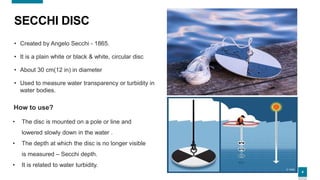
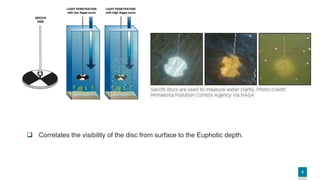
SECCHI DISC
• Created by Angelo Secchi - 1865.
• It is a plain white or black & white, circular disc
• About 30 cm(12 in) in diameter
• Used to measure water transparency or turbidity in
water bodies.
• The disc is mounted on a pole or line and
lowered slowly down in the water .
• The depth at which the disc is no longer visible
is measured – Secchi depth.
• It is related to water turbidity.
How to use?
5
 Correlates the visibility of the disc from surface to the Euphotic depth.
6
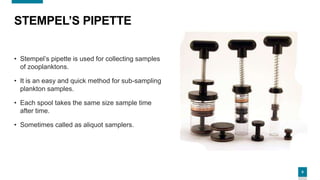
STEMPEL’S PIPETTE
• Stempel’s pipette is used for collecting samples
of zooplanktons.
• It is an easy and quick method for sub-sampling
plankton samples.
• Each spool takes the same size sample time
after time.
• Sometimes called as aliquot samplers.
7
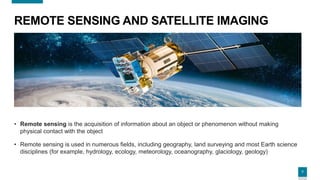
REMOTE SENSING AND SATELLITE IMAGING
• Remote sensing is the acquisition of information about an object or phenomenon without making
physical contact with the object
• Remote sensing is used in numerous fields, including geography, land surveying and most Earth science
disciplines (for example, hydrology, ecology, meteorology, oceanography, glaciology, geology)
8
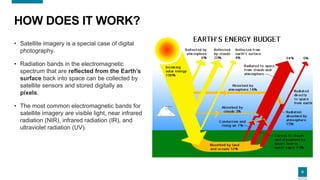
HOW DOES IT WORK?
• Satellite imagery is a special case of digital
photography.
• Radiation bands in the electromagnetic
spectrum that are reflected from the Earth’s
surface back into space can be collected by
satellite sensors and stored digitally as
pixels.
• The most common electromagnetic bands for
satellite imagery are visible light, near infrared
radiation (NIR), infrared radiation (IR), and
ultraviolet radiation (UV).
9
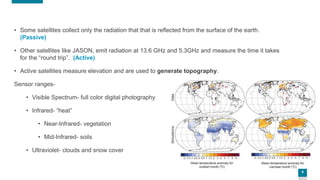
• Some satellites collect only the radiation that that is reflected from the surface of the earth.
(Passive)
• Other satellites like JASON, emit radiation at 13.6 GHz and 5.3GHz and measure the time it takes
for the “round trip”. (Active)
• Active satellites measure elevation and are used to generate topography.
Sensor ranges-
• Visible Spectrum- full color digital photography
• Infrared- “heat”
• Near-Infrared- vegetation
• Mid-Infrared- soils
• Ultraviolet- clouds and snow cover
10
ADVANTAGES
• Remote sensing makes it possible to collect data of dangerous or inaccessible
areas.
• Remote sensing applications include monitoring deforestation in areas such
as the Amazon Basin, glacial features in Arctic and Antarctic regions,
and depth sounding of coastal and ocean depths.
• It provides researchers with enough information to monitor trends such as El
Niño and other natural long and short term phenomena.
• Remote sensing also replaces costly and slow data collection on the
ground, ensuring in the process that areas or objects are not disturbed.
1111
UNDERWATER
PHOTOGRAPHY
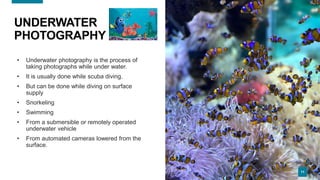
• Underwater photography is the process of
taking photographs while under water.
• It is usually done while scuba diving.
• But can be done while diving on surface
supply
• Snorkeling
• Swimming
• From a submersible or remotely operated
underwater vehicle
• From automated cameras lowered from the
surface.
11
12
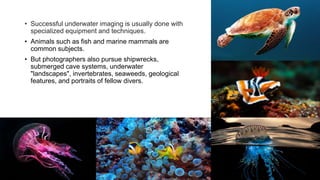
• Successful underwater imaging is usually done with
specialized equipment and techniques.
• Animals such as fish and marine mammals are
common subjects.
• But photographers also pursue shipwrecks,
submerged cave systems, underwater
"landscapes", invertebrates, seaweeds, geological
features, and portraits of fellow divers.
13
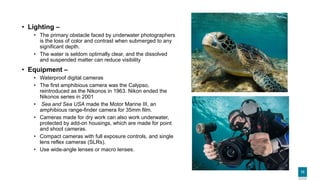
• Lighting –
• The primary obstacle faced by underwater photographers
is the loss of color and contrast when submerged to any
significant depth.
• The water is seldom optimally clear, and the dissolved
and suspended matter can reduce visibility
• Equipment –
• Waterproof digital cameras
• The first amphibious camera was the Calypso,
reintroduced as the Nikonos in 1963. Nikon ended the
Nikonos series in 2001
• Sea and Sea USA made the Motor Marine III, an
amphibious range-finder camera for 35mm film.
• Cameras made for dry work can also work underwater,
protected by add-on housings, which are made for point
and shoot cameras.
• Compact cameras with full exposure controls, and single
lens reflex cameras (SLRs).
• Use wide-angle lenses or macro lenses.
14
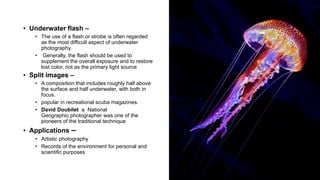
• Underwater flash –
• The use of a flash or strobe is often regarded
as the most difficult aspect of underwater
photography.
• Generally, the flash should be used to
supplement the overall exposure and to restore
lost color, not as the primary light source
• Split images –
• A composition that includes roughly half above
the surface and half underwater, with both in
focus.
• popular in recreational scuba magazines.
• David Doubilet a National
Geographic photographer was one of the
pioneers of the traditional technique
• Applications –
• Artistic photography
• Records of the environment for personal and
scientific purposes
15
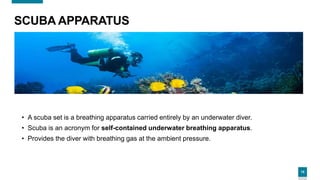
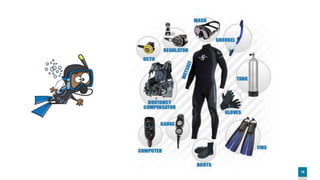
SCUBA APPARATUS
• A scuba set is a breathing apparatus carried entirely by an underwater diver.
• Scuba is an acronym for self-contained underwater breathing apparatus.
• Provides the diver with breathing gas at the ambient pressure.
16
17
REFERENCES
• Websites –
• http://www.coastalwiki.org/wiki/Oceanographic_instrument
• https://www.nalms.org/secchidipin/monitoring-methods/the-secchi-disk/what-is-a-
secchi-disk/
• https://en.wikipedia.org/wiki/Secchi_disk
• https://en.wikipedia.org/wiki/Remote_sensing#Satellites
• https://en.wikipedia.org/wiki/Scuba_set#Hazards_and_safety
• https://en.wikipedia.org/wiki/Underwater_photography
• Satellite imagery and remote sensing ppt – by D. Whitaker
18
THANK YOU

Oceanographic instruments

  • 1.
    1 PRESENTED BY: VISHAKHA CHODANKAR ROLLNO: 03 OCEANOGRAPHIC INSTRUMENTS
  • 2.
    22 DEFINITION Oceanographic instruments aredevices that allows for the measurement of one or more properties of seawater in situ. 2
  • 3.
    33 TOPICS TO BECOVERED Secchi disc Stempel’s pipette Remote sensing and satellite imaging Underwater photography SCUBA apparatus
  • 4.
    4 SECCHI DISC • Createdby Angelo Secchi - 1865. • It is a plain white or black & white, circular disc • About 30 cm(12 in) in diameter • Used to measure water transparency or turbidity in water bodies. • The disc is mounted on a pole or line and lowered slowly down in the water . • The depth at which the disc is no longer visible is measured – Secchi depth. • It is related to water turbidity. How to use?
  • 5.
    5  Correlates thevisibility of the disc from surface to the Euphotic depth.
  • 6.
    6 STEMPEL’S PIPETTE • Stempel’spipette is used for collecting samples of zooplanktons. • It is an easy and quick method for sub-sampling plankton samples. • Each spool takes the same size sample time after time. • Sometimes called as aliquot samplers.
  • 7.
    7 REMOTE SENSING ANDSATELLITE IMAGING • Remote sensing is the acquisition of information about an object or phenomenon without making physical contact with the object • Remote sensing is used in numerous fields, including geography, land surveying and most Earth science disciplines (for example, hydrology, ecology, meteorology, oceanography, glaciology, geology)
  • 8.
    8 HOW DOES ITWORK? • Satellite imagery is a special case of digital photography. • Radiation bands in the electromagnetic spectrum that are reflected from the Earth’s surface back into space can be collected by satellite sensors and stored digitally as pixels. • The most common electromagnetic bands for satellite imagery are visible light, near infrared radiation (NIR), infrared radiation (IR), and ultraviolet radiation (UV).
  • 9.
    9 • Some satellitescollect only the radiation that that is reflected from the surface of the earth. (Passive) • Other satellites like JASON, emit radiation at 13.6 GHz and 5.3GHz and measure the time it takes for the “round trip”. (Active) • Active satellites measure elevation and are used to generate topography. Sensor ranges- • Visible Spectrum- full color digital photography • Infrared- “heat” • Near-Infrared- vegetation • Mid-Infrared- soils • Ultraviolet- clouds and snow cover
  • 10.
    10 ADVANTAGES • Remote sensingmakes it possible to collect data of dangerous or inaccessible areas. • Remote sensing applications include monitoring deforestation in areas such as the Amazon Basin, glacial features in Arctic and Antarctic regions, and depth sounding of coastal and ocean depths. • It provides researchers with enough information to monitor trends such as El Niño and other natural long and short term phenomena. • Remote sensing also replaces costly and slow data collection on the ground, ensuring in the process that areas or objects are not disturbed.
  • 11.
    1111 UNDERWATER PHOTOGRAPHY • Underwater photographyis the process of taking photographs while under water. • It is usually done while scuba diving. • But can be done while diving on surface supply • Snorkeling • Swimming • From a submersible or remotely operated underwater vehicle • From automated cameras lowered from the surface. 11
  • 12.
    12 • Successful underwaterimaging is usually done with specialized equipment and techniques. • Animals such as fish and marine mammals are common subjects. • But photographers also pursue shipwrecks, submerged cave systems, underwater "landscapes", invertebrates, seaweeds, geological features, and portraits of fellow divers.
  • 13.
    13 • Lighting – •The primary obstacle faced by underwater photographers is the loss of color and contrast when submerged to any significant depth. • The water is seldom optimally clear, and the dissolved and suspended matter can reduce visibility • Equipment – • Waterproof digital cameras • The first amphibious camera was the Calypso, reintroduced as the Nikonos in 1963. Nikon ended the Nikonos series in 2001 • Sea and Sea USA made the Motor Marine III, an amphibious range-finder camera for 35mm film. • Cameras made for dry work can also work underwater, protected by add-on housings, which are made for point and shoot cameras. • Compact cameras with full exposure controls, and single lens reflex cameras (SLRs). • Use wide-angle lenses or macro lenses.
  • 14.
    14 • Underwater flash– • The use of a flash or strobe is often regarded as the most difficult aspect of underwater photography. • Generally, the flash should be used to supplement the overall exposure and to restore lost color, not as the primary light source • Split images – • A composition that includes roughly half above the surface and half underwater, with both in focus. • popular in recreational scuba magazines. • David Doubilet a National Geographic photographer was one of the pioneers of the traditional technique • Applications – • Artistic photography • Records of the environment for personal and scientific purposes
  • 15.
    15 SCUBA APPARATUS • Ascuba set is a breathing apparatus carried entirely by an underwater diver. • Scuba is an acronym for self-contained underwater breathing apparatus. • Provides the diver with breathing gas at the ambient pressure.
  • 16.
  • 17.
    17 REFERENCES • Websites – •http://www.coastalwiki.org/wiki/Oceanographic_instrument • https://www.nalms.org/secchidipin/monitoring-methods/the-secchi-disk/what-is-a- secchi-disk/ • https://en.wikipedia.org/wiki/Secchi_disk • https://en.wikipedia.org/wiki/Remote_sensing#Satellites • https://en.wikipedia.org/wiki/Scuba_set#Hazards_and_safety • https://en.wikipedia.org/wiki/Underwater_photography • Satellite imagery and remote sensing ppt – by D. Whitaker
  • 18.