Certifying (RISC) Machine
Code Safe from Aliasing
Peter T. Breuer
University of Birmingham, UK
Jonathan P. Bowen
London South Bank University, UK
Little and Large Problem
● Small arithmetic unit, embedded processor
– 40 bit arithmetic
● Large memory unit
– 64 bit addressing
● What do we do with the extra wires?
Hardware Aliasing
● What happens to the extra wires?
– depends on the hardware
● 4 + 0xfffffffffffffffc =
0x0000000000000000 or
0xfffff00000000000 ?
● Both mean 0
– If use arithmetic to calculate address 0
● Sometimes get the 0 you want
● Sometimes not!
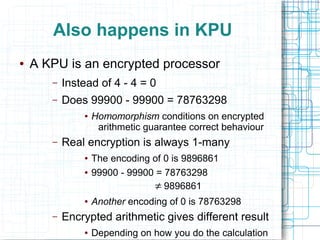
Also happens in KPU
● A KPU is an encrypted processor
– Instead of 4 - 4 = 0
– Does 99900 - 99900 = 78763298
● Homomorphism conditions on encrypted
arithmetic guarantee correct behaviour
– Real encryption is always 1-many
● The encoding of 0 is 9896861
● 99900 - 99900 = 78763298
 9896861
● Another encoding of 0 is 78763298
– Encrypted arithmetic gives different result
● Depending on how you do the calculation
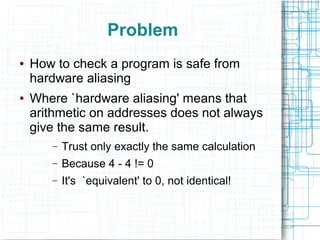
Problem
● How to check a program is safe from
hardware aliasing
● Where `hardware aliasing' means that
arithmetic on addresses does not always
give the same result.
– Trust only exactly the same calculation
– Because 4 - 4 != 0
– It's `equivalent' to 0, not identical!
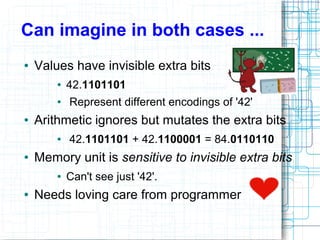
Can imagine in both cases ...
● Values have invisible extra bits
● 42.1101101
● Represent different encodings of '42'
● Arithmetic ignores but mutates the extra bits
● 42.1101101 + 42.1100001 = 84.0110110
● Memory unit is sensitive to invisible extra bits
● Can't see just '42'.
● Needs loving care from programmer
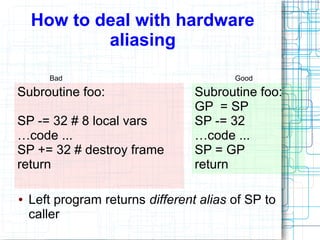
How to deal with hardware
aliasing
● Left program returns different alias of SP to
caller
Subroutine foo:
SP -= 32 # 8 local vars
…code ...
SP += 32 # destroy frame
return
Subroutine foo:
GP = SP
SP -= 32
…code ...
SP = GP
return
GoodBad
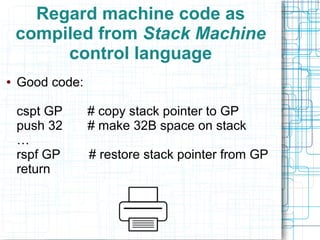
Regard machine code as
compiled from Stack Machine
control language
● Good code:
cspt GP # copy stack pointer to GP
push 32 # make 32B space on stack
…
rspf GP # restore stack pointer from GP
return
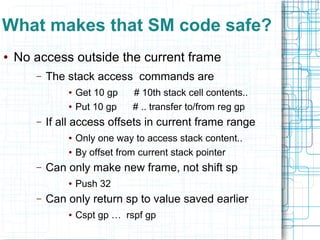
What makes that SM code safe?
● No access outside the current frame
– The stack access commands are
● Get 10 gp # 10th stack cell contents..
● Put 10 gp # .. transfer to/from reg gp
– If all access offsets in current frame range
● Only one way to access stack content..
● By offset from current stack pointer
– Can only make new frame, not shift sp
● Push 32
– Can only return sp to value saved earlier
● Cspt gp … rspf gp
Heap access
● Deal with that later!
– Look for array and string treatment in text
Verifying SM code
● Means verifying that all stack accesses
are within the current frame boundary
● That's so easy! Check n in 'get n r'.
● But we have machine code, not SM code!
Machine code looks like this
● Mov gp sp # cspt gp
Addi sp sp -32 # push 32
…
mov sp gp # rspf gp
jr ra # return
● Is it compiled from safe SM code?
To prove m/c safe
● Apply Hoare-like rules of reasoning
– Whose names are the SM code that the
m/c is supposed to be compiled from
● Requires human being to chose rule
– Or an automaton to search solution space
– Either way, it's deduction-guided
disassembly
Example
● Think about a 32B current frame
{ sp=c32
!10; (10)=x }
ld gp 10(sp) [get 10 gp]
{sp=c32
!10; (10)=gp=x}
●
'c32
!10' means pointer to 32B
– Already written at offset 10
● (10)=x means stack cell 10 has an x-thing
● Machine code is 'ld gp 10(sp)'
– Load reg gp from offset 10 from stack ptr
● Name of the rule is 'get 10 gp'
Types
● Logic is based on stack machine model
– manipulates types in register/stack/heap
●
C32
– pointer to stack frame of size 32
– Only access by bounded offset from ptr
●
U10
– array of size 10 on heap
– Can only access by offset from fixed base
●
C1
- string accessed in increments of 1
– String is like a stack of frames size 1
– Stepping up `pops one off the stack'
– Access within `current frame' only
Typing
● Milner typing
– Assign type variables to every register
and stack position within current frame
– Calculate effect of instructions
– Ambiguous modulo assignment of rule
● Equals dis-assembly of instruction
● Proved – soundness
– Assigned types say what really happens
Other Proved Things
● Termination
– Milner algorithm terminates
– With a typing, if one exists, errors if not
● Uniqueness
– The type found is unique most general
● For a given annotation
● There are at most 32 valid annotations
– Differ in position of stack pointer register
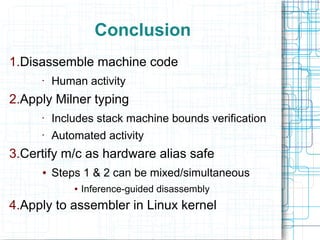
Conclusion
1.Disassemble machine code
• Human activity
2.Apply Milner typing
• Includes stack machine bounds verification
• Automated activity
3.Certify m/c as hardware alias safe
● Steps 1 & 2 can be mixed/simultaneous
● Inference-guided disassembly
4.Apply to assembler in Linux kernel

Certifying (RISC) Machine Code Safe from Aliasing (OpenCert 2013)

  • 1.
    Certifying (RISC) Machine CodeSafe from Aliasing Peter T. Breuer University of Birmingham, UK Jonathan P. Bowen London South Bank University, UK
  • 2.
    Little and LargeProblem ● Small arithmetic unit, embedded processor – 40 bit arithmetic ● Large memory unit – 64 bit addressing ● What do we do with the extra wires?
  • 3.
    Hardware Aliasing ● Whathappens to the extra wires? – depends on the hardware ● 4 + 0xfffffffffffffffc = 0x0000000000000000 or 0xfffff00000000000 ? ● Both mean 0 – If use arithmetic to calculate address 0 ● Sometimes get the 0 you want ● Sometimes not!
  • 4.
    Also happens inKPU ● A KPU is an encrypted processor – Instead of 4 - 4 = 0 – Does 99900 - 99900 = 78763298 ● Homomorphism conditions on encrypted arithmetic guarantee correct behaviour – Real encryption is always 1-many ● The encoding of 0 is 9896861 ● 99900 - 99900 = 78763298  9896861 ● Another encoding of 0 is 78763298 – Encrypted arithmetic gives different result ● Depending on how you do the calculation
  • 5.
    Problem ● How tocheck a program is safe from hardware aliasing ● Where `hardware aliasing' means that arithmetic on addresses does not always give the same result. – Trust only exactly the same calculation – Because 4 - 4 != 0 – It's `equivalent' to 0, not identical!
  • 6.
    Can imagine inboth cases ... ● Values have invisible extra bits ● 42.1101101 ● Represent different encodings of '42' ● Arithmetic ignores but mutates the extra bits ● 42.1101101 + 42.1100001 = 84.0110110 ● Memory unit is sensitive to invisible extra bits ● Can't see just '42'. ● Needs loving care from programmer
  • 7.
    How to dealwith hardware aliasing ● Left program returns different alias of SP to caller Subroutine foo: SP -= 32 # 8 local vars …code ... SP += 32 # destroy frame return Subroutine foo: GP = SP SP -= 32 …code ... SP = GP return GoodBad
  • 8.
    Regard machine codeas compiled from Stack Machine control language ● Good code: cspt GP # copy stack pointer to GP push 32 # make 32B space on stack … rspf GP # restore stack pointer from GP return
  • 9.
    What makes thatSM code safe? ● No access outside the current frame – The stack access commands are ● Get 10 gp # 10th stack cell contents.. ● Put 10 gp # .. transfer to/from reg gp – If all access offsets in current frame range ● Only one way to access stack content.. ● By offset from current stack pointer – Can only make new frame, not shift sp ● Push 32 – Can only return sp to value saved earlier ● Cspt gp … rspf gp
  • 10.
    Heap access ● Dealwith that later! – Look for array and string treatment in text
  • 11.
    Verifying SM code ●Means verifying that all stack accesses are within the current frame boundary ● That's so easy! Check n in 'get n r'. ● But we have machine code, not SM code!
  • 12.
    Machine code lookslike this ● Mov gp sp # cspt gp Addi sp sp -32 # push 32 … mov sp gp # rspf gp jr ra # return ● Is it compiled from safe SM code?
  • 13.
    To prove m/csafe ● Apply Hoare-like rules of reasoning – Whose names are the SM code that the m/c is supposed to be compiled from ● Requires human being to chose rule – Or an automaton to search solution space – Either way, it's deduction-guided disassembly
  • 14.
    Example ● Think abouta 32B current frame { sp=c32 !10; (10)=x } ld gp 10(sp) [get 10 gp] {sp=c32 !10; (10)=gp=x} ● 'c32 !10' means pointer to 32B – Already written at offset 10 ● (10)=x means stack cell 10 has an x-thing ● Machine code is 'ld gp 10(sp)' – Load reg gp from offset 10 from stack ptr ● Name of the rule is 'get 10 gp'
  • 15.
    Types ● Logic isbased on stack machine model – manipulates types in register/stack/heap ● C32 – pointer to stack frame of size 32 – Only access by bounded offset from ptr ● U10 – array of size 10 on heap – Can only access by offset from fixed base ● C1 - string accessed in increments of 1 – String is like a stack of frames size 1 – Stepping up `pops one off the stack' – Access within `current frame' only
  • 16.
    Typing ● Milner typing –Assign type variables to every register and stack position within current frame – Calculate effect of instructions – Ambiguous modulo assignment of rule ● Equals dis-assembly of instruction ● Proved – soundness – Assigned types say what really happens
  • 17.
    Other Proved Things ●Termination – Milner algorithm terminates – With a typing, if one exists, errors if not ● Uniqueness – The type found is unique most general ● For a given annotation ● There are at most 32 valid annotations – Differ in position of stack pointer register
  • 18.
    Conclusion 1.Disassemble machine code •Human activity 2.Apply Milner typing • Includes stack machine bounds verification • Automated activity 3.Certify m/c as hardware alias safe ● Steps 1 & 2 can be mixed/simultaneous ● Inference-guided disassembly 4.Apply to assembler in Linux kernel