Abstract Interpretation meets model
checking near the 1000000 LOC
mark
- Finding errors in the Linux Kernel
Source
Peter T. Breuer & Simon Pickin
Universidad Carlos III de Madrid
Goal
•
Apply
Formal Methods
to the
Linux kernel
•
Methods must be
➢ post-hoc
➢ capable of application by non-experts
➢ able to handle 6.5 millions of lines of
rapidly changing C code
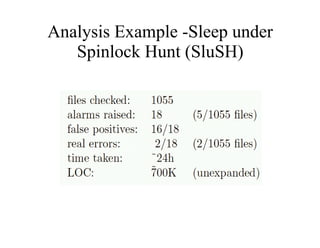
Analysis Example -Sleep under
Spinlock Hunt (SluSH)
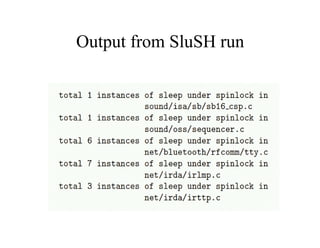
Output from SluSH run
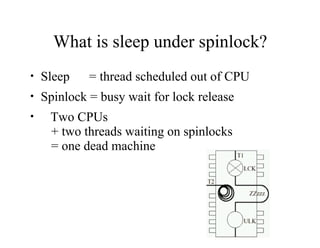
What is sleep under spinlock?
• Sleep = thread scheduled out of CPU
• Spinlock = busy wait for lock release
• Two CPUs
+ two threads waiting on spinlocks
= one dead machine
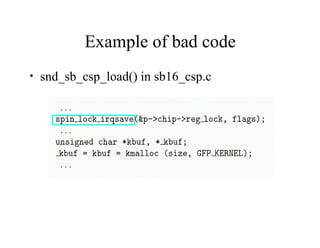
Example of bad code
• snd_sb_csp_load() in sb16_csp.c
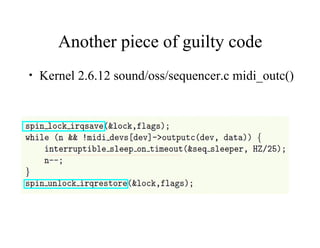
Another piece of guilty code
• Kernel 2.6.12 sound/oss/sequencer.c midi_outc()
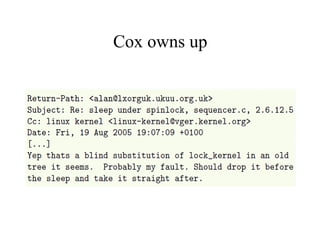
Cox owns up
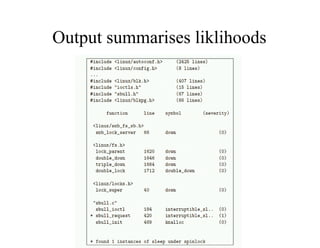
Output summarises liklihoods
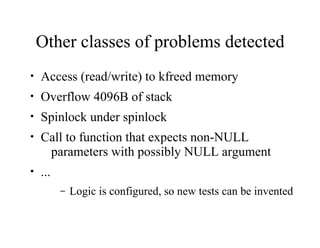
Other classes of problems detected
• Access (read/write) to kfreed memory
• Overflow 4096B of stack
• Spinlock under spinlock
• Call to function that expects non-NULL
parameters with possibly NULL argument
• ...
– Logic is configured, so new tests can be invented
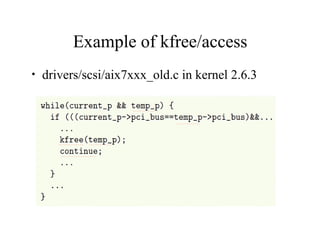
Example of kfree/access
• drivers/scsi/aix7xxx_old.c in kernel 2.6.3
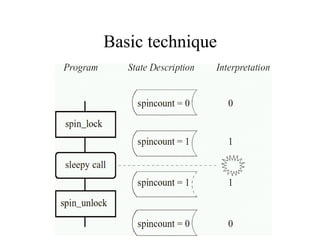
Basic technique
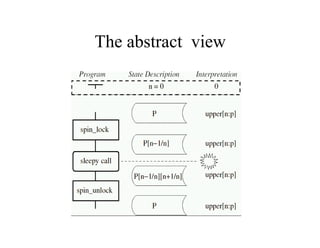
The abstract view
Components of analysis system
• Description of statements as logic transformers
– p .... p[n-1/n]
• Trigger/action system for raising alarms!
• Combining logic NRB
• Guiding abstract interpretation s to state x
x ∈s ∩ p
stops dead code evaluation, etc.
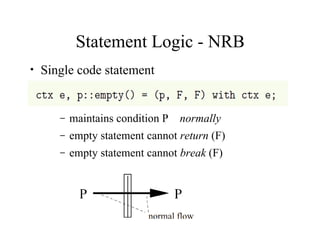
Statement Logic - NRB
• Single code statement
– maintains condition P normally
– empty statement cannot return (F)
– empty statement cannot break (F)
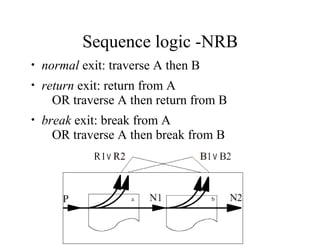
Sequence logic -NRB
• normal exit: traverse A then B
• return exit: return from A
OR traverse A then return from B
• break exit: break from A
OR traverse A then break from B
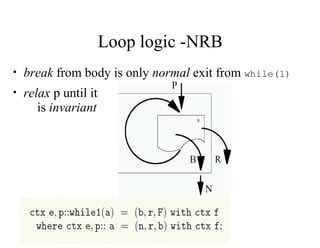
Loop logic -NRB
• break from body is only normal exit from while(1)
• relax p until it
is invariant
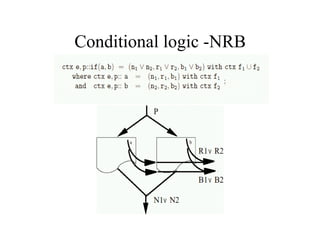
Conditional logic -NRB
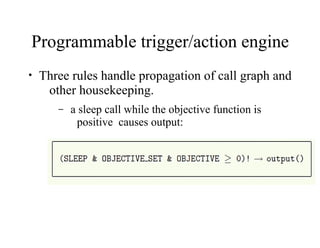
Programmable trigger/action engine
• Three rules handle propagation of call graph and
other housekeeping.
– a sleep call while the objective function is
positive causes output:
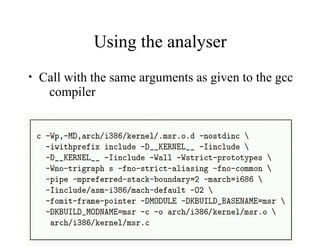
Using the analyser
• Call with the same arguments as given to the gcc
compiler
Limitations
• Predicates are restricted to unions of n-cubes
• State is not followed well enough:
– x = 1; if (x) A else B;
● treated correctly - only A is evaluated
– if (x) A else B; if (x) C else D;
● over-abstracted - A;C | A;D | B;C | B;D
– possible solution is to push state into the
predicates
((x!=0);A | (x==0);B) ; ((x!=0);C | (x==0);D)
● but we can't follow calculation well - quickly get
to 
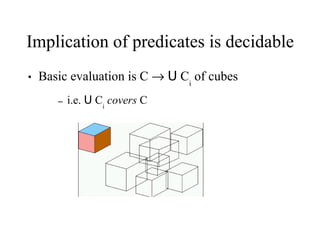
Implication of predicates is decidable
• Basic evaluation is C  U Ci
of cubes
– i.e. U Ci
covers C
Summary
• A step towards analyses of 100MLoC.
– No expertise needed
– Fast
– Copes with massive amounts of code
– Soundly based
• Negatives
– Not good tracking program state; model
checking?
– Not yet easy to extend to new problem classes

Abstract Interpretation meets model checking near the 1000000 LOC mark: Finding errors in the Linux Kernel Source (AVIS '06)

  • 1.
    Abstract Interpretation meetsmodel checking near the 1000000 LOC mark - Finding errors in the Linux Kernel Source Peter T. Breuer & Simon Pickin Universidad Carlos III de Madrid
  • 2.
    Goal • Apply Formal Methods to the Linuxkernel • Methods must be ➢ post-hoc ➢ capable of application by non-experts ➢ able to handle 6.5 millions of lines of rapidly changing C code
  • 3.
    Analysis Example -Sleepunder Spinlock Hunt (SluSH)
  • 4.
  • 5.
    What is sleepunder spinlock? • Sleep = thread scheduled out of CPU • Spinlock = busy wait for lock release • Two CPUs + two threads waiting on spinlocks = one dead machine
  • 6.
    Example of badcode • snd_sb_csp_load() in sb16_csp.c
  • 7.
    Another piece ofguilty code • Kernel 2.6.12 sound/oss/sequencer.c midi_outc()
  • 8.
  • 9.
  • 10.
    Other classes ofproblems detected • Access (read/write) to kfreed memory • Overflow 4096B of stack • Spinlock under spinlock • Call to function that expects non-NULL parameters with possibly NULL argument • ... – Logic is configured, so new tests can be invented
  • 11.
    Example of kfree/access •drivers/scsi/aix7xxx_old.c in kernel 2.6.3
  • 12.
  • 13.
  • 14.
    Components of analysissystem • Description of statements as logic transformers – p .... p[n-1/n] • Trigger/action system for raising alarms! • Combining logic NRB • Guiding abstract interpretation s to state x x ∈s ∩ p stops dead code evaluation, etc.
  • 15.
    Statement Logic -NRB • Single code statement – maintains condition P normally – empty statement cannot return (F) – empty statement cannot break (F)
  • 16.
    Sequence logic -NRB •normal exit: traverse A then B • return exit: return from A OR traverse A then return from B • break exit: break from A OR traverse A then break from B
  • 17.
    Loop logic -NRB •break from body is only normal exit from while(1) • relax p until it is invariant
  • 18.
  • 19.
    Programmable trigger/action engine •Three rules handle propagation of call graph and other housekeeping. – a sleep call while the objective function is positive causes output:
  • 20.
    Using the analyser •Call with the same arguments as given to the gcc compiler
  • 21.
    Limitations • Predicates arerestricted to unions of n-cubes • State is not followed well enough: – x = 1; if (x) A else B; ● treated correctly - only A is evaluated – if (x) A else B; if (x) C else D; ● over-abstracted - A;C | A;D | B;C | B;D – possible solution is to push state into the predicates ((x!=0);A | (x==0);B) ; ((x!=0);C | (x==0);D) ● but we can't follow calculation well - quickly get to 
  • 22.
    Implication of predicatesis decidable • Basic evaluation is C  U Ci of cubes – i.e. U Ci covers C
  • 23.
    Summary • A steptowards analyses of 100MLoC. – No expertise needed – Fast – Copes with massive amounts of code – Soundly based • Negatives – Not good tracking program state; model checking? – Not yet easy to extend to new problem classes