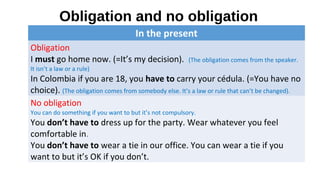
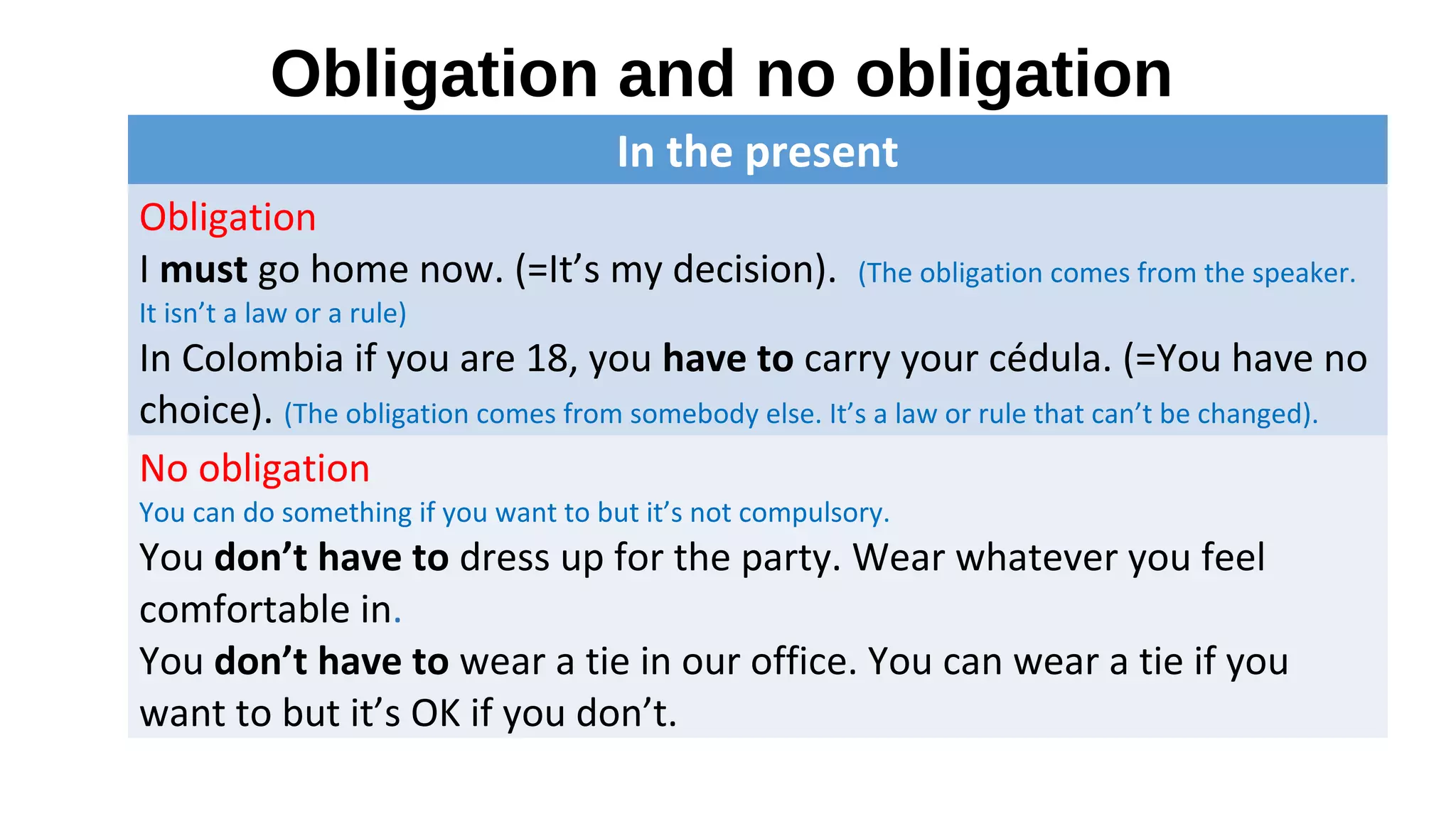
Obligation and no obligation
In the present
Obligation
I must go home now. (=It’s my decision). (The obligation comes from the speaker.
It isn’t a law or a rule)
In Colombia if you are 18, you have to carry your cédula. (=You have no
choice). (The obligation comes from somebody else. It’s a law or rule that can’t be changed).
No obligation
You can do something if you want to but it’s not compulsory.
You don’t have to dress up for the party. Wear whatever you feel
comfortable in.
You don’t have to wear a tie in our office. You can wear a tie if you
want to but it’s OK if you don’t.
Permission and prohibition
In the present
They can / are allowed to vote
We can’t / aren’t allowed to / musn’t speak.
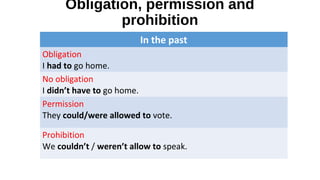
Obligation, permission and
prohibition
In the past
Obligation
I had to go home.
No obligation
I didn’t have to go home.
Permission
They could/were allowed to vote.
Prohibition
We couldn’t / weren’t allow to speak.
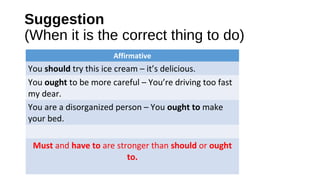
Suggestion
(When it is the correct thing to do)
Affirmative
You should try this ice cream – it’s delicious.
You ought to be more careful – You’re driving too fast
my dear.
You are a disorganized person – You ought to make
your bed.
Must and have to are stronger than should or ought
to.
Rules for Politeness in Different
Countries
• http://www.ba-bamail.com/content.aspx?emailid=17141
Rules for Politeness in Different
Countries
• http://www.ba-bamail.com/content.aspx?emailid=17141

Obligation permission prohibition corregida

  • 1.
    Obligation and noobligation In the present Obligation I must go home now. (=It’s my decision). (The obligation comes from the speaker. It isn’t a law or a rule) In Colombia if you are 18, you have to carry your cédula. (=You have no choice). (The obligation comes from somebody else. It’s a law or rule that can’t be changed). No obligation You can do something if you want to but it’s not compulsory. You don’t have to dress up for the party. Wear whatever you feel comfortable in. You don’t have to wear a tie in our office. You can wear a tie if you want to but it’s OK if you don’t.
  • 2.
    Permission and prohibition Inthe present They can / are allowed to vote We can’t / aren’t allowed to / musn’t speak.
  • 3.
    Obligation, permission and prohibition Inthe past Obligation I had to go home. No obligation I didn’t have to go home. Permission They could/were allowed to vote. Prohibition We couldn’t / weren’t allow to speak.
  • 4.
    Suggestion (When it isthe correct thing to do) Affirmative You should try this ice cream – it’s delicious. You ought to be more careful – You’re driving too fast my dear. You are a disorganized person – You ought to make your bed. Must and have to are stronger than should or ought to.
  • 5.
    Rules for Politenessin Different Countries • http://www.ba-bamail.com/content.aspx?emailid=17141
  • 6.
    Rules for Politenessin Different Countries • http://www.ba-bamail.com/content.aspx?emailid=17141