IELTS and Course introduction
Designed by Professor Alexander Benito
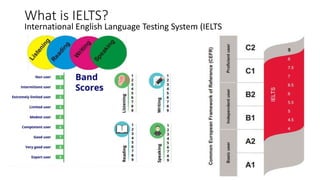
What is IELTS?
International English Language Testing System (IELTS
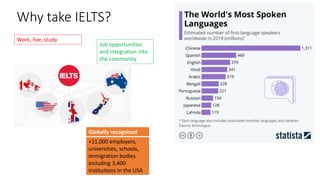
Why take IELTS?
Work, live, study
Job opportunities
and integration into
the community
Globally recognised
+11,000 employers,
universities, schools,
immigration bodies
including 3,400
institutions in the USA
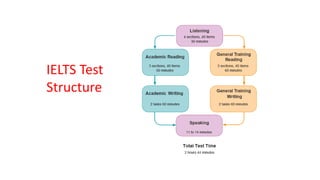
IELTS Test
Structure
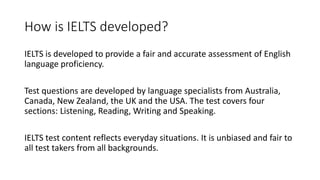
How is IELTS developed?
IELTS is developed to provide a fair and accurate assessment of English
language proficiency.
Test questions are developed by language specialists from Australia,
Canada, New Zealand, the UK and the USA. The test covers four
sections: Listening, Reading, Writing and Speaking.
IELTS test content reflects everyday situations. It is unbiased and fair to
all test takers from all backgrounds.
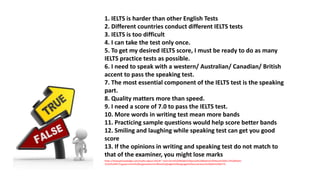
1. IELTS is harder than other English Tests
2. Different countries conduct different IELTS tests
3. IELTS is too difficult
4. I can take the test only once.
5. To get my desired IELTS score, I must be ready to do as many
IELTS practice tests as possible.
6. I need to speak with a western/ Australian/ Canadian/ British
accent to pass the speaking test.
7. The most essential component of the IELTS test is the speaking
part.
8. Quality matters more than speed.
9. I need a score of 7.0 to pass the IELTS test.
10. More words in writing test mean more bands
11. Practicing sample questions would help score better bands
12. Smiling and laughing while speaking test can get you good
score
13. If the opinions in writing and speaking test do not match to
that of the examiner, you might lose marks
https://levelupknowledge.com/myths-about-ielts/#:~:text=Some%20Wide%20Spread%20Myths%20About%20IELTS%20Myth-
1%3A%20IELTS,government%20organizations%20too%20judge%20language%20convenience%20with%20IELTS.
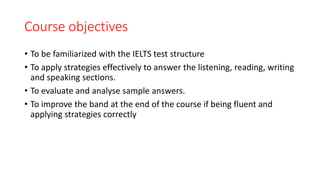
Course objectives
• To be familiarized with the IELTS test structure
• To apply strategies effectively to answer the listening, reading, writing
and speaking sections.
• To evaluate and analyse sample answers.
• To improve the band at the end of the course if being fluent and
applying strategies correctly
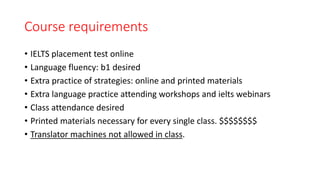
Course requirements
• IELTS placement test online
• Language fluency: b1 desired
• Extra practice of strategies: online and printed materials
• Extra language practice attending workshops and ielts webinars
• Class attendance desired
• Printed materials necessary for every single class. $$$$$$$$
• Translator machines not allowed in class.
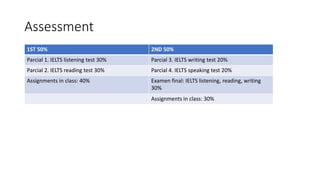
Assessment
1ST 50% 2ND 50%
Parcial 1. IELTS listening test 30% Parcial 3. IELTS writing test 20%
Parcial 2. IELTS reading test 30% Parcial 4. IELTS speaking test 20%
Assignments in class: 40% Examen final: IELTS listening, reading, writing
30%
Assignments in class: 30%

introduction to ielts and course.pptx

  • 1.
    IELTS and Courseintroduction Designed by Professor Alexander Benito
  • 2.
    What is IELTS? InternationalEnglish Language Testing System (IELTS
  • 3.
    Why take IELTS? Work,live, study Job opportunities and integration into the community Globally recognised +11,000 employers, universities, schools, immigration bodies including 3,400 institutions in the USA
  • 5.
  • 6.
    How is IELTSdeveloped? IELTS is developed to provide a fair and accurate assessment of English language proficiency. Test questions are developed by language specialists from Australia, Canada, New Zealand, the UK and the USA. The test covers four sections: Listening, Reading, Writing and Speaking. IELTS test content reflects everyday situations. It is unbiased and fair to all test takers from all backgrounds.
  • 7.
    1. IELTS isharder than other English Tests 2. Different countries conduct different IELTS tests 3. IELTS is too difficult 4. I can take the test only once. 5. To get my desired IELTS score, I must be ready to do as many IELTS practice tests as possible. 6. I need to speak with a western/ Australian/ Canadian/ British accent to pass the speaking test. 7. The most essential component of the IELTS test is the speaking part. 8. Quality matters more than speed. 9. I need a score of 7.0 to pass the IELTS test. 10. More words in writing test mean more bands 11. Practicing sample questions would help score better bands 12. Smiling and laughing while speaking test can get you good score 13. If the opinions in writing and speaking test do not match to that of the examiner, you might lose marks https://levelupknowledge.com/myths-about-ielts/#:~:text=Some%20Wide%20Spread%20Myths%20About%20IELTS%20Myth- 1%3A%20IELTS,government%20organizations%20too%20judge%20language%20convenience%20with%20IELTS.
  • 8.
    Course objectives • Tobe familiarized with the IELTS test structure • To apply strategies effectively to answer the listening, reading, writing and speaking sections. • To evaluate and analyse sample answers. • To improve the band at the end of the course if being fluent and applying strategies correctly
  • 9.
    Course requirements • IELTSplacement test online • Language fluency: b1 desired • Extra practice of strategies: online and printed materials • Extra language practice attending workshops and ielts webinars • Class attendance desired • Printed materials necessary for every single class. $$$$$$$$ • Translator machines not allowed in class.
  • 10.
    Assessment 1ST 50% 2ND50% Parcial 1. IELTS listening test 30% Parcial 3. IELTS writing test 20% Parcial 2. IELTS reading test 30% Parcial 4. IELTS speaking test 20% Assignments in class: 40% Examen final: IELTS listening, reading, writing 30% Assignments in class: 30%