Download to read offline

![Solution
• Solution
public delegate bool IntFilter(int i);
public class Common
{
public static int[] FilterArray(int[] ints, IntFilter filter)
{
ArrayList aList = new ArrayList();
foreach(int I in ints)
{
if(filter(i))
{aList.Add(i);}
}
return((int[])aList.ToArray(typeof(int)));
}
} mmouf@2017](https://image.slidesharecdn.com/intake37linq1-170215162333/75/Intake-37-linq1-4-2048.jpg)
![The Application Code Developer (I)
Class MyApplication
{
public static bool IsOdd(int i)
{
return ((i % 2)==1);
}
public static void Main()
{
int[] nums = {1, 2, 3, 4, 5, 6, 7, 8, 9, 10};
int[] fnum = Common.FilterArray(nums, MyApplication.IsOdd);
foreach(int i in fnum)
Console.WriteLine(i);
}
}
mmouf@2017](https://image.slidesharecdn.com/intake37linq1-170215162333/75/Intake-37-linq1-5-2048.jpg)
![The Application Code Developer Anonymous
method “C#2.0” (II)
Class MyApplication
{
public static void Main()
{
int[] nums = {1, 2, 3, 4, 5, 6, 7, 8, 9, 10};
int[] fnum = Common.FilterArray(nums, delegate(int i)
{return((i%2)==1);});
foreach(int i in fnum)
Console.WriteLine(i);
}
}
mmouf@2017](https://image.slidesharecdn.com/intake37linq1-170215162333/75/Intake-37-linq1-6-2048.jpg)

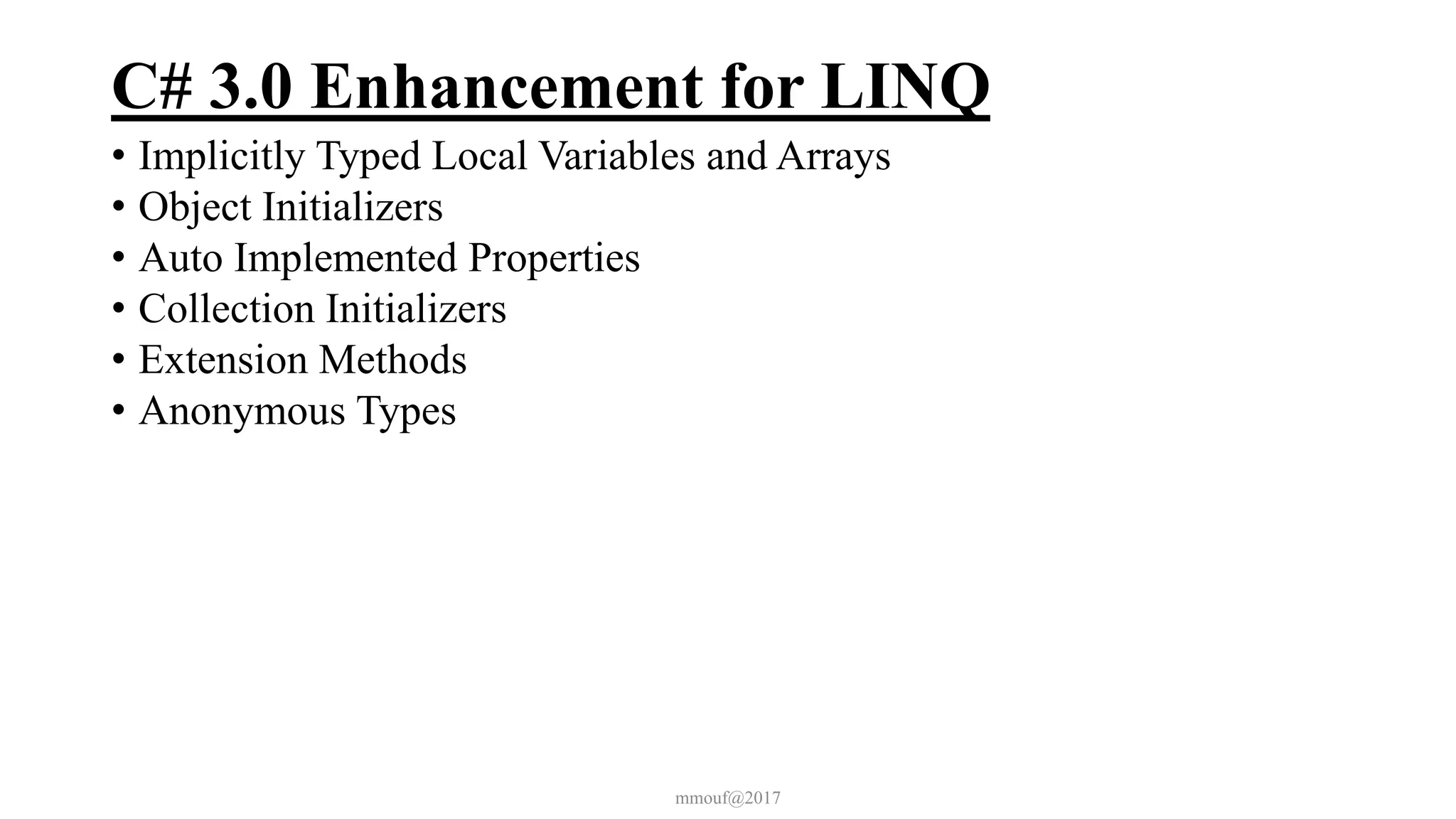
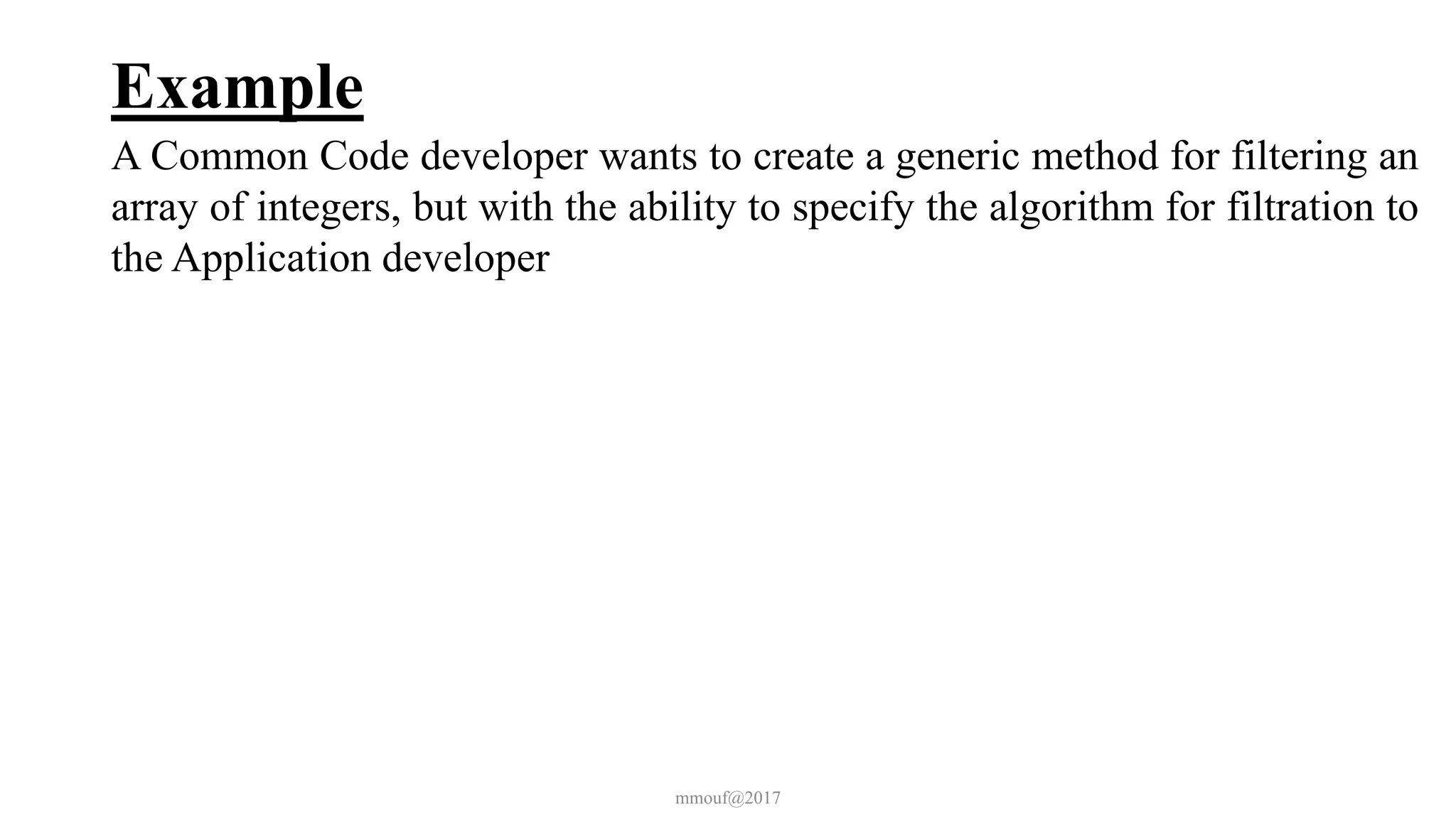
This document discusses Language Integrated Query (LINQ) and some of the C# 3.0 enhancements that support LINQ, such as implicitly typed local variables. It also provides an example of using a delegate and generic method to filter an integer array, allowing the filtering algorithm to be specified by the calling application code. The example shows how an application developer can define a filtering method or use an anonymous method to filter the array to return only odd numbers.


![The Product Owner's Survival Kit - ein Überblick [DE]](https://cdn.slidesharecdn.com/ss_thumbnails/oop2017ndo4productownersurvivalkitmahlbergslideshare-170209124144-thumbnail.jpg?width=640&height=640&fit=bounds)


![Vibe Coding vs. Spec-Driven Development [Free Meetup]](https://cdn.slidesharecdn.com/ss_thumbnails/vibecodingvsspecdrivendevelopment-251209105622-43f455e7-thumbnail.jpg?width=640&height=640&fit=bounds)


