Burden and Prevention of Domestic
injuries and RTA
Dr. Jayaramachandran S
Assistant Professor
Dept. of Community Medicine
MGMCRI
Definition – Accidents
• An unexpected unplanned occurrence which may involve injury
• Unpremeditated event resulting in recognizable damage
• Occurrence in a sequence of events which usually produces
unintended injury, death or property damage
Definition – Injuries
• A bodily lesion due to acute exposure to energy beyond the
physiological tolerance
• In some cases: due to insufficiency of a vital element
• Feeling of preventable nature
Burden
Mortality
• Proportional mortality rate
• No. of deaths / million population
• Death rate / 1000 vehicles per year
• No. of fatalities to no. of vehicles per km or no. of passengers per km
• Deaths of vehicle occupants per 1000 vehicles per year
Burden
Morbidity
• Measured : serious & slight injuries
• Assessed by abbreviated injury scale
• Less reliable because of under reporting and mis-reporting
Burden
Disability
• Can be temporary or permanent
• Usually only the duration is considered
• Psychological and social aspect is neglected
• International classification of impairments, disabilities and
handicapped
Problem – World
• 2008 – RTA – 4th leading cause of death
• 9% of deaths & 16% of disabilities
• Major cause : 10 – 24 yrs
• Unintentional : RTA, Poisoning, falls, fires, drowning, etc
• Intentional : self inflicted, violence, war
RTA trend
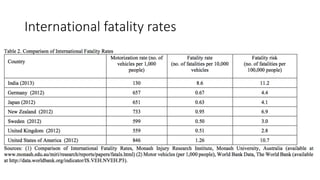
International fatality rates
Age wise distribution of RTA
Sex wise distribution of RTA
78%
14.9%
2% 1.8%
1.4%
1%
0.8%
Cause of Road Accidents in 2013
Fault of the Driver
All other causes
Fault of the Pedistrian
Defect in the condition of the
Motor vehicle
Defect in Road conditions
Unknown
Fault of the cyclist
Problem – India
• Accidents are definitely
increasing
• Increased mechanisation in
agriculture and industry
• Induction of semi-skilled and
unskilled workers
• Rapid increase in vehicular
traffic
• Over crowding
• Lack of awareness
• Poor implementation of safety
mechanism
• Causes – socio economic loss to
individuals, family, society and
country
Problem – India
• Traffic accidents
• Poisoning
• Sudden deaths
• Drowning
• Fire
• Natural calamity
• Falls
• Electrocution
• Explosions
• Fire arms
• Collapse of structures
• Factory / machine accidents
• Killed by animals
• Mines / quarry disaster
• Stampede
• Suffocation
Accidents & Injuries
1. Road traffic accidents
2. Industrial accidents
3. Railway accidents
4. Violence
5. Domestic accidents
• Drowning
• Burns
• Falls
• Poisoning
• Snake bite
1. Road traffic accidents
• 1.24 million die – world
• Every death
• 10 – 20 serious injuries
• 20 – 50 non fatal injuries
• < 25 yrs : 30 % deaths
• Males are more likely
• 46% dying on road are
pedestrians, cyclists and
motorcyclists
• 90% RTA deaths – low & middle
income countries
• Lower SES – in high income
countries are more involved
Risk factors for RTA
• Speed – directly related to impact
• Drunk and driving – < 0.04 g/dl
• Motorcycle helmets – reduces the severity of head injury
• Seat belts – reduces impact
• child restrains – reduces deaths by 70%
• Distracted driving – use of mobile phones, etc
Risk factors for RTA
• Low driving standards
• Widespread disregard of traffic rules
• Defective roads, poor lighting, defective roads and speed breakers
• Unusual behaviour of men & animals
• Pedestrian and animals share the roadways with slow & fast vehicle
• Old poorly maintained vehicles
Multiple causation
Human – 90%
• Age
• Sex
• Education
• Medical conditions
• Fatigue
• Psychological factors
• Lack of body protection
Environment – 10%
• Relating to road
• Relating to vehicle
• Bad weather
• Mixed traffic
Psychological factors
• Lack of experience
• Risk taking
• Impulsiveness
• Defective judgement
• Delay in decision
• Aggressiveness
• Poor perception
• Family dysfunction
Prevention of RTA
1. Data collection
2. Safety education
3. Promotion of safety measures
4. Alcohol and other drugs
5. Primary care
5. Elimination of causative
factors
6. Enforcement of laws
7. Rehabilitation services
8. Accident research
Health of vehicles should
be strictly enforced.
???
Prevention of RTA – Agent
Prevention of RTA – Host
• Road safety awareness from
young age
• Raising of lower age limit to 21.
• Issue of Driving license is to be
made more stringent and
foolproof.
• Helmet should be made
compulsory: Rider & Pillion
• Maintain distance between 2
vehicles
• Heavy Penalty - who cross speed
limits
• Speed limits at accident prone
areas & Cancellation of license
• Vision of old aged driving license
holders should be tested
periodically.
• License of drunkard drivers /
riders should be cancelled
immediately .
Prevention of RTA – Environment
• Roads should be properly
marked.
• Proper road maintenance
• Speed humps with proper signs
• Illumination and road markers
• Advertisements boards should
be installed at curves
• Signals for road crossings at
important busy places.
• Proper sign boards should be
installed.
• Footpaths and medians should
be made mandatory for
important roads.
• Zebra crossings should be
provided for pedestrians for safe
road crossings at appropriate
places.
2. Industrial accidents
• 60 – 80% : agriculture, fisheries, home industries, small scale units
• Majority of them work in unorganised sector
• 1% of deaths & 10% of injuries : agriculture
• Agricultural workers are exposed to
• Physical – machines, sunlight
• Chemical – pesticides
• Biological – animal bites
• Agricultural injury : 116 / 1,00,000 workers
• Serious injuries – mechanised equipment & tractors
Industrial accidents
• Rapid industrialization – morbidity & mortality of many workers
• Manual labour content is high
• Man – machine interaction is unsafe
• Greater emphasis to change the behaviour of workers
• Children & people who are mentally and physically challenged are at
more risk of encountering occupational injuries
3. Railway accidents
• Increase in the no. of trains and passengers – increase in the no. of
accidents and casualties
• The main factor involved in these accidents is human failure
• Ignorance of the public about various safety measures
• Violation of rules
• Unprotected crossing
• Impatience of the public
4. Violence
4. Violence
• World : 15,10,000 people died in 2008
• SEAR : 4,20,000
• Many go unreported or many don’t revel that its because of violence
• Violence behind closed doors goes grossly unreported
• Inspite of low reporting, there is increase in the rate of violence
• Political and religious violence is more common
Violence – Risk Factors
• Exposure to violence
• Acceptance of violence as a mean to solve problem
• Availability of lethal weapons
• Consumption of alcohol and narcotic drugs
5. Domestic accidents
• Drowning
• Burns
• Falls
• Poisoning
• Snake bites
Drowning
5. Domestic accidents – Drowning
• Respiratory impairment from submersion / immersion into liquid
• One of the major public health problem
• 3rd leading cause of unintentional death / injury
• 96% – low & middle income countries
• High mortality rates
• Consciousness lost in 2 min, irreversible brain damage after 5 – 6 min
Drowning – Risk Factors
• Age – under 5 years
• Gender – males
• Access to water
• Infant left unsupervised
• Unsafe or overcrowded transportation vessels with flotation devices
• Alcohol use
• Medical conditions – epilepsy
• Tourist unfamiliar with local water body risks
Drowning – Prevention
• Engineering methods
• Development and implementation of safe water supply / drainage system
• Four sides pool fence for water bodies
• Creating safe water zones for recreation
• Covering of wells
• Emptying buckets & bath tubs and storing them upside down
• Legislation to enforce prevention & assure decreased exposure
• Education for individuals and communities to build awareness risk
and to aid in response if a drowning occurs
Burns
5. Domestic accidents – Burns
• Injury to the skin or other organic tissue primary caused by heat or
due to radiation, radioactivity, electricity, friction or contact with
chemicals
• Thermal burns
• Hot liquids (scalds)
• Hot solids (contact burns)
• Flames (flame burns)
Burns – problem
• Estimated 1 million people are moderately or severly burnt every year
in India.
• Non fatal burns – leading cause of morbidity, including prolonged
hospitalisation, disfigurement and disability, often with resulting
stigma and rejection
Risk Factors
• Gender – females
• Age – adult women, children (11th leading cause of death in children
b/n 1- 9 yrs & 5th MC cause of childhood injuries)
• Socio-economic factors – low & middle income countries
• Occupational exposure
• Poverty, overcrowding, lack of proper safety measures
• Placement of young girls in household roles
Burns – Risk Factors
• Underlying medical condition – epilepsy
• Alcohol abuse & smoking
• Easy access to chemicals
• Use of kerosene
• Inadequate safety measures for LPG and electricity
Burns – Prevention
• Hazards of specific burn injuries
• Education of vulnerable population
• Training of communities in first aid
• Multi-sectoral
• Increased efforts for implementation of safety measures
Burns – First Aid
Do’s
• Remove clothing & irrigation
• Use cool water for irrigation
• Roll on the ground
• Apply blanket
• Use fire extinguisher
• Chemical burns – water
• Wrap in clean cloth & transport
Don’ts
• Not ensuring your safety
• Not wearing gloves for chemicals
• Applying oil, turmeric, cotton
• Applying ice
• Prolonged cold water exposure
• Opening blisters
• Applying directly over wound
Falls
5. Domestic accidents – Falls
• 2nd leading cause of unintentional injury death after RTA
• 80% fatal falls – low & middle income countries
• Death rates highest among adults > 60 years
• Children & young adults – largest no. of hospital visits
• Fall from rooftops, balcony, window , stairs – common
• SEAR – falling from coconut / palm tree, children fall from roof top
while playing kites, high incidence of falls among construction &
forestry workers
Falls – Risk Factors
• Occupation at elevated heights
• Alcohol / substance abuse
• Poverty
• Over crowding
• Young maternal age
• Neuro / cardiac condition
• Side effects of medication
• Physical inactivity
• Loss of balance, particularly
among older people
• Unsafe environments
• Limited vision
• Poor balance
• Hazardous working condition
Falls – Prevention
Children:
• Multifaceted community programmes
• Engineering modification of nursery furniture, playground equipment
• Legislation for use of window guard
Falls – Prevention
Older individual:
• Screening the living environment / arrangements for risk of fall
• Clinical examination to identify risk factors
• Treatment of low blood pressure
• Vitamin D & calcium supplementation
• Treatment of visual impairment
• Home assessment & environmental modification for those at risk
• Prescription of appropriate assistive devices
• Muscle strengthening excercises
Poisoning
5. Domestic accidents – Poisoning
• World – 2,52,000 deaths (2008)
• India – 28,012 deaths (2010)
• Most common agents : pesticides, kerosene, prescription drugs and
household chemicals
• Pesticides as widely used in places where agriculture is an important
part of the economy
• Organophosphorous, paraquet intoxication and kerosene
Snake Bite
5. Domestic accidents – Snake Bite
• Neglected public health problem
• 5 million snake bites each year
• 2.5 million envenomation
• 1,00,000 deaths
• MC in Asia, Africa and Latin America
• Africa : 1 million snake bites
• MC among children, women and farmers in poor rural communities in
low and ,middle income countries
Snake Bite – outcome
• Species of snake
• Area of the body bitten
• Amount of venom injected
• Health condition of the victim
• Feeling of tremor and panic are common
• Symptoms d/t ANS : tachycardia, nausea
• May trigger anaphylactic reaction
• Non venomous snake bite causing laceration might lead to infection
Snake Bite – toxin
Neurotoxin
• Respiratory paralysis
• Ptosis
• Dysphagia
• Diplopia
Cytolysis
• Tissue destruction by digestion
and haemorrhage d/t
haemolysis and destruction of
the endothelial lining of the
blood vessels.
Snake Bite – toxin
Cobras & almost all vipers
• Necrosis of muscle tissue
• Accumulation of myoglobin in
renal tubules
• Results in ARF
Rattle
• Local pain
• Redness
• Swelling
• Extravasation of blood
• Perioral tingling
• Metallic taste, nausea, vomiting
• Hypotension, coagulopathy
Signs of Envenomation
• Snake identified as dangerous one
• Rapid early extension of the swelling from the site of bite
• Early tender enlargement of lymph nodes
• Early systemic symptoms : collapse (hypotension, shock), nausea,
vomiting, diarrhoea, severe headache, heaviness of the eyelids,
inappropriate drowsiness and early ptosis
• Early spontaneous systemic bleeding
• Passage of dark brown / black urine
Snake bite – First Aid
• National snake bite protocol (2008)
• Reassure the patient
• Immobilise the bitten part
• Don’t give alcohol or stimulants
• Remove any tight clothing constricting the bitten part
• Do not incise or manipulate the bitten part
• Transport the patient for definitive treatment
Antivenom
• Neutralises the venom
• But can’t revert the damage done
• Antivenom should be administered asap after giving test dose and
taking blood for baseline parameters
• Patient may develop anaphylaxis. Those health care provider who can
tackle such emergencies only should administer antivenom
• If such health care institutions are absent, outweighing the risks
antivenom must be administered.

Accidents & Injuries

  • 2.
    Burden and Preventionof Domestic injuries and RTA Dr. Jayaramachandran S Assistant Professor Dept. of Community Medicine MGMCRI
  • 3.
    Definition – Accidents •An unexpected unplanned occurrence which may involve injury • Unpremeditated event resulting in recognizable damage • Occurrence in a sequence of events which usually produces unintended injury, death or property damage
  • 4.
    Definition – Injuries •A bodily lesion due to acute exposure to energy beyond the physiological tolerance • In some cases: due to insufficiency of a vital element • Feeling of preventable nature
  • 5.
    Burden Mortality • Proportional mortalityrate • No. of deaths / million population • Death rate / 1000 vehicles per year • No. of fatalities to no. of vehicles per km or no. of passengers per km • Deaths of vehicle occupants per 1000 vehicles per year
  • 6.
    Burden Morbidity • Measured :serious & slight injuries • Assessed by abbreviated injury scale • Less reliable because of under reporting and mis-reporting
  • 7.
    Burden Disability • Can betemporary or permanent • Usually only the duration is considered • Psychological and social aspect is neglected • International classification of impairments, disabilities and handicapped
  • 8.
    Problem – World •2008 – RTA – 4th leading cause of death • 9% of deaths & 16% of disabilities • Major cause : 10 – 24 yrs • Unintentional : RTA, Poisoning, falls, fires, drowning, etc • Intentional : self inflicted, violence, war
  • 9.
  • 10.
  • 11.
  • 12.
  • 13.
    78% 14.9% 2% 1.8% 1.4% 1% 0.8% Cause ofRoad Accidents in 2013 Fault of the Driver All other causes Fault of the Pedistrian Defect in the condition of the Motor vehicle Defect in Road conditions Unknown Fault of the cyclist
  • 15.
    Problem – India •Accidents are definitely increasing • Increased mechanisation in agriculture and industry • Induction of semi-skilled and unskilled workers • Rapid increase in vehicular traffic • Over crowding • Lack of awareness • Poor implementation of safety mechanism • Causes – socio economic loss to individuals, family, society and country
  • 16.
    Problem – India •Traffic accidents • Poisoning • Sudden deaths • Drowning • Fire • Natural calamity • Falls • Electrocution • Explosions • Fire arms • Collapse of structures • Factory / machine accidents • Killed by animals • Mines / quarry disaster • Stampede • Suffocation
  • 17.
    Accidents & Injuries 1.Road traffic accidents 2. Industrial accidents 3. Railway accidents 4. Violence 5. Domestic accidents • Drowning • Burns • Falls • Poisoning • Snake bite
  • 18.
    1. Road trafficaccidents
  • 19.
    1. Road trafficaccidents • 1.24 million die – world • Every death • 10 – 20 serious injuries • 20 – 50 non fatal injuries • < 25 yrs : 30 % deaths • Males are more likely • 46% dying on road are pedestrians, cyclists and motorcyclists • 90% RTA deaths – low & middle income countries • Lower SES – in high income countries are more involved
  • 20.
  • 21.
    Risk factors forRTA • Speed – directly related to impact • Drunk and driving – < 0.04 g/dl • Motorcycle helmets – reduces the severity of head injury • Seat belts – reduces impact • child restrains – reduces deaths by 70% • Distracted driving – use of mobile phones, etc
  • 22.
    Risk factors forRTA • Low driving standards • Widespread disregard of traffic rules • Defective roads, poor lighting, defective roads and speed breakers • Unusual behaviour of men & animals • Pedestrian and animals share the roadways with slow & fast vehicle • Old poorly maintained vehicles
  • 23.
    Multiple causation Human –90% • Age • Sex • Education • Medical conditions • Fatigue • Psychological factors • Lack of body protection Environment – 10% • Relating to road • Relating to vehicle • Bad weather • Mixed traffic Psychological factors • Lack of experience • Risk taking • Impulsiveness • Defective judgement • Delay in decision • Aggressiveness • Poor perception • Family dysfunction
  • 24.
    Prevention of RTA 1.Data collection 2. Safety education 3. Promotion of safety measures 4. Alcohol and other drugs 5. Primary care 5. Elimination of causative factors 6. Enforcement of laws 7. Rehabilitation services 8. Accident research
  • 25.
    Health of vehiclesshould be strictly enforced. ??? Prevention of RTA – Agent
  • 26.
    Prevention of RTA– Host • Road safety awareness from young age • Raising of lower age limit to 21. • Issue of Driving license is to be made more stringent and foolproof. • Helmet should be made compulsory: Rider & Pillion • Maintain distance between 2 vehicles • Heavy Penalty - who cross speed limits • Speed limits at accident prone areas & Cancellation of license • Vision of old aged driving license holders should be tested periodically. • License of drunkard drivers / riders should be cancelled immediately .
  • 27.
    Prevention of RTA– Environment • Roads should be properly marked. • Proper road maintenance • Speed humps with proper signs • Illumination and road markers • Advertisements boards should be installed at curves • Signals for road crossings at important busy places. • Proper sign boards should be installed. • Footpaths and medians should be made mandatory for important roads. • Zebra crossings should be provided for pedestrians for safe road crossings at appropriate places.
  • 28.
  • 29.
    2. Industrial accidents •60 – 80% : agriculture, fisheries, home industries, small scale units • Majority of them work in unorganised sector • 1% of deaths & 10% of injuries : agriculture • Agricultural workers are exposed to • Physical – machines, sunlight • Chemical – pesticides • Biological – animal bites • Agricultural injury : 116 / 1,00,000 workers • Serious injuries – mechanised equipment & tractors
  • 30.
    Industrial accidents • Rapidindustrialization – morbidity & mortality of many workers • Manual labour content is high • Man – machine interaction is unsafe • Greater emphasis to change the behaviour of workers • Children & people who are mentally and physically challenged are at more risk of encountering occupational injuries
  • 31.
  • 32.
    3. Railway accidents •Increase in the no. of trains and passengers – increase in the no. of accidents and casualties • The main factor involved in these accidents is human failure • Ignorance of the public about various safety measures • Violation of rules • Unprotected crossing • Impatience of the public
  • 33.
  • 34.
    4. Violence • World: 15,10,000 people died in 2008 • SEAR : 4,20,000 • Many go unreported or many don’t revel that its because of violence • Violence behind closed doors goes grossly unreported • Inspite of low reporting, there is increase in the rate of violence • Political and religious violence is more common
  • 35.
    Violence – RiskFactors • Exposure to violence • Acceptance of violence as a mean to solve problem • Availability of lethal weapons • Consumption of alcohol and narcotic drugs
  • 36.
    5. Domestic accidents •Drowning • Burns • Falls • Poisoning • Snake bites
  • 37.
  • 38.
    5. Domestic accidents– Drowning • Respiratory impairment from submersion / immersion into liquid • One of the major public health problem • 3rd leading cause of unintentional death / injury • 96% – low & middle income countries • High mortality rates • Consciousness lost in 2 min, irreversible brain damage after 5 – 6 min
  • 39.
    Drowning – RiskFactors • Age – under 5 years • Gender – males • Access to water • Infant left unsupervised • Unsafe or overcrowded transportation vessels with flotation devices • Alcohol use • Medical conditions – epilepsy • Tourist unfamiliar with local water body risks
  • 40.
    Drowning – Prevention •Engineering methods • Development and implementation of safe water supply / drainage system • Four sides pool fence for water bodies • Creating safe water zones for recreation • Covering of wells • Emptying buckets & bath tubs and storing them upside down • Legislation to enforce prevention & assure decreased exposure • Education for individuals and communities to build awareness risk and to aid in response if a drowning occurs
  • 41.
  • 42.
    5. Domestic accidents– Burns • Injury to the skin or other organic tissue primary caused by heat or due to radiation, radioactivity, electricity, friction or contact with chemicals • Thermal burns • Hot liquids (scalds) • Hot solids (contact burns) • Flames (flame burns)
  • 43.
    Burns – problem •Estimated 1 million people are moderately or severly burnt every year in India. • Non fatal burns – leading cause of morbidity, including prolonged hospitalisation, disfigurement and disability, often with resulting stigma and rejection
  • 44.
    Risk Factors • Gender– females • Age – adult women, children (11th leading cause of death in children b/n 1- 9 yrs & 5th MC cause of childhood injuries) • Socio-economic factors – low & middle income countries • Occupational exposure • Poverty, overcrowding, lack of proper safety measures • Placement of young girls in household roles
  • 45.
    Burns – RiskFactors • Underlying medical condition – epilepsy • Alcohol abuse & smoking • Easy access to chemicals • Use of kerosene • Inadequate safety measures for LPG and electricity
  • 46.
    Burns – Prevention •Hazards of specific burn injuries • Education of vulnerable population • Training of communities in first aid • Multi-sectoral • Increased efforts for implementation of safety measures
  • 47.
    Burns – FirstAid Do’s • Remove clothing & irrigation • Use cool water for irrigation • Roll on the ground • Apply blanket • Use fire extinguisher • Chemical burns – water • Wrap in clean cloth & transport Don’ts • Not ensuring your safety • Not wearing gloves for chemicals • Applying oil, turmeric, cotton • Applying ice • Prolonged cold water exposure • Opening blisters • Applying directly over wound
  • 48.
  • 49.
    5. Domestic accidents– Falls • 2nd leading cause of unintentional injury death after RTA • 80% fatal falls – low & middle income countries • Death rates highest among adults > 60 years • Children & young adults – largest no. of hospital visits • Fall from rooftops, balcony, window , stairs – common • SEAR – falling from coconut / palm tree, children fall from roof top while playing kites, high incidence of falls among construction & forestry workers
  • 50.
    Falls – RiskFactors • Occupation at elevated heights • Alcohol / substance abuse • Poverty • Over crowding • Young maternal age • Neuro / cardiac condition • Side effects of medication • Physical inactivity • Loss of balance, particularly among older people • Unsafe environments • Limited vision • Poor balance • Hazardous working condition
  • 51.
    Falls – Prevention Children: •Multifaceted community programmes • Engineering modification of nursery furniture, playground equipment • Legislation for use of window guard
  • 52.
    Falls – Prevention Olderindividual: • Screening the living environment / arrangements for risk of fall • Clinical examination to identify risk factors • Treatment of low blood pressure • Vitamin D & calcium supplementation • Treatment of visual impairment • Home assessment & environmental modification for those at risk • Prescription of appropriate assistive devices • Muscle strengthening excercises
  • 53.
  • 54.
    5. Domestic accidents– Poisoning • World – 2,52,000 deaths (2008) • India – 28,012 deaths (2010) • Most common agents : pesticides, kerosene, prescription drugs and household chemicals • Pesticides as widely used in places where agriculture is an important part of the economy • Organophosphorous, paraquet intoxication and kerosene
  • 55.
  • 56.
    5. Domestic accidents– Snake Bite • Neglected public health problem • 5 million snake bites each year • 2.5 million envenomation • 1,00,000 deaths • MC in Asia, Africa and Latin America • Africa : 1 million snake bites • MC among children, women and farmers in poor rural communities in low and ,middle income countries
  • 57.
    Snake Bite –outcome • Species of snake • Area of the body bitten • Amount of venom injected • Health condition of the victim • Feeling of tremor and panic are common • Symptoms d/t ANS : tachycardia, nausea • May trigger anaphylactic reaction • Non venomous snake bite causing laceration might lead to infection
  • 58.
    Snake Bite –toxin Neurotoxin • Respiratory paralysis • Ptosis • Dysphagia • Diplopia Cytolysis • Tissue destruction by digestion and haemorrhage d/t haemolysis and destruction of the endothelial lining of the blood vessels.
  • 59.
    Snake Bite –toxin Cobras & almost all vipers • Necrosis of muscle tissue • Accumulation of myoglobin in renal tubules • Results in ARF Rattle • Local pain • Redness • Swelling • Extravasation of blood • Perioral tingling • Metallic taste, nausea, vomiting • Hypotension, coagulopathy
  • 60.
    Signs of Envenomation •Snake identified as dangerous one • Rapid early extension of the swelling from the site of bite • Early tender enlargement of lymph nodes • Early systemic symptoms : collapse (hypotension, shock), nausea, vomiting, diarrhoea, severe headache, heaviness of the eyelids, inappropriate drowsiness and early ptosis • Early spontaneous systemic bleeding • Passage of dark brown / black urine
  • 61.
    Snake bite –First Aid • National snake bite protocol (2008) • Reassure the patient • Immobilise the bitten part • Don’t give alcohol or stimulants • Remove any tight clothing constricting the bitten part • Do not incise or manipulate the bitten part • Transport the patient for definitive treatment
  • 62.
    Antivenom • Neutralises thevenom • But can’t revert the damage done • Antivenom should be administered asap after giving test dose and taking blood for baseline parameters • Patient may develop anaphylaxis. Those health care provider who can tackle such emergencies only should administer antivenom • If such health care institutions are absent, outweighing the risks antivenom must be administered.