Unit- I
Understanding Human Behavior, Understanding
individual behavior as an input-output system,
Biological foundation of Behavior, The dynamics
of People and Organization, Biographical
characteristics of Individual Behavior
“Organizational behavior is a field of study
that investigates the impact that
individuals, groups, and structure have on
behavior within an organization, then
applies that knowledge to make
organizations work more effectively.”
- Robbins
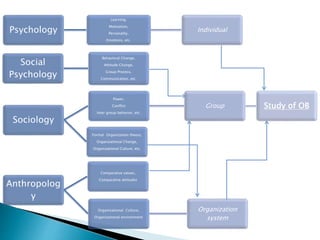
Psychology
Learning,
Motivation,
Personality,
Emotions, etc.
Individual
Social
Psychology
Behavioral Change,
Attitude Change,
Group Process,
Communication, etc.
Sociology
Power,
Conflict
Inter group behavior, etc.
Group Study of OB
Formal Organization theory,
Organizational Change,
Organizational Culture, etc.
Anthropolog
y
Comparative values,
Comparative attitudes
Organizational Culture,
Organizational environment
Organization
system
 It is the science that tries to measure,
explain and change the behavior of
humans and other animals.
 Early industrial or organizational
psychologists were concerned with
problems of tiredness, boredom and
other factors that affect performance.
 But now, they are concerned with
emotions, perception, personality,
needs, leadership job stress, etc.
 It mixes the concepts of psychology
and sociology.
 It focuses on influence of people on
one another (Change, Trust , etc.)
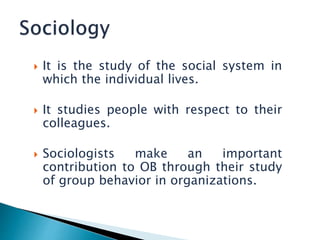
 It is the study of the social system in
which the individual lives.
 It studies people with respect to their
colleagues.
 Sociologists make an important
contribution to OB through their study
of group behavior in organizations.
 It is the study of societies to learn about
human beings and their activities.
 Anthropologists work on culture and
environments.
 They help in understanding differences
in fundamental values, attitudes and
behavior of people in different countries
and different organizations.
Following are some of societal mechanisms
that exist because of this belief in the
power of learned behavior:
 Role of parenting
 Importance of education
 Job training
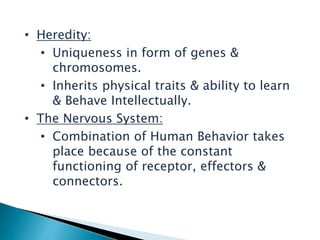
• Heredity:
• Uniqueness in form of genes &
chromosomes.
• Inherits physical traits & ability to learn
& Behave Intellectually.
• The Nervous System:
• Combination of Human Behavior takes
place because of the constant
functioning of receptor, effectors &
connectors.
Comprehensive Organizational
Behavior Model
1. Traditional Perspective:
S-R
(Stimulus cause or at least precedes Response)
Does not give total concept of behavior
Human behavior is caused by external stimuli, internal
force and goal – directed.
• “O” Stands for HUMAN ORGANISM which is
• Not immobile,
• It is Mediating, Maintenance & Adjustive function
• Mediating function:
• O is constantly active ,
• Scanning surroundings,
• Monitoring its own actions,
• Seeking / avoiding certain conditions
• There are 3 categories of Maintenance organs :
• Receptors
• Connectors
• Effectors
• Adjustive function :
• monitor person’s activities
2. Behavioral Perspective
S-O-B - C
• “S” Stands for SITUATION– All environmental
aspects, like socio- cultural & technological
environment.
• “O” Stands for HUMAN ORGANISM which also
talks about psychological being.
• “B” stands for BEHAVIOR embracing overt and
covert responses & patterns.
• “C” stands for consequences
 Freudian approach depends on conflict model
of humans. Freud felt that behavior is not
always consciously explained. "Unconscious"
is the major factor which guides the
individual's behavior. He felt that individual's
behavior depends on three factors:
 Id
 Ego
 Super Ego
 Id: Id it means pleasure. To certain degree of
having Id in an individual is constructive but
may also lead to destructive tendencies like
being aggressive, dominating, fighting and
generally destroy. This kind of instinctive is
more dominating in childhood. But once
individuals develop and mature they learn to
control the id. But it is always ‘Unconscious’.
 Ego: Ego represents `conscious' stage in
one's behavior. Though Id comes in conflict
with ego, the ego depends on the super ego.
 Superego: It represents "conscience". An
individual is not aware of the superego's
functioning. The conscience is dependent on
two factors that is cultural values and moral
of a society.
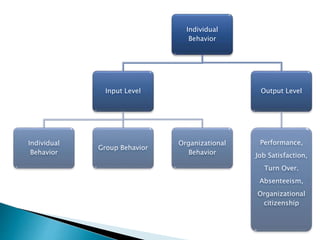
Individual
Behavior
Input Level
Individual
Behavior
Group Behavior
Organizational
Behavior
Output Level
Performance,
Job Satisfaction,
Turn Over.
Absenteeism,
Organizational
citizenship
Individual
Behavior
Personal
Biographical Learnt
Environmental Organizational
Conformity
Creative
Individualism
Isolation Rebellion
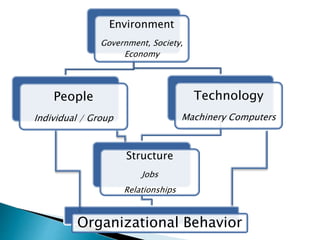
Environment
Government, Society,
Economy
People
Individual / Group
Technology
Machinery Computers
Structure
Jobs
Relationships
Organizational Behavior
FOUNDATIONS OF INDIVIDUAL
BEHAVIOUR
PERSONAL FACTORS
•Age
•Sex
•Education
•Abilities
•Marital Status
•No. of dependants
•Creativity
•Emotional Intelligence
PSYCHOLOGICAL
•Personality
•Perception
•Attitude
•Value
•Learning
ORGANIZATIONAL
SYSTEMS & RESOURCE
•Physical facilities
•Organization structure &
design
•Leadership
•Reward system
•Work—related behavior
ENVIRONMENTAL FACTORS
ECONOMIC
•Social norms & cultural
values
•Ethics & Social
Responsibility
Political
INDIVIDUAL
BEHAVIOUR
 Organizations are complex systems.
 Human behavior in organizations is sometimes
unpredictable.
 Human behavior in an organization can be partially
understood by studying and applying the frameworks
of behavioral science, management, and other
disciplines
Levels of Analysis
 Helps managers look at the behavior of individuals.
 Aids managers in understanding the complexities
involved in interpersonal relations when two people
interact.
 The dynamics of relationships within small groups.
When two groups need to coordinate their efforts,
inter-group relations.
 Organizations can be viewed and managed as whole
systems that have inter organizational relationships.
Four Goals of Organizational Behavior
 Describe - (How people behave under a variety of
conditions)
 Understand – (Why people behave as they do)
 Predict - (Managers should have the capacity to
predict employees actions on a certain day and take
preventive actions)
 Control Human Behavior at Work – (To develop some
human activity at work)
Four Key Sources
1) People – make up the internal Social System of the
Organization. That System consists of individuals and
groups. There are formal and informal groups.
2) Structure – defines the formal relationship and use of
people in organizations.
3) Technology - provides the resources with which
people work and affects the tasks that they perform.
The Technology used has a significant influence on
working relationships.
4) Environment – All organizations operate within an
internal and an external environment. Numerous
changes in the environment create demands on
organizations
 Personal characteristics such as age, gender, and
marital status that are objective and easily obtained
from personnel records.
 Biographical characteristics are generic in nature
and are inherited.
29
 Physical characteristics
 Age
 Gender
 Religion
 Marital status
 Experience
 Intelligence
 Ability
 Social group
30
a) Physical characteristics-
◦ These characteristics are related to height, skin,
complexion, vision, shape and size.
◦ Whether there is a correlation between body structure or
not has been scientifically proven.
b) Age-
◦ The relationship between age and job performance is an
issue of increasing performance.
◦ Psychologically, young people are expected to be more
energetic, innovative, adventurous, ambitious and risk
taking.
◦ Whereas old people are supposed to be more
conservative, set their own way and less adaptable.
◦ Though it is incorrect to generalize in all the cases.
◦ There is a relationship between age and absenteeism.
31
c) Gender -
 Studies and research has proved that there are few,
if any, important differences between man and
woman that will affect their job performance.
 Gender has its impact on absenteeism.
d) Religion -
 Religion and religion based cultures play an
important role in determining some aspects of
individual behaviour.
e) Marital status -
 There are not enough studies which could draw any
conclusion as to whether there is any relationship
between marital status and job performance.
32
f) Experience :-
◦ It is considered to be a good indicator of employee
performance.
◦ There is a positive relationship between experience and
job performance.
◦ There is negative relationship between seniority and
absenteeism.
g) Intelligence:-
◦ Whether it is an inherited trait or acquired trait,
intelligence affects the behaviour of the people.
h) Ability:-
◦ Ability is the criterion used to determine what a person
can do.
33
Organizational Behavior Introduction and

Organizational Behavior Introduction and

  • 1.
    Unit- I Understanding HumanBehavior, Understanding individual behavior as an input-output system, Biological foundation of Behavior, The dynamics of People and Organization, Biographical characteristics of Individual Behavior
  • 2.
    “Organizational behavior isa field of study that investigates the impact that individuals, groups, and structure have on behavior within an organization, then applies that knowledge to make organizations work more effectively.” - Robbins
  • 3.
    Psychology Learning, Motivation, Personality, Emotions, etc. Individual Social Psychology Behavioral Change, AttitudeChange, Group Process, Communication, etc. Sociology Power, Conflict Inter group behavior, etc. Group Study of OB Formal Organization theory, Organizational Change, Organizational Culture, etc. Anthropolog y Comparative values, Comparative attitudes Organizational Culture, Organizational environment Organization system
  • 4.
     It isthe science that tries to measure, explain and change the behavior of humans and other animals.  Early industrial or organizational psychologists were concerned with problems of tiredness, boredom and other factors that affect performance.  But now, they are concerned with emotions, perception, personality, needs, leadership job stress, etc.
  • 5.
     It mixesthe concepts of psychology and sociology.  It focuses on influence of people on one another (Change, Trust , etc.)
  • 6.
     It isthe study of the social system in which the individual lives.  It studies people with respect to their colleagues.  Sociologists make an important contribution to OB through their study of group behavior in organizations.
  • 7.
     It isthe study of societies to learn about human beings and their activities.  Anthropologists work on culture and environments.  They help in understanding differences in fundamental values, attitudes and behavior of people in different countries and different organizations.
  • 8.
    Following are someof societal mechanisms that exist because of this belief in the power of learned behavior:  Role of parenting  Importance of education  Job training
  • 9.
    • Heredity: • Uniquenessin form of genes & chromosomes. • Inherits physical traits & ability to learn & Behave Intellectually. • The Nervous System: • Combination of Human Behavior takes place because of the constant functioning of receptor, effectors & connectors.
  • 10.
  • 11.
    1. Traditional Perspective: S-R (Stimuluscause or at least precedes Response) Does not give total concept of behavior Human behavior is caused by external stimuli, internal force and goal – directed.
  • 12.
    • “O” Standsfor HUMAN ORGANISM which is • Not immobile, • It is Mediating, Maintenance & Adjustive function • Mediating function: • O is constantly active , • Scanning surroundings, • Monitoring its own actions, • Seeking / avoiding certain conditions • There are 3 categories of Maintenance organs : • Receptors • Connectors • Effectors • Adjustive function : • monitor person’s activities
  • 13.
    2. Behavioral Perspective S-O-B- C • “S” Stands for SITUATION– All environmental aspects, like socio- cultural & technological environment. • “O” Stands for HUMAN ORGANISM which also talks about psychological being. • “B” stands for BEHAVIOR embracing overt and covert responses & patterns. • “C” stands for consequences
  • 14.
     Freudian approachdepends on conflict model of humans. Freud felt that behavior is not always consciously explained. "Unconscious" is the major factor which guides the individual's behavior. He felt that individual's behavior depends on three factors:  Id  Ego  Super Ego
  • 17.
     Id: Idit means pleasure. To certain degree of having Id in an individual is constructive but may also lead to destructive tendencies like being aggressive, dominating, fighting and generally destroy. This kind of instinctive is more dominating in childhood. But once individuals develop and mature they learn to control the id. But it is always ‘Unconscious’.
  • 18.
     Ego: Egorepresents `conscious' stage in one's behavior. Though Id comes in conflict with ego, the ego depends on the super ego.  Superego: It represents "conscience". An individual is not aware of the superego's functioning. The conscience is dependent on two factors that is cultural values and moral of a society.
  • 20.
    Individual Behavior Input Level Individual Behavior Group Behavior Organizational Behavior OutputLevel Performance, Job Satisfaction, Turn Over. Absenteeism, Organizational citizenship
  • 21.
  • 22.
  • 23.
    Environment Government, Society, Economy People Individual /Group Technology Machinery Computers Structure Jobs Relationships Organizational Behavior
  • 24.
    FOUNDATIONS OF INDIVIDUAL BEHAVIOUR PERSONALFACTORS •Age •Sex •Education •Abilities •Marital Status •No. of dependants •Creativity •Emotional Intelligence PSYCHOLOGICAL •Personality •Perception •Attitude •Value •Learning ORGANIZATIONAL SYSTEMS & RESOURCE •Physical facilities •Organization structure & design •Leadership •Reward system •Work—related behavior ENVIRONMENTAL FACTORS ECONOMIC •Social norms & cultural values •Ethics & Social Responsibility Political INDIVIDUAL BEHAVIOUR
  • 25.
     Organizations arecomplex systems.  Human behavior in organizations is sometimes unpredictable.  Human behavior in an organization can be partially understood by studying and applying the frameworks of behavioral science, management, and other disciplines
  • 26.
    Levels of Analysis Helps managers look at the behavior of individuals.  Aids managers in understanding the complexities involved in interpersonal relations when two people interact.  The dynamics of relationships within small groups. When two groups need to coordinate their efforts, inter-group relations.  Organizations can be viewed and managed as whole systems that have inter organizational relationships.
  • 27.
    Four Goals ofOrganizational Behavior  Describe - (How people behave under a variety of conditions)  Understand – (Why people behave as they do)  Predict - (Managers should have the capacity to predict employees actions on a certain day and take preventive actions)  Control Human Behavior at Work – (To develop some human activity at work)
  • 28.
    Four Key Sources 1)People – make up the internal Social System of the Organization. That System consists of individuals and groups. There are formal and informal groups. 2) Structure – defines the formal relationship and use of people in organizations. 3) Technology - provides the resources with which people work and affects the tasks that they perform. The Technology used has a significant influence on working relationships. 4) Environment – All organizations operate within an internal and an external environment. Numerous changes in the environment create demands on organizations
  • 29.
     Personal characteristicssuch as age, gender, and marital status that are objective and easily obtained from personnel records.  Biographical characteristics are generic in nature and are inherited. 29
  • 30.
     Physical characteristics Age  Gender  Religion  Marital status  Experience  Intelligence  Ability  Social group 30
  • 31.
    a) Physical characteristics- ◦These characteristics are related to height, skin, complexion, vision, shape and size. ◦ Whether there is a correlation between body structure or not has been scientifically proven. b) Age- ◦ The relationship between age and job performance is an issue of increasing performance. ◦ Psychologically, young people are expected to be more energetic, innovative, adventurous, ambitious and risk taking. ◦ Whereas old people are supposed to be more conservative, set their own way and less adaptable. ◦ Though it is incorrect to generalize in all the cases. ◦ There is a relationship between age and absenteeism. 31
  • 32.
    c) Gender - Studies and research has proved that there are few, if any, important differences between man and woman that will affect their job performance.  Gender has its impact on absenteeism. d) Religion -  Religion and religion based cultures play an important role in determining some aspects of individual behaviour. e) Marital status -  There are not enough studies which could draw any conclusion as to whether there is any relationship between marital status and job performance. 32
  • 33.
    f) Experience :- ◦It is considered to be a good indicator of employee performance. ◦ There is a positive relationship between experience and job performance. ◦ There is negative relationship between seniority and absenteeism. g) Intelligence:- ◦ Whether it is an inherited trait or acquired trait, intelligence affects the behaviour of the people. h) Ability:- ◦ Ability is the criterion used to determine what a person can do. 33