(eBook PDF) M: Organizational Behavior 4th
Edition download
https://ebooksecure.com/product/ebook-pdf-m-organizational-
behavior-4th-edition/
Download full version ebook from https://ebooksecure.com
We believe these products will be a great fit for you. Click
the link to download now, or visit ebooksecure.com
to discover even more!
M: Organizational Behavior 4th Edition Steven Mcshane -
eBook PDF
https://ebooksecure.com/download/m-organizational-behavior-ebook-
pdf/
(eBook PDF) M: Organizational Behavior 3rd Edition by
Steven McShane
http://ebooksecure.com/product/ebook-pdf-m-organizational-
behavior-3rd-edition-by-steven-mcshane/
(eBook PDF) Organizational Behavior 7th Edition
http://ebooksecure.com/product/ebook-pdf-organizational-
behavior-7th-edition/
(eBook PDF) Organizational Behavior 8th Edition
http://ebooksecure.com/product/ebook-pdf-organizational-
behavior-8th-edition/
Organizational Behavior, 13th Edition (eBook PDF)
http://ebooksecure.com/product/organizational-behavior-13th-
edition-ebook-pdf/
Organizational Behavior 17th Edition (eBook PDF)
http://ebooksecure.com/product/organizational-behavior-17th-
edition-ebook-pdf/
Organizational Behavior 18th Edition (eBook PDF)
http://ebooksecure.com/product/organizational-behavior-18th-
edition-ebook-pdf/
(eBook PDF) Organizational Behavior: Human Behavior at
Work 14th Edition
http://ebooksecure.com/product/ebook-pdf-organizational-behavior-
human-behavior-at-work-14th-edition/
(eBook PDF) Organizational Behavior Interactive 2nd
Edition
http://ebooksecure.com/product/ebook-pdf-organizational-behavior-
interactive-2nd-edition/
McSHANE | VON GLINOW
4th Edition
ORGANIZATIONAL
BEHAVIOR
IN WHICH COUNTRIES
DO EMPLOYEES
HAVE THE HIGHEST
ORGANIZATIONAL
COMMITMENT?
CH 4
WHAT IS YOUR
PREFERRED
MANAGERIAL
LEADERSHIP STYLE?
CH 11
INTROVERTS CAN
BE EFFECTIVE SOCIAL
NETWORKERS, TOO!
CH 9
is Motivation. is Momentum. is Moving Forward. is McGraw-Hill.
part one Introduction 2
1 Introduction to the Field of Organizational Behavior 2
part two Individual Behavior and Processes 28
2 
Individual Behavior, Personality, and
Values 28
3 
Perceiving Ourselves and Others in
Organizations 54
4 
Workplace Emotions, Attitudes, and
Stress 78
5 Employee Motivation 106
6 Decision Making and Creativity 136
part three Team Processes 160
7 Team Dynamics 160
8 
Communicating in Teams and
Organizations 186
9 Power and Influence in the Workplace 210
10 
Conflict and Negotiation in the
Workplace 232
11 Leadership in Organizational Settings 256
part four Organizational Processes 278
Contents
Brief
Indexes 341
12 Designing Organizational Structures 278
13 Organizational Culture 298
14 Organizational Change 320
vii
viii
ANCHORS OF ORGANIZATIONAL
BEHAVIOR KNOWLEDGE 10
The Systematic Research Anchor 11
The Multidisciplinary Anchor 11
The Contingency Anchor 12
The Multiple Levels of Analysis
Anchor 12
PERSPECTIVES OF ORGANIZATIONAL
EFFECTIVENESS 12
Open Systems Perspective 12
Organizational Learning Perspective 14
High-Performance Work Practices
Perspective 16
Stakeholder Perspective 18
Connecting the Dots: An Integrative
Model of Organizational
Behavior 20
THE JOURNEY BEGINS 21
1 Introduction to the
Field of Organizational
Behavior 2
THE FIELD OF ORGANIZATIONAL
BEHAVIOR 3
Historical Foundations of
Organizational Behavior 4
Why Study Organizational
Behavior? 5
CONTEMPORARY DEVELOPMENTS
FACING ORGANIZATIONS 6
Technological Change 6
Globalization 7
Emerging Employment
Relationships 7
Increasing Workforce Diversity 9
Consequences of Diversity 9
Contents
part one Introduction 2
ŠRobert Kneschke/Shutterstock
2 Individual Behavior,
Personality, and
Values 28
MARS MODEL OF INDIVIDUAL
BEHAVIOR AND PERFORMANCE 29
Employee Motivation 29
Ability 30
Role Perceptions 30
Situational Factors 32
TYPES OF INDIVIDUAL BEHAVIOR 32
Task Performance 32
Organizational Citizenship 32
Counterproductive Work Behaviors 33
Joining and Staying with the
Organization 33
Maintaining Work Attendance 33
PERSONALITY IN ORGANIZATIONS 34
Personality Determinants: Nature
versus Nurture 35
Five-Factor Model of Personality 35
Jungian Personality Theory
and the Myers-Briggs Type
Indicator 38
VALUES IN THE WORKPLACE 39
Types of Values 40
Values and Individual Behavior 41
Values Congruence 42
ETHICAL VALUES AND BEHAVIOR 42
Three Ethical Principles 43
part two Individual Behavior and Processes 28
CONTENTS ix
ORGANIZATIONAL COMMITMENT 91
Consequences of Affective and
Continuance Commitment 91
Building Organizational Commitment 92
WORK-RELATED STRESS AND ITS
MANAGEMENT 93
General Adaptation Syndrome 93
Consequences of Distress 94
Stressors: The Causes of Stress 94
Individual Differences in Stress 96
Managing Work-Related Stress 96
5 Employee Motivation 106
EMPLOYEE ENGAGEMENT 107
EMPLOYEE DRIVES AND NEEDS 108
Individual Differences in Needs 109
Four-Drive Theory 110
Maslow’s Needs Hierarchy Theory 111
Intrinsic and Extrinsic Motivation 112
Learned Needs Theory 113
EXPECTANCY THEORY OF
MOTIVATION 114
Applying Expectancy Theory 114
ORGANIZATIONAL BEHAVIOR
MODIFICATION AND SOCIAL
COGNITIVE THEORY 116
Organizational Behavior
Modification 116
Social Cognitive Theory 117
GOAL SETTING AND FEEDBACK 118
Characteristics of Effective Feedback 119
Sources of Feedback 120
Evaluating Goal Setting and
Feedback 121
ORGANIZATIONAL JUSTICE 121
Equity Theory 121
Procedural Justice 123
Attribution Theory 65
Self-Fulfilling Prophecy 67
Other Perceptual Effects 68
IMPROVING PERCEPTIONS 69
Awareness of Perceptual Biases 69
Improving Self-Awareness 69
Meaningful Interaction 70
GLOBAL MINDSET: DEVELOPING
PERCEPTIONS ACROSS BORDERS 71
Developing a Global Mindset 72
4 Workplace Emotions,
Attitudes, and Stress 78
EMOTIONS IN THE WORKPLACE 79
Types of Emotions 80
Emotions, Attitudes, and Behavior 81
Cognitive Dissonance 83
Emotions and Personality 84
MANAGING EMOTIONS AT WORK 85
Emotional Display Norms across
Cultures 85
Emotional Dissonance 85
EMOTIONAL INTELLIGENCE 86
Emotional Intelligence Outcomes and
Development 87
JOB SATISFACTION 88
Job Satisfaction and Work Behavior 88
Job Satisfaction and Performance 89
Job Satisfaction and Customer
Satisfaction 90
Job Satisfaction and Business Ethics 91
Moral Intensity, Moral Sensitivity, and
Situational Influences 43
Supporting Ethical Behavior 44
VALUES ACROSS CULTURES 45
Individualism and Collectivism 45
Power Distance 47
Uncertainty Avoidance 47
Achievement-Nurturing
Orientation 47
Caveats about Cross-Cultural
Knowledge 47
3 Perceiving Ourselves
and Others in
Organizations 54
SELF-CONCEPT: HOW WE PERCEIVE
OURSELVES 55
Self-Concept Complexity, Consistency,
and Clarity 55
Self-Enhancement 57
Self-Verification 58
Self-Evaluation 58
The Social Self 59
Self-Concept and Organizational
Behavior 60
PERCEIVING THE WORLD
AROUND US 61
Perceptual Organization and
Interpretation 62
SPECIFIC PERCEPTUAL PROCESSES
AND PROBLEMS 63
Stereotyping in Organizations 63
ŠPeopleImages/Digital Vision/Getty Images
ŠElnur/Shutterstock
x CONTENTS
EVALUATING DECISIONS 146
Escalation of Commitment 147
Evaluating Decision Outcomes More
Effectively 148
CREATIVITY 148
The Creative Process 148
Characteristics of Creative People 149
Organizational Conditions Supporting
Creativity 151
Activities That Encourage
Creativity 151
EMPLOYEE INVOLVEMENT IN
DECISION MAKING 152
Benefits of Employee Involvement 153
Contingencies of Employee
Involvement 153
IDENTIFYING PROBLEMS AND
OPPORTUNITIES 139
Problems with Problem Identification 140
Identifying Problems and Opportunities
More Effectively 141
SEARCHING FOR, EVALUATING, AND
CHOOSING ALTERNATIVES 141
Problems with Goals 141
Problems with Information
Processing 141
Problems with Maximization 143
Selecting Opportunities 144
Emotions and Making Choices 144
Intuition and Making Choices 145
Making Choices More Effectively 145
IMPLEMENTING DECISIONS 146
JOB DESIGN 124
Job Design and Work Efficiency 124
Scientific Management 125
Problems with Job Specialization 126
Job Design and Work Motivation 126
Job Design Practices That
Motivate 128
6 Decision Making and
Creativity 136
RATIONAL CHOICE DECISION
MAKING 137
Rational Choice Decision-Making
Process 139
Problems with Rational Choice Decision
Making 139
7 Team Dynamics 160
TEAMS AND INFORMAL GROUPS 161
Informal Groups 162
ADVANTAGES AND DISADVANTAGES
OF TEAMS 163
The Challenges of Teams 164
A MODEL OF TEAM
EFFECTIVENESS 165
Organizational and Team
Environment 166
TEAM DESIGN ELEMENTS 167
Task Characteristics 167
Team Size 167
Team Composition 168
Workplace Communication through
Social Media 191
Nonverbal Communication 192
CHOOSING THE BEST
COMMUNICATION CHANNEL 194
Synchronicity 194
Social Presence 194
Social Acceptance 194
Media Richness 195
Communication Channels and
Persuasion 197
COMMUNICATION BARRIERS
(NOISE) 197
Information Overload 198
CROSS-CULTURAL AND GENDER
COMMUNICATION 199
Nonverbal Differences across
Cultures 200
Gender Differences in
Communication 200
IMPROVING INTERPERSONAL
COMMUNICATION 200
Getting Your Message Across 201
Active Listening 201
IMPROVING COMMUNICATION
THROUGHOUT THE HIERARCHY 202
Workspace Design 202
Internet-Based Organizational
Communication 203
Direct Communication with Top
Management 203
TEAM PROCESSES 170
Team Development 170
Team Norms 173
Team Cohesion 174
Team Trust 175
SELF-DIRECTED TEAMS 176
Success Factors for Self-Directed
Teams 176
VIRTUAL (REMOTE) TEAMS 176
Success Factors for Virtual
Teams 177
TEAM DECISION MAKING 178
Constraints on Team Decision
Making 178
Improving Creative Decision Making in
Teams 179
8 Communicating in Teams
and Organizations 186
THE IMPORTANCE OF
COMMUNICATION 187
A MODEL OF COMMUNICATION 188
Influences on Effective Encoding and
Decoding 189
COMMUNICATION CHANNELS 189
Internet and Digital
Communication 190
Problems with Email and Other Digital
Message Channels 190
ŠMoopixel/Shutterstock
part three Team Processes 160
CONTENTS xi
TRANSFORMATIONAL LEADERSHIP
PERSPECTIVE 258
Develop and Communicate a Strategic
Vision 259
Model the Vision 260
Encourage Experimentation 260
Build Commitment toward the
Vision 261
Transformational Leadership and
Charisma 261
Evaluating the Transformational
Leadership Perspective 261
MANAGERIAL LEADERSHIP
PERSPECTIVE 262
Interdependence of Managerial and
Transformational Leadership 262
Task-Oriented and People-Oriented
Leadership 263
Servant Leadership 263
PATH–GOAL AND LEADERSHIP
SUBSTITUTES THEORIES 264
Path–Goal Leadership Theory 264
Leadership Substitutes Theory 266
IMPLICIT LEADERSHIP
PERSPECTIVE 267
Prototypes of Effective
Leaders 267
The Romance of Leadership 268
PERSONAL ATTRIBUTES PERSPECTIVE
OF LEADERSHIP 268
Most Important Leadership
Attributes 268
Authentic Leadership 270
Personal Attributes Perspective
Limitations and Practical
Implications 271
CROSS-CULTURAL AND GENDER
ISSUES IN LEADERSHIP 271
Gender and Leadership 271
10 Conflict and Negotiation
in the Workplace 232
THE MEANING AND CONSEQUENCES
OF CONFLICT 233
Is Conflict Good or Bad? 233
THE EMERGING VIEW: TASK AND
RELATIONSHIP CONFLICT 235
Task Conflict 235
Relationship Conflict 235
Separating Task from Relationship
Conflict 235
CONFLICT PROCESS MODEL 236
STRUCTURAL SOURCES OF CONFLICT
IN ORGANIZATIONS 237
Incompatible Goals 237
Differentiation 237
Interdependence 238
Scarce Resources 238
Ambiguous Rules 238
Communication Problems 238
INTERPERSONAL CONFLICT-
HANDLING STYLES 239
Choosing the Best Conflict-Handling
Style 240
Cultural and Gender Differences in
Conflict-Handling Styles 242
STRUCTURAL APPROACHES TO
CONFLICT MANAGEMENT 242
Emphasizing Superordinate Goals 242
Reducing Differentiation 243
Improving Communication and Mutual
Understanding 243
Reducing Interdependence 244
Increasing Resources 244
Clarifying Rules and Procedures 244
THIRD-PARTY CONFLICT
RESOLUTION 245
Choosing the Best Third-Party
Intervention Strategy 245
RESOLVING CONFLICT THROUGH
NEGOTIATION 246
Distributive versus Integrative
Approaches to Negotiation 246
Preparing to Negotiate 247
The Negotiation Process 248
The Negotiation Setting 249
Gender and Negotiation 250
11 Leadership in
Organizational Settings 256
WHAT IS LEADERSHIP? 257
Shared Leadership 257
COMMUNICATING THROUGH THE
GRAPEVINE 204
Grapevine Characteristics 204
Grapevine Benefits and
Limitations 204
9 Power and Influence in
the Workplace 210
THE MEANING OF POWER 211
SOURCES OF POWER IN
ORGANIZATIONS 212
Legitimate Power 213
Reward Power 214
Coercive Power 214
Expert Power 214
Referent Power 215
CONTINGENCIES OF POWER 215
Substitutability 215
Centrality 216
Visibility 216
Discretion 216
THE POWER OF SOCIAL
NETWORKS 216
Social Capital and Sources of
Power 217
Gaining Power through Social
Networks 218
CONSEQUENCES OF POWER 220
INFLUENCING OTHERS 221
Types of Influence Tactics 221
Consequences and Contingencies of
Influence Tactics 224
ORGANIZATIONAL POLITICS 226
Minimizing Organizational
Politics 226
ŠHero Images/Getty Images
ŠEllisDon Corporation
xii CONTENTS
DECIPHERING ORGANIZATIONAL
CULTURE THROUGH ARTIFACTS 302
Organizational Stories and
Legends 303
Organizational Language 303
Rituals and Ceremonies 304
Physical Structures and
Symbols 304
IS ORGANIZATIONAL CULTURE
IMPORTANT? 305
Meaning and Potential Benefits of a
Strong Culture 305
Contingencies of Organizational
Culture and Effectiveness 305
Organizational Culture and Business
Ethics 307
MERGING ORGANIZATIONAL
CULTURES 308
Bicultural Audit 308
Strategies for Merging Different
Organizational Cultures 308
CHANGING AND STRENGTHENING
ORGANIZATIONAL CULTURE 310
Model Desired Culture through the
Actions of Founders and
Leaders 310
Align Artifacts with the Desired
Culture 311
Introduce Culturally Consistent
Rewards and Recognition 311
Support Workforce Stability and
Communication 312
Use Attraction, Selection, and
Socialization for Cultural Fit 312
ORGANIZATIONAL
SOCIALIZATION 313
Learning and Adjustment
Process 313
Stages of Organizational
Socialization 313
Improving the Socialization
Process 314
14 Organizational
Change 320
LEWIN’S FORCE FIELD ANALYSIS
MODEL 321
UNDERSTANDING RESISTANCE TO
CHANGE 322
Why Employees Resist
Change 323
UNFREEZING, CHANGING, AND
REFREEZING 325
Creating an Urgency for
Change 325
Reducing the Restraining
Forces 327
Refreezing the Desired
Conditions 329
LEADERSHIP, COALITIONS, AND
PILOT PROJECTS 329
Transformational Leadership and
Change 329
Coalitions, Social Networks, and
Change 329
Pilot Projects and Diffusion of
Change 331
TWO APPROACHES TO
ORGANIZATIONAL CHANGE 331
Action Research Approach 332
Appreciative Inquiry Approach 333
CROSS-CULTURAL AND ETHICAL
ISSUES IN ORGANIZATIONAL
CHANGE 335
ORGANIZATIONAL BEHAVIOR: THE
JOURNEY CONTINUES 335
Organization Index 341
Name Index 343
Glossary/Subject Index 356
12 Designing Organizational
Structures 278
DIVISION OF LABOR AND
COORDINATION 279
Division of Labor 279
Coordination of Work Activities 280
ELEMENTS OF ORGANIZATIONAL
STRUCTURE 282
Span of Control 282
Centralization and Decentralization 284
Formalization 285
Mechanistic versus Organic
Structures 285
FORMS OF DEPARTMENTALIZATION 286
Simple Structure 286
Functional Structure 286
Divisional Structure 287
Team-Based Structure 289
Matrix Structure 290
CONTINGENCIES OF
ORGANIZATIONAL DESIGN 292
External Environment 292
Organizational Size 293
Technology 293
Organizational Strategy 293
13 Organizational Culture 298
ELEMENTS OF ORGANIZATIONAL
CULTURE 299
Espoused versus Enacted Values 299
Content of Organizational Culture 300
Organizational Subcultures 302
part four Organizational Processes 278
ŠJacob Lund/Shutterstock
xiii
M: Organizational Behavior, Fourth Edition, has been significantly
revised, guided by useful feedback from reviewers and our active
monitoring of evidence-based literature. All chapters have new
examples and either new or revised factoids; most chapters have
new conceptual content or literature foundation. The most
substantial changes have occurred in Chapter 1 (introduction to OB),
Chapter 4 (workplace emotions, attitudes, and stress), Chapter 6
(decision making and creativity), Chapter 8 (communication), and
Chapter 10 (conflict and negotiation). The authors personally
researched, selected, and wrote all of this content, thereby
providing superior integration of knowledge and ensuring that the
examples are relevant and recent. Here are the key changes we’ve
made to this fourth edition, broken out by chapter:
Chapter 1: Introduction to the Field of
Organizational Behavior
Technological change has been added in the section on
contemporary developments facing organizations. The section on
perspectives of organizational effectiveness has been streamlined.
Most topics have updated content, particularly the text on the four
contemporary developments, why study OB, and several aspects of
organizational effectiveness.
Chapter 2: Individual Behavior, Personality,
and Values
Several topics in this chapter have been updated, particularly
coverage of the five-factor model of personality and work
performance, values and individual behavior, and moral
sensitivity.
Chapter 3: Perceiving Ourselves and Others
in Organizations
This book pioneered the full model of self-concept and its
relevance to organizational behavior. This edition further
develops this important topic and provides new information on
the opposing motives for distinctiveness and inclusion. The
section on stereotyping also incorporates the concept of
stereotype threat.
What’s New
in the Fourth Edition
Chapter 4: Workplace Emotions, Attitudes,
and Stress
This edition significantly revises and updates discussion on four key
workplace stressors, with new writing about organizational
constraints and interpersonal conflict as stressors. In addition, there
is new content on attitude–behavior contingencies.
Chapter 5: Employee Motivation
New to this edition is the topic of intrinsic and extrinsic motivation,
as well as the question of whether introducing extrinsic sources of
motivation reduces intrinsic motivation. We also have reorganized
and refined the writing on drives and needs, Maslow’s needs
hierarchy, and four-drive theory. The previous edition introduced
the social and information processing characteristics of jobs. This
edition further refines that emerging topic.
Chapter 6: Decision Making and Creativity
This chapter has been substantially revised and updated in several
ways. Design thinking now receives more attention as a concept
and practice to improve workplace creativity. ­
The topic of problems
with information processing when choosing alternatives also has
been substantially updated. Additional updates have been made to
solution-focused problems, problems with goals, implicit favorite
bias, and satisficing (problems with maximization).
Chapter 7: Team Dynamics
This edition refines discussion introduced in the previous edition
on the three characteristics that distinguish types of teams. It
also offers more detail about social loafing, team mental models
(as part of team development), and team development through
team building.
Chapter 8: Communicating in Teams and
Organizations
This edition substantially revises and updates the important topic of
choosing the best communication medium. Specifically, this topic
xiv
Chapter 11: Leadership in Organizational
Settings
This chapter, substantially revised in the previous edition, includes
updates on the topics of transformational leadership, comparing
transformational with managerial leadership, and evaluating
path–goal theory.
Chapter 12: Designing Organizational
Structures
This chapter has been revised to include updates on span of
control, problems with flatter structures, and types of divisional
structure. It also includes numerous new in-text examples of
companies that apply various forms of departmentalization.
Chapter 13: Organizational Culture
In addition to replacing most examples and updating references, this
chapter has revised content on the topics of espoused versus enacted
values, content of organizational culture, types of organizational culture
artifacts, adaptive cultures, the integration strategy for merging
cultures, and how founders and leaders shape and strengthen culture.
Chapter 14: Organizational Change
This edition includes updates on understanding resistance to
change, social networks and viral change, and appreciative inquiry.
As with other chapters, it also has several new real-world examples.
discusses four key factors (synchronicity, social presence, social
acceptance, and media richness) as well as associated
contingencies to consider when choosing a communication
channel. This edition continues to shift the focus toward various
forms of digital communication (less focus on email alone). Another
noticeable change is the updated discussion on the characteristics
and benefits of enterprise social media.
Chapter 9: Power and Influence
in the Workplace
This chapter contains updates on topics including legitimate power,
visibility, and organizational politics.
Chapter 10: Conflict and Negotiation
in the Workplace
This edition substantially reorganizes and updates the entire
section on resolving conflict through negotiation. The new or
revised topics include distributive and integrative approaches
to bargaining, understanding needs, bargaining zone dynamics,
how BATNA increases bargaining power, the importance of
listening, and strategies for making concessions. This edition
also introduces recent evidence about gender differences in
negotiation. Elsewhere in this chapter, we update the topics of
task and relationship conflict and problems resulting from
relationship conflict. We also revised portions on the topic of
whether conflict is good or bad.
Organizational
Behavior
2
1
PART
1
Introduction to the Field of
Organizational Behavior
ŠRobert
Kneschke/Shutterstock
After you read this chapter, you should be able to:
LO1-3 Discuss the anchors on which
organizational behavior knowledge is
based.
LO1-4 Compare and contrast the four
perspectives of organizational
effectiveness.
Learning Objectives
LO1-1 Define organizational behavior and
organizations, and discuss the importance
of this field of inquiry.
LO1-2 Debate the organizational
opportunities and challenges of
technological change, globalization,
emerging employment relationships, and
workforce diversity.
CHAPTER 1 | Introduction to the Field of Organizational Behavior 3
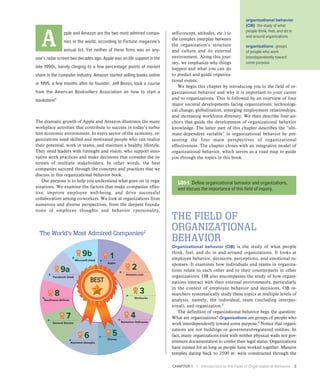
A
pple and Amazon are the two most admired compa-
nies in the world, according to Fortune magazine’s
annual list. Yet neither of these firms was on any-
one’s radar screen two decades ago. Apple was on life support in the
late 1990s, barely clinging to a few percentage points of market
share in the computer industry. Amazon started selling books online
in 1995, a few months after its founder, Jeff Bezos, took a course
from the American Booksellers Association on how to start a
bookstore!1
The dramatic growth of Apple and Amazon illustrates the many
workplace activities that contribute to success in today’s turbu-
lent economic environment. In every sector of the economy, or-
ganizations need skilled and motivated people who can realize
their potential, work in teams, and maintain a healthy lifestyle.
They need leaders with foresight and vision, who support inno-
vative work practices and make decisions that consider the in-
terests of multiple stakeholders. In other words, the best
companies succeed through the concepts and practices that we
discuss in this organizational behavior book.
Our purpose is to help you understand what goes on in orga-
nizations. We examine the factors that make companies effec-
tive, improve employee well-being, and drive successful
collaboration among co-workers. We look at organizations from
numerous and diverse perspectives, from the deepest founda-
tions of employee thoughts and behavior (personality,
self-concept, attitudes, etc.) to
the complex interplay between
the organization’s structure
and culture and its external
environment. Along this jour-
ney, we emphasize why things
happen and what you can do
to predict and guide organiza-
tional events.
We begin this chapter by introducing you to the field of or-
ganizational behavior and why it is important to your career
and to organizations. This is followed by an overview of four
major societal developments facing organizations: technologi-
cal change, globalization, emerging employment relationships,
and increasing workforce diversity. We then describe four an-
chors that guide the development of organizational behavior
knowledge. The latter part of this chapter describes the “ulti-
mate dependent variable” in organizational behavior by pre-
senting the four main perspectives of organizational
effectiveness. The chapter closes with an integrative model of
organizational behavior, which serves as a road map to guide
you through the topics in this book.
The World’s Most
Admired Companies
1
2
3
4
5
6
7
8
9a
9b
Apple
Amazon.com
Starbucks
Berkshire Hathaway
Disney
Alphabet (Google)
General Electric
Southwest Airlines
Facebook (tied)
Microsoft (tied)
THE FIELD OF
ORGANIZATIONAL
BEHAVIOR
Organizational behavior (OB) is the study of what people
think, feel, and do in and around organizations. It looks at
employee behavior, decisions, perceptions, and emotional re-
sponses. It examines how individuals and teams in organiza-
tions relate to each other and to their counterparts in other
organizations. OB also encompasses the study of how organi-
zations interact with their external environments, particularly
in the context of employee behavior and decisions. OB re-
searchers systematically study these topics at multiple levels of
analysis, namely, the individual, team (including interper-
sonal), and organization.3
The definition of organizational behavior begs the question:
What are organizations? Organizations are groups of people who
work interdependently toward some purpose.4
Notice that organi-
zations are not buildings or government-registered entities. In
fact, many organizations exist with neither physical walls nor gov-
ernment documentation to confer their legal status. Organizations
have existed for as long as people have worked together. Massive
temples dating back to 3500 bc were constructed through the
LO1-1 Define organizational behavior and organizations,
and discuss the importance of this field of inquiry.
organizational behavior
(OB) the study of what
people think, feel, and do in
and around organizations
organizations groups
of people who work
interdependently toward
some purpose
The World’s Most Admired Companies2
4 PART 1 | Introduction
organized actions of multitudes of
people. Craftspeople and mer-
chants in ancient Rome formed
guilds, complete with elected man-
agers. More than 1,000 years ago,
Chinese factories were producing
125,000 tons of iron each year.5
One key feature of all organi-
zations throughout history is that
they are collective entities.6
They
consist of human beings—typically,
but not necessarily, employees—
who interact with each other in
an organized way. This organized
relationship requires communica-
tion, coordination, and collabora-
tion to achieve organizational
objectives. As such, all organiza-
tional members have degrees of
interdependence; they accom-
plish goals by sharing materials,
information, or expertise with
coworkers.
A second key feature of orga-
nizations is that their members
have a collective sense of pur-
pose. This collective purpose isn’t always well defined or agreed
on. Most companies have vision and mission statements, but
they are sometimes out of date or don’t describe what employ-
ees actually try to achieve. Still, imagine an organization without
a collective sense of purpose. It would be an assemblage of
had changed the name of its MBA human relations course to
“Organizational Behavior.”
Although the field of OB is recent, experts in other fields
have been studying organizations for many centuries. The Greek
philosopher Plato (400 bc) wrote about the essence of
leadership, and the Chinese philosopher Confucius (500 bc)
extolled the virtues of ethics and leadership. Economist Adam
Smith (late 1700s) discussed the benefits of job specialization
and division of labor. German sociologist Max Weber (early
1900s) wrote about rational organizations, the work ethic, and
charismatic leadership. Around the same time, industrial engi-
neer Frederick Winslow Taylor proposed systematic ways to or-
ganize work processes and motivate employees through goal
setting and rewards.9
Political scientist Mary Parker Follett (1920s) offered new
ways of thinking about constructive conflict, team dynamics,
power, and leadership. Harvard professor Elton Mayo and his
colleagues (1930s and 1940s) established the “human relations”
One key feature of all organizations is that they consist of human beings who interact with each
other in an organized way.
ŠImage Source
A company is one of humanity’s most amazing
inventions. . . . [It’s] this abstract construct we’ve
invented, and it’s incredibly powerful.7
—Steve Jobs, Apple and Pixar Animation cofounder
people without direction or unifying force. So, whether they are
designing and marketing the latest communication technology
at Apple or selling almost anything on the Internet at Amazon,
people working in organizations do have some sense of collec-
tive purpose.
Historical Foundations of
Organizational Behavior
Organizational behavior emerged as a distinct field sometime
around the early 1940s.8
During that decade, a few researchers
began describing their research as organizational (rather than
sociological or psychological). And by the late 1940s, Harvard
CHAPTER 1 | Introduction to the Field of Organizational Behavior 5
school of management, which pioneered re-
search on employee attitudes, formal team
dynamics, informal groups, and supervisor
leadership style. American executive and Harvard
associate Chester Barnard (1930s) wrote insight-
ful views regarding organizational communica-
tion, coordination, leadership and authority,
organizations as open systems, and team dynam-
ics.10
This brief historical tour indicates that OB
has been around for a long time; it just wasn’t
organized into a unified discipline until around
World War II.
Why Study Organizational
Behavior?
In all likelihood, you are reading this book as
part of a required course in organizational be-
havior. Apart from degree or diploma require-
ments, why should you learn the ideas and
practices discussed in this book? After all, who
ever heard of a career path leading to a “vice
president of OB” or a “chief OB officer”? Our
answer to this question begins with survey findings that stu-
dents who have been in the workforce for some time typically
point to OB as one of their most valuable courses. Why? Be-
cause they have learned through experience that OB does make
a difference to one’s career success.11
There are three main rea-
sons why OB theories and practices are personally important
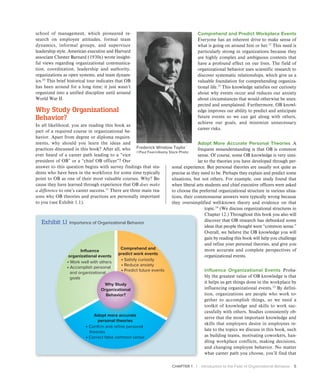
to you (see Exhibit 1.1).
Comprehend and Predict Workplace Events
Everyone has an inherent drive to make sense of
what is going on around him or her.12
This need is
particularly strong in organizations because they
are highly complex and ambiguous contexts that
have a profound effect on our lives. The field of
organizational behavior uses scientific research to
discover systematic relationships, which give us a
valuable foundation for comprehending organiza-
tional life.13
This knowledge satisfies our curiosity
about why events occur and reduces our anxiety
about circumstances that would otherwise be unex-
pected and unexplained. Furthermore, OB knowl-
edge improves our ability to predict and anticipate
future events so we can get along with others,
achieve our goals, and minimize unnecessary
career risks.
Adopt More Accurate Personal Theories A
frequent misunderstanding is that OB is common
sense. Of course, some OB knowledge is very simi-
lar to the theories you have developed through per-
sonal experience. But personal theories are usually not quite as
precise as they need to be. Perhaps they explain and predict some
situations, but not others. For example, one study found that
when liberal arts students and chief executive officers were asked
to choose the preferred organizational structure in various situa-
tions, their commonsense answers were typically wrong because
they oversimplified well-known theory and evidence on that
topic.14
(We discuss organizational structures in
Chapter 12.) Throughout this book you also will
discover that OB research has debunked some
ideas that people thought were “common sense.”
Overall, we believe the OB knowledge you will
gain by reading this book will help you challenge
and refine your personal theories, and give you
more accurate and complete perspectives of
organizational events.
Influence Organizational Events Proba-
bly the greatest value of OB knowledge is that
it helps us get things done in the workplace by
influencing organizational events.15
By defini-
tion, organizations are people who work to-
gether to accomplish things, so we need a
toolkit of knowledge and skills to work suc-
cessfully with others. Studies consistently ob-
serve that the most important knowledge and
skills that employers desire in employees re-
late to the topics we discuss in this book, such
as building teams, motivating coworkers, han-
dling workplace conflicts, making decisions,
and changing employee behavior. No matter
what career path you choose, you’ll find that
Frederick Winslow Taylor
ŠPaul Fearn/Alamy Stock Photo
Exhibit 1.1 Importance of Organizational Behavior
• Satisfy curiosity
• Reduce anxiety
• Predict future events
Comprehend and
predict work events
• Work well with others
• Accomplish personal
and organizational
goals
Influence
organizational events
• Confirm and refine personal
theories
• Correct false common sense
Adopt more accurate
personal theories
Why Study
Organizational
Behavior?
6 PART 1 | Introduction
CONTEMPORARY
DEVELOPMENTS
FACING ORGANIZATIONS
Organizations are experiencing unprecedented change. Techno-
logical developments, consumer expectations, global competi-
tion, and many other factors have substantially altered business
strategy and everyday workplace activities. The field of organiza-
tional behavior plays a vital role in guiding organizations
through this continuous turbulence. As we will explain in more
detail later in this chapter, organizations are deeply affected by
the external environment. Consequently, they need to maintain
a good organization–environment fit by anticipating and adjust-
ing to changes in society. Over the next few pages, we introduce
four major environmental developments facing organizations:
technological change, globalization, emerging employment rela-
tionships, and increasing workforce diversity.
Technological Change
Technological change has always been a disruptive force in orga-
nizations, as well as in society.19
Waterwheels, cotton gins, steam
engines, microprocessors (such as in automated systems and
artificial intelligence), and many other innovations dramatically
boost productivity, but also usually displace employees and ren-
der obsolete entire occupational groups. Other technologies,
OB concepts play an important
role in performing your job and
working more effectively within
organizations.
Organizational Behavior Is
for Everyone Organizational
behavior is discussed by some
writers as a topic for managers.
Effective management does de-
pend on OB concepts and prac-
tices, but this book pioneered the
broader view that OB is valuable
for everyone who works in and
around organizations. Whether
you are a software engineer, cus-
tomer service representative, for-
eign exchange analyst, or chief
executive officer, you need to
understand and apply the many
organizational behavior topics
that are discussed in this book. In fact, OB knowledge is probably
more valuable than ever before because employees increas-
ingly need to be proactive, self-motivated, and able to work
effectively with coworkers without management intervention.
In the words of one forward-thinking OB writer more than four
decades ago: Everyone is a manager.16
OB and the Bottom Line Up to this point, our answer to
the question “Why study OB?” has focused on how organiza-
tional behavior knowledge benefits you as an individual.
However, OB is also vital to the organization’s survival and
success.17
For instance, the best 100 companies to work for in
America (i.e., companies with the highest levels of employee
satisfaction) enjoy significantly higher financial performance
than other businesses within the same industry. Companies
with higher levels of employee engagement have higher sales
and profitability (see Chapter 5). OB practices also are asso-
ciated with various indicators of hospital performance, such
as lower patient mortality rates and higher patient satisfac-
tion. Other studies have consistently found a positive rela-
tionship between the quality of leadership and the company’s
financial performance.
The bottom-line value of organizational behavior is
supported by research into the best predictors of investment
portfolio performance. These investigations suggest that
leadership, performance-based rewards, employee develop-
ment, employee attitudes, and other specific OB characteris-
tics are important “positive screens” for selecting companies
with the highest and most consistent long-term investment
gains.18
Overall, the organizational behavior concepts, theo-
ries, and practices presented throughout this book make a
positive difference to you personally, to the organization, and
ultimately to society.
Probably the greatest value of OB knowledge is that it helps us get things done in the workplace
by influencing organizational events.
ŠColorBlind Images/Blend Images LLC
LO1-2 Debate the organizational opportunities and
challenges of technological change, globalization, emerging
employment relationships, and workforce diversity.
CHAPTER 1 | Introduction to the Field of Organizational Behavior 7
globalize when they actively
participate in other countries
and cultures. Although busi-
nesses have traded goods
across borders for centuries,
the degree of globalization to-
day is unprecedented because
information technology and
transportation systems allow a much more intense level of con-
nectivity and interdependence around the planet.22
Globalization offers numerous benefits to organizations in
terms of larger markets, lower costs, and greater access to
knowledge and innovation. At the same time, there is consider-
able debate about whether globalization benefits developing na-
tions and the extent to which it is responsible for increasing
work intensification, reduced job security, and poor work–life
balance in developed countries.23
The field of organizational behavior focuses on the effects of
globalization on organizations and how to lead and work effec-
tively in this emerging reality. Throughout this book, we will refer
to the effects of globalization on teamwork, diversity, cultural val-
ues, organizational structure, leadership, and other themes. Glo-
balization has brought more complexity and new ways of working
to the workplace. It also requires additional knowledge and skills
that we will discuss in this book, such as emotional intelligence, a
global mindset, nonverbal communication, and conflict handling.
Emerging Employment Relationships
Technology, globalization, and several other developments
have substantially altered the employment relationship in most
countries. Before the digital age, most employees would finish
work after eight or nine hours and
could separate their personal time from
their employment. Today, they are
more likely to be connected to work on
a 24/7 schedule. Globalization in-
creases competitive pressure to work
longer and creates a 24-hour schedule
because coworkers, suppliers, and cli-
ents work in different time zones. Infor-
mation technology enables employers
and others to easily and quickly com-
municate with employees beyond their
traditional workday.
Little wonder that one of the most im-
portant employment issues over the past
decade has been work–life balance.
Work–life balance occurs when people
are able to minimize conflict between
their work and nonwork demands.24
Most employees lack this balance be-
cause they spend too many hours each
week performing or thinking about their
job, whether at the workplace, at home,
such as the telegraph, smartphone, and the Internet, have in-
creased productivity but also altered work relationships and pat-
terns of behavior with coworkers, clients, and suppliers. Still
other technologies aim to improve health and well-being, such as
the development of better medicines and medical equipment,
new leisure apparatus, and environmentally safer materials.
Information technology is one of the most significant forms
of technological change in recent times.20
As we discuss in
Chapter 8, communication patterns and power dynamics have
substantially changed due to the introduction of email and
other forms of digital messaging. Social media and other col-
laboration technologies are slowly replacing email, and will fur-
ther reshape how people associate and coordinate with each
other. Some OB experts argue that information technology
gives employees a stronger voice through direct communica-
tion with executives and broader distribution of their opinions
to coworkers and beyond.
Information technology also has created challenges, such as
tethering people to their jobs for longer hours, reducing their
attention spans at work, and increasing techno-stress. We dis-
cuss these concerns below and in Chapter 4 (workplace stress).
At a macro-level, information technology has reconfigured en-
tire organizations by integrating suppliers and other external
entities into the transformation process. Eventually, technology
may render organizations less of a place where people work and
more of a process or network where people collaborate across
space and time (see Chapter 12).
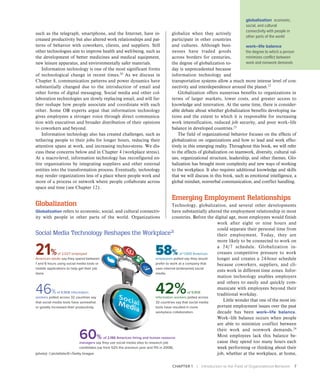
Globalization
Globalization refers to economic, social, and cultural connectiv-
ity with people in other parts of the world. Organizations
46%of 9,908 information
workers polled across 32 countries say
that social media tools have somewhat
or greatly increased their productivity.
60% of 2,186 American hiring and human resource
managers say they use social media sites to research job
candidates (up from 52% the previous year and 11% in 2006).
21%of 2,027 employed
American adults say they spend between
1 and 6 hours using social media tools or
mobile applications to help get their job
done.
42%of 9,908
information workers polled across
32 countries say that social media
tools have resulted in more
workplace collaboration.
58% of 1,000 American
employees polled say they would
prefer to work at a company that
uses internal (enterprise) social
media.
Social Media Technology Reshapes the Workplace21
(photo): Špictafolio/E+/Getty Images
globalization economic,
social, and cultural
connectivity with people in
other parts of the world
work–life balance
the degree to which a person
minimizes conflict between
work and nonwork demands
8 PART 1 | Introduction
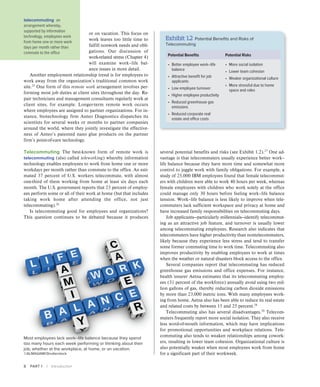
several potential benefits and risks (see Exhibit 1.2).27
One ad-
vantage is that telecommuters usually experience better work–
life balance because they have more time and somewhat more
control to juggle work with family obligations. For example, a
study of 25,000 IBM employees found that female telecommut-
ers with children were able to work 40 hours per week, whereas
female employees with children who work solely at the office
could manage only 30 hours before feeling work–life balance
tension. Work–life balance is less likely to improve when tele-
commuters lack sufficient workspace and privacy at home and
have increased family responsibilities on telecommuting days.
Job applicants—particularly millennials—identify telecommut-
ing as an attractive job feature, and turnover is usually lower
among telecommuting employees. Research also indicates that
telecommuters have higher productivity than nontelecommuters,
likely because they experience less stress and tend to transfer
some former commuting time to work time. Telecommuting also
improves productivity by enabling employees to work at times
when the weather or natural disasters block access to the office.
Several companies report that telecommuting has reduced
greenhouse gas emissions and office expenses. For instance,
health insurer Aetna estimates that its telecommuting employ-
ees (31 percent of the workforce) annually avoid using two mil-
lion gallons of gas, thereby reducing carbon dioxide emissions
by more than 23,000 metric tons. With many employees work-
ing from home, Aetna also has been able to reduce its real estate
and related costs by between 15 and 25 percent.28
Telecommuting also has several disadvantages.29
Telecom-
muters frequently report more social isolation. They also receive
less word-of-mouth information, which may have implications
for promotional opportunities and workplace relations. Tele-
commuting also tends to weaken relationships among cowork-
ers, resulting in lower team cohesion. Organizational culture is
also potentially weaker when most employees work from home
for a significant part of their workweek.
or on vacation. This focus on
work leaves too little time to
fulfill nonwork needs and obli-
gations. Our discussion of
work-related stress (Chapter 4)
will examine work–life bal-
ance issues in more detail.
Another employment relationship trend is for employees to
work away from the organization’s traditional common work
site.25
One form of this remote work arrangement involves per-
forming most job duties at client sites throughout the day. Re-
pair technicians and management consultants regularly work at
client sites, for example. Longer-term remote work occurs
where employees are assigned to partner organizations. For in-
stance, biotechnology firm Anteo Diagnostics dispatches its
scientists for several weeks or months to partner companies
around the world, where they jointly investigate the effective-
ness of Anteo’s patented nano glue products on the partner
firm’s point-of-care technology.
Telecommuting The best-known form of remote work is
telecommuting (also called teleworking) whereby information
technology enables employees to work from home one or more
workdays per month rather than commute to the office. An esti-
mated 37 percent of U.S. workers telecommute, with almost
one-third of them working from home at least six days each
month. The U.S. government reports that 23 percent of employ-
ees perform some or all of their work at home (but that includes
taking work home after attending the office, not just
telecommuting).26
Is telecommuting good for employees and organizations?
This question continues to be debated because it produces
Most employees lack work–life balance because they spend
too many hours each week performing or thinking about their
job, whether at the workplace, at home, or on vacation.
ŠALMAGAMI/Shutterstock
telecommuting an
arrangement whereby,
supported by information
technology, employees work
from home one or more work
days per month rather than
commute to the office
Exhibit 1.2 Potential Benefits and Risks of
Telecommuting
Potential Benefits Potential Risks
• 
Better employee work–life
balance
• 
Attractive benefit for job
applicants
• 
Low employee turnover
• 
Higher employee productivity
• 
Reduced greenhouse gas
emissions
• 
Reduced corporate real
estate and office costs
• 
More social isolation
• 
Lower team cohesion
• 
Weaker organizational culture
• 
More stressful due to home
space and roles
CHAPTER 1 | Introduction to the Field of Organizational Behavior 9
Telecommuting success depends on several characteristics of
the employee, job, and organization.30
Employees who work
effectively from home typically have higher self-motivation, self-
organization, need for autonomy, and information technology
skills. Those who telecommute most of the time also fulfill their
social needs more from sources outside the workplace. Jobs are
better suited to telecommuting when the tasks do not require
resources at the workplace, the work is performed independently
from coworkers, and task performance is measurable.
Organizations improve telecommuting success by rewarding
and promoting employees based on their performance rather
than their presence in the office (face time). Effective compa-
nies also help telecommuters maintain sufficient cohesion with
their team and psychological connectedness with the organiza-
tion. This occurs by limiting the number of telecommuting days,
having special meetings or events where all employees assemble
at the workplace, and regularly using video communication and
other technology that improves personal relatedness.
SELF-ASSESSMENT 1.1: Are You a Good Telecommuter?
Telecommuting is an increasingly popular workplace relationship, and it
potentially offers benefits for both companies and telecommuters. However, some
people are better suited than others to telecommuting and other forms of remote
work. You can discover how well you adjust to telecommuting and remote work
by locating this self-assessment in Connect if it is assigned by your instructor.
Increasing Workforce Diversity
Immigrants to the United States and many other countries have
much more multicultural origins than a few decades ago, result-
ing in a much more diverse workforce in most organizations. In
addition, globalization has increased the diversity of people em-
ployees interact with in partner organizations (suppliers, clients,
etc.) located elsewhere in the world.
When discussing workforce diversity, we usually think about
surface-level diversity—the observable demographic and other
overt differences among members of a group, such as their race,
ethnicity, gender, age, and physical capabilities.31
Surface-level di-
versity in the United States and many other countries has in-
creased substantially over the past few decades. For instance,
people with non-Caucasian or Hispanic origin currently represent
almost 40 percent of the American population. Within the next
50 years, an estimated one-quarter of Americans will be Hispanic
(currently 18 percent), 14 percent
will be of Asian descent (cur-
rently 6 percent), and 13 per-
cent will be African American
(currently 14 percent).32
Diversity also includes dif-
ferences in personalities, be-
liefs, values, and attitudes.33
We can’t directly see this deep-
level diversity, but it is evident
in a person’s choices, words,
and actions. Deep-level diver-
sity is revealed when employees have different perceptions and
attitudes about the same situation (see Chapter 10) and when
they form like-minded informal social groups (see
Chapter 7). Some deep-level diversity is associated with surface-
level attributes. For example, studies report significant differ-
ences between men and women regarding their preference of
conflict-handling styles, ethical
principles, and approaches to
communicating with other
people in various situations.34
An example of deep-level di-
versity is the variations in beliefs
and expectations across genera-
tions.35
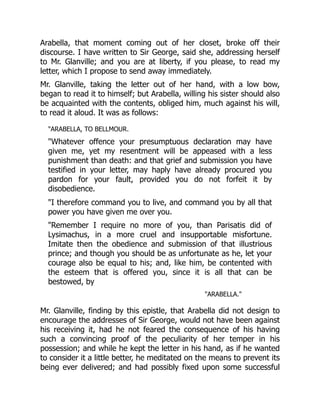
Exhibit 1.3 illustrates the
distribution of the American
workforce by major generational
cohorts: Baby Boomers (born
from 1946 to 1964), Generation
Xers (born from 1965 to 1980), and Millennials (also called Genera-
tion Yers, born between 1981 and 1997).
Generational deep-level diversity does exist to some extent, but
it tends to be subtler than the popular press would suggest. Also,
some generational differences are actually due to age, not co-
hort.37
For instance, Millennials have a stronger motivation for
personal development, advancement, and recognition, whereas
Baby Boomers are more motivated by interesting and meaningful
work. Research indicates that as Millennials age, their motivation
for learning and advancement will wane and their motivation for
interesting and meaningful work will increase.
Consequences of Diversity
Workforce diversity offers numerous advantages to organiza-
tions.38
Teams with high informational diversity—members have
different knowledge and skills—tend to be more creative and
surface-level diversity
the observable demographic
or physiological differences in
people, such as their race,
ethnicity, gender, age, and
physical disabilities
deep-level diversity
differences in the
psychological characteristics
of employees, including
personalities, beliefs, values,
and attitudes
Employees who work effectively from home typically have
higher self-motivation, self-organization, need for autonomy,
and information technology skills.
10 PART 1 | Introduction
make better decisions in complex situations compared to teams
with less informational diversity. A workforce with surface- and
deep-level diversity is also more representative of most commu-
nities, so companies are better able to recognize and address
community needs. These and other benefits may explain why
companies that win diversity awards have higher financial re-
turns, at least in the short run.39
Diversity also poses challenges in the workplace.40
One prob-
lem is that employees with diverse backgrounds usually take lon-
ger to perform effectively together because they experience
numerous communication problems and create “faultlines” in
informal group dynamics (see Chapter 7). Some forms of diver-
sity also increase the risk of dysfunctional conflict, which re-
duces information sharing and satisfaction with coworkers (see
Chapter 10). Research suggests that these problems can offset
the advantages of diversity in some situations.
But even with these challenges, companies need to make diver-
sity a priority because surface-level diversity and some forms of
deep-level diversity are moral and legal imperatives. Companies
that offer an inclusive workplace are, in essence, fulfilling the ethi-
cal standard of fairness in their decisions regarding employment
and the allocation of rewards. Inclusive workplace practices im-
prove the quality of hiring and promotion, and increase employee
satisfaction and loyalty. Companies that create an inclusive work-
place also nurture a culture of respect, which, in turn, improves
cooperation and coordination among employees.
Exhibit 1.3 America’s Multigenerational Workforce36
Silents
Generation Z
(Linkster)
Millennials
(Gen Y)
Generation X
Baby
Boomers
Note: Percentage of U.S. workforce by age group, based on data
from the U.S. Bureau of Labor Statistics. “Silents” represent the
generation of employees born before 1946. Generation Zers (also
called Linksters) were born after 1997.
O B T H E O R Y T O P R A C T I C E
Diversity as Competitive Advantage
at MasterCard
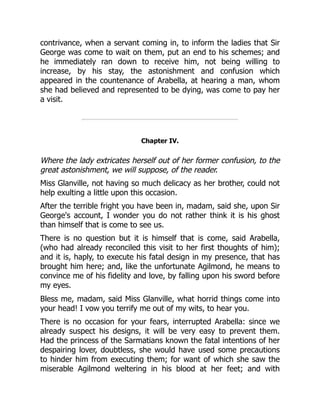
Supporting workforce diversity is the right thing to do as well as a source
of competitive advantage at MasterCard Incorporated. “Our culture of
inclusion has established us as a global company of empowered em-
ployees who use their diversity of thought, experience and background
to advance innovation and MasterCard’s contributions to society,” says
MasterCard president and CEO Ajay Banga (shown in this photo).
Banga personally chairs MasterCard’s Global Diversity and Inclu-
sion Council and meets several times each year with its eight Busi-
ness Resource Groups. More than half of MasterCard’s employees
participate in these diversity-based groups, which serve as internal
business consultants to guide the company on consumer prefer-
ences, cultural insights, and access to networks. “By valuing a culture
of inclusion, we gain additional insights and perspectives that allow
us to make the best decisions for our business and customers,” ex-
plains Donna Johnson, MasterCard’s chief diversity officer.41
ŠPau Barrena/Bloomberg/Getty Images
ANCHORS OF
ORGANIZATIONAL
BEHAVIOR KNOWLEDGE
Technological change, globalization, emerging employment re-
lationships, and increasing workforce diversity are just a few of
the societal changes that make organizational behavior knowl-
edge more useful than ever before. To understand these and
other topics, the field of organizational behavior relies on a set
of basic beliefs or knowledge structures (see Exhibit 1.4). These
conceptual anchors represent the principles on which OB
knowledge is developed and refined.42
LO1-3 Discuss the anchors on which organizational
behavior knowledge is based.
Another Random Scribd Document
with Unrelated Content
Arabella, that moment coming out of her closet, broke off their
discourse. I have written to Sir George, said she, addressing herself
to Mr. Glanville; and you are at liberty, if you please, to read my
letter, which I propose to send away immediately.
Mr. Glanville, taking the letter out of her hand, with a low bow,
began to read it to himself; but Arabella, willing his sister should also
be acquainted with the contents, obliged him, much against his will,
to read it aloud. It was as follows:
ARABELLA, TO BELLMOUR.
Whatever offence your presumptuous declaration may have
given me, yet my resentment will be appeased with a less
punishment than death: and that grief and submission you have
testified in your letter, may haply have already procured you
pardon for your fault, provided you do not forfeit it by
disobedience.
I therefore command you to live, and command you by all that
power you have given me over you.
Remember I require no more of you, than Parisatis did of
Lysimachus, in a more cruel and insupportable misfortune.
Imitate then the obedience and submission of that illustrious
prince; and though you should be as unfortunate as he, let your
courage also be equal to his; and, like him, be contented with
the esteem that is offered you, since it is all that can be
bestowed, by
ARABELLA.
Mr. Glanville, finding by this epistle, that Arabella did not design to
encourage the addresses of Sir George, would not have been against
his receiving it, had he not feared the consequence of his having
such a convincing proof of the peculiarity of her temper in his
possession; and while he kept the letter in his hand, as if he wanted
to consider it a little better, he meditated on the means to prevent its
being ever delivered; and had possibly fixed upon some successful
contrivance, when a servant coming in, to inform the ladies that Sir
George was come to wait on them, put an end to his schemes; and
he immediately ran down to receive him, not being willing to
increase, by his stay, the astonishment and confusion which
appeared in the countenance of Arabella, at hearing a man, whom
she had believed and represented to be dying, was come to pay her
a visit.
Chapter IV.
Where the lady extricates herself out of her former confusion, to the
great astonishment, we will suppose, of the reader.
Miss Glanville, not having so much delicacy as her brother, could not
help exulting a little upon this occasion.
After the terrible fright you have been in, madam, said she, upon Sir
George's account, I wonder you do not rather think it is his ghost
than himself that is come to see us.
There is no question but it is himself that is come, said Arabella,
(who had already reconciled this visit to her first thoughts of him);
and it is, haply, to execute his fatal design in my presence, that has
brought him here; and, like the unfortunate Agilmond, he means to
convince me of his fidelity and love, by falling upon his sword before
my eyes.
Bless me, madam, said Miss Glanville, what horrid things come into
your head! I vow you terrify me out of my wits, to hear you.
There is no occasion for your fears, interrupted Arabella: since we
already suspect his designs, it will be very easy to prevent them.
Had the princess of the Sarmatians known the fatal intentions of her
despairing lover, doubtless, she would have used some precautions
to hinder him from executing them; for want of which she saw the
miserable Agilmond weltering in his blood at her feet; and with
reason accused herself of being the cause of so deplorable a
spectacle.
The astonishment Miss Glanville was in, to hear her cousin talk in
this manner, kept her from giving her any interruption, while she
related several other terrible instances of despair.
In the mean time, Sir George, who was impatient to go up to Lady
Bella's apartment, having flattered himself into a belief, that his
letter was favourably received; and that he should be permitted to
hope at least; made a short visit to Sir Charles in his own room; and,
accompanied by Mr. Glanville, who was resolved to see in what
manner Arabella received him, went to her apartment.
As he had taken care, at his entrance, to accommodate his looks to
the character he had assumed of an humble despairing lover,
Arabella no sooner saw him, than her countenance changed; and,
making a sign to Mr. Glanville, who could not comprehend what she
meant, to seize upon the guard of his sword, she hastily stepped
forward to meet him.
I am too well convinced, said she to Sir George, that the intent of
your coming hither to-day is to commit some violence against
yourself before my eyes: but listen not, I beseech you, to the
dictates of your despair. Live; I command you, live; and since you
say I have the absolute disposal of your life, do not deprive yourself
of it, without the consent of her on whom you profess to have
bestowed it.
Sir George, who did not imagine Arabella would communicate his
letter to her cousins, and only expected some distant hints from her
concerning it, was so confounded at this reception before them, that
he was not able to reply. He blushed, and turned pale alternately;
and, not daring to look either upon Miss Glanville or her brother, or
to meet the eyes of the fair visionary, who with great impatience
expected his answer, he hung down his head, in a very silly posture;
and, by his silence, confirmed Arabella in her opinion.
As he did not want for wit and assurance, during that interval of
silence and expectation from all parties, his imagination suggested
to him the means of extricating himself out of the ridiculous
perplexity he was in; and as it concerned him greatly to avoid any
quarrel with the brother and sister, he determined to turn the whole
matter into a jest; but, if possible, to manage it so that Arabella
should not enter into his meaning.
Raising therefore his eyes, and looking upon Arabella with a
melancholy air—
You are not deceived, madam, said he: this criminal, with whom you
are so justly offended, comes with an intention to die at your feet,
and breathe out his miserable life, to expiate those crimes of which
you accuse him: but since your severe compassion will oblige me to
live, I obey, O most divine, but cruel Arabella! I obey your harsh
commands; and, by endeavouring to live, give you a more
convincing proof of that respect and submission I shall always have
for your will.
I expected no less from your courage and generosity, said Arabella,
with a look of great complacency; and since you so well know how
to imitate the great Lysimachus in your obedience, I shall be no less
acknowledging than the fair Parisatis; but will have for you an
esteem equal to that virtue I have observed in you.
Sir George, having received this gracious promise with a most
profound bow, turned to Mr. Glanville, with a kind of chastened smile
upon his countenance.
And you, fortunate and deserving knight, said he, happy in the
affections of the fairest person in the world! grudge me not this
small alleviation of my misfortunes; and envy me not that esteem
which alone is able to make me suffer life, while you possess, in the
heart of the divine Arabella, a felicity that might be envied by the
greatest monarchs in the world.
As diverting as this scene was, Mr. Glanville was extremely uneasy:
for though Sir George's stratagem took, and he believed he was only
indulging the gaiety of his humour by carrying on this farce, yet he
could not endure he should divert himself at Arabella's expense. The
solemn speech he had made him, did indeed force him to smile; but
he soon assumed a graver look, and told Sir George, in a low voice,
that when he had finished his visit, he should be glad to take a turn
with him in the garden.
Sir George promised to follow him, and Mr. Glanville left the room,
and went into the gardens; where the baronet, having taken a
respectful leave of Arabella, and by a sly glance convinced Miss
Glanville he had sacrificed her cousin to her mirth, went to join her
brother.
Mr. Glanville, as soon as he saw him, walked to meet him with a very
reserved air; which Sir George observing, and being resolved to keep
up his humour—
What, inhuman but too-happy lover, said he, what am I to
understand by that cloud upon your brow? Is it possible that thou
canst envy me the small comfort I have received? And, not satisfied
with the glorious advantages thou possessest, wilt thou still deny me
that esteem, which the divine Arabella has been pleased to bestow
upon me?
Pray, Sir George, said Mr. Glanville, lay aside this pompous style: I
am not disposed to be merry at present, and have not all the relish
for this kind of wit that you seem to expect. I desired to see you
here, that I might tell you, without witnesses, I take it extremely ill
you should presume to make my cousin the object of your mirth.
Lady Bella, sir, is not a person with whom such liberties ought to be
taken: nor will I, in the double character of her lover and relation,
suffer it from any one whatever.
Cruel fortune! said Sir George, stepping back a little, and lifting up
his eyes, shall I always be exposed to thy persecutions? And must I,
without any apparent cause, behold an enemy in the person of my
friend; who, though, without murmuring, I resign to him the
adorable Arabella, is yet resolved to dispute with me a satisfaction
which does not deprive him of any part of that glorious fortune to
which he is destined? Since it is so, unjust and cruel friend, pursued
he, strike this breast which carries the image of the divine Arabella;
but think not that I will offer to defend myself, or lift my sword
against a man beloved by her.
This is all very fine, returned Mr. Glanville, hardly able to forbear
laughing; but it is impossible, with all your gaiety, to hinder me from
being serious upon this business.
Then be as serious as thou wilt, dear Charles, interrupted Sir
George, provided you will allow me to be gay; and not pretend to
infect me with thy unbecoming gravity.
I have but a few words to say to you, then, sir, replied Mr. Glanville:
either behave with more respect to my cousin; or prepare to give me
satisfaction for the insults you offer her.
Oh! I understand you, sir, said Sir George; and because you have
taken it into your head to be offended at a trifle of no consequence
in the world, I must give you a fair chance to run me through the
body! There is something very foolish, faith, in such an extravagant
expectation: but since custom has made it necessary that a man
must venture his soul and body upon these important occasions,
because I will not be out of the fashion, you shall command me
whenever you think fit; though I shall fight with my schoolfellow
with a very ill will, I assure you.
There is no necessity for fighting, said Mr. Glanville, blushing at the
ludicrous light in which the gay baronet had placed his challenge:
the concession I have required is very small, and not worth the
contesting for on your side. Lady Bella's peculiarity, to which you
contribute so much, can afford you, at best but an ill-natured
diversion, while it gives me a real pain; and sure you must
acknowledge you are doing me a very great injury, when you
endeavour to confirm a lady, who is to be my wife, in a behaviour
that excites your mirth, and makes her a fit object for your ridicule
and contempt.
You do Lady Bella, a much greater injury than I do, replied Sir
George, by supposing she can ever be an object of ridicule and
contempt. I think very highly of her understanding; and though the
bent of her studies has given her mind a romantic turn, yet the
singularity of her manners is far less disagreeable than the lighter
follies of most of her sex.
But to be absolutely perfect, interrupted Mr. Glanville, I must cure
her of that singularity; and therefore I beg you will not persist in
assuming a behaviour conformable to her romantic ideas; but rather
help me to banish them from her imagination.
Well, replied Sir George, since you no longer threaten, I'll do what I
can to content you; but I must quit my heroics by degrees, and sink
with decency into my own character; otherwise she will never
endure me in her presence.
Arabella and Miss Glanville appearing in the walk, broke off the
conversation. The baronet and Mr. Glanville walked forward to meet
them; but Arabella, who did not desire company, struck into another
walk, whither Mr. Glanville following, proposed to join her, when he
saw his father, who had been taking a turn there alone, make up to
Arabella; and supposing he would take that opportunity to talk to
her concerning him, he went back to his sister and Sir George,
whose conversation he interrupted, to the great regret of Miss
Glanville.
Chapter V.
In which will be found one of the former mistakes pursued,
and another cleared up, to the great satisfaction of two
persons; among whom the reader, we expect, will make a
third.
Arabella no sooner saw Sir Charles advancing towards her, than,
sensible of the consequence of being alone with a person whom she
did not doubt would make use of that advantage to talk to her of
love, she endeavoured to avoid him, but in vain; for Sir Charles,
guessing her intentions, walked hastily up to her; and, taking hold of
her hand—
You must not go away, Lady Bella, said he: I have something to say
to you.
Arabella, extremely discomposed at this behaviour, struggled to free
her hand from her uncle; and giving him a look, on which disdain
and fear were visibly painted—
Unhand me, sir, said she, and force me not to forget the respect I
owe you as my uncle, by treating you with a severity such
uncommon insolence demands.
Sir Charles, letting go her hand in a great surprise at the word
insolent, which she had used, asked her if she knew to whom she
was speaking?
Questionless, I am speaking to my uncle, replied she; and it is with
great regret I see myself obliged to make use of expressions no way
conformable to the respect I bear that sacred character.
And, pray, madam, said Sir Charles, somewhat softened by this
speech, who is it that obliges you to lay aside that respect you seem
to acknowledge is due to your uncle?
You do, sir, replied she; and it is with infinite sorrow that I behold
you assuming a character unbecoming the brother of my father.
This is pretty plain, indeed, interrupted Sir Charles: but pray,
madam, inform me what it is you complain of.
You questionless know much better than I can tell you, replied
Arabella, blushing, the offence I accuse you of; nor is it proper for
me to mention what it would not become me to suffer.
Zounds! cried Sir Charles, no longer able to suppress his growing
anger: this is enough to make a man mad.
Ah! I beseech you, sir, resumed Arabella, suffer not an unfortunate
and ill-judged passion to be the bane of all your happiness and
virtue. Recall your wandering thoughts; reflect upon the dishonour
you will bring upon yourself by persisting in such unjustifiable
sentiments.
I do not know how it is possible to avoid it, said Sir Charles; and,
notwithstanding all this fine reasoning, there are few people but
would fly into greater extremities; but my affection for you makes
me——
Hold, hold, I conjure you, sir; interrupted Arabella; force me not to
listen to such injurious language; carry that odious affection
somewhere else; and do not persecute an unfortunate maid, who
has contributed nothing to thy fault, and is only guilty of too much
compassion for thy weakness.
Good God! cried Sir Charles, starting back, and looking upon
Arabella with astonishment; how I pity my son! What would I not
give, if he did not love this girl?
Think not, replied Arabella, that the passion your son has for me
makes your condition a bit the worse; for I would be such as I am
with respect to you, were there no Mr. Glanville in the world.
I never thought, niece, said Sir Charles, after a little pause, that any
part of my behaviour could give you the offence you complain of, or
authorise that hatred and contempt you take the liberty to express
for me: but since it is so, I promise you I will quit your house, and
leave you to your self. I have always been solicitous for your welfare;
and ungrateful as you are——
Call me not ungrateful, interrupted Arabella again: Heaven is my
witness, that had you not forgot I was your niece, I would have
always remembered you was my uncle; and not only have regarded
you as such, but have looked upon you as another father, under
whose direction Providence had placed me, since it had deprived me
of my real father, and whose tenderness and care might have in
some measure supplied the loss I had of him: but Heaven has
decreed it otherwise; and since it is its will that I should be deprived
of the comfort and assistance my orphan state requires, I must
submit, without murmuring, to my destiny. Go then, unfortunate and
lamented uncle, pursued she, wiping some tears from her fine eyes;
go, and endeavour by reason and absence to recover thy repose;
and be assured, whenever you can convince me you have triumphed
over these sentiments, which now cause both our unhappiness, you
shall have no cause to complain of my conduct towards you.
Finishing these words, she left him with so much speed, that it
would have been impossible for him to have stopped her, though he
had intended it: but indeed he was so lost in wonder and confusion
at a behaviour for which he was not able to assign any other cause
than madness, that he remained fixed in the same posture of
surprise, in which she had left him; and from which he was first
interrupted by the voice of his son, who, seeing Arabella flying
towards the house in great seeming emotion, came to know the
result of their conversation.
Sir, said Mr. Glanville, who had spoken to his father before, but had
no answer, will you not inform me what success you have had with
my cousin? How did she receive your proposal?
Speak of her no more, said Sir Charles: she is a proud ungrateful
girl, and unworthy the affection you have for her.
Mr. Glanville, who trembled to hear so unfavourable an answer to his
enquiries, was struck dumb with his surprise and grief; when Sir
Charles, taking notice of the alteration in his countenance—
I am sorry, said he, to find you have set your heart upon this
fantastic girl: if ever she be your wife, which I very much doubt, she
will make you very unhappy. But, Charles, pursued he, I would
advise you to think no more of her; content yourself with the estate
you gain by her refusal of you: with that addition to your own
fortune, you may pretend to any lady whatever; and you will find
many that are full as agreeable as your cousin, who will be proud of
your addresses.
Indeed, sir, said Mr. Glanville, with a sigh, there is no woman upon
earth whom I would choose to marry, but Lady Bella. I flattered
myself I had been happy enough to have made some progress in her
affection; but it seems I was mistaken; however, I should be glad to
know if she gave you any reasons for refusing me.
Reasons! said Sir Charles: there is no making her hear reason, or
expecting reason from her. I never knew so strange a woman in my
life: she would not allow me to speak what I intended concerning
you; but interrupted me every moment, with some high-flown stuff
or other.
Then I have not lost all hopes of her, cried Mr. Glanville eagerly; for
since she did not hear what you had to say, she could not possibly
deny you.
But she behaved in a very impertinent manner to me, interrupted Sir
Charles; complained of my harsh treatment of her; and said several
other things, which, because of her uncommon style, I could not
perfectly understand; yet they seemed shocking; and, upon the
whole, treated me so rudely, that I am determined to leave her to
herself, and trouble my head no more about her.
For God's sake, dear sir, said Mr. Glanville, alarmed at this resolution,
suspend your anger till I have seen my cousin: there is some
mistake, I am persuaded, in all this. I know she has some very odd
humours, which you are not so well acquainted with, as I am. I'll go
to her, and prevail upon her to explain herself.
You may do so, if you please, replied Sir Charles; but I fear it will be
to very little purpose; for I really suspect her head is a little turned. I
do not know what to do with her: it is not fit she should have the
management of herself; and yet it is impossible to live upon easy
terms with her.
Mr. Glanville, who did not doubt but Arabella had been guilty of
some very ridiculous folly, offered nothing more in her justification;
but, having attended his father to his own chamber, went to
Arabella's apartment.
He found the pensive fair-one in a melancholy posture, her head
reclined upon one of her fair hands; and though her eyes were fixed
upon a book she held in the other, yet she did not seem to read, but
rather to be wholly buried in contemplation.
Mr. Glanville having so happily found her alone (for her women were
not then in her chamber) seated himself near her; having first asked
pardon for the interruption he had given to her studies; and
Arabella, throwing aside her book, prepared to listen to his
discourse; which by the agitation which appeared in his looks, she
imagined would be upon some extraordinary subject.
I left my father just now, said he, in a great deal of uneasiness, on
account of something you said to him, Lady Bella: he apprehends
you are disobliged, and he would willingly know how.
Has your father then acquainted you with the subject of our
conversation? interrupted Arabella.
I know what would have been the subject of your conversation,
replied Mr. Glanville, if you had been pleased to listen to what Sir
Charles intended to say to you on my behalf.
On your behalf? interrupted Arabella: Ah, poor deceived Glanville!
how I pity thy blind sincerity! But it is not for me to undeceive thee:
only thus much I must say to you, beware of committing your
interests to a person who will be a much better advocate for another
than for you.
Mr. Glanville, rejoiced to find by these words that her resentment
against his father was occasioned by a suspicion so favourable for
him, assured her, that Sir Charles wished for nothing more earnestly
than that he might be able to merit her esteem; and that it was to
dispose her to listen to his addresses, that he wanted to discourse
with her that morning.
Mr. Glanville being obliged, through his knowledge of his cousin's
temper, to speak to her in this distant manner, went on with his
assurances of his father's candour in this respect; and Arabella, who
would not declare her reasons for doubting it, only replied, that she
wished Sir Charles meant all that he had said to him; but that she
could not persuade herself to believe him sincere, till his future
actions had convinced her he was so.
Mr. Glanville, impatient to let his father know how greatly he had
been mistaken in the cause of Arabella's behaviour, made his visit
shorter than he would otherwise have done, in order to undeceive
him.
Is it possible, said Sir Charles, when his son had repeated the
conversation he had just had with Arabella, that she could be so
foolish as to imagine I had a design to propose any one else to her
but you? What reason have I ever given her, to think I would not be
glad to have her for my daughter-in-law? Indeed, she has some odd
ways that are very disagreeable; but she is one of the best matches
in England for all that. Poor girl! pursued he, she had reason to be
angry, if that was the case; and now I remember, she cried, when I
told her I would leave the house; yet her spirit was so great, that
she told me I might go. Well, I'll go and make it up with her; but
who could have imagined she would have been so foolish? Sir
Charles, at the repetition of these words, hurried away to Arabella's
apartment.
Niece, said he at his entrance, I am come to ask you pardon, for
having led you into a belief, that I meant——
It is enough, sir, interrupted Arabella; I grant you my pardon for
what is past; and as it does not become me to receive submissions
from my uncle, while he remembers he is so, I will dispense with
your acknowledgments at present; only to convince me, that this
sudden alteration is sincere, avoid, I beseech you, for the future, all
occasions of displeasing me.
I protest, cried Sir Charles, that I never intended——
I will not hear you say a word more of your past intentions,
interrupted Arabella again; I have forgot them all; and, while you
continue to regard me as your niece, I will never remember them to
your disadvantage.
Then I may hope——, said Sir Charles.
Oh! Heavens! cried Arabella, not suffering him to proceed; do you
come to insult me thus, with a mock repentance? And has my
easiness in being so ready to forget the injury you would have done
me, made you presumptuous enough to cherish an insolent hope
that I will ever change my resolution?
How vexatious is this! replied Sir Charles, fretting to see her
continually mistaking him. I swear to you, by all that is sacred, that
it is my son for whom I would solicit your consent.
How! said Arabella, astonished, will you then be just at last? And can
you resolve to plead for that son, whose interest, but a moment ago,
you would have destroyed?
I see, said Sir Charles, it is impossible to convince you.
No, no! interrupted Arabella, hastily; it is not impossible but my own
ardent wishes that it may be so, will help to convince me of the truth
of what you say: for, in fine, do you think, I shall not be as glad as
yourself, to find you capable of acting honourably by your son; and
to see myself no longer the cause of the most unjustifiable conduct
imaginable?
Sir Charles was opening his mouth, to press her in favour of Mr.
Glanville; whom, notwithstanding her strange behaviour, he was glad
to find she loved; when Arabella preventing him—
Seek not, I beseech you, said she, to destroy that belief I am willing
to give your words, by any more attempts at this time to persuade
me; for truly, I shall interpret your solicitude no way in your favour:
therefore, if you desire I should be convinced you are sincere, let the
silence I require of you be one proof of it.
Sir Charles, who looked excessively out of countenance at such a
peremptory command from his niece, was going out of her chamber,
in a very ill humour, when the dinner-bell ringing, she gave him her
hand with a very gracious air; and permitted him to lead her into the
dining-room, where they found Mr. Glanville, his sister, and Sir
George, who had been detained to dinner by Miss Glanville,
expecting their coming.
Chapter VI.
Containing some account of Thalestris, queen of the
Amazons, with other curious anecdotes.
Lady Bella having recovered her usual cheerfulness, through the
satisfaction she felt at her uncle's returning to reason, and the
abatement she perceived in Sir George's extreme melancholy, mixed
in the conversation with that wit and vivacity which was natural to
her, and which so absolutely charmed the whole company, that not
one of them remembered any of her former extravagancies.
Mr. Glanville gazed on her with a passionate tenderness, Sir George
with admiration, and the old baronet with wonder and delight.
But Miss Glanville, who was inwardly vexed at the superiority her
cousin's wit gave her over herself, wished for nothing more than an
opportunity of interrupting a conversation in which she could have
no share; and willing to put them in mind of some of Arabella's
strange notions, when she observed them disputing concerning
some of the actions of the ancient Romans, she very innocently
asked Sir George, whether in former times women went to the wars,
and fought like men? For my cousin, added she, talks of one
Thaltris, a woman, that was as courageous as any soldier whatever.
Mr. Glanville, horridly vexed at a question that was likely to engage
Arabella in a discourse very different from that she had been so
capable of pleasing in, frowned very intelligibly at his sister; and to
prevent any answer being given to her absurd demand, directed
some other conversation to Arabella: but she, who saw a favourite
subject started, took no notice of what Mr. Glanville was saying to
her; but directing her looks to Sir George—
Though Miss Glanville, said she, be a little mistaken in the name of
that fair queen she has mentioned; yet I am persuaded you know
whom she means; and that it is the renowned Thalestris, whose
valour staggers her belief, and of whom she wants to be informed.
Ay, ay, Thalestris, said Miss Glanville: it is such a strange name I
could not remember it; but, pray, was there ever such a person?
Certainly, madam, there was, replied Sir George: she was queen of
the Amazons, a warlike nation of women, who possessed great part
of Cappadocia, and extended their conquests so far, that they
became formidable to all their neighbours.
You find, miss, said Arabella, I did not attempt to impose upon you,
when I told you of the admirable valour of that beautiful queen;
which indeed was so great, that the united princes, in whose cause
she fought, looked upon her assistance to be equal to that of a
whole army; and they honoured her accordingly, with the most
distinguishing marks of their esteem and acknowledgment, and
offered her the chief command of their forces.
O shameful! cried Sir Charles: offer a woman the command of an
army! Brave fellows indeed, that would be commanded by a woman!
Sure you mistake, niece: there never was such a thing heard of in
the world.
What, sir, said Arabella, will you contradict a fact attested by the
greatest historians that ever were? You may as well pretend to say,
there never were such persons as Oroondates or Juba, as dispute
the existence of the famous Thalestris.
Why, pray, madam, said Sir Charles, who were those?
One of them, replied Arabella, was the great king of Scythia; and the
other, prince of the Two Mauritanias.
Odds-heart! interrupted Sir Charles, I believe their kingdoms are in
the moon: I never heard of Scythia, or the Two Mauritanias, before.
And yet, sir, replied Arabella, those kingdoms are doubtless as well
known as France or England; and there is no question but the
descendants of the great Oroondates, and the valiant Juba, sway the
sceptres of them to this day.
I must confess, said Sir George, I have a very great admiration for
those two renowned princes, and have read their beautiful exploits
with infinite pleasure; notwithstanding which, I am more inclined to
esteem the great Artaban than either of them.
Though Artaban, replied Arabella, is, without question, a warrior
equal to either of them, and haply no person in the world possessed
so sublime a courage as his was; yet, it may be, your partiality
proceeds from another cause; and you having the honour to
resemble him in some little infidelities he was accused of, with less
justice than yourself perhaps, induces you to favour him more than
any other.
Arabella blushed when she ended these words: and Sir George
replied with a sigh—
I have, indeed, the honour, madam, to resemble the great Artaban,
in having dared to raise my thoughts towards a divine person, who,
with reason, condemns my adorations.
Hey-day! cried Sir Charles, are you going to speak of divine things,
after all the fables you have been talking of? Troth, I love to hear
young men enter upon such subjects: but pray, niece, who told you
Sir George was an infidel?
Mr. Glanville, replied Arabella: and I am inclined to think he spoke
truth; for Sir George has never pretended to deny it.
How! interrupted Sir Charles; I am sorry to hear that. I hope you
have never, added he, looking at the young baronet, endeavoured to
corrupt my son with any of your free-thinking principles. I am for
every body having liberty of conscience; but I cannot endure to hear
people of your stamp endeavouring to propagate your mischievous
notions; and because you have no regard for your own future
happiness, disturbing other people in the laudable pursuit of theirs.
We will not absolutely condemn Sir George, said Arabella, till we
have heard his history from his own mouth, which he promised,
some time ago, to relate when I desired it.
I do not imagine his history is fit to be heard by ladies, said Sir
Charles; for your infidels live a strange kind of life.
However that may be, replied Arabella, we must not dispense with
Sir George from performing his promise. I dare say there are no
ladies here who will think the worse of him for freely confessing his
faults.
You may answer for yourself, if you please, madam, said Sir Charles;
but I hope my girl there will not say as much.
I dare say my cousin is not so rigid, said Arabella: she has too much
the spirit of Julia in her, to find fault with a little infidelity.
I am always obliged to you for your comparisons, cousin, said Miss
Glanville: I suppose this is greatly to my advantage too.
I assure you, madam, said Sir George, Lady Bella has done you no
injury by the comparison she has just now made; for Julia was one
of the finest princesses in the world.
Yet she was not free from the suspicion of infidelity, replied Arabella;
but though I do not pretend to tax my cousin with that fault, yet it is
with a great deal of reason that I say she resembles her in her
volatile humour.
I was never thought to be ill-humoured in my life, madam, said Miss
Glanville, colouring; and I cannot imagine what reason I have given
you for saying I am.
Nay, cousin, said Arabella, I am not condemning your humour; for,
to say the truth, there are a great many charms in a volatile
disposition; and notwithstanding the admirable beauty of Julia, it is
possible she made as many slaves by her light and airy carriage, as
she did by her eyes, though they were the fairest in the world,
except the divine Cleopatra's.
Cleopatra! cried Sir Charles: why she was a gipsy, was she not?
I never heard her called so, said Arabella, gravely; and I am apt to
believe you are not at all acquainted with her. But pray, pursued she,
let us wave this discourse at present, and prepare to listen to Sir
George's relation of his life: which, I dare say, is full of very
extraordinary events. However, sir, added she, directing her speech
to the young baronet, I am afraid your modesty will induce you to
speak with less candour than you ought, of those great actions,
which questionless you have performed: therefore we shall hear
your history, with greater satisfaction, from the mouth of your
faithful squire, who will not have the same reasons that you have for
suppressing what is most admirable in the adventures of your life.
Since it is your pleasure, madam, replied Sir George, to hear my
adventures, I will recount them as well as I am able myself, to the
end that I may have an opportunity of obliging you by doing some
violence to my natural modesty, which will not suffer me to relate
things the world have been pleased to speak of to my advantage,
without some little confusion.
Then, casting down his eyes, he seemed to be recollecting the most
material passages in his life. Mr. Glanville, though he could have
wished he had not indulged Arabella in her ridiculous request, was
not able to deny himself the diversion of hearing what kind of history
he would invent; and therefore resolved to stay and listen to him.
Miss Glanville was also highly delighted with the proposal; but Sir
Charles, who could not conceive there could be any thing worth
listening to, in a young rake's account of himself, got up with an
intention to walk in the garden; when perceiving it rained, he
changed his resolution, and resuming his seat, prepared to listen, as
every one else did, to the expected story.
When Sir George, after having paused a quarter of an hour longer,
during which all the company observed a profound silence, began
his relation in this manner, addressing himself to Arabella.
BOOK VI.
Chapter I.
Containing the beginning of Sir George's history; in which
the ingenious relator has exactly copied the style of
romance.
Though at present, madam, you behold me in the quality of a
private gentleman, in the possession only of a tolerable estate, yet
my birth is illustrious enough: my ancestors having formerly worn a
crown, which, as they won by their valour, so they lost by their
misfortune only.
How! interrupted Sir Charles, are you descended from kings? Why, I
never heard you say so before: pray, sir, how far are you removed
from royal blood? and which of your forefathers was it that wore a
crown?
Sir, replied Sir George, it is not much more than eight hundred years
since my ancestors, who were Saxons, swayed the sceptre of Kent;
and from the first monarch of that mighty kingdom am I lineally
descended.
Pray where may that kingdom of Kent lie? said Sir Charles.
Sir, replied Sir George, it is bounded by Sussex on the south-west;
Surrey on the west; the English Channel on the south; Dover Straits
on the south-east; and the Downs on the east; and it is divided from
Middlesex and Essex on the north by the Thames.
A mighty kingdom, indeed! said Sir Charles: why, it makes but a very
small part of the kingdom of Britain now. Well, if your ancestors
were kings of that county, as it is now called, it must be confessed
their dominions were very small.
However that may be, said Arabella, it raises Sir George greatly in
my esteem, to hear he is descended from kings; for, truly, a royal
extraction does infinitely set off noble and valiant actions, and
inspires only lofty and generous sentiments: therefore, illustrious
prince (for in that light I shall always consider you), be assured,
though fortune has despoiled you of your dominions, yet since she
cannot deprive you of your courage and virtue, Providence will one
day assist your noble endeavours to recover your rights, and place
you upon the throne of your ancestors, from whence you have been
so inhumanly driven; or, haply, to repair that loss, your valour may
procure you other kingdoms, no less considerable than that to which
you was born.
For Heaven's sake, niece, said Sir Charles, how come such
improbable things into your head? Is it such an easy matter, think
you, to conquer kingdoms, that you can flatter a young man, who
has neither fleets nor armies, with such strange hopes?
The great Artaban, sir, resumed Arabella, had neither fleets nor
armies, and was master only of a single sword; yet he soon saw
himself greater than any king, disposing the destinies of monarchs
by his will, and deciding the fates of empires by a single word. But
pray let this dispute rest where it is, and permit Sir George to
continue his relation.
It is not necessary, madam, resumed Sir George, to acquaint you
with the misfortunes of my family, or relate the several progressions
it made towards the private condition in which it now is: for, besides
that reciting the events of so many hundred years may haply, in
some measure, try your patience, I should be glad if you would
dispense with me from entering into a detail of accidents that would
sensibly afflict me. It shall suffice, therefore, to inform you, that my
father, being a peaceable man, fond of retirement and tranquillity,
made no attempts to recover the sovereignty from which his
ancestors had been unjustly expelled; but quietly beheld the
kingdom of Kent in the possession of other masters, while he
contented himself with the improvement of that small pittance of
ground, which was all that the unhappy Prince Veridomer, my
grandfather, was able to bequeath to him.
Hey-day! cried Sir Charles, will you new-christen your grandfather,
when he has been in his grave these forty years? I knew honest Sir
Edward Bellmour very well, though I was but a youth when he died;
but I believe no person in Kent ever gave him the title of Prince
Veridomer. Fie! fie! these are idle brags.
Sir George, without taking notice of the old baronet's heat, went on
with his narration in this manner:—
Things were in this state, madam, when I was born. I will not
trouble you with the relation of what I did in my infancy.
No, pray skip over all that, interrupted Sir Charles; I suppose your
infancy was like other people's; what can there be worth hearing in
that?
You are deceived, sir, said Arabella: the infancy of illustrious
personages has always something very extraordinary in it; and from
their childish words and actions there have been often presages
drawn of their future greatness and glory.
Not to disoblige Sir Charles, however, said the young prince of Kent,
I will not repeat many things which I said and did in the first years
of my life, that those about me thought very surprising; and from
them prognosticated that very strange accidents would befall me.
I have been a witness of some very unfavourable prognostics of you,
said Sir Charles, smiling; for you was the most unlucky bold spark
that ever I knew in my life.
It is very certain, pursued Sir George, that the forwardness of my
spirit gave great uneasiness to my father; who being, as I said
before, inclinable to a peaceable and sedentary life, endeavoured as
much as possible to repress that vivacity in my disposition which he
feared might involve me in dangerous enterprises. The pains he took
in my education, I recompensed by a more than ordinary docility;
and before I was thirteen, performed all my exercises with a
marvellous grace; and, if I may dare say so, was, at those early
years, the admiration and wonder of all that saw me.
Lady Bella had some reason to fear your modesty, I find, said Sir
Charles, smiling; for, methinks you really speak too slightly of your
excellencies.
However that may be, resumed Sir George, my father saw these
early instances of a towering genius in me, with a pleasure,
chastened by his fears, that the grandeur of my courage would lead
me to attempt something for the recovery of that kingdom, which
was my due; and which might haply occasion his losing me.
Possessed with these thoughts, he carefully avoided saying any thing
to me concerning the glorious pretences to which my birth gave me
a right; and often wished it had been possible for him to conceal
from me, that I was the true and lawful heir of the kingdom of Kent;
a circumstance he never chose to mention to any person, and would
have been glad if it had always remained a secret.
And so it was a secret, interrupted Sir Charles; for, till this day, I
never heard of it; and it might still have been a secret if you had
pleased; for nobody, I dare say, would suspect such a thing; and
very few, I believe, will be inclined to think there is any thing in such
an improbable tale.
Notwithstanding all my father's endeavours to the contrary, madam,
pursued Sir George, I cherished those towering sentiments the
knowledge of my birth inspired me with; and it was not without the
utmost impatience that I brooked the private condition to which I
found myself reduced.
Cruel fate! would I sometimes cry; was it not enough to deprive me
of that kingdom which is my due, and subject me to a mean and
inglorious state; but to make that condition infinitely more grievous,
must thou give me a soul towering above my abject fortune? A soul,
that cannot but disdain the base submission I must pay to those
who triumph in the spoils of my ruined house? A soul, which sees
nothing above its hopes and expectations? And, in fine, a soul, that
excites me daily to attempt things worthy of my birth, and those
noble sentiments I inherit from my great forefathers? Ah! pursued I,
unhappy Bellmour, what hinders thee from making thyself known
and acknowledged for what thou art? What hinders thee from boldly
asserting thy just and natural rights; and from defying the usurper
who detains them from thee? What hinders thee, I say?
What? interrupted Sir Charles; why the fear of a halter, I suppose:
there is nothing more easy than to answer that question.
Such, madam, said Sir George, were the thoughts which continually
disturbed my imagination; and, doubtless, they had not failed to
push me on to some hazardous enterprise, had not a fatal passion
interposed; and by its sweet but dangerous allurements, stifled for a
while that flame which ambition, and the love of glory kindled in my
soul.
Sir George here pausing, and fixing his eyes with a melancholy air
on the ground, as if pressed with a tender remembrance,—
Mr. Glanville asked him, smiling, if the thoughts of poor Dolly
disturbed him? Pray, added he, give us the history of your first love,
without any mixture of fable; or shall I take the trouble off you? For
you know, I am very well acquainted with your affair with the pretty
milk-maid, and can tell it very succinctly.
It is true, sir, said Sir George, sighing, I cannot recall the idea of
Dorothea into my remembrance, without some pain: that fair but
unfaithful shepherdess, who first taught me to sigh, and repaid my
tenderness with the blackest infidelity: yet I will endeavour to
compose myself, and go on with my narration.
Be pleased to know then, madam, pursued Sir George, that having
my thoughts, in this manner, wholly employed with the disasters of
my family, I had arrived to my seventeenth year, without being
sensible of the power of love; but the moment now arrived, which
was to prove fatal to my liberty. Following the chase one day with
my father and some other gentlemen, I happened to lag a little
behind them; and, being taken up with my ordinary reflections, I lost
my way, and wandered a long time, without knowing or considering
whither I was going. Chance at last conducted me to a pleasant
valley, surrounded with trees: and, being tired with riding, I alighted,
and tying my horse to a tree, walked forward with an intention to
repose myself a few moments under the shade of one of those trees
that had attracted my observation: but while I was looking for the
most convenient place, I spied, at the distance of some few yards
from me, a woman lying asleep upon the grass. Curiosity tempted
me to go nearer this person; and, advancing softly, that I might not
disturb her, I got near enough to have a view of her person: but, ah!
heavens! what wonders did my eyes encounter in this view!—--The
age of this fair sleeper seemed not to exceed sixteen; her shape was
formed with the exactest symmetry; one of her hands supported her
head; the other, as it lay carelessly stretched at her side, gave me an
opportunity of admiring its admirable colour and proportion. The thin
covering upon her neck discovered part of its inimitable beauty to
my eyes; but her face, her lovely face, fixed all my attention.
Certain it is, madam, that, out of this company, it would be hard to
find any thing so perfect as what I now viewed. Her complexion was
the purest white imaginable, heightened by the enchanting glow
which dyed her fair cheeks with a colour like that of a new-blown
rose: her lips, formed with the greatest perfection, and of a deeper
red, seemed to receive new beauties from the fragrance of that
breath that parted from them. Her auburn hair fell in loose ringlets
over her neck; and some straggling curls, that played upon her fair
forehead, set off by a charming contrast the whiteness of that skin it
partly hid. Her eyes indeed were closed; and though I knew not
whether their colour and beauty were equal to those other miracles
in her face, yet their proportion seemed to be large; and the snowy
lids, which covered them, were admirably set off by those long and
sable lashes that adorned them.
For some moments I gazed upon this lovely sleeper, wholly lost in
wonder and admiration.
Where, whispered I, where has this miracle been concealed, that my
eyes were never blessed with the sight of her before? These words,
though I uttered them softly, and with the utmost caution; yet by
the murmuring noise they made, caused an emotion in the
beauteous sleeper, that she started, and presently after opened her
eyes: but what words shall I find to express the wonder, the
astonishment, and rapture, which the sight of those bright stars
inspired me with? The flames which darted from those glorious orbs
cast such a dazzling splendor upon a sight too weak to bear a
radiance so unusual, that stepping back a few paces, I contemplated
at a distance, that brightness which began already to kindle a
consuming fire in my soul.
Bless me! interrupted Sir Charles, confounded at so pompous a
description; who could this be?
The pretty milk-maid, Dolly Acorn, replied Mr. Glanville gravely: did
you never see her, sir, when you was at your seat, at ——? She used
often to bring cream to my lady.
Aye, aye, replied Sir Charles, I remember her: she was a very pretty
girl. And so it was from her eyes that all those splendors and flames
came, that had like to have burnt you up, Sir George? Well, well, I
guess how the story will end: pray let us hear it out.
I have already told you, madam, resumed Sir George, the marvellous
effects the sight of those bright eyes produced upon my spirit. I
remained fixed in a posture of astonishment and delight; and all the
faculties of my soul were so absorbed in the contemplation of the
miracles before me, that I believe, had she still continued before my
eyes, I should never have moved from the place where I then stood:
but the fair virgin, who had spied me at the small distance to which I
was retired, turned hastily about, and flew away with extraordinary
swiftness.
When love, now lending me wings, whom admiration had before
made motionless, I pursued her so eagerly, that at last I overtook
her; and, throwing myself upon my knees before her,—
Stay, I conjure you, cried I; and if you be a divinity, as your celestial
beauty makes me believe, do not refuse the adoration I offer you:
but if, as I most ardently wish, you are a mortal, though sure the
fairest that ever graced the earth; stop a moment to look upon a
Welcome to Our Bookstore - The Ultimate Destination for Book Lovers
Are you passionate about testbank and eager to explore new worlds of
knowledge? At our website, we offer a vast collection of books that
cater to every interest and age group. From classic literature to
specialized publications, self-help books, and children’s stories, we
have it all! Each book is a gateway to new adventures, helping you
expand your knowledge and nourish your soul
Experience Convenient and Enjoyable Book Shopping Our website is more
than just an online bookstore—it’s a bridge connecting readers to the
timeless values of culture and wisdom. With a sleek and user-friendly
interface and a smart search system, you can find your favorite books
quickly and easily. Enjoy special promotions, fast home delivery, and
a seamless shopping experience that saves you time and enhances your
love for reading.
Let us accompany you on the journey of exploring knowledge and
personal growth!
ebooksecure.com


(eBook PDF) M: Organizational Behavior 4th Edition

  • 1.
    (eBook PDF) M:Organizational Behavior 4th Edition download https://ebooksecure.com/product/ebook-pdf-m-organizational- behavior-4th-edition/ Download full version ebook from https://ebooksecure.com
  • 2.
    We believe theseproducts will be a great fit for you. Click the link to download now, or visit ebooksecure.com to discover even more! M: Organizational Behavior 4th Edition Steven Mcshane - eBook PDF https://ebooksecure.com/download/m-organizational-behavior-ebook- pdf/ (eBook PDF) M: Organizational Behavior 3rd Edition by Steven McShane http://ebooksecure.com/product/ebook-pdf-m-organizational- behavior-3rd-edition-by-steven-mcshane/ (eBook PDF) Organizational Behavior 7th Edition http://ebooksecure.com/product/ebook-pdf-organizational- behavior-7th-edition/ (eBook PDF) Organizational Behavior 8th Edition http://ebooksecure.com/product/ebook-pdf-organizational- behavior-8th-edition/
  • 3.
    Organizational Behavior, 13thEdition (eBook PDF) http://ebooksecure.com/product/organizational-behavior-13th- edition-ebook-pdf/ Organizational Behavior 17th Edition (eBook PDF) http://ebooksecure.com/product/organizational-behavior-17th- edition-ebook-pdf/ Organizational Behavior 18th Edition (eBook PDF) http://ebooksecure.com/product/organizational-behavior-18th- edition-ebook-pdf/ (eBook PDF) Organizational Behavior: Human Behavior at Work 14th Edition http://ebooksecure.com/product/ebook-pdf-organizational-behavior- human-behavior-at-work-14th-edition/ (eBook PDF) Organizational Behavior Interactive 2nd Edition http://ebooksecure.com/product/ebook-pdf-organizational-behavior- interactive-2nd-edition/
  • 4.
    McSHANE | VONGLINOW 4th Edition ORGANIZATIONAL BEHAVIOR IN WHICH COUNTRIES DO EMPLOYEES HAVE THE HIGHEST ORGANIZATIONAL COMMITMENT? CH 4 WHAT IS YOUR PREFERRED MANAGERIAL LEADERSHIP STYLE? CH 11 INTROVERTS CAN BE EFFECTIVE SOCIAL NETWORKERS, TOO! CH 9 is Motivation. is Momentum. is Moving Forward. is McGraw-Hill.
  • 5.
    part one Introduction2 1 Introduction to the Field of Organizational Behavior 2 part two Individual Behavior and Processes 28 2 Individual Behavior, Personality, and Values 28 3 Perceiving Ourselves and Others in Organizations 54 4 Workplace Emotions, Attitudes, and Stress 78 5 Employee Motivation 106 6 Decision Making and Creativity 136 part three Team Processes 160 7 Team Dynamics 160 8 Communicating in Teams and Organizations 186 9 Power and Influence in the Workplace 210 10 Conflict and Negotiation in the Workplace 232 11 Leadership in Organizational Settings 256 part four Organizational Processes 278 Contents Brief Indexes 341 12 Designing Organizational Structures 278 13 Organizational Culture 298 14 Organizational Change 320 vii
  • 6.
    viii ANCHORS OF ORGANIZATIONAL BEHAVIORKNOWLEDGE 10 The Systematic Research Anchor 11 The Multidisciplinary Anchor 11 The Contingency Anchor 12 The Multiple Levels of Analysis Anchor 12 PERSPECTIVES OF ORGANIZATIONAL EFFECTIVENESS 12 Open Systems Perspective 12 Organizational Learning Perspective 14 High-Performance Work Practices Perspective 16 Stakeholder Perspective 18 Connecting the Dots: An Integrative Model of Organizational Behavior 20 THE JOURNEY BEGINS 21 1 Introduction to the Field of Organizational Behavior 2 THE FIELD OF ORGANIZATIONAL BEHAVIOR 3 Historical Foundations of Organizational Behavior 4 Why Study Organizational Behavior? 5 CONTEMPORARY DEVELOPMENTS FACING ORGANIZATIONS 6 Technological Change 6 Globalization 7 Emerging Employment Relationships 7 Increasing Workforce Diversity 9 Consequences of Diversity 9 Contents part one Introduction 2 ŠRobert Kneschke/Shutterstock 2 Individual Behavior, Personality, and Values 28 MARS MODEL OF INDIVIDUAL BEHAVIOR AND PERFORMANCE 29 Employee Motivation 29 Ability 30 Role Perceptions 30 Situational Factors 32 TYPES OF INDIVIDUAL BEHAVIOR 32 Task Performance 32 Organizational Citizenship 32 Counterproductive Work Behaviors 33 Joining and Staying with the Organization 33 Maintaining Work Attendance 33 PERSONALITY IN ORGANIZATIONS 34 Personality Determinants: Nature versus Nurture 35 Five-Factor Model of Personality 35 Jungian Personality Theory and the Myers-Briggs Type Indicator 38 VALUES IN THE WORKPLACE 39 Types of Values 40 Values and Individual Behavior 41 Values Congruence 42 ETHICAL VALUES AND BEHAVIOR 42 Three Ethical Principles 43 part two Individual Behavior and Processes 28
  • 7.
    CONTENTS ix ORGANIZATIONAL COMMITMENT91 Consequences of Affective and Continuance Commitment 91 Building Organizational Commitment 92 WORK-RELATED STRESS AND ITS MANAGEMENT 93 General Adaptation Syndrome 93 Consequences of Distress 94 Stressors: The Causes of Stress 94 Individual Differences in Stress 96 Managing Work-Related Stress 96 5 Employee Motivation 106 EMPLOYEE ENGAGEMENT 107 EMPLOYEE DRIVES AND NEEDS 108 Individual Differences in Needs 109 Four-Drive Theory 110 Maslow’s Needs Hierarchy Theory 111 Intrinsic and Extrinsic Motivation 112 Learned Needs Theory 113 EXPECTANCY THEORY OF MOTIVATION 114 Applying Expectancy Theory 114 ORGANIZATIONAL BEHAVIOR MODIFICATION AND SOCIAL COGNITIVE THEORY 116 Organizational Behavior Modification 116 Social Cognitive Theory 117 GOAL SETTING AND FEEDBACK 118 Characteristics of Effective Feedback 119 Sources of Feedback 120 Evaluating Goal Setting and Feedback 121 ORGANIZATIONAL JUSTICE 121 Equity Theory 121 Procedural Justice 123 Attribution Theory 65 Self-Fulfilling Prophecy 67 Other Perceptual Effects 68 IMPROVING PERCEPTIONS 69 Awareness of Perceptual Biases 69 Improving Self-Awareness 69 Meaningful Interaction 70 GLOBAL MINDSET: DEVELOPING PERCEPTIONS ACROSS BORDERS 71 Developing a Global Mindset 72 4 Workplace Emotions, Attitudes, and Stress 78 EMOTIONS IN THE WORKPLACE 79 Types of Emotions 80 Emotions, Attitudes, and Behavior 81 Cognitive Dissonance 83 Emotions and Personality 84 MANAGING EMOTIONS AT WORK 85 Emotional Display Norms across Cultures 85 Emotional Dissonance 85 EMOTIONAL INTELLIGENCE 86 Emotional Intelligence Outcomes and Development 87 JOB SATISFACTION 88 Job Satisfaction and Work Behavior 88 Job Satisfaction and Performance 89 Job Satisfaction and Customer Satisfaction 90 Job Satisfaction and Business Ethics 91 Moral Intensity, Moral Sensitivity, and Situational Influences 43 Supporting Ethical Behavior 44 VALUES ACROSS CULTURES 45 Individualism and Collectivism 45 Power Distance 47 Uncertainty Avoidance 47 Achievement-Nurturing Orientation 47 Caveats about Cross-Cultural Knowledge 47 3 Perceiving Ourselves and Others in Organizations 54 SELF-CONCEPT: HOW WE PERCEIVE OURSELVES 55 Self-Concept Complexity, Consistency, and Clarity 55 Self-Enhancement 57 Self-Verification 58 Self-Evaluation 58 The Social Self 59 Self-Concept and Organizational Behavior 60 PERCEIVING THE WORLD AROUND US 61 Perceptual Organization and Interpretation 62 SPECIFIC PERCEPTUAL PROCESSES AND PROBLEMS 63 Stereotyping in Organizations 63 ©PeopleImages/Digital Vision/Getty Images ©Elnur/Shutterstock
  • 8.
    x CONTENTS EVALUATING DECISIONS146 Escalation of Commitment 147 Evaluating Decision Outcomes More Effectively 148 CREATIVITY 148 The Creative Process 148 Characteristics of Creative People 149 Organizational Conditions Supporting Creativity 151 Activities That Encourage Creativity 151 EMPLOYEE INVOLVEMENT IN DECISION MAKING 152 Benefits of Employee Involvement 153 Contingencies of Employee Involvement 153 IDENTIFYING PROBLEMS AND OPPORTUNITIES 139 Problems with Problem Identification 140 Identifying Problems and Opportunities More Effectively 141 SEARCHING FOR, EVALUATING, AND CHOOSING ALTERNATIVES 141 Problems with Goals 141 Problems with Information Processing 141 Problems with Maximization 143 Selecting Opportunities 144 Emotions and Making Choices 144 Intuition and Making Choices 145 Making Choices More Effectively 145 IMPLEMENTING DECISIONS 146 JOB DESIGN 124 Job Design and Work Efficiency 124 Scientific Management 125 Problems with Job Specialization 126 Job Design and Work Motivation 126 Job Design Practices That Motivate 128 6 Decision Making and Creativity 136 RATIONAL CHOICE DECISION MAKING 137 Rational Choice Decision-Making Process 139 Problems with Rational Choice Decision Making 139 7 Team Dynamics 160 TEAMS AND INFORMAL GROUPS 161 Informal Groups 162 ADVANTAGES AND DISADVANTAGES OF TEAMS 163 The Challenges of Teams 164 A MODEL OF TEAM EFFECTIVENESS 165 Organizational and Team Environment 166 TEAM DESIGN ELEMENTS 167 Task Characteristics 167 Team Size 167 Team Composition 168 Workplace Communication through Social Media 191 Nonverbal Communication 192 CHOOSING THE BEST COMMUNICATION CHANNEL 194 Synchronicity 194 Social Presence 194 Social Acceptance 194 Media Richness 195 Communication Channels and Persuasion 197 COMMUNICATION BARRIERS (NOISE) 197 Information Overload 198 CROSS-CULTURAL AND GENDER COMMUNICATION 199 Nonverbal Differences across Cultures 200 Gender Differences in Communication 200 IMPROVING INTERPERSONAL COMMUNICATION 200 Getting Your Message Across 201 Active Listening 201 IMPROVING COMMUNICATION THROUGHOUT THE HIERARCHY 202 Workspace Design 202 Internet-Based Organizational Communication 203 Direct Communication with Top Management 203 TEAM PROCESSES 170 Team Development 170 Team Norms 173 Team Cohesion 174 Team Trust 175 SELF-DIRECTED TEAMS 176 Success Factors for Self-Directed Teams 176 VIRTUAL (REMOTE) TEAMS 176 Success Factors for Virtual Teams 177 TEAM DECISION MAKING 178 Constraints on Team Decision Making 178 Improving Creative Decision Making in Teams 179 8 Communicating in Teams and Organizations 186 THE IMPORTANCE OF COMMUNICATION 187 A MODEL OF COMMUNICATION 188 Influences on Effective Encoding and Decoding 189 COMMUNICATION CHANNELS 189 Internet and Digital Communication 190 Problems with Email and Other Digital Message Channels 190 ŠMoopixel/Shutterstock part three Team Processes 160
  • 9.
    CONTENTS xi TRANSFORMATIONAL LEADERSHIP PERSPECTIVE258 Develop and Communicate a Strategic Vision 259 Model the Vision 260 Encourage Experimentation 260 Build Commitment toward the Vision 261 Transformational Leadership and Charisma 261 Evaluating the Transformational Leadership Perspective 261 MANAGERIAL LEADERSHIP PERSPECTIVE 262 Interdependence of Managerial and Transformational Leadership 262 Task-Oriented and People-Oriented Leadership 263 Servant Leadership 263 PATH–GOAL AND LEADERSHIP SUBSTITUTES THEORIES 264 Path–Goal Leadership Theory 264 Leadership Substitutes Theory 266 IMPLICIT LEADERSHIP PERSPECTIVE 267 Prototypes of Effective Leaders 267 The Romance of Leadership 268 PERSONAL ATTRIBUTES PERSPECTIVE OF LEADERSHIP 268 Most Important Leadership Attributes 268 Authentic Leadership 270 Personal Attributes Perspective Limitations and Practical Implications 271 CROSS-CULTURAL AND GENDER ISSUES IN LEADERSHIP 271 Gender and Leadership 271 10 Conflict and Negotiation in the Workplace 232 THE MEANING AND CONSEQUENCES OF CONFLICT 233 Is Conflict Good or Bad? 233 THE EMERGING VIEW: TASK AND RELATIONSHIP CONFLICT 235 Task Conflict 235 Relationship Conflict 235 Separating Task from Relationship Conflict 235 CONFLICT PROCESS MODEL 236 STRUCTURAL SOURCES OF CONFLICT IN ORGANIZATIONS 237 Incompatible Goals 237 Differentiation 237 Interdependence 238 Scarce Resources 238 Ambiguous Rules 238 Communication Problems 238 INTERPERSONAL CONFLICT- HANDLING STYLES 239 Choosing the Best Conflict-Handling Style 240 Cultural and Gender Differences in Conflict-Handling Styles 242 STRUCTURAL APPROACHES TO CONFLICT MANAGEMENT 242 Emphasizing Superordinate Goals 242 Reducing Differentiation 243 Improving Communication and Mutual Understanding 243 Reducing Interdependence 244 Increasing Resources 244 Clarifying Rules and Procedures 244 THIRD-PARTY CONFLICT RESOLUTION 245 Choosing the Best Third-Party Intervention Strategy 245 RESOLVING CONFLICT THROUGH NEGOTIATION 246 Distributive versus Integrative Approaches to Negotiation 246 Preparing to Negotiate 247 The Negotiation Process 248 The Negotiation Setting 249 Gender and Negotiation 250 11 Leadership in Organizational Settings 256 WHAT IS LEADERSHIP? 257 Shared Leadership 257 COMMUNICATING THROUGH THE GRAPEVINE 204 Grapevine Characteristics 204 Grapevine Benefits and Limitations 204 9 Power and Influence in the Workplace 210 THE MEANING OF POWER 211 SOURCES OF POWER IN ORGANIZATIONS 212 Legitimate Power 213 Reward Power 214 Coercive Power 214 Expert Power 214 Referent Power 215 CONTINGENCIES OF POWER 215 Substitutability 215 Centrality 216 Visibility 216 Discretion 216 THE POWER OF SOCIAL NETWORKS 216 Social Capital and Sources of Power 217 Gaining Power through Social Networks 218 CONSEQUENCES OF POWER 220 INFLUENCING OTHERS 221 Types of Influence Tactics 221 Consequences and Contingencies of Influence Tactics 224 ORGANIZATIONAL POLITICS 226 Minimizing Organizational Politics 226 ©Hero Images/Getty Images ©EllisDon Corporation
  • 10.
    xii CONTENTS DECIPHERING ORGANIZATIONAL CULTURETHROUGH ARTIFACTS 302 Organizational Stories and Legends 303 Organizational Language 303 Rituals and Ceremonies 304 Physical Structures and Symbols 304 IS ORGANIZATIONAL CULTURE IMPORTANT? 305 Meaning and Potential Benefits of a Strong Culture 305 Contingencies of Organizational Culture and Effectiveness 305 Organizational Culture and Business Ethics 307 MERGING ORGANIZATIONAL CULTURES 308 Bicultural Audit 308 Strategies for Merging Different Organizational Cultures 308 CHANGING AND STRENGTHENING ORGANIZATIONAL CULTURE 310 Model Desired Culture through the Actions of Founders and Leaders 310 Align Artifacts with the Desired Culture 311 Introduce Culturally Consistent Rewards and Recognition 311 Support Workforce Stability and Communication 312 Use Attraction, Selection, and Socialization for Cultural Fit 312 ORGANIZATIONAL SOCIALIZATION 313 Learning and Adjustment Process 313 Stages of Organizational Socialization 313 Improving the Socialization Process 314 14 Organizational Change 320 LEWIN’S FORCE FIELD ANALYSIS MODEL 321 UNDERSTANDING RESISTANCE TO CHANGE 322 Why Employees Resist Change 323 UNFREEZING, CHANGING, AND REFREEZING 325 Creating an Urgency for Change 325 Reducing the Restraining Forces 327 Refreezing the Desired Conditions 329 LEADERSHIP, COALITIONS, AND PILOT PROJECTS 329 Transformational Leadership and Change 329 Coalitions, Social Networks, and Change 329 Pilot Projects and Diffusion of Change 331 TWO APPROACHES TO ORGANIZATIONAL CHANGE 331 Action Research Approach 332 Appreciative Inquiry Approach 333 CROSS-CULTURAL AND ETHICAL ISSUES IN ORGANIZATIONAL CHANGE 335 ORGANIZATIONAL BEHAVIOR: THE JOURNEY CONTINUES 335 Organization Index 341 Name Index 343 Glossary/Subject Index 356 12 Designing Organizational Structures 278 DIVISION OF LABOR AND COORDINATION 279 Division of Labor 279 Coordination of Work Activities 280 ELEMENTS OF ORGANIZATIONAL STRUCTURE 282 Span of Control 282 Centralization and Decentralization 284 Formalization 285 Mechanistic versus Organic Structures 285 FORMS OF DEPARTMENTALIZATION 286 Simple Structure 286 Functional Structure 286 Divisional Structure 287 Team-Based Structure 289 Matrix Structure 290 CONTINGENCIES OF ORGANIZATIONAL DESIGN 292 External Environment 292 Organizational Size 293 Technology 293 Organizational Strategy 293 13 Organizational Culture 298 ELEMENTS OF ORGANIZATIONAL CULTURE 299 Espoused versus Enacted Values 299 Content of Organizational Culture 300 Organizational Subcultures 302 part four Organizational Processes 278 ©Jacob Lund/Shutterstock
  • 11.
    xiii M: Organizational Behavior,Fourth Edition, has been significantly revised, guided by useful feedback from reviewers and our active monitoring of evidence-based literature. All chapters have new examples and either new or revised factoids; most chapters have new conceptual content or literature foundation. The most substantial changes have occurred in Chapter 1 (introduction to OB), Chapter 4 (workplace emotions, attitudes, and stress), Chapter 6 (decision making and creativity), Chapter 8 (communication), and Chapter 10 (conflict and negotiation). The authors personally researched, selected, and wrote all of this content, thereby providing superior integration of knowledge and ensuring that the examples are relevant and recent. Here are the key changes we’ve made to this fourth edition, broken out by chapter: Chapter 1: Introduction to the Field of Organizational Behavior Technological change has been added in the section on contemporary developments facing organizations. The section on perspectives of organizational effectiveness has been streamlined. Most topics have updated content, particularly the text on the four contemporary developments, why study OB, and several aspects of organizational effectiveness. Chapter 2: Individual Behavior, Personality, and Values Several topics in this chapter have been updated, particularly coverage of the five-factor model of personality and work performance, values and individual behavior, and moral sensitivity. Chapter 3: Perceiving Ourselves and Others in Organizations This book pioneered the full model of self-concept and its relevance to organizational behavior. This edition further develops this important topic and provides new information on the opposing motives for distinctiveness and inclusion. The section on stereotyping also incorporates the concept of stereotype threat. What’s New in the Fourth Edition Chapter 4: Workplace Emotions, Attitudes, and Stress This edition significantly revises and updates discussion on four key workplace stressors, with new writing about organizational constraints and interpersonal conflict as stressors. In addition, there is new content on attitude–behavior contingencies. Chapter 5: Employee Motivation New to this edition is the topic of intrinsic and extrinsic motivation, as well as the question of whether introducing extrinsic sources of motivation reduces intrinsic motivation. We also have reorganized and refined the writing on drives and needs, Maslow’s needs hierarchy, and four-drive theory. The previous edition introduced the social and information processing characteristics of jobs. This edition further refines that emerging topic. Chapter 6: Decision Making and Creativity This chapter has been substantially revised and updated in several ways. Design thinking now receives more attention as a concept and practice to improve workplace creativity. ­ The topic of problems with information processing when choosing alternatives also has been substantially updated. Additional updates have been made to solution-focused problems, problems with goals, implicit favorite bias, and satisficing (problems with maximization). Chapter 7: Team Dynamics This edition refines discussion introduced in the previous edition on the three characteristics that distinguish types of teams. It also offers more detail about social loafing, team mental models (as part of team development), and team development through team building. Chapter 8: Communicating in Teams and Organizations This edition substantially revises and updates the important topic of choosing the best communication medium. Specifically, this topic
  • 12.
    xiv Chapter 11: Leadershipin Organizational Settings This chapter, substantially revised in the previous edition, includes updates on the topics of transformational leadership, comparing transformational with managerial leadership, and evaluating path–goal theory. Chapter 12: Designing Organizational Structures This chapter has been revised to include updates on span of control, problems with flatter structures, and types of divisional structure. It also includes numerous new in-text examples of companies that apply various forms of departmentalization. Chapter 13: Organizational Culture In addition to replacing most examples and updating references, this chapter has revised content on the topics of espoused versus enacted values, content of organizational culture, types of organizational culture artifacts, adaptive cultures, the integration strategy for merging cultures, and how founders and leaders shape and strengthen culture. Chapter 14: Organizational Change This edition includes updates on understanding resistance to change, social networks and viral change, and appreciative inquiry. As with other chapters, it also has several new real-world examples. discusses four key factors (synchronicity, social presence, social acceptance, and media richness) as well as associated contingencies to consider when choosing a communication channel. This edition continues to shift the focus toward various forms of digital communication (less focus on email alone). Another noticeable change is the updated discussion on the characteristics and benefits of enterprise social media. Chapter 9: Power and Influence in the Workplace This chapter contains updates on topics including legitimate power, visibility, and organizational politics. Chapter 10: Conflict and Negotiation in the Workplace This edition substantially reorganizes and updates the entire section on resolving conflict through negotiation. The new or revised topics include distributive and integrative approaches to bargaining, understanding needs, bargaining zone dynamics, how BATNA increases bargaining power, the importance of listening, and strategies for making concessions. This edition also introduces recent evidence about gender differences in negotiation. Elsewhere in this chapter, we update the topics of task and relationship conflict and problems resulting from relationship conflict. We also revised portions on the topic of whether conflict is good or bad.
  • 13.
  • 14.
    2 1 PART 1 Introduction to theField of Organizational Behavior ŠRobert Kneschke/Shutterstock After you read this chapter, you should be able to: LO1-3 Discuss the anchors on which organizational behavior knowledge is based. LO1-4 Compare and contrast the four perspectives of organizational effectiveness. Learning Objectives LO1-1 Define organizational behavior and organizations, and discuss the importance of this field of inquiry. LO1-2 Debate the organizational opportunities and challenges of technological change, globalization, emerging employment relationships, and workforce diversity.
  • 15.
    CHAPTER 1 |Introduction to the Field of Organizational Behavior 3 A pple and Amazon are the two most admired compa- nies in the world, according to Fortune magazine’s annual list. Yet neither of these firms was on any- one’s radar screen two decades ago. Apple was on life support in the late 1990s, barely clinging to a few percentage points of market share in the computer industry. Amazon started selling books online in 1995, a few months after its founder, Jeff Bezos, took a course from the American Booksellers Association on how to start a bookstore!1 The dramatic growth of Apple and Amazon illustrates the many workplace activities that contribute to success in today’s turbu- lent economic environment. In every sector of the economy, or- ganizations need skilled and motivated people who can realize their potential, work in teams, and maintain a healthy lifestyle. They need leaders with foresight and vision, who support inno- vative work practices and make decisions that consider the in- terests of multiple stakeholders. In other words, the best companies succeed through the concepts and practices that we discuss in this organizational behavior book. Our purpose is to help you understand what goes on in orga- nizations. We examine the factors that make companies effec- tive, improve employee well-being, and drive successful collaboration among co-workers. We look at organizations from numerous and diverse perspectives, from the deepest founda- tions of employee thoughts and behavior (personality, self-concept, attitudes, etc.) to the complex interplay between the organization’s structure and culture and its external environment. Along this jour- ney, we emphasize why things happen and what you can do to predict and guide organiza- tional events. We begin this chapter by introducing you to the field of or- ganizational behavior and why it is important to your career and to organizations. This is followed by an overview of four major societal developments facing organizations: technologi- cal change, globalization, emerging employment relationships, and increasing workforce diversity. We then describe four an- chors that guide the development of organizational behavior knowledge. The latter part of this chapter describes the “ulti- mate dependent variable” in organizational behavior by pre- senting the four main perspectives of organizational effectiveness. The chapter closes with an integrative model of organizational behavior, which serves as a road map to guide you through the topics in this book. The World’s Most Admired Companies 1 2 3 4 5 6 7 8 9a 9b Apple Amazon.com Starbucks Berkshire Hathaway Disney Alphabet (Google) General Electric Southwest Airlines Facebook (tied) Microsoft (tied) THE FIELD OF ORGANIZATIONAL BEHAVIOR Organizational behavior (OB) is the study of what people think, feel, and do in and around organizations. It looks at employee behavior, decisions, perceptions, and emotional re- sponses. It examines how individuals and teams in organiza- tions relate to each other and to their counterparts in other organizations. OB also encompasses the study of how organi- zations interact with their external environments, particularly in the context of employee behavior and decisions. OB re- searchers systematically study these topics at multiple levels of analysis, namely, the individual, team (including interper- sonal), and organization.3 The definition of organizational behavior begs the question: What are organizations? Organizations are groups of people who work interdependently toward some purpose.4 Notice that organi- zations are not buildings or government-registered entities. In fact, many organizations exist with neither physical walls nor gov- ernment documentation to confer their legal status. Organizations have existed for as long as people have worked together. Massive temples dating back to 3500 bc were constructed through the LO1-1 Define organizational behavior and organizations, and discuss the importance of this field of inquiry. organizational behavior (OB) the study of what people think, feel, and do in and around organizations organizations groups of people who work interdependently toward some purpose The World’s Most Admired Companies2
  • 16.
    4 PART 1| Introduction organized actions of multitudes of people. Craftspeople and mer- chants in ancient Rome formed guilds, complete with elected man- agers. More than 1,000 years ago, Chinese factories were producing 125,000 tons of iron each year.5 One key feature of all organi- zations throughout history is that they are collective entities.6 They consist of human beings—typically, but not necessarily, employees— who interact with each other in an organized way. This organized relationship requires communica- tion, coordination, and collabora- tion to achieve organizational objectives. As such, all organiza- tional members have degrees of interdependence; they accom- plish goals by sharing materials, information, or expertise with coworkers. A second key feature of orga- nizations is that their members have a collective sense of pur- pose. This collective purpose isn’t always well defined or agreed on. Most companies have vision and mission statements, but they are sometimes out of date or don’t describe what employ- ees actually try to achieve. Still, imagine an organization without a collective sense of purpose. It would be an assemblage of had changed the name of its MBA human relations course to “Organizational Behavior.” Although the field of OB is recent, experts in other fields have been studying organizations for many centuries. The Greek philosopher Plato (400 bc) wrote about the essence of leadership, and the Chinese philosopher Confucius (500 bc) extolled the virtues of ethics and leadership. Economist Adam Smith (late 1700s) discussed the benefits of job specialization and division of labor. German sociologist Max Weber (early 1900s) wrote about rational organizations, the work ethic, and charismatic leadership. Around the same time, industrial engi- neer Frederick Winslow Taylor proposed systematic ways to or- ganize work processes and motivate employees through goal setting and rewards.9 Political scientist Mary Parker Follett (1920s) offered new ways of thinking about constructive conflict, team dynamics, power, and leadership. Harvard professor Elton Mayo and his colleagues (1930s and 1940s) established the “human relations” One key feature of all organizations is that they consist of human beings who interact with each other in an organized way. ©Image Source A company is one of humanity’s most amazing inventions. . . . [It’s] this abstract construct we’ve invented, and it’s incredibly powerful.7 —Steve Jobs, Apple and Pixar Animation cofounder people without direction or unifying force. So, whether they are designing and marketing the latest communication technology at Apple or selling almost anything on the Internet at Amazon, people working in organizations do have some sense of collec- tive purpose. Historical Foundations of Organizational Behavior Organizational behavior emerged as a distinct field sometime around the early 1940s.8 During that decade, a few researchers began describing their research as organizational (rather than sociological or psychological). And by the late 1940s, Harvard
  • 17.
    CHAPTER 1 |Introduction to the Field of Organizational Behavior 5 school of management, which pioneered re- search on employee attitudes, formal team dynamics, informal groups, and supervisor leadership style. American executive and Harvard associate Chester Barnard (1930s) wrote insight- ful views regarding organizational communica- tion, coordination, leadership and authority, organizations as open systems, and team dynam- ics.10 This brief historical tour indicates that OB has been around for a long time; it just wasn’t organized into a unified discipline until around World War II. Why Study Organizational Behavior? In all likelihood, you are reading this book as part of a required course in organizational be- havior. Apart from degree or diploma require- ments, why should you learn the ideas and practices discussed in this book? After all, who ever heard of a career path leading to a “vice president of OB” or a “chief OB officer”? Our answer to this question begins with survey findings that stu- dents who have been in the workforce for some time typically point to OB as one of their most valuable courses. Why? Be- cause they have learned through experience that OB does make a difference to one’s career success.11 There are three main rea- sons why OB theories and practices are personally important to you (see Exhibit 1.1). Comprehend and Predict Workplace Events Everyone has an inherent drive to make sense of what is going on around him or her.12 This need is particularly strong in organizations because they are highly complex and ambiguous contexts that have a profound effect on our lives. The field of organizational behavior uses scientific research to discover systematic relationships, which give us a valuable foundation for comprehending organiza- tional life.13 This knowledge satisfies our curiosity about why events occur and reduces our anxiety about circumstances that would otherwise be unex- pected and unexplained. Furthermore, OB knowl- edge improves our ability to predict and anticipate future events so we can get along with others, achieve our goals, and minimize unnecessary career risks. Adopt More Accurate Personal Theories A frequent misunderstanding is that OB is common sense. Of course, some OB knowledge is very simi- lar to the theories you have developed through per- sonal experience. But personal theories are usually not quite as precise as they need to be. Perhaps they explain and predict some situations, but not others. For example, one study found that when liberal arts students and chief executive officers were asked to choose the preferred organizational structure in various situa- tions, their commonsense answers were typically wrong because they oversimplified well-known theory and evidence on that topic.14 (We discuss organizational structures in Chapter 12.) Throughout this book you also will discover that OB research has debunked some ideas that people thought were “common sense.” Overall, we believe the OB knowledge you will gain by reading this book will help you challenge and refine your personal theories, and give you more accurate and complete perspectives of organizational events. Influence Organizational Events Proba- bly the greatest value of OB knowledge is that it helps us get things done in the workplace by influencing organizational events.15 By defini- tion, organizations are people who work to- gether to accomplish things, so we need a toolkit of knowledge and skills to work suc- cessfully with others. Studies consistently ob- serve that the most important knowledge and skills that employers desire in employees re- late to the topics we discuss in this book, such as building teams, motivating coworkers, han- dling workplace conflicts, making decisions, and changing employee behavior. No matter what career path you choose, you’ll find that Frederick Winslow Taylor ©Paul Fearn/Alamy Stock Photo Exhibit 1.1 Importance of Organizational Behavior • Satisfy curiosity • Reduce anxiety • Predict future events Comprehend and predict work events • Work well with others • Accomplish personal and organizational goals Influence organizational events • Confirm and refine personal theories • Correct false common sense Adopt more accurate personal theories Why Study Organizational Behavior?
  • 18.
    6 PART 1| Introduction CONTEMPORARY DEVELOPMENTS FACING ORGANIZATIONS Organizations are experiencing unprecedented change. Techno- logical developments, consumer expectations, global competi- tion, and many other factors have substantially altered business strategy and everyday workplace activities. The field of organiza- tional behavior plays a vital role in guiding organizations through this continuous turbulence. As we will explain in more detail later in this chapter, organizations are deeply affected by the external environment. Consequently, they need to maintain a good organization–environment fit by anticipating and adjust- ing to changes in society. Over the next few pages, we introduce four major environmental developments facing organizations: technological change, globalization, emerging employment rela- tionships, and increasing workforce diversity. Technological Change Technological change has always been a disruptive force in orga- nizations, as well as in society.19 Waterwheels, cotton gins, steam engines, microprocessors (such as in automated systems and artificial intelligence), and many other innovations dramatically boost productivity, but also usually displace employees and ren- der obsolete entire occupational groups. Other technologies, OB concepts play an important role in performing your job and working more effectively within organizations. Organizational Behavior Is for Everyone Organizational behavior is discussed by some writers as a topic for managers. Effective management does de- pend on OB concepts and prac- tices, but this book pioneered the broader view that OB is valuable for everyone who works in and around organizations. Whether you are a software engineer, cus- tomer service representative, for- eign exchange analyst, or chief executive officer, you need to understand and apply the many organizational behavior topics that are discussed in this book. In fact, OB knowledge is probably more valuable than ever before because employees increas- ingly need to be proactive, self-motivated, and able to work effectively with coworkers without management intervention. In the words of one forward-thinking OB writer more than four decades ago: Everyone is a manager.16 OB and the Bottom Line Up to this point, our answer to the question “Why study OB?” has focused on how organiza- tional behavior knowledge benefits you as an individual. However, OB is also vital to the organization’s survival and success.17 For instance, the best 100 companies to work for in America (i.e., companies with the highest levels of employee satisfaction) enjoy significantly higher financial performance than other businesses within the same industry. Companies with higher levels of employee engagement have higher sales and profitability (see Chapter 5). OB practices also are asso- ciated with various indicators of hospital performance, such as lower patient mortality rates and higher patient satisfac- tion. Other studies have consistently found a positive rela- tionship between the quality of leadership and the company’s financial performance. The bottom-line value of organizational behavior is supported by research into the best predictors of investment portfolio performance. These investigations suggest that leadership, performance-based rewards, employee develop- ment, employee attitudes, and other specific OB characteris- tics are important “positive screens” for selecting companies with the highest and most consistent long-term investment gains.18 Overall, the organizational behavior concepts, theo- ries, and practices presented throughout this book make a positive difference to you personally, to the organization, and ultimately to society. Probably the greatest value of OB knowledge is that it helps us get things done in the workplace by influencing organizational events. ©ColorBlind Images/Blend Images LLC LO1-2 Debate the organizational opportunities and challenges of technological change, globalization, emerging employment relationships, and workforce diversity.
  • 19.
    CHAPTER 1 |Introduction to the Field of Organizational Behavior 7 globalize when they actively participate in other countries and cultures. Although busi- nesses have traded goods across borders for centuries, the degree of globalization to- day is unprecedented because information technology and transportation systems allow a much more intense level of con- nectivity and interdependence around the planet.22 Globalization offers numerous benefits to organizations in terms of larger markets, lower costs, and greater access to knowledge and innovation. At the same time, there is consider- able debate about whether globalization benefits developing na- tions and the extent to which it is responsible for increasing work intensification, reduced job security, and poor work–life balance in developed countries.23 The field of organizational behavior focuses on the effects of globalization on organizations and how to lead and work effec- tively in this emerging reality. Throughout this book, we will refer to the effects of globalization on teamwork, diversity, cultural val- ues, organizational structure, leadership, and other themes. Glo- balization has brought more complexity and new ways of working to the workplace. It also requires additional knowledge and skills that we will discuss in this book, such as emotional intelligence, a global mindset, nonverbal communication, and conflict handling. Emerging Employment Relationships Technology, globalization, and several other developments have substantially altered the employment relationship in most countries. Before the digital age, most employees would finish work after eight or nine hours and could separate their personal time from their employment. Today, they are more likely to be connected to work on a 24/7 schedule. Globalization in- creases competitive pressure to work longer and creates a 24-hour schedule because coworkers, suppliers, and cli- ents work in different time zones. Infor- mation technology enables employers and others to easily and quickly com- municate with employees beyond their traditional workday. Little wonder that one of the most im- portant employment issues over the past decade has been work–life balance. Work–life balance occurs when people are able to minimize conflict between their work and nonwork demands.24 Most employees lack this balance be- cause they spend too many hours each week performing or thinking about their job, whether at the workplace, at home, such as the telegraph, smartphone, and the Internet, have in- creased productivity but also altered work relationships and pat- terns of behavior with coworkers, clients, and suppliers. Still other technologies aim to improve health and well-being, such as the development of better medicines and medical equipment, new leisure apparatus, and environmentally safer materials. Information technology is one of the most significant forms of technological change in recent times.20 As we discuss in Chapter 8, communication patterns and power dynamics have substantially changed due to the introduction of email and other forms of digital messaging. Social media and other col- laboration technologies are slowly replacing email, and will fur- ther reshape how people associate and coordinate with each other. Some OB experts argue that information technology gives employees a stronger voice through direct communica- tion with executives and broader distribution of their opinions to coworkers and beyond. Information technology also has created challenges, such as tethering people to their jobs for longer hours, reducing their attention spans at work, and increasing techno-stress. We dis- cuss these concerns below and in Chapter 4 (workplace stress). At a macro-level, information technology has reconfigured en- tire organizations by integrating suppliers and other external entities into the transformation process. Eventually, technology may render organizations less of a place where people work and more of a process or network where people collaborate across space and time (see Chapter 12). Globalization Globalization refers to economic, social, and cultural connectiv- ity with people in other parts of the world. Organizations 46%of 9,908 information workers polled across 32 countries say that social media tools have somewhat or greatly increased their productivity. 60% of 2,186 American hiring and human resource managers say they use social media sites to research job candidates (up from 52% the previous year and 11% in 2006). 21%of 2,027 employed American adults say they spend between 1 and 6 hours using social media tools or mobile applications to help get their job done. 42%of 9,908 information workers polled across 32 countries say that social media tools have resulted in more workplace collaboration. 58% of 1,000 American employees polled say they would prefer to work at a company that uses internal (enterprise) social media. Social Media Technology Reshapes the Workplace21 (photo): ©pictafolio/E+/Getty Images globalization economic, social, and cultural connectivity with people in other parts of the world work–life balance the degree to which a person minimizes conflict between work and nonwork demands
  • 20.
    8 PART 1| Introduction several potential benefits and risks (see Exhibit 1.2).27 One ad- vantage is that telecommuters usually experience better work– life balance because they have more time and somewhat more control to juggle work with family obligations. For example, a study of 25,000 IBM employees found that female telecommut- ers with children were able to work 40 hours per week, whereas female employees with children who work solely at the office could manage only 30 hours before feeling work–life balance tension. Work–life balance is less likely to improve when tele- commuters lack sufficient workspace and privacy at home and have increased family responsibilities on telecommuting days. Job applicants—particularly millennials—identify telecommut- ing as an attractive job feature, and turnover is usually lower among telecommuting employees. Research also indicates that telecommuters have higher productivity than nontelecommuters, likely because they experience less stress and tend to transfer some former commuting time to work time. Telecommuting also improves productivity by enabling employees to work at times when the weather or natural disasters block access to the office. Several companies report that telecommuting has reduced greenhouse gas emissions and office expenses. For instance, health insurer Aetna estimates that its telecommuting employ- ees (31 percent of the workforce) annually avoid using two mil- lion gallons of gas, thereby reducing carbon dioxide emissions by more than 23,000 metric tons. With many employees work- ing from home, Aetna also has been able to reduce its real estate and related costs by between 15 and 25 percent.28 Telecommuting also has several disadvantages.29 Telecom- muters frequently report more social isolation. They also receive less word-of-mouth information, which may have implications for promotional opportunities and workplace relations. Tele- commuting also tends to weaken relationships among cowork- ers, resulting in lower team cohesion. Organizational culture is also potentially weaker when most employees work from home for a significant part of their workweek. or on vacation. This focus on work leaves too little time to fulfill nonwork needs and obli- gations. Our discussion of work-related stress (Chapter 4) will examine work–life bal- ance issues in more detail. Another employment relationship trend is for employees to work away from the organization’s traditional common work site.25 One form of this remote work arrangement involves per- forming most job duties at client sites throughout the day. Re- pair technicians and management consultants regularly work at client sites, for example. Longer-term remote work occurs where employees are assigned to partner organizations. For in- stance, biotechnology firm Anteo Diagnostics dispatches its scientists for several weeks or months to partner companies around the world, where they jointly investigate the effective- ness of Anteo’s patented nano glue products on the partner firm’s point-of-care technology. Telecommuting The best-known form of remote work is telecommuting (also called teleworking) whereby information technology enables employees to work from home one or more workdays per month rather than commute to the office. An esti- mated 37 percent of U.S. workers telecommute, with almost one-third of them working from home at least six days each month. The U.S. government reports that 23 percent of employ- ees perform some or all of their work at home (but that includes taking work home after attending the office, not just telecommuting).26 Is telecommuting good for employees and organizations? This question continues to be debated because it produces Most employees lack work–life balance because they spend too many hours each week performing or thinking about their job, whether at the workplace, at home, or on vacation. ©ALMAGAMI/Shutterstock telecommuting an arrangement whereby, supported by information technology, employees work from home one or more work days per month rather than commute to the office Exhibit 1.2 Potential Benefits and Risks of Telecommuting Potential Benefits Potential Risks • Better employee work–life balance • Attractive benefit for job applicants • Low employee turnover • Higher employee productivity • Reduced greenhouse gas emissions • Reduced corporate real estate and office costs • More social isolation • Lower team cohesion • Weaker organizational culture • More stressful due to home space and roles
  • 21.
    CHAPTER 1 |Introduction to the Field of Organizational Behavior 9 Telecommuting success depends on several characteristics of the employee, job, and organization.30 Employees who work effectively from home typically have higher self-motivation, self- organization, need for autonomy, and information technology skills. Those who telecommute most of the time also fulfill their social needs more from sources outside the workplace. Jobs are better suited to telecommuting when the tasks do not require resources at the workplace, the work is performed independently from coworkers, and task performance is measurable. Organizations improve telecommuting success by rewarding and promoting employees based on their performance rather than their presence in the office (face time). Effective compa- nies also help telecommuters maintain sufficient cohesion with their team and psychological connectedness with the organiza- tion. This occurs by limiting the number of telecommuting days, having special meetings or events where all employees assemble at the workplace, and regularly using video communication and other technology that improves personal relatedness. SELF-ASSESSMENT 1.1: Are You a Good Telecommuter? Telecommuting is an increasingly popular workplace relationship, and it potentially offers benefits for both companies and telecommuters. However, some people are better suited than others to telecommuting and other forms of remote work. You can discover how well you adjust to telecommuting and remote work by locating this self-assessment in Connect if it is assigned by your instructor. Increasing Workforce Diversity Immigrants to the United States and many other countries have much more multicultural origins than a few decades ago, result- ing in a much more diverse workforce in most organizations. In addition, globalization has increased the diversity of people em- ployees interact with in partner organizations (suppliers, clients, etc.) located elsewhere in the world. When discussing workforce diversity, we usually think about surface-level diversity—the observable demographic and other overt differences among members of a group, such as their race, ethnicity, gender, age, and physical capabilities.31 Surface-level di- versity in the United States and many other countries has in- creased substantially over the past few decades. For instance, people with non-Caucasian or Hispanic origin currently represent almost 40 percent of the American population. Within the next 50 years, an estimated one-quarter of Americans will be Hispanic (currently 18 percent), 14 percent will be of Asian descent (cur- rently 6 percent), and 13 per- cent will be African American (currently 14 percent).32 Diversity also includes dif- ferences in personalities, be- liefs, values, and attitudes.33 We can’t directly see this deep- level diversity, but it is evident in a person’s choices, words, and actions. Deep-level diver- sity is revealed when employees have different perceptions and attitudes about the same situation (see Chapter 10) and when they form like-minded informal social groups (see Chapter 7). Some deep-level diversity is associated with surface- level attributes. For example, studies report significant differ- ences between men and women regarding their preference of conflict-handling styles, ethical principles, and approaches to communicating with other people in various situations.34 An example of deep-level di- versity is the variations in beliefs and expectations across genera- tions.35 Exhibit 1.3 illustrates the distribution of the American workforce by major generational cohorts: Baby Boomers (born from 1946 to 1964), Generation Xers (born from 1965 to 1980), and Millennials (also called Genera- tion Yers, born between 1981 and 1997). Generational deep-level diversity does exist to some extent, but it tends to be subtler than the popular press would suggest. Also, some generational differences are actually due to age, not co- hort.37 For instance, Millennials have a stronger motivation for personal development, advancement, and recognition, whereas Baby Boomers are more motivated by interesting and meaningful work. Research indicates that as Millennials age, their motivation for learning and advancement will wane and their motivation for interesting and meaningful work will increase. Consequences of Diversity Workforce diversity offers numerous advantages to organiza- tions.38 Teams with high informational diversity—members have different knowledge and skills—tend to be more creative and surface-level diversity the observable demographic or physiological differences in people, such as their race, ethnicity, gender, age, and physical disabilities deep-level diversity differences in the psychological characteristics of employees, including personalities, beliefs, values, and attitudes Employees who work effectively from home typically have higher self-motivation, self-organization, need for autonomy, and information technology skills.
  • 22.
    10 PART 1| Introduction make better decisions in complex situations compared to teams with less informational diversity. A workforce with surface- and deep-level diversity is also more representative of most commu- nities, so companies are better able to recognize and address community needs. These and other benefits may explain why companies that win diversity awards have higher financial re- turns, at least in the short run.39 Diversity also poses challenges in the workplace.40 One prob- lem is that employees with diverse backgrounds usually take lon- ger to perform effectively together because they experience numerous communication problems and create “faultlines” in informal group dynamics (see Chapter 7). Some forms of diver- sity also increase the risk of dysfunctional conflict, which re- duces information sharing and satisfaction with coworkers (see Chapter 10). Research suggests that these problems can offset the advantages of diversity in some situations. But even with these challenges, companies need to make diver- sity a priority because surface-level diversity and some forms of deep-level diversity are moral and legal imperatives. Companies that offer an inclusive workplace are, in essence, fulfilling the ethi- cal standard of fairness in their decisions regarding employment and the allocation of rewards. Inclusive workplace practices im- prove the quality of hiring and promotion, and increase employee satisfaction and loyalty. Companies that create an inclusive work- place also nurture a culture of respect, which, in turn, improves cooperation and coordination among employees. Exhibit 1.3 America’s Multigenerational Workforce36 Silents Generation Z (Linkster) Millennials (Gen Y) Generation X Baby Boomers Note: Percentage of U.S. workforce by age group, based on data from the U.S. Bureau of Labor Statistics. “Silents” represent the generation of employees born before 1946. Generation Zers (also called Linksters) were born after 1997. O B T H E O R Y T O P R A C T I C E Diversity as Competitive Advantage at MasterCard Supporting workforce diversity is the right thing to do as well as a source of competitive advantage at MasterCard Incorporated. “Our culture of inclusion has established us as a global company of empowered em- ployees who use their diversity of thought, experience and background to advance innovation and MasterCard’s contributions to society,” says MasterCard president and CEO Ajay Banga (shown in this photo). Banga personally chairs MasterCard’s Global Diversity and Inclu- sion Council and meets several times each year with its eight Busi- ness Resource Groups. More than half of MasterCard’s employees participate in these diversity-based groups, which serve as internal business consultants to guide the company on consumer prefer- ences, cultural insights, and access to networks. “By valuing a culture of inclusion, we gain additional insights and perspectives that allow us to make the best decisions for our business and customers,” ex- plains Donna Johnson, MasterCard’s chief diversity officer.41 ©Pau Barrena/Bloomberg/Getty Images ANCHORS OF ORGANIZATIONAL BEHAVIOR KNOWLEDGE Technological change, globalization, emerging employment re- lationships, and increasing workforce diversity are just a few of the societal changes that make organizational behavior knowl- edge more useful than ever before. To understand these and other topics, the field of organizational behavior relies on a set of basic beliefs or knowledge structures (see Exhibit 1.4). These conceptual anchors represent the principles on which OB knowledge is developed and refined.42 LO1-3 Discuss the anchors on which organizational behavior knowledge is based.
  • 23.
    Another Random ScribdDocument with Unrelated Content
  • 24.
    Arabella, that momentcoming out of her closet, broke off their discourse. I have written to Sir George, said she, addressing herself to Mr. Glanville; and you are at liberty, if you please, to read my letter, which I propose to send away immediately. Mr. Glanville, taking the letter out of her hand, with a low bow, began to read it to himself; but Arabella, willing his sister should also be acquainted with the contents, obliged him, much against his will, to read it aloud. It was as follows: ARABELLA, TO BELLMOUR. Whatever offence your presumptuous declaration may have given me, yet my resentment will be appeased with a less punishment than death: and that grief and submission you have testified in your letter, may haply have already procured you pardon for your fault, provided you do not forfeit it by disobedience. I therefore command you to live, and command you by all that power you have given me over you. Remember I require no more of you, than Parisatis did of Lysimachus, in a more cruel and insupportable misfortune. Imitate then the obedience and submission of that illustrious prince; and though you should be as unfortunate as he, let your courage also be equal to his; and, like him, be contented with the esteem that is offered you, since it is all that can be bestowed, by ARABELLA. Mr. Glanville, finding by this epistle, that Arabella did not design to encourage the addresses of Sir George, would not have been against his receiving it, had he not feared the consequence of his having such a convincing proof of the peculiarity of her temper in his possession; and while he kept the letter in his hand, as if he wanted to consider it a little better, he meditated on the means to prevent its being ever delivered; and had possibly fixed upon some successful
  • 25.
    contrivance, when aservant coming in, to inform the ladies that Sir George was come to wait on them, put an end to his schemes; and he immediately ran down to receive him, not being willing to increase, by his stay, the astonishment and confusion which appeared in the countenance of Arabella, at hearing a man, whom she had believed and represented to be dying, was come to pay her a visit. Chapter IV. Where the lady extricates herself out of her former confusion, to the great astonishment, we will suppose, of the reader. Miss Glanville, not having so much delicacy as her brother, could not help exulting a little upon this occasion. After the terrible fright you have been in, madam, said she, upon Sir George's account, I wonder you do not rather think it is his ghost than himself that is come to see us. There is no question but it is himself that is come, said Arabella, (who had already reconciled this visit to her first thoughts of him); and it is, haply, to execute his fatal design in my presence, that has brought him here; and, like the unfortunate Agilmond, he means to convince me of his fidelity and love, by falling upon his sword before my eyes. Bless me, madam, said Miss Glanville, what horrid things come into your head! I vow you terrify me out of my wits, to hear you. There is no occasion for your fears, interrupted Arabella: since we already suspect his designs, it will be very easy to prevent them. Had the princess of the Sarmatians known the fatal intentions of her despairing lover, doubtless, she would have used some precautions to hinder him from executing them; for want of which she saw the miserable Agilmond weltering in his blood at her feet; and with
  • 26.
    reason accused herselfof being the cause of so deplorable a spectacle. The astonishment Miss Glanville was in, to hear her cousin talk in this manner, kept her from giving her any interruption, while she related several other terrible instances of despair. In the mean time, Sir George, who was impatient to go up to Lady Bella's apartment, having flattered himself into a belief, that his letter was favourably received; and that he should be permitted to hope at least; made a short visit to Sir Charles in his own room; and, accompanied by Mr. Glanville, who was resolved to see in what manner Arabella received him, went to her apartment. As he had taken care, at his entrance, to accommodate his looks to the character he had assumed of an humble despairing lover, Arabella no sooner saw him, than her countenance changed; and, making a sign to Mr. Glanville, who could not comprehend what she meant, to seize upon the guard of his sword, she hastily stepped forward to meet him. I am too well convinced, said she to Sir George, that the intent of your coming hither to-day is to commit some violence against yourself before my eyes: but listen not, I beseech you, to the dictates of your despair. Live; I command you, live; and since you say I have the absolute disposal of your life, do not deprive yourself of it, without the consent of her on whom you profess to have bestowed it. Sir George, who did not imagine Arabella would communicate his letter to her cousins, and only expected some distant hints from her concerning it, was so confounded at this reception before them, that he was not able to reply. He blushed, and turned pale alternately; and, not daring to look either upon Miss Glanville or her brother, or to meet the eyes of the fair visionary, who with great impatience expected his answer, he hung down his head, in a very silly posture; and, by his silence, confirmed Arabella in her opinion.
  • 27.
    As he didnot want for wit and assurance, during that interval of silence and expectation from all parties, his imagination suggested to him the means of extricating himself out of the ridiculous perplexity he was in; and as it concerned him greatly to avoid any quarrel with the brother and sister, he determined to turn the whole matter into a jest; but, if possible, to manage it so that Arabella should not enter into his meaning. Raising therefore his eyes, and looking upon Arabella with a melancholy air— You are not deceived, madam, said he: this criminal, with whom you are so justly offended, comes with an intention to die at your feet, and breathe out his miserable life, to expiate those crimes of which you accuse him: but since your severe compassion will oblige me to live, I obey, O most divine, but cruel Arabella! I obey your harsh commands; and, by endeavouring to live, give you a more convincing proof of that respect and submission I shall always have for your will. I expected no less from your courage and generosity, said Arabella, with a look of great complacency; and since you so well know how to imitate the great Lysimachus in your obedience, I shall be no less acknowledging than the fair Parisatis; but will have for you an esteem equal to that virtue I have observed in you. Sir George, having received this gracious promise with a most profound bow, turned to Mr. Glanville, with a kind of chastened smile upon his countenance. And you, fortunate and deserving knight, said he, happy in the affections of the fairest person in the world! grudge me not this small alleviation of my misfortunes; and envy me not that esteem which alone is able to make me suffer life, while you possess, in the heart of the divine Arabella, a felicity that might be envied by the greatest monarchs in the world. As diverting as this scene was, Mr. Glanville was extremely uneasy: for though Sir George's stratagem took, and he believed he was only
  • 28.
    indulging the gaietyof his humour by carrying on this farce, yet he could not endure he should divert himself at Arabella's expense. The solemn speech he had made him, did indeed force him to smile; but he soon assumed a graver look, and told Sir George, in a low voice, that when he had finished his visit, he should be glad to take a turn with him in the garden. Sir George promised to follow him, and Mr. Glanville left the room, and went into the gardens; where the baronet, having taken a respectful leave of Arabella, and by a sly glance convinced Miss Glanville he had sacrificed her cousin to her mirth, went to join her brother. Mr. Glanville, as soon as he saw him, walked to meet him with a very reserved air; which Sir George observing, and being resolved to keep up his humour— What, inhuman but too-happy lover, said he, what am I to understand by that cloud upon your brow? Is it possible that thou canst envy me the small comfort I have received? And, not satisfied with the glorious advantages thou possessest, wilt thou still deny me that esteem, which the divine Arabella has been pleased to bestow upon me? Pray, Sir George, said Mr. Glanville, lay aside this pompous style: I am not disposed to be merry at present, and have not all the relish for this kind of wit that you seem to expect. I desired to see you here, that I might tell you, without witnesses, I take it extremely ill you should presume to make my cousin the object of your mirth. Lady Bella, sir, is not a person with whom such liberties ought to be taken: nor will I, in the double character of her lover and relation, suffer it from any one whatever. Cruel fortune! said Sir George, stepping back a little, and lifting up his eyes, shall I always be exposed to thy persecutions? And must I, without any apparent cause, behold an enemy in the person of my friend; who, though, without murmuring, I resign to him the adorable Arabella, is yet resolved to dispute with me a satisfaction
  • 29.
    which does notdeprive him of any part of that glorious fortune to which he is destined? Since it is so, unjust and cruel friend, pursued he, strike this breast which carries the image of the divine Arabella; but think not that I will offer to defend myself, or lift my sword against a man beloved by her. This is all very fine, returned Mr. Glanville, hardly able to forbear laughing; but it is impossible, with all your gaiety, to hinder me from being serious upon this business. Then be as serious as thou wilt, dear Charles, interrupted Sir George, provided you will allow me to be gay; and not pretend to infect me with thy unbecoming gravity. I have but a few words to say to you, then, sir, replied Mr. Glanville: either behave with more respect to my cousin; or prepare to give me satisfaction for the insults you offer her. Oh! I understand you, sir, said Sir George; and because you have taken it into your head to be offended at a trifle of no consequence in the world, I must give you a fair chance to run me through the body! There is something very foolish, faith, in such an extravagant expectation: but since custom has made it necessary that a man must venture his soul and body upon these important occasions, because I will not be out of the fashion, you shall command me whenever you think fit; though I shall fight with my schoolfellow with a very ill will, I assure you. There is no necessity for fighting, said Mr. Glanville, blushing at the ludicrous light in which the gay baronet had placed his challenge: the concession I have required is very small, and not worth the contesting for on your side. Lady Bella's peculiarity, to which you contribute so much, can afford you, at best but an ill-natured diversion, while it gives me a real pain; and sure you must acknowledge you are doing me a very great injury, when you endeavour to confirm a lady, who is to be my wife, in a behaviour that excites your mirth, and makes her a fit object for your ridicule and contempt.
  • 30.
    You do LadyBella, a much greater injury than I do, replied Sir George, by supposing she can ever be an object of ridicule and contempt. I think very highly of her understanding; and though the bent of her studies has given her mind a romantic turn, yet the singularity of her manners is far less disagreeable than the lighter follies of most of her sex.
  • 31.
    But to beabsolutely perfect, interrupted Mr. Glanville, I must cure her of that singularity; and therefore I beg you will not persist in assuming a behaviour conformable to her romantic ideas; but rather help me to banish them from her imagination. Well, replied Sir George, since you no longer threaten, I'll do what I can to content you; but I must quit my heroics by degrees, and sink with decency into my own character; otherwise she will never endure me in her presence. Arabella and Miss Glanville appearing in the walk, broke off the conversation. The baronet and Mr. Glanville walked forward to meet them; but Arabella, who did not desire company, struck into another walk, whither Mr. Glanville following, proposed to join her, when he saw his father, who had been taking a turn there alone, make up to Arabella; and supposing he would take that opportunity to talk to her concerning him, he went back to his sister and Sir George, whose conversation he interrupted, to the great regret of Miss Glanville. Chapter V. In which will be found one of the former mistakes pursued, and another cleared up, to the great satisfaction of two persons; among whom the reader, we expect, will make a third. Arabella no sooner saw Sir Charles advancing towards her, than, sensible of the consequence of being alone with a person whom she did not doubt would make use of that advantage to talk to her of love, she endeavoured to avoid him, but in vain; for Sir Charles, guessing her intentions, walked hastily up to her; and, taking hold of her hand—
  • 32.
    You must notgo away, Lady Bella, said he: I have something to say to you. Arabella, extremely discomposed at this behaviour, struggled to free her hand from her uncle; and giving him a look, on which disdain and fear were visibly painted— Unhand me, sir, said she, and force me not to forget the respect I owe you as my uncle, by treating you with a severity such uncommon insolence demands. Sir Charles, letting go her hand in a great surprise at the word insolent, which she had used, asked her if she knew to whom she was speaking? Questionless, I am speaking to my uncle, replied she; and it is with great regret I see myself obliged to make use of expressions no way conformable to the respect I bear that sacred character. And, pray, madam, said Sir Charles, somewhat softened by this speech, who is it that obliges you to lay aside that respect you seem to acknowledge is due to your uncle? You do, sir, replied she; and it is with infinite sorrow that I behold you assuming a character unbecoming the brother of my father. This is pretty plain, indeed, interrupted Sir Charles: but pray, madam, inform me what it is you complain of. You questionless know much better than I can tell you, replied Arabella, blushing, the offence I accuse you of; nor is it proper for me to mention what it would not become me to suffer. Zounds! cried Sir Charles, no longer able to suppress his growing anger: this is enough to make a man mad. Ah! I beseech you, sir, resumed Arabella, suffer not an unfortunate and ill-judged passion to be the bane of all your happiness and virtue. Recall your wandering thoughts; reflect upon the dishonour you will bring upon yourself by persisting in such unjustifiable sentiments.
  • 33.
    I do notknow how it is possible to avoid it, said Sir Charles; and, notwithstanding all this fine reasoning, there are few people but would fly into greater extremities; but my affection for you makes me—— Hold, hold, I conjure you, sir; interrupted Arabella; force me not to listen to such injurious language; carry that odious affection somewhere else; and do not persecute an unfortunate maid, who has contributed nothing to thy fault, and is only guilty of too much compassion for thy weakness. Good God! cried Sir Charles, starting back, and looking upon Arabella with astonishment; how I pity my son! What would I not give, if he did not love this girl? Think not, replied Arabella, that the passion your son has for me makes your condition a bit the worse; for I would be such as I am with respect to you, were there no Mr. Glanville in the world. I never thought, niece, said Sir Charles, after a little pause, that any part of my behaviour could give you the offence you complain of, or authorise that hatred and contempt you take the liberty to express for me: but since it is so, I promise you I will quit your house, and leave you to your self. I have always been solicitous for your welfare; and ungrateful as you are—— Call me not ungrateful, interrupted Arabella again: Heaven is my witness, that had you not forgot I was your niece, I would have always remembered you was my uncle; and not only have regarded you as such, but have looked upon you as another father, under whose direction Providence had placed me, since it had deprived me of my real father, and whose tenderness and care might have in some measure supplied the loss I had of him: but Heaven has decreed it otherwise; and since it is its will that I should be deprived of the comfort and assistance my orphan state requires, I must submit, without murmuring, to my destiny. Go then, unfortunate and lamented uncle, pursued she, wiping some tears from her fine eyes; go, and endeavour by reason and absence to recover thy repose;
  • 34.
    and be assured,whenever you can convince me you have triumphed over these sentiments, which now cause both our unhappiness, you shall have no cause to complain of my conduct towards you. Finishing these words, she left him with so much speed, that it would have been impossible for him to have stopped her, though he had intended it: but indeed he was so lost in wonder and confusion at a behaviour for which he was not able to assign any other cause than madness, that he remained fixed in the same posture of surprise, in which she had left him; and from which he was first interrupted by the voice of his son, who, seeing Arabella flying towards the house in great seeming emotion, came to know the result of their conversation. Sir, said Mr. Glanville, who had spoken to his father before, but had no answer, will you not inform me what success you have had with my cousin? How did she receive your proposal? Speak of her no more, said Sir Charles: she is a proud ungrateful girl, and unworthy the affection you have for her. Mr. Glanville, who trembled to hear so unfavourable an answer to his enquiries, was struck dumb with his surprise and grief; when Sir Charles, taking notice of the alteration in his countenance— I am sorry, said he, to find you have set your heart upon this fantastic girl: if ever she be your wife, which I very much doubt, she will make you very unhappy. But, Charles, pursued he, I would advise you to think no more of her; content yourself with the estate you gain by her refusal of you: with that addition to your own fortune, you may pretend to any lady whatever; and you will find many that are full as agreeable as your cousin, who will be proud of your addresses. Indeed, sir, said Mr. Glanville, with a sigh, there is no woman upon earth whom I would choose to marry, but Lady Bella. I flattered myself I had been happy enough to have made some progress in her affection; but it seems I was mistaken; however, I should be glad to know if she gave you any reasons for refusing me.
  • 35.
    Reasons! said SirCharles: there is no making her hear reason, or expecting reason from her. I never knew so strange a woman in my life: she would not allow me to speak what I intended concerning you; but interrupted me every moment, with some high-flown stuff or other. Then I have not lost all hopes of her, cried Mr. Glanville eagerly; for since she did not hear what you had to say, she could not possibly deny you. But she behaved in a very impertinent manner to me, interrupted Sir Charles; complained of my harsh treatment of her; and said several other things, which, because of her uncommon style, I could not perfectly understand; yet they seemed shocking; and, upon the whole, treated me so rudely, that I am determined to leave her to herself, and trouble my head no more about her. For God's sake, dear sir, said Mr. Glanville, alarmed at this resolution, suspend your anger till I have seen my cousin: there is some mistake, I am persuaded, in all this. I know she has some very odd humours, which you are not so well acquainted with, as I am. I'll go to her, and prevail upon her to explain herself. You may do so, if you please, replied Sir Charles; but I fear it will be to very little purpose; for I really suspect her head is a little turned. I do not know what to do with her: it is not fit she should have the management of herself; and yet it is impossible to live upon easy terms with her. Mr. Glanville, who did not doubt but Arabella had been guilty of some very ridiculous folly, offered nothing more in her justification; but, having attended his father to his own chamber, went to Arabella's apartment. He found the pensive fair-one in a melancholy posture, her head reclined upon one of her fair hands; and though her eyes were fixed upon a book she held in the other, yet she did not seem to read, but rather to be wholly buried in contemplation.
  • 36.
    Mr. Glanville havingso happily found her alone (for her women were not then in her chamber) seated himself near her; having first asked pardon for the interruption he had given to her studies; and Arabella, throwing aside her book, prepared to listen to his discourse; which by the agitation which appeared in his looks, she imagined would be upon some extraordinary subject. I left my father just now, said he, in a great deal of uneasiness, on account of something you said to him, Lady Bella: he apprehends you are disobliged, and he would willingly know how. Has your father then acquainted you with the subject of our conversation? interrupted Arabella. I know what would have been the subject of your conversation, replied Mr. Glanville, if you had been pleased to listen to what Sir Charles intended to say to you on my behalf. On your behalf? interrupted Arabella: Ah, poor deceived Glanville! how I pity thy blind sincerity! But it is not for me to undeceive thee: only thus much I must say to you, beware of committing your interests to a person who will be a much better advocate for another than for you. Mr. Glanville, rejoiced to find by these words that her resentment against his father was occasioned by a suspicion so favourable for him, assured her, that Sir Charles wished for nothing more earnestly than that he might be able to merit her esteem; and that it was to dispose her to listen to his addresses, that he wanted to discourse with her that morning. Mr. Glanville being obliged, through his knowledge of his cousin's temper, to speak to her in this distant manner, went on with his assurances of his father's candour in this respect; and Arabella, who would not declare her reasons for doubting it, only replied, that she wished Sir Charles meant all that he had said to him; but that she could not persuade herself to believe him sincere, till his future actions had convinced her he was so.
  • 37.
    Mr. Glanville, impatientto let his father know how greatly he had been mistaken in the cause of Arabella's behaviour, made his visit shorter than he would otherwise have done, in order to undeceive him. Is it possible, said Sir Charles, when his son had repeated the conversation he had just had with Arabella, that she could be so foolish as to imagine I had a design to propose any one else to her but you? What reason have I ever given her, to think I would not be glad to have her for my daughter-in-law? Indeed, she has some odd ways that are very disagreeable; but she is one of the best matches in England for all that. Poor girl! pursued he, she had reason to be angry, if that was the case; and now I remember, she cried, when I told her I would leave the house; yet her spirit was so great, that she told me I might go. Well, I'll go and make it up with her; but who could have imagined she would have been so foolish? Sir Charles, at the repetition of these words, hurried away to Arabella's apartment. Niece, said he at his entrance, I am come to ask you pardon, for having led you into a belief, that I meant—— It is enough, sir, interrupted Arabella; I grant you my pardon for what is past; and as it does not become me to receive submissions from my uncle, while he remembers he is so, I will dispense with your acknowledgments at present; only to convince me, that this sudden alteration is sincere, avoid, I beseech you, for the future, all occasions of displeasing me. I protest, cried Sir Charles, that I never intended—— I will not hear you say a word more of your past intentions, interrupted Arabella again; I have forgot them all; and, while you continue to regard me as your niece, I will never remember them to your disadvantage. Then I may hope——, said Sir Charles. Oh! Heavens! cried Arabella, not suffering him to proceed; do you come to insult me thus, with a mock repentance? And has my
  • 38.
    easiness in beingso ready to forget the injury you would have done me, made you presumptuous enough to cherish an insolent hope that I will ever change my resolution? How vexatious is this! replied Sir Charles, fretting to see her continually mistaking him. I swear to you, by all that is sacred, that it is my son for whom I would solicit your consent. How! said Arabella, astonished, will you then be just at last? And can you resolve to plead for that son, whose interest, but a moment ago, you would have destroyed? I see, said Sir Charles, it is impossible to convince you. No, no! interrupted Arabella, hastily; it is not impossible but my own ardent wishes that it may be so, will help to convince me of the truth of what you say: for, in fine, do you think, I shall not be as glad as yourself, to find you capable of acting honourably by your son; and to see myself no longer the cause of the most unjustifiable conduct imaginable? Sir Charles was opening his mouth, to press her in favour of Mr. Glanville; whom, notwithstanding her strange behaviour, he was glad to find she loved; when Arabella preventing him— Seek not, I beseech you, said she, to destroy that belief I am willing to give your words, by any more attempts at this time to persuade me; for truly, I shall interpret your solicitude no way in your favour: therefore, if you desire I should be convinced you are sincere, let the silence I require of you be one proof of it. Sir Charles, who looked excessively out of countenance at such a peremptory command from his niece, was going out of her chamber, in a very ill humour, when the dinner-bell ringing, she gave him her hand with a very gracious air; and permitted him to lead her into the dining-room, where they found Mr. Glanville, his sister, and Sir George, who had been detained to dinner by Miss Glanville, expecting their coming.
  • 39.
    Chapter VI. Containing someaccount of Thalestris, queen of the Amazons, with other curious anecdotes. Lady Bella having recovered her usual cheerfulness, through the satisfaction she felt at her uncle's returning to reason, and the abatement she perceived in Sir George's extreme melancholy, mixed in the conversation with that wit and vivacity which was natural to her, and which so absolutely charmed the whole company, that not one of them remembered any of her former extravagancies. Mr. Glanville gazed on her with a passionate tenderness, Sir George with admiration, and the old baronet with wonder and delight. But Miss Glanville, who was inwardly vexed at the superiority her cousin's wit gave her over herself, wished for nothing more than an opportunity of interrupting a conversation in which she could have no share; and willing to put them in mind of some of Arabella's strange notions, when she observed them disputing concerning some of the actions of the ancient Romans, she very innocently asked Sir George, whether in former times women went to the wars, and fought like men? For my cousin, added she, talks of one Thaltris, a woman, that was as courageous as any soldier whatever. Mr. Glanville, horridly vexed at a question that was likely to engage Arabella in a discourse very different from that she had been so capable of pleasing in, frowned very intelligibly at his sister; and to prevent any answer being given to her absurd demand, directed some other conversation to Arabella: but she, who saw a favourite subject started, took no notice of what Mr. Glanville was saying to her; but directing her looks to Sir George— Though Miss Glanville, said she, be a little mistaken in the name of that fair queen she has mentioned; yet I am persuaded you know whom she means; and that it is the renowned Thalestris, whose valour staggers her belief, and of whom she wants to be informed.
  • 40.
    Ay, ay, Thalestris,said Miss Glanville: it is such a strange name I could not remember it; but, pray, was there ever such a person? Certainly, madam, there was, replied Sir George: she was queen of the Amazons, a warlike nation of women, who possessed great part of Cappadocia, and extended their conquests so far, that they became formidable to all their neighbours. You find, miss, said Arabella, I did not attempt to impose upon you, when I told you of the admirable valour of that beautiful queen; which indeed was so great, that the united princes, in whose cause she fought, looked upon her assistance to be equal to that of a whole army; and they honoured her accordingly, with the most distinguishing marks of their esteem and acknowledgment, and offered her the chief command of their forces. O shameful! cried Sir Charles: offer a woman the command of an army! Brave fellows indeed, that would be commanded by a woman! Sure you mistake, niece: there never was such a thing heard of in the world. What, sir, said Arabella, will you contradict a fact attested by the greatest historians that ever were? You may as well pretend to say, there never were such persons as Oroondates or Juba, as dispute the existence of the famous Thalestris. Why, pray, madam, said Sir Charles, who were those? One of them, replied Arabella, was the great king of Scythia; and the other, prince of the Two Mauritanias. Odds-heart! interrupted Sir Charles, I believe their kingdoms are in the moon: I never heard of Scythia, or the Two Mauritanias, before. And yet, sir, replied Arabella, those kingdoms are doubtless as well known as France or England; and there is no question but the descendants of the great Oroondates, and the valiant Juba, sway the sceptres of them to this day. I must confess, said Sir George, I have a very great admiration for those two renowned princes, and have read their beautiful exploits
  • 41.
    with infinite pleasure;notwithstanding which, I am more inclined to esteem the great Artaban than either of them. Though Artaban, replied Arabella, is, without question, a warrior equal to either of them, and haply no person in the world possessed so sublime a courage as his was; yet, it may be, your partiality proceeds from another cause; and you having the honour to resemble him in some little infidelities he was accused of, with less justice than yourself perhaps, induces you to favour him more than any other. Arabella blushed when she ended these words: and Sir George replied with a sigh— I have, indeed, the honour, madam, to resemble the great Artaban, in having dared to raise my thoughts towards a divine person, who, with reason, condemns my adorations. Hey-day! cried Sir Charles, are you going to speak of divine things, after all the fables you have been talking of? Troth, I love to hear young men enter upon such subjects: but pray, niece, who told you Sir George was an infidel? Mr. Glanville, replied Arabella: and I am inclined to think he spoke truth; for Sir George has never pretended to deny it. How! interrupted Sir Charles; I am sorry to hear that. I hope you have never, added he, looking at the young baronet, endeavoured to corrupt my son with any of your free-thinking principles. I am for every body having liberty of conscience; but I cannot endure to hear people of your stamp endeavouring to propagate your mischievous notions; and because you have no regard for your own future happiness, disturbing other people in the laudable pursuit of theirs. We will not absolutely condemn Sir George, said Arabella, till we have heard his history from his own mouth, which he promised, some time ago, to relate when I desired it. I do not imagine his history is fit to be heard by ladies, said Sir Charles; for your infidels live a strange kind of life.
  • 42.
    However that maybe, replied Arabella, we must not dispense with Sir George from performing his promise. I dare say there are no ladies here who will think the worse of him for freely confessing his faults. You may answer for yourself, if you please, madam, said Sir Charles; but I hope my girl there will not say as much. I dare say my cousin is not so rigid, said Arabella: she has too much the spirit of Julia in her, to find fault with a little infidelity. I am always obliged to you for your comparisons, cousin, said Miss Glanville: I suppose this is greatly to my advantage too. I assure you, madam, said Sir George, Lady Bella has done you no injury by the comparison she has just now made; for Julia was one of the finest princesses in the world. Yet she was not free from the suspicion of infidelity, replied Arabella; but though I do not pretend to tax my cousin with that fault, yet it is with a great deal of reason that I say she resembles her in her volatile humour. I was never thought to be ill-humoured in my life, madam, said Miss Glanville, colouring; and I cannot imagine what reason I have given you for saying I am. Nay, cousin, said Arabella, I am not condemning your humour; for, to say the truth, there are a great many charms in a volatile disposition; and notwithstanding the admirable beauty of Julia, it is possible she made as many slaves by her light and airy carriage, as she did by her eyes, though they were the fairest in the world, except the divine Cleopatra's. Cleopatra! cried Sir Charles: why she was a gipsy, was she not? I never heard her called so, said Arabella, gravely; and I am apt to believe you are not at all acquainted with her. But pray, pursued she, let us wave this discourse at present, and prepare to listen to Sir George's relation of his life: which, I dare say, is full of very extraordinary events. However, sir, added she, directing her speech
  • 43.
    to the youngbaronet, I am afraid your modesty will induce you to speak with less candour than you ought, of those great actions, which questionless you have performed: therefore we shall hear your history, with greater satisfaction, from the mouth of your faithful squire, who will not have the same reasons that you have for suppressing what is most admirable in the adventures of your life. Since it is your pleasure, madam, replied Sir George, to hear my adventures, I will recount them as well as I am able myself, to the end that I may have an opportunity of obliging you by doing some violence to my natural modesty, which will not suffer me to relate things the world have been pleased to speak of to my advantage, without some little confusion. Then, casting down his eyes, he seemed to be recollecting the most material passages in his life. Mr. Glanville, though he could have wished he had not indulged Arabella in her ridiculous request, was not able to deny himself the diversion of hearing what kind of history he would invent; and therefore resolved to stay and listen to him. Miss Glanville was also highly delighted with the proposal; but Sir Charles, who could not conceive there could be any thing worth listening to, in a young rake's account of himself, got up with an intention to walk in the garden; when perceiving it rained, he changed his resolution, and resuming his seat, prepared to listen, as every one else did, to the expected story. When Sir George, after having paused a quarter of an hour longer, during which all the company observed a profound silence, began his relation in this manner, addressing himself to Arabella. BOOK VI.
  • 44.
    Chapter I. Containing thebeginning of Sir George's history; in which the ingenious relator has exactly copied the style of romance. Though at present, madam, you behold me in the quality of a private gentleman, in the possession only of a tolerable estate, yet my birth is illustrious enough: my ancestors having formerly worn a crown, which, as they won by their valour, so they lost by their misfortune only. How! interrupted Sir Charles, are you descended from kings? Why, I never heard you say so before: pray, sir, how far are you removed from royal blood? and which of your forefathers was it that wore a crown? Sir, replied Sir George, it is not much more than eight hundred years since my ancestors, who were Saxons, swayed the sceptre of Kent; and from the first monarch of that mighty kingdom am I lineally descended. Pray where may that kingdom of Kent lie? said Sir Charles. Sir, replied Sir George, it is bounded by Sussex on the south-west; Surrey on the west; the English Channel on the south; Dover Straits on the south-east; and the Downs on the east; and it is divided from Middlesex and Essex on the north by the Thames. A mighty kingdom, indeed! said Sir Charles: why, it makes but a very small part of the kingdom of Britain now. Well, if your ancestors were kings of that county, as it is now called, it must be confessed their dominions were very small. However that may be, said Arabella, it raises Sir George greatly in my esteem, to hear he is descended from kings; for, truly, a royal extraction does infinitely set off noble and valiant actions, and inspires only lofty and generous sentiments: therefore, illustrious
  • 45.
    prince (for inthat light I shall always consider you), be assured, though fortune has despoiled you of your dominions, yet since she cannot deprive you of your courage and virtue, Providence will one day assist your noble endeavours to recover your rights, and place you upon the throne of your ancestors, from whence you have been so inhumanly driven; or, haply, to repair that loss, your valour may procure you other kingdoms, no less considerable than that to which you was born. For Heaven's sake, niece, said Sir Charles, how come such improbable things into your head? Is it such an easy matter, think you, to conquer kingdoms, that you can flatter a young man, who has neither fleets nor armies, with such strange hopes? The great Artaban, sir, resumed Arabella, had neither fleets nor armies, and was master only of a single sword; yet he soon saw himself greater than any king, disposing the destinies of monarchs by his will, and deciding the fates of empires by a single word. But pray let this dispute rest where it is, and permit Sir George to continue his relation. It is not necessary, madam, resumed Sir George, to acquaint you with the misfortunes of my family, or relate the several progressions it made towards the private condition in which it now is: for, besides that reciting the events of so many hundred years may haply, in some measure, try your patience, I should be glad if you would dispense with me from entering into a detail of accidents that would sensibly afflict me. It shall suffice, therefore, to inform you, that my father, being a peaceable man, fond of retirement and tranquillity, made no attempts to recover the sovereignty from which his ancestors had been unjustly expelled; but quietly beheld the kingdom of Kent in the possession of other masters, while he contented himself with the improvement of that small pittance of ground, which was all that the unhappy Prince Veridomer, my grandfather, was able to bequeath to him. Hey-day! cried Sir Charles, will you new-christen your grandfather, when he has been in his grave these forty years? I knew honest Sir
  • 46.
    Edward Bellmour verywell, though I was but a youth when he died; but I believe no person in Kent ever gave him the title of Prince Veridomer. Fie! fie! these are idle brags. Sir George, without taking notice of the old baronet's heat, went on with his narration in this manner:— Things were in this state, madam, when I was born. I will not trouble you with the relation of what I did in my infancy. No, pray skip over all that, interrupted Sir Charles; I suppose your infancy was like other people's; what can there be worth hearing in that? You are deceived, sir, said Arabella: the infancy of illustrious personages has always something very extraordinary in it; and from their childish words and actions there have been often presages drawn of their future greatness and glory. Not to disoblige Sir Charles, however, said the young prince of Kent, I will not repeat many things which I said and did in the first years of my life, that those about me thought very surprising; and from them prognosticated that very strange accidents would befall me. I have been a witness of some very unfavourable prognostics of you, said Sir Charles, smiling; for you was the most unlucky bold spark that ever I knew in my life. It is very certain, pursued Sir George, that the forwardness of my spirit gave great uneasiness to my father; who being, as I said before, inclinable to a peaceable and sedentary life, endeavoured as much as possible to repress that vivacity in my disposition which he feared might involve me in dangerous enterprises. The pains he took in my education, I recompensed by a more than ordinary docility; and before I was thirteen, performed all my exercises with a marvellous grace; and, if I may dare say so, was, at those early years, the admiration and wonder of all that saw me. Lady Bella had some reason to fear your modesty, I find, said Sir Charles, smiling; for, methinks you really speak too slightly of your
  • 47.
    excellencies. However that maybe, resumed Sir George, my father saw these early instances of a towering genius in me, with a pleasure, chastened by his fears, that the grandeur of my courage would lead me to attempt something for the recovery of that kingdom, which was my due; and which might haply occasion his losing me. Possessed with these thoughts, he carefully avoided saying any thing to me concerning the glorious pretences to which my birth gave me a right; and often wished it had been possible for him to conceal from me, that I was the true and lawful heir of the kingdom of Kent; a circumstance he never chose to mention to any person, and would have been glad if it had always remained a secret. And so it was a secret, interrupted Sir Charles; for, till this day, I never heard of it; and it might still have been a secret if you had pleased; for nobody, I dare say, would suspect such a thing; and very few, I believe, will be inclined to think there is any thing in such an improbable tale. Notwithstanding all my father's endeavours to the contrary, madam, pursued Sir George, I cherished those towering sentiments the knowledge of my birth inspired me with; and it was not without the utmost impatience that I brooked the private condition to which I found myself reduced. Cruel fate! would I sometimes cry; was it not enough to deprive me of that kingdom which is my due, and subject me to a mean and inglorious state; but to make that condition infinitely more grievous, must thou give me a soul towering above my abject fortune? A soul, that cannot but disdain the base submission I must pay to those who triumph in the spoils of my ruined house? A soul, which sees nothing above its hopes and expectations? And, in fine, a soul, that excites me daily to attempt things worthy of my birth, and those noble sentiments I inherit from my great forefathers? Ah! pursued I, unhappy Bellmour, what hinders thee from making thyself known and acknowledged for what thou art? What hinders thee from boldly
  • 48.
    asserting thy justand natural rights; and from defying the usurper who detains them from thee? What hinders thee, I say? What? interrupted Sir Charles; why the fear of a halter, I suppose: there is nothing more easy than to answer that question. Such, madam, said Sir George, were the thoughts which continually disturbed my imagination; and, doubtless, they had not failed to push me on to some hazardous enterprise, had not a fatal passion interposed; and by its sweet but dangerous allurements, stifled for a while that flame which ambition, and the love of glory kindled in my soul. Sir George here pausing, and fixing his eyes with a melancholy air on the ground, as if pressed with a tender remembrance,— Mr. Glanville asked him, smiling, if the thoughts of poor Dolly disturbed him? Pray, added he, give us the history of your first love, without any mixture of fable; or shall I take the trouble off you? For you know, I am very well acquainted with your affair with the pretty milk-maid, and can tell it very succinctly. It is true, sir, said Sir George, sighing, I cannot recall the idea of Dorothea into my remembrance, without some pain: that fair but unfaithful shepherdess, who first taught me to sigh, and repaid my tenderness with the blackest infidelity: yet I will endeavour to compose myself, and go on with my narration. Be pleased to know then, madam, pursued Sir George, that having my thoughts, in this manner, wholly employed with the disasters of my family, I had arrived to my seventeenth year, without being sensible of the power of love; but the moment now arrived, which was to prove fatal to my liberty. Following the chase one day with my father and some other gentlemen, I happened to lag a little behind them; and, being taken up with my ordinary reflections, I lost my way, and wandered a long time, without knowing or considering whither I was going. Chance at last conducted me to a pleasant valley, surrounded with trees: and, being tired with riding, I alighted, and tying my horse to a tree, walked forward with an intention to
  • 49.
    repose myself afew moments under the shade of one of those trees that had attracted my observation: but while I was looking for the most convenient place, I spied, at the distance of some few yards from me, a woman lying asleep upon the grass. Curiosity tempted me to go nearer this person; and, advancing softly, that I might not disturb her, I got near enough to have a view of her person: but, ah! heavens! what wonders did my eyes encounter in this view!—--The age of this fair sleeper seemed not to exceed sixteen; her shape was formed with the exactest symmetry; one of her hands supported her head; the other, as it lay carelessly stretched at her side, gave me an opportunity of admiring its admirable colour and proportion. The thin covering upon her neck discovered part of its inimitable beauty to my eyes; but her face, her lovely face, fixed all my attention. Certain it is, madam, that, out of this company, it would be hard to find any thing so perfect as what I now viewed. Her complexion was the purest white imaginable, heightened by the enchanting glow which dyed her fair cheeks with a colour like that of a new-blown rose: her lips, formed with the greatest perfection, and of a deeper red, seemed to receive new beauties from the fragrance of that breath that parted from them. Her auburn hair fell in loose ringlets over her neck; and some straggling curls, that played upon her fair forehead, set off by a charming contrast the whiteness of that skin it partly hid. Her eyes indeed were closed; and though I knew not whether their colour and beauty were equal to those other miracles in her face, yet their proportion seemed to be large; and the snowy lids, which covered them, were admirably set off by those long and sable lashes that adorned them. For some moments I gazed upon this lovely sleeper, wholly lost in wonder and admiration. Where, whispered I, where has this miracle been concealed, that my eyes were never blessed with the sight of her before? These words, though I uttered them softly, and with the utmost caution; yet by the murmuring noise they made, caused an emotion in the beauteous sleeper, that she started, and presently after opened her
  • 50.
    eyes: but whatwords shall I find to express the wonder, the astonishment, and rapture, which the sight of those bright stars inspired me with? The flames which darted from those glorious orbs cast such a dazzling splendor upon a sight too weak to bear a radiance so unusual, that stepping back a few paces, I contemplated at a distance, that brightness which began already to kindle a consuming fire in my soul. Bless me! interrupted Sir Charles, confounded at so pompous a description; who could this be? The pretty milk-maid, Dolly Acorn, replied Mr. Glanville gravely: did you never see her, sir, when you was at your seat, at ——? She used often to bring cream to my lady. Aye, aye, replied Sir Charles, I remember her: she was a very pretty girl. And so it was from her eyes that all those splendors and flames came, that had like to have burnt you up, Sir George? Well, well, I guess how the story will end: pray let us hear it out. I have already told you, madam, resumed Sir George, the marvellous effects the sight of those bright eyes produced upon my spirit. I remained fixed in a posture of astonishment and delight; and all the faculties of my soul were so absorbed in the contemplation of the miracles before me, that I believe, had she still continued before my eyes, I should never have moved from the place where I then stood: but the fair virgin, who had spied me at the small distance to which I was retired, turned hastily about, and flew away with extraordinary swiftness. When love, now lending me wings, whom admiration had before made motionless, I pursued her so eagerly, that at last I overtook her; and, throwing myself upon my knees before her,— Stay, I conjure you, cried I; and if you be a divinity, as your celestial beauty makes me believe, do not refuse the adoration I offer you: but if, as I most ardently wish, you are a mortal, though sure the fairest that ever graced the earth; stop a moment to look upon a
  • 51.
    Welcome to OurBookstore - The Ultimate Destination for Book Lovers Are you passionate about testbank and eager to explore new worlds of knowledge? At our website, we offer a vast collection of books that cater to every interest and age group. From classic literature to specialized publications, self-help books, and children’s stories, we have it all! Each book is a gateway to new adventures, helping you expand your knowledge and nourish your soul Experience Convenient and Enjoyable Book Shopping Our website is more than just an online bookstore—it’s a bridge connecting readers to the timeless values of culture and wisdom. With a sleek and user-friendly interface and a smart search system, you can find your favorite books quickly and easily. Enjoy special promotions, fast home delivery, and a seamless shopping experience that saves you time and enhances your love for reading. Let us accompany you on the journey of exploring knowledge and personal growth! ebooksecure.com