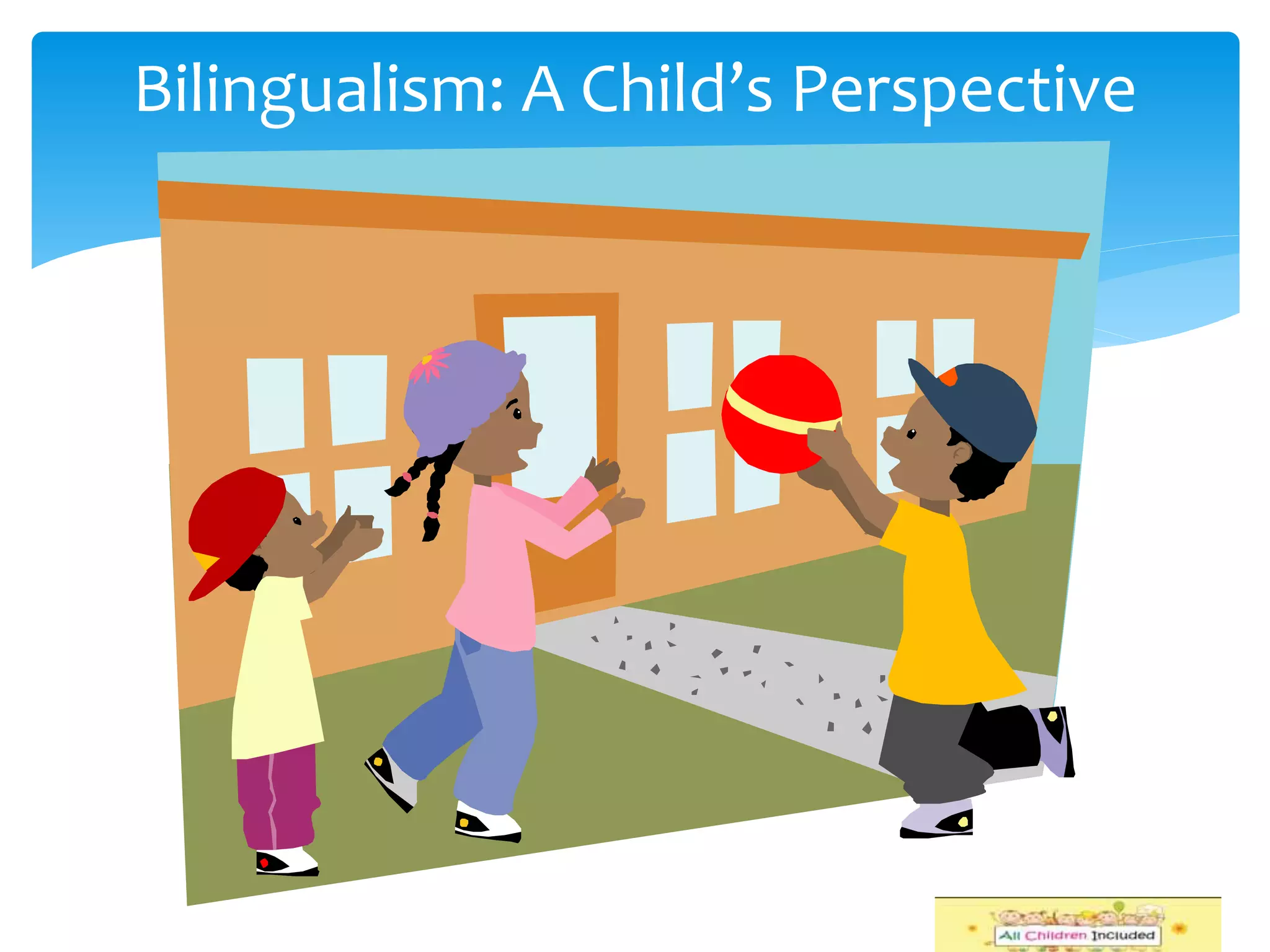


Bilingualism: A Child’s Perspective
 https://www.youtube.com/watch?v=rhpVd30AJaY
 1. Is it a good idea to raise my child bilingually?
 2. Is it normal for children to learn two languages at
the same time?
 3. Will my child become confused if we use two

 languages in the home?
 4. Should I worry if my child mixes languages?
 5. Will my child’s language learning be delayed

Top 10 parent questions
 6. Will my child’s grammar suffer?
 7. Should we use the one-parent, one-language

 (OP/OL) rule in our home?
 8. What about children with language impairment?

 Is it a good idea for them to learn two languages

 at the same time?
 “The main message for new moms is that their babies are
listening and learning and remembering during the last
stages of pregnancy. Their brains do not wait for birth to
start absorbing information”. Patricia K. Kuhl, PhD
 “…bilingual infants, along with monolingual infants, are
able to discriminate between the two languages, providing
a mechanism from the first moments of life that helps
ensure bilingual infants do not confuse their two
languages
Research about developing language
and Bilingualism
 Babbling and learning sounds – birth to 6 months
 Learning “NO!” & speech-sound babble 4 – 8 months
 Differentiating between languages: 8-10 month phase,
extended for bilingual children
 First words and phrases: 1-2 years
 Bilingual children follow the same pattern. Vocabulary may
be smaller in each language.
 Advantage of bilingual child’s greater ability to focus and
switch attention
 Brain development different
Stages of Bilingualism
Babies learning to talk
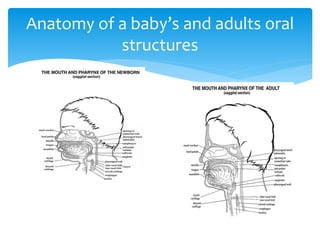
Anatomy of a baby’s and adults oral
structures
 Simultaneous
 Sequential/ Consequential
 Passive
 Additive
 Subtractive
Types of Bilingualism
 MOTHER tongue
 Importance of building on their existing knowledge
about language
 The impact of attitudes towards them personally and
their culture, language, religion and ethnicity on their
learning and their identity
 English should not replace the home language but
learned as an addition
The Importance of the home
language
 There may be a period of time when children continue to
use their home languages in the second language situation
 When they discover that their home language does not
work in this situation, children enter a non-verbal period as
they collect information about the new language and
perhaps spend some time in sound experimentation
 Children begin to use individual words and phrases in new
language
 Children begin to develop productive use of second
language (Tabors, 1997)
Broad outline of early developmental
stages of learning English
 Continue talking even when children do not respond
 Persistent inclusion in small groups
 Use of varied questioning
 Inclusion of other children as the focus in the conversation
(buddies)
 Use the first language
 Accept non-verbal responses
 Praise even minimal efforts
 Continue to expect that the child will respond
 Structure the programme to encourage child to child interaction
 Provide activities which reinforce language practice through role
play (Priscilla Clarke, 1992)
Strategies for Encouraging children to
participate during the silent period.
 Don’t put pressure on the child to talk
 Use other ways of communicating: drawing pictures, singing,
talking in gestures and mime.
 Talk to him in short, clear sentences using only one language
(don’t mix the words)
 Give him a chance to hear his own language as well as English.
 Tell him the meaning of what is said in both languages, if known.
 Tell him stories in both languages. Use books without words, to
tell the stories in both his home language and English.
 Use play things such as tea sets, cooking things, dolls, cars, play
houses, dressing up clothes, to act out stories.
More Ideas to encourage a bilingual
child to communicate
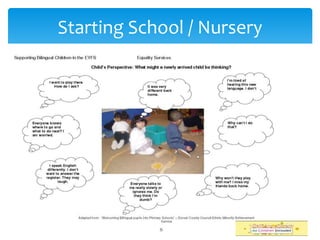
Starting School / Nursery
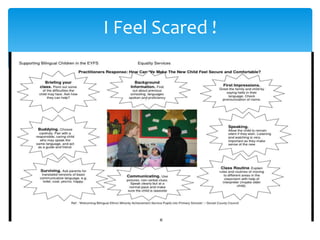
I Feel Scared !
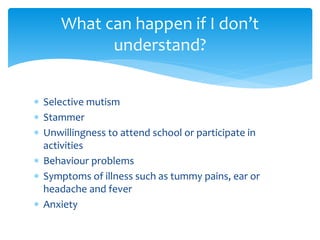
 Selective mutism
 Stammer
 Unwillingness to attend school or participate in
activities
 Behaviour problems
 Symptoms of illness such as tummy pains, ear or
headache and fever
 Anxiety
What can happen if I don’t
understand?
Social and cultural differences
 Eye contact
 Physical contact
 Greeting and respect
 Eating at home and school
 Bedtimes and routines
 Religious customs and respect for family beliefs
Behind the Language
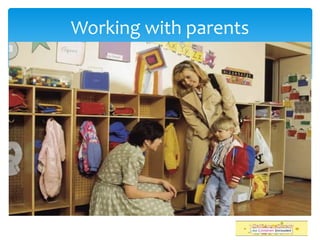
Working with parents
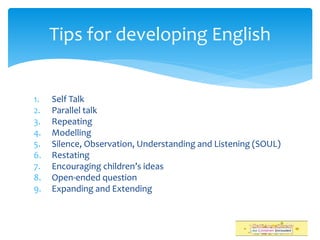
1. Self Talk
2. Parallel talk
3. Repeating
4. Modelling
5. Silence, Observation, Understanding and Listening (SOUL)
6. Restating
7. Encouraging children’s ideas
8. Open-ended question
9. Expanding and Extending
Tips for developing English
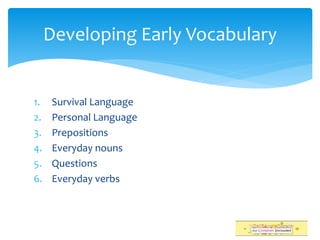
1. Survival Language
2. Personal Language
3. Prepositions
4. Everyday nouns
5. Questions
6. Everyday verbs
Developing Early Vocabulary
7. Assertions/ Negatives
8. Numeracy
9. Other early vocabulary
10. Sand/ Water
11. Vocabulary related to role play area eg shop
12. Time vocabulary
Developing Early vocabulary (cont)
 Enhances attention control: Dr. Poulin-Dubois
 Two sets of words and two sets of sound systems :
Freedman
 Language mixing is often helpful, is normal and
happens for good reasons
Recent research
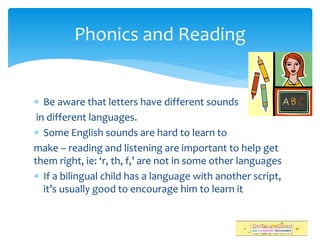
 Be aware that letters have different sounds
in different languages.
 Some English sounds are hard to learn to
make – reading and listening are important to help get
them right, ie: ‘r, th, f,’ are not in some other languages
 If a bilingual child has a language with another script,
it’s usually good to encourage him to learn it
Phonics and Reading
 Delayed speech
 SLI and language difficulties
 Down Syndrome
 Children with ASD / ADHD
 Hearing impairment
Bilingualism and the child with
learning difficulties
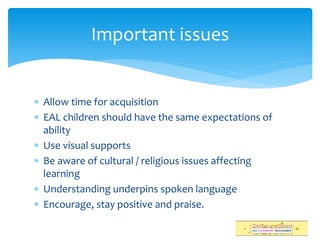
 Allow time for acquisition
 EAL children should have the same expectations of
ability
 Use visual supports
 Be aware of cultural / religious issues affecting
learning
 Understanding underpins spoken language
 Encourage, stay positive and praise.
Important issues
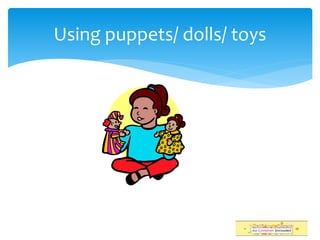
Using puppets/ dolls/ toys
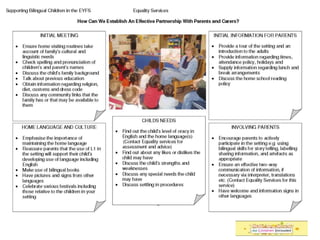
 Record detailed language background and home
language use, preferences and skills on admission?
 Check spelling and pronunciation of children’s and
parent’s name
 Reassure parents that use of home languages in the
setting will support their child’s overall learning
 Seek religious or cultural advice
 Collaborate to raise language awareness
Reflecting on practice
 Ensure effective two way communication
 Reflect on your provision and practice
 Look closely at your practice and find it to be
equitable for all families
 Genuinely welcome all children without prejudice
 Seek training and support
 Have policies in place
more
Sally Evans, Inclusion and Education Consultant
allchildrenincluded@gmail.com
Margi Khan, Speech & Language Therapist,
margi.khan@live.co.uk
Adieue, Au revoir, Khodah Hafeez,
Maasalaam, Ciao, Bye for now!

Raising a Bilingual Baby

  • 1.
  • 2.
  • 3.
     1. Isit a good idea to raise my child bilingually?  2. Is it normal for children to learn two languages at the same time?  3. Will my child become confused if we use two   languages in the home?  4. Should I worry if my child mixes languages?  5. Will my child’s language learning be delayed  Top 10 parent questions
  • 4.
     6. Willmy child’s grammar suffer?  7. Should we use the one-parent, one-language   (OP/OL) rule in our home?  8. What about children with language impairment?   Is it a good idea for them to learn two languages   at the same time?
  • 5.
     “The mainmessage for new moms is that their babies are listening and learning and remembering during the last stages of pregnancy. Their brains do not wait for birth to start absorbing information”. Patricia K. Kuhl, PhD  “…bilingual infants, along with monolingual infants, are able to discriminate between the two languages, providing a mechanism from the first moments of life that helps ensure bilingual infants do not confuse their two languages Research about developing language and Bilingualism
  • 6.
     Babbling andlearning sounds – birth to 6 months  Learning “NO!” & speech-sound babble 4 – 8 months  Differentiating between languages: 8-10 month phase, extended for bilingual children  First words and phrases: 1-2 years  Bilingual children follow the same pattern. Vocabulary may be smaller in each language.  Advantage of bilingual child’s greater ability to focus and switch attention  Brain development different Stages of Bilingualism Babies learning to talk
  • 7.
    Anatomy of ababy’s and adults oral structures
  • 8.
     Simultaneous  Sequential/Consequential  Passive  Additive  Subtractive Types of Bilingualism
  • 9.
     MOTHER tongue Importance of building on their existing knowledge about language  The impact of attitudes towards them personally and their culture, language, religion and ethnicity on their learning and their identity  English should not replace the home language but learned as an addition The Importance of the home language
  • 10.
     There maybe a period of time when children continue to use their home languages in the second language situation  When they discover that their home language does not work in this situation, children enter a non-verbal period as they collect information about the new language and perhaps spend some time in sound experimentation  Children begin to use individual words and phrases in new language  Children begin to develop productive use of second language (Tabors, 1997) Broad outline of early developmental stages of learning English
  • 11.
     Continue talkingeven when children do not respond  Persistent inclusion in small groups  Use of varied questioning  Inclusion of other children as the focus in the conversation (buddies)  Use the first language  Accept non-verbal responses  Praise even minimal efforts  Continue to expect that the child will respond  Structure the programme to encourage child to child interaction  Provide activities which reinforce language practice through role play (Priscilla Clarke, 1992) Strategies for Encouraging children to participate during the silent period.
  • 12.
     Don’t putpressure on the child to talk  Use other ways of communicating: drawing pictures, singing, talking in gestures and mime.  Talk to him in short, clear sentences using only one language (don’t mix the words)  Give him a chance to hear his own language as well as English.  Tell him the meaning of what is said in both languages, if known.  Tell him stories in both languages. Use books without words, to tell the stories in both his home language and English.  Use play things such as tea sets, cooking things, dolls, cars, play houses, dressing up clothes, to act out stories. More Ideas to encourage a bilingual child to communicate
  • 13.
  • 14.
  • 15.
     Selective mutism Stammer  Unwillingness to attend school or participate in activities  Behaviour problems  Symptoms of illness such as tummy pains, ear or headache and fever  Anxiety What can happen if I don’t understand?
  • 16.
    Social and culturaldifferences  Eye contact  Physical contact  Greeting and respect  Eating at home and school  Bedtimes and routines  Religious customs and respect for family beliefs Behind the Language
  • 17.
  • 19.
    1. Self Talk 2.Parallel talk 3. Repeating 4. Modelling 5. Silence, Observation, Understanding and Listening (SOUL) 6. Restating 7. Encouraging children’s ideas 8. Open-ended question 9. Expanding and Extending Tips for developing English
  • 20.
    1. Survival Language 2.Personal Language 3. Prepositions 4. Everyday nouns 5. Questions 6. Everyday verbs Developing Early Vocabulary
  • 21.
    7. Assertions/ Negatives 8.Numeracy 9. Other early vocabulary 10. Sand/ Water 11. Vocabulary related to role play area eg shop 12. Time vocabulary Developing Early vocabulary (cont)
  • 22.
     Enhances attentioncontrol: Dr. Poulin-Dubois  Two sets of words and two sets of sound systems : Freedman  Language mixing is often helpful, is normal and happens for good reasons Recent research
  • 23.
     Be awarethat letters have different sounds in different languages.  Some English sounds are hard to learn to make – reading and listening are important to help get them right, ie: ‘r, th, f,’ are not in some other languages  If a bilingual child has a language with another script, it’s usually good to encourage him to learn it Phonics and Reading
  • 24.
     Delayed speech SLI and language difficulties  Down Syndrome  Children with ASD / ADHD  Hearing impairment Bilingualism and the child with learning difficulties
  • 25.
     Allow timefor acquisition  EAL children should have the same expectations of ability  Use visual supports  Be aware of cultural / religious issues affecting learning  Understanding underpins spoken language  Encourage, stay positive and praise. Important issues
  • 26.
  • 27.
     Record detailedlanguage background and home language use, preferences and skills on admission?  Check spelling and pronunciation of children’s and parent’s name  Reassure parents that use of home languages in the setting will support their child’s overall learning  Seek religious or cultural advice  Collaborate to raise language awareness Reflecting on practice
  • 28.
     Ensure effectivetwo way communication  Reflect on your provision and practice  Look closely at your practice and find it to be equitable for all families  Genuinely welcome all children without prejudice  Seek training and support  Have policies in place more
  • 29.
    Sally Evans, Inclusionand Education Consultant allchildrenincluded@gmail.com Margi Khan, Speech & Language Therapist, margi.khan@live.co.uk Adieue, Au revoir, Khodah Hafeez, Maasalaam, Ciao, Bye for now!

Editor's Notes