EMASEMAS
Ethnic Minority Achievement ServiceEthnic Minority Achievement Service
Meeting the needs of Children with EALMeeting the needs of Children with EAL
Sarah BerlinerSarah Berliner
Christine BoothChristine Booth
Kaneez RahmanKaneez Rahman
Ethnic Minority Achievement Service (EMAS)Ethnic Minority Achievement Service (EMAS)
EMAS –EMAS – Who are we?Who are we?
Ethnic Minority Achievement ServiceEthnic Minority Achievement Service
We are a group of specialist teachers, teachingWe are a group of specialist teachers, teaching
assistants, BLAs (bilingual assistants) and homeassistants, BLAs (bilingual assistants) and home
school liaison officers who support children and theirschool liaison officers who support children and their
families coming in to our schools and pre-schoolsfamilies coming in to our schools and pre-schools
with limited or no English.with limited or no English.
We work in nursery settings, infant, junior andWe work in nursery settings, infant, junior and
primary schools as well as some secondary schoolsprimary schools as well as some secondary schools
and special schools in Brighton and Hove supportingand special schools in Brighton and Hove supporting
in many different languages.in many different languages.
Definitions of TermsDefinitions of Terms
► Bilingual (bilingual learners)Bilingual (bilingual learners) – those with a– those with a
different home language to English. It does notdifferent home language to English. It does not
always mean they are fluent in English.always mean they are fluent in English.
► MultilingualMultilingual – those who have 2 or more– those who have 2 or more
languages other than English.languages other than English.
► MonolingualMonolingual – those who only speak one language– those who only speak one language
e.g. Englishe.g. English
► EALEAL – English as an Additional Language– English as an Additional Language
► ESOLESOL – English speakers of other languages (this– English speakers of other languages (this
refers to post 16 learners)refers to post 16 learners)
Learning in another LanguageLearning in another Language
Put yourself in their shoes…
Learning in another LanguageLearning in another Language
How did you feel?How did you feel?
What helped you?What helped you?
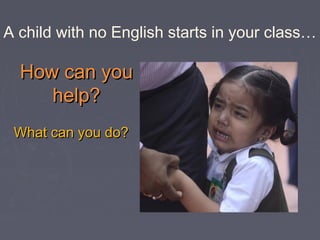
How can youHow can you
help?help?
What can you do?What can you do?
A child with no English starts in your class…
DonDon’’t panic!t panic!
. Smile, be welcoming & make an effort. Smile, be welcoming & make an effort
to communicate – gestures go a long wayto communicate – gestures go a long way
. Make the parents feel welcome, they will. Make the parents feel welcome, they will
be feeling more nervous than yoube feeling more nervous than you
. Find a good buddy to show the child around. Find a good buddy to show the child around
the school and take care of them at playtimethe school and take care of them at playtime
. Help them to learn the class routines and use visual support e.g. picture. Help them to learn the class routines and use visual support e.g. picture
fans, Makaton symbols, visual timetables and photosfans, Makaton symbols, visual timetables and photos
. Find time to get to know the child and don’. Find time to get to know the child and don’t put too much pressure ont put too much pressure on
them to perform initially.them to perform initially.
Remember a child that feels welcome will settle quicklyRemember a child that feels welcome will settle quickly
20% or 53,351 B&H residents are
BME….
44% of BME residents are Non
UK/British White
The BME population is increasing…
A changing demographicA changing demographic
In 2013 just over a quarter (26 per cent)
of births in Brighton & Hove were to
mothers born outside of the UK.
One fifth of our children and young people are from a BME
background
BME residents’ age profile is younger
The diversity of EAL studentsThe diversity of EAL students
► Diverse cultural and linguistic backgroundsDiverse cultural and linguistic backgrounds
► Different educational experiencesDifferent educational experiences
► Different background experiencesDifferent background experiences
► Different emotional contextsDifferent emotional contexts
► Transferable skills in L1Transferable skills in L1
► Part of a community or anPart of a community or an
isolated learnerisolated learner
A Refugee StoryA Refugee Story
Support Systems
What support systems do you regularly access?
neighbours
Family & friends
social security
library
Careers advice
doctors
dentists
school admissions
housing advice
banks family centres
midwives
health visitors
pharmacies
schools & colleges hospitals
Some Support networks we access regularly…
pre - school
Take all of these support networks away
and this is how it is for our Newly Arrived families
The Diversity of EAL pupils
You can find out….
Languages spoken and country they’re from
Previous school experience if any
Trauma suffered although parents may not be
ready to share this
Literacy skills in home language etc
If the Newly Arrived child feels welcomed and valued this will make a significant
difference to them settling quickly and becoming a happy member of the
class.
It is important to find out the history of
the child but this is not always easy
A meeting with the parents is invaluable if they
speak some English. If not, and you have a
bilingual assistant, then a three way meeting could
happen
The voice of the child with EALThe voice of the child with EAL
What might they say?What might they say?
The Voice of the child with EALThe Voice of the child with EAL
I want my parents to
know about all the things
that happen at school
I might want to
be silent and just
take things in
I want people to understand my
religion and not make fun of me
I want you to know I
can read & write in
my MT
I might get cross
sometimes because I
can’t express myself
I want to feel safe in the
playground as I can’t say if
someone hurts me
It helps me to have
pictures and diagrams
so I can understand
I don’t want to be given
easy work just because I
can’t speak English yet
…most of all I want to be treated like everyone else
I am naughty sometimes
because I just want to fit in
How long does it take?
Me toilet
go please
II can balance the
ball on my head
without losing
control of it
How long does it take to learn a newHow long does it take to learn a new
language?language?
Superficial, conversationalSuperficial, conversational
fluency takes about 2 yearsfluency takes about 2 years
(BICS – Basic Interpersonal Communication Skills)(BICS – Basic Interpersonal Communication Skills)
Academic fluency can takeAcademic fluency can take
between 5 and 9 yearsbetween 5 and 9 years
((CALP – Cognitive Academic Proficiency)CALP – Cognitive Academic Proficiency)
Remodel mistakes sensitively rather than over correctingRemodel mistakes sensitively rather than over correcting
II can balance the
ball on my head
without losing
control of it
Me toilet go
please
Re-modeling mistakesRe-modeling mistakes
You went to a farm
yesterday and saw
some sheep? Who
did you go with?
Yesterday I go-ed to
the farm and I see-ed
sheeps I go-ed with
my mum
You went with
your mum, how
lovely.
Yes I went
with my mum
The Early stages of learning aThe Early stages of learning a
languagelanguage
►The silent periodThe silent period
►Understanding firstUnderstanding first
►Using gesturesUsing gestures
►Echoing othersEchoing others
►Using common phrasesUsing common phrases
e.g. ‘sit down’e.g. ‘sit down’
Don’t worry during this stage or try to insist the child speaks as this can beDon’t worry during this stage or try to insist the child speaks as this can be
stressful for them. Remember if the child is happy they will still be takingstressful for them. Remember if the child is happy they will still be taking
everything in and therefore learning even if they are silenteverything in and therefore learning even if they are silent
(the silent stage is different from a refusal to speak as in selective mutism)(the silent stage is different from a refusal to speak as in selective mutism)
The Language Aware TeacherThe Language Aware Teacher
What do bilingual learners need?What do bilingual learners need?
► To have thinking time before answeringTo have thinking time before answering
questions so they can process languagequestions so they can process language
► To have home language and culture valuedTo have home language and culture valued
► To have language modelled for themTo have language modelled for them
e.g. being last to speak in circle time so they can copy otherse.g. being last to speak in circle time so they can copy others
► To have opportunities to speak e.g. give questions requiring one wordTo have opportunities to speak e.g. give questions requiring one word
answers or give them a choice of answers, so child is able to join inanswers or give them a choice of answers, so child is able to join in
even when a beginnereven when a beginner
► To use language structures they can easily build on e.g. I can… / ITo use language structures they can easily build on e.g. I can… / I
can’t… / I like… / I don’t like…can’t… / I like… / I don’t like…
Importantly they need to feel safe enough to take risksImportantly they need to feel safe enough to take risks
You can….You can….
Create stress free situations where…Create stress free situations where…
language can be practiced in a non-language can be practiced in a non-
threatening way e.g. home cornerthreatening way e.g. home corner
encourage games where the child canencourage games where the child can
play alongside their peersplay alongside their peers
use non verbal activities e.g. takinguse non verbal activities e.g. taking
a message with a partner or giving outa message with a partner or giving out
work so child learns names of their peerswork so child learns names of their peers
use other children with the same home language to help child feel settled,use other children with the same home language to help child feel settled,
this also shows them their Mother Tongue is valued by everyonethis also shows them their Mother Tongue is valued by everyone
encourage child to socialise and sit with children who are good language roleencourage child to socialise and sit with children who are good language role
models and use trios instead of talk partners taking pressure off beginnermodels and use trios instead of talk partners taking pressure off beginner
Adapt activities so child is doing similar work to peers e.g. drawings related toAdapt activities so child is doing similar work to peers e.g. drawings related to
topic that can then be labelled so they begin to learn topic languagetopic that can then be labelled so they begin to learn topic language
The child who feels included in the class will progress quicklyThe child who feels included in the class will progress quickly
Support with WritingSupport with Writing
Provide children with story mats or
writing frames to support their
writing. This means even at the
early stages of writing they can still
access a task
Give key words with
pictures related to familiar
stories so the EAL child can
write simple sentences
The Benefits of Bilingualism
► 70% of the world live with two or more languages
► Bilingualism can have long term advantages to our brains
► Bilingualism builds a natural awareness of how languages work. It’s called ‘meta-
linguistic- awareness. Children can find it easier to learn third or fourth languages
► Choosing between languages gives children greater flexibility of thinking. They can apply
this to other areas. For example they can be good at problem solving. They can also be
more sensitive to others from a young age
► Multilingual children can outperform monolingual children at secondary school, if their
first language is acknowledged and supported alongside English.
► New research suggests bilingualism has long-term cognitive advantages. E.g. protecting
against dementia in old age
► Children need to be strong in their first language or they may develop ‘limited
bilingualism’ when they are not strong in either language. This ‘half half’ situation means
they will lack a rich vocabulary. For example, this will affect their ability to write
imaginatively when they are older
Remember EAL is not a Special Educational Need but an asset
Teaching Practice TaskTeaching Practice Task
► What is the system for supporting children with EAL in theWhat is the system for supporting children with EAL in the
school?school?
► Find out the languages spoken in your class/ the schoolFind out the languages spoken in your class/ the school
► Are there any children receiving EMAS support? What doAre there any children receiving EMAS support? What do
they receive?they receive?
► Identify a ‘language aware’ teacher. What strategies to theyIdentify a ‘language aware’ teacher. What strategies to they
use?use?
► Be language aware in your lesson planning and teachingBe language aware in your lesson planning and teaching
► Look at how the learning environment supports childrenLook at how the learning environment supports children
acquiring Englishacquiring English
► How do the school monitor achievement of children withHow do the school monitor achievement of children with
EAL?EAL?
EMAS, Fairlight School, St Leonard’s Road, Brighton. BN2 3AJ Tel:01273-
292521

Eal uni 2016

  • 1.
    EMASEMAS Ethnic Minority AchievementServiceEthnic Minority Achievement Service Meeting the needs of Children with EALMeeting the needs of Children with EAL Sarah BerlinerSarah Berliner Christine BoothChristine Booth Kaneez RahmanKaneez Rahman Ethnic Minority Achievement Service (EMAS)Ethnic Minority Achievement Service (EMAS)
  • 2.
    EMAS –EMAS –Who are we?Who are we? Ethnic Minority Achievement ServiceEthnic Minority Achievement Service We are a group of specialist teachers, teachingWe are a group of specialist teachers, teaching assistants, BLAs (bilingual assistants) and homeassistants, BLAs (bilingual assistants) and home school liaison officers who support children and theirschool liaison officers who support children and their families coming in to our schools and pre-schoolsfamilies coming in to our schools and pre-schools with limited or no English.with limited or no English. We work in nursery settings, infant, junior andWe work in nursery settings, infant, junior and primary schools as well as some secondary schoolsprimary schools as well as some secondary schools and special schools in Brighton and Hove supportingand special schools in Brighton and Hove supporting in many different languages.in many different languages.
  • 3.
    Definitions of TermsDefinitionsof Terms ► Bilingual (bilingual learners)Bilingual (bilingual learners) – those with a– those with a different home language to English. It does notdifferent home language to English. It does not always mean they are fluent in English.always mean they are fluent in English. ► MultilingualMultilingual – those who have 2 or more– those who have 2 or more languages other than English.languages other than English. ► MonolingualMonolingual – those who only speak one language– those who only speak one language e.g. Englishe.g. English ► EALEAL – English as an Additional Language– English as an Additional Language ► ESOLESOL – English speakers of other languages (this– English speakers of other languages (this refers to post 16 learners)refers to post 16 learners)
  • 4.
    Learning in anotherLanguageLearning in another Language Put yourself in their shoes…
  • 5.
    Learning in anotherLanguageLearning in another Language How did you feel?How did you feel? What helped you?What helped you?
  • 6.
    How can youHowcan you help?help? What can you do?What can you do? A child with no English starts in your class…
  • 7.
    DonDon’’t panic!t panic! .Smile, be welcoming & make an effort. Smile, be welcoming & make an effort to communicate – gestures go a long wayto communicate – gestures go a long way . Make the parents feel welcome, they will. Make the parents feel welcome, they will be feeling more nervous than yoube feeling more nervous than you . Find a good buddy to show the child around. Find a good buddy to show the child around the school and take care of them at playtimethe school and take care of them at playtime . Help them to learn the class routines and use visual support e.g. picture. Help them to learn the class routines and use visual support e.g. picture fans, Makaton symbols, visual timetables and photosfans, Makaton symbols, visual timetables and photos . Find time to get to know the child and don’. Find time to get to know the child and don’t put too much pressure ont put too much pressure on them to perform initially.them to perform initially. Remember a child that feels welcome will settle quicklyRemember a child that feels welcome will settle quickly
  • 8.
    20% or 53,351B&H residents are BME…. 44% of BME residents are Non UK/British White The BME population is increasing…
  • 9.
    A changing demographicAchanging demographic In 2013 just over a quarter (26 per cent) of births in Brighton & Hove were to mothers born outside of the UK. One fifth of our children and young people are from a BME background
  • 10.
    BME residents’ ageprofile is younger
  • 13.
    The diversity ofEAL studentsThe diversity of EAL students ► Diverse cultural and linguistic backgroundsDiverse cultural and linguistic backgrounds ► Different educational experiencesDifferent educational experiences ► Different background experiencesDifferent background experiences ► Different emotional contextsDifferent emotional contexts ► Transferable skills in L1Transferable skills in L1 ► Part of a community or anPart of a community or an isolated learnerisolated learner
  • 14.
    A Refugee StoryARefugee Story
  • 17.
    Support Systems What supportsystems do you regularly access?
  • 18.
    neighbours Family & friends socialsecurity library Careers advice doctors dentists school admissions housing advice banks family centres midwives health visitors pharmacies schools & colleges hospitals Some Support networks we access regularly… pre - school
  • 19.
    Take all ofthese support networks away and this is how it is for our Newly Arrived families
  • 20.
    The Diversity ofEAL pupils You can find out…. Languages spoken and country they’re from Previous school experience if any Trauma suffered although parents may not be ready to share this Literacy skills in home language etc If the Newly Arrived child feels welcomed and valued this will make a significant difference to them settling quickly and becoming a happy member of the class. It is important to find out the history of the child but this is not always easy A meeting with the parents is invaluable if they speak some English. If not, and you have a bilingual assistant, then a three way meeting could happen
  • 21.
    The voice ofthe child with EALThe voice of the child with EAL What might they say?What might they say?
  • 22.
    The Voice ofthe child with EALThe Voice of the child with EAL I want my parents to know about all the things that happen at school I might want to be silent and just take things in I want people to understand my religion and not make fun of me I want you to know I can read & write in my MT I might get cross sometimes because I can’t express myself I want to feel safe in the playground as I can’t say if someone hurts me It helps me to have pictures and diagrams so I can understand I don’t want to be given easy work just because I can’t speak English yet …most of all I want to be treated like everyone else I am naughty sometimes because I just want to fit in
  • 23.
    How long doesit take? Me toilet go please II can balance the ball on my head without losing control of it
  • 24.
    How long doesit take to learn a newHow long does it take to learn a new language?language? Superficial, conversationalSuperficial, conversational fluency takes about 2 yearsfluency takes about 2 years (BICS – Basic Interpersonal Communication Skills)(BICS – Basic Interpersonal Communication Skills) Academic fluency can takeAcademic fluency can take between 5 and 9 yearsbetween 5 and 9 years ((CALP – Cognitive Academic Proficiency)CALP – Cognitive Academic Proficiency) Remodel mistakes sensitively rather than over correctingRemodel mistakes sensitively rather than over correcting II can balance the ball on my head without losing control of it Me toilet go please
  • 25.
    Re-modeling mistakesRe-modeling mistakes Youwent to a farm yesterday and saw some sheep? Who did you go with? Yesterday I go-ed to the farm and I see-ed sheeps I go-ed with my mum You went with your mum, how lovely. Yes I went with my mum
  • 26.
    The Early stagesof learning aThe Early stages of learning a languagelanguage ►The silent periodThe silent period ►Understanding firstUnderstanding first ►Using gesturesUsing gestures ►Echoing othersEchoing others ►Using common phrasesUsing common phrases e.g. ‘sit down’e.g. ‘sit down’ Don’t worry during this stage or try to insist the child speaks as this can beDon’t worry during this stage or try to insist the child speaks as this can be stressful for them. Remember if the child is happy they will still be takingstressful for them. Remember if the child is happy they will still be taking everything in and therefore learning even if they are silenteverything in and therefore learning even if they are silent (the silent stage is different from a refusal to speak as in selective mutism)(the silent stage is different from a refusal to speak as in selective mutism)
  • 27.
    The Language AwareTeacherThe Language Aware Teacher
  • 28.
    What do bilinguallearners need?What do bilingual learners need? ► To have thinking time before answeringTo have thinking time before answering questions so they can process languagequestions so they can process language ► To have home language and culture valuedTo have home language and culture valued ► To have language modelled for themTo have language modelled for them e.g. being last to speak in circle time so they can copy otherse.g. being last to speak in circle time so they can copy others ► To have opportunities to speak e.g. give questions requiring one wordTo have opportunities to speak e.g. give questions requiring one word answers or give them a choice of answers, so child is able to join inanswers or give them a choice of answers, so child is able to join in even when a beginnereven when a beginner ► To use language structures they can easily build on e.g. I can… / ITo use language structures they can easily build on e.g. I can… / I can’t… / I like… / I don’t like…can’t… / I like… / I don’t like… Importantly they need to feel safe enough to take risksImportantly they need to feel safe enough to take risks
  • 29.
    You can….You can…. Createstress free situations where…Create stress free situations where… language can be practiced in a non-language can be practiced in a non- threatening way e.g. home cornerthreatening way e.g. home corner encourage games where the child canencourage games where the child can play alongside their peersplay alongside their peers use non verbal activities e.g. takinguse non verbal activities e.g. taking a message with a partner or giving outa message with a partner or giving out work so child learns names of their peerswork so child learns names of their peers use other children with the same home language to help child feel settled,use other children with the same home language to help child feel settled, this also shows them their Mother Tongue is valued by everyonethis also shows them their Mother Tongue is valued by everyone encourage child to socialise and sit with children who are good language roleencourage child to socialise and sit with children who are good language role models and use trios instead of talk partners taking pressure off beginnermodels and use trios instead of talk partners taking pressure off beginner Adapt activities so child is doing similar work to peers e.g. drawings related toAdapt activities so child is doing similar work to peers e.g. drawings related to topic that can then be labelled so they begin to learn topic languagetopic that can then be labelled so they begin to learn topic language The child who feels included in the class will progress quicklyThe child who feels included in the class will progress quickly
  • 30.
    Support with WritingSupportwith Writing Provide children with story mats or writing frames to support their writing. This means even at the early stages of writing they can still access a task Give key words with pictures related to familiar stories so the EAL child can write simple sentences
  • 31.
    The Benefits ofBilingualism ► 70% of the world live with two or more languages ► Bilingualism can have long term advantages to our brains ► Bilingualism builds a natural awareness of how languages work. It’s called ‘meta- linguistic- awareness. Children can find it easier to learn third or fourth languages ► Choosing between languages gives children greater flexibility of thinking. They can apply this to other areas. For example they can be good at problem solving. They can also be more sensitive to others from a young age ► Multilingual children can outperform monolingual children at secondary school, if their first language is acknowledged and supported alongside English. ► New research suggests bilingualism has long-term cognitive advantages. E.g. protecting against dementia in old age ► Children need to be strong in their first language or they may develop ‘limited bilingualism’ when they are not strong in either language. This ‘half half’ situation means they will lack a rich vocabulary. For example, this will affect their ability to write imaginatively when they are older Remember EAL is not a Special Educational Need but an asset
  • 32.
    Teaching Practice TaskTeachingPractice Task ► What is the system for supporting children with EAL in theWhat is the system for supporting children with EAL in the school?school? ► Find out the languages spoken in your class/ the schoolFind out the languages spoken in your class/ the school ► Are there any children receiving EMAS support? What doAre there any children receiving EMAS support? What do they receive?they receive? ► Identify a ‘language aware’ teacher. What strategies to theyIdentify a ‘language aware’ teacher. What strategies to they use?use? ► Be language aware in your lesson planning and teachingBe language aware in your lesson planning and teaching ► Look at how the learning environment supports childrenLook at how the learning environment supports children acquiring Englishacquiring English ► How do the school monitor achievement of children withHow do the school monitor achievement of children with EAL?EAL?
  • 33.
    EMAS, Fairlight School,St Leonard’s Road, Brighton. BN2 3AJ Tel:01273- 292521

Editor's Notes

  • #3 Do we need to in clude address and details. (EMAS, Fairlight School, St Leonards Road, Brighton. BN2 3AJ 01273 292521 email: EMASadmin@brighton-hove.hove.gov.uk ) Special schools?
  • #4 Do we need to include Minority Ethnic- most commonly used term Black & Asian- used as a general term for people of African, Caribbean origin, and other Asian origin
  • #6 Before this slide do lesson in another language with BLA if available. e.g. drawing a house or simple maths lesson
  • #9 Brighton & Hove’s Black & minority ethnic population is increasing. Our best data about the number of people in Brighton & Hove from different ethnic backgrounds is from the official census that is carried out every ten years. At the time of the 2001 census 12 per cent of our city’s population (29,683 people) were from a BME background. By the 2011 census 20 per cent were (53,351 people).
  • #10 The greatest proportion in 2013 was to mothers born in Europe (17.8 per cent), Middle East and Asia (5.8 per cent) and Africa (5.0 per cent).[ [1] Office for National Statistics
  • #11 Our BME population’s age profile is younger than our White UK/ British population; 2011 census shows 20%of residents in B&H are BME Other white (Eastern European) most increased by number 8k to 12k Black African has biggest increase of 57% (217 -341) Turquoise is mixed ethnicity  
  • #12 Brighton and Hove currently have 23.7% ethnic minority pupils– this has increased from 15.2% in 2007 (national figure of 27.5%) The three biggest ethnicities (other than White British) represented are: White - other6.0% Mixed dual background - other 2.9% Mixed dual background - white & Asian2.5% In terms of numbers, there are 5,218 Mixed ethnic background 0-19 year olds making this the largest ethnic group of young people in the city aside from White UK/British. Note, however that whilst there will be many differences within ethnic categories, this group could be considered the most diverse.
  • #13 Currently 12% of Brighton & Hove pupils (reception year and above) have English as an additional language (EAL). This is lower than the national figure of 18.2%*.   In January 2015 there were 3,729 pupils with at least 101 different languages other than English (including British Sign Language), attending Brighton and Hove schools and Academies.
  • #27 Do we need to add any thing about speech & Lang issues or SEN
  • #30 Work in pairs to think of ways to help the Newly Arrived child in your class and feed back Allow children time to be observers