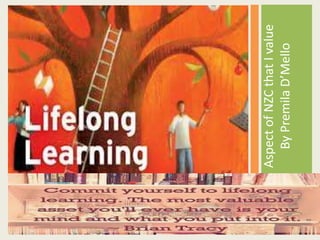
AspectofNZCthatIvalue
ByPremilaD’Mello
ASPECT OF THE NZ CURRICULUM THAT I VALUE
Lifelong learning is the "ongoing, voluntary, and self-motivated" pursuit of
knowledge for either personal or professional reasons. The term recognizes
that learning is not confined to childhood or the classroom but takes place
throughout life and in a range of situations (Wikipedia)
In the ‘Confident children/confident learner’ study done by NZCER it was
evident that leaners with good attitudes towards education stayed in
education longer than those who did not have a favourable attitude towards
school. Hence, education should aim at shaping a disposition towards life-
long learning as this is often the result of our earliest experiences in
education
The New Zealand Curriculum describes Lifelong learners as (pg.8)
Literate and numerate
Critical creative thinkers,
Active seekers, users and creators of knowledge
Informed decision makers
The vision of creating life-long learners which underpins the
New Zealand Curriculum, is clearly evident through the
values, key competencies and the principles in the NZC.
…
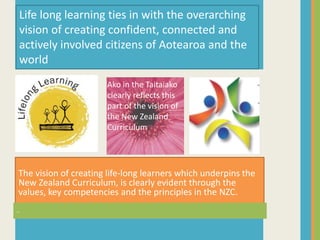
Ako in the Taitaiako
clearly reflects this
part of the vision of
the New Zealand
Curriculum
Life long learning ties in with the overarching
vision of creating confident, connected and
actively involved citizens of Aotearoa and the
world
Literacy is defined as the ability to understand, respond and use
forms of language that are required by society and valued by
Individuals and communities (literacyonline.tki.org.nz). Thus
Literacy teaching sets individuals up to undertake
lifelong learning as they are equipped with the basic
literacy skills to pursue their personal educational and
professional goals. This encompasses a multitude of
literacies; Scientific, Technological, Digital as well as
Cultural.
Numeracy is defined by the ability of a person to make effective
use of mathematical competencies for successful participation in
everyday life and in their wider community.’(W.Alex Neil –NZCER
conference).
This definition of Numeracy reflects the goal of
the New Zealand Education system to be
participants in globalization and prepares
learners for the 21st century.
Reflective thinkers use all the key learning areas to satisfy their curiosity and
to express their creativity, herein lays the link to the habits of life-long
learners. In the Values described in the NZC -Innovation, Inquiry and curiosity
are to be encouraged (NZC.pg.10). Among the Principles mentioned in the
NZC -‘Learning to Learn’ (NZC.pg.9) encourages students to reflect on their
own learning processes and learning how to learn. These are all habits of Life-
long learners.
Lifelong learners are
creative and critical thinkers
Effective pedagogy
(NZC.pg.34-6)
requires teachers
to encourage
Reflective thinking
and Metacognitive
skills in students.
Creative and critical
thinking is the first
Key competency.
The New Zealand
Curriculum
further describes
lifelong learners
as active seekers,
users and
creators of
knowledge and
Informed decision
makers (pg.8 )
The aim of the Principle of Coherence, which is to offer all
students a broad education that makes links within and
across learning areas, provides for transitions and opens up
pathways for further learning.(pg.9) ; fits well with the
vision of fostering life-long learning. . Developing
learning Dispositions through Inquiry based learning
encourages learners to actively seek new
perspectives, think deeper about the information,
analyse the information critically and evaluate their
own learning.
An informed decision maker is
equipped to participate in a
range of life contexts
The use of Technology in
Teaching and learning will
play an important role in
shaping young people who
will be equipped to be
participants and
practitioners of learning
throughout their lives.
The responsibility of
Principals is to ensure
that Protection,
Participation and
Partnership (Treaty of
Waitangi) is reflected in
the school’s curriculum.
As an educator I would seek to create
a Life-long learner by modeling to
the learners that as a teacher I am
constantly learning new things about
the world . I would endeavour to
display a curiosity and excitement for
learning so that it is evident to
learners that we are all learners at
different stages in this journey of
Learning
MY PEDAGOGICAL PRACTICE
WILL….
*Encourage reflective thinking in the classroom.
* Encourage collaborative learning
* Create confident learners
*Ensure equity and inclusiveness in classroom
* Encourage students to manage themselves by
setting their own goals and strategies to meet those
goals.
*Involving the whanau and community in the
student’s learning
* Include use of information technology
The use of the principle of Ako would ensure I complete
the process of ‘Effective teaching practice’ as I would
inquire into the impact of my teaching on the learners
,based on Evidence. This will help me to evolve in my
teaching practice and provide new challenges for
students.
In the Teacher’s Code of Ethics, the
aspiration for teaching professionals to
exhibit a Commitment to the Profession,
Section( b) suggests that teachers will
model lifelong learning behaviour
themselves by undertaking Professional
Development.
I would ensure that my Planning allows for children to investigate,
it will facilitate questioning and inquiry and analyse their own
learning and encourage problem solving. I would encourage
reflective learning and relate learning to meaningful contexts for
learners.
References
Clive McGee & Deborah Fraser (2007). Teachers and
Curriculum decisions .The Professional Practice of
Teaching.
The New Zealand Curriculum (2007). Ministry Of
Education
National Education Guidelines (2004. Education in
New Zealand
Taitaiako. Cultural competencies for teachers of
Maori Learners. Haemata Lmited
The New Zealand Curriculum Update 16 January
2012
Preparing to Lead Change (2007). Vision, Principles
and Values . Ministry of Education

Nz curriculum 3

  • 1.
  • 2.
    ASPECT OF THENZ CURRICULUM THAT I VALUE Lifelong learning is the "ongoing, voluntary, and self-motivated" pursuit of knowledge for either personal or professional reasons. The term recognizes that learning is not confined to childhood or the classroom but takes place throughout life and in a range of situations (Wikipedia) In the ‘Confident children/confident learner’ study done by NZCER it was evident that leaners with good attitudes towards education stayed in education longer than those who did not have a favourable attitude towards school. Hence, education should aim at shaping a disposition towards life- long learning as this is often the result of our earliest experiences in education The New Zealand Curriculum describes Lifelong learners as (pg.8) Literate and numerate Critical creative thinkers, Active seekers, users and creators of knowledge Informed decision makers
  • 3.
    The vision ofcreating life-long learners which underpins the New Zealand Curriculum, is clearly evident through the values, key competencies and the principles in the NZC. … Ako in the Taitaiako clearly reflects this part of the vision of the New Zealand Curriculum Life long learning ties in with the overarching vision of creating confident, connected and actively involved citizens of Aotearoa and the world
  • 4.
    Literacy is definedas the ability to understand, respond and use forms of language that are required by society and valued by Individuals and communities (literacyonline.tki.org.nz). Thus Literacy teaching sets individuals up to undertake lifelong learning as they are equipped with the basic literacy skills to pursue their personal educational and professional goals. This encompasses a multitude of literacies; Scientific, Technological, Digital as well as Cultural. Numeracy is defined by the ability of a person to make effective use of mathematical competencies for successful participation in everyday life and in their wider community.’(W.Alex Neil –NZCER conference). This definition of Numeracy reflects the goal of the New Zealand Education system to be participants in globalization and prepares learners for the 21st century.
  • 5.
    Reflective thinkers useall the key learning areas to satisfy their curiosity and to express their creativity, herein lays the link to the habits of life-long learners. In the Values described in the NZC -Innovation, Inquiry and curiosity are to be encouraged (NZC.pg.10). Among the Principles mentioned in the NZC -‘Learning to Learn’ (NZC.pg.9) encourages students to reflect on their own learning processes and learning how to learn. These are all habits of Life- long learners. Lifelong learners are creative and critical thinkers Effective pedagogy (NZC.pg.34-6) requires teachers to encourage Reflective thinking and Metacognitive skills in students. Creative and critical thinking is the first Key competency.
  • 6.
    The New Zealand Curriculum furtherdescribes lifelong learners as active seekers, users and creators of knowledge and Informed decision makers (pg.8 ) The aim of the Principle of Coherence, which is to offer all students a broad education that makes links within and across learning areas, provides for transitions and opens up pathways for further learning.(pg.9) ; fits well with the vision of fostering life-long learning. . Developing learning Dispositions through Inquiry based learning encourages learners to actively seek new perspectives, think deeper about the information, analyse the information critically and evaluate their own learning. An informed decision maker is equipped to participate in a range of life contexts The use of Technology in Teaching and learning will play an important role in shaping young people who will be equipped to be participants and practitioners of learning throughout their lives. The responsibility of Principals is to ensure that Protection, Participation and Partnership (Treaty of Waitangi) is reflected in the school’s curriculum.
  • 7.
    As an educatorI would seek to create a Life-long learner by modeling to the learners that as a teacher I am constantly learning new things about the world . I would endeavour to display a curiosity and excitement for learning so that it is evident to learners that we are all learners at different stages in this journey of Learning
  • 8.
    MY PEDAGOGICAL PRACTICE WILL…. *Encouragereflective thinking in the classroom. * Encourage collaborative learning * Create confident learners *Ensure equity and inclusiveness in classroom * Encourage students to manage themselves by setting their own goals and strategies to meet those goals. *Involving the whanau and community in the student’s learning * Include use of information technology
  • 9.
    The use ofthe principle of Ako would ensure I complete the process of ‘Effective teaching practice’ as I would inquire into the impact of my teaching on the learners ,based on Evidence. This will help me to evolve in my teaching practice and provide new challenges for students. In the Teacher’s Code of Ethics, the aspiration for teaching professionals to exhibit a Commitment to the Profession, Section( b) suggests that teachers will model lifelong learning behaviour themselves by undertaking Professional Development. I would ensure that my Planning allows for children to investigate, it will facilitate questioning and inquiry and analyse their own learning and encourage problem solving. I would encourage reflective learning and relate learning to meaningful contexts for learners.
  • 10.
    References Clive McGee &Deborah Fraser (2007). Teachers and Curriculum decisions .The Professional Practice of Teaching. The New Zealand Curriculum (2007). Ministry Of Education National Education Guidelines (2004. Education in New Zealand Taitaiako. Cultural competencies for teachers of Maori Learners. Haemata Lmited The New Zealand Curriculum Update 16 January 2012 Preparing to Lead Change (2007). Vision, Principles and Values . Ministry of Education