Curriculum Review Progress Report
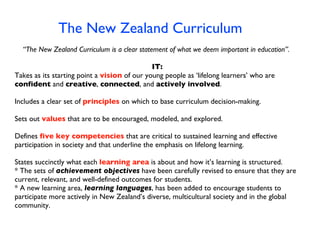
The New Zealand Curriculum “ The New Zealand Curriculum is a clear statement of what we deem important in education”.   IT: Takes as its starting point a  vision  of our young people as ‘lifelong learners’ who are  confident  and  creative ,  connected , and  actively involved .  Includes a clear set of  principles  on which to base curriculum decision-making.  Sets out  values  that are to be encouraged, modeled, and explored.  Defines  five key competencies  that are critical to sustained learning and effective participation in society and that underline the emphasis on lifelong learning. States succinctly what each  learning area  is about and how it’s learning is structured.  * The sets of  achievement objectives  have been carefully revised to ensure that they are current, relevant, and well-defined outcomes for students.  * A new learning area,  learning languages , has been added to encourage students to participate more actively in New Zealand’s diverse, multicultural society and in the global community.
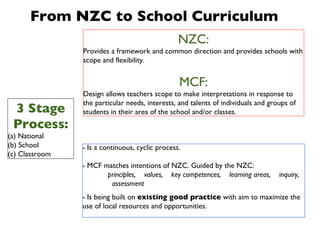
From NZC to School Curriculum - Is a continuous, cyclic process. - MCF matches intentions of NZC. Guided by the NZC: principles,  values,  key competences,  learning areas,  inquiry,  assessment - Is being built on  existing good practice  with aim to maximize the  use of local resources and opportunities. 3 Stage Process: (a) National (b) School (c) Classroom NZC: Provides a framework and common direction and provides schools with scope and flexibility. MCF: Design allows teachers scope to make interpretations in response to the particular needs, interests, and talents of individuals and groups of students in their area of the school and/or classes.
OUR VISION For our students and their learning is both clear and shared. Every student is different  ( BTBTTCB ) Self assured, confident and ready to take on new challenges Confident   Connected   Creative  Actively Involved
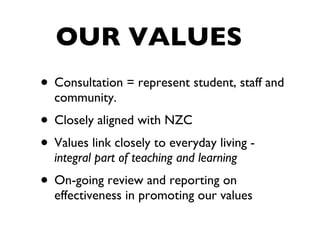
OUR VALUES Consultation = represent student, staff and community. Closely aligned with NZC  Values link closely to everyday living -  integral part of teaching and learning On-going review and reporting on effectiveness in promoting our values
KEY COMPETENCIES Have clarified what each KC means for students and their learning. Are included in all areas and contexts of learning. Students involved in monitoring their development and demonstration of each KC - self/peer assessment (rubrics)
LEARNING AREAS The meaning and intent of each curriculum area are aligned with the NZC. Includes an explanation of how programmes meet the needs and interests of our students. Includes a rationale and structure for coverage and selection of AO’s. Integrated, inquiry approach, KC, Values ... Assessment - monitoring, measuring, recording in relation to learning intentions/objectives ( ‘learning through inquiry’ ).
CURRICULUM  FRAMEWORK? So What about our
What have we done Collaborative Utilized Expertise Defined who we are and how we do things Process - inclusive WHAT HOW WHY belief
ONE STOP SHOP Under Continual Review Changes as we change - Pillars - Supports - Conditions 1. NZC 2. Charter 3. Learning and behavioural ecology 4. Foundation areas of learning 5. Balanced curriculum - all learning  areas 6. Gate/Learning support 7. Assessment 8. Howie Learn (strategies, tools) The  way we learn round here. 8. Reporting to parents 9. Resourcing
Where are we at? Literacy Numracy PE and Health Te Reo Visual Art ICT
Whats next? Science Social Science Technology Front   Se ction Learning languages  -  outside of Te Reo
ACCESS? Server access In place end of term 2 Web friendly version  In place end of term 3
ACCESS? Show example

Curriculum update

  • 1.
  • 2.
    The New ZealandCurriculum “ The New Zealand Curriculum is a clear statement of what we deem important in education”. IT: Takes as its starting point a vision of our young people as ‘lifelong learners’ who are confident and creative , connected , and actively involved . Includes a clear set of principles on which to base curriculum decision-making. Sets out values that are to be encouraged, modeled, and explored. Defines five key competencies that are critical to sustained learning and effective participation in society and that underline the emphasis on lifelong learning. States succinctly what each learning area is about and how it’s learning is structured. * The sets of achievement objectives have been carefully revised to ensure that they are current, relevant, and well-defined outcomes for students. * A new learning area, learning languages , has been added to encourage students to participate more actively in New Zealand’s diverse, multicultural society and in the global community.
  • 3.
    From NZC toSchool Curriculum - Is a continuous, cyclic process. - MCF matches intentions of NZC. Guided by the NZC: principles, values, key competences, learning areas, inquiry, assessment - Is being built on existing good practice with aim to maximize the use of local resources and opportunities. 3 Stage Process: (a) National (b) School (c) Classroom NZC: Provides a framework and common direction and provides schools with scope and flexibility. MCF: Design allows teachers scope to make interpretations in response to the particular needs, interests, and talents of individuals and groups of students in their area of the school and/or classes.
  • 4.
    OUR VISION Forour students and their learning is both clear and shared. Every student is different ( BTBTTCB ) Self assured, confident and ready to take on new challenges Confident Connected Creative Actively Involved
  • 5.
    OUR VALUES Consultation= represent student, staff and community. Closely aligned with NZC Values link closely to everyday living - integral part of teaching and learning On-going review and reporting on effectiveness in promoting our values
  • 6.
    KEY COMPETENCIES Haveclarified what each KC means for students and their learning. Are included in all areas and contexts of learning. Students involved in monitoring their development and demonstration of each KC - self/peer assessment (rubrics)
  • 7.
    LEARNING AREAS Themeaning and intent of each curriculum area are aligned with the NZC. Includes an explanation of how programmes meet the needs and interests of our students. Includes a rationale and structure for coverage and selection of AO’s. Integrated, inquiry approach, KC, Values ... Assessment - monitoring, measuring, recording in relation to learning intentions/objectives ( ‘learning through inquiry’ ).
  • 8.
    CURRICULUM FRAMEWORK?So What about our
  • 9.
    What have wedone Collaborative Utilized Expertise Defined who we are and how we do things Process - inclusive WHAT HOW WHY belief
  • 10.
    ONE STOP SHOPUnder Continual Review Changes as we change - Pillars - Supports - Conditions 1. NZC 2. Charter 3. Learning and behavioural ecology 4. Foundation areas of learning 5. Balanced curriculum - all learning areas 6. Gate/Learning support 7. Assessment 8. Howie Learn (strategies, tools) The way we learn round here. 8. Reporting to parents 9. Resourcing
  • 11.
    Where are weat? Literacy Numracy PE and Health Te Reo Visual Art ICT
  • 12.
    Whats next? ScienceSocial Science Technology Front Se ction Learning languages - outside of Te Reo
  • 13.
    ACCESS? Server accessIn place end of term 2 Web friendly version In place end of term 3
  • 14.