GOLLIS UNIVERSITY
DEPARTMENT OF PUBLIC HEALTH
Course: Nutrition
Lecturer: Sa’ad Ahmed Abdiwali
Dean of Public Health, Nutrition and Laboratory
BSc, MPH
1
Course content
1. Introduction
– Human nutrition
– Public health nutrition
– Nutrition and development
– Causes of malnutrition
– Malnutrition and infection
2. Nutritional requirements
– Energy
– Proteins
– Fat
– Carbohydrates
– Vitamins
– Minerals
2
Course content…
3. Nutritional assessment
– Methods of nutritional assessment
– The present nutrition situation
– Nutritional surveillance
4. Nutrition through the lifecycle
– Maternal nutrition through the lifecycle
– Low birth weight
3
Course content…
5. Nutritional problems of public health importance
– Protein-energy malnutrition
– Vitamin A deficiency
– Iron deficiency anemia
– Iodine deficiency disorders
– Zinc deficiency
6. Nutrition interventions
– Essential nutrition actions
– Emergency Nutrition Interventions
– Somaliland National Nutrition strategy
7. Nutrition and Development
8. Nutrition in emergencies
9. Food security
10. Infant and young child feeding in emergencies
situation
4
Course Objective
Enable the student acquire theoretical
knowledge (principles) and analytical skills
(methods) in Human Nutrition
5
Course Organization
• Course delivery modalities;
– Lectures
– Group Assignments
• Literature Review and Presentations
– Reading Assignments
6
Examples of topics for Literature
Review and Presentation
• Breast feeding and cognitive development
• Breast feeding and Social
development/family attachment
• Developmental origins of diseases
• HIV/AIDS and infant feeding
• Biofuels and Nutrition security
• Climate change and food security
• Etc.
7
Unit one: Introduction -
Outline:
– Definitions
– Forms of Malnutrition
– Causes/Etiology of Malnutrition
8
Nutrition
The science of Nutrition:
• Nutrition studies the interaction between the
individual and the environment mediated by food
• Study of food in relation to man, and study of
man in relation to food
• Science of food as it relates to optimal health
and performance
9
Nutrition…
• Human Nutrition is a scientific discipline,
concerned with the access and utilization
of foods and nutrients for life, health,
growth, development, and well- being
10
The science of Nutrition:
• Areas of Study
– Food production
– Diet composition (including non-nutritive
substances)
– Food intake, appetite, food preferences
– Digestion and absorption of nutrients
– Intermediary metabolism, nutritional
biochemistry
11
The Science of Nutrition:
 Areas of Study
– Biological actions of essential nutrients
– Nutrient requirements in individuals and
populations
– Heath effects of nutrient deficiencies and
excesses
– Long-term effects of diet constituents
– Therapeutic and preventive effects of foods
12
Nutrition…
• Dietetics
– Science/ art of applying the principles of
nutrition in feeding
– Older subject, practiced by Hippocrates 460-
360 BC.
13
Public Health Nutrition
• Public Health Nutrition focuses on issues
that affect the whole population rather
than the specific dietary needs of
individuals
• The emphasis is on promoting health and
disease prevention
14
Malnutrition
• A pathological state resulting from a
relative or absolute deficiency or excess
of one or more essential nutrients, this
state being clinically manifested or
detected only by biochemical,
anthropometric or physiological tests
15
Forms of Malnutrition
• Under nutrition
– Pathological state resulting from the consumption of
an inadequate quality/ quantity over an extended
period of time
• Over-nutrition
– Pathological state resulting from the consumption of
an excess quantity of food, and hence an energy
excess, over an extended period of time
16
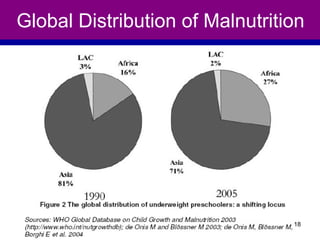
The Scale of the Problem
– Protein−energy malnutrition (PEM),
– vitamin A deficiency,
– iodine deficiency disorders (IDD) and
– nutritional anaemias − mainly resulting from
iron deficiency or iron losses −
• are the most common serious nutritional problems
in almost all countries of Asia, Africa, Latin
America and the Near East.
17
Global Distribution of Malnutrition
18
Prevalence of chronic undernutrition in
developing regions (1969-1992)
19
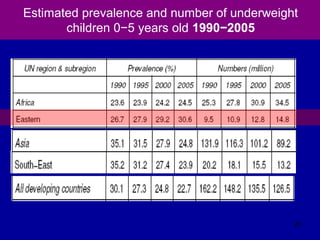
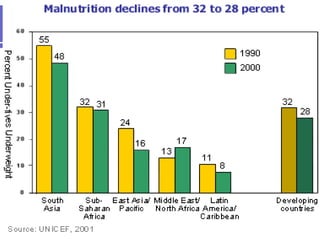
Estimated prevalence and number of underweight
children 0−5 years old 1990−2005
20
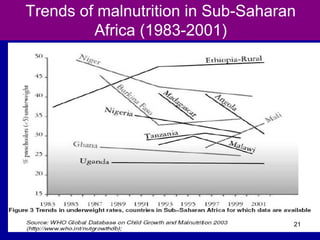
Trends of malnutrition in Sub-Saharan
Africa (1983-2001)
21
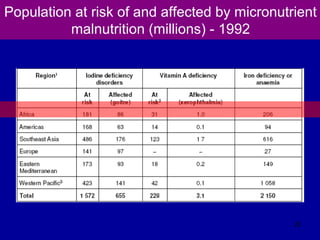
Population at risk of and affected by micronutrient
malnutrition (millions) - 1992
22
23
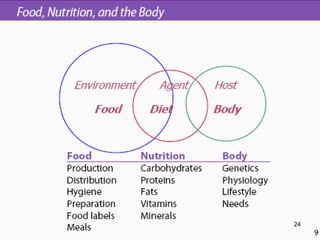
24
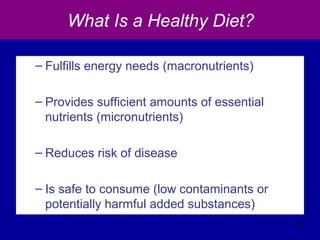
What Is a Healthy Diet?
– Fulfills energy needs (macronutrients)
– Provides sufficient amounts of essential
nutrients (micronutrients)
– Reduces risk of disease
– Is safe to consume (low contaminants or
potentially harmful added substances)
25
26
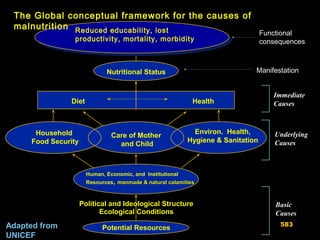
Causes of Malnutrition
• Malnutrition, is not a simple problem with a
single, simple solution
• Multiple and interrelated determinants are
involved in why malnutrition develops, and
a similarly intricate series of approaches,
multifaceted and multisectoral, are needed
to deal with it
27
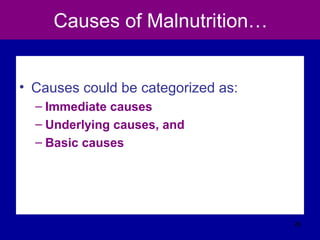
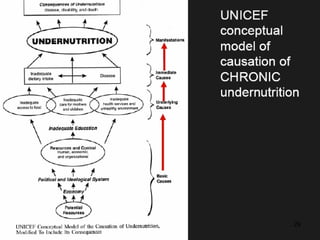
Causes of Malnutrition…
• Causes could be categorized as:
– Immediate causes
– Underlying causes, and
– Basic causes
28
29
Malnutrition - Immediate causes
Immediate causes
• The interplay between the two most significant
immediate causes of malnutrition - inadequate
dietary intake and illness - tends to create a
vicious circle:
• A malnourished child, whose resistance to
illness is compromised, falls ill, and
malnourishment worsens
30
Malnutrition - Immediate causes…
• Children who enter the malnutrition-infection
cycle can quickly fall into a potentially fatal spiral
as one condition feeds off the other
• Malnutrition lowers the body’s immune-response
mechanisms.
– This leads to longer, more severe and more frequent
episodes of illness
31
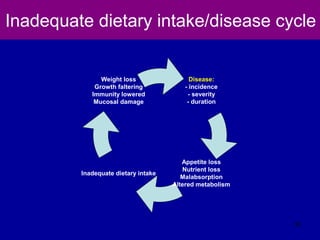
Inadequate dietary intake/disease cycle
Disease:
- incidence
- severity
- duration
Inadequate dietary intake
Weight loss
Growth faltering
Immunity lowered
Mucosal damage
Appetite loss
Nutrient loss
Malabsorption
Altered metabolism
32
Malnutrition - Immediate causes…
• Infections cause loss of appetite,
malabsorption and metabolic and
behavioral changes.
• These, in turn, increase the body’s
requirements for nutrients, which further
affects young children’s eating patterns
and how they are cared for
33
Malnutrition - Underlying causes
• Three clusters of underlying causes lead
to inadequate dietary intake and infectious
disease:
– inadequate access to food in a household;
– insufficient health services and an
unhealthful environment; and
– inadequate care for children and women
34
Malnutrition - Underlying causes
(HHFS)…
Household food security (HHFS)
– is defined as sustainable access to safe
food of sufficient quality and quantity -
including energy, protein and micronutrients -
to ensure adequate intake and a healthy life
for all members of the family
35
Malnutrition - Underlying causes
(HHFS)…
• In rural areas, HHFS may depend on access to land
and other agricultural resources to guarantee
sufficient domestic production
• In urban areas, where food is largely bought on the
market, foods must be available at accessible prices
• Other potential sources of food are by exchange, gifts
from friends or family and in extreme circumstances food
aid provided by humanitarian agencies
36
Malnutrition - Underlying causes
(HHFS)…
• HHFS depends on access to food -
financial, physical and social - as
distinct from its availability
37
Malnutrition - Underlying causes
(Services and sanitation)…
• Health services, safe water and
sanitation
– access to curative and preventive health
services that are affordable and of good
quality
– Families should have a health centre within a
reasonable distance, and the centre’s staff
should be qualified and equipped to give the
advice and care needed
38
Malnutrition - Underlying causes
(caring)…
• Caring practices
– even when there is adequate food in the house and a
family lives in a safe and healthful environment and
has access to health services, children can still
become malnourished
– Inadequate care for children and women, the third
element of malnutrition’s underlying causes, has only
recently been recognized and understood in all its
harmful ramifications
39
Malnutrition - Underlying causes
(caring)…
• Care is manifested in the ways a child is
fed, nurtured, taught and guided
• Nutritionally, care encompasses all
measures and behaviors that translate
available food and health resources into
good child growth and development
40
Malnutrition - Underlying causes
(caring)…
• In communities where mothers are
supported and cared for, they are, in turn,
better able to care for young children
• Among the range of caring behaviors that
affects child nutrition and health, the
following are most critical:
41
Malnutrition - Underlying causes
(caring)…
• Feeding:
– The introduction of complementary foods is a critical
stage. A child will be put at increased risk of
malnutrition and illness if these foods are introduced
much before the age of six months, or if the
preparation and storage of food in the home is not
hygienic
– Good caring practices need to be grounded in good
information & knowledge and free of cultural biases
and misperceptions
42
Malnutrition - Underlying causes
(caring)…
– Other behaviors that affect nutrition include
whether children are fed first or last among
family members, and whether boys are fed
preferentially over girls
• Protecting children’s health:
– Ensure that children receive essential health
care at the right time (e.g. immunizations, and
early treatment)
43
Malnutrition - Underlying causes
(caring)…
• Support and cognitive stimulation for
children:
– For optimal development, children require
emotional support and cognitive stimulation,
and parents and other caregivers have a
crucial role in recognizing and responding to
the actions and needs of infants
– Breastfeeding affords the best early occasion
to provide support and stimulation
44
Malnutrition - Underlying causes
(caring)…
– Verbal stimulation by caregivers is particularly
important for a child’s linguistic development
– Ill or malnourished children who are in pain
and have lost their appetite need special
attention to encourage them to feed and take
a renewed interest in their surroundings
during recovery
45
Malnutrition - Underlying causes
(caring)…
• Care and support for mothers:
– As long as the unequal division of labour and
resources in families and communities continues to
favour men, and as long as girls and women face
discrimination in education and employment, the
caring practices vital to the nutritional well-being of
children will suffer
– Adolescent pregnancy is a major risk factor for both
mother and infant, as the girl may not have finished
growing before her first pregnancy, making childbirth
dangerous
46
Malnutrition - Basic causes
– It is often said that poverty at the family level
is the principal cause of child malnutrition
– Political, legal and cultural factors at the
national and regional levels may defeat the
best efforts of households to attain good
nutrition for all members
47
Malnutrition - Basic causes…
– These include:
• the degree to which the rights of women and girls
are protected by law and custom;
• the political and economic system that determines
how income and assets are distributed; and
• the ideologies and policies that govern the social
sectors
48
Nutrition Intervention
• A wide variety of policies and programs can
improve nutrition
• Could be seen as short or long-term
interventions
• Several short route interventions can improve
child nutrition fast - in 2 to 5 years, within the
time frame in which politicians need to see
results
49
Nutrition Interventions – short routes
• Community-based nutrition and health services
(community growth promotion programs, community
Integrated Management of Childhood Illnesses [C-IMCI])
• Facility-based nutrition and health services (health and
nutrition services, and antenatal care)
• Micronutrient supplements, Micronutrient fortification
• Targeted food aid
50
Nutrition Interventions – short routes…
• Conditional cash transfers
• Food supplementation
• Food stamps
51
Nutrition Interventions – short routes…
Behavior change
• Maternal nutrition, knowledge, and care-seeking during
pregnancy and lactation
• Infant and young child feeding
• Hygiene education
• Promoting healthy life styles (increase physical activity;
consume more fruits and vegetables and less salt,
sugar, and fat, and so on)
52
Nutrition Interventions – Long routes
• Primary health services (such as family planning) and infectious
disease control
• Safe water and sanitation
• Policies on marketing breast milk substitutes
• Food and agricultural policies to increase supply of safe and healthy
food, or of healthier foods
• Food industry development and market incentives (disincentives) for
developing healthy (unhealthy) food
53
Nutrition Interventions – Long routes…
• Economic development (incomes of the poor)
• Employment creation
• Food price policies to increase poor peoples’
purchasing power for the right kind of foods
• Marketing regulation of unhealthy food
54
Nutrition Interventions – Long routes…
Behavior change
• Improving women’s status
• Reducing women’s workload, especially in
pregnancy
• Increasing women’s education
55
The energy requirements of
individuals depend on
• ♦ Physical activities ♦ Body size and
composition ♦ Age may affect
requirements in two main ways
• – During childhood, the infant needs more
energy because it is growing
• – During old age, the energy need is less
because aged people are engaged with
activities that requires less energy.
• ♦ Climate: Both very cold and very hot
climate restrict outdoor activities. 57
• In general feeding is dependent on the
controlling centres, appetite and satiety in
the brain. There are a variety of stimuli,
nervous, chemical and thermal, which may
affect the centres and so alter feeding
behaviour.
58
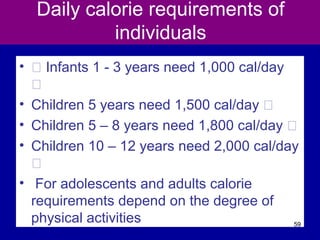
Daily calorie requirements of
individuals
• Š Infants 1 - 3 years need 1,000 cal/day
Š
• Children 5 years need 1,500 cal/day Š
• Children 5 – 8 years need 1,800 cal/day Š
• Children 10 – 12 years need 2,000 cal/day
Š
• For adolescents and adults calorie
requirements depend on the degree of
physical activities 59
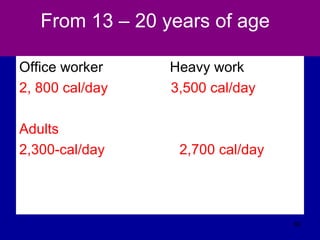
From 13 – 20 years of age
Office worker Heavy work
2, 800 cal/day 3,500 cal/day
Adults
2,300-cal/day 2,700 cal/day
60
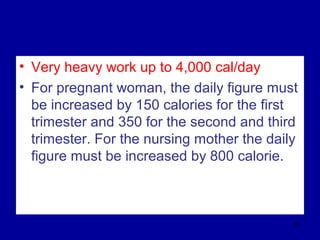
• Very heavy work up to 4,000 cal/day
• For pregnant woman, the daily figure must
be increased by 150 calories for the first
trimester and 350 for the second and third
trimester. For the nursing mother the daily
figure must be increased by 800 calorie.
61
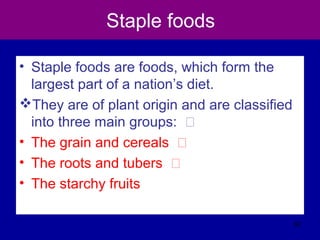
Staple foods
• Staple foods are foods, which form the
largest part of a nation’s diet.
They are of plant origin and are classified
into three main groups: Š
• The grain and cereals Š
• The roots and tubers Š
• The starchy fruits
62
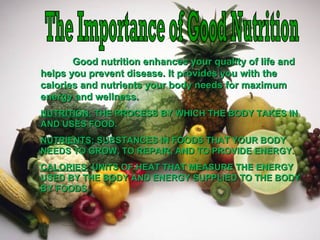
Good nutrition enhances your quality of life andGood nutrition enhances your quality of life and
helps you prevent disease. It provides you with thehelps you prevent disease. It provides you with the
calories and nutrients your body needs for maximumcalories and nutrients your body needs for maximum
energy and wellness.energy and wellness.
NUTRITION:NUTRITION: THE PROCESS BY WHICH THE BODY TAKES INTHE PROCESS BY WHICH THE BODY TAKES IN
AND USES FOOD.AND USES FOOD.
NUTRIENTS:NUTRIENTS: SUBSTANCES IN FOODS THAT YOUR BODYSUBSTANCES IN FOODS THAT YOUR BODY
NEEDS TO GROW, TO REPAIR, AND TO PROVIDE ENERGY.NEEDS TO GROW, TO REPAIR, AND TO PROVIDE ENERGY.
CALORIES:CALORIES: UNITS OF HEAT THAT MEASURE THE ENERGYUNITS OF HEAT THAT MEASURE THE ENERGY
USED BY THE BODY AND ENERGY SUPPLIED TO THE BODYUSED BY THE BODY AND ENERGY SUPPLIED TO THE BODY
BY FOODS.BY FOODS.
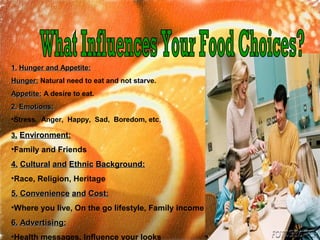
33.. Environment:Environment:
•Family and Friends
4.4. CulturalCultural andand EthnicEthnic Background:Background:
•Race, Religion, Heritage
5.5. ConvenienceConvenience andand Cost:Cost:
•Where you live, On the go lifestyle, Family income
6.6. Advertising:Advertising:
•Health messages, Influence your looks
1.1. Hunger and Appetite:Hunger and Appetite:
Hunger:Hunger: Natural need to eat and not starve.
Appetite:Appetite: A desire to eat.
2.2. Emotions:Emotions:
•Stress, Anger, Happy, Sad, Boredom, etc,
66 GROUPSGROUPS OFOF NUTRIENTS:NUTRIENTS:
•CarbohydratesCarbohydrates
•ProteinsProteins
•FatsFats
•VitaminsVitamins
•MineralsMinerals
•WaterWater
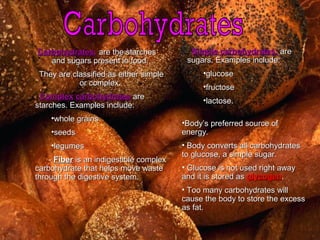
•Body’s preferred source ofBody’s preferred source of
energy.energy.
• Body converts all carbohydratesBody converts all carbohydrates
to glucose, a simple sugar.to glucose, a simple sugar.
• Glucose is not used right awayGlucose is not used right away
and it is stored asand it is stored as glycogenglycogen..
• Too many carbohydrates willToo many carbohydrates will
cause the body to store the excesscause the body to store the excess
as fat.as fat.
Carbohydrates:Carbohydrates: are the starchesare the starches
and sugars present in food.and sugars present in food.
They are classified as either simpleThey are classified as either simple
or complex.or complex.
ComplexComplex carbohydratescarbohydrates areare
starches. Examples include:starches. Examples include:
•whole grainswhole grains
•seedsseeds
•legumeslegumes
-- FiberFiber is an indigestible complexis an indigestible complex
carbohydrate that helps move wastecarbohydrate that helps move waste
through the digestive system.through the digestive system.
Simple carbohydrates:Simple carbohydrates: areare
sugars. Examples include:sugars. Examples include:
•glucoseglucose
•fructosefructose
•lactose.lactose.
carbohydrate
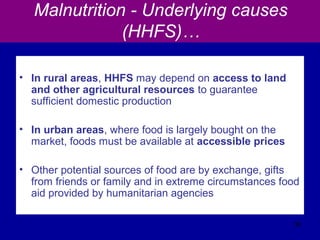
• Carbohydrates
provide a great part of
the energy in all
human diets.
• In the diet of poor
people, especially in
the tropics up to 85%
of the energy may
come from this source
• On the other hand, in the
diet of the rich people in
many countries the
proportion may be as low
as 40%.
• However, the cheapest
and easily digestible fuel
of humans is
carbohydrate.
67
carbohydrate
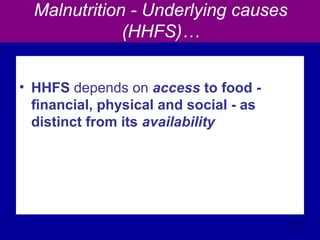
• Carbohydrates are
components of body
substances needed
for the regulation of
body processes.
Heparin, which
prevents blood from
clotting, contains
carbohydrate
• Nervous tissue,
connective tissue,
various hormones,
and enzymes also
contain carbohydrate.
68
carbohydrate
• Ribose, another
carbohydrates are
part of
Deoxyribonucleic acid
(DNA) and ribonucleic
acid RNA), the
substance that carry
the hereditary
factorsin the cell.
• Carbohydrate is also
a component of a
compound in the liver
that destroys toxic
substances.
69
carbohydrate
• Carbohydrates are
necessary for the
proper use of fats.
• If carbohydrate
intake is low, larger
than normal amounts
of fats are called on to
supply energy.
• The body is unable to
handle the excessive
breakdown of fat. As a
result, the fat does not
burn completely, and
abnormal amounts of
certain breakdown
products accumulate in
the blood, causing a
condition known as
ketosis
70
71
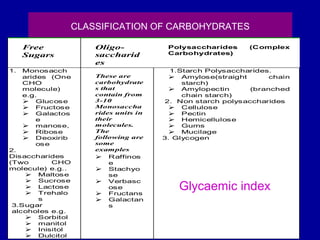
CLASSIFICATION OF CARBOHYDRATES
Free
Sugars
Oligo-
saccharid
es
Polysaccharides (Complex
Carbohydrates)
1. Monosacch
arides (One
CHO
molecule)
e.g.
 Glucose
 Fructose
 Galactos
e
 manose,
 Ribose
 Deoxirib
ose
2.
Disaccharides
(Two CHO
molecule) e.g..
 Maltose
 Sucrose
 Lactose
 Trehalo
s
3.Sugar
alcoholes e.g.
 Sorbitol
 manitol
 Inisitol
 Dulcitol
These are
carbohydrate
s that
contain from
3-10
Monosaccha
rides units in
their
molecules.
The
following are
some
examples
 Raffinos
e
 Stachyo
se
 Verbasc
ose
 Fructans
 Galactan
s
1.Starch Polysaccharides.
 Amylose(straight chain
starch)
 Amylopectin (branched
chain starch)
2. Non starch polysaccharides
 Cellulose
 Pectin
 Hemicellulose
 Gums
 Mucilage
3. Glycogen
Glycaemic index
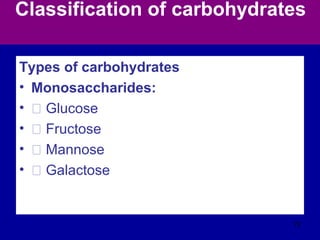
Classification of carbohydrates
Types of carbohydrates
• Monosaccharides:
• Š Glucose
• Š Fructose
• Š Mannose
• Š Galactose
72
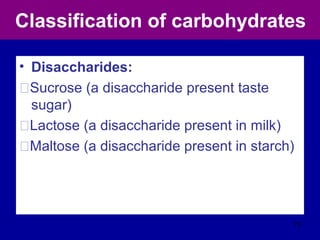
Classification of carbohydrates
• Disaccharides:
ŠSucrose (a disaccharide present taste
sugar)
ŠLactose (a disaccharide present in milk)
ŠMaltose (a disaccharide present in starch)
73
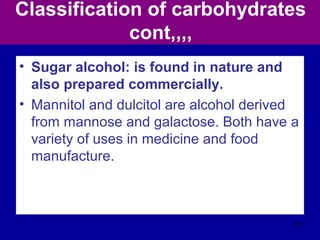
Classification of carbohydrates
cont,,,,
• Sugar alcohol: is found in nature and
also prepared commercially.
• Mannitol and dulcitol are alcohol derived
from mannose and galactose. Both have a
variety of uses in medicine and food
manufacture.
74
Classification of carbohydrates
cont,,,,
• Honey: is a mixture of glucose and fructose.
It is a balanced diet as it contains all the
nutrients in sufficient amount and proper ratio.
Honey has also medicinal effect. The bees first
cover the beehive with antibiotics to prevent the
growth and multiplications of microorganisms.
• If you keep honey for a long time, it will not be
spoiled because of antibiotics.
75
Classification of carbohydrates
cont,,,,
Glycogen:
is the animal equivalent of starch
present in the liver and muscle. In most
foods of animal origin it is a negligible
source of dietary carbohydrate.
• The glycogen in the liver is a reserve fuel
and it serves between meals and over
night. The breakdown of glycogen in the
liver is facilitated by the hormone
glucagons. 76
Classification of carbohydrates
cont,,,,
• Starch: is one form of carbohydrate
that is stored in granules in the roots
and seeds of plants.
77
78
How does fiber prevent different health
problems?
Cancer (Colonic, breast..)
• Prevents secondary bile acid circulation
• Decrease intestinal transit time
• Decrease contact of carcinogens with
intestinal cells
• Fermentation product butyrate has apoptotic
effect
• Decreases absorption fats and sugars
79
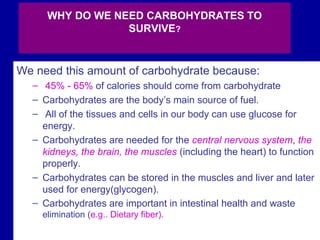
WHY DO WE NEED CARBOHYDRATES TO
SURVIVE?
We need this amount of carbohydrate because:
– 45% - 65% of calories should come from carbohydrate
– Carbohydrates are the body’s main source of fuel.
– All of the tissues and cells in our body can use glucose for
energy.
– Carbohydrates are needed for the central nervous system, the
kidneys, the brain, the muscles (including the heart) to function
properly.
– Carbohydrates can be stored in the muscles and liver and later
used for energy(glycogen).
– Carbohydrates are important in intestinal health and waste
elimination (e.g.. Dietary fiber).
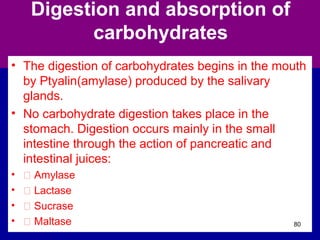
Digestion and absorption of
carbohydrates
• The digestion of carbohydrates begins in the mouth
by Ptyalin(amylase) produced by the salivary
glands.
• No carbohydrate digestion takes place in the
stomach. Digestion occurs mainly in the small
intestine through the action of pancreatic and
intestinal juices:
• Š Amylase
• Š Lactase
• Š Sucrase
• Š Maltase 80
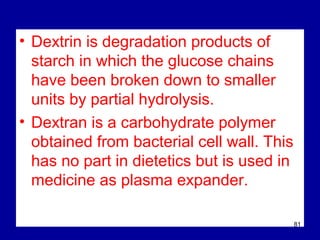
• Dextrin is degradation products of
starch in which the glucose chains
have been broken down to smaller
units by partial hydrolysis.
• Dextran is a carbohydrate polymer
obtained from bacterial cell wall. This
has no part in dietetics but is used in
medicine as plasma expander.
81
82
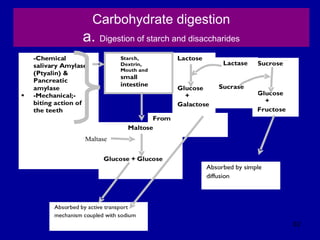
Carbohydrate digestion
a. Digestion of starch and disaccharides
Absorbed by active transport
mechanism coupled with sodium
Sucrose
Glucose
+
Fructose
From the small
intestine
-Chemical
salivary Amylase
(Ptyalin) &
Pancreatic
amylase
 -Mechanical;-
biting action of
the teeth
Maltose
Glucose + Glucose
Lactose
Glucose
+
Galactose
Absorbed by simple
diffusion
Lactase
Sucrase
Maltase
Starch,
Dextrin,
Mouth and
small
intestine
83
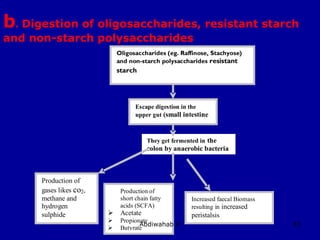
They get fermented in the
colon by anaerobic bacteria
Oligosaccharides (eg. Raffinose, Stachyose)
and non-starch polysaccharides resistant
starch
Escape digestion in the
upper gut (small intestine
Increased faecal Biomass
resulting in increased
peristalsis
Production of
short chain fatty
acids (SCFA)
 Acetate
 Propionate
 Butyrate
Production of
gases likes co2,
methane and
hydrogen
sulphide
b. Digestion of oligosaccharides, resistant starch
and non-starch polysaccharides
Abdiwahab H
84
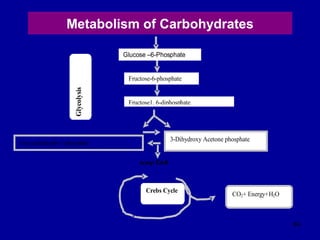
Metabolism of Carbohydrates
Fructose-6-phosphate
Fructose1, 6-diphosphate
Glycolysis
Crebs Cycle
Glyceraldehyde-3 phosphate
bGlyceraldehyde 3-phosphatephosphate
3-Dihydroxy Acetone phosphate
CO2+ Energy+H2O
Acetyl CoA
Glucose –6-Phosphate
• In Health and with normal diet, the available
carbohydrate is digested and absorbed completely
in the small intestine.
• If an excess of unabsorbed carbohydrate arise due
to a disorder of the absorption mechanisms or
occasionally to excessive intake, the osmotic
pressure (effects) leads to retention of fluids in the
lumen and as the result there will be watery
diarrhoea. This diarrhoea is known as osmotic
diarrhoea.
85
• The tissues use as fuel a mixture
of glucose and fatty acids. But the
brain normally uses only glucose
and requires around 80g daily.
86
• In starvation glucose may be provided by
gluconeogenesis from the amino acids in
tissues proteins, mainly from muscle
proteins, but fats cannot be converted into
glucose. With prolonged starvation the
brain adapts and can then utilize fatty
acids and ketone.
87
• The two hormones, which control the
metabolisms of carbohydrates,are insulin
and glucagons
ŠInsulin is secreted by the beta cells of the
islets of Langerhans and the secretion is
stimulated by:
– Hyperglycemias
– Parasympathetic nervous activity
88
Function of insulin
• Š To facilitate glucose transport to the
liver and muscle cells
• Š To facilitate formation of glycogen in the
liver and muscle cells
• Š To incorporate formation of protein from
the amino acids.
89
• Glucagons is secreted by the alpha cells
of the islet of Langerhans and the
secretion is stimulated by
Š Hypoglycaemia
Š Sympathetic nervous activity
90
Function of glucagons
• To facilitate the breakdown of glycogen in
the liver and muscle cells into glucose
91
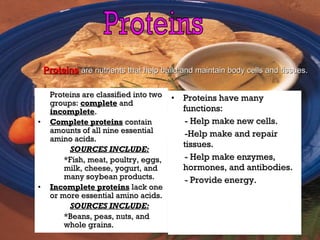
Proteins are classified into twoProteins are classified into two
groups:groups: completecomplete andand
incompleteincomplete..
• Complete proteinsComplete proteins containcontain
amounts of all nine essentialamounts of all nine essential
amino acids.amino acids.
SOURCES INCLUDE:SOURCES INCLUDE:
*Fish, meat, poultry, eggs,*Fish, meat, poultry, eggs,
milk, cheese, yogurt, andmilk, cheese, yogurt, and
many soybean products.many soybean products.
• Incomplete proteinsIncomplete proteins lack onelack one
or more essential amino acids.or more essential amino acids.
SOURCES INCLUDE:SOURCES INCLUDE:
*Beans, peas, nuts, and*Beans, peas, nuts, and
whole grains.whole grains.
• Proteins have manyProteins have many
functions:functions:
- Help make new cells.- Help make new cells.
-Help make and repair-Help make and repair
tissues.tissues.
- Help make enzymes,- Help make enzymes,
hormones, and antibodies.hormones, and antibodies.
- Provide energy.- Provide energy.
ProteinsProteins are nutrients that help build and maintain body cells and tissues.are nutrients that help build and maintain body cells and tissues.
93
Proteins
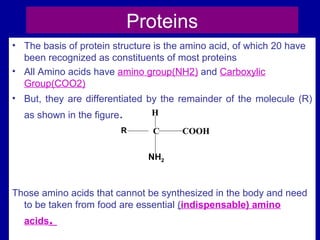
• The basis of protein structure is the amino acid, of which 20 have
been recognized as constituents of most proteins
• All Amino acids have amino group(NH2) and Carboxylic
Group(COO2)
• But, they are differentiated by the remainder of the molecule (R)
as shown in the figure.
Those amino acids that cannot be synthesized in the body and need
to be taken from food are essential (indispensable) amino
acids.
C
H
COOHR
NH2
94
Cont..
• Absence Essential a.a.from the diet leads to poor growth
performance by a growing animal. Essential amino acids are
labelled by (**) sign in the following table .
95
WHY DO WE NEED PROTEIN TO SURVIVE ?
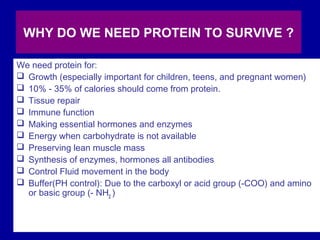
We need protein for:
 Growth (especially important for children, teens, and pregnant women)
 10% - 35% of calories should come from protein.
 Tissue repair
 Immune function
 Making essential hormones and enzymes
 Energy when carbohydrate is not available
 Preserving lean muscle mass
 Synthesis of enzymes, hormones all antibodies
 Control Fluid movement in the body
 Buffer(PH control): Due to the carboxyl or acid group (-COO) and amino
or basic group (- NH2
)
96
Classification of proteins
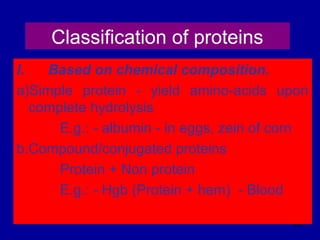
I. Based on chemical composition.
a)Simple protein - yield amino-acids upon
complete hydrolysis
E.g.: - albumin - in eggs, zein of corn
b.Compound/conjugated proteins
Protein + Non protein
E.g.: - Hgb (Protein + hem) - Blood
97
Cont..
II. Based on Nutritional Value:- This classification
depends on the essential amino acids content of the
protein.
a. Complete proteins: Contain all the essential amino
acids in the proportion that is required to support growth
and maintain tissues. E.g. Almost all animal proteins
except gelatine (lack two essential A.As.). They are
denoted as complete because they resemble body
protein (Egg & Milk).
b. Incomplete Proteins: This refers to proteins that do
not contain all essential amino acids in the proportion
that is required to maintain growth and tissue repair.
98
III. Based on Conformation of the Protein: This refers
to the three dimensional shape of the protein in its natural state.
Based on this proteins are classified as:
a.Globular proteins
-Tightly folded poly peptide chain - spherical or globular shape
-Mostly soluble in water
E.g.: - Enzymes, antibodies, and many hormones, Hgb
b. Fibrous proteins
-Polypeptide chains arranged in parallel manner along an axis
-Tough & in soluble in water
E.g.: - Collagen of tendons & bone matrix
- Keratin of hair, skin, nails and
- Elastin of blood vessels
99
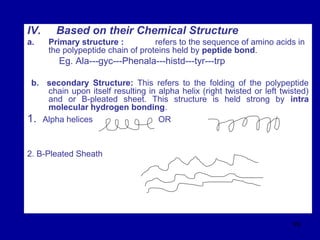
IV. Based on their Chemical Structure
a. Primary structure : refers to the sequence of amino acids in
the polypeptide chain of proteins held by peptide bond.
Eg. Ala---gyc---Phenala---histd---tyr---trp
b. secondary Structure: This refers to the folding of the polypeptide
chain upon itself resulting in alpha helix (right twisted or left twisted)
and or B-pleated sheet. This structure is held strong by intra
molecular hydrogen bonding.
1. Alpha helices OR
2. B-Pleated Sheath
100
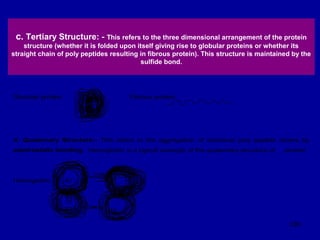
c. Tertiary Structure: - This refers to the three dimensional arrangement of the protein
structure (whether it is folded upon itself giving rise to globular proteins or whether its
straight chain of poly peptides resulting in fibrous protein). This structure is maintained by the
sulfide bond.
Globular protein Fibrous protein
d. Quaternary Structure:- This refers to the aggregation of individual poly peptide chains by
electrostatic bonding. Hemoglobin is a typical example of the quaternary structure of protein.
Hemoglobin A1 A2
B1 B2
Proteins
• Proteins have long been recognized as
fundamental structural elements of
every cell of the body. Specific proteins
and protein derivatives have been
recognized as functional elements in
certain specialized cells glandular
secretion, enzymes and hormones.
101
Proteins
• A good quality or a
complete protein is
the one that supplies
all the essential
amino acids in
sufficient quantities
and in proper ratio for
normal growth and
maintenance
• In general all proteins
from animal source,
such as meat, poultry,
fish, eggs, milk and
milk products provide
good quality proteins.
102
Source of proteins
• Š Milk and milk
products such as
cheese, ice cream all
derive their protein
from milk.
• Š Meat, poultry, and
fish are all forms of
animal tissues
• Š Eggs are in a class
by themselves a
protein food of high
nutritive value.
103
Source of proteins
ŠVegetables are poor source of protein.
ŠLegumes provide more than 4 or 6 percent. They
are listed as meat alternates in the four-food
group chart because they provide one of the
better quality plant proteins.
ŠBread and cereals make an important contribution
to the protein of the diet, the protein of uncooked
grain ranges 7 to 14 percent.
104
Digestion and absorption of protein
• The digestion of protein in the alimentary tract is
accomplished by the action of several proteolytic
enzymes in the gastric, pancreatic and intestinal
juices.
• Any of these enzymes that have the power to
attack native proteins must be secreted in an
inactive form to prevent damage to the tissues
where they are formed.
105
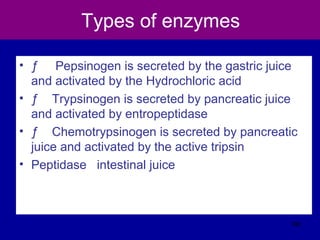
Types of enzymes
• ƒ Pepsinogen is secreted by the gastric juice
and activated by the Hydrochloric acid
• ƒ Trypsinogen is secreted by pancreatic juice
and activated by entropeptidase
• ƒ Chemotrypsinogen is secreted by pancreatic
juice and activated by the active tripsin
• Peptidase intestinal juice
106
Summary of protein digestion
• See in your book/////
107
The Amino Acid Pool
• The amino acids from the food or from the body
tissues enter a common pool, which is drawn upon
for the synthesis of proteins, hormones, enzymes,
blood protein and nucleic acids,
• or some of the amino acids are degraded for
energy needs.
• Proteins are absorbed as amino acids. Ideally,
they are used to build or maintain body proteins. If
carbohydrates and fats are not meeting the energy
needs of the body, amino acids can be used to
provide energy. 108
Danger of the weaning period
• The weaning period is fraught with dangers for a large
proportion of the world’s children and nutritional disorders
are common at this time of life. In the West a general
awareness of the nutritional needs of the weaning, together
with the ability of the average family to provide the
necessary foods, have helped to remove most of the
dangers of the weaning period.
• In the peasant society of developing countries, however,
parents are generally are unaware of the dietary needs of
children, and several customs associated with weaning are
likely to give rise to nutritional deficiencies.
109
Danger of the Weaning period cont;;;;;
• In the traditional society, weaning is commonly
abrupt and unplanned. Often it is brought by the
occurrence of another pregnancy. There are
superstitions and beliefs concerning the effects of
another pregnancy on the quality of the breast
milk. It is believed that the heat from the womb
“poisons” the milk in the breast.
110
Danger of the Weaning period
cont;;;;;
• They also think that the baby in the womb is
jealous of the older sibling on the breast. It is
therefore considered urgent that the child should
be taken off the breast immediately
111
Danger of the Weaning period
cont;;;;;
• The mother may
apply potions (bitter
material) to the
nipples so that when
the child takes the
breast the sharp bitter
taste makes him/her
give up suckling..
• The child has very
close relationship with
the mother, the
mother takes him/her
back wherever and
whenever she goes to
fetch water or to bring
firewood, the child
has also access to
breast milk on
demand.
112
Danger of the Weaning period
cont;;;;;
• The child sleeps on
her back, but this
intimacy will be
interrupted when the
mother knows that
she is pregnant for
the subsequent child.
• This is a psychological
blow for the child and
causes poor appetite
and as the result the
child can develop
protein energy
malnutrition.
113
Protein energy malnutrition (PEM)
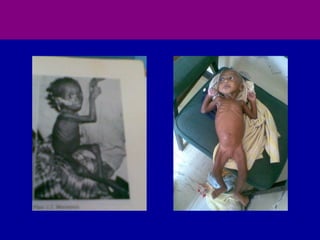
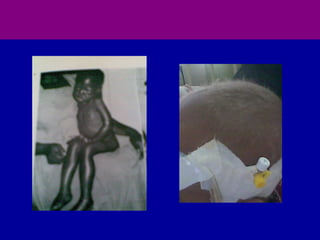
• PEM is today the most serious nutritional problem
in Africa and other developing countries. Its two
clinical forms are Kwashiorkor and Marasmus.
• The diseases occur mostly in children between
one and three years of age, after they have been
taken of the breast.
114
PEM:
• Although there is no final clarity about the etiology
of kwashiorkor in biomedical terms, it is
nevertheless, clear that it is related to nutritional
deficiencies
117
PEM:
• Therefore, all factors that could possibly contribute to the
child malnutrition in general should be avoided.
These include: Š
 Seasonal food shortage Š
 Unfavorable family condition, Š
 Inadequate water supply and sanitary facilities,
 Š Certain traditional attitudes during pregnancy, prenatal
period, breast-feeding and weaning periods, and
 All infectious diseases, which generally reduce immunity.
118
PEM:
Other diseases may sometime play an important role
in precipitating the onset of kwashiorkor in already
malnourished child.
E.g. ƒ Gastrointestinal tract infection
ƒDiarrhea
Intestinal worms share the diet and cause other ill-
health and
poor appetite ƒ
Constipation ƒ
Childhood diseases such as measles, whooping
cough, etc, 119
Signs and symptoms of kwashiorkor
• ƒ Growth failure occurs always ƒ
• Wasting of muscle is also typical but may not be
evident because of edema
• ƒ There may be mental change ƒ
• Hair and skin color change ƒ
• Diarrhea and vomiting ƒ
• Sign of other micronutrient deficiencies
120
Skin changes
• Mild: localized hyper pigmentation and skin
cracks
• Moderate: skin peals off, desquamation.
• Severe: superficial ulceration, bleeding
121
Hair changes
• Hair changes are classified into three categories:
Mild: beginning of visible color and structural
changes
• Moderate: color and structural changes, loss of
hair
• Severe: loss of hair together with ulceration of
head
122
Physiological functions of the various
systems are markedly disturbed with:
• ƒ Diarrhea ƒ
• Electrolyte disturbance ƒ
• Circulatory insufficiency ƒ
• Metabolic imbalance ƒ
• Poor renal functions
• Hence the child with kwashiorkor should be
thought of as an emergency in need of referral to
the nearest health facility.
123
Nutritional Marasmus
• ƒThere is a failure to thrive ƒ
• Irritability, restlessness and diarrhea are frequent.
ƒ
• Many infants are hungry, but some anorexic. ƒ
• There are little or no subcutaneous fats. ƒ
• The weight is much below the standard for age. ƒ
Temperature may be subnormal. ƒ
• The abdomen may be shrunken or distended with
gas. ƒ
124
Nutritional Marasmus
• Because of the thinness of the abdominal wall,
peristalsis may be easily visible. ƒ
• The muscles are weak and atrophic and this
makes the limbs appear as skin and bone ƒ
• Evidence of vitamin deficiencies may or may not
be found.
125
Criteria for referral to the nearest health
facility
• Š Substantial weight def.<60%WAF or <70%
HFA
• Š Severe generalized edema and any of the
following:
– Anorexia
– Diarrhea and vomiting
– Dehydration
– Loss of consciousness and convulsion
126
Criteria for referral ……….
• ƒSevere anemia <15%of Hematocrit ƒ
• Respiratory distress ƒ
• Hypothermia <35.50c ƒ
• Jaundice
127
After discharge management of PEM:
• ƒTo prevent relapse and future deterioration,
through nutrition education and demonstration of
the parents.
• ƒTo achieve long term follow up
128
Child status after discharge from
hospital
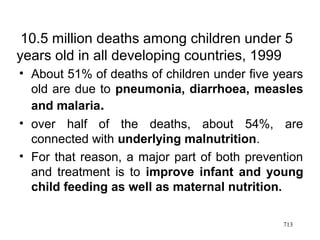
• ƒ Mental state has improved as shown by
smiling, response to stimuli, awareness, and
interest in the surroundings ƒ
• Appetite has returned and he/she is eating well ƒ
• Shows physical activity ƒ
• Temperature is normal ƒ
• No vomiting or diarrhea
• ƒ No edema ƒ
• Starting to gain weight.
129
Protein energy malnutrition
Severe acute malnutrition
Outline for nutritional requirement
Feeding during the 1st
6 month of life –
BF
Feeding during the second 6 month of
life
Feeding problems during the 1st
year of
life
Feeding during second year of life
Feeding during later childhood
Objective
At the end of this lecture the students
should be able to
Describe the nutritional requirement of
infants and children
Identify common problems encountered
during feeding of infants
Breast feeding
 Feeding should be initiated as soon after birth
as possible unless contraindicated.
 maintains normal metabolism during transition
 Promotes maternal infant bonding
 The time required for an infant stomach to
empty may vary from 1-4 hrs
 6 – 9 feedings in 24 hrs
 Most infants take 80-90ml per feed
 Satisfactory feeding
 No more wt loss at the end of 1st
week
 Started to gain wt at the end of 2nd
week
Advantage of BF
 Always available at a proper temperature and
requires no preparation time
 Fewer feeding difficulties, low incidence to
allergy
 Contains bacterial and viral antibodies
 High conc. Of secretary IgA
 Substances that inhibit growth of many common
viruses
 Macrophages synthesize complement, lysozyme
and lactoferrin
 Lower incidence of diarrhea as well as otitis media,
pneumonia, bacteremia, and meningitis
Continued…
 Contains bile salt-stimulated lipase, which kills giardia lamblia
and enteameba histolytica
 Supply all necessary nutrients except flouride and
after several months vit. D
 The psychological advantage of BF to the mother and
the infant – well known
 Establishing and maintaining the milk supply
 Empting of the breast – most important stimulus
Suckling – afferent to hypothalamus –pituitary – prolactin and
oxytocin
 Tender or sore nipples- nursing more frequently, manually
expressing milk, nursing in diffirent conditions, and keeping
the breast dry
 Less relaxed anxious mother – express milk feeding
Maternal diet
 Should contain enough calories and other nutrients
 To compensate those secreted in the milk and those required
to produce it
 Role – to maintain wt and generous in fluid, minerals and
vitamin
 Milk is an important component of the diet
 No food need to be withheld from the mother
 Should not take drugs
 Antithyroid medications, lithium, anticancer agent, INH,
chloramphenicol, metronidazole
 Smoking cigarettes and drinking alcohol- discouraged
Feeding during the second 6 month
of life
 By 6 month of age infants capacity to
 Digest and absorb a variety of dietary components
 Metabolize, utilize and excrete the absorbed products of
digestion is near adult capacity
 Teeth are beginning to erupt
 Begin to explore his surrounding
 Addition of other foods is recommended ( weaning)
 Complementary foods – additional foods including
formulas, given to breast fed infants
 Replacement foods – foods other than formula given
to formula fed infants
 Weaning should be stepwise to both breast fed
and formula fed infants
 Cereals, a good source of iron, usually should be
the first food
 Vegetable and fruits are introduced next
 Meats follows shortly and finally eggs
 One new food should be introduced at a time
 Additional new foods should be spaced by 3-4 days
 Adverse reactions (families with food or other allergies)
 Either home prepared or manufactured
complementary foods can be used
 The latter are more convenient and likely to
contain less salt – have supplemental nutrients
( eg Iron)
 Egg containing products should be delayed
 Food should be served 3 -5 time per day
including night
 With this most infants receive adequate
nutrients
Feeding problems during the 1st
year of life
 Underfeeding
 Suggested by restlessness and crying
 Failure to gain wt
 Possible causes
 Check frequency of feeding, mechanics of feeding
 Abnormal mother infant bonding
 Possible systemic disease
 Rx – instructing mother about the art of BF and
psychological support
_ specific management of systemic illnesses
 Overfeeding
 Regurgitation and vomiting
 Reg. –return of small amount of swallowed food
 Vomiting – more complete emptying of stamach
 Too high in fat – delay in gastric emptying, cause
distention and abd. Discomfort,
 Too high in CHT- distention and flatulance
 Loose stools
 Milk stool – loose, greenish yellow containing
mucus with freq. of 6-8 times/24hrs
 All diarrhea - infectious
 Constipation
 Consistency rather than freq. is the basis for
diagnosis
 Perform PR exam
 Aganglionic megacolon, tight or spastic anal
sphincter
 May be caused by an insufficient amount of food or
fluid
 From diets that are too high in fat or protein or
deficient in bulk
 Functional constipation – the most common
 Enemas and suppositories – temporary use
Colic – infantile colic
Common in infants younger than 3 month
The attack usually begins suddenly with a
loud continuous cry
Etiology is not usually apparent
Holding the infant upside helps and burping
Occasionally sedation for prolonged attack
Feeding during the 2nd
year of life
 By the end of 1st
year- 3 meals a day plus 1-2 snacks
 Changes in eating behavior
 Reduced food intake –rate of growth declines
 Lack of interest in food – temporary
 Never force feed
 Self selection of diets – should be respected
 Self feeding by infant
 Basic daily diets
 Grains, fruits, vegetables, meats and dairy products-balanced
diet with
 Snacks between meals- orange or other fruit juice with biscuit
 Vegetarian diet – vitamin B12 and trace mineral deficiency
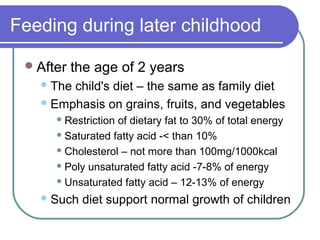
Feeding during later childhood
After the age of 2 years
The child's diet – the same as family diet
Emphasis on grains, fruits, and vegetables
 Restriction of dietary fat to 30% of total energy
 Saturated fatty acid -< than 10%
 Cholesterol – not more than 100mg/1000kcal
 Poly unsaturated fatty acid -7-8% of energy
 Unsaturated fatty acid – 12-13% of energy
Such diet support normal growth of children
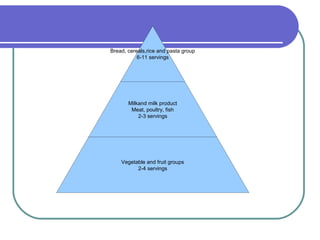
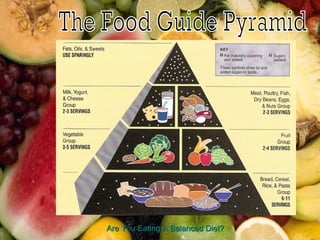
Bread, cereals,rice and pasta group
6-11 servings
Milkand milk product
Meat, poultry, fish
2-3 servings
Vegetable and fruit groups
2-4 servings
These servings usually meat the daily
requirement of 1600kcal(less active
child) and 2800kcal ( more active child)
Severe malnutrition
Objective
At the end of this lecture the students
should be able to describe the def.,
pathogenesis, clinical feature and
management of severe acute malnutrition
Outline
 Introduction
 Epidemiology
 Cause
 Classification
 Pathogenesis
 Clinical feature
 Diagnosis
 Complications
 Principles of management
 Prognosis and mortality
HUMAN NUTRITION
 Nutrients are substances that are crucial
for human life, growth & well-being.
 Macronutrients (carbohydrates, lipids,
proteins & water) are needed for
 energy and
 cell multiplication & repair.
 Micronutrients are trace elements &
vitamins,
 which are essential for metabolic processes.
HUMAN NUTRITION/2
 Obesity & under-nutrition are the 2 ends of
the spectrum of malnutrition.
 A healthy diet provides a balanced
nutrients that satisfy the metabolic needs
of the body without excess or shortage.
 Dietary requirements of children vary
according to
 age,
 sex &
 development.
Assessment of Nutritional status
Clinical
Anthropometric
Dietary
Laboratory
Clinical Assessment
Useful in severe forms of PEM
Based on thorough physical
examination for features of PEM &
vitamin deficiencies.
Focuses on skin, eye, hair, mouth &
bones.
Clinical Assessment/2
ADVANTAGES
Fast & Easy to perform
Inexpensive
Non-invasive
LIMITATIONS
Did not detect early cases
Trained staff needed
ANTHROPOMETRY
Objective with high specificity &
sensitivity
Measuring Ht, Wt, MUAC, HC, skin fold
thickness, waist & hip ratio & BMI
Reading are numerical & gradable on
standard growth charts
Non-expensive & need minimal training
ANTHROPOMETRY/2
LIMITATIONS
Inter-observers’ errors in
measurement
Limited nutritional diagnosis
Problems with reference standards
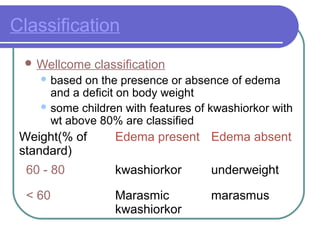
Classification
 Wellcome classification
 based on the presence or absence of edema
and a deficit on body weight
 some children with features of kwashiorkor with
wt above 80% are classified
Weight(% of
standard)
Edema present Edema absent
60 - 80 kwashiorkor underweight
< 60 Marasmic
kwashiorkor
marasmus
Continued..
 Advantage
-simplicity
 Disadvantage
 If the age of the
patient is not
known-difficult to
use
 It doesn’t take into
consideration the
chronicity of the
disease process
continued
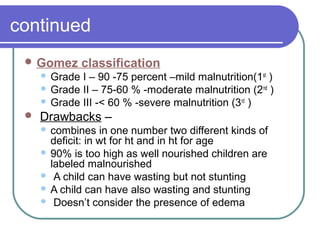
 Gomez classification
 Grade I – 90 -75 percent –mild malnutrition(1st
)
 Grade II – 75-60 % -moderate malnutrition (2nd
)
 Grade III -< 60 % -severe malnutrition (3rd
)
 Drawbacks –
 combines in one number two different kinds of
deficit: in wt for ht and in ht for age
 90% is too high as well nourished children are
labeled malnourished
 A child can have wasting but not stunting
 A child can have also wasting and stunting
 Doesn’t consider the presence of edema
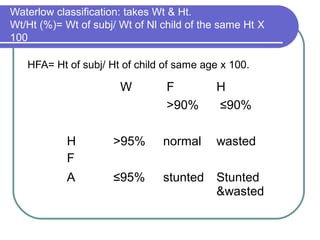
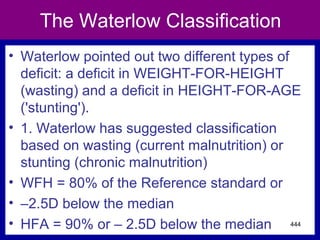
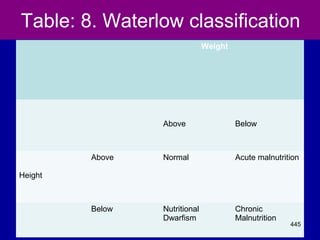
Waterlow classification: takes Wt & Ht.
Wt/Ht (%)= Wt of subj/ Wt of Nl child of the same Ht Χ
100
HFA= Ht of subj/ Ht of child of same age x 100.
W F H
>90% ≤90%
H
F
>95% normal wasted
A ≤95% stunted Stunted
&wasted
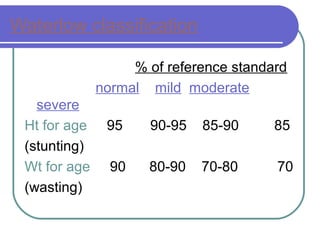
Waterlow classification
% of reference standard
normal mild moderate
severe
Ht for age 95 90-95 85-90 85
(stunting)
Wt for age 90 80-90 70-80 70
(wasting)
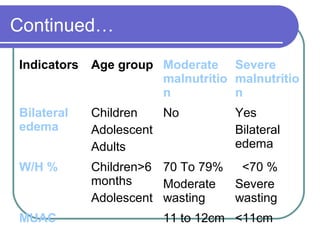
Continued…
Indicators Age group Moderate
malnutritio
n
Severe
malnutritio
n
Bilateral
edema
Children
Adolescent
Adults
No Yes
Bilateral
edema
W/H % Children>6
months
Adolescent
70 To 79%
Moderate
wasting
<70 %
Severe
wasting
MUAC 11 to 12cm <11cm
LAB ASSESSMENT
Biochemical
Serum proteins,
creatinine/hydroxyproline
Hematological
CBC, iron, vitamin levels
Microbiology
Parasites/infection
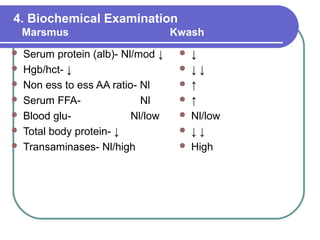
4. Biochemical Examination
Marsmus Kwash
 Serum protein (alb)- Nl/mod ↓
 Hgb/hct- ↓
 Non ess to ess AA ratio- Nl
 Serum FFA- Nl
 Blood glu- Nl/low
 Total body protein- ↓
 Transaminases- Nl/high
 ↓
 ↓ ↓
 ↑
 ↑
 Nl/low
 ↓ ↓
 High
DIETARY ASSESSMENT
Breast & complementary feeding
details
24 hr dietary recall
Home visits
Calculation of protein & Calorie
content of children foods.
Feeding technique & food habits
OVERVIEW OF PEM
The majority of world’s children live
in developing countries
Lack of food & clean water, poor
sanitation, infection & social unrest
lead to LBW & PEM
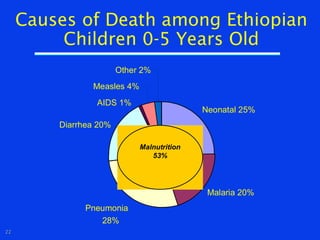
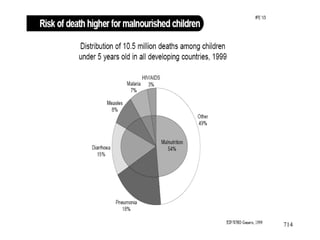
Malnutrition is implicated in >50% of
deaths of <5 children (5 million/yr)
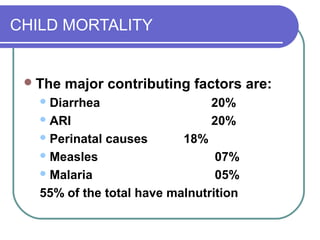
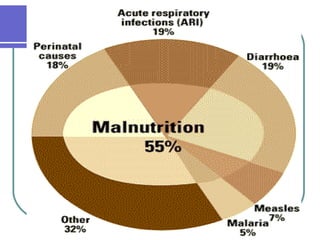
CHILD MORTALITY
The major contributing factors are:
Diarrhea 20%
ARI 20%
Perinatal causes 18%
Measles 07%
Malaria 05%
55% of the total have malnutrition
EPIDEMIOLOGY
The term protein energy malnutrition
has been adopted by WHO in 1976.
Highly prevalent in developing
countries among <5 children;
 severe forms 1-10% &
 underweight 20-40%.
All children with PEM have
micronutrient deficiency.
PEM
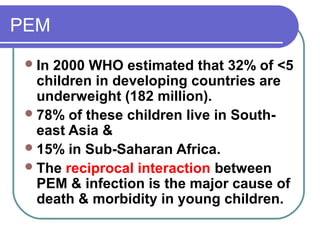
In 2000 WHO estimated that 32% of <5
children in developing countries are
underweight (182 million).
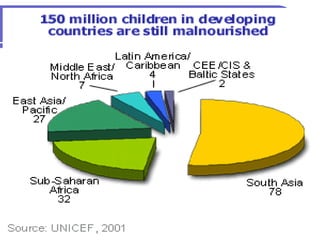
78% of these children live in South-
east Asia &
15% in Sub-Saharan Africa.
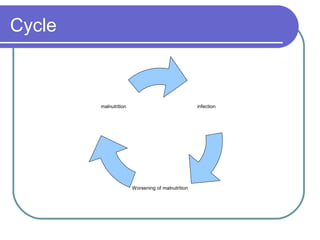
The reciprocal interaction between
PEM & infection is the major cause of
death & morbidity in young children.
Cycle
infection
Worsening of malnutrition
malnutrition
PEM in Sub-Saharan Africa
PEM in Africa is related to:
The high birth rate
Subsistence farming
Overused soil, draught & desertification
Pets & diseases destroy crops
Poverty
Low protein diet
Political instability (war & displacement)
PRECIPITATING FACTORS
• LACK OF FOOD (famine, poverty)
• INADEQUATE BREAST FEEDING
• WRONG CONCEPTS ABOUT NUTRITION
• DIARRHOEA & MALABSORPTION
• INFECTIONS (worms, measles, T.B)
Introduction
Malnutrition is defined as chronic
inadequacy in food instances
combined with high levels of illness
Is a long term year round
phenomena
Chronic problem found in majority of
households
More than half of the deaths in
children have stunting and wasting
as the underling cause
 Occurs more frequently when
infections impose additional
demands, induce greater loss of
nutrients
Most deaths in children have some form
of malnutrition as the background
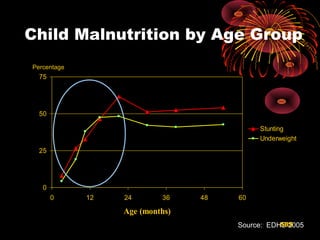
Stunting is due to chronic malnutrition
Wasting and edema are due to acute
malnutrition
Is both medical and social disorder so
management includes both medical and
social problems identified and managed—
this prevents relapse of the problem
Epidemiology
Most malnourished persons live in
developing countries,
One of every three children under the
age of 5 years in the developing country
 177 million children –are or had been
malnourished
In industrialized countries, malnutrition is
seen mainly among
 young children of low socioeconomic groups,
 the elderly who live alone,
 adults addicted to alcohol and drugs
According to unicef the extent of
malnutrition in Ethiopia is
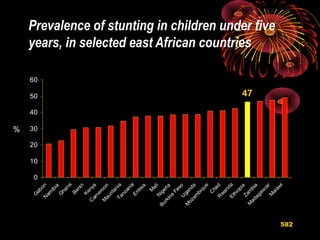
Stunting ( 24 -59 months) – 43%
Underweight ( 0 -4 yrs) – 38
Wasting (12 -23 months) – 19%
Cause
There are two types
Primary – nutritional insufficiency
Inadequate protein, calorie and nutrient
intake
Secondary – malnutrition following
infections, injury, chronic disease, excessive
nutrient loss as occurs in chronic diarrhea,
HIV, malabsorption syndrome etc…
Social, economic, biologic, and
environmental factors underlying
severe malnutrition
Social and economic –
 Poverty that results in
 low food availability,
 overcrowding and
 unsanitary living condition
ignorance by itself or associated with
poverty leads to poor infant and child
rearing practices
misconception about the use of certain
foods
inadequate feeding conduct during illness
 inadequate BF and weaning practices
-Social problems like child abuse,
Continued…
Biologic factors
 Maternal malnutrition prior or during
pregnancy
Infectious diseases like diarrheal disease,
measles, respiratory and other infections
Diets with low concentration of proteins and
energy like over diluted milk formulas or
bulky vegetable foods that have low nutrient
densities
 Infection
 Anorexic
 Malabsorption
 Intestinal damage
 Increased metabolic rate
 Redistribution of nutrients
 Activation of inflammatory responses
 End result –
 reduced nutrient intake,
 reduced nutrient absorption,
 nutrient loss,
 increased nutrient requirement
Environmental factors
Overcowded or unsanitary living
conditions
Agricultural patterns, drought, floods,
wars and forced migration lead to
cyclic, sudden or prolonged food
scarcities
Pathogenesis
1) Dietary theory –believed in 1960’s
Kwashiorkor-is primary protein malnutrition
accompanied by a relatively excess of
energy
Marasmus is under nutrition with lack of
predominantly energy
Marasmic kwashiorkor is a combination of
chronic energy deficiency and chronic or
acute protein deficit.
Early weaning and prolonged BF without
weaning
2) Maladaptation theory –
• kwashiorkor is essentially failure of
adaptation where the body utilized
proteins and conserve S/C fat
• marasmus is due to the elevated plasma
glucocorticoid concentration which are
associated with an increased rate of muscle
protein catabolism which provided
• energy for the body’s needs and
• released amino acids for the hepatic synthesis
of protein.
Continued…
Aflatoxin theory –
 kwashiorkor results from aflatoxin
poisoning but
 there is no difference in the
amount of aflatoxin in both
marasmus and kwashiorkor
Free radicals theory – Michael Golden
 Imbalance between the
production of toxic free radicals
(superoxide,peroxidase) and their
safe disposal
The factors that increase free
radicals are
infections,
 toxins,
 sunlight,
 trauma, and catalysts such as iron
Formation of free radicals is
decreased by the antioxidant function
of vitamin A, C, and E, by ceruplasmin
and transfferin
The toxic effect of free radicals would
be responsible for cell damage leading
to alteration seen in kwashiorkor, such
as edema, fatty liver, skin changes.
more comprehensive and include all
other theories
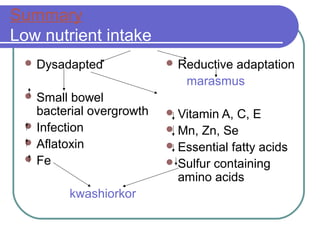
Summary
Low nutrient intake
 Dysadapted
 Small bowel
bacterial overgrowth
 Infection
 Aflatoxin
 Fe
kwashiorkor
 Reductive adaptation
marasmus
 Vitamin A, C, E
 Mn, Zn, Se
 Essential fatty acids
 Sulfur containing
amino acids
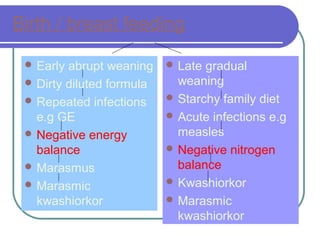
Birth / breast feeding
 Early abrupt weaning
 Dirty diluted formula
 Repeated infections
e.g GE
 Negative energy
balance
 Marasmus
 Marasmic
kwashiorkor
 Late gradual
weaning
 Starchy family diet
 Acute infections e.g
measles
 Negative nitrogen
balance
 Kwashiorkor
 Marasmic
kwashiorkor
Pathophysiology
Develops gradually allowing the body
to adapt for the low food intake,
enabling survival in a compensated manner.
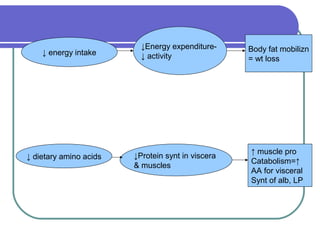
The adaptive mechanisms:
1. functional limitation & ↓ interaction
with the physical & social environment.
↓ energy intake
↓Energy expenditure-
↓ activity
Body fat mobilizn
= wt loss
↓ dietary amino acids ↓Protein synt in viscera
& muscles
↑ muscle pro
Catabolism=↑
AA for visceral
Synt of alb, LP
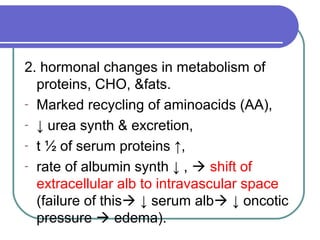
2. hormonal changes in metabolism of
proteins, CHO, &fats.
- Marked recycling of aminoacids (AA),
- ↓ urea synth & excretion,
- t ½ of serum proteins ↑,
- rate of albumin synth ↓ ,  shift of
extracellular alb to intravascular space
(failure of this ↓ serum alb ↓ oncotic
pressure  edema).
Cont…
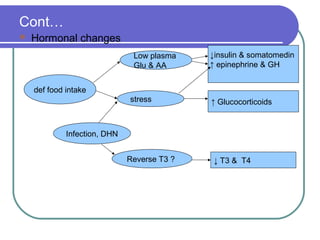
 Hormonal changes
def food intake
Low plasma
Glu & AA
stress
↓insulin & somatomedin
↑ epinephrine & GH
↑ Glucocorticoids
Reverse T3 ? ↓ T3 & T4
Infection, DHN
Cont…
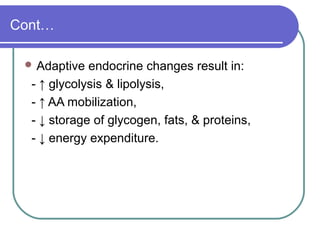
 Adaptive endocrine changes result in:
- ↑ glycolysis & lipolysis,
- ↑ AA mobilization,
- ↓ storage of glycogen, fats, & proteins,
- ↓ energy expenditure.
Cont…
 3. hematological & Oxygen transport:
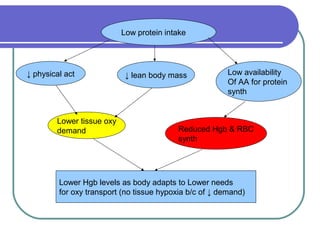
Low protein intake
↓ physical act ↓ lean body mass Low availability
Of AA for protein
synth
Lower tissue oxy
demand Reduced Hgb & RBC
synth
Lower Hgb levels as body adapts to Lower needs
for oxy transport (no tissue hypoxia b/c of ↓ demand)
Rx with dietary protein & energy leads to ↑
tissue synth & lean body mass, and ↑
physical activity  greater tissue oxy
demand
 greater needs for hematopoietic
factors.
This leads to:
 ↑ Hgb & RBC synth (when available),
 anemia & tissue hypoxia (if not
available).
► iron should only be given during the
recovery phase.
4. CV & Renal functions
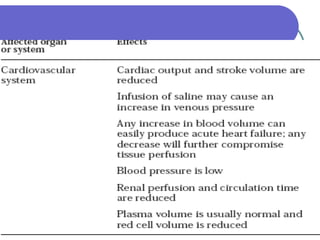
 CV reflexes will be depressed, central circulation
takes precedence over the peripheral
 peripheral circulatory failure which sometimes
mimics hypovolemic shock.
 GFR & renal plasma flow will reduce
5. immune system:
- marked depletion of lymphocytes from the
thymus (atrophy of the gland),
- ↓ complement number & function (↓ opsonin
activity),
Cont…
- phagocytosis, chemotaxis, & IC killing are all
impaired,
- the circulating levels of B-cells & Ig remain
normal, except for IgA- slightly depressed.
6. electrolytes:
- total body K+ ↓(↓ muscle protein & loss of IC
K+,
- IC Na+ ↑ (low insulin action impt for
mobilization of Na+-K+ into & out of the cell
and ↓ in ATP & phosphocreatinine).
7. GI function:
a. atrophy/edema of intestinal epithelium,
b. ↓ brush border enzymes (e.g. disaccharidase)
 mal absorption,
c. gastric, pancreatic, & billiary secretions will all
be depleted,
d. GI mobility ↓  paralytic ileus,
e. def of enzymes, overgrowth of bacteria 
diarrhea,
f. fat accumulation in the liver from def of
lipoprotein.
Cont…
8. CNS & peripheral NS: a long term
complication and includes:
- decreased growth of the brain,
- decreased myelination,
- decreased neurotransmitters,
 decreased velocity of nerve conduction.
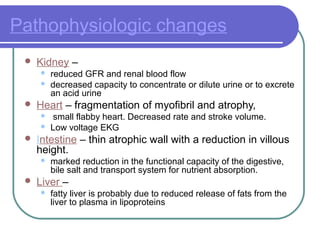
Pathophysiologic changes
 Kidney –
 reduced GFR and renal blood flow
 decreased capacity to concentrate or dilute urine or to excrete
an acid urine
 Heart – fragmentation of myofibril and atrophy,
 small flabby heart. Decreased rate and stroke volume.
 Low voltage EKG
 Intestine – thin atrophic wall with a reduction in villous
height.
 marked reduction in the functional capacity of the digestive,
bile salt and transport system for nutrient absorption.
 Liver –
 fatty liver is probably due to reduced release of fats from the
liver to plasma in lipoproteins
Continued…
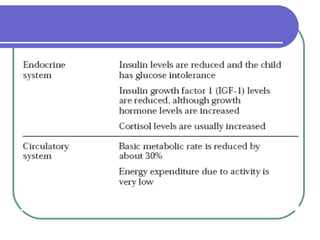
 Endocrine –
 GH increased with decreased insulin
 cortisol increased,
 T3 and T4 decreased
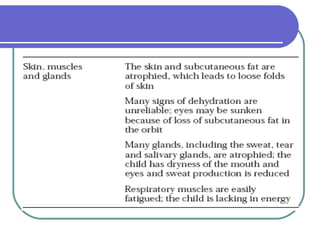
 Hair – there is atrophy of hair roots of the
scalp.
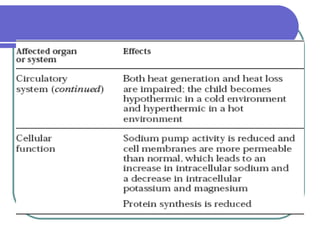
 Fluid and electrolytes –
 an increased of total body Na
 with a loss of total body K . This loss of K is due to
loss of K rich tissues
 Immune response:
 Disruption of skin integrity and mucus membrane
 Impaired bactericidal action of phagocyte
 Impaired cell mediated immunity
 Low serum transferrin
 low complement level
 low activity of IL-1(poor febrile response),
cachectin, TNF
 Lower mucosal secretory IgA antibody titer
 Nervous system – decreased brain growth,
neurotransmitter prod’n
Clinical features
• PEM can affect all ages but
common among infants and young
children
• Marasmus – before 1 year of age
• Kwashiorkor – after 18 months of
age
• Diagnosis is principally based on
• dietary history and
• clinical features
MARASMUS
The term marasmus is derived from
the Greek marasmos, which means
wasting.
Marasmus involves inadequate intake
of protein and calories and is
characterized by emaciation.
Marasmus represents the end result
of starvation where both proteins and
calories are deficient.
MARASMUS/2
Marasmus represents an adaptive
response to starvation, whereas
kwashiorkor represents a maladaptive
response to starvation
In Marasmus the body utilizes all fat
stores before using muscles.
EPIDEMIOLOGY &
ETIOLOGY
Seen most commonly in the first year
of life due to lack of
 breast feeding and
the use of dilute animal milk.
Poverty or famine and diarrhoea are
the usual precipitating factors
Ignorance & poor maternal nutrition
are also contributory
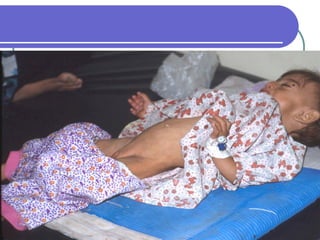
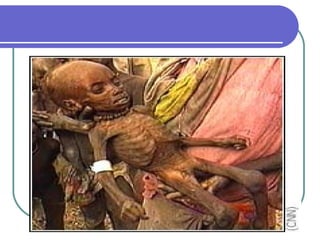
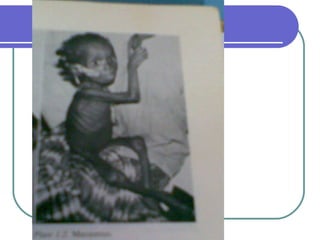
Clinical Features of Marasmus
Severe wasting of muscle & s/c
fats(60% or less of wt for age)
Severe growth retardation(stunted)
Child looks older than his age
Alert but miserable
Hungry
Diarrhoea & Dehydration
No edema
• The hair sparce, thin, dry, and easily
pluckable
• The skin is dry, thin, and wrinkles –
‘baggy pant ‘
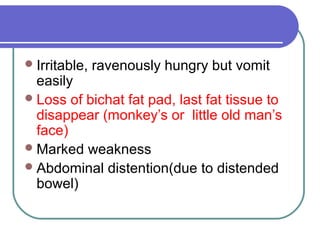
Irritable, ravenously hungry but vomit
easily
Loss of bichat fat pad, last fat tissue to
disappear (monkey’s or little old man’s
face)
Marked weakness
Abdominal distention(due to distended
bowel)
KWASHIORKOR
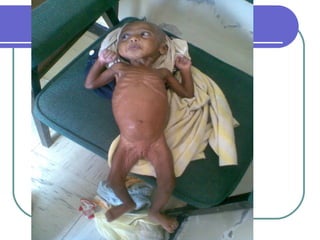
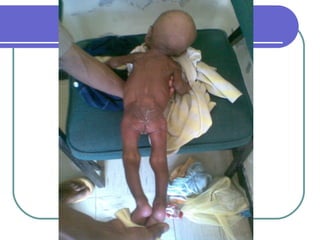
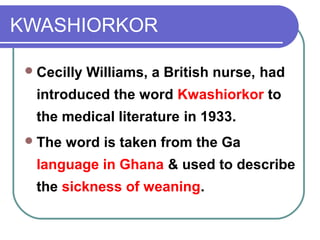
Cecilly Williams, a British nurse, had
introduced the word Kwashiorkor to
the medical literature in 1933.
The word is taken from the Ga
language in Ghana & used to describe
the sickness of weaning.
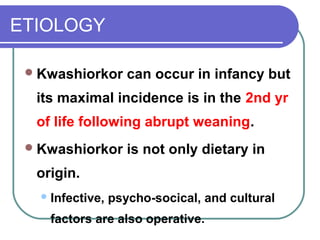
ETIOLOGY
Kwashiorkor can occur in infancy but
its maximal incidence is in the 2nd yr
of life following abrupt weaning.
Kwashiorkor is not only dietary in
origin.
Infective, psycho-socical, and cultural
factors are also operative.
ETIOLOGY (2)
Kwashiorkor is an example of lack of
physiological adaptation to unbalanced
deficiency where the body utilized
proteins and conserve S/C fat.
One theory says Kwash is a result of
liver insult with hypoproteinemia and
oedema.
Food toxins like aflatoxins have been
suggested as precipitating factors.
CLINICAL
PRESENTATION
Kwash is characterized by certain
constant features in addition to a variable
spectrum of symptoms and signs.
Clinical presentation is affected by:
• The degree of deficiency
• The duration of deficiency
• The speed of onset
• The age at onset
• Presence of conditioning factors
• Genetic factors
CONSTANT FEATURES OF KWASH
OEDEMA(doesn’t involve serous
membrane)
PSYCHOMOTOR CHANGES(Apathetic
and irritable, cry easily, and have an
expression of misery and sadnes
GROWTH RETARDATION
USUALLY PRESENT
SIGNS
MOON FACE
HAIR CHANGES
SKIN DEPIGMENTATION
ANAEMIA
OCCASIONALLY PRESENT
SIGNS
HEPATOMEGALY
FLAKY PAINT DERMATITIS
CARDIOMYOPATHY & FAILURE
DEHYDRATION (Diarrh. & Vomiting)
SIGNS OF VITAMIN DEFICIENCIES
 SIGNS OF INFECTIONS
Continued…
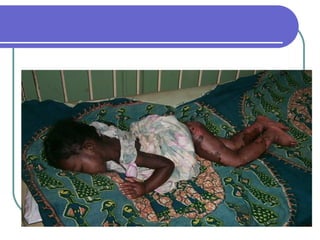
Kwashiorkor –
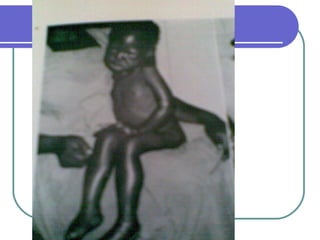
 soft, pitting, painless edema, usually in
the feet and leg
Subcutaneous fat is preserved
Weight deficit is not as severe as
marasmus
Height may be normal or retarded
Continued…
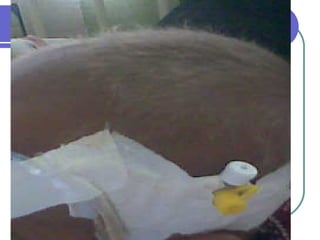
The hair is dry, brittle, easily
pulled out without pain, pigment
changed to brown, red, or
even yellow white
‘Flag sign’ – due to alternating
period of poor and good protein
intake
Anorexic and diarrhea is common
Hepatomegaly
Protuberant abdomen and peristalsis is
slow
Muscle tone and strength is reduced
Marasmic kwashiorkor
Combines clinical feature of both
kwashiorkor and marasmus
Edema
Muscle wasting and decreased
subcutaneous fat
When edema subsides, the patient
appearance resembles that of
marasmus
Wt less that 60%and edema
Diagnosis
 History – nutritional history
 Physical findings
 Anthropometric measurements
-most children have similar growth potential
regardless of ethinicity
-need for international reference standard
-WHO recommends NCHS as a reference
-wt for ht –index of current nutritional
status
-ht for age –index of past nutritional history
-Harvard status – for under 5th
Assessment of Nutritional Status
1. Nutritional Hx & Dietary measurement:
- hx of breast feeding (frequency, day & night ?),
- total duration of breast feeding,
- any additional food (when was it started? If cow’s milk is
used, is it diluted/not?),
- amount, frequency, & type of additional food. Nutritional
hx should continue until present age.
 Dietary measurement
- measuring the diet/replica of the diet the child is getting,
- referring to the reference diet .
2. Anthropometric Measurement
Wt, ht/length, MUAC, HC, & skin fold thickness
(SFT).
Interpretation:
1. NCHS (National Curve for Health Statistics): widely
employed, extends from 5th
to 95th
centile.
Children below the 5th
centile are considered abnormal. In
areas where PEM is prevalent a 3rd
centile is used as a
cut off point.
2. Harvard/Wellcome curve:
- impt for under five children,
- takes the wt & age,
- uses standard wt (expected wt for age, 80%) &

presence/absence of edema. The standard is equivalent
to the 50th
centile of the NCHS curve.
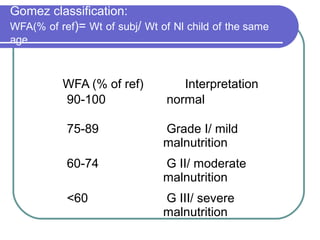
Gomez classification:
WFA(% of ref)= Wt of subj/ Wt of Nl child of the same
age
WFA (% of ref) Interpretation
90-100 normal
75-89 Grade I/ mild
malnutrition
60-74 G II/ moderate
malnutrition
<60 G III/ severe
malnutrition
Cont…
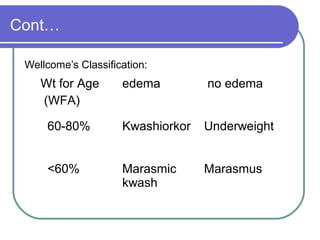
Wellcome’s Classification:
Wt for Age
(WFA)
edema no edema
60-80% Kwashiorkor Underweight
<60% Marasmic
kwash
Marasmus
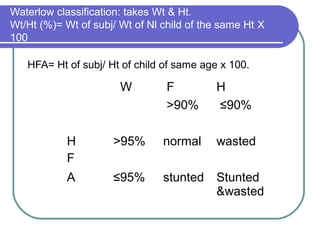
Waterlow classification: takes Wt & Ht.
Wt/Ht (%)= Wt of subj/ Wt of Nl child of the same Ht Χ
100
HFA= Ht of subj/ Ht of child of same age x 100.
W F H
>90% ≤90%
H
F
>95% normal wasted
A ≤95% stunted Stunted
&wasted
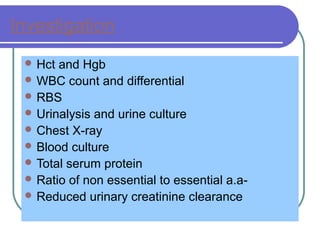
Investigation
 Hct and Hgb
 WBC count and differential
 RBS
 Urinalysis and urine culture
 Chest X-ray
 Blood culture
 Total serum protein
 Ratio of non essential to essential a.a-
 Reduced urinary creatinine clearance
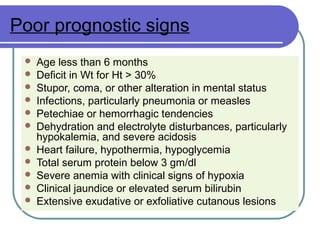
Poor prognostic signs
 Age less than 6 months
 Deficit in Wt for Ht > 30%
 Stupor, coma, or other alteration in mental status
 Infections, particularly pneumonia or measles
 Petechiae or hemorrhagic tendencies
 Dehydration and electrolyte disturbances, particularly
hypokalemia, and severe acidosis
 Heart failure, hypothermia, hypoglycemia
 Total serum protein below 3 gm/dl
 Severe anemia with clinical signs of hypoxia
 Clinical jaundice or elevated serum bilirubin
 Extensive exudative or exfoliative cutanous lesions
Complications
Hypoglycemia
Hypothermia
Dehydration
Infection especially pneumonia, sepsis,
UTI, gastroenteritis
Fluid and electrolyte imbalance
Anemia
Developmental delay
Hypoglycemia
Life threatening comp’n
At risk because of alteration in glucose
metabolism
Signs –low body temperature, lethargy,
eye lid retraction, twitching or convulsion
RBS <54 mg/dl
Immediately give glucose containing
solution po or iv
Hypoglycemia: a common cause of
death in the 1st
2 days.
Can be due to a systemic infec or not
being fed for 4-6 hr.
- often have hypothermia, limpness,
drowsiness, lethargy.
- rx should be immediate (before lab
confirmation): 5ml/kg of 10% glucose,
this can also be given orally.
- also consider broad spectrum
antibiotics.
Dehydration
Useful signs –
thirst,
dry tongue and mouth,
 low urinary output,
weak and rapid pulse,
 low blood pressure,
 cool and moist extremities, and
declining state of consciousness.
Unreliable signs – sunken eyeball,
decreased skin turgor, irritability and
apathy
Rehydration should be preferably orally
or through NG tube
Solution should contain less Na and
more K – ORS ( not ideal) Resomal
(best)
Indication for iv fluid – shock and coma
257
Types of ORS
Solution Glu
g/dl
Na
mEq/L
K
meq/L
Cl
meq/L
WHO 2.0 90 20 80
Rehydralyt
e
2.5 75 20 65
Pedialyte 2.5 45 20 35
Infalyte 2.0 50 20 40
particular renal problem that makes the
children sensitive to sodium overload.
Dehydration:
- ‘narrow therapeutic window”
inappropriate rehydration can lead to
fluid overload & cardiac failure
- rx when possible should be orally, even
for severe DHN, unless there is shock,
loss of consciousness, or confirmed
severe DHN.
- fluids: half strength Darrow’s solution,
RL with 5% dextr, half strength saline
with 5% dextrose,
- oral rehydration: 5ml/kg of ReSoMal q 30min
for the 1st
2 hr, orally/ NG tube, then adjust
according to wt,
i.e. if continued wt loss, ↑ the rate by
10ml/kg/hr;
if no wt gain, ↑ rate by 5ml/kg/hr;
if wt gained but still signs of DHN, continue
same rx;
wt gained & no signs of DHN, stop rehydration.
NB: continuous reassessment vital!!
- in kwash, increased total body water &
Na+,
- frequently hypovolemic due to dilatation
of the blood vessels with a low cardiac
output,
-
definite watery diarrhea, clinical
deterioration DHN.
- a fast weak pulse, cold peripheries,
disturbed consciousness, absence of
signs of heart failure shock
(hypovolemic/ septic).
- mx uses the same fluids as in marasmus,
amount 10ml/kg/hr for 2 hr.
- watch for signs of over-hydration: ↑ RR,
grunting, ↑ liver size, vein engorgement,
- as soon as the patient improves, stop
all IV intake.
- also treat hypoglycemia, hypothermia,
infection.
If pts is in shock
give 15ml/kg over the 1st
hr & reassess,
dose can be repeated if wt loss/ wt is
stable.
- as soon as consciousness improves/
PR drops, stop the drip &
Give NG tube with 10ml/kg/hr
ReSoMal.
SIGN OF OVERHYDRATION
.Engorged neck vein
RR increment by more than 10
PR increment by 15
RUQ tenderness
Liver size increased by 1cm
Peripheral edema
Any sign of respiratory distress like
grunting and cyanosis
Hypothermia
Body temperature <35.5 degree
Due to impaired thermoregulatory
mechanism, reduced fuel substrate or
severe infection
Use kangaroo technique, put a hat
and the room should be kept warm
(b/n 28 -32 degree)
The should always sleep with the mother
Anemia
Usually due to Fe and/or folic acid
deficiency
Clinically pale , low HGB/ HCT
Fe treatment in phase II
Indication for transfusion –HGB
<4gm/dl , HCT <12% or heart failure
10ml/kg of packed RBC/ whole blood
slowly over 3hr.
Infection
Clinical manifestations may be
mild
Classical signs ( fever,
tachycardia and leukocytosis)
may be absent
Assume that children with
severe malnutrition have a
bacterial infection
Gram positive and gram negative
Safer to treat all with broad spectrum
antibiotics
Po route is preferred unless the patient
is in septic shock (a fast and weak pulse,
cold extremities, low BP and disturbed
consciousness)
Management
 Ten essential steps in the routine care of severely
malnourished children
 Treat / prevent hypoglycemia
 Treat / prevent hypothermia
 Treat / prevent dehydration
 Correct electrolyte imbalance
 Treat infection
 Correct micronutrient deficiencies
 Initiate feeding
 Replete wasted tissue (catch-up growth)
 Provide sensory stimulation and emotional support
 Prepare for follow up after recovery
Admission criteria
Age 6mo to 18 yrs - W/H or W/L <70% or
- MUAC <11cm with L
>65cm or
- Bilateral pitting edema
Adults -MUAC <170mm or
- BMI <16 or
-Presence of bilateral
pitting edema (exclude
other causes)
Nutritional therapy
Routine medicines
• Vitamin A – one capsule on the day of
admission and discharge
• Folic acid – a single dose of 5mg folic
acid
• Other nutrients – no need b/c F75 and
F100
• Antibiotics – should be given to all
• 1st
line treatment – oral amoxacillin
(ampicillin)
• 2nd
line teatment – Add chloramphenicol or
gentamycin
Routine medicines
1. Vitamin A
Continued…
 Duration of antibiotic –
 every day during phase I and 4 more days –in
patient
 7 days total in out patient care
 Malaria
 Measles vaccine on the 4th
week of treatment
 Deworming – at the start of phase II
 worm medicine is only given children who can walk
 Albendazole 400mg PO STAT
 mebendazole 100mg TWICE DAILY FOR 3 DAYS
Cont…
2. Folic acid: on the day of admission, one dose of folic
acid (5mg) to children with anemia.
3. Antibiotics: should be given to every severely
malnourished patient, even if no clinical signs of
systemic infection (nearly all are infected).
- small bowel bacterial overgrowth occurs in all these
children: systemic infection, malabsorption, & chronic d.
- in children with kwash, bacteria that are normally not
invasive, such as S. epidermidis can cause systemic
infection/ septicemia.
- recommended also in those who go to phase II directly.
Antibiotic regimen:
 Oral amoxicillin (oral ampicillin, if unavailable): 1st
line,
 2nd
line rx: add chloroamphenicol, or
- add gentamicin, or
- change to amoxicillin/clavulinic acid.
4. Iron: given in phase II.
Phase I:
- pts with inadequate appetite and/or a
major medical cxn,
- formula used in this phase is F-75,
- promotes recovery of normal metabolic
fn & nutrition-ele balance,
- rapid wt gain is dangerous (F-75
ensures that).
Phase I
Diet – F75 (one sachet mixed
with 2 liters of water)
provides 75 kcal per 100 ml
8 feeds per day –larger volume
feeding can result in osmotic
diarrhea
 Naso-gastric feeding is used if
 the child takes less than 75% of the prescribed
diet
 pneumonia with fast breathing
 painful lesions of the mouth
 cleft palate or other physical deformity
 disturbance of consciousness
Surveillance using multichart
Transition phase
 Criteria to progress from phase I
 Return of appetite
 Beginning of loss of edema and
 No iv line, no NG tube
 Diet – F100 (100kcal in 100ml)
 The no. of feeds, their timing, and volume is the
same as phase I this leads to a 30% increase in
energy intake & thus the wt gain should be
~6g/kg/day,
 Transition phase should last 1-5 days
- criteria to move back to phase I include:
1. Increasing edema, new onset edema,
2. Rapid increase in liver size,
3. Significant refeeding diarrhea (& wt
loss),
4. Medical cxn, if NG tube needed,
5. Intake <75% of feeds in transition
phase,
6. Wt gain >10g/kg/d (excess fluid
retention).
Phase II
 Criteria to progress
 Good appetite (taking >90% of F-100)
 Loss of edema entirely
 designed for rapid wt gain (>8g/kg/day).
 Diet – F100
 Have unlimited intake
 5 feeds of F100 are given
 One porridge may be given
 Always offer plenty of clean water while eating
 Children must never be forced fed
 Provide additional quantity of diet after feeding
Phase II: amount increased to ~180-
225ml/kg/day of F-100,
 iron is added here
 .
- criteria to move back to phase I:
Development of edema,
refeeding diarrhea with wt loss,
Wt loss of >5% of body wt at any visit
Wt loss for 2 consecutive weighing,
Static wt for 3 consecutive weighing.
Criteria for failure to respond
 Primary failure to respond (phase I)
 Failure to regain appetite (Day 4)
 Failure to start to loss edema (Day 4)
 Edema still present (Day 10)
 Failure to enter phase II and gain 5g/kg/d (Day 10)
 Secondary failure to respond
 Failure to gain more than 5g/kg/d for three
consecutive days (during phase II)
 Measure to take
 Extensive history and examination or lab. Test
 Look for hidden infection
Cont…
Discharge criteria:
Age
6mo-18
yr
• W/L (W/H) ≥85% on
more than one occasion,&
No edema for 10 days.
• target wt gain reached &
no edema for 10 days.
Prognosis
 Upon treatment the acute signs of the disease
are corrected
 Catch-up growth in height may take long or
might never be achieved
 Mortality rate can be as high as 40%
 Immediate cause of death are comp’n
particularly infections, hypoglycemia, and
dehydration
 Mortality rates can be reduced to < 10% by
prevention and treatment of comp’n
• FatsFats are a type of lipid, a fattyare a type of lipid, a fatty
substance that do not dissolve in water.substance that do not dissolve in water.
• The building blocks of fats are calledThe building blocks of fats are called
fatty acidsfatty acids
• Fatty AcidsFatty Acids are classified as two typesare classified as two types
• Saturated:Saturated:
– Animal fats and tropical oilsAnimal fats and tropical oils
– High intake is associated with anHigh intake is associated with an
increased risk of heart diseaseincreased risk of heart disease
• Unsaturated:Unsaturated:
– Vegetable fatsVegetable fats
– Associated with a reduced risk ofAssociated with a reduced risk of
heart diseaseheart disease
• Fatty acids that the body needs, but isFatty acids that the body needs, but is
unable to make are called essential fattyunable to make are called essential fatty
acidsacids
• Transport vitamins A, D, E, and KTransport vitamins A, D, E, and K
• Sources of linoleic acid- essential fatty acidSources of linoleic acid- essential fatty acid
that is needed for growth and healthy skinthat is needed for growth and healthy skin
• High intake of saturated fats is linked toHigh intake of saturated fats is linked to
increased cholesterol productionincreased cholesterol production
• Excess cholesterol can lead to an increasedExcess cholesterol can lead to an increased
risk of heart diseaserisk of heart disease
Lipids
• are a group of organic compounds that are
insoluble in water but soluble in organic solvents.
• Lipids are fats and oils.
295
Lipids:
• ƒ Are the form of stored energy in animals
• Have high energy value 9 kcal/gm of fat ƒ
• Act as carriers for fat soluble vitamins ƒ
• Are palatable giving good taste and satiety ƒ
• Serve as insulator preventing heat loss from the
body ƒ
• Lubricate the gastrointestinal tract ƒ
• Protect the delicate organs such as Kidney,
Eyes, heart and the like.
296
Classification of lipids
Lipids are classified into 3 on the basis of their
chemical structure. ƒ
•Simple lipids = Fats and oils ƒ
•Compound lipid = Phospho-lipids and lipoproteins
ƒ
•Derived lipids= fatty acids and sterols
297
• ƒHuman beings cannot synthesize the Poly
Unsaturated Fatty Acids (PUFA), hence they are
termed as essential FA. ƒ
• Saturated fatty acids tend to raise blood
cholesterol level. ƒ
• Polyunsaturated Fatty Acids lowers blood
cholesterol and large amounts of unsaturated
Fatty Acids are of vegetable origin and have
lower melting point.
298
Phospholipids, sterols and lipoproteins
• Phospholipids are structural compounds found in
cell membranes.
• They are essential components of enzyme
systems and are involved in the transport of
lipids in plasma.
299
Sterols
• ƒThese are precursors of vitamin D, which are
found both in plants and animals. Cholesterol in
animal’s tissues, egg yolk butter. Ergosterol in
plants ƒ
• Lipids are transported in the blood in the form of
lipoprotein (soluble fat protein complexes). ƒ
• They are 25-30% proteins and the remaining as
lipids
300
Lipoprotein
• These are compound lipids that contain both
protein and various types and amounts of lipids.
• They are made mostly in the liver and are used to
transport water-soluble lipids throughout the body
and the types of lipoproteins are VLDL, LDL, HDL,
and Chylomicrons.
301
• Low-density lipoprotein (LDL) This is composed
mainly of cholesterol.
• LDL. Transports cholesterol from the liver to the
tissues. High serum level of LDL greatly increases
the risk of atherosclerosis ” is a disease in which
fatty deposits collect along the inside walls of
large or medium - sized arteries. These deposits
clog or narrow the passageway. If blood clots
become lodged in the narrowed vessels, the
blood flow to the heart or brain many be partially
or completely blocked, resulting in a heart attach
or stroke”. Diets that are high in saturated fatty
acids are associated with elevation in LDL
cholesterol. 302
Cholesterol
• Cholesterol is found
only in animal
products. Plant foods,
regardless of their fat
content, do not
contain cholesterol.
Cholesterol is a fatlike
lipid that normally
occurs in the blood
and all cell
membranes.
• It is a major part of
brain and nerve
tissues. Cholesterol is
necessary for normal
body functioning as
structural material in
the body cells, and in
the production of bile,
vitamin D and a
number of hormones
including cortisone
and sex hormone. 303
• Hereditary, diet, exercise, and other conditions
affect blood cholesterol levels. Persons with high
blood cholesterol levels appear to be more likely
than those with normal levels to develop
atherosclerosis.
• No recommended dietary allowance has been
established for total fat or essential fatty acids;
however, the reduction in total fat is
recommended.
304
The essential fatty acids are: Š
• Linoleic acid Š
• Linolnic acid Š
•Arachidonic acid
305
The essential fatty acids are:
• Essential Fatty Acids are needed for the normal
functioning of all tissues
• Essential Fatty Acids form a part of the structure
of each cell membrane.
• Essential Fatty Acids help transport nutrients
and metabolites across the cell membrane
• Essential Fatty Acids are also involved in brain
development
• Essential Fatty Acids are needed for the
synthesis of prostaglandin
306
Linoleic acid:
Linoleic acid: occurs abundantly in vegetable oils
such as: ƒ
•Corn oils ƒ
•Cottonseed oils ƒ
•Soybeans oils ƒ
•Sesame oils ƒ
•Sunflower oils
307
Digestion of fats:
• In the mouth
• Enzyme – lingual
lipase
• End products –
diglycerides
• In the stomach
• Enzyme – Gastric
lipase
• End products – Fatty
acids, glycerol,
diglycerides and
monglycerides
308
Digestion of fats:
• In small intestine
Triglycerides,
diglycerides
• Enzyme – Pancreatic
lipase
• End products –
monglycerides, fatty
acids, glycerol
Food source of fats ƒ
•Animal – Fish, butter,
beef, pork, and lamb
• ƒPlant - vegetable,
fruit avocado, nuts,
margarine, cooking oils
309
– Water-soluble vitaminsWater-soluble vitamins
dissolve in water and passdissolve in water and pass
easily into the blood duringeasily into the blood during
digestion. The body does notdigestion. The body does not
store these so they need to bestore these so they need to be
replenished regularly.replenished regularly.
Includes vitamins C, B1 ,B2,Includes vitamins C, B1 ,B2,
Niacin, B6, Folic acid, and B12.Niacin, B6, Folic acid, and B12.
– Fat-soluble vitaminsFat-soluble vitamins areare
absorbed, stored, andabsorbed, stored, and
transported in fat. Your bodytransported in fat. Your body
stores these vitamins in yourstores these vitamins in your
fatty tissue, liver, and kidneys.fatty tissue, liver, and kidneys.
Excess buildup can beExcess buildup can be
toxic.These include vitaminstoxic.These include vitamins
A, D, E, and K.A, D, E, and K.
VitaminsVitamins are compounds that help regulate many vital bodyare compounds that help regulate many vital body
processes that include:processes that include:
1.1. Digestion 2. Absorption 3. Metabolism 4. CirculationDigestion 2. Absorption 3. Metabolism 4. Circulation
Vitamins are classified into two groups:Vitamins are classified into two groups:
MineralsMinerals are substances that the body cannotare substances that the body cannot
manufacture but are needed for forming healthy bonesmanufacture but are needed for forming healthy bones
and teeth and regulating many vital body processes.and teeth and regulating many vital body processes.
ImportantImportant mineralsminerals iinclude:nclude:
-Calcium -Phosphorus –Magnesium -Iron-Calcium -Phosphorus –Magnesium -Iron
Vitamins;
• Vitamins: are defined
as organic
compounds, other than
any of the amino acids,
fatty acids and
carbohydrates that are
necessary in small
amounts in the diet of
higher animals for
growth, maintenances
of health and
reproduction.
• All animals need
vitamins, but not every
vitamin that has been
discovered is needed in
the diet of each animal
species. E.g. humans
and guinea pigs need
Vitamin C, but dogs,
rats, do not need
vitamin C in their diet
because they can
synthesis this vitamin in
their bodies.
311
Classification of vitamins:
• Š Vitamin A (Retinol)
• Š Vitamin B1 (Thiamine)
• Š Vitamin B2 (Riboflavin)
• Š Vitamin B6 (pyridoxine) Š
• Vitamin B12 (Cyanocobalamine) Š
• Niacin Š
• Panthotonic Acid Š
• Folacin Š
• Biotin Š
• Vitamin C (Ascorbic acid)
312
Classification of vitamins:
• Š Vitamin D (Cholecalciferol)
• Š Vitamin E (Tocopherol) Š
• Vitamin K (Antihemorrhagic vitamin)
• These vitamins are found in wholesome foods,
milk, vegetables, fruits, eggs, meat, beans,
wholegrain cereals etc
313
Function of vitamins:
• ƒTo promote Growth ƒ
• To promote Reproduction ƒ
• To promote Health & vigor ƒ
• To promote Nervous activity ƒ
• To promote Normal appetite ƒ
• To promote Digestion
• ƒTo promote Utilization ƒ
• To promote Resistances to infection.
314
Groups of vitamins:
Š Water soluble Vitamins are:
(C and B group) Š
Fat-soluble Vitamins are
(A, D, E, and K)
315
Characteristics of water soluble
vitamins
• ƒ They are widely distributed in natural foods ƒ
• B 12 is found only in animal products ƒ
• Soluble in water and absorbed in the intestine ƒ
• Excess will be excreted, thus not toxic. ƒ
• Most functions of these vitamins are as co-
enzymes ƒ
• They are important for energy production ƒ
• They are heat labile
316
Characteristics of fat - soluble
vitamins
• ƒ Metabolize along with fats ƒ
• Resistance to heat ƒ
• Stored in the liver and adipose tissue ƒ
• Slow to develop deficiency syndrome ƒ
• Present only in certain foods, mostly in animal
products, oily foods, yellow and green vegetable
ƒ
• Excess can be toxic to the body.
317
Function of vitamin A
It controls the general state of the epithelial cells
and reduces the risk of infection. ƒ
It is required for the regeneration of two pigments,
visual purple in the rods of retina and visual violet
in the cones of the retina.
 These two pigments are responsible for vision in
dim and bright light ƒ
It aids growth and development during childhood
ƒ
It helps to keep the cornea of the eye in healthy
condition.
318
Function of vitamin A
 Š Dietary Vitamin A is required for the growth and
survival of all animals and it is present in most
biological tissues. ƒ
 In the visual system the retina is dependent on
Vitamin A and its metabolites. ƒ
 In the auditory system vitamin A plays a role in
the maintenance of the middle and inner ear and
it also helps the olfactory system, ƒ
It is required for reproduction, embryonic
development and bone formation. 319
Who is affected by Vitamin A
deficiency?
• Vitamin A deficiency is a major health problem in
many developing countries. Many children do not
survive.
• Recent research findings suggest that improving
vitamin A status amongst deficient populations
can significantly reduce young child mortality.
• The population groups at highest risk of the
deficiency are infants and young children under
five years.
320
Vitamin A deficiency
• Vitamin A deficiency occurs when vitamin A
intakes (or liver stores) fail to meet daily metabolic
requirements. The most common cause is
inadequate consumption of vitamin A – rich foods.
Deficiency also occurs when there is problem of
absorption, conversion or utilization of vitamin A
or when there are repeated infections of diseases
such as measles or diarrhea. In the absence of
foods containing oils or fats in the diet, vitamin A
is not well absorbed and metabolized.
321
Animal source of vitamin A
• The best sources of
vitamin A is animal
products such as
organ meat like liver,
whole milk and milk
products, eggs,
butter, cheese, and
fish liver oils.
• Animal sources contain
preformed active
retinol, which can be
used effectively by the
body. The best source
of vitamin A for infants
is breast milk
• The mother’s secretion
of vitamin A into breast
milk, however, is
related to her own
vitamin A status. 322
Plant source of vitamin A
• Plants contain beta-
carotene that can be
converted into vitamin
A by the body.
• The best plant sources of
vitamin A are orange,
yellow colour fruits and
vegetables (papaya,
mango, pumpkin,
tomatoes, carrots, yellow
sweets potatoes)
• Dark green
vegetables.
323
What are the consequences of vitamin
A deficiency?
• Vitamin A deficiency has long been associated
with blindness. But more importantly, vitamin A
deficiency is associated with increased morbidity
and mortality among young children.
• Improvement of vitamin A levels among deprived
populations has been associated with reduction in
young child mortality.
324
The common symptoms of vitamin A
deficiency
• Š Night blindness:
The child cannot see
in the dark. He/she
has to go in to the
house early in the
evening.
• Š Conjuctival xerosis:
The conjuctival
covering the white
surface of the
eyeballs become dry
and rough instead of
being moist, smooth
and shining. The child
cannot open and
close his/her eyes
because it is painful.
325
The common symptoms of vitamin
A deficiency
• Bitot’s spots: A foamy or cheesy accumulation,
which forms in the inner quadrant of the cornea in
the eyes.
• The cornea the central transparent part of the eye
becomes cloudy.
• It reflects more advanced vitamin A deficiency,
but tends to be reversible with treatment.
326
The common symptoms of vitamin
A deficiency
• ŠCorneal ulceration: an ulcer on the cornea may
leave scar, which can affect vision. Š
• Keratomalacia: The eyeballs become opaque and
soft, jelly like substance; hereafter there will be a
rapid destruction of the eyeball and no hope of
recovery after the condition reached the stage of
keratomalacia.
327
• Diagnostic criteria for vitamin A deficiency at the
community level, WHO identifies a vitamin A
deficiency as a major public health problem if
prevalence of any one of the following in children
below six years of age exceeds the prescribed
levels.
328
Identifications of vitamin A deficiency at
the community level
Vitamin A deficiency sign/symptoms
Who cut - off level for identifying a
public health problem
Night blindness >1%
Bitot’s Spot(s) >0.5%
Conjuctival
Xerosis/ulceration/keratomalacia
>0.01%
Corneal scar >0.05%
329
Prevention of vitamin A deficiency
• ƒ A diet containing plenty of vitamin A is the best.
ƒ
• Breast-feed infants for at least one year.
• Do not discard the 1st breast milk soon after
delivery. ƒ
• At 6 months start to feed infants with dark green
vegetables, yellow and orange fruits and if
possible, some finely chopped and well cooked
liver. ƒ
• Include some fats in the child’s diet
330
Prevention of vitamin A deficiency
• Children with diarrhea, measles, respiratory and
other serious infections need extra vitamin A. ƒ
•Pregnant and lactating mothers should eat foods
rich in vitamin A every day. ƒ
•Tell families that night blindness is an early warning
sign of xerophthalmia (Vitamin A deficiency). ƒ
•Teach school children to look for night blindness in
young children. ƒ
•Learn which vitamin A rich food is available in the
locality 331
Strategies to control and eliminate
vitamin A deficiency ƒ
• Universal supplementation of vitamin A ƒ
• Food fortification ƒ
• Food diversification
332
Universal supplementation of vitamin a
capsules (short term strategy)
• ƒ Children 6-59 months of age ƒ
• Lactating mothers ƒ
• Pregnant women ƒ
• Targeted diseases i.e. Measles, diarrhea, acute
respiratory infection, xerophthalmia and PEM.
333
Fortification of foods
• Fortification of a widely consumed centrally
processed staple food with a nutrient is one way
of controlling deficiencies of certain nutrients such
as iron, vitamin B1 and vitamin A in many
countries.
334
Fortification of foods
• Fortification of a nutrient is the addition of the
deficient nutrient supplements in processed
dietary components in factories.
• In industrialized countries the most commonly
fortified food products are:
Wheat flour
ƒBread ƒ
Milk products ƒ
Infant formulas ƒ
Weaning foods. 335
Food diversification
• Food diversification is an important strategy, which
is considered as a long term and sustainable
strategy for the prevention of vitamin A deficiency.
• In this regard, people should be encouraged to
grow and consume vitamin A rich foods at a vast
scale in all regions
336
Vitamin B1 (Thiamine)
• The vitamin B1 (thiamine) plays an important part
in the utilization of carbohydrates, cereals, roots
and tubers are especially rich in carbohydrates
and if these foods are to be properly utilized, it is
essential that the daily food intake should supply
sufficient vitamin B1.
• It occurs particularly in cereals but it is localized
on the outer surface of the grain close to the
sheath.
337
Vitamin B1 deficiency
1. Acute Beriberi (Dry Beriberi)
Symptoms: Š
 Epigastric pain Š
 Nausea & Vomiting Š
 Urgent Cardiac sign of cardiac failure & death
338
Vitamin B1 (Thiamine) deficiency
2. Wet Beriberi
Symptoms: ƒ
•Gradual onset ƒ
•Loss of power of limbs ƒ
•Gradually develops edema and ascitis
339
Vitamin B1 (Thiamine) deficiency
3. Chronic Beriberi
•Symptoms: ƒ
•Paralysis of the lower extremities ƒ
•Cramping of the calf muscle ƒ
•Coldness of the feet ƒ
•Stabbing pain on walking ƒ
•Absence of knee and ankle jerks
340
Vitamin B2 (Riboflavin)
• Vitamin B2 is found in many foods, especially in
milk, certain vegetables and meat.
• It plays a very important role in assisting the
various chemical activities, which are essential to
life such as cellular oxidation, co-enzymes, and
function of the nervous system
341
Deficiency of vitamin B2 is characterized by:
• ƒ Angular Stomatits with fissuring at the angle of
the mouth ƒ
• Cheilosis (Red shiny lips) ƒ
• Glossitis (inflammation of the tongue) ƒ
• Scrotal dermatitis ƒ
• Lacrimation ƒ
• Corneal vascularization
342
Vitamin B6 (Pyridoxine)
• It is one of the vitamins about which little is known.
It is found in both animal and plant foods. The
animal foods include chicken, fish, kidney, liver,
pork, eggs, and plant foods include wheat germ
oils, soybeans, brawn rice, peanuts and walnuts.
Dairy products and vegetables are poor sources.
Yeast is an important source of B6.
343
Deficiency of Vitamin B6
• ŠOccurs in combination with deficiencies of other
B-complex vitamins. Š
• Nervous disturbance such as irritability and
insomnia is observed.
• ŠMuscular weakness, fatigue and convulsion
have been recorded in infants.
344
Vitamin B12 (Cobalamin)
• According to the present evidence this vitamin is
found only in animal products.
• Source of vitamin B12:
The content of liver and kidney is high, the content
of fish, milk and meat is medium, and however,
the source of B12 has not been widely
investigated.
345
Deficiency of vitamin B12:
• ƒThe red blood cells are abnormally large and are
reduced in number ƒ
• Stomatits ƒ
• Lack of appetite ƒ
• Poor coordination in walking & mental disturbance
346
Note:
• The body effectively regulates the vitamin from
bile and other secretions.
• This accounts for its long biologic effectiveness.
• Vegetarians who eat no animal products develop
a vitamin B12 deficiency only after 20 to 30 years
347
Source of Niacin
• ƒ Meat, liver, fish, poultry ƒ Peanut, peas, beans,
and whole grains ƒ Milk, eggs, and cheese are
poor source, however, they are good source of
Tryptophan (one of the essential amino acids ),
which is converted to Niacin.
348
Functions of Niacin
• It affects a number of important metabolic
activities needed for the maintenance of healthy
skin and the proper functioning of the nervous
and digestive system.
• Niacin is a coenzyme in energy metabolism along
with other B-complex vitamins
349
Deficiency of Niacin
• Niacin deficiency is common in areas where the
staple food is Maize because Maize is low in
Niacin and Tryptophan one of the essential amino
acids which is a precursor of Niacin.
350
Early signs and symptoms of Niacin
deficiency
• ƒFatigue,
• poor appetite, ƒ
• Weakness,
• mild digestive disturbance, ƒ
• Anxiety, irritability, ƒ
• Pellagra (a prolonged niacin deficiency), which is
characterized by the 4Ds which are:
 Diarrhea
 Dermatitis
 Dementia
 Death if the disorder is untreated. The skin is dry, scaly,
and cracked and the condition is aggravated by exposure
to heat or light.
351
Vitamin C (Ascorbic Acid)
• ƒ Found in fresh vegetables and citrus fruits ƒ
Vegetables and fruits should not be left soaked in
water for a long time since it is soluble in water ƒ
• Cooking itself destroys about half of the vitamin C
present in the food ƒ
• The best way to make sure of a regular intake of
vitamin C is to eat raw fruits or salad every day
352
Functions of vitamin C
• Helps the formation of
various body tissues,
particularly
connective tissues,
bones, cartilage and
teeth.
•Stimulates the
production of red blood
cells,
•Helps resistance to
infection and neutralizes
poisons.
353
Vitamin C
• Vitamin C is unstable and easily destroyed. Foods
lose almost half of their vitamin C content when
they are cooked and when the foods are kept hot
after they have been cooked.
• Drying, storage, bruising, cutting, and chopping of
fruits and vegetables lead to the loss of vitamin C.
• Potatoes boiled in their skin retain most of their
Vitamin C.
• Therefore, to ensure a regular intake of vitamin C
is to take fruits and vegetable every day.
354
Deficiency of Vitamin C
• Weakness of the wall of the capillaries,
• Gum bleeding,
• Loosening of the teeth,
• Browsing of the skin and petechia
• The bones become painful, swollen and brittle
• General weakness and anemia may result if the
disorder is not treated.
• Skin abnormalities such as adult acne may be the
earliest sign of scurvy
355
Deficiency of Vitamin C
• Hardening and scaling of the skin surrounding the
hair follicles and hemorrhages surrounding the
hair follicles also point to scurvy
• The skin of the forearm, legs and thighs is most
affected
• Scurvy: symptoms include weakness, fatigue,
restlessness, and neurotic behavior, aching
bones, joints, and muscles.
356
Vitamin D (cholecalciferol)
• Vitamin D is known as the antirachtic vitamin and
chemically as calciferol.
• The two most important vitamin D compounds are
ergocalciferol (vitamin D2) and cholecalciferol (vitamin
D3).
These substances are formed from precursors in
plants, animal and in the skin and are converted to
vitamin D. by the ultraviolet rays of the sun.
357
• Vitamin D is stored in the liver mainly; some is
stored in the brain, bones and skin as well.
• It undergoes changes in the liver, and in the
kidneys that convert it to active, hormone like
form.
358
Functions of vitamin D
• Absorption of calcium and phosphorous
• The presence of vitamin D is essential to the
activity of the parathyroid hormone in removing
calcium and Phosphorous from the bone in order
to maintain normal serum levels of calcium.
• Stimulates the reabsorption of Calcium by the
kidney when serum calcium level is low.
• Bone formation
359
Source of vitamin D
• Fish liver oil is a rich source of vitamin D.
• A nonfood source is the sunlight for the action of
sunlight on the skin changes the cholesterol to
vitamin D.
360
Deficiency of vitamin D
• It leads to rickets, which is characterized by
weakness and deformity of bones.
• Rickets generally occurs between the six months
to the second year of life, during the weaning
period.
361
On examination the skull bone of rachitic child, we will
find the following characteristics:
• Depression will be seen along the suture
• The forehead is prominent
• The anterior fontanel remains wide open
• The abnormalities give the head the general
appearance of a box
• If you press the skull bone with your thumb of a
rachitic child, it will remain depressed and this
known as craniotabus.
362
On examination the skull bone of rachitic child,
we will find the following characteristics:
• The chest is narrow and deformed
• The long limbs curve and may take the shape of a
bow and the sufferers are referred as bowlegs or it
may take the opposite shape i.e. the knees may
knock together and the sufferers may be described
as knock-knees.
• The vertebral column may curve, causing Kyphosis.
• Rickets in adults is known as osteomalacia, the
bones become soft and very painful.
• In women it causes difficult labor, as the pelvis
becomes contracted, thus narrowing the birth canal.
363
Vitamin k (Antihemorrhagic vitamin)
• This vitamin can be synthesized by the action of
bacteria in the intestinal tract of a healthy person.
• It is also found in liver, fish, and green vegetables.
• Daily requirement is not known. Cooking does not
destroy it. The liver requires vitamin K for the
formation of prothrombin a substance needed for
clotting mechanism of blood.
364
Deficiency of vitamin K
• A person deficient in Vitamin K shows a tendency
to bleed profusely whenever blood vessels are
injured.
• The treatment and prevention is to provide with
high content of vitamin K foods and give vitamin K
injection to stop active bleeding.
365
Minerals
• Minerals: are inorganic elements occurring in
nature. They are inorganic because they do not
originate in animal or plant life but rather from the
earth’s crust.
• Although minerals make up only a small portion of
body tissues, they are essential for growth and
normal functioning of the body.
• The body can make most of the things it needs
from energy foods and the amino acids in proteins
but it cannot make vitamins and minerals.
366
Benefits of minerals
• Minerals are essentials both as structural
components and in many vital processes,
• Some form hard tissues such as bones and teeth
• Some are in fluids and soft tissues.
• For normal muscular activity the ratio between
potassium and calcium in the extra cellular fluid is
important.
• Electrolytes, sodium and potassium are the most
important factors in the osmotic control of water
metabolism.
367
Benefits of minerals
• Some minerals may act as catalysts in the enzyme
system, or as integral parts of organic compounds
in the body such as:
�Iron in hemoglobin
�Iodine in thyroxin
�Cobalt in vitamin B12.
�Zinc in insulin and
�Sulfur in thiamine.
Plants, animals, bacteria, and other one celled
organisms all require proper concentration of
certain minerals to make life possible. 368
Benefits of minerals
• The principal minerals, which the body requires.
Calcium Chlorine Iron
Phosphorus Sodium Iodine
Magnesium Potassium Sulfur
369
Minerals cont,,,,
• Animals, in trace quantities, use minerals and these
are: Copper, Manganese, Cobalt, Zinc, and Fluorine.
• Other trace elements are present in animal tissues,
but their functions are uncertain and these are
Aluminum, Arsenic, Boron, Cadmium, and Silicon.
370
Minerals
• In natural foods, minerals present in various
forms mixed or combined with:
• � Protein
• � Fats and
• � Carbohydrate
371
Minerals
• Iron
Sources of Iron
�Beef, liver, egg yolk
�Wheat and Teff
� Dark green
vegetables, onions &
fresh fruits.
• Daily requirements for
men and women are 8
to 10mg and 10 to 18
mg respectively.
• For pregnant and
lactating mother the
requirement increases
to 20mg. Absorption of
iron is enhanced in the
presence of
• vitamin C. 372
Functions of Iron
• It is an essential component of hemoglobin,
responsible for the red coloring of blood and for
the transportation of oxygen to the tissues.
373
Causes of Iron Deficiency
• � Insufficient iron in diet
• � Blood loss during menstruation
• � Hook worm infestation
374
Causes of anemia
• Causes of anemia are multiple and the main
causes are nutritional deficiencies, which
represent more than half of all cases, blood loss
through hemorrhage, destruction of red blood
cells by infections such as malaria and parasitic
infections, genetic defects of red blood cells and
infections by most of febrile diseases and chronic
diseases like tuberculoses.
375
Consequences of anemia
• Delayed psychomotor
development and
cognitive performance in
children and
adolescence.
• Neurological
manifestation in children
and adolescents.
• In adults, anemia with
hemoglobin concentration
reduces work
• capacity, mental
performance and
tolerance to infections.
376
Consequences of anemia
• When the level of
hemoglobin
concentration falls
below 4g/ld it may
cause death from
anemic heart failure.
• can also cause
increased maternal
mortality due to
adverse immune
reaction,
• Maternal anemia can
cause prenatal infant
loss, low birth weight
and prematurity,
• Prenatal deaths
• Reduces work
capacity in adults and
learning ability in
children.
377
Strategies for prevention and treatment
of iron deficiency
• Supplementation of
iron tablets (with
folates) preferably with
vitamin B12 and
vitamin C
• Dietary improvement of
iron rich foods
• Changing of dietary
habits and food
preparation practices
through nutrition
• Fortification of foods
with iron
• Control of malaria
infection
• Control of febrile and
chronic diseases,
• Promotion of hygiene
and sanitation,
378
Strategies for prevention and treatment of
iron deficiency
• Education, information and communication on
iron supplementation,
• Networking and collaborating with relevant
sectors on issue,
379
Who needs more iron?
• Pregnant women require much higher amount of
iron than is met by most diets.
• Many infants beyond 6 months of age need more
iron than is available in breast milk and common
weaning foods.
• Infants with low birth weight have less iron stores,
and are thus at a higher risk for deficiency after
two months of age.
380
• Therefore, it is important that pregnant women
routinely receive iron supplements. In places
where anemia prevalence is high,
supplementation should continue into the
postpartum period, to enable them acquire
adequate stores of iron.
381
Iodine
• Iodine is one of the micronutrients, which is highly
essential for regulation of physical growth and
neural developments.
• Iodine is an essential component of the thyroid
hormones, thyroxin.
• Failure to have adequate level of iodine in the
blood leads to insufficient production of these
hormones, which affect many different parts of the
body, particularly muscle, liver, kidney, and the
developing brain.
382
Sources of Iodine
• Milk and sea food
• Drinking water
• Plant source depends on whether or not iodine
present in the soil
• Iodized salt
383
Functions of Iodine
• It is required for normal physical and mental
growth.
• It is required by the thyroid gland for the
production of thyroxin, which regulates the
metabolic rate.
384
Iodine
• soil erosion and
flooding, thus the crop
we grow for food do
not have iodine in
them and as a result
leads to iodine
deficiency.
• People of all ages
and sexes are
vulnerable but
become acute in
fetus, children,
pregnant women and
lactating mothers.
385
Iodine
• Livestock suffer from iodine deficiency in the
same way that humans do.
• They eat the same iodine deficient food and drink
the same iodine deficient water.
• The introduction of iodized salt in their diet will
improve their health and productivity; livestock
fed iodized salt will produce iodine rich milk and
meat. An iodine deficient diet will lead to
increased stillbirth and miscarriages and a
reduced yield of milk, eggs, meat and wool.
386
How do we prevent Iodine
Deficiency Disorder?
• Iodine Deficiency Disorder can be eliminated by
the daily consumption of iodized salt.
• That is why Universal Salt Iodization is a crucial.
387
Why salt is iodized?
• Salt has been chosen as vehicle for the supply of
iodine because it is used universally by all ages,
sexes, socio-economic, cultural and religious
groups throughout the year.
• Iodized salt is also a preventive and corrective
measure for iodine deficiency and is the most
effective low cost, long-term solution to a major
public health problem.
388
How long do we need to use iodized salt?
• Iodized salt has to be used on a daily basis as
long as one lives in an iodine deficient
environment.
• This is the only safe and long-term solution to a
problem that affects many People.
389
The benefits of iodized salt
• Universal Salt Iodization can lead to an increase
of the average intelligence of the entire school
age population.
• The Iodization of salt will mean saving hundreds
of thousands of children.
• Iodine enhances intellectual and cognitive
development of whole generations.
390
The major consequences of iodine
deficiency
• Mental retardation
• Defects in the
development of
nervous system
• Goiter
• Physical sluggishness
• Reduced work
capacity
• Impaired work
performance
• Decreased average
intelligence
• Loss of memory
• Inability to produce
enough milk for
offspring
• Lower birth weight
• Growth retardation
391
The major consequences of iodine
deficiency
• � Dwarfism
• � Deaf-mutism
• � Cretinism
• � Reproductive failures (abortion, prematurity,
stillbirth)
• � Increased childhood morbidity and mortality
• � Economic stagnation and
• � Impotency.
392
WaterWater helps to maintain many bodilyhelps to maintain many bodily
functions.functions.
• Lubricates your joints and mucousLubricates your joints and mucous
membranes.membranes.
- Enables you to swallow and digest foods.- Enables you to swallow and digest foods.
- Absorb other nutrients, and eliminateAbsorb other nutrients, and eliminate
wastes.wastes.
- Perspiration helps maintain normal body- Perspiration helps maintain normal body
temperature.temperature.
• Water makes up around 65% of the body.Water makes up around 65% of the body.
• It’s important to drink at least 8 cups ofIt’s important to drink at least 8 cups of
water a day to maintain health.water a day to maintain health.
Importance of water
• Water, next to oxygen is the body’s most
urgent need. It is more essential than
food.
• Without water, nutrients are of no value to
the body.
• Failure to understand the role of body
water contributes to health problems such
as indigestion and constipations and even
to needless death.
394
Importance of water
• Infant and children have a greater
proportion of water than old persons, and
obese persons have proportionately less
water than lean persons,
• Water is taken in the form of water itself,
beverages, such as coffee, tea, fruit
juices, and milk; and soups,
• Solid foods contribute the next largest
amount of water, as much as 25% to 50%
of water requirements, 395
Importance of water
• Fresh vegetables and fruits are 80% to
90% water; meat is 50% to 60% water,
and even bread is about 35% water,
• The sensation of thirst usually is a reliable
guide to water intake.
• Except in infants and sick persons,
especially comatose person who cannot
respond to the thirst stimulus.
396
Importance of water
• If losses are not replenished, heat exhausting
and possibility heat stroke may occur,
• Dehydration can occur rapidly in comatose
patients and in disabled or elderly persons
with brain impairment that are unable to
respond to the sensation of thirst,
• Other conditions, such as fever, diabetes
mellitus, vomiting, diarrhea, and the use of
drugs such as diuretics also increase water
need. 397
Body water
• About half of the adult body weight is
water 55% for man and 47% for woman.
• About 2000 to 2500 cc of water is
eliminated every day from the body
carrying waste products with it.
398
Body water
• The lost water has to be replaced in the
form of fluid or foods containing water.
• Although some water is formed, as end
products of food metabolism, from 6 to 8
glass of water should be drunk every day,
399
Water in relation to body function.
• It is an essential component of blood and
lymph and the secretion of the body, as
well as the more solid tissues.
• Moisture is necessary for the normal
functioning of every organ in the body.
400
Water in relation to body function
• Water is the universal medium in which
the various chemical changes of the body
take place.
• As a carrier water aids in digestion,
absorption, circulation and excretion.
• It is essential in the regulation of body
temperature.
401
Water in relation to body function
• Lubrication of joints and movement of the
viscera in the abdominal cavity
• Waste products are transported to the
blood in watery solution and eliminated by
the kidneys.
402
Table. 7. Body water components in the reference man
403
Normal loss of water
• •From the skin, as perspiration
• •From the lung, as water vapor
• •From the kidney, as urine
• •From the intestine, in the faeces
404
Abnormally
• Due to kidney disease
• If there is excessive perspiration due to
high environmental temperature.
• Due to diarrhea and vomiting
• Due to hemorrhage and burn
405
Dehydration
• The term dehydration implies more than
changes in water balance.
• There are always accompanying changes
in electrolyte balance.
• When the water supply is restricted or
when losses are excessive the rate of
water loss exceeds the rate of electrolyte
loss.
406
Dehydration
• Then the extra cellular fluid becomes
concentrated and osmotic pressure draws
water from the intra-cellular fluid into the
extra-cellular fluid to compensate.
• This condition is called extreme thirst and
dehydration.
407
Basal Metabolism
• Basal metabolism: is the energy required to
carry on vital body processes at rest, which
include all the activities of the cells, glands,
skeletal muscles tone, body temperature,
circulation, and respiration.
• In persons who are generally inactive physically,
basal metabolic needs make up the largest part,
about two thirds, of the total energy requirement.
409
Factors affecting basal metabolism
• Size and shape:
The greater the skin area, the greater will be
the amount of heat lost by the body and, in
turn, greater the necessary heat
production by the individual. E.g. tall
person needs more food than short
person with
the same weight.
410
Factors affecting basal metabolism
Age and growth:
They are responsible for normal variation in
basal metabolism.
The relative rate is highest during the first
and second years and decreases after that,
although it is still relatively high through the
ages of puberty.
During adult life there is a steady decrease
in rate with a marked drop in old age.
411
Factors affecting basal metabolism
• Sex:
Sex probably has little effect on metabolism.
Women have a lower metabolism than
men. Women usually have a less fat and
less
muscular development than men.
412
Factors affecting basal metabolism
• Climate:
Climate has little effect on BMR, which is
always measured in a room temperature.
413
Factors affecting basal metabolism
• Racial:
Differences in metabolism have been noted.
Eskimos have been reported to have a
BMR above accepted standards.
414
Factors affecting basal metabolism
• State of nutrition:
In starvation or under nutrition the BMR is
lower.
415
Factors affecting basal metabolism
• Diseases:
Diseases such as infection or fevers raise
the BMR in proportion to the elevation of
the body temperature.
The internal secretion of certain glands such
as the thyroid and the adrenal, affect
metabolism. Hyperthyroidism accelerates
metabolism by increasing production of
thyroxin.
416
Factors affecting basal metabolism
• Sleep:
Sleep varies depending on individuals,
some are restless and others are quiet.
417
Factors affecting basal metabolism
• Pregnancy:
After four months of gestation the BMR will
increase.
418
Are You Eating A Balanced Diet?Are You Eating A Balanced Diet?
Product labeling advertise a food’s nutritious value. SomeProduct labeling advertise a food’s nutritious value. Some
common used terms are light, less, free, more, rich, rich in, lean, or excellentcommon used terms are light, less, free, more, rich, rich in, lean, or excellent
source of. Many food products have open dates on their label. Examples aresource of. Many food products have open dates on their label. Examples are
expiration date, freshness date, pack date, and sell-by date.expiration date, freshness date, pack date, and sell-by date.
1. Food Allergy1. Food Allergy - a condition in which the body’s immune- a condition in which the body’s immune
system reacts to substances in some foods.system reacts to substances in some foods.
•Allergies to peanuts, tree nuts, eggs, wheat, soy, fish,Allergies to peanuts, tree nuts, eggs, wheat, soy, fish,
and shellfish.and shellfish.
•A simple blood test can can indicate whether a personA simple blood test can can indicate whether a person
is allergic to a specific food.is allergic to a specific food.
•These reactions may include rash, hives, or itchinessThese reactions may include rash, hives, or itchiness
of the skin; vomiting, diarrhea or abdominal pain; orof the skin; vomiting, diarrhea or abdominal pain; or
itchy eyes and sneezing.itchy eyes and sneezing.
2. Food Intolerance2. Food Intolerance - a negative reaction to a food or part of- a negative reaction to a food or part of
a food caused by a metabolic problem.a food caused by a metabolic problem.
•The inability to digest parts of certain foods or foodThe inability to digest parts of certain foods or food
components.components.
•May be associated with certain foods such as milk orMay be associated with certain foods such as milk or
wheat, or even with some food additives.wheat, or even with some food additives.
•Common symptoms include nausea, vomiting,Common symptoms include nausea, vomiting,
diarrhea, and fever.diarrhea, and fever.
3. Food borne Illness3. Food borne Illness – A term that means a person has food– A term that means a person has food
poisoning.poisoning.
•To prevent foodborne illness you should clean,To prevent foodborne illness you should clean,
separate, cook and chill food when handling it.separate, cook and chill food when handling it.
•A foodborne illness can result from eating foodsA foodborne illness can result from eating foods
contaminated with pathogens or poisonouscontaminated with pathogens or poisonous
chemicals.chemicals.
•The symptoms from the most common types ofThe symptoms from the most common types of
food poisoning generally start within 2 to 6 hoursfood poisoning generally start within 2 to 6 hours
of eating the food responsible. That time may beof eating the food responsible. That time may be
longer (even a number of days) or shorter,longer (even a number of days) or shorter,
depending on the toxin or organism responsibledepending on the toxin or organism responsible
for the food poisoning. The possible symptomsfor the food poisoning. The possible symptoms
include: nausea/vomiting, abdominal cramps,include: nausea/vomiting, abdominal cramps,
diarrhea, weakness, fever and headache.diarrhea, weakness, fever and headache.
Growth And Development
• It is worth remembering that the fetus
development in 40 weeks from the two cells
joined at conception into an independent infant
with a functioning nervous system, lungs, heart,
stomach, and kidneys.
• To support this rapid growth and development
major changes takes place in the mother’s body.
• Under normal conditions the mother’s weight
increases by 20 per cent during pregnancy.
423
Components of weight gain during pregnancy.
• Fetus, placenta, amniotic fluid 4750gms
• Uterus and breasts 1300gms
• Blood 1250gms
• Water 1200gms
• Fat 4000gms
Total 12500gms
424
Causes for low weight gain during pregnancy
• Low food intake,
• Many women continue to do hard physical
activities like carrying wood and water,
and do other strenuous jobs until
childbirth.
425
Causes for low weight gain during pregnancy
• Many factors cause variation in weight at
birth, but in developing countries the
mothers' health and nutritional status and
her diet during pregnancy are probably
most important. Low birth weight (LBW) is
defined as being below 2.5kg.
426
There are two main reasons for L.B.W:
• Premature or early delivery
• Retarded fetal growth
427
Causes of premature delivery
• � Poor maternal nutrition,
• � High maternal blood pressure
• � Acute infections
• � Hard physical work
• � Multiple pregnancies
• � In many cases the cause is unknown
428
Causes of retarded fetal growth
• Fetus, due to infections such as Rubella
and syphilis
• Placenta, if it is abnormally small or with
blockage
• Mother, maternal nutrition and health
• Anemia
• Acute or chronic infections such as TB
429
NB:
• Mothers are often the key care takers for
the children in the household.
• They have to be healthy and need the
time, the knowledge and the right
environment to carryout their duties.
430
Proper care of children
• Appropriate hygiene and sanitation
• Safe food preparation and storage
• Successful breast feeding and adequate
weaning practice
• Psychosocial care such as attention,
affection and encouragement
• Equitable health services and a healthy
environment,
• Spacing of child birth.
431
Children at risk
• High risk factors which often have
influences on a child's nutritional states
are the followings:
• � Low birth weight
• � Twins or multiple births
• � Many children in the family
• � Short intervals between births
• � Poor growth in early life
432
Children at risk
• High risk factors which often have
influences on a child's nutritional states
are the followings:
• Early stopping of breast milk < 6 moths
• Introduction of complementary feeding
either too early or too late
• Many episodes of infections
• Illiterate mothers,
433
Children at risk
High risk factors which often have influences
on a child's nutritional states are the
followings:
•Resources scarcity,
•Recent migration of mother to the area,
•Children with single parent.
434
435
Unit: Three
Assessment of nutritional status
• Nutritional assessment is the process of
estimating the nutritional position of an
individual or groups, at a given point in
time, by using proxy measurement of
nutritional adequacy.
• It provides an indication of the adequacy
of the balance between dietary intake and
metabolic requirement.
436
Uses of Nutritional Assessment
• It should aim at discovering facts to guide
actions intended to improve nutrition and
health.
437
Diagnostic tool; (individual and group)
• Does a problem exist – identify
• Type of problems
• Magnitude of the problem
• Who are affected by the problem
438
Monitoring tool (individuals and group)
• Requires repeated assessment over time
• Has the situation changed?
• Direction and magnitude of change
439
Evaluation tool (individual or group).
• To what extent has the intervention,
treatment, or programme had the intended
effect (impact)
440
Anthropometrics assessment
• It is the measurement of the variation of
physical dimensions and the gross
composition of the human body at
different age levels and degrees of
nutrition.
441
Anthropometrics assessment of growth
Common measurements include;
•– Stature (height)
•– Body weight
•– Skin fold
•– Mid Upper Arm Circumference (MUAC)
442
Indices derived from growth measurements;
• – Weight-for-height,
• – Height-for-age,
• – Body Mass Index (BMI) = Weight in Kg
divided by Height in metre square that is
Wt/(Ht)2
443
The Waterlow Classification
• Waterlow pointed out two different types of
deficit: a deficit in WEIGHT-FOR-HEIGHT
(wasting) and a deficit in HEIGHT-FOR-AGE
('stunting').
• 1. Waterlow has suggested classification
based on wasting (current malnutrition) or
stunting (chronic malnutrition)
• WFH = 80% of the Reference standard or
• –2.5D below the median
• HFA = 90% or – 2.5D below the median 444
Table: 8. Waterlow classification
Weight
Above Below
Height
Above Normal Acute malnutrition
Below Nutritional
Dwarfism
Chronic
Malnutrition
445
Identification malnutrition superficially
• Changes in the superficial tissues or in
organs near the surface of the body, which
are readily seen or felt upon examination.
These include
• changes in:
• – Eyes
• – Skin
• – Hair
• – Thyroid gland 446
Common indicators
• � Edema
• � Dyspigmentation of the hair
• � Angular Stomatits
• � Corneal lesions
• � Swelling (enlargement) of glands
447
Nutritional Surveillance
• Nutritional surveillance: is defined as the
measurement of the frequency and
distribution of nutrition related diseases or
problems using regularly collected and
available information.
• It comprises the compelling and analysis
of nutrition information for decision making
• relative to national or regional polices or
programme planning.
449
Nutritional Surveillance
•Nutritional surveillance could be concerned
with everything that affects nutrition, from
food production, distribution, and intake to
health status itself.
450
Objectives of nutritional surveillance
• To provide information so that decision
can be more favorable to nutrition
• To increase the allocation of resources to
improve the nutrition of the malnourished
in drought and famine condition.
451
Potential users of Nutritional Surveillance
Information (N.S.I)
• � Ministry of health
• � Ministry of agriculture,
• � Government and nongovernmental
organizations.
452
Nutritional outcome indicators
• Prevalence of malnutrition among preschool
children (<80% WFH)
• Prevalence of birth weight infants (<2.5kg)
• Prevalence of stunting in school entrants
(<90% HFA)
• Estimate of infant and/or child mortality rate.
• Quality of housing
• Water supply
• Sanitation and literacy rate.
453
Unit: Four
Nutrition throughout the
Life-cycle
Course: Public Health Nutrition
Lecturer: Saad Ahmed Abdiwali(MPH)
Aim of this Unit
 Describe importance of proper nutrition
throughout the lifecycle,
Learning Objectives
By the end of this unit, the students should
be able to;
 Discuss nutrition issues at different life
stages,
 Understand intergenerational link of
malnutrition,
Introduction
 Nutrition challenges continue throughout the
life cycle,
 Poor nutrition often starts in utero
 extends into adolescent and adult life, (girls and
women)
 Spans generations
 Undernutrition during childhood,
adolescence, and pregnancy,
 additive negative impact on birth weight of infants
Intrauterine (foetal) Life
 Low birth weight infants,
 Intrauterine growth retardation (IUGR),
 High risk of neonatal or infant mortality,
 Less likely to catch-up significantly,
 High risk of developmental deficits,
 More likely to be underweight or stunted,
 Consequences extend into adulthood,
 “foetal origins of disease hypothesis”
Figure 1. Nutrition throughout the Lifecycle
Infancy and Childhood
 Frequent, prolonged infections,
 Inadequate intake of nutrients
 Energy, protein, vitamin A, zinc, iron
 Exacerbate effect of fetal growth retardation,
 Most growth faltering, resulting in stunting
and underweight, occurs during first two
years of age,
0
25
50
75
0 12 24 36 48 60
Age (months)
Stunting
Underweight
Child Malnutrition by Age Group,
Ethiopia DHS 2006.
 Undernutrition in early childhood has serious
consequences;
 More severe illness (diarrhea, pneumonia, etc.)
 Strong exponential association between severity
of underweight and mortality,
 54% of 11.6million child deaths in 1995 in
developing countries associated with underweight,
 Most deaths attributable to mild-moderate
undernutrition,
2222
Neonatal 25%
Malaria 20%
Pneumonia
28%
Diarrhea 20%
AIDS 1%
Measles 4%
Other 2%
Malnutrition
53%
Causes of Death among Ethiopian
Children 0-5 Years Old
School-age Children
 Health-nutrition received attention recently,
 Assumed to have passed critical stage, and
no longer vulnerable ?
 Little data on health-nutrition (school children)
 Many infections affecting preschool children
persist into the school years,
 Malnutrition widespread in school children,
 Adversely affect
 school attendance,
 performance, learning
 Determinants of physical growth
 Environmental + genetic factors
 Poor food consumption pattern,
 Illness,
 Lack of sanitation,
 Poor health and hygienic practices,
 Potential for catch-up growth among stunted
children is limited after age two,
 Particularly when children remain in poor environment,
 Stunting at age two years associated with later
deficits in cognitive ability, regardless of catch-up,
 School feeding (breakfast, lunch)
 Improves school performance (hunger alleviation),
 Malnourished children benefited most,
 Cost-effective interventions
 Mass application of antihelminthics,
 Micronutrient supplementation (iron, iodine),
 Treatment of injuries and routine health problems,
 Enormous educational and economic gains,
 Achieved from improving health and nutrition of children
Figure 1. Nutrition throughout the Lifecycle
Adolescent Nutrition
 Transition between childhood-adulthood,
 Accelerated growth in height (hormonal changes)
 Second period of rapid growth
 Window of opportunity for compensating for early childhood
growth failure,
 Limited potential for significant catch up,
 Effects of early childhood undernutrition on cognitive
development and behavior may not be fully redressed,
 Stunted girl most likely to become a stunted adolescent
and later a stunted woman => LBW
 Better nourished girls have higher premenstrual
growth velocities and reach menarche earlier,
 Malnourished girls grow slowly but for longer,
menarche is delayed,
 May not finish growing before their first pregnancy,
 Growing adolescents give birth to smaller baby,
 Poor placental function,
 Competition for nutrients
 Adolescent pregnancies;
 High risk of maternal and infant mortality,
 Preterm delivery
 Less likely to use antenatal and obstetric services
 Maternal mortality ratios for 15-19 year olds
twice as high as those 20-24 year olds
(Bangladesh)
Adult undernutrition
 Economic livelihood of populations depends on
health and nutrition of adults,
 Continuous gradient in working capacity and
productivity, linked to body weight,
 Progressive increase in mortality and morbidity
 individuals with a BMI<18.5 (dev’g countries)
 Higher mortality rates among Nigerian adults with
CED;
 Mild 40%, moderate 140%, severe 150% greater
 Women’s health and nutrition
 Productivity and quality of women’s life,
 Survival and development of children
 Nutrition policy and interventions
 Aimed at reducing young child malnutrition
 Pregnant or lactating women
 Target but not intended beneficiary
 Nutrition interventions in pregnancy and early
childhood,
 improvements in body size and composition in adolescents
and young adults,
 Improvements in physical and intellectual performance
 Investing in maternal and childhood nutrition,
 Short- and long-term benefits (economic, social),
 Reduced health care costs through the lifecycle,
 Increased educability and intellectual capacity,
 Increased adult productivity,
Figure 1. Nutrition throughout the Lifecycle
Intrauterine Growth Retardation
 Foetal growth constrained by inadequate
nutritional environment in utero,
 Newborn that has not attained its growth
potential,
 Difficult to determine gestational age in
developing countries,
 Low birth weight (<2500) often used as a
proxy for intrauterine growth retardation
(IUGR)
 Three types of IUGR
 Group 1:
 Born after 37 weeks of gestation and weight less
than 2,500 g at birth,
 Group 2:
 Newborns are preterm and weigh less than the
10th
percentile at birth,
 Group 3:
 Weigh less than the 10th
percentile, but have a
birth weight greater than 2,500 g.
Figure 2. Different types of IUGR
Epidemiology of IUGR
 In 2000, an estimated 11.0% f newborns in
developing countries, or 11.7 million infants,
have low birth weight at term,
 In Asia, 20.9% of newborns are affected, and
sub-region accounts for 80% of all affected
newborns worldwide,
 IUGR affects more newborns than who have
low birth weight; about 24% or 30 million
newborns per year in developing countries,
 Major global human development problem
with profound short- and long-term
consequences for individuals, communities,
and whole populations,
Causes of IUGR
 Developing countries, mainly nutritional;
 Inadequate maternal nutritional status before
conception,
 Short maternal stature,
 undernutrition and infection in childhood,
 Poor maternal nutrition during pregnancy,
 low gestational weight gain (inadequate dietary intake)
 Infections, diarrheal diseases, intestinal
parasitosis, respiratory infections, malaria, etc.
 Cigarette smoking
 Underlying and basic causes
 Care of women,
 Access to and quality of health services,
 Environmental hygiene and sanitation,
 Household food security,
 Educational status,
 Poverty,
 Industrialized countries,
 Cigarette smoking is the most important
determinant of IUGR,
 Low gestational weight gain,
 Low pre-pregnancy body mass index
 Pre-eclampsia, short stature, genetic factors,
alcohol and drug use during pregnancy,
 Established etiological roles, but quantitatively less
important
 Etiologic role of micronutrieints
 Remain to be clarified;
 RCT required to define possible effects of folate,
iron, calcium, vitamins D and A, magnesium, and
zinc, especially in developing countries,
 Use of multiple vitamin and mineral supplements
by women in developing countries is an important
strategy to improve micronutrient status and
benefit women’s health, pregnancy outcome, and
child health,
Consequences of IUGR
 Risk of neonatal death for term infants weighing
2,000-2,500 g at birth is four times higher than for
infants weighing 2,500-3,000 g, and ten times higher
than for infants weighting 3,000-3,500 g,
 In developing countries with a high prevalence of
low weight at birth, IUGR infants account for the
majority of neonatal deaths,
 Risk of mortality due to IUGR extends beyond
neonatal period,
 Increased risk of morbidity due to diarrhea, ARI,
Long term consequences of IUGR
 Less likely to catch-up during first two years
of life,
 Neurodevelopmental outcomes;
 Neurological dysfunction associated with
 Attention deficit, hyperactivity, clumsiness, poor school
performance,
 Cognitive development and behavior,
 Deficit in cognition
 Impaired immune function,
 Related to extent of foetal growth retardation
Barker’s foetal origins of disease
hypethesis
 Evidence of association between retarded
foetal growth & chronic diseases in adult life;
 Blood pressure,
 Noninsulindependent diabetes,
 Coronary heart disease,
 Cancer
Barker’s foetal origins of disease
hypethesis, …. Cont’d
 Adult consequences of early undernutrition
may be accelerated by the nutrition transition;
 Shifts in dietary patterns and lifestyle related to
urbanization and rapid economic development,
 Life-cycle approach
 Analysis of nutrition problems,
 Choice of interventions
 Emphasis on
 nutritional status, unlike disease, as cumulative over
time and not an isolated incident,
 Centrality of nutrition in maintaining women’s health
 Birth weight is a critical indicator of lifecycle
of malnutrition (maternal-child-adult),
 The life cycle provides a strong framework for
discussing the challenges facing human
nutrition
Nutrition of Older People
 World population is aging;
 1950: 200 million people over 60 years,
 2025: 1.2 billion, 70% live in dev’ng countries,
 Demographic transition in 20th
century
 High birth and death rates to low fertility and mortality
 Majority of poor older people in developing
countries enter old age after a lifetime of poverty
and deprivation, poor access to health care, a diet
usually inadequate in quality and quantity
 Poverty, lack of pension, death of younger
adults from AIDS, and rural to urban
migration of younger people compel older
people to continue working,
 Adequate nutrition, healthy ageing, and
ability to function independently are essential
components of a good quality of life,
 Conventional BMI cut-offs for defining CED
may not be appropriate for older people
above 70 years,
 Age related changes in body composition,
 Practical problems in obtaining accurate height
measurements, (curvature of spine)
 Nutritional status in elderly related to;
 functional ability,
 Psychomotor speed and coordination,
 Mobility,
 Ability to carry out activities of daily living
 Research needed on elderly;
 Magnitude of malnutrition (+ micronutrient status),
 Refine techniques of anthropometric methods,
 Nutrient requirements,
 Age related changes leading to reduced/altered intake,
 Physiological changes in sense of taste,
 Poor appetite associated with loneliness, social
isolation, depression, medications,
 Physical factors such as absent or ill-fitting dentures,
 limited ability to procure or prepare food,
 chronic diseases,
Unit: Five
Nutritional problems of Public
Health importance
Overview of micronutrient
deficiency disorders and
clinical signs
Objectives
 Overview of major micronutrient deficiencies
• Iron
• Iodine
• Vitamin A
• Zinc
 Clinical features
 Biochemical assessment
 Treatment
 Micronutrient deficiencies in emergencies
What is Malnutrition?
 Malnutrition = “lack of nutrients / poor nutrition”
 Two principle constituents:
• Protein-energy malnutrition
• Deficiency in micronutrients
Vitamin AVitamin A
ThiaminThiamin RiboflavinRiboflavin
NiacinNiacinFolateFolate
ManganeseManganese
MagnesiumMagnesium
IronIron
IodineIodine
CobalaminCobalamin
CobaltCobaltZincZinc
Vitamin CVitamin C
Vitamin EVitamin E
Vitamin DVitamin D
Vitamin KVitamin K
Vitamin BVitamin B66
Vitamin BVitamin B1212
SeleniuSeleniu
mm
ChromiumChromium
PhosphorusPhosphorus
Micronutrient deficiencies are common throughout the world
including in most emergency-affected populations….
Overview of Micronutrient Deficiencies
• Common when dependent on relief food
• Preventable, BUT
– Food sources not common and are expensive
– Fortification adds to cost of relief food
• Difficult to recognize
– Symptomatic cases often represent tip of iceberg
– Laboratory assessment difficult & expensive
• Lack of 1 micronutrient typically associated with deficiencies of other
micronutrients
• Highest risk groups
– Young children
– Pregnant Women
– Lactating women
4 Major Micronutrient Deficiencies
• Iron
• Iodine
• Vitamin A
• Zinc
 Anemia
 Iodine Deficiency
Disorders (IDD)
 Xeropthalmia
 Multiple disorders
Anemia
• Most common global nutrition problem
• Common causes of anemia
– Iron deficiency anemia (IDA)
– Infections (malaria, hookworm, HIV)
– Other vitamin deficiencies
– Hemoglobinopathies
• Health impact
– Perinatal & maternal mortality
– Delayed child development
– Reduced work capacity
•Low dietary intakes
• Diet poor in iron-rich
foods/animal foods
• High intake of inhibitors (Tea)
• Infections (malaria, helminthes
infection, schistosomiasis)
• Blood loss
Anemia- Risk Factors
Anemia- Signs & Symptoms
• Tiredness and
fatigue
• Headache and
breathlessness
• Pallor: pale
conjunctivae,
palms, tongue, lips
and skin
Anemia- Assessment
• Blood can be tested for anaemia using different methods which
look at the colour of the blood, the number of blood cells, or use
a chemical which reacts with the haemoglobin.
– Hemoglogin (Hemocue)
– Hematocrit
• Defined by WHO as:
– Hb <11.0 g/dL – children
– Hb <12.0 g/dL – women
– Hb <12.0 g/dL - Men
Indicators of Iron Status
• Soluble transferrin receptor (sTfR)
• Ferritin (FER)
• Iron (Fe) and total iron binding capacity (TIBC)
• Zinc protoporphyrin (ZP)
• Hemoglobin (Hb)
Price,ComplexityofTest
Lab
Field
Anemia- Treatment
• Dietary diversification
– Foods that are rich in iron include:
• Meat
• Fortified cereals
• Spinach
• Cashew nuts
• Lentils and beans
• Fortification
• Iron supplements
Iodine Deficiency Disorders (IDD)
• Significant cause of preventable brain damage in children
• Health effects:
– Increased perinatal mortality
– Mental retardation
– Growth retardation
• Preventable by consumption of adequately iodized salt
Iodine Deficiency Affects
the Brain
ReducedReduced
intellectualintellectual
performanceperformance
GoiterGoiter
CretinismCretinism
*Goiter manifests only a small portion of IDD
IDD- Risk Factors
• Low iodine level in food
– products grown on iodine-poor soil
– erosion, floods
– mountainous areas
– distance from sea (low fish intake)
• Non-availability of iodized food (salt)
IDD- Assessment
 
• Measure urinary iodine excretion (UIE)
• Measure levels of thyroid hormones in blood
• Measure degree of goitre
Grade 0 No Goitre
Grade 1 Palpable Goitre
Grade 2 Visible Goitre
 
Salt Iodine Measurement
WYD Iodine Checker
Single wavelength (585 nm) spectrophotometer
Measures iodine level (ppm) in salt based on the
absorption of the iodine-starch blue compound
Titration
Gold standard
Rapid Kit
Qualitatively measures iodine content in salt
Highly sensitive but not specific
Inexpensive
Price,ComplexityofTest
Lab
Field
Vitamin A Deficiency (VAD)
 Leading cause of preventable blindness among pre-school
children
 Also affects school age children and pregnant women
 Weakens the immune system and increases clinical
severity and mortality risk from measles and diarrhoea
 Supplementation with vitamin A capsules can reduce child
mortality by 23%.
 WHO (2002) estimates that 21% of all children suffer from
VAD, mostly in Africa and Asia
• Clinical deficiency is defined by:
– night blindness
– Bitot’s spots
– corneal xerosis and/ or ulcerations
– corneal scars caused by xerophthalmia
VAD- Signs & Symptoms
WHO Classification of Xerophthalmia
2B
1N Night blindness
2B Bitot’s spots
X3 Corneal xerosis
X4 Corneal
ulcerations
-Keratomalacia
X5 Corneal scars
- permanent
blindness
X3
X5X4
• Low availability of
vitamin A-rich foods
• Lack of breastfeeding
• High rates of infection
(measles, diarrhoea)
• Malnutrition
VAD- Risk Factors
VAD - Assessment
• Clinical assessment for night blindness
• Biochemical assessment
– Retinol
• Serum analyzed by HPLC
• Cutoff: < 0.7 µmol/L
– Retinol-binding protein (RBP)
• Serum or DBS analyzed by ELISA
• Cutoff: ~ < 0.7 µmol/L
Dried Blood Spots for RBP
• Quick and easy field friendly technique
• Collection through venipuncture or finger stick
• Fasting not necessary
• DBS should completely dry and be protected from humidity
• Storage of DBS at –20o
C only for short term, –70o
C for long
term
• Shipping of DBS cards on frozen ice packs to the laboratory
Poor Quality DBS
VAD- Treatment
• Supplementation
– Capsules given during immunization days
• Food Forms
– As pre-formed vitamin A in foods from animals
• Liver, fish
– As pro-vitamin A in some plant foods
• red palm oil, carrots, yellow maize
• Fortified blended foods (CSB or WSB)
High dose oral supplements of vitamin
A
• Rapid and targeted
• Highly effective in lowering
mortality in infants and
children in third world
communities
• Highly effective in reducing
complications in measles
• Reduced prevalence of
malaria in children in Papua
New Guinea
Zinc Deficiency
 Zinc essential for the function of many enzymes
and metabolic processes
 Zinc deficiency is common in developing countries
with high mortality
 Zinc commonly the most deficient nutrient in
complementary food mixtures fed to infants during
weaning
 Zinc interventions are among those proposed to
help reduce child deaths globally by 63% (Lancet,
2003)
Zinc Deficiency- Signs & Symptoms
 Hair loss
 Skin lesions
 Diarrhea
 Poor growth
 Acrodermatitis enteropathica
 Death
Zinc Deficiency- Assessment
 No simple, quantitative biochemical test of zinc status
 Serum Zinc
• Can fluctuate as much as 20% in 24-hour period
• Levels decreased during acute infections
• Expensive
 Hair zinc analysis
Zinc Deficiency- Treatment
 Regular zinc supplements can greatly reduce common
infant morbidities in developing countries
• Adjunct treatment of diarrhea
 20mg /day x 10 days
• Pneumonia
• Stunting
 Zinc deficiency commonly coexists with other micronutrient
deficiencies including iron, making single supplements
inappropriate
 Dietary diversification
• Animal protein (oysters, red meat)
Vitamin AVitamin A
ThiaminThiamin RiboflavinRiboflavin
NiacinNiacinFolateFolate
ManganeseManganese
MagnesiumMagnesium
IronIron
IodineIodine
CobalaminCobalamin
CobaltCobaltZincZinc
Vitamin CVitamin C
Vitamin EVitamin E
Vitamin DVitamin D
Vitamin KVitamin K
Vitamin BVitamin B66
Vitamin BVitamin B1212
SeleniuSeleniu
mm
ChromiumChromium
PhosphorusPhosphorus
What do the micronutrients in red have in common?
Deficiencies of:
• Vitamin C  scurvy
• Niacin (vitamin B3)  pellagra
• Thiamin (vitamin B1)  beriberi
…usually associated with situations where
populations are fully dependent on limited
commodities for their food needs.
Micronutrient deficiencies in
emergencies
Vitamin C - Ascorbic Acid
• Humans are among the few species that cannot
synthesize vitamin C and must obtain it from
food
• Manufacture of collagen
– Helps support and protect blood vessels, bones,
joints, organs and muscles
– Protective barrier against infection and disease
– Promotes healing of wounds, fractures and bruises
• Sources
– Citrus fruits, strawberries, kiwifruit, blackcurrants,
papaya, and vegetables
Scurvy – Signs & Symptoms
• Small blood vessels fragile
• Gums reddened and bleed easily
• Teeth loose
• Joint pains
• Dry scaly skin
• lower wound-healing, increased susceptibility
to infections, and defects in bone
development in children
Thiamin – Vitamin B1
• What it does in the body
– energy production and carbohydrate and fatty
acid metabolism
– vital for normal development, growth,
reproduction, healthy skin and hair, blood
production and immune function
• Deficiency due to diets of polished rice
Beri Beri- Signs & Symptoms
• Develop within 12 weeks
• Dry Beriberi  peripheral neuropathy
– Difficulty walking and paralysis of the legs
– Reduced knee jerk and other tendon reflexes, foot and
wrist drop
– Progressive, severe weakness and wasting of muscles
• Wet Beriberi  cardiopathy
– Edema of legs, trunk and face
– Congestive heart failure (cause of death)
Wrist & foot drop:
Dry Beri Beri
Edema:
Wet Beri Beri
Riboflavin Deficiency
• Deficiency is rare and often occurs with
other B vitamin deficiencies
• Several months for symptoms to occur
– Burning, itching of eyes
– Angular stomatitis
– Cheilosis
• Swelling and shallow ulcerations of lips
– Glossitis
Riboflavin deficiency
Angular stomatitis Glossitis
Niacin – Vitamin B3
• Essential for healthy skin, tongue, digestive
tract tissues, and RBC formation
• Processing of grains removes most of their
niacin content so flour is enriched with the
vitamin
Pellagra – Signs & Symptoms
• ‘three Ds’: diarrhea, dermatitis and dementia
• Reddish skin rash on the face, hands and feet
which becomes rough and dark when exposed
to sunlight (pellagrous dermatosis)
– acute: red, swollen with itching, cracking, burning,
and exudate
– chronic: dry, rough, thickened and scaly with
brown pigmentation
• dementia, tremors, irritability, anxiety,
confusion and depression
Pellagra Dermatitis
Summary
• Major risk factors for micronutrient deficiency
diseases include poor dietary intake, infection,
disease and sanitation
• The 4 major MDD are anemia, iodine
deficiency, vitamin A deficiency, and zinc
deficiency
• Treatment for MDD include dietary
diversification, supplementation, and food
fortification
Unit: Six
Nutrition Intervention
• When there is a nutritional problem in a
community, if the magnitude and the
causes of the problem are known, we will
plan to do intervention.
544
Methods of nutrition intervention
• � Food fortification
• � Food for work
• � Price subsidization
• � Supplementation
• � Family planning
• � Integration of nutrition with health
• � Price policy
545
Mechanisms of nutrition interventions
• There are five principal mechanisms
through which all interventions work.
546
1) Availability of food at local or regional
level. Making the required foods more
available with the respect to place and
time.
547
2) Accessibility to food and availability of
foodstuff at the household level. Making the
required foods more accessible and
available to the households
548
3) Food utilization at household level.
Making better use of available foods. Food
processing such as fermentation, preparing
weaning food.
549
4) Distribution within the household.
• 􀂾 Intra household distribution of food
• 􀂾 Supplementation
• 􀂾 Education
550
5) Physiological utilization
•Health service activities and environmental
sanitation
•Primary health care
•Environmental health
551
Criteria used for successful interventions
• Relevance of the intervention to solve the
problem at hand
• Feasibility
• Integratability
• Effectiveness
• Ease in targeting
• Cost effectiveness
• Ease in evaluation
• Long-term continuation 552
553
Essential Nutrition Actions Approach
• An action oriented approach to nutrition...
• If we use ENA approach to nutrition,
estimated decrease of child mortality is
25%.
• The seven essential actions and the six
contact points should be included in the
curricula of all health science students.
554
There are seven action areas:
1. Promotion of Breastfeeding:
Key messages
• Timely initiation of breastfeeding (1 hour of birth)
• Exclusive breastfeeding until six months
• Breastfeed day and night at least 10 times
• Correct positioning & attachment
• Empty one breast before switching to the other
•Estimated decrease of child mortality is 13% if the
child is optimally breastfed
555
There are seven action areas:
2. Appropriate Complementary Feeding
Key messages:
• Introduce appropriate complementary
foods at 6 months
• Continue breastfeeding until 24 months &
more
556
There are seven action areas:
• Increase the number of feeding with age
• Increase density, quantity and variety with
age
• Responsive feeding
• Ensure good hygiene (use clean water,
food and utensils)
557
There are seven action areas:
3. Feeding of the sick child
Key messages:
• Increase breastfeeding and complementary
feeding during and after illness
• Appropriate Therapeutic Feeding.
558
There are seven action areas:
4. Women's nutrition:
Key messages:
•During pregnancy and lactation Increase
feeding
􀂾Iron/folic Acid Supplementations
􀂾Treatment and prevention of malaria
• De-worming during pregnancy
• Vitamin A Capsule after delivery 559
There are seven action areas:
5. Control of Vitamin A Deficiency:
Estimated decrease of child mortality is 2%
Key messages:
• Promote breastfeeding: source of vitamin A
• Vitamin A rich foods
• Maternal supplementation
• Child supplementation
• Food fortification
560
There are seven action areas:
6. Control of Anemia
Key messages:
• Supplementation of women and children
(IMCI)
• De-worming for pregnant women and
children (Twice/year)
• Malaria control
• Iron rich foods
• Fortifications 561
There are seven action areas:
7. Control of Iodine Deficiency Disorders:
Key messages
•Access and consumption by all families of
iodized salt
How the Essential Nutrition Actions expands
coverage of nutrition support in the health
sector:
562
There are six critical contact points in the lifecycle
1. During Antenatal Care
•• Pregnancy: TT
•• Antenatal visit, Iron/Folic Acid
•• De-worming
•• Maternal diet
•• EBF
•• Risk signs, FP, STI prevention
•• Safe delivery, iodized salt
563
There are six critical contact points
in the lifecycle
2. Delivery;
•• Safe delivery,
•• EBF,
•• Vitamin A, Iron/Folic Acid
•• Diet, FP and STI, Referral
564
There are six critical contact points
in the lifecycle
3. Postnatal and Family Planning:
•• EBF, Diet, Iron/Folic Acid
•• FP, STI prevention
•• Child's vaccination
565
There are six critical contact points
in the lifecycle
4. Immunizations:
•• Vaccination, Vitamin A
•• De-worming
•• Assess and treat infant's anemia
•• FP, STI, Referral
566
There are six critical contact points
in the lifecycle
5. Well child and GMP:
•• Monitor growth
•• Assess and counsel on feeding
•• Iodized salt
•• Check and complete vaccination
•• Vitamin A/de-worming
567
There are six critical contact points
in the lifecycle
6. Sick child:
•• Monitor Growth
•• Assess and treat per IMCI
•• Counsel on feeding
•• Assess and treat for anemia,
•• Check and complete vitamin A
•• Immunization/de-worming
568
Need to integrate ENA into other
health programme
1. a) Child survival EPI+
•b) Community IMCI
•c) Health facilities IMCI
2. a) Reproductive Health
•b) Women's Nutrition
•c) Lactational Amenorrhea Method
569
Need to integrate ENA into other
health programme
3. a) National immunization Days Polio and
Measles
4. a) Nutrition programme positive deviance
community GMP
5. a) Infectious Diseases, Control of Malaria,
Tuberculoses HIV/AIDS (PMTCT)
•How the Essential Nutrition Actions expand
coverage outside the health sector?
570
Need to integrate ENA into other sectors
1. a) Schools, Adolescent nutrition
•b) De-worming
•c) Iron supplementation
•d) School lunch
571
Need to integrate ENA into other sectors
2. a) Agriculture, food diversification
•b) Food security
•c) Women's farmers clubs
•3. a) Emergency women to women support
572
Need to integrate ENA into other sectors
4. a) Sanitation, clean water & sanitation
•b) Public health education
•c) Prevention of diarrhoea, malaria, ARI
•5. a) Micro-credit, income generation
•b) Nutrition education
573
NB:
• The most visible evidence of good
nutrition is a taller, stronger, healthier child
who learns more in school and become
productive, happy adults who participate in
society.
• Malnutrition dose not need to be severe to
pose a threat to survival.
574
NB:
• Worldwide, fewer than 20% of deaths
associated with childhood malnutrition
involve severe malnutrition; more
than 80% involve only mild or
moderate malnutrition.
575
Unit: Seven
Nutrition and Development
Why invest on
nutrition?
576
Nutrition and
Development
Why invest on nutrition?
577
Nutrition in the MDGs
MDG Relevance of nutrition
Eradicate extreme poverty
and hunger
Contributes to human capacity and productivity
throughout life cycle and across generations
Achieve universal primary
education
Improves readiness to learn and school achievement
Promote gender equity and
empower women
Empowers women more than men
Reduce child mortality Reduces child mortality (over half attributable to
malnutrition)
Improve maternal health Contributes to maternal health thru many pathways
Addresses gender inequalities in food, care and
health
Combat HIV/AIDS, malaria
and other diseases
Slows onset and progression of AIDS
Important component of treatment and care
Ensure environmental
sustainability
Highlights importance of local crops for diet diversity
and quality
Develop a global partnership
for development
Brings together many sectors around a common
problem 578
Trends in stunting (low height for age) in children < 5 yrs, by region and year
0
25
50
75
1980 1990 1995 2000
%stunted
SS Africa Asia South America
4th
Report on World Nutrition Situation, ACC/SCN
579
Rates of stunting in children < 5 years have increased
or remained high in Africa
0
20
40
60
1980 1990 2000
East and Southern West North
De Onis et al, 2000 - WHO Global Databank
%
580
The number of stunted children is rising
dramatically in Africa
0
20
40
60
1980 1990 2000
East and Southern West North Total
De Onis et al, 2000 - WHO Global Databank
Number of children in millions
581
Prevalence of stunting in children under five
years, in selected east African countries
47
0
10
20
30
40
50
60
G
abonN
am
ibia
G
hana
Benin
K
enya
C
am
eroonM
auritaniaTanzania
E
ritrea
M
aliN
igeria
Burkina
FasoU
ganda
M
ozam
bique
C
hadR
wandaEthiopiaZam
bia
M
adagascarM
alaw
i
%
582
Human, Economic, and Institutional
Resources,, manmade & natural calamitiesmanmade & natural calamities
Nutritional Status
HealthDiet
Household
Food Security
Potential Resources
Ecological Conditions
Care of Mother
and Child
Environ. Health,
Hygiene & Sanitation
Political and Ideological Structure Basic
Causes
Immediate
Causes
Underlying
Causes
Adapted from
UNICEF
The Global conceptual framework for the causes of
malnutrition
Functional
consequences
Manifestation
Reduced educability, lost
productivity, mortality, morbidity
583
Malnutrition: Hidden Problem
UNICEF/94-1173Pirozzi

Majority (80%)
mild & moderate

Victims not aware
584
Child Malnutrition by Age Group
0
25
50
75
0 12 24 36 48 60
Age (months)
Stunting
Underweight
Percentage
Source:: EDHS 2005585
What are the developmental
consequences quantitatively?
Profiles Model
Current scientific data
Functional Consequences 586
Assumptions & Data Sources

Period: 2006-2015

UN Medium Population Projection

EDHS 2005, National Surveys & MOH
Reports

Targets: National Micronutrient
Guidelines and National Nutrition
Strategy
587
Four Functional Consequences

Mortality

Illness

Intelligence loss

Reduced productivity
588
•
Malnutrition
and
Child Survival
589
Child Mortality (2006-2015)
UNICEF/C-56-19/Murray-Lee
1.3 million child deaths 590
Breastfeeding Practices
UNICEF/93-COU-0173/Lemoyne
49 50
0
25
50
75
100
0-6 months 6-9 months
Exclusive
Breastfeeding
Complementary
Feeding
%
591
Infant Deaths due to Poor
Breastfeeding Practices
18%
592
Poor Breastfeeding Practices
50,000
infant deaths
every year
UNICEF/93-COU-0173/Lemoyne
593
Vitamin A Deficiency

Night blindnessNight blindness
 Ulceration of the corneaUlceration of the cornea
 Permanent blindnessPermanent blindness
594
Sub-clinical
Vitamin A deficiency
Night blindness
Xerophthalmia
Permanent blindness
Children with Vitamin A
Deficiency (VAD)
595
Low Birth Weight
• 2006-2015: 0ver 600,000 infant
deaths
13.5%
UNICEF/C-56-19/Murray-Lee
596
The Intergenerational
Cycle of Malnutrition
Child growth failure
Early
pregnancy
Small adult women
Low birth
weight babies
Low weight and
height in teens
ACC/SCN, 1992597
Key Actions
to Improve
Maternal Nutrition
598
Control of iodine deficiency
disorders

Ensure access to
and consumption of
salt fortified with iodine
in every household
UNICEF/90-058/Goodsmith
599
Control of vitamin A
deficiency

Distribute a
high-dose of
vitamin A within
six weeks after
delivery
UNICEF/C-56-19/Murray-Lee
600
Control of iron
deficiency anemia

Distribute
iron
supplements
during the
last six
months
UNICEF/C-56-19/Murray-Lee
601
Improve access to
family planning services

Delay
first pregnancy,

Increase birth
intervals
UNICEF/C-56-19/Murray-Lee
602
Increase food intake

Increase food intake
during pregnancy &
lactation:

Pregnancy (at least 1
additional meal /
200kcal)

lactation (at least
2 additional
UNICEF/C-56-19/Murray-Lee
603
Decrease energy expenditure
in the mother
UNICEF/93-COU-0931/Ethiopia/Thomas

Access to labor saving devices 604
Care in emergencies


Promote proper
caring practices
during emergency
situations
including
HIV/AIDS
UNICEF/90-008/Lemoyne
605
•
Integrate food security &
nutrition


Implement food
security activities
along with
nutritional
interventions
LINKAGESEthiopia
606
•
Key Actions to Improve
Child Survival, Growth, and
Development (0-24 Months)
607
Breast Feeding

Promote
exclusive,
on-demand
breastfeeding
until 6 months
UNICEF/D0192-0060/Johnson
608
Complementary Feeding

Promote
appropriate
feeding
practices
from 6
to 24
months
609
Sick Child Feeding

Promote appropriate child feeding practices
during and after illness
610
Prevention of vitamin A
defciency

Distribute vitamin
A supplements
to children
6-59 months
611
Improve access to
preventive health
interventions

Immunization

Malaria
control( use bed
nets)

Safe water

Sanitation 612
Unit: Eight
Nutrition in emergencies
By
Saad Ahmed Abdiwali
Overview
• Of all the deaths that occur in major humanitarian
emergencies about 33 - 50% are associated with
malnutrition.
• in emergencies, the mortality rate is closely associated
with the severity of malnutrition.
• Malnutrition is already the highest risk factor for
illness and death in Africa.
• Four to five million children die in Africa each year
from malnutrition-related problems 620
Overview…
• These deaths are because of a
combination of factors, such as
• gross poverty
• gross under-development in the form
of
-high illiteracy,
-unclean water, and
-inadequate health facilities
621
Food security
means all people having access at all
times to the food needed for an active and
healthy life.
• Three things are required for overall food
security:
1. Adequate and stable food availability or a
consistent food supply in the affected area.
2. Food access, or the ability of the displaced
population to get to the food and be able to
afford it.
3. Bio-utilization
622
Food security…
 Food insecurity, may exist at any level:
national, community, or household level.
• When a large number of people experience food
insecurity, a food emergency may occur.
• is not common during natural disasters that occur
suddenly
• Decreased rainfall ,,,,,,the early signs of a food
emergency……decline in food supply and an
increase in food prices.
623
Food security…
• The final stage of a food emergency is a
nutritional emergency in which reduced
access to food is associated with actual or
threatened increases in morbidity and death.
624
Food Security in Famine, Drought,
and Conflicts
• A famine is a condition of a population
in which a considerable increase in
deaths is associated with inadequate
food consumption.
• Most famines occur when large
numbers of people in a region, who are
already undernourished, cannot obtain
enough food
625
Causes of famine include
• War, civil conflict, or social upheaval.
• Failure of a harvest due to climatic or other
environmental conditions, such as drought,
flood,
• collapse of the food-distribution network
and/or the marketing system,
• Lack or disruption of an emergency food-
support system that ensures the rural poor
have access to food during shortages
626
consequences of famine
• Physiological — a significant increase in
deaths, which is mainly due to malnutrition.
• Psychological — altered patterns of behavior
• Social — weakened family ties Social bonds
grow weak as people begin to care only for
themselves.
627
drought
• is any unusual, prolonged dry period that is severe
enough to reduce soil moisture and water supplies
below the minimum level necessary for sustaining
plant, animal, and human life.
Effects of drought
• Immediate — occurs due to overtaxing and drying
up of water supplies; this results in loss of crops,
livestock, and other animals and no water for
washing, bathing, and drinking
628
Drought…
• Secondary — occurs due to a depletion of
crops and grazing for livestock
o Causes temporary migration of families to
areas with better grazing for remaining
livestock, or to cities for alternative sources
of income.
629
Conflicts and Complex
Emergencies
conflicts can create famine as well as disrupt famine-
relief operations in the following ways:
 by disrupting the agricultural cycle
 by driving farmers from the land
 by interfering with the marketing processes
 by destroying stores of harvested foods
 by decreasing access to displaced persons
630
Complex emergencies
 may be caused by multiple factors.
e.g., war and drought in Ethiopia then
Refugees and internally displaced persons
(IDP) have a high risk of becoming
malnourished.
631
Malnutrition
A condition in which health is impaired
due to a lack , imbalance, or excessive
intake of one or more nutrients.
For the sake of this presentation
• Malnutrition encompasses a range of
conditions, including acute malnutrition,
chronic malnutrition and micronutrient
deficiencies.
632
The impact of an emergency on nutrition
TRIGGERS
IMPACT ON POPULATION
IMPACT ON HOUSEHOLDS
IMPACT ON INDIVIDUALS
Advances in nutrition in emergencies
WarNatural disaster
(flood, drought, earthquake)
Political/economic
shock
Loss of earnings
and access to
health services
Large-scale
migration
Destruction of
infrastructure
(roads, markets
etc.)
Loss of property
and business
(houses, land,
animals, stock
etc.)
Breakdown of
essential services
(health, water,
sanitation etc.)
Reduced
access to food
Malnutrition Disease
DEATH
Residence in
overcrowded
settlements
Lack of
water,
hygiene,
sanitation
Social
disruption
Families
split
633
Effects of Malnutrition and
Micronutrient Deficiencies
• Through interfering with their normal growth
and development, causing permanent
disability or reducing their ability to work….
Wasting and/or Edema (Acute Malnutrition)
Stunting (Chronic Malnutrition)
Micronutrient Deficiency Disorders
634
Wasting and/or Edema
• Sign of Acute Malnutrition
• Wasting results from rapid weight loss or
failure to gain weight due to inadequate food
intake or disease,
• The risk of death is high among
malnourished children with edema.
• The emotional and social development of
these children may also be affected
635
clinical forms of severe acute malnutrition
Marasmus
Wasting, hunger, old-man appearance
Hunger, old-man appearance
Kwashiorkor
Edema, poor appetite, flaky paint
dermatitis, moon face, sparse,
loose, straight hair, irritable
Marasmic kwashiorkor
Wasting + edema
636
Stunting (Chronic Malnutrition)
• result from long-term nutrition problems that
existed before the emergency.
• Children may look normal but have a low
height for their age.
• Stunting in women increases the risks of
childbirth complications and death of the
mother and the baby.
637
Micronutrient Deficiency
Disorders
• lack of certain vitamins and minerals.
• lead to severe disability or even death.
• They often co-exist with acute malnutrition
• but emerge only during treatment of or
recovery from severe malnutrition
638
micronutrient deficiency disorders can
occur among displaced populations
 Iron deficiency anemia:
 Vitamin A deficiency
 Zinc deficiency
 Niacin deficiency, or pellagra
 Thiamin (vitamin B1) deficiency
 Vitamin C deficiency, or scurvy
 Iodine deficiency
639
Nutritional Assessment in
emergencies
Definition: - Nutritional assessment is an
interpretation of anthropometric, biochemical
(laboratory), clinical and dietary survey data to
tell whether a person/ group of people is well
nourished or malnourished (Over nourished or
under nourished).
640
Anthropometric Assessments
Anthropometry
is the measurement of human growth and
body size to obtain information about an
individual’s health status in terms of his
intake of nutrients and past illness.
641
Anthropometric indicators of
Malnutrition
• Median WFH less than 80% indicates wasting
• Median HFA less than 90% indicates stunting
• Median WFA less than 80% median indicates underweight
• MUAC less than 12.5 cm indicates wasting
• BMI less than 17 indicates wasting in adults
• Malnutrition rate is the proportion of children aged 6 months to
5 years who are below –2 Z-scores or the median 80% of the
reference value.
642
Clinical Assessments
Anthropometric measurements do not
reveal all the signs of nutritional
deficiencies that affect mortality or
productivity.
a.Presence of nutritional oedema
b.Signs of vitamin deficiencies
c.Signs of mineral deficiencies
d.Signs of infectious diseases
643
Food Security Assessments
• Food Security indicators — markets,
food production, livestock, household
assets, employment, food gathering,
sufficiency of food and fuel, food
preparation and consumption,
breastfeeding, endemic micronutrient
deficiencies, etc.
644
Food Security Assessments...
• Public Health indicators — disease
patterns, access to health services and
feeding centres, nutrition education,
environmental risk factors, hygiene
measures, traditional medicinal practices,
etc.
645
Food Security Assessments...
• Social and Care Environment indicators
— especially with respect to vulnerable
populations (such as minority or separated
groups, pregnant women, breastfeeding
mothers), infant and young child feeding
practices, shelter and overcrowding, and
social support systems.
646
NUTRITIONAL SURVEILLANCE
• It is system organized to monitor the food
and nutrition situation of a country or a
region within a country on a continuous and
regular basis.
• Methods
– Active surveillance
– Passive surveillance
– Sentinel Surveillance
647
The Early warning signs(EWS)
This includes data on :
– Crop assessments
– Epidemic diseases
– Nutritional status of vulnerable groups
– livestock conditions
– Impact of precipitation on crops and
livestock
– Market situation
– Magnitude of food shortages and measures
taken for mitigation.
648
Early warning signs(EWS)
Food crises
Production patterns
Market prices
Food stocks(food balance sheets)
Rainfall pattern
649
EWS cont…
Prevalence of malnutrition(PEM)
Wt/age, wt/ht,
BMI
Children’s growth
 Infectious disease rates
Food intake relative to need
650
EWS cont…
Household food security
Employment levels
Market prices
Changes in real income and
purchasing power
Dietary energy supply
651
EWS cont…
Caring capacity
Maternal education
Literacy rates
Maternal employment
Public expenditure
Breast feeding(duration and percentage
652
EWS cont…
Malnutrition-infection complex
Incidence of diarrhea
EPI coverage
availability of clean water
Children’s wt for age
653
EWS cont…
Micronutrient deficiencies
Iron deficiency(rates of anemia
Vitamin A Deficiency (Night blindness) in
children
IDD(goiter, cretinism)
654
Source of data
1. Agricultural data food balance sheet
2. Socio-economic data(marketing, distribution
& storing
3. Food consumption pattern(Antropocultural )
4. ABCD studies
5. Vital and health statistics
655
The TRIPLe A’ CyCLe
• Surveillance should be followed by intervention
action in a cyclic manner
656
Assessment
of the nutrition
Situation of
A country or
A region
Action based
on analysis
and available
resources
Analysis of the
cause of nutritional
Problems
Emergency Nutrition
Intervention
• Direct Intervention
• Indirect Intervention
657
1. General Rations
• This is the distribution of food
commodities in sufficient quantities to
meet a family’s basic nutritional
requirements.
• The general ration usually consists of
– basic foods
– Complementary foods
658
GFD if 1>
• Unusual severe decline in food availability
or affordability
• Coping mechanisms are, or will be,
insufficient
• There is a high prevalence of malnutrition
• The GR should include a nutritionally
balanced combination of cereals, pulses
and edible oil.
659
The daily general ration should include
660
Based on this nutrient composition, the
recommendation in Ethiopia is for the complete
ration/full basket:
661
2. Selective Feeding Programs
• include a combination of a blended food, a
high-energy source and sugar (optional),
which are distributed in addition to the
General Ration
• Blended Foods: Various cereal-based
Corn-Soy Blend, Famix, Faffa and
Unimix.
662
Selective Feeding Programs…
• Two types of selective FP
1. supplementary feeding and
2. therapeutic feeding.
• When the GR being provided is not
adequate, leading to an increase in
malnutrition
1.Targeted
2.Blanket
663
1. supplementary feeding
programme
1.1 Blanket SFP
For vulnerable group(U5,pregnant &
lactating mothers, elderly and those with
chronic disease.
1.2 Targeted SFP
For moderately malnourished group
664
SFP carried out
1. Take Home or Dry Rations
2. On-Site Feeding or Wet Rations
665
Nutrient Composition
666
Nutrient Composition…
667
Nutrient Composition…
668
Nutrient Composition…
669
670
Aggravating Factors
• poor household food availability and accessibility, GFR
below mean energy requirement
• CMR >1 per 10,000 per day
• epidemic of measles, whooping cough (pertussis), cholera,
shigella and other important communicable diseases
• high prevalence of respiratory or diarrhoeal disases
• high prevalence of HIV/AIDS
• outbreaks of diseases (malaria, etc.)
• low levels of measles vaccination and vitamin A
supplementation
• inadequate safe water supplies and sanitation
• inadequate shelter
• war and conflict, civil strife, migration and displacement 671
2. Therapeutic Feeding Programs
(TFP)
Provide a rehabilitative diet together with
medical Rx for diseases and complications
associated with the presence of SAM.
When to Establish TFP?
• The number of SAM individuals exceeds the
capacity of the local health system/facility OR
• When the prevalence of SAM is > 3%
672
When to close TFP
⇒ Decrease in admissions to TFP over 2
consecutive months AND the number of
inpatients in the TFC/Phase I of TFP is within
the capacity of the local health system
⇒ Prevalence of SAM is following a downward
trend and must be evaluated in the context of
population size and capacity of local health
system
673
When to close TFP…
⇒ Prevalence of GAM is < 10% in presence
of aggravating factors
⇒ Referral facility for TF available
⇒ Presence of targeted SFP for
referral/follow-up of TFP participants
⇒ Under-five mortality rate < 2/10,000/day
674
Therapeutic Feeding Programs
(TFPs)
TFPs may be administered through:
• Therapeutic Feeding Center (TFC)
• Nutrition Rehabilitation Unit (NRU) at a
hospital or health facility
• Community-Based Therapeutic Care
(CTC/OTP) program
675
Other Emergency Interventions
1. Promoting Breastfeeding and Safe Infant
Feeding
2. Nutrition Education
3. Disease Control Measures
676
M&E FOOD AND NUTRITION
PROGRAMS
• Document the effectiveness of the program
in meeting its goals, objectives, and targets
• Monitor the use of the food aid distributed
• Monitor the impact of the program on the
food security status of the target population
677
Indicators for which data should
be collected:
• Monthly attendance
• Proportion of exits – recovery rate, death
rate, defaulter rate, transfer rate
• Mean length of stay
• Average rate of weight gain
678
679
Evaluating Food and Nutrition
Programs
• Evaluating food and nutrition programs is
important because it measures their
effectiveness, identifies lessons for future
preparedness, mitigation, and assistance,
and promotes accountability.
• All programs should be evaluated in terms
of set objectives and agreed standards.
680
681
682
11/21/15 683
Unit: NINE
Food security
Saad Ahmed Abdiwali, (MPH)
11/21/15 684
Outline
 What is food security?
 Dimensions
 Realities and myths around hunger
11/21/15 685
What is food security?
 Food security describes a situation in
which people do not live in hunger or fear of
starvation.
11/21/15 686
food security
 Food security exists when all people, at all
times, have access to sufficient, safe and
nutritious food to meet their dietary
needs and food preferences for an active
and healthy life (FAO)
 Food security for a household means
access by all members at all times to
enough food for an active, healthy life.
11/21/15 687
Dimensions
Food security includes at a minimum
• the ready availability of nutritionally adequate
and safe foods, and
• an assured ability to acquire acceptable foods in
socially acceptable ways (that is, without
resorting to emergency food supplies,
scavenging, stealing, or other coping strategies).
11/21/15 688
Food sovereignty
is the right of peoples
 to define their own food preferences and agriculture/food
production system;
 to protect and regulate both domestic agricultural production
and trade in order to achieve sustainable development
objectives;
 to determine the extent to which they want to be self-reliant; to
restrict the dumping of products in their markets; and
11/21/15 689
 Rosset (2003) argues that "Food sovereignty goes beyond the
concept of food security… [Food security] means that…
[everyone] must have the certainty of having enough to eat each
day[,] … but says nothing about where that food comes from or
how it is produced."
 Food sovereignty includes support for smallholders and for
collectively owned farms, fisheries, etc., rather than
industrializing these sectors in a minimally regulated global
economy
11/21/15 690
 Food sovereignty” “right of peoples to define their
own food, agriculture, livestock and fisheries systems”,
in contrast to having food largely subject to
international market forces.
 Food sovereignty is the right of peoples to healthy and
culturally appropriate food produced through
ecologically sound and sustainable methods, and their
right to define their own food and agriculture systems.
11/21/15 691
Viewpoint: Hunger is not a myth, but myths
keep us from ending hunger
 World Hunger: 12 Myths, 2nd Edition,
by Frances Moore Lappé, Joseph Collins
and Peter Rosset, with Luis Esparza. )
 Source:
http://www.food first.org /pubs/ backgrdrs/ 1998/ s98v5n3.htm
)
11/21/15 692
Myth 1: Not Enough Food to Go Around
 Reality
 Enough food is available to provide at least
2.15 kg of food per person a day worldwide.
 The problem is that many people are too poor
to buy readily available food.
11/21/15 693
Myth 2: Nature's to Blame for Famine
 Reality
 It's easy to blame nature.
 Food is always available for those who can afford it.
 Human-made forces are making people increasingly
vulnerable to nature's vagaries
 The real culprits are an economy that fails to offer
everyone opportunities, and a society that places
economic efficiency over compassion.
11/21/15 694
Myth 3: Too Many People
 Reality
 Although rapid population growth remains a
serious concern in many countries, nowhere does
population density explain hunger.
 For every Bangladesh, a densely populated and
hungry country, we find a Nigeria, Brazil or Bolivia,
where abundant food resources coexist with hunger
11/21/15 695
Myth 4: The Environment vs. More Food?
Reality
 Efforts to feed the hungry are not causing the
environmental crisis.
 Large corporations are mainly responsible for deforestation-
creating and profiting from developed-country consumer
demand for tropical hardwoods and exotic or out-of-season
food items.
 Most pesticides used in the Third World are applied to
export crops, playing little role in feeding the hungry.
11/21/15 696
Myth 5: The Green Revolution is the Answer
 Reality
 production advances of the Green Revolution
are no myth
 Great production increases were achieved
through the green revolution but hunger has
persisted
 Increasing production alone cannot alleviate
hunger.
 Fails to alter the distribution of economic
power that determines who can buy the
additional food.
11/21/15 697
Myth 6: We Need Large Farms
 Reality
 Small farmers typically achieve at least four to
five times greater output per acre than large-
scale farmers, in part because they work their
land more intensively and use integrated, and
often more sustainable, production systems.
 Secure land tenure is needed, to give farmers
incentives to invest in land improvements, to
rotate crops, or to leave land fallow for the
sake of long-term soil fertility.
11/21/15 698
Myth 7 The Free Market Can End Hunger
 Reality
 The trade promotion formula has proven an
abject failure at alleviating hunger
 Export crop production squeezes out basic
food production
11/21/15 699
Myth 9
Too Hungry to Fight for Their Rights
 Reality
 Bombarded with images of poor people as
weak and hungry, we lose sight of the
obvious: for those with few resources, mere
survival requires tremendous effort
 If the poor were truly passive, few of them
could even survive.
11/21/15 700
Myth 10 More U.S. Aid Will Help the Hungry
 Reality
 Foreign aid can only reinforce, not change, the
status quo.
 Our aid is used to impose free trade and free
market policies, to promote exports at the
expense of food production
11/21/15 701
Myth 11 -We Benefit From Their Poverty
 Reality
 Low wages-both abroad and in inner cities at
home-may mean cheaper bananas, shirts,
computers and fast food for most Americans
 Enforced poverty in the Third World
jeopardizes U.S. jobs, wages and working
conditions as corporations seek cheaper labor
abroad.
11/21/15 702
Myth 12: Curtail Freedom to End Hunger?
 Reality
 we see no correlation between hunger and
civil liberty ??
 freedom taken as the right to unlimited
accumulation of wealth-producing property
and the right to use that property however
one sees fit-is in fundamental conflict with
ending hunger
11/21/15 703
Steps proved to be most effective at achieving
food security? seven pro-poor action areas
1. Investing in Human Resources
2. Improving Access to Productive Resources and
Remunerative Employment
3. Improving Markets, Infrastructure, and Institutions
4. Expanding Appropriate Research, Knowledge, and
Technology
5. Improving Natural Resource Management
6. Good Governance
7. Pro-poor National and International Trade and
Macroeconomic Policies
Unit: TEN
Infant and young child feeding
in emergencies situation
By
SAAD AHMED ABDIWALI
704
“Breast feeding is the most precious gift
a mother can give her infant. When there
is illness or malnutrition, it may be life
saving gift; when there is poverty, it may
be the only gift.” Ruth Lawrence, MD
705
PRACTICAL STEPS
on how to ensure appropriate infant and
young child feeding in emergencies.
1. Endorse or Develop Policies
• Each agency should, at central level, endorse or develop a
policy
• Policies should be widely disseminated and procedures at all
levels adapted accordingly.
2. Train Staff.
• ensure basic orientation for all relevant staff (at national and
international level) to support appropriate IYCF
• health and nutrition program staff and
• Specific expertise on breastfeeding counseling and support will
require technical training
706
Cont…
3. Co-ordinate Operations
an agency or group of agencies should responsible for:
• Policy co-ordination:
• Intersect oral co-ordination:
• Development of an action plan for the emergency operation
• Dissemination of the policy and action plan to operational
and non-operational agencies including donors
4. Assess and Monitor
 determine the priorities for action and response
 Obtain key information through RA & by informed observation
and discussion includes :
• Demographic profile: women, infants and young children,
pregnant women, un accompanied children
• predominant feeding practices
707
Cont…
5. Protect, Promote and Support Optimal IYCF with
Integrated Multi-Sectoral Interventions
• Ensure demographic breakdown at registration of children under five
with specific age categories:
0-<12months, 12-<24 months, 24-59 months to identify the size of
potential beneficiary groups
• Establish registration of new-borns within two weeks of delivery to
ensure timely access to additional household ration entitlement
6. Minimizes the Risks of Artificial Feeding as much as
possible.
• Procurement, management, distribution, targeting and use of breast
milk substitutes, other milks, bottles and teats should be strictly
controlled and comply with the International Code.
708
Introduction
• In emergencies, children under five are more
likely to become ill and die from malnutrition
and disease than anyone else.
• In general, the younger they are, the more
vulnerable they are.
• Inappropriate feeding increases their risks.
• Malnutrition during the early years of life has
a negative impact on cognitive, motor-skill,
physical, social and emotional development.
709
Risks of death highest for the youngest
Around the world, in non-emergency situations
• two thirds of under-five deaths occur during
the first 12 months of life.
• Whether this proportion changes in an
emergency depends in part on how infants
are fed.
• up to 10%of the malnourished children
admitted were under six months old, most
deaths were among younger children.
710
Increased illness (morbidity)
 Lack of food, adequate water and shelter,
 overcrowding,
 inadequate sanitation,
 separation of parents and children, and
trauma
are characteristic of emergencies.
Many of these increase child illness
711
Risks of death higher for
malnourished children
• Malnourished infants are much more likely to
die than are well-nourished infants.
• An underweight child who falls ill is much
more likely to die.
• Anemia and other micronutrient deficiencies
make children even more vulnerable.
• Low birth weight due to malnutrition of
pregnant mothers also is associated with
higher infant mortality
712
10.5 million deaths among children under 5
years old in all developing countries, 1999
• About 51% of deaths of children under five years
old are due to pneumonia, diarrhoea, measles
and malaria.
• over half of the deaths, about 54%, are
connected with underlying malnutrition.
• For that reason, a major part of both prevention
and treatment is to improve infant and young
child feeding as well as maternal nutrition.
713
714
Breast feeding protects infants in famine
• In the early 1980s, several years of drought
and crop failures triggered famine in the
Darfur region of Sudan during 1984-85.
• A survey in eight villages showed deaths
were closely related to age.
• Children of one to four years were six times
as likely to die as adults.
• But they were also three times as likely to die
as the infants under one year, a difference
that might be correlated with the almost
universal breastfeeding.
715
Recommendations
There is consensus on recommendations for
the best, the optimal infant feeding for
ordinary conditions. These are not changed
for emergencies.
 Start breast feeding within one hour of birth.
 Breast feed exclusively for six months.
 From six months,add adequate
complementary foods.
 Continue breastfeeding up to two years or
beyond.
716
Infant feeding
• Breastfeeding is the best way to feed an infant
• It the best quality food for infants, in emergencies or
non-emergencies
• BF has many Advantages to infant, mother & society
These include health, nutritional, immunologic,
developmental, psychological, social, economic, and
environmental benefits.
• Substitutes are inferior to breast milk
• The infant under six months benefits most from
exclusive breastfeeding.
717
Protection by BF is greatest for the youngest
infants even in non-emergency settings
• Not to breastfeed increases the risk of dying
by six times in infants less than two months
old, and
• even between 9 and 11 months the risk is
increased by 40%.
• Breastfeeding continues to provide the best
quality of food during the second year, and to
reduce the impact of illness.
718
Challenges to infant feeding in
emergencies
• In both ordinary life and emergencies, women
may sometimes have difficulties with
breastfeeding.
• These may have physical or social causes, or
simply be due to lack of confidence.
• These difficulties can in most cases be prevented
and overcome.
• If alternatives are unavoidable, it is important to
reduce the risks of using them as much as
possible.
719
Common concerns about BF
“Malnourished mothers cannot breastfeed.”
“The mother thinks she is not producing
enough milk to feed her baby.”
“Stress prevents mothers from producing
milk.”
“The mothers may have HIV and transmit it
through breastfeeding.”
720
Main tasks to do:
• Gives accurate information to correct
misconceptions & answer questions
• Builds the mother’s confidence
• Makes sure that the mother is supported
721
Alternatives to breast milk
and their problems
For use of alternatives to mother’s milk
wet-nursing
milk banks
infant formula
animal milk
powdered full cream milk
If artificial feeding is given, use of feeding
bottles should be avoided.Cup feeding is
possible from birth and a safer option.
722
Mother has died or is unavoidably
absent.
 Mother is very ill.
Mother is relactating.
 Mother tests HIV positive and chooses
to use a breast milk substitute.
Mother rejects infant.
Infant dependent on artificial feeding
For use of alternatives to mother’s milk
723
Problems in artificial feeding in emergency
• lack of water
• poor sanitation
• inadequate cooking utensils
• shortage of fuel
• daily survival activities take more time and
energy
• uncertain, unsustainable supplies of breast
milk substitutes
• lack of knowledge on preparation and use of
artificial feeding
724
Conditions to reduce dangers of
artificial feeding
􀂾 Infant formula with directions in users’
language
􀂾Alternatively, ingredients and knowledge
for home-prepared formula
􀂾 Supply of breast milk substitutes until at
least six months or until relactation
achieved.
􀂾 Milk and other ingredients used within
expiry date
725
Additional requirements
• Easily cleaned cups, and soap for cleaning them
• A clean surface and safe storage for home
preparation
• Means of measuring water and milk powder (not
a feeding bottle)
• Adequate fuel and water
• Home visits to lessen difficulties preparing feeds
• Follow-up with extra health care and supportive
counseling
• Monitoring and correction of spillover
726
Some important points from International Code of
Marketing of Breast milk Substitutes
 no advertising or promotion to the public
 no free samples to mothers or families
no donation of free supplies to the health care
system
health care system obtains breast milk
substitutes through normal procurement
channels, not through free or subsidized
supplies
 labels in appropriate language, with specified
information and warnings
727
Thank you!
728
References:
1. Interagency working group on Infant and young child feeding in emergency.
Operational Guidance for emergency Relief staff and programe manager:
Nov.2001.
2. Draft material developed through collaboration of UNCHR, UNICEF, LINKAGES,
IBFAN, ENN and additional contributors, Module 1 for emergency staff. Manual
for orientation reading and reference: November 2001
3.Graeme A. Clugston. Nutrition for Health and Development World Health:
Organization Geneva, Switzerland
3. Ethiopian nutrition coordination unit of the Early Warning Department of the
Disaster Prevention and preparedness commission. Emergency Nutrition
Intervention Guideline: A. A, Ethiopia. August 2004
4. LINKAGES Project. Recommended Feeding and Dietary Practices to Improve
Infant and Maternal Nutrition: Academy for Educational Development1825
Connecticut Avenue NW Washington, DC 20009, Feb. 1999
729

Nutrition ppt

  • 1.
    GOLLIS UNIVERSITY DEPARTMENT OFPUBLIC HEALTH Course: Nutrition Lecturer: Sa’ad Ahmed Abdiwali Dean of Public Health, Nutrition and Laboratory BSc, MPH 1
  • 2.
    Course content 1. Introduction –Human nutrition – Public health nutrition – Nutrition and development – Causes of malnutrition – Malnutrition and infection 2. Nutritional requirements – Energy – Proteins – Fat – Carbohydrates – Vitamins – Minerals 2
  • 3.
    Course content… 3. Nutritionalassessment – Methods of nutritional assessment – The present nutrition situation – Nutritional surveillance 4. Nutrition through the lifecycle – Maternal nutrition through the lifecycle – Low birth weight 3
  • 4.
    Course content… 5. Nutritionalproblems of public health importance – Protein-energy malnutrition – Vitamin A deficiency – Iron deficiency anemia – Iodine deficiency disorders – Zinc deficiency 6. Nutrition interventions – Essential nutrition actions – Emergency Nutrition Interventions – Somaliland National Nutrition strategy 7. Nutrition and Development 8. Nutrition in emergencies 9. Food security 10. Infant and young child feeding in emergencies situation 4
  • 5.
    Course Objective Enable thestudent acquire theoretical knowledge (principles) and analytical skills (methods) in Human Nutrition 5
  • 6.
    Course Organization • Coursedelivery modalities; – Lectures – Group Assignments • Literature Review and Presentations – Reading Assignments 6
  • 7.
    Examples of topicsfor Literature Review and Presentation • Breast feeding and cognitive development • Breast feeding and Social development/family attachment • Developmental origins of diseases • HIV/AIDS and infant feeding • Biofuels and Nutrition security • Climate change and food security • Etc. 7
  • 8.
    Unit one: Introduction- Outline: – Definitions – Forms of Malnutrition – Causes/Etiology of Malnutrition 8
  • 9.
    Nutrition The science ofNutrition: • Nutrition studies the interaction between the individual and the environment mediated by food • Study of food in relation to man, and study of man in relation to food • Science of food as it relates to optimal health and performance 9
  • 10.
    Nutrition… • Human Nutritionis a scientific discipline, concerned with the access and utilization of foods and nutrients for life, health, growth, development, and well- being 10
  • 11.
    The science ofNutrition: • Areas of Study – Food production – Diet composition (including non-nutritive substances) – Food intake, appetite, food preferences – Digestion and absorption of nutrients – Intermediary metabolism, nutritional biochemistry 11
  • 12.
    The Science ofNutrition:  Areas of Study – Biological actions of essential nutrients – Nutrient requirements in individuals and populations – Heath effects of nutrient deficiencies and excesses – Long-term effects of diet constituents – Therapeutic and preventive effects of foods 12
  • 13.
    Nutrition… • Dietetics – Science/art of applying the principles of nutrition in feeding – Older subject, practiced by Hippocrates 460- 360 BC. 13
  • 14.
    Public Health Nutrition •Public Health Nutrition focuses on issues that affect the whole population rather than the specific dietary needs of individuals • The emphasis is on promoting health and disease prevention 14
  • 15.
    Malnutrition • A pathologicalstate resulting from a relative or absolute deficiency or excess of one or more essential nutrients, this state being clinically manifested or detected only by biochemical, anthropometric or physiological tests 15
  • 16.
    Forms of Malnutrition •Under nutrition – Pathological state resulting from the consumption of an inadequate quality/ quantity over an extended period of time • Over-nutrition – Pathological state resulting from the consumption of an excess quantity of food, and hence an energy excess, over an extended period of time 16
  • 17.
    The Scale ofthe Problem – Protein−energy malnutrition (PEM), – vitamin A deficiency, – iodine deficiency disorders (IDD) and – nutritional anaemias − mainly resulting from iron deficiency or iron losses − • are the most common serious nutritional problems in almost all countries of Asia, Africa, Latin America and the Near East. 17
  • 18.
    Global Distribution ofMalnutrition 18
  • 19.
    Prevalence of chronicundernutrition in developing regions (1969-1992) 19
  • 20.
    Estimated prevalence andnumber of underweight children 0−5 years old 1990−2005 20
  • 21.
    Trends of malnutritionin Sub-Saharan Africa (1983-2001) 21
  • 22.
    Population at riskof and affected by micronutrient malnutrition (millions) - 1992 22
  • 23.
  • 24.
  • 25.
    What Is aHealthy Diet? – Fulfills energy needs (macronutrients) – Provides sufficient amounts of essential nutrients (micronutrients) – Reduces risk of disease – Is safe to consume (low contaminants or potentially harmful added substances) 25
  • 26.
  • 27.
    Causes of Malnutrition •Malnutrition, is not a simple problem with a single, simple solution • Multiple and interrelated determinants are involved in why malnutrition develops, and a similarly intricate series of approaches, multifaceted and multisectoral, are needed to deal with it 27
  • 28.
    Causes of Malnutrition… •Causes could be categorized as: – Immediate causes – Underlying causes, and – Basic causes 28
  • 29.
  • 30.
    Malnutrition - Immediatecauses Immediate causes • The interplay between the two most significant immediate causes of malnutrition - inadequate dietary intake and illness - tends to create a vicious circle: • A malnourished child, whose resistance to illness is compromised, falls ill, and malnourishment worsens 30
  • 31.
    Malnutrition - Immediatecauses… • Children who enter the malnutrition-infection cycle can quickly fall into a potentially fatal spiral as one condition feeds off the other • Malnutrition lowers the body’s immune-response mechanisms. – This leads to longer, more severe and more frequent episodes of illness 31
  • 32.
    Inadequate dietary intake/diseasecycle Disease: - incidence - severity - duration Inadequate dietary intake Weight loss Growth faltering Immunity lowered Mucosal damage Appetite loss Nutrient loss Malabsorption Altered metabolism 32
  • 33.
    Malnutrition - Immediatecauses… • Infections cause loss of appetite, malabsorption and metabolic and behavioral changes. • These, in turn, increase the body’s requirements for nutrients, which further affects young children’s eating patterns and how they are cared for 33
  • 34.
    Malnutrition - Underlyingcauses • Three clusters of underlying causes lead to inadequate dietary intake and infectious disease: – inadequate access to food in a household; – insufficient health services and an unhealthful environment; and – inadequate care for children and women 34
  • 35.
    Malnutrition - Underlyingcauses (HHFS)… Household food security (HHFS) – is defined as sustainable access to safe food of sufficient quality and quantity - including energy, protein and micronutrients - to ensure adequate intake and a healthy life for all members of the family 35
  • 36.
    Malnutrition - Underlyingcauses (HHFS)… • In rural areas, HHFS may depend on access to land and other agricultural resources to guarantee sufficient domestic production • In urban areas, where food is largely bought on the market, foods must be available at accessible prices • Other potential sources of food are by exchange, gifts from friends or family and in extreme circumstances food aid provided by humanitarian agencies 36
  • 37.
    Malnutrition - Underlyingcauses (HHFS)… • HHFS depends on access to food - financial, physical and social - as distinct from its availability 37
  • 38.
    Malnutrition - Underlyingcauses (Services and sanitation)… • Health services, safe water and sanitation – access to curative and preventive health services that are affordable and of good quality – Families should have a health centre within a reasonable distance, and the centre’s staff should be qualified and equipped to give the advice and care needed 38
  • 39.
    Malnutrition - Underlyingcauses (caring)… • Caring practices – even when there is adequate food in the house and a family lives in a safe and healthful environment and has access to health services, children can still become malnourished – Inadequate care for children and women, the third element of malnutrition’s underlying causes, has only recently been recognized and understood in all its harmful ramifications 39
  • 40.
    Malnutrition - Underlyingcauses (caring)… • Care is manifested in the ways a child is fed, nurtured, taught and guided • Nutritionally, care encompasses all measures and behaviors that translate available food and health resources into good child growth and development 40
  • 41.
    Malnutrition - Underlyingcauses (caring)… • In communities where mothers are supported and cared for, they are, in turn, better able to care for young children • Among the range of caring behaviors that affects child nutrition and health, the following are most critical: 41
  • 42.
    Malnutrition - Underlyingcauses (caring)… • Feeding: – The introduction of complementary foods is a critical stage. A child will be put at increased risk of malnutrition and illness if these foods are introduced much before the age of six months, or if the preparation and storage of food in the home is not hygienic – Good caring practices need to be grounded in good information & knowledge and free of cultural biases and misperceptions 42
  • 43.
    Malnutrition - Underlyingcauses (caring)… – Other behaviors that affect nutrition include whether children are fed first or last among family members, and whether boys are fed preferentially over girls • Protecting children’s health: – Ensure that children receive essential health care at the right time (e.g. immunizations, and early treatment) 43
  • 44.
    Malnutrition - Underlyingcauses (caring)… • Support and cognitive stimulation for children: – For optimal development, children require emotional support and cognitive stimulation, and parents and other caregivers have a crucial role in recognizing and responding to the actions and needs of infants – Breastfeeding affords the best early occasion to provide support and stimulation 44
  • 45.
    Malnutrition - Underlyingcauses (caring)… – Verbal stimulation by caregivers is particularly important for a child’s linguistic development – Ill or malnourished children who are in pain and have lost their appetite need special attention to encourage them to feed and take a renewed interest in their surroundings during recovery 45
  • 46.
    Malnutrition - Underlyingcauses (caring)… • Care and support for mothers: – As long as the unequal division of labour and resources in families and communities continues to favour men, and as long as girls and women face discrimination in education and employment, the caring practices vital to the nutritional well-being of children will suffer – Adolescent pregnancy is a major risk factor for both mother and infant, as the girl may not have finished growing before her first pregnancy, making childbirth dangerous 46
  • 47.
    Malnutrition - Basiccauses – It is often said that poverty at the family level is the principal cause of child malnutrition – Political, legal and cultural factors at the national and regional levels may defeat the best efforts of households to attain good nutrition for all members 47
  • 48.
    Malnutrition - Basiccauses… – These include: • the degree to which the rights of women and girls are protected by law and custom; • the political and economic system that determines how income and assets are distributed; and • the ideologies and policies that govern the social sectors 48
  • 49.
    Nutrition Intervention • Awide variety of policies and programs can improve nutrition • Could be seen as short or long-term interventions • Several short route interventions can improve child nutrition fast - in 2 to 5 years, within the time frame in which politicians need to see results 49
  • 50.
    Nutrition Interventions –short routes • Community-based nutrition and health services (community growth promotion programs, community Integrated Management of Childhood Illnesses [C-IMCI]) • Facility-based nutrition and health services (health and nutrition services, and antenatal care) • Micronutrient supplements, Micronutrient fortification • Targeted food aid 50
  • 51.
    Nutrition Interventions –short routes… • Conditional cash transfers • Food supplementation • Food stamps 51
  • 52.
    Nutrition Interventions –short routes… Behavior change • Maternal nutrition, knowledge, and care-seeking during pregnancy and lactation • Infant and young child feeding • Hygiene education • Promoting healthy life styles (increase physical activity; consume more fruits and vegetables and less salt, sugar, and fat, and so on) 52
  • 53.
    Nutrition Interventions –Long routes • Primary health services (such as family planning) and infectious disease control • Safe water and sanitation • Policies on marketing breast milk substitutes • Food and agricultural policies to increase supply of safe and healthy food, or of healthier foods • Food industry development and market incentives (disincentives) for developing healthy (unhealthy) food 53
  • 54.
    Nutrition Interventions –Long routes… • Economic development (incomes of the poor) • Employment creation • Food price policies to increase poor peoples’ purchasing power for the right kind of foods • Marketing regulation of unhealthy food 54
  • 55.
    Nutrition Interventions –Long routes… Behavior change • Improving women’s status • Reducing women’s workload, especially in pregnancy • Increasing women’s education 55
  • 57.
    The energy requirementsof individuals depend on • ♦ Physical activities ♦ Body size and composition ♦ Age may affect requirements in two main ways • – During childhood, the infant needs more energy because it is growing • – During old age, the energy need is less because aged people are engaged with activities that requires less energy. • ♦ Climate: Both very cold and very hot climate restrict outdoor activities. 57
  • 58.
    • In generalfeeding is dependent on the controlling centres, appetite and satiety in the brain. There are a variety of stimuli, nervous, chemical and thermal, which may affect the centres and so alter feeding behaviour. 58
  • 59.
    Daily calorie requirementsof individuals • Š Infants 1 - 3 years need 1,000 cal/day Š • Children 5 years need 1,500 cal/day Š • Children 5 – 8 years need 1,800 cal/day Š • Children 10 – 12 years need 2,000 cal/day Š • For adolescents and adults calorie requirements depend on the degree of physical activities 59
  • 60.
    From 13 –20 years of age Office worker Heavy work 2, 800 cal/day 3,500 cal/day Adults 2,300-cal/day 2,700 cal/day 60
  • 61.
    • Very heavywork up to 4,000 cal/day • For pregnant woman, the daily figure must be increased by 150 calories for the first trimester and 350 for the second and third trimester. For the nursing mother the daily figure must be increased by 800 calorie. 61
  • 62.
    Staple foods • Staplefoods are foods, which form the largest part of a nation’s diet. They are of plant origin and are classified into three main groups: Š • The grain and cereals Š • The roots and tubers Š • The starchy fruits 62
  • 63.
    Good nutrition enhancesyour quality of life andGood nutrition enhances your quality of life and helps you prevent disease. It provides you with thehelps you prevent disease. It provides you with the calories and nutrients your body needs for maximumcalories and nutrients your body needs for maximum energy and wellness.energy and wellness. NUTRITION:NUTRITION: THE PROCESS BY WHICH THE BODY TAKES INTHE PROCESS BY WHICH THE BODY TAKES IN AND USES FOOD.AND USES FOOD. NUTRIENTS:NUTRIENTS: SUBSTANCES IN FOODS THAT YOUR BODYSUBSTANCES IN FOODS THAT YOUR BODY NEEDS TO GROW, TO REPAIR, AND TO PROVIDE ENERGY.NEEDS TO GROW, TO REPAIR, AND TO PROVIDE ENERGY. CALORIES:CALORIES: UNITS OF HEAT THAT MEASURE THE ENERGYUNITS OF HEAT THAT MEASURE THE ENERGY USED BY THE BODY AND ENERGY SUPPLIED TO THE BODYUSED BY THE BODY AND ENERGY SUPPLIED TO THE BODY BY FOODS.BY FOODS.
  • 64.
    33.. Environment:Environment: •Family andFriends 4.4. CulturalCultural andand EthnicEthnic Background:Background: •Race, Religion, Heritage 5.5. ConvenienceConvenience andand Cost:Cost: •Where you live, On the go lifestyle, Family income 6.6. Advertising:Advertising: •Health messages, Influence your looks 1.1. Hunger and Appetite:Hunger and Appetite: Hunger:Hunger: Natural need to eat and not starve. Appetite:Appetite: A desire to eat. 2.2. Emotions:Emotions: •Stress, Anger, Happy, Sad, Boredom, etc,
  • 65.
    66 GROUPSGROUPS OFOFNUTRIENTS:NUTRIENTS: •CarbohydratesCarbohydrates •ProteinsProteins •FatsFats •VitaminsVitamins •MineralsMinerals •WaterWater
  • 66.
    •Body’s preferred sourceofBody’s preferred source of energy.energy. • Body converts all carbohydratesBody converts all carbohydrates to glucose, a simple sugar.to glucose, a simple sugar. • Glucose is not used right awayGlucose is not used right away and it is stored asand it is stored as glycogenglycogen.. • Too many carbohydrates willToo many carbohydrates will cause the body to store the excesscause the body to store the excess as fat.as fat. Carbohydrates:Carbohydrates: are the starchesare the starches and sugars present in food.and sugars present in food. They are classified as either simpleThey are classified as either simple or complex.or complex. ComplexComplex carbohydratescarbohydrates areare starches. Examples include:starches. Examples include: •whole grainswhole grains •seedsseeds •legumeslegumes -- FiberFiber is an indigestible complexis an indigestible complex carbohydrate that helps move wastecarbohydrate that helps move waste through the digestive system.through the digestive system. Simple carbohydrates:Simple carbohydrates: areare sugars. Examples include:sugars. Examples include: •glucoseglucose •fructosefructose •lactose.lactose.
  • 67.
    carbohydrate • Carbohydrates provide agreat part of the energy in all human diets. • In the diet of poor people, especially in the tropics up to 85% of the energy may come from this source • On the other hand, in the diet of the rich people in many countries the proportion may be as low as 40%. • However, the cheapest and easily digestible fuel of humans is carbohydrate. 67
  • 68.
    carbohydrate • Carbohydrates are componentsof body substances needed for the regulation of body processes. Heparin, which prevents blood from clotting, contains carbohydrate • Nervous tissue, connective tissue, various hormones, and enzymes also contain carbohydrate. 68
  • 69.
    carbohydrate • Ribose, another carbohydratesare part of Deoxyribonucleic acid (DNA) and ribonucleic acid RNA), the substance that carry the hereditary factorsin the cell. • Carbohydrate is also a component of a compound in the liver that destroys toxic substances. 69
  • 70.
    carbohydrate • Carbohydrates are necessaryfor the proper use of fats. • If carbohydrate intake is low, larger than normal amounts of fats are called on to supply energy. • The body is unable to handle the excessive breakdown of fat. As a result, the fat does not burn completely, and abnormal amounts of certain breakdown products accumulate in the blood, causing a condition known as ketosis 70
  • 71.
    71 CLASSIFICATION OF CARBOHYDRATES Free Sugars Oligo- saccharid es Polysaccharides(Complex Carbohydrates) 1. Monosacch arides (One CHO molecule) e.g.  Glucose  Fructose  Galactos e  manose,  Ribose  Deoxirib ose 2. Disaccharides (Two CHO molecule) e.g..  Maltose  Sucrose  Lactose  Trehalo s 3.Sugar alcoholes e.g.  Sorbitol  manitol  Inisitol  Dulcitol These are carbohydrate s that contain from 3-10 Monosaccha rides units in their molecules. The following are some examples  Raffinos e  Stachyo se  Verbasc ose  Fructans  Galactan s 1.Starch Polysaccharides.  Amylose(straight chain starch)  Amylopectin (branched chain starch) 2. Non starch polysaccharides  Cellulose  Pectin  Hemicellulose  Gums  Mucilage 3. Glycogen Glycaemic index
  • 72.
    Classification of carbohydrates Typesof carbohydrates • Monosaccharides: • Š Glucose • Š Fructose • Š Mannose • Š Galactose 72
  • 73.
    Classification of carbohydrates •Disaccharides: ŠSucrose (a disaccharide present taste sugar) ŠLactose (a disaccharide present in milk) ŠMaltose (a disaccharide present in starch) 73
  • 74.
    Classification of carbohydrates cont,,,, •Sugar alcohol: is found in nature and also prepared commercially. • Mannitol and dulcitol are alcohol derived from mannose and galactose. Both have a variety of uses in medicine and food manufacture. 74
  • 75.
    Classification of carbohydrates cont,,,, •Honey: is a mixture of glucose and fructose. It is a balanced diet as it contains all the nutrients in sufficient amount and proper ratio. Honey has also medicinal effect. The bees first cover the beehive with antibiotics to prevent the growth and multiplications of microorganisms. • If you keep honey for a long time, it will not be spoiled because of antibiotics. 75
  • 76.
    Classification of carbohydrates cont,,,, Glycogen: isthe animal equivalent of starch present in the liver and muscle. In most foods of animal origin it is a negligible source of dietary carbohydrate. • The glycogen in the liver is a reserve fuel and it serves between meals and over night. The breakdown of glycogen in the liver is facilitated by the hormone glucagons. 76
  • 77.
    Classification of carbohydrates cont,,,, •Starch: is one form of carbohydrate that is stored in granules in the roots and seeds of plants. 77
  • 78.
    78 How does fiberprevent different health problems? Cancer (Colonic, breast..) • Prevents secondary bile acid circulation • Decrease intestinal transit time • Decrease contact of carcinogens with intestinal cells • Fermentation product butyrate has apoptotic effect • Decreases absorption fats and sugars
  • 79.
    79 WHY DO WENEED CARBOHYDRATES TO SURVIVE? We need this amount of carbohydrate because: – 45% - 65% of calories should come from carbohydrate – Carbohydrates are the body’s main source of fuel. – All of the tissues and cells in our body can use glucose for energy. – Carbohydrates are needed for the central nervous system, the kidneys, the brain, the muscles (including the heart) to function properly. – Carbohydrates can be stored in the muscles and liver and later used for energy(glycogen). – Carbohydrates are important in intestinal health and waste elimination (e.g.. Dietary fiber).
  • 80.
    Digestion and absorptionof carbohydrates • The digestion of carbohydrates begins in the mouth by Ptyalin(amylase) produced by the salivary glands. • No carbohydrate digestion takes place in the stomach. Digestion occurs mainly in the small intestine through the action of pancreatic and intestinal juices: • Š Amylase • Š Lactase • Š Sucrase • Š Maltase 80
  • 81.
    • Dextrin isdegradation products of starch in which the glucose chains have been broken down to smaller units by partial hydrolysis. • Dextran is a carbohydrate polymer obtained from bacterial cell wall. This has no part in dietetics but is used in medicine as plasma expander. 81
  • 82.
    82 Carbohydrate digestion a. Digestionof starch and disaccharides Absorbed by active transport mechanism coupled with sodium Sucrose Glucose + Fructose From the small intestine -Chemical salivary Amylase (Ptyalin) & Pancreatic amylase  -Mechanical;- biting action of the teeth Maltose Glucose + Glucose Lactose Glucose + Galactose Absorbed by simple diffusion Lactase Sucrase Maltase Starch, Dextrin, Mouth and small intestine
  • 83.
    83 They get fermentedin the colon by anaerobic bacteria Oligosaccharides (eg. Raffinose, Stachyose) and non-starch polysaccharides resistant starch Escape digestion in the upper gut (small intestine Increased faecal Biomass resulting in increased peristalsis Production of short chain fatty acids (SCFA)  Acetate  Propionate  Butyrate Production of gases likes co2, methane and hydrogen sulphide b. Digestion of oligosaccharides, resistant starch and non-starch polysaccharides Abdiwahab H
  • 84.
    84 Metabolism of Carbohydrates Fructose-6-phosphate Fructose1,6-diphosphate Glycolysis Crebs Cycle Glyceraldehyde-3 phosphate bGlyceraldehyde 3-phosphatephosphate 3-Dihydroxy Acetone phosphate CO2+ Energy+H2O Acetyl CoA Glucose –6-Phosphate
  • 85.
    • In Healthand with normal diet, the available carbohydrate is digested and absorbed completely in the small intestine. • If an excess of unabsorbed carbohydrate arise due to a disorder of the absorption mechanisms or occasionally to excessive intake, the osmotic pressure (effects) leads to retention of fluids in the lumen and as the result there will be watery diarrhoea. This diarrhoea is known as osmotic diarrhoea. 85
  • 86.
    • The tissuesuse as fuel a mixture of glucose and fatty acids. But the brain normally uses only glucose and requires around 80g daily. 86
  • 87.
    • In starvationglucose may be provided by gluconeogenesis from the amino acids in tissues proteins, mainly from muscle proteins, but fats cannot be converted into glucose. With prolonged starvation the brain adapts and can then utilize fatty acids and ketone. 87
  • 88.
    • The twohormones, which control the metabolisms of carbohydrates,are insulin and glucagons ŠInsulin is secreted by the beta cells of the islets of Langerhans and the secretion is stimulated by: – Hyperglycemias – Parasympathetic nervous activity 88
  • 89.
    Function of insulin •Š To facilitate glucose transport to the liver and muscle cells • Š To facilitate formation of glycogen in the liver and muscle cells • Š To incorporate formation of protein from the amino acids. 89
  • 90.
    • Glucagons issecreted by the alpha cells of the islet of Langerhans and the secretion is stimulated by Š Hypoglycaemia Š Sympathetic nervous activity 90
  • 91.
    Function of glucagons •To facilitate the breakdown of glycogen in the liver and muscle cells into glucose 91
  • 92.
    Proteins are classifiedinto twoProteins are classified into two groups:groups: completecomplete andand incompleteincomplete.. • Complete proteinsComplete proteins containcontain amounts of all nine essentialamounts of all nine essential amino acids.amino acids. SOURCES INCLUDE:SOURCES INCLUDE: *Fish, meat, poultry, eggs,*Fish, meat, poultry, eggs, milk, cheese, yogurt, andmilk, cheese, yogurt, and many soybean products.many soybean products. • Incomplete proteinsIncomplete proteins lack onelack one or more essential amino acids.or more essential amino acids. SOURCES INCLUDE:SOURCES INCLUDE: *Beans, peas, nuts, and*Beans, peas, nuts, and whole grains.whole grains. • Proteins have manyProteins have many functions:functions: - Help make new cells.- Help make new cells. -Help make and repair-Help make and repair tissues.tissues. - Help make enzymes,- Help make enzymes, hormones, and antibodies.hormones, and antibodies. - Provide energy.- Provide energy. ProteinsProteins are nutrients that help build and maintain body cells and tissues.are nutrients that help build and maintain body cells and tissues.
  • 93.
    93 Proteins • The basisof protein structure is the amino acid, of which 20 have been recognized as constituents of most proteins • All Amino acids have amino group(NH2) and Carboxylic Group(COO2) • But, they are differentiated by the remainder of the molecule (R) as shown in the figure. Those amino acids that cannot be synthesized in the body and need to be taken from food are essential (indispensable) amino acids. C H COOHR NH2
  • 94.
    94 Cont.. • Absence Essentiala.a.from the diet leads to poor growth performance by a growing animal. Essential amino acids are labelled by (**) sign in the following table .
  • 95.
    95 WHY DO WENEED PROTEIN TO SURVIVE ? We need protein for:  Growth (especially important for children, teens, and pregnant women)  10% - 35% of calories should come from protein.  Tissue repair  Immune function  Making essential hormones and enzymes  Energy when carbohydrate is not available  Preserving lean muscle mass  Synthesis of enzymes, hormones all antibodies  Control Fluid movement in the body  Buffer(PH control): Due to the carboxyl or acid group (-COO) and amino or basic group (- NH2 )
  • 96.
    96 Classification of proteins I.Based on chemical composition. a)Simple protein - yield amino-acids upon complete hydrolysis E.g.: - albumin - in eggs, zein of corn b.Compound/conjugated proteins Protein + Non protein E.g.: - Hgb (Protein + hem) - Blood
  • 97.
    97 Cont.. II. Based onNutritional Value:- This classification depends on the essential amino acids content of the protein. a. Complete proteins: Contain all the essential amino acids in the proportion that is required to support growth and maintain tissues. E.g. Almost all animal proteins except gelatine (lack two essential A.As.). They are denoted as complete because they resemble body protein (Egg & Milk). b. Incomplete Proteins: This refers to proteins that do not contain all essential amino acids in the proportion that is required to maintain growth and tissue repair.
  • 98.
    98 III. Based onConformation of the Protein: This refers to the three dimensional shape of the protein in its natural state. Based on this proteins are classified as: a.Globular proteins -Tightly folded poly peptide chain - spherical or globular shape -Mostly soluble in water E.g.: - Enzymes, antibodies, and many hormones, Hgb b. Fibrous proteins -Polypeptide chains arranged in parallel manner along an axis -Tough & in soluble in water E.g.: - Collagen of tendons & bone matrix - Keratin of hair, skin, nails and - Elastin of blood vessels
  • 99.
    99 IV. Based ontheir Chemical Structure a. Primary structure : refers to the sequence of amino acids in the polypeptide chain of proteins held by peptide bond. Eg. Ala---gyc---Phenala---histd---tyr---trp b. secondary Structure: This refers to the folding of the polypeptide chain upon itself resulting in alpha helix (right twisted or left twisted) and or B-pleated sheet. This structure is held strong by intra molecular hydrogen bonding. 1. Alpha helices OR 2. B-Pleated Sheath
  • 100.
    100 c. Tertiary Structure:- This refers to the three dimensional arrangement of the protein structure (whether it is folded upon itself giving rise to globular proteins or whether its straight chain of poly peptides resulting in fibrous protein). This structure is maintained by the sulfide bond. Globular protein Fibrous protein d. Quaternary Structure:- This refers to the aggregation of individual poly peptide chains by electrostatic bonding. Hemoglobin is a typical example of the quaternary structure of protein. Hemoglobin A1 A2 B1 B2
  • 101.
    Proteins • Proteins havelong been recognized as fundamental structural elements of every cell of the body. Specific proteins and protein derivatives have been recognized as functional elements in certain specialized cells glandular secretion, enzymes and hormones. 101
  • 102.
    Proteins • A goodquality or a complete protein is the one that supplies all the essential amino acids in sufficient quantities and in proper ratio for normal growth and maintenance • In general all proteins from animal source, such as meat, poultry, fish, eggs, milk and milk products provide good quality proteins. 102
  • 103.
    Source of proteins •Š Milk and milk products such as cheese, ice cream all derive their protein from milk. • Š Meat, poultry, and fish are all forms of animal tissues • Š Eggs are in a class by themselves a protein food of high nutritive value. 103
  • 104.
    Source of proteins ŠVegetablesare poor source of protein. ŠLegumes provide more than 4 or 6 percent. They are listed as meat alternates in the four-food group chart because they provide one of the better quality plant proteins. ŠBread and cereals make an important contribution to the protein of the diet, the protein of uncooked grain ranges 7 to 14 percent. 104
  • 105.
    Digestion and absorptionof protein • The digestion of protein in the alimentary tract is accomplished by the action of several proteolytic enzymes in the gastric, pancreatic and intestinal juices. • Any of these enzymes that have the power to attack native proteins must be secreted in an inactive form to prevent damage to the tissues where they are formed. 105
  • 106.
    Types of enzymes •ƒ Pepsinogen is secreted by the gastric juice and activated by the Hydrochloric acid • ƒ Trypsinogen is secreted by pancreatic juice and activated by entropeptidase • ƒ Chemotrypsinogen is secreted by pancreatic juice and activated by the active tripsin • Peptidase intestinal juice 106
  • 107.
    Summary of proteindigestion • See in your book///// 107
  • 108.
    The Amino AcidPool • The amino acids from the food or from the body tissues enter a common pool, which is drawn upon for the synthesis of proteins, hormones, enzymes, blood protein and nucleic acids, • or some of the amino acids are degraded for energy needs. • Proteins are absorbed as amino acids. Ideally, they are used to build or maintain body proteins. If carbohydrates and fats are not meeting the energy needs of the body, amino acids can be used to provide energy. 108
  • 109.
    Danger of theweaning period • The weaning period is fraught with dangers for a large proportion of the world’s children and nutritional disorders are common at this time of life. In the West a general awareness of the nutritional needs of the weaning, together with the ability of the average family to provide the necessary foods, have helped to remove most of the dangers of the weaning period. • In the peasant society of developing countries, however, parents are generally are unaware of the dietary needs of children, and several customs associated with weaning are likely to give rise to nutritional deficiencies. 109
  • 110.
    Danger of theWeaning period cont;;;;; • In the traditional society, weaning is commonly abrupt and unplanned. Often it is brought by the occurrence of another pregnancy. There are superstitions and beliefs concerning the effects of another pregnancy on the quality of the breast milk. It is believed that the heat from the womb “poisons” the milk in the breast. 110
  • 111.
    Danger of theWeaning period cont;;;;; • They also think that the baby in the womb is jealous of the older sibling on the breast. It is therefore considered urgent that the child should be taken off the breast immediately 111
  • 112.
    Danger of theWeaning period cont;;;;; • The mother may apply potions (bitter material) to the nipples so that when the child takes the breast the sharp bitter taste makes him/her give up suckling.. • The child has very close relationship with the mother, the mother takes him/her back wherever and whenever she goes to fetch water or to bring firewood, the child has also access to breast milk on demand. 112
  • 113.
    Danger of theWeaning period cont;;;;; • The child sleeps on her back, but this intimacy will be interrupted when the mother knows that she is pregnant for the subsequent child. • This is a psychological blow for the child and causes poor appetite and as the result the child can develop protein energy malnutrition. 113
  • 114.
    Protein energy malnutrition(PEM) • PEM is today the most serious nutritional problem in Africa and other developing countries. Its two clinical forms are Kwashiorkor and Marasmus. • The diseases occur mostly in children between one and three years of age, after they have been taken of the breast. 114
  • 117.
    PEM: • Although thereis no final clarity about the etiology of kwashiorkor in biomedical terms, it is nevertheless, clear that it is related to nutritional deficiencies 117
  • 118.
    PEM: • Therefore, allfactors that could possibly contribute to the child malnutrition in general should be avoided. These include: Š  Seasonal food shortage Š  Unfavorable family condition, Š  Inadequate water supply and sanitary facilities,  Š Certain traditional attitudes during pregnancy, prenatal period, breast-feeding and weaning periods, and  All infectious diseases, which generally reduce immunity. 118
  • 119.
    PEM: Other diseases maysometime play an important role in precipitating the onset of kwashiorkor in already malnourished child. E.g. ƒ Gastrointestinal tract infection ƒDiarrhea Intestinal worms share the diet and cause other ill- health and poor appetite ƒ Constipation ƒ Childhood diseases such as measles, whooping cough, etc, 119
  • 120.
    Signs and symptomsof kwashiorkor • ƒ Growth failure occurs always ƒ • Wasting of muscle is also typical but may not be evident because of edema • ƒ There may be mental change ƒ • Hair and skin color change ƒ • Diarrhea and vomiting ƒ • Sign of other micronutrient deficiencies 120
  • 121.
    Skin changes • Mild:localized hyper pigmentation and skin cracks • Moderate: skin peals off, desquamation. • Severe: superficial ulceration, bleeding 121
  • 122.
    Hair changes • Hairchanges are classified into three categories: Mild: beginning of visible color and structural changes • Moderate: color and structural changes, loss of hair • Severe: loss of hair together with ulceration of head 122
  • 123.
    Physiological functions ofthe various systems are markedly disturbed with: • ƒ Diarrhea ƒ • Electrolyte disturbance ƒ • Circulatory insufficiency ƒ • Metabolic imbalance ƒ • Poor renal functions • Hence the child with kwashiorkor should be thought of as an emergency in need of referral to the nearest health facility. 123
  • 124.
    Nutritional Marasmus • ƒThereis a failure to thrive ƒ • Irritability, restlessness and diarrhea are frequent. ƒ • Many infants are hungry, but some anorexic. ƒ • There are little or no subcutaneous fats. ƒ • The weight is much below the standard for age. ƒ Temperature may be subnormal. ƒ • The abdomen may be shrunken or distended with gas. ƒ 124
  • 125.
    Nutritional Marasmus • Becauseof the thinness of the abdominal wall, peristalsis may be easily visible. ƒ • The muscles are weak and atrophic and this makes the limbs appear as skin and bone ƒ • Evidence of vitamin deficiencies may or may not be found. 125
  • 126.
    Criteria for referralto the nearest health facility • Š Substantial weight def.<60%WAF or <70% HFA • Š Severe generalized edema and any of the following: – Anorexia – Diarrhea and vomiting – Dehydration – Loss of consciousness and convulsion 126
  • 127.
    Criteria for referral………. • ƒSevere anemia <15%of Hematocrit ƒ • Respiratory distress ƒ • Hypothermia <35.50c ƒ • Jaundice 127
  • 128.
    After discharge managementof PEM: • ƒTo prevent relapse and future deterioration, through nutrition education and demonstration of the parents. • ƒTo achieve long term follow up 128
  • 129.
    Child status afterdischarge from hospital • ƒ Mental state has improved as shown by smiling, response to stimuli, awareness, and interest in the surroundings ƒ • Appetite has returned and he/she is eating well ƒ • Shows physical activity ƒ • Temperature is normal ƒ • No vomiting or diarrhea • ƒ No edema ƒ • Starting to gain weight. 129
  • 130.
  • 131.
    Outline for nutritionalrequirement Feeding during the 1st 6 month of life – BF Feeding during the second 6 month of life Feeding problems during the 1st year of life Feeding during second year of life Feeding during later childhood
  • 132.
    Objective At the endof this lecture the students should be able to Describe the nutritional requirement of infants and children Identify common problems encountered during feeding of infants
  • 133.
    Breast feeding  Feedingshould be initiated as soon after birth as possible unless contraindicated.  maintains normal metabolism during transition  Promotes maternal infant bonding  The time required for an infant stomach to empty may vary from 1-4 hrs  6 – 9 feedings in 24 hrs  Most infants take 80-90ml per feed  Satisfactory feeding  No more wt loss at the end of 1st week  Started to gain wt at the end of 2nd week
  • 134.
    Advantage of BF Always available at a proper temperature and requires no preparation time  Fewer feeding difficulties, low incidence to allergy  Contains bacterial and viral antibodies  High conc. Of secretary IgA  Substances that inhibit growth of many common viruses  Macrophages synthesize complement, lysozyme and lactoferrin  Lower incidence of diarrhea as well as otitis media, pneumonia, bacteremia, and meningitis
  • 135.
    Continued…  Contains bilesalt-stimulated lipase, which kills giardia lamblia and enteameba histolytica  Supply all necessary nutrients except flouride and after several months vit. D  The psychological advantage of BF to the mother and the infant – well known  Establishing and maintaining the milk supply  Empting of the breast – most important stimulus Suckling – afferent to hypothalamus –pituitary – prolactin and oxytocin  Tender or sore nipples- nursing more frequently, manually expressing milk, nursing in diffirent conditions, and keeping the breast dry  Less relaxed anxious mother – express milk feeding
  • 136.
    Maternal diet  Shouldcontain enough calories and other nutrients  To compensate those secreted in the milk and those required to produce it  Role – to maintain wt and generous in fluid, minerals and vitamin  Milk is an important component of the diet  No food need to be withheld from the mother  Should not take drugs  Antithyroid medications, lithium, anticancer agent, INH, chloramphenicol, metronidazole  Smoking cigarettes and drinking alcohol- discouraged
  • 137.
    Feeding during thesecond 6 month of life  By 6 month of age infants capacity to  Digest and absorb a variety of dietary components  Metabolize, utilize and excrete the absorbed products of digestion is near adult capacity  Teeth are beginning to erupt  Begin to explore his surrounding  Addition of other foods is recommended ( weaning)  Complementary foods – additional foods including formulas, given to breast fed infants  Replacement foods – foods other than formula given to formula fed infants
  • 138.
     Weaning shouldbe stepwise to both breast fed and formula fed infants  Cereals, a good source of iron, usually should be the first food  Vegetable and fruits are introduced next  Meats follows shortly and finally eggs  One new food should be introduced at a time  Additional new foods should be spaced by 3-4 days  Adverse reactions (families with food or other allergies)
  • 139.
     Either homeprepared or manufactured complementary foods can be used  The latter are more convenient and likely to contain less salt – have supplemental nutrients ( eg Iron)  Egg containing products should be delayed  Food should be served 3 -5 time per day including night  With this most infants receive adequate nutrients
  • 140.
    Feeding problems duringthe 1st year of life  Underfeeding  Suggested by restlessness and crying  Failure to gain wt  Possible causes  Check frequency of feeding, mechanics of feeding  Abnormal mother infant bonding  Possible systemic disease  Rx – instructing mother about the art of BF and psychological support _ specific management of systemic illnesses
  • 141.
     Overfeeding  Regurgitationand vomiting  Reg. –return of small amount of swallowed food  Vomiting – more complete emptying of stamach  Too high in fat – delay in gastric emptying, cause distention and abd. Discomfort,  Too high in CHT- distention and flatulance  Loose stools  Milk stool – loose, greenish yellow containing mucus with freq. of 6-8 times/24hrs  All diarrhea - infectious
  • 142.
     Constipation  Consistencyrather than freq. is the basis for diagnosis  Perform PR exam  Aganglionic megacolon, tight or spastic anal sphincter  May be caused by an insufficient amount of food or fluid  From diets that are too high in fat or protein or deficient in bulk  Functional constipation – the most common  Enemas and suppositories – temporary use
  • 143.
    Colic – infantilecolic Common in infants younger than 3 month The attack usually begins suddenly with a loud continuous cry Etiology is not usually apparent Holding the infant upside helps and burping Occasionally sedation for prolonged attack
  • 144.
    Feeding during the2nd year of life  By the end of 1st year- 3 meals a day plus 1-2 snacks  Changes in eating behavior  Reduced food intake –rate of growth declines  Lack of interest in food – temporary  Never force feed  Self selection of diets – should be respected  Self feeding by infant  Basic daily diets  Grains, fruits, vegetables, meats and dairy products-balanced diet with  Snacks between meals- orange or other fruit juice with biscuit  Vegetarian diet – vitamin B12 and trace mineral deficiency
  • 145.
    Feeding during laterchildhood After the age of 2 years The child's diet – the same as family diet Emphasis on grains, fruits, and vegetables  Restriction of dietary fat to 30% of total energy  Saturated fatty acid -< than 10%  Cholesterol – not more than 100mg/1000kcal  Poly unsaturated fatty acid -7-8% of energy  Unsaturated fatty acid – 12-13% of energy Such diet support normal growth of children
  • 146.
    Bread, cereals,rice andpasta group 6-11 servings Milkand milk product Meat, poultry, fish 2-3 servings Vegetable and fruit groups 2-4 servings
  • 147.
    These servings usuallymeat the daily requirement of 1600kcal(less active child) and 2800kcal ( more active child)
  • 148.
    Severe malnutrition Objective At theend of this lecture the students should be able to describe the def., pathogenesis, clinical feature and management of severe acute malnutrition
  • 149.
    Outline  Introduction  Epidemiology Cause  Classification  Pathogenesis  Clinical feature  Diagnosis  Complications  Principles of management  Prognosis and mortality
  • 150.
    HUMAN NUTRITION  Nutrientsare substances that are crucial for human life, growth & well-being.  Macronutrients (carbohydrates, lipids, proteins & water) are needed for  energy and  cell multiplication & repair.  Micronutrients are trace elements & vitamins,  which are essential for metabolic processes.
  • 151.
    HUMAN NUTRITION/2  Obesity& under-nutrition are the 2 ends of the spectrum of malnutrition.  A healthy diet provides a balanced nutrients that satisfy the metabolic needs of the body without excess or shortage.  Dietary requirements of children vary according to  age,  sex &  development.
  • 152.
    Assessment of Nutritionalstatus Clinical Anthropometric Dietary Laboratory
  • 153.
    Clinical Assessment Useful insevere forms of PEM Based on thorough physical examination for features of PEM & vitamin deficiencies. Focuses on skin, eye, hair, mouth & bones.
  • 154.
    Clinical Assessment/2 ADVANTAGES Fast &Easy to perform Inexpensive Non-invasive LIMITATIONS Did not detect early cases Trained staff needed
  • 155.
    ANTHROPOMETRY Objective with highspecificity & sensitivity Measuring Ht, Wt, MUAC, HC, skin fold thickness, waist & hip ratio & BMI Reading are numerical & gradable on standard growth charts Non-expensive & need minimal training
  • 156.
    ANTHROPOMETRY/2 LIMITATIONS Inter-observers’ errors in measurement Limitednutritional diagnosis Problems with reference standards
  • 157.
    Classification  Wellcome classification based on the presence or absence of edema and a deficit on body weight  some children with features of kwashiorkor with wt above 80% are classified Weight(% of standard) Edema present Edema absent 60 - 80 kwashiorkor underweight < 60 Marasmic kwashiorkor marasmus
  • 158.
    Continued..  Advantage -simplicity  Disadvantage If the age of the patient is not known-difficult to use  It doesn’t take into consideration the chronicity of the disease process
  • 159.
    continued  Gomez classification Grade I – 90 -75 percent –mild malnutrition(1st )  Grade II – 75-60 % -moderate malnutrition (2nd )  Grade III -< 60 % -severe malnutrition (3rd )  Drawbacks –  combines in one number two different kinds of deficit: in wt for ht and in ht for age  90% is too high as well nourished children are labeled malnourished  A child can have wasting but not stunting  A child can have also wasting and stunting  Doesn’t consider the presence of edema
  • 160.
    Waterlow classification: takesWt & Ht. Wt/Ht (%)= Wt of subj/ Wt of Nl child of the same Ht Χ 100 HFA= Ht of subj/ Ht of child of same age x 100. W F H >90% ≤90% H F >95% normal wasted A ≤95% stunted Stunted &wasted
  • 161.
    Waterlow classification % ofreference standard normal mild moderate severe Ht for age 95 90-95 85-90 85 (stunting) Wt for age 90 80-90 70-80 70 (wasting)
  • 162.
    Continued… Indicators Age groupModerate malnutritio n Severe malnutritio n Bilateral edema Children Adolescent Adults No Yes Bilateral edema W/H % Children>6 months Adolescent 70 To 79% Moderate wasting <70 % Severe wasting MUAC 11 to 12cm <11cm
  • 163.
  • 164.
    4. Biochemical Examination MarsmusKwash  Serum protein (alb)- Nl/mod ↓  Hgb/hct- ↓  Non ess to ess AA ratio- Nl  Serum FFA- Nl  Blood glu- Nl/low  Total body protein- ↓  Transaminases- Nl/high  ↓  ↓ ↓  ↑  ↑  Nl/low  ↓ ↓  High
  • 165.
    DIETARY ASSESSMENT Breast &complementary feeding details 24 hr dietary recall Home visits Calculation of protein & Calorie content of children foods. Feeding technique & food habits
  • 167.
    OVERVIEW OF PEM Themajority of world’s children live in developing countries Lack of food & clean water, poor sanitation, infection & social unrest lead to LBW & PEM Malnutrition is implicated in >50% of deaths of <5 children (5 million/yr)
  • 168.
    CHILD MORTALITY The majorcontributing factors are: Diarrhea 20% ARI 20% Perinatal causes 18% Measles 07% Malaria 05% 55% of the total have malnutrition
  • 170.
    EPIDEMIOLOGY The term proteinenergy malnutrition has been adopted by WHO in 1976. Highly prevalent in developing countries among <5 children;  severe forms 1-10% &  underweight 20-40%. All children with PEM have micronutrient deficiency.
  • 172.
    PEM In 2000 WHOestimated that 32% of <5 children in developing countries are underweight (182 million). 78% of these children live in South- east Asia & 15% in Sub-Saharan Africa. The reciprocal interaction between PEM & infection is the major cause of death & morbidity in young children.
  • 173.
  • 175.
    PEM in Sub-SaharanAfrica PEM in Africa is related to: The high birth rate Subsistence farming Overused soil, draught & desertification Pets & diseases destroy crops Poverty Low protein diet Political instability (war & displacement)
  • 176.
    PRECIPITATING FACTORS • LACKOF FOOD (famine, poverty) • INADEQUATE BREAST FEEDING • WRONG CONCEPTS ABOUT NUTRITION • DIARRHOEA & MALABSORPTION • INFECTIONS (worms, measles, T.B)
  • 177.
    Introduction Malnutrition is definedas chronic inadequacy in food instances combined with high levels of illness Is a long term year round phenomena Chronic problem found in majority of households
  • 178.
    More than halfof the deaths in children have stunting and wasting as the underling cause  Occurs more frequently when infections impose additional demands, induce greater loss of nutrients
  • 179.
    Most deaths inchildren have some form of malnutrition as the background Stunting is due to chronic malnutrition Wasting and edema are due to acute malnutrition Is both medical and social disorder so management includes both medical and social problems identified and managed— this prevents relapse of the problem
  • 180.
    Epidemiology Most malnourished personslive in developing countries, One of every three children under the age of 5 years in the developing country  177 million children –are or had been malnourished In industrialized countries, malnutrition is seen mainly among  young children of low socioeconomic groups,  the elderly who live alone,  adults addicted to alcohol and drugs
  • 181.
    According to unicefthe extent of malnutrition in Ethiopia is Stunting ( 24 -59 months) – 43% Underweight ( 0 -4 yrs) – 38 Wasting (12 -23 months) – 19%
  • 182.
    Cause There are twotypes Primary – nutritional insufficiency Inadequate protein, calorie and nutrient intake Secondary – malnutrition following infections, injury, chronic disease, excessive nutrient loss as occurs in chronic diarrhea, HIV, malabsorption syndrome etc… Social, economic, biologic, and environmental factors underlying severe malnutrition
  • 183.
    Social and economic–  Poverty that results in  low food availability,  overcrowding and  unsanitary living condition ignorance by itself or associated with poverty leads to poor infant and child rearing practices misconception about the use of certain foods inadequate feeding conduct during illness  inadequate BF and weaning practices -Social problems like child abuse,
  • 184.
    Continued… Biologic factors  Maternalmalnutrition prior or during pregnancy Infectious diseases like diarrheal disease, measles, respiratory and other infections Diets with low concentration of proteins and energy like over diluted milk formulas or bulky vegetable foods that have low nutrient densities
  • 185.
     Infection  Anorexic Malabsorption  Intestinal damage  Increased metabolic rate  Redistribution of nutrients  Activation of inflammatory responses  End result –  reduced nutrient intake,  reduced nutrient absorption,  nutrient loss,  increased nutrient requirement
  • 186.
    Environmental factors Overcowded orunsanitary living conditions Agricultural patterns, drought, floods, wars and forced migration lead to cyclic, sudden or prolonged food scarcities
  • 187.
    Pathogenesis 1) Dietary theory–believed in 1960’s Kwashiorkor-is primary protein malnutrition accompanied by a relatively excess of energy Marasmus is under nutrition with lack of predominantly energy Marasmic kwashiorkor is a combination of chronic energy deficiency and chronic or acute protein deficit. Early weaning and prolonged BF without weaning
  • 188.
    2) Maladaptation theory– • kwashiorkor is essentially failure of adaptation where the body utilized proteins and conserve S/C fat • marasmus is due to the elevated plasma glucocorticoid concentration which are associated with an increased rate of muscle protein catabolism which provided • energy for the body’s needs and • released amino acids for the hepatic synthesis of protein.
  • 189.
    Continued… Aflatoxin theory – kwashiorkor results from aflatoxin poisoning but  there is no difference in the amount of aflatoxin in both marasmus and kwashiorkor
  • 190.
    Free radicals theory– Michael Golden  Imbalance between the production of toxic free radicals (superoxide,peroxidase) and their safe disposal The factors that increase free radicals are infections,  toxins,  sunlight,  trauma, and catalysts such as iron
  • 191.
    Formation of freeradicals is decreased by the antioxidant function of vitamin A, C, and E, by ceruplasmin and transfferin The toxic effect of free radicals would be responsible for cell damage leading to alteration seen in kwashiorkor, such as edema, fatty liver, skin changes. more comprehensive and include all other theories
  • 192.
    Summary Low nutrient intake Dysadapted  Small bowel bacterial overgrowth  Infection  Aflatoxin  Fe kwashiorkor  Reductive adaptation marasmus  Vitamin A, C, E  Mn, Zn, Se  Essential fatty acids  Sulfur containing amino acids
  • 193.
    Birth / breastfeeding  Early abrupt weaning  Dirty diluted formula  Repeated infections e.g GE  Negative energy balance  Marasmus  Marasmic kwashiorkor  Late gradual weaning  Starchy family diet  Acute infections e.g measles  Negative nitrogen balance  Kwashiorkor  Marasmic kwashiorkor
  • 194.
    Pathophysiology Develops gradually allowingthe body to adapt for the low food intake, enabling survival in a compensated manner. The adaptive mechanisms: 1. functional limitation & ↓ interaction with the physical & social environment.
  • 195.
    ↓ energy intake ↓Energyexpenditure- ↓ activity Body fat mobilizn = wt loss ↓ dietary amino acids ↓Protein synt in viscera & muscles ↑ muscle pro Catabolism=↑ AA for visceral Synt of alb, LP
  • 196.
    2. hormonal changesin metabolism of proteins, CHO, &fats. - Marked recycling of aminoacids (AA), - ↓ urea synth & excretion, - t ½ of serum proteins ↑, - rate of albumin synth ↓ ,  shift of extracellular alb to intravascular space (failure of this ↓ serum alb ↓ oncotic pressure  edema).
  • 197.
    Cont…  Hormonal changes deffood intake Low plasma Glu & AA stress ↓insulin & somatomedin ↑ epinephrine & GH ↑ Glucocorticoids Reverse T3 ? ↓ T3 & T4 Infection, DHN
  • 198.
    Cont…  Adaptive endocrinechanges result in: - ↑ glycolysis & lipolysis, - ↑ AA mobilization, - ↓ storage of glycogen, fats, & proteins, - ↓ energy expenditure.
  • 199.
    Cont…  3. hematological& Oxygen transport:
  • 200.
    Low protein intake ↓physical act ↓ lean body mass Low availability Of AA for protein synth Lower tissue oxy demand Reduced Hgb & RBC synth Lower Hgb levels as body adapts to Lower needs for oxy transport (no tissue hypoxia b/c of ↓ demand)
  • 201.
    Rx with dietaryprotein & energy leads to ↑ tissue synth & lean body mass, and ↑ physical activity  greater tissue oxy demand  greater needs for hematopoietic factors. This leads to:  ↑ Hgb & RBC synth (when available),  anemia & tissue hypoxia (if not available). ► iron should only be given during the recovery phase.
  • 202.
    4. CV &Renal functions  CV reflexes will be depressed, central circulation takes precedence over the peripheral  peripheral circulatory failure which sometimes mimics hypovolemic shock.  GFR & renal plasma flow will reduce 5. immune system: - marked depletion of lymphocytes from the thymus (atrophy of the gland), - ↓ complement number & function (↓ opsonin activity),
  • 203.
    Cont… - phagocytosis, chemotaxis,& IC killing are all impaired, - the circulating levels of B-cells & Ig remain normal, except for IgA- slightly depressed. 6. electrolytes: - total body K+ ↓(↓ muscle protein & loss of IC K+, - IC Na+ ↑ (low insulin action impt for mobilization of Na+-K+ into & out of the cell and ↓ in ATP & phosphocreatinine).
  • 204.
    7. GI function: a.atrophy/edema of intestinal epithelium, b. ↓ brush border enzymes (e.g. disaccharidase)  mal absorption, c. gastric, pancreatic, & billiary secretions will all be depleted, d. GI mobility ↓  paralytic ileus, e. def of enzymes, overgrowth of bacteria  diarrhea, f. fat accumulation in the liver from def of lipoprotein.
  • 205.
    Cont… 8. CNS &peripheral NS: a long term complication and includes: - decreased growth of the brain, - decreased myelination, - decreased neurotransmitters,  decreased velocity of nerve conduction.
  • 214.
    Pathophysiologic changes  Kidney–  reduced GFR and renal blood flow  decreased capacity to concentrate or dilute urine or to excrete an acid urine  Heart – fragmentation of myofibril and atrophy,  small flabby heart. Decreased rate and stroke volume.  Low voltage EKG  Intestine – thin atrophic wall with a reduction in villous height.  marked reduction in the functional capacity of the digestive, bile salt and transport system for nutrient absorption.  Liver –  fatty liver is probably due to reduced release of fats from the liver to plasma in lipoproteins
  • 215.
    Continued…  Endocrine – GH increased with decreased insulin  cortisol increased,  T3 and T4 decreased  Hair – there is atrophy of hair roots of the scalp.  Fluid and electrolytes –  an increased of total body Na  with a loss of total body K . This loss of K is due to loss of K rich tissues
  • 216.
     Immune response: Disruption of skin integrity and mucus membrane  Impaired bactericidal action of phagocyte  Impaired cell mediated immunity  Low serum transferrin  low complement level  low activity of IL-1(poor febrile response), cachectin, TNF  Lower mucosal secretory IgA antibody titer  Nervous system – decreased brain growth, neurotransmitter prod’n
  • 217.
    Clinical features • PEMcan affect all ages but common among infants and young children • Marasmus – before 1 year of age • Kwashiorkor – after 18 months of age • Diagnosis is principally based on • dietary history and • clinical features
  • 218.
    MARASMUS The term marasmusis derived from the Greek marasmos, which means wasting. Marasmus involves inadequate intake of protein and calories and is characterized by emaciation. Marasmus represents the end result of starvation where both proteins and calories are deficient.
  • 219.
    MARASMUS/2 Marasmus represents anadaptive response to starvation, whereas kwashiorkor represents a maladaptive response to starvation In Marasmus the body utilizes all fat stores before using muscles.
  • 220.
    EPIDEMIOLOGY & ETIOLOGY Seen mostcommonly in the first year of life due to lack of  breast feeding and the use of dilute animal milk. Poverty or famine and diarrhoea are the usual precipitating factors Ignorance & poor maternal nutrition are also contributory
  • 221.
    Clinical Features ofMarasmus Severe wasting of muscle & s/c fats(60% or less of wt for age) Severe growth retardation(stunted) Child looks older than his age Alert but miserable Hungry Diarrhoea & Dehydration No edema
  • 222.
    • The hairsparce, thin, dry, and easily pluckable • The skin is dry, thin, and wrinkles – ‘baggy pant ‘
  • 223.
    Irritable, ravenously hungrybut vomit easily Loss of bichat fat pad, last fat tissue to disappear (monkey’s or little old man’s face) Marked weakness Abdominal distention(due to distended bowel)
  • 229.
    KWASHIORKOR Cecilly Williams, aBritish nurse, had introduced the word Kwashiorkor to the medical literature in 1933. The word is taken from the Ga language in Ghana & used to describe the sickness of weaning.
  • 230.
    ETIOLOGY Kwashiorkor can occurin infancy but its maximal incidence is in the 2nd yr of life following abrupt weaning. Kwashiorkor is not only dietary in origin. Infective, psycho-socical, and cultural factors are also operative.
  • 231.
    ETIOLOGY (2) Kwashiorkor isan example of lack of physiological adaptation to unbalanced deficiency where the body utilized proteins and conserve S/C fat. One theory says Kwash is a result of liver insult with hypoproteinemia and oedema. Food toxins like aflatoxins have been suggested as precipitating factors.
  • 232.
    CLINICAL PRESENTATION Kwash is characterizedby certain constant features in addition to a variable spectrum of symptoms and signs. Clinical presentation is affected by: • The degree of deficiency • The duration of deficiency • The speed of onset • The age at onset • Presence of conditioning factors • Genetic factors
  • 233.
    CONSTANT FEATURES OFKWASH OEDEMA(doesn’t involve serous membrane) PSYCHOMOTOR CHANGES(Apathetic and irritable, cry easily, and have an expression of misery and sadnes GROWTH RETARDATION
  • 235.
    USUALLY PRESENT SIGNS MOON FACE HAIRCHANGES SKIN DEPIGMENTATION ANAEMIA
  • 236.
    OCCASIONALLY PRESENT SIGNS HEPATOMEGALY FLAKY PAINTDERMATITIS CARDIOMYOPATHY & FAILURE DEHYDRATION (Diarrh. & Vomiting) SIGNS OF VITAMIN DEFICIENCIES  SIGNS OF INFECTIONS
  • 238.
    Continued… Kwashiorkor –  soft,pitting, painless edema, usually in the feet and leg Subcutaneous fat is preserved Weight deficit is not as severe as marasmus Height may be normal or retarded
  • 239.
    Continued… The hair isdry, brittle, easily pulled out without pain, pigment changed to brown, red, or even yellow white ‘Flag sign’ – due to alternating period of poor and good protein intake
  • 241.
    Anorexic and diarrheais common Hepatomegaly Protuberant abdomen and peristalsis is slow Muscle tone and strength is reduced
  • 242.
    Marasmic kwashiorkor Combines clinicalfeature of both kwashiorkor and marasmus Edema Muscle wasting and decreased subcutaneous fat When edema subsides, the patient appearance resembles that of marasmus Wt less that 60%and edema
  • 243.
    Diagnosis  History –nutritional history  Physical findings  Anthropometric measurements -most children have similar growth potential regardless of ethinicity -need for international reference standard -WHO recommends NCHS as a reference -wt for ht –index of current nutritional status -ht for age –index of past nutritional history -Harvard status – for under 5th
  • 244.
    Assessment of NutritionalStatus 1. Nutritional Hx & Dietary measurement: - hx of breast feeding (frequency, day & night ?), - total duration of breast feeding, - any additional food (when was it started? If cow’s milk is used, is it diluted/not?), - amount, frequency, & type of additional food. Nutritional hx should continue until present age.  Dietary measurement - measuring the diet/replica of the diet the child is getting, - referring to the reference diet .
  • 245.
    2. Anthropometric Measurement Wt,ht/length, MUAC, HC, & skin fold thickness (SFT). Interpretation: 1. NCHS (National Curve for Health Statistics): widely employed, extends from 5th to 95th centile. Children below the 5th centile are considered abnormal. In areas where PEM is prevalent a 3rd centile is used as a cut off point. 2. Harvard/Wellcome curve: - impt for under five children, - takes the wt & age, - uses standard wt (expected wt for age, 80%) & presence/absence of edema. The standard is equivalent to the 50th centile of the NCHS curve.
  • 246.
    Gomez classification: WFA(% ofref)= Wt of subj/ Wt of Nl child of the same age WFA (% of ref) Interpretation 90-100 normal 75-89 Grade I/ mild malnutrition 60-74 G II/ moderate malnutrition <60 G III/ severe malnutrition
  • 247.
    Cont… Wellcome’s Classification: Wt forAge (WFA) edema no edema 60-80% Kwashiorkor Underweight <60% Marasmic kwash Marasmus
  • 248.
    Waterlow classification: takesWt & Ht. Wt/Ht (%)= Wt of subj/ Wt of Nl child of the same Ht Χ 100 HFA= Ht of subj/ Ht of child of same age x 100. W F H >90% ≤90% H F >95% normal wasted A ≤95% stunted Stunted &wasted
  • 249.
    Investigation  Hct andHgb  WBC count and differential  RBS  Urinalysis and urine culture  Chest X-ray  Blood culture  Total serum protein  Ratio of non essential to essential a.a-  Reduced urinary creatinine clearance
  • 250.
    Poor prognostic signs Age less than 6 months  Deficit in Wt for Ht > 30%  Stupor, coma, or other alteration in mental status  Infections, particularly pneumonia or measles  Petechiae or hemorrhagic tendencies  Dehydration and electrolyte disturbances, particularly hypokalemia, and severe acidosis  Heart failure, hypothermia, hypoglycemia  Total serum protein below 3 gm/dl  Severe anemia with clinical signs of hypoxia  Clinical jaundice or elevated serum bilirubin  Extensive exudative or exfoliative cutanous lesions
  • 251.
    Complications Hypoglycemia Hypothermia Dehydration Infection especially pneumonia,sepsis, UTI, gastroenteritis Fluid and electrolyte imbalance Anemia Developmental delay
  • 252.
    Hypoglycemia Life threatening comp’n Atrisk because of alteration in glucose metabolism Signs –low body temperature, lethargy, eye lid retraction, twitching or convulsion RBS <54 mg/dl Immediately give glucose containing solution po or iv
  • 253.
    Hypoglycemia: a commoncause of death in the 1st 2 days. Can be due to a systemic infec or not being fed for 4-6 hr. - often have hypothermia, limpness, drowsiness, lethargy.
  • 254.
    - rx shouldbe immediate (before lab confirmation): 5ml/kg of 10% glucose, this can also be given orally. - also consider broad spectrum antibiotics.
  • 255.
    Dehydration Useful signs – thirst, drytongue and mouth,  low urinary output, weak and rapid pulse,  low blood pressure,  cool and moist extremities, and declining state of consciousness. Unreliable signs – sunken eyeball, decreased skin turgor, irritability and apathy
  • 256.
    Rehydration should bepreferably orally or through NG tube Solution should contain less Na and more K – ORS ( not ideal) Resomal (best) Indication for iv fluid – shock and coma
  • 257.
    257 Types of ORS SolutionGlu g/dl Na mEq/L K meq/L Cl meq/L WHO 2.0 90 20 80 Rehydralyt e 2.5 75 20 65 Pedialyte 2.5 45 20 35 Infalyte 2.0 50 20 40
  • 259.
    particular renal problemthat makes the children sensitive to sodium overload. Dehydration: - ‘narrow therapeutic window” inappropriate rehydration can lead to fluid overload & cardiac failure
  • 260.
    - rx whenpossible should be orally, even for severe DHN, unless there is shock, loss of consciousness, or confirmed severe DHN. - fluids: half strength Darrow’s solution, RL with 5% dextr, half strength saline with 5% dextrose,
  • 261.
    - oral rehydration:5ml/kg of ReSoMal q 30min for the 1st 2 hr, orally/ NG tube, then adjust according to wt, i.e. if continued wt loss, ↑ the rate by 10ml/kg/hr; if no wt gain, ↑ rate by 5ml/kg/hr; if wt gained but still signs of DHN, continue same rx; wt gained & no signs of DHN, stop rehydration. NB: continuous reassessment vital!!
  • 262.
    - in kwash,increased total body water & Na+, - frequently hypovolemic due to dilatation of the blood vessels with a low cardiac output, -
  • 263.
    definite watery diarrhea,clinical deterioration DHN. - a fast weak pulse, cold peripheries, disturbed consciousness, absence of signs of heart failure shock (hypovolemic/ septic).
  • 264.
    - mx usesthe same fluids as in marasmus, amount 10ml/kg/hr for 2 hr. - watch for signs of over-hydration: ↑ RR, grunting, ↑ liver size, vein engorgement, - as soon as the patient improves, stop all IV intake. - also treat hypoglycemia, hypothermia, infection.
  • 265.
    If pts isin shock give 15ml/kg over the 1st hr & reassess, dose can be repeated if wt loss/ wt is stable. - as soon as consciousness improves/ PR drops, stop the drip & Give NG tube with 10ml/kg/hr ReSoMal.
  • 266.
    SIGN OF OVERHYDRATION .Engorgedneck vein RR increment by more than 10 PR increment by 15 RUQ tenderness Liver size increased by 1cm Peripheral edema Any sign of respiratory distress like grunting and cyanosis
  • 267.
    Hypothermia Body temperature <35.5degree Due to impaired thermoregulatory mechanism, reduced fuel substrate or severe infection Use kangaroo technique, put a hat and the room should be kept warm (b/n 28 -32 degree) The should always sleep with the mother
  • 269.
    Anemia Usually due toFe and/or folic acid deficiency Clinically pale , low HGB/ HCT Fe treatment in phase II Indication for transfusion –HGB <4gm/dl , HCT <12% or heart failure 10ml/kg of packed RBC/ whole blood slowly over 3hr.
  • 270.
    Infection Clinical manifestations maybe mild Classical signs ( fever, tachycardia and leukocytosis) may be absent Assume that children with severe malnutrition have a bacterial infection
  • 271.
    Gram positive andgram negative Safer to treat all with broad spectrum antibiotics Po route is preferred unless the patient is in septic shock (a fast and weak pulse, cold extremities, low BP and disturbed consciousness)
  • 272.
    Management  Ten essentialsteps in the routine care of severely malnourished children  Treat / prevent hypoglycemia  Treat / prevent hypothermia  Treat / prevent dehydration  Correct electrolyte imbalance  Treat infection  Correct micronutrient deficiencies  Initiate feeding  Replete wasted tissue (catch-up growth)  Provide sensory stimulation and emotional support  Prepare for follow up after recovery
  • 273.
    Admission criteria Age 6moto 18 yrs - W/H or W/L <70% or - MUAC <11cm with L >65cm or - Bilateral pitting edema Adults -MUAC <170mm or - BMI <16 or -Presence of bilateral pitting edema (exclude other causes)
  • 274.
    Nutritional therapy Routine medicines •Vitamin A – one capsule on the day of admission and discharge • Folic acid – a single dose of 5mg folic acid • Other nutrients – no need b/c F75 and F100 • Antibiotics – should be given to all • 1st line treatment – oral amoxacillin (ampicillin) • 2nd line teatment – Add chloramphenicol or gentamycin
  • 275.
  • 276.
    Continued…  Duration ofantibiotic –  every day during phase I and 4 more days –in patient  7 days total in out patient care  Malaria  Measles vaccine on the 4th week of treatment  Deworming – at the start of phase II  worm medicine is only given children who can walk  Albendazole 400mg PO STAT  mebendazole 100mg TWICE DAILY FOR 3 DAYS
  • 277.
    Cont… 2. Folic acid:on the day of admission, one dose of folic acid (5mg) to children with anemia. 3. Antibiotics: should be given to every severely malnourished patient, even if no clinical signs of systemic infection (nearly all are infected). - small bowel bacterial overgrowth occurs in all these children: systemic infection, malabsorption, & chronic d. - in children with kwash, bacteria that are normally not invasive, such as S. epidermidis can cause systemic infection/ septicemia. - recommended also in those who go to phase II directly.
  • 278.
    Antibiotic regimen:  Oralamoxicillin (oral ampicillin, if unavailable): 1st line,  2nd line rx: add chloroamphenicol, or - add gentamicin, or - change to amoxicillin/clavulinic acid. 4. Iron: given in phase II.
  • 279.
    Phase I: - ptswith inadequate appetite and/or a major medical cxn, - formula used in this phase is F-75, - promotes recovery of normal metabolic fn & nutrition-ele balance, - rapid wt gain is dangerous (F-75 ensures that).
  • 280.
    Phase I Diet –F75 (one sachet mixed with 2 liters of water) provides 75 kcal per 100 ml 8 feeds per day –larger volume feeding can result in osmotic diarrhea
  • 281.
     Naso-gastric feedingis used if  the child takes less than 75% of the prescribed diet  pneumonia with fast breathing  painful lesions of the mouth  cleft palate or other physical deformity  disturbance of consciousness Surveillance using multichart
  • 282.
    Transition phase  Criteriato progress from phase I  Return of appetite  Beginning of loss of edema and  No iv line, no NG tube  Diet – F100 (100kcal in 100ml)  The no. of feeds, their timing, and volume is the same as phase I this leads to a 30% increase in energy intake & thus the wt gain should be ~6g/kg/day,  Transition phase should last 1-5 days
  • 283.
    - criteria tomove back to phase I include: 1. Increasing edema, new onset edema, 2. Rapid increase in liver size, 3. Significant refeeding diarrhea (& wt loss), 4. Medical cxn, if NG tube needed, 5. Intake <75% of feeds in transition phase, 6. Wt gain >10g/kg/d (excess fluid retention).
  • 285.
    Phase II  Criteriato progress  Good appetite (taking >90% of F-100)  Loss of edema entirely  designed for rapid wt gain (>8g/kg/day).  Diet – F100  Have unlimited intake  5 feeds of F100 are given  One porridge may be given  Always offer plenty of clean water while eating  Children must never be forced fed  Provide additional quantity of diet after feeding
  • 286.
    Phase II: amountincreased to ~180- 225ml/kg/day of F-100,  iron is added here
  • 287.
     . - criteriato move back to phase I: Development of edema, refeeding diarrhea with wt loss, Wt loss of >5% of body wt at any visit Wt loss for 2 consecutive weighing, Static wt for 3 consecutive weighing.
  • 288.
    Criteria for failureto respond  Primary failure to respond (phase I)  Failure to regain appetite (Day 4)  Failure to start to loss edema (Day 4)  Edema still present (Day 10)  Failure to enter phase II and gain 5g/kg/d (Day 10)  Secondary failure to respond  Failure to gain more than 5g/kg/d for three consecutive days (during phase II)  Measure to take  Extensive history and examination or lab. Test  Look for hidden infection
  • 289.
    Cont… Discharge criteria: Age 6mo-18 yr • W/L(W/H) ≥85% on more than one occasion,& No edema for 10 days. • target wt gain reached & no edema for 10 days.
  • 290.
    Prognosis  Upon treatmentthe acute signs of the disease are corrected  Catch-up growth in height may take long or might never be achieved  Mortality rate can be as high as 40%  Immediate cause of death are comp’n particularly infections, hypoglycemia, and dehydration  Mortality rates can be reduced to < 10% by prevention and treatment of comp’n
  • 294.
    • FatsFats area type of lipid, a fattyare a type of lipid, a fatty substance that do not dissolve in water.substance that do not dissolve in water. • The building blocks of fats are calledThe building blocks of fats are called fatty acidsfatty acids • Fatty AcidsFatty Acids are classified as two typesare classified as two types • Saturated:Saturated: – Animal fats and tropical oilsAnimal fats and tropical oils – High intake is associated with anHigh intake is associated with an increased risk of heart diseaseincreased risk of heart disease • Unsaturated:Unsaturated: – Vegetable fatsVegetable fats – Associated with a reduced risk ofAssociated with a reduced risk of heart diseaseheart disease • Fatty acids that the body needs, but isFatty acids that the body needs, but is unable to make are called essential fattyunable to make are called essential fatty acidsacids • Transport vitamins A, D, E, and KTransport vitamins A, D, E, and K • Sources of linoleic acid- essential fatty acidSources of linoleic acid- essential fatty acid that is needed for growth and healthy skinthat is needed for growth and healthy skin • High intake of saturated fats is linked toHigh intake of saturated fats is linked to increased cholesterol productionincreased cholesterol production • Excess cholesterol can lead to an increasedExcess cholesterol can lead to an increased risk of heart diseaserisk of heart disease
  • 295.
    Lipids • are agroup of organic compounds that are insoluble in water but soluble in organic solvents. • Lipids are fats and oils. 295
  • 296.
    Lipids: • ƒ Arethe form of stored energy in animals • Have high energy value 9 kcal/gm of fat ƒ • Act as carriers for fat soluble vitamins ƒ • Are palatable giving good taste and satiety ƒ • Serve as insulator preventing heat loss from the body ƒ • Lubricate the gastrointestinal tract ƒ • Protect the delicate organs such as Kidney, Eyes, heart and the like. 296
  • 297.
    Classification of lipids Lipidsare classified into 3 on the basis of their chemical structure. ƒ •Simple lipids = Fats and oils ƒ •Compound lipid = Phospho-lipids and lipoproteins ƒ •Derived lipids= fatty acids and sterols 297
  • 298.
    • ƒHuman beingscannot synthesize the Poly Unsaturated Fatty Acids (PUFA), hence they are termed as essential FA. ƒ • Saturated fatty acids tend to raise blood cholesterol level. ƒ • Polyunsaturated Fatty Acids lowers blood cholesterol and large amounts of unsaturated Fatty Acids are of vegetable origin and have lower melting point. 298
  • 299.
    Phospholipids, sterols andlipoproteins • Phospholipids are structural compounds found in cell membranes. • They are essential components of enzyme systems and are involved in the transport of lipids in plasma. 299
  • 300.
    Sterols • ƒThese areprecursors of vitamin D, which are found both in plants and animals. Cholesterol in animal’s tissues, egg yolk butter. Ergosterol in plants ƒ • Lipids are transported in the blood in the form of lipoprotein (soluble fat protein complexes). ƒ • They are 25-30% proteins and the remaining as lipids 300
  • 301.
    Lipoprotein • These arecompound lipids that contain both protein and various types and amounts of lipids. • They are made mostly in the liver and are used to transport water-soluble lipids throughout the body and the types of lipoproteins are VLDL, LDL, HDL, and Chylomicrons. 301
  • 302.
    • Low-density lipoprotein(LDL) This is composed mainly of cholesterol. • LDL. Transports cholesterol from the liver to the tissues. High serum level of LDL greatly increases the risk of atherosclerosis ” is a disease in which fatty deposits collect along the inside walls of large or medium - sized arteries. These deposits clog or narrow the passageway. If blood clots become lodged in the narrowed vessels, the blood flow to the heart or brain many be partially or completely blocked, resulting in a heart attach or stroke”. Diets that are high in saturated fatty acids are associated with elevation in LDL cholesterol. 302
  • 303.
    Cholesterol • Cholesterol isfound only in animal products. Plant foods, regardless of their fat content, do not contain cholesterol. Cholesterol is a fatlike lipid that normally occurs in the blood and all cell membranes. • It is a major part of brain and nerve tissues. Cholesterol is necessary for normal body functioning as structural material in the body cells, and in the production of bile, vitamin D and a number of hormones including cortisone and sex hormone. 303
  • 304.
    • Hereditary, diet,exercise, and other conditions affect blood cholesterol levels. Persons with high blood cholesterol levels appear to be more likely than those with normal levels to develop atherosclerosis. • No recommended dietary allowance has been established for total fat or essential fatty acids; however, the reduction in total fat is recommended. 304
  • 305.
    The essential fattyacids are: Š • Linoleic acid Š • Linolnic acid Š •Arachidonic acid 305
  • 306.
    The essential fattyacids are: • Essential Fatty Acids are needed for the normal functioning of all tissues • Essential Fatty Acids form a part of the structure of each cell membrane. • Essential Fatty Acids help transport nutrients and metabolites across the cell membrane • Essential Fatty Acids are also involved in brain development • Essential Fatty Acids are needed for the synthesis of prostaglandin 306
  • 307.
    Linoleic acid: Linoleic acid:occurs abundantly in vegetable oils such as: ƒ •Corn oils ƒ •Cottonseed oils ƒ •Soybeans oils ƒ •Sesame oils ƒ •Sunflower oils 307
  • 308.
    Digestion of fats: •In the mouth • Enzyme – lingual lipase • End products – diglycerides • In the stomach • Enzyme – Gastric lipase • End products – Fatty acids, glycerol, diglycerides and monglycerides 308
  • 309.
    Digestion of fats: •In small intestine Triglycerides, diglycerides • Enzyme – Pancreatic lipase • End products – monglycerides, fatty acids, glycerol Food source of fats ƒ •Animal – Fish, butter, beef, pork, and lamb • ƒPlant - vegetable, fruit avocado, nuts, margarine, cooking oils 309
  • 310.
    – Water-soluble vitaminsWater-solublevitamins dissolve in water and passdissolve in water and pass easily into the blood duringeasily into the blood during digestion. The body does notdigestion. The body does not store these so they need to bestore these so they need to be replenished regularly.replenished regularly. Includes vitamins C, B1 ,B2,Includes vitamins C, B1 ,B2, Niacin, B6, Folic acid, and B12.Niacin, B6, Folic acid, and B12. – Fat-soluble vitaminsFat-soluble vitamins areare absorbed, stored, andabsorbed, stored, and transported in fat. Your bodytransported in fat. Your body stores these vitamins in yourstores these vitamins in your fatty tissue, liver, and kidneys.fatty tissue, liver, and kidneys. Excess buildup can beExcess buildup can be toxic.These include vitaminstoxic.These include vitamins A, D, E, and K.A, D, E, and K. VitaminsVitamins are compounds that help regulate many vital bodyare compounds that help regulate many vital body processes that include:processes that include: 1.1. Digestion 2. Absorption 3. Metabolism 4. CirculationDigestion 2. Absorption 3. Metabolism 4. Circulation Vitamins are classified into two groups:Vitamins are classified into two groups: MineralsMinerals are substances that the body cannotare substances that the body cannot manufacture but are needed for forming healthy bonesmanufacture but are needed for forming healthy bones and teeth and regulating many vital body processes.and teeth and regulating many vital body processes. ImportantImportant mineralsminerals iinclude:nclude: -Calcium -Phosphorus –Magnesium -Iron-Calcium -Phosphorus –Magnesium -Iron
  • 311.
    Vitamins; • Vitamins: aredefined as organic compounds, other than any of the amino acids, fatty acids and carbohydrates that are necessary in small amounts in the diet of higher animals for growth, maintenances of health and reproduction. • All animals need vitamins, but not every vitamin that has been discovered is needed in the diet of each animal species. E.g. humans and guinea pigs need Vitamin C, but dogs, rats, do not need vitamin C in their diet because they can synthesis this vitamin in their bodies. 311
  • 312.
    Classification of vitamins: •Š Vitamin A (Retinol) • Š Vitamin B1 (Thiamine) • Š Vitamin B2 (Riboflavin) • Š Vitamin B6 (pyridoxine) Š • Vitamin B12 (Cyanocobalamine) Š • Niacin Š • Panthotonic Acid Š • Folacin Š • Biotin Š • Vitamin C (Ascorbic acid) 312
  • 313.
    Classification of vitamins: •Š Vitamin D (Cholecalciferol) • Š Vitamin E (Tocopherol) Š • Vitamin K (Antihemorrhagic vitamin) • These vitamins are found in wholesome foods, milk, vegetables, fruits, eggs, meat, beans, wholegrain cereals etc 313
  • 314.
    Function of vitamins: •ƒTo promote Growth ƒ • To promote Reproduction ƒ • To promote Health & vigor ƒ • To promote Nervous activity ƒ • To promote Normal appetite ƒ • To promote Digestion • ƒTo promote Utilization ƒ • To promote Resistances to infection. 314
  • 315.
    Groups of vitamins: ŠWater soluble Vitamins are: (C and B group) Š Fat-soluble Vitamins are (A, D, E, and K) 315
  • 316.
    Characteristics of watersoluble vitamins • ƒ They are widely distributed in natural foods ƒ • B 12 is found only in animal products ƒ • Soluble in water and absorbed in the intestine ƒ • Excess will be excreted, thus not toxic. ƒ • Most functions of these vitamins are as co- enzymes ƒ • They are important for energy production ƒ • They are heat labile 316
  • 317.
    Characteristics of fat- soluble vitamins • ƒ Metabolize along with fats ƒ • Resistance to heat ƒ • Stored in the liver and adipose tissue ƒ • Slow to develop deficiency syndrome ƒ • Present only in certain foods, mostly in animal products, oily foods, yellow and green vegetable ƒ • Excess can be toxic to the body. 317
  • 318.
    Function of vitaminA It controls the general state of the epithelial cells and reduces the risk of infection. ƒ It is required for the regeneration of two pigments, visual purple in the rods of retina and visual violet in the cones of the retina.  These two pigments are responsible for vision in dim and bright light ƒ It aids growth and development during childhood ƒ It helps to keep the cornea of the eye in healthy condition. 318
  • 319.
    Function of vitaminA  Š Dietary Vitamin A is required for the growth and survival of all animals and it is present in most biological tissues. ƒ  In the visual system the retina is dependent on Vitamin A and its metabolites. ƒ  In the auditory system vitamin A plays a role in the maintenance of the middle and inner ear and it also helps the olfactory system, ƒ It is required for reproduction, embryonic development and bone formation. 319
  • 320.
    Who is affectedby Vitamin A deficiency? • Vitamin A deficiency is a major health problem in many developing countries. Many children do not survive. • Recent research findings suggest that improving vitamin A status amongst deficient populations can significantly reduce young child mortality. • The population groups at highest risk of the deficiency are infants and young children under five years. 320
  • 321.
    Vitamin A deficiency •Vitamin A deficiency occurs when vitamin A intakes (or liver stores) fail to meet daily metabolic requirements. The most common cause is inadequate consumption of vitamin A – rich foods. Deficiency also occurs when there is problem of absorption, conversion or utilization of vitamin A or when there are repeated infections of diseases such as measles or diarrhea. In the absence of foods containing oils or fats in the diet, vitamin A is not well absorbed and metabolized. 321
  • 322.
    Animal source ofvitamin A • The best sources of vitamin A is animal products such as organ meat like liver, whole milk and milk products, eggs, butter, cheese, and fish liver oils. • Animal sources contain preformed active retinol, which can be used effectively by the body. The best source of vitamin A for infants is breast milk • The mother’s secretion of vitamin A into breast milk, however, is related to her own vitamin A status. 322
  • 323.
    Plant source ofvitamin A • Plants contain beta- carotene that can be converted into vitamin A by the body. • The best plant sources of vitamin A are orange, yellow colour fruits and vegetables (papaya, mango, pumpkin, tomatoes, carrots, yellow sweets potatoes) • Dark green vegetables. 323
  • 324.
    What are theconsequences of vitamin A deficiency? • Vitamin A deficiency has long been associated with blindness. But more importantly, vitamin A deficiency is associated with increased morbidity and mortality among young children. • Improvement of vitamin A levels among deprived populations has been associated with reduction in young child mortality. 324
  • 325.
    The common symptomsof vitamin A deficiency • Š Night blindness: The child cannot see in the dark. He/she has to go in to the house early in the evening. • Š Conjuctival xerosis: The conjuctival covering the white surface of the eyeballs become dry and rough instead of being moist, smooth and shining. The child cannot open and close his/her eyes because it is painful. 325
  • 326.
    The common symptomsof vitamin A deficiency • Bitot’s spots: A foamy or cheesy accumulation, which forms in the inner quadrant of the cornea in the eyes. • The cornea the central transparent part of the eye becomes cloudy. • It reflects more advanced vitamin A deficiency, but tends to be reversible with treatment. 326
  • 327.
    The common symptomsof vitamin A deficiency • ŠCorneal ulceration: an ulcer on the cornea may leave scar, which can affect vision. Š • Keratomalacia: The eyeballs become opaque and soft, jelly like substance; hereafter there will be a rapid destruction of the eyeball and no hope of recovery after the condition reached the stage of keratomalacia. 327
  • 328.
    • Diagnostic criteriafor vitamin A deficiency at the community level, WHO identifies a vitamin A deficiency as a major public health problem if prevalence of any one of the following in children below six years of age exceeds the prescribed levels. 328
  • 329.
    Identifications of vitaminA deficiency at the community level Vitamin A deficiency sign/symptoms Who cut - off level for identifying a public health problem Night blindness >1% Bitot’s Spot(s) >0.5% Conjuctival Xerosis/ulceration/keratomalacia >0.01% Corneal scar >0.05% 329
  • 330.
    Prevention of vitaminA deficiency • ƒ A diet containing plenty of vitamin A is the best. ƒ • Breast-feed infants for at least one year. • Do not discard the 1st breast milk soon after delivery. ƒ • At 6 months start to feed infants with dark green vegetables, yellow and orange fruits and if possible, some finely chopped and well cooked liver. ƒ • Include some fats in the child’s diet 330
  • 331.
    Prevention of vitaminA deficiency • Children with diarrhea, measles, respiratory and other serious infections need extra vitamin A. ƒ •Pregnant and lactating mothers should eat foods rich in vitamin A every day. ƒ •Tell families that night blindness is an early warning sign of xerophthalmia (Vitamin A deficiency). ƒ •Teach school children to look for night blindness in young children. ƒ •Learn which vitamin A rich food is available in the locality 331
  • 332.
    Strategies to controland eliminate vitamin A deficiency ƒ • Universal supplementation of vitamin A ƒ • Food fortification ƒ • Food diversification 332
  • 333.
    Universal supplementation ofvitamin a capsules (short term strategy) • ƒ Children 6-59 months of age ƒ • Lactating mothers ƒ • Pregnant women ƒ • Targeted diseases i.e. Measles, diarrhea, acute respiratory infection, xerophthalmia and PEM. 333
  • 334.
    Fortification of foods •Fortification of a widely consumed centrally processed staple food with a nutrient is one way of controlling deficiencies of certain nutrients such as iron, vitamin B1 and vitamin A in many countries. 334
  • 335.
    Fortification of foods •Fortification of a nutrient is the addition of the deficient nutrient supplements in processed dietary components in factories. • In industrialized countries the most commonly fortified food products are: Wheat flour ƒBread ƒ Milk products ƒ Infant formulas ƒ Weaning foods. 335
  • 336.
    Food diversification • Fooddiversification is an important strategy, which is considered as a long term and sustainable strategy for the prevention of vitamin A deficiency. • In this regard, people should be encouraged to grow and consume vitamin A rich foods at a vast scale in all regions 336
  • 337.
    Vitamin B1 (Thiamine) •The vitamin B1 (thiamine) plays an important part in the utilization of carbohydrates, cereals, roots and tubers are especially rich in carbohydrates and if these foods are to be properly utilized, it is essential that the daily food intake should supply sufficient vitamin B1. • It occurs particularly in cereals but it is localized on the outer surface of the grain close to the sheath. 337
  • 338.
    Vitamin B1 deficiency 1.Acute Beriberi (Dry Beriberi) Symptoms: Š  Epigastric pain Š  Nausea & Vomiting Š  Urgent Cardiac sign of cardiac failure & death 338
  • 339.
    Vitamin B1 (Thiamine)deficiency 2. Wet Beriberi Symptoms: ƒ •Gradual onset ƒ •Loss of power of limbs ƒ •Gradually develops edema and ascitis 339
  • 340.
    Vitamin B1 (Thiamine)deficiency 3. Chronic Beriberi •Symptoms: ƒ •Paralysis of the lower extremities ƒ •Cramping of the calf muscle ƒ •Coldness of the feet ƒ •Stabbing pain on walking ƒ •Absence of knee and ankle jerks 340
  • 341.
    Vitamin B2 (Riboflavin) •Vitamin B2 is found in many foods, especially in milk, certain vegetables and meat. • It plays a very important role in assisting the various chemical activities, which are essential to life such as cellular oxidation, co-enzymes, and function of the nervous system 341
  • 342.
    Deficiency of vitaminB2 is characterized by: • ƒ Angular Stomatits with fissuring at the angle of the mouth ƒ • Cheilosis (Red shiny lips) ƒ • Glossitis (inflammation of the tongue) ƒ • Scrotal dermatitis ƒ • Lacrimation ƒ • Corneal vascularization 342
  • 343.
    Vitamin B6 (Pyridoxine) •It is one of the vitamins about which little is known. It is found in both animal and plant foods. The animal foods include chicken, fish, kidney, liver, pork, eggs, and plant foods include wheat germ oils, soybeans, brawn rice, peanuts and walnuts. Dairy products and vegetables are poor sources. Yeast is an important source of B6. 343
  • 344.
    Deficiency of VitaminB6 • ŠOccurs in combination with deficiencies of other B-complex vitamins. Š • Nervous disturbance such as irritability and insomnia is observed. • ŠMuscular weakness, fatigue and convulsion have been recorded in infants. 344
  • 345.
    Vitamin B12 (Cobalamin) •According to the present evidence this vitamin is found only in animal products. • Source of vitamin B12: The content of liver and kidney is high, the content of fish, milk and meat is medium, and however, the source of B12 has not been widely investigated. 345
  • 346.
    Deficiency of vitaminB12: • ƒThe red blood cells are abnormally large and are reduced in number ƒ • Stomatits ƒ • Lack of appetite ƒ • Poor coordination in walking & mental disturbance 346
  • 347.
    Note: • The bodyeffectively regulates the vitamin from bile and other secretions. • This accounts for its long biologic effectiveness. • Vegetarians who eat no animal products develop a vitamin B12 deficiency only after 20 to 30 years 347
  • 348.
    Source of Niacin •ƒ Meat, liver, fish, poultry ƒ Peanut, peas, beans, and whole grains ƒ Milk, eggs, and cheese are poor source, however, they are good source of Tryptophan (one of the essential amino acids ), which is converted to Niacin. 348
  • 349.
    Functions of Niacin •It affects a number of important metabolic activities needed for the maintenance of healthy skin and the proper functioning of the nervous and digestive system. • Niacin is a coenzyme in energy metabolism along with other B-complex vitamins 349
  • 350.
    Deficiency of Niacin •Niacin deficiency is common in areas where the staple food is Maize because Maize is low in Niacin and Tryptophan one of the essential amino acids which is a precursor of Niacin. 350
  • 351.
    Early signs andsymptoms of Niacin deficiency • ƒFatigue, • poor appetite, ƒ • Weakness, • mild digestive disturbance, ƒ • Anxiety, irritability, ƒ • Pellagra (a prolonged niacin deficiency), which is characterized by the 4Ds which are:  Diarrhea  Dermatitis  Dementia  Death if the disorder is untreated. The skin is dry, scaly, and cracked and the condition is aggravated by exposure to heat or light. 351
  • 352.
    Vitamin C (AscorbicAcid) • ƒ Found in fresh vegetables and citrus fruits ƒ Vegetables and fruits should not be left soaked in water for a long time since it is soluble in water ƒ • Cooking itself destroys about half of the vitamin C present in the food ƒ • The best way to make sure of a regular intake of vitamin C is to eat raw fruits or salad every day 352
  • 353.
    Functions of vitaminC • Helps the formation of various body tissues, particularly connective tissues, bones, cartilage and teeth. •Stimulates the production of red blood cells, •Helps resistance to infection and neutralizes poisons. 353
  • 354.
    Vitamin C • VitaminC is unstable and easily destroyed. Foods lose almost half of their vitamin C content when they are cooked and when the foods are kept hot after they have been cooked. • Drying, storage, bruising, cutting, and chopping of fruits and vegetables lead to the loss of vitamin C. • Potatoes boiled in their skin retain most of their Vitamin C. • Therefore, to ensure a regular intake of vitamin C is to take fruits and vegetable every day. 354
  • 355.
    Deficiency of VitaminC • Weakness of the wall of the capillaries, • Gum bleeding, • Loosening of the teeth, • Browsing of the skin and petechia • The bones become painful, swollen and brittle • General weakness and anemia may result if the disorder is not treated. • Skin abnormalities such as adult acne may be the earliest sign of scurvy 355
  • 356.
    Deficiency of VitaminC • Hardening and scaling of the skin surrounding the hair follicles and hemorrhages surrounding the hair follicles also point to scurvy • The skin of the forearm, legs and thighs is most affected • Scurvy: symptoms include weakness, fatigue, restlessness, and neurotic behavior, aching bones, joints, and muscles. 356
  • 357.
    Vitamin D (cholecalciferol) •Vitamin D is known as the antirachtic vitamin and chemically as calciferol. • The two most important vitamin D compounds are ergocalciferol (vitamin D2) and cholecalciferol (vitamin D3). These substances are formed from precursors in plants, animal and in the skin and are converted to vitamin D. by the ultraviolet rays of the sun. 357
  • 358.
    • Vitamin Dis stored in the liver mainly; some is stored in the brain, bones and skin as well. • It undergoes changes in the liver, and in the kidneys that convert it to active, hormone like form. 358
  • 359.
    Functions of vitaminD • Absorption of calcium and phosphorous • The presence of vitamin D is essential to the activity of the parathyroid hormone in removing calcium and Phosphorous from the bone in order to maintain normal serum levels of calcium. • Stimulates the reabsorption of Calcium by the kidney when serum calcium level is low. • Bone formation 359
  • 360.
    Source of vitaminD • Fish liver oil is a rich source of vitamin D. • A nonfood source is the sunlight for the action of sunlight on the skin changes the cholesterol to vitamin D. 360
  • 361.
    Deficiency of vitaminD • It leads to rickets, which is characterized by weakness and deformity of bones. • Rickets generally occurs between the six months to the second year of life, during the weaning period. 361
  • 362.
    On examination theskull bone of rachitic child, we will find the following characteristics: • Depression will be seen along the suture • The forehead is prominent • The anterior fontanel remains wide open • The abnormalities give the head the general appearance of a box • If you press the skull bone with your thumb of a rachitic child, it will remain depressed and this known as craniotabus. 362
  • 363.
    On examination theskull bone of rachitic child, we will find the following characteristics: • The chest is narrow and deformed • The long limbs curve and may take the shape of a bow and the sufferers are referred as bowlegs or it may take the opposite shape i.e. the knees may knock together and the sufferers may be described as knock-knees. • The vertebral column may curve, causing Kyphosis. • Rickets in adults is known as osteomalacia, the bones become soft and very painful. • In women it causes difficult labor, as the pelvis becomes contracted, thus narrowing the birth canal. 363
  • 364.
    Vitamin k (Antihemorrhagicvitamin) • This vitamin can be synthesized by the action of bacteria in the intestinal tract of a healthy person. • It is also found in liver, fish, and green vegetables. • Daily requirement is not known. Cooking does not destroy it. The liver requires vitamin K for the formation of prothrombin a substance needed for clotting mechanism of blood. 364
  • 365.
    Deficiency of vitaminK • A person deficient in Vitamin K shows a tendency to bleed profusely whenever blood vessels are injured. • The treatment and prevention is to provide with high content of vitamin K foods and give vitamin K injection to stop active bleeding. 365
  • 366.
    Minerals • Minerals: areinorganic elements occurring in nature. They are inorganic because they do not originate in animal or plant life but rather from the earth’s crust. • Although minerals make up only a small portion of body tissues, they are essential for growth and normal functioning of the body. • The body can make most of the things it needs from energy foods and the amino acids in proteins but it cannot make vitamins and minerals. 366
  • 367.
    Benefits of minerals •Minerals are essentials both as structural components and in many vital processes, • Some form hard tissues such as bones and teeth • Some are in fluids and soft tissues. • For normal muscular activity the ratio between potassium and calcium in the extra cellular fluid is important. • Electrolytes, sodium and potassium are the most important factors in the osmotic control of water metabolism. 367
  • 368.
    Benefits of minerals •Some minerals may act as catalysts in the enzyme system, or as integral parts of organic compounds in the body such as: �Iron in hemoglobin �Iodine in thyroxin �Cobalt in vitamin B12. �Zinc in insulin and �Sulfur in thiamine. Plants, animals, bacteria, and other one celled organisms all require proper concentration of certain minerals to make life possible. 368
  • 369.
    Benefits of minerals •The principal minerals, which the body requires. Calcium Chlorine Iron Phosphorus Sodium Iodine Magnesium Potassium Sulfur 369
  • 370.
    Minerals cont,,,, • Animals,in trace quantities, use minerals and these are: Copper, Manganese, Cobalt, Zinc, and Fluorine. • Other trace elements are present in animal tissues, but their functions are uncertain and these are Aluminum, Arsenic, Boron, Cadmium, and Silicon. 370
  • 371.
    Minerals • In naturalfoods, minerals present in various forms mixed or combined with: • � Protein • � Fats and • � Carbohydrate 371
  • 372.
    Minerals • Iron Sources ofIron �Beef, liver, egg yolk �Wheat and Teff � Dark green vegetables, onions & fresh fruits. • Daily requirements for men and women are 8 to 10mg and 10 to 18 mg respectively. • For pregnant and lactating mother the requirement increases to 20mg. Absorption of iron is enhanced in the presence of • vitamin C. 372
  • 373.
    Functions of Iron •It is an essential component of hemoglobin, responsible for the red coloring of blood and for the transportation of oxygen to the tissues. 373
  • 374.
    Causes of IronDeficiency • � Insufficient iron in diet • � Blood loss during menstruation • � Hook worm infestation 374
  • 375.
    Causes of anemia •Causes of anemia are multiple and the main causes are nutritional deficiencies, which represent more than half of all cases, blood loss through hemorrhage, destruction of red blood cells by infections such as malaria and parasitic infections, genetic defects of red blood cells and infections by most of febrile diseases and chronic diseases like tuberculoses. 375
  • 376.
    Consequences of anemia •Delayed psychomotor development and cognitive performance in children and adolescence. • Neurological manifestation in children and adolescents. • In adults, anemia with hemoglobin concentration reduces work • capacity, mental performance and tolerance to infections. 376
  • 377.
    Consequences of anemia •When the level of hemoglobin concentration falls below 4g/ld it may cause death from anemic heart failure. • can also cause increased maternal mortality due to adverse immune reaction, • Maternal anemia can cause prenatal infant loss, low birth weight and prematurity, • Prenatal deaths • Reduces work capacity in adults and learning ability in children. 377
  • 378.
    Strategies for preventionand treatment of iron deficiency • Supplementation of iron tablets (with folates) preferably with vitamin B12 and vitamin C • Dietary improvement of iron rich foods • Changing of dietary habits and food preparation practices through nutrition • Fortification of foods with iron • Control of malaria infection • Control of febrile and chronic diseases, • Promotion of hygiene and sanitation, 378
  • 379.
    Strategies for preventionand treatment of iron deficiency • Education, information and communication on iron supplementation, • Networking and collaborating with relevant sectors on issue, 379
  • 380.
    Who needs moreiron? • Pregnant women require much higher amount of iron than is met by most diets. • Many infants beyond 6 months of age need more iron than is available in breast milk and common weaning foods. • Infants with low birth weight have less iron stores, and are thus at a higher risk for deficiency after two months of age. 380
  • 381.
    • Therefore, itis important that pregnant women routinely receive iron supplements. In places where anemia prevalence is high, supplementation should continue into the postpartum period, to enable them acquire adequate stores of iron. 381
  • 382.
    Iodine • Iodine isone of the micronutrients, which is highly essential for regulation of physical growth and neural developments. • Iodine is an essential component of the thyroid hormones, thyroxin. • Failure to have adequate level of iodine in the blood leads to insufficient production of these hormones, which affect many different parts of the body, particularly muscle, liver, kidney, and the developing brain. 382
  • 383.
    Sources of Iodine •Milk and sea food • Drinking water • Plant source depends on whether or not iodine present in the soil • Iodized salt 383
  • 384.
    Functions of Iodine •It is required for normal physical and mental growth. • It is required by the thyroid gland for the production of thyroxin, which regulates the metabolic rate. 384
  • 385.
    Iodine • soil erosionand flooding, thus the crop we grow for food do not have iodine in them and as a result leads to iodine deficiency. • People of all ages and sexes are vulnerable but become acute in fetus, children, pregnant women and lactating mothers. 385
  • 386.
    Iodine • Livestock sufferfrom iodine deficiency in the same way that humans do. • They eat the same iodine deficient food and drink the same iodine deficient water. • The introduction of iodized salt in their diet will improve their health and productivity; livestock fed iodized salt will produce iodine rich milk and meat. An iodine deficient diet will lead to increased stillbirth and miscarriages and a reduced yield of milk, eggs, meat and wool. 386
  • 387.
    How do weprevent Iodine Deficiency Disorder? • Iodine Deficiency Disorder can be eliminated by the daily consumption of iodized salt. • That is why Universal Salt Iodization is a crucial. 387
  • 388.
    Why salt isiodized? • Salt has been chosen as vehicle for the supply of iodine because it is used universally by all ages, sexes, socio-economic, cultural and religious groups throughout the year. • Iodized salt is also a preventive and corrective measure for iodine deficiency and is the most effective low cost, long-term solution to a major public health problem. 388
  • 389.
    How long dowe need to use iodized salt? • Iodized salt has to be used on a daily basis as long as one lives in an iodine deficient environment. • This is the only safe and long-term solution to a problem that affects many People. 389
  • 390.
    The benefits ofiodized salt • Universal Salt Iodization can lead to an increase of the average intelligence of the entire school age population. • The Iodization of salt will mean saving hundreds of thousands of children. • Iodine enhances intellectual and cognitive development of whole generations. 390
  • 391.
    The major consequencesof iodine deficiency • Mental retardation • Defects in the development of nervous system • Goiter • Physical sluggishness • Reduced work capacity • Impaired work performance • Decreased average intelligence • Loss of memory • Inability to produce enough milk for offspring • Lower birth weight • Growth retardation 391
  • 392.
    The major consequencesof iodine deficiency • � Dwarfism • � Deaf-mutism • � Cretinism • � Reproductive failures (abortion, prematurity, stillbirth) • � Increased childhood morbidity and mortality • � Economic stagnation and • � Impotency. 392
  • 393.
    WaterWater helps tomaintain many bodilyhelps to maintain many bodily functions.functions. • Lubricates your joints and mucousLubricates your joints and mucous membranes.membranes. - Enables you to swallow and digest foods.- Enables you to swallow and digest foods. - Absorb other nutrients, and eliminateAbsorb other nutrients, and eliminate wastes.wastes. - Perspiration helps maintain normal body- Perspiration helps maintain normal body temperature.temperature. • Water makes up around 65% of the body.Water makes up around 65% of the body. • It’s important to drink at least 8 cups ofIt’s important to drink at least 8 cups of water a day to maintain health.water a day to maintain health.
  • 394.
    Importance of water •Water, next to oxygen is the body’s most urgent need. It is more essential than food. • Without water, nutrients are of no value to the body. • Failure to understand the role of body water contributes to health problems such as indigestion and constipations and even to needless death. 394
  • 395.
    Importance of water •Infant and children have a greater proportion of water than old persons, and obese persons have proportionately less water than lean persons, • Water is taken in the form of water itself, beverages, such as coffee, tea, fruit juices, and milk; and soups, • Solid foods contribute the next largest amount of water, as much as 25% to 50% of water requirements, 395
  • 396.
    Importance of water •Fresh vegetables and fruits are 80% to 90% water; meat is 50% to 60% water, and even bread is about 35% water, • The sensation of thirst usually is a reliable guide to water intake. • Except in infants and sick persons, especially comatose person who cannot respond to the thirst stimulus. 396
  • 397.
    Importance of water •If losses are not replenished, heat exhausting and possibility heat stroke may occur, • Dehydration can occur rapidly in comatose patients and in disabled or elderly persons with brain impairment that are unable to respond to the sensation of thirst, • Other conditions, such as fever, diabetes mellitus, vomiting, diarrhea, and the use of drugs such as diuretics also increase water need. 397
  • 398.
    Body water • Abouthalf of the adult body weight is water 55% for man and 47% for woman. • About 2000 to 2500 cc of water is eliminated every day from the body carrying waste products with it. 398
  • 399.
    Body water • Thelost water has to be replaced in the form of fluid or foods containing water. • Although some water is formed, as end products of food metabolism, from 6 to 8 glass of water should be drunk every day, 399
  • 400.
    Water in relationto body function. • It is an essential component of blood and lymph and the secretion of the body, as well as the more solid tissues. • Moisture is necessary for the normal functioning of every organ in the body. 400
  • 401.
    Water in relationto body function • Water is the universal medium in which the various chemical changes of the body take place. • As a carrier water aids in digestion, absorption, circulation and excretion. • It is essential in the regulation of body temperature. 401
  • 402.
    Water in relationto body function • Lubrication of joints and movement of the viscera in the abdominal cavity • Waste products are transported to the blood in watery solution and eliminated by the kidneys. 402
  • 403.
    Table. 7. Bodywater components in the reference man 403
  • 404.
    Normal loss ofwater • •From the skin, as perspiration • •From the lung, as water vapor • •From the kidney, as urine • •From the intestine, in the faeces 404
  • 405.
    Abnormally • Due tokidney disease • If there is excessive perspiration due to high environmental temperature. • Due to diarrhea and vomiting • Due to hemorrhage and burn 405
  • 406.
    Dehydration • The termdehydration implies more than changes in water balance. • There are always accompanying changes in electrolyte balance. • When the water supply is restricted or when losses are excessive the rate of water loss exceeds the rate of electrolyte loss. 406
  • 407.
    Dehydration • Then theextra cellular fluid becomes concentrated and osmotic pressure draws water from the intra-cellular fluid into the extra-cellular fluid to compensate. • This condition is called extreme thirst and dehydration. 407
  • 409.
    Basal Metabolism • Basalmetabolism: is the energy required to carry on vital body processes at rest, which include all the activities of the cells, glands, skeletal muscles tone, body temperature, circulation, and respiration. • In persons who are generally inactive physically, basal metabolic needs make up the largest part, about two thirds, of the total energy requirement. 409
  • 410.
    Factors affecting basalmetabolism • Size and shape: The greater the skin area, the greater will be the amount of heat lost by the body and, in turn, greater the necessary heat production by the individual. E.g. tall person needs more food than short person with the same weight. 410
  • 411.
    Factors affecting basalmetabolism Age and growth: They are responsible for normal variation in basal metabolism. The relative rate is highest during the first and second years and decreases after that, although it is still relatively high through the ages of puberty. During adult life there is a steady decrease in rate with a marked drop in old age. 411
  • 412.
    Factors affecting basalmetabolism • Sex: Sex probably has little effect on metabolism. Women have a lower metabolism than men. Women usually have a less fat and less muscular development than men. 412
  • 413.
    Factors affecting basalmetabolism • Climate: Climate has little effect on BMR, which is always measured in a room temperature. 413
  • 414.
    Factors affecting basalmetabolism • Racial: Differences in metabolism have been noted. Eskimos have been reported to have a BMR above accepted standards. 414
  • 415.
    Factors affecting basalmetabolism • State of nutrition: In starvation or under nutrition the BMR is lower. 415
  • 416.
    Factors affecting basalmetabolism • Diseases: Diseases such as infection or fevers raise the BMR in proportion to the elevation of the body temperature. The internal secretion of certain glands such as the thyroid and the adrenal, affect metabolism. Hyperthyroidism accelerates metabolism by increasing production of thyroxin. 416
  • 417.
    Factors affecting basalmetabolism • Sleep: Sleep varies depending on individuals, some are restless and others are quiet. 417
  • 418.
    Factors affecting basalmetabolism • Pregnancy: After four months of gestation the BMR will increase. 418
  • 419.
    Are You EatingA Balanced Diet?Are You Eating A Balanced Diet?
  • 420.
    Product labeling advertisea food’s nutritious value. SomeProduct labeling advertise a food’s nutritious value. Some common used terms are light, less, free, more, rich, rich in, lean, or excellentcommon used terms are light, less, free, more, rich, rich in, lean, or excellent source of. Many food products have open dates on their label. Examples aresource of. Many food products have open dates on their label. Examples are expiration date, freshness date, pack date, and sell-by date.expiration date, freshness date, pack date, and sell-by date.
  • 421.
    1. Food Allergy1.Food Allergy - a condition in which the body’s immune- a condition in which the body’s immune system reacts to substances in some foods.system reacts to substances in some foods. •Allergies to peanuts, tree nuts, eggs, wheat, soy, fish,Allergies to peanuts, tree nuts, eggs, wheat, soy, fish, and shellfish.and shellfish. •A simple blood test can can indicate whether a personA simple blood test can can indicate whether a person is allergic to a specific food.is allergic to a specific food. •These reactions may include rash, hives, or itchinessThese reactions may include rash, hives, or itchiness of the skin; vomiting, diarrhea or abdominal pain; orof the skin; vomiting, diarrhea or abdominal pain; or itchy eyes and sneezing.itchy eyes and sneezing. 2. Food Intolerance2. Food Intolerance - a negative reaction to a food or part of- a negative reaction to a food or part of a food caused by a metabolic problem.a food caused by a metabolic problem. •The inability to digest parts of certain foods or foodThe inability to digest parts of certain foods or food components.components. •May be associated with certain foods such as milk orMay be associated with certain foods such as milk or wheat, or even with some food additives.wheat, or even with some food additives. •Common symptoms include nausea, vomiting,Common symptoms include nausea, vomiting, diarrhea, and fever.diarrhea, and fever.
  • 422.
    3. Food borneIllness3. Food borne Illness – A term that means a person has food– A term that means a person has food poisoning.poisoning. •To prevent foodborne illness you should clean,To prevent foodborne illness you should clean, separate, cook and chill food when handling it.separate, cook and chill food when handling it. •A foodborne illness can result from eating foodsA foodborne illness can result from eating foods contaminated with pathogens or poisonouscontaminated with pathogens or poisonous chemicals.chemicals. •The symptoms from the most common types ofThe symptoms from the most common types of food poisoning generally start within 2 to 6 hoursfood poisoning generally start within 2 to 6 hours of eating the food responsible. That time may beof eating the food responsible. That time may be longer (even a number of days) or shorter,longer (even a number of days) or shorter, depending on the toxin or organism responsibledepending on the toxin or organism responsible for the food poisoning. The possible symptomsfor the food poisoning. The possible symptoms include: nausea/vomiting, abdominal cramps,include: nausea/vomiting, abdominal cramps, diarrhea, weakness, fever and headache.diarrhea, weakness, fever and headache.
  • 423.
    Growth And Development •It is worth remembering that the fetus development in 40 weeks from the two cells joined at conception into an independent infant with a functioning nervous system, lungs, heart, stomach, and kidneys. • To support this rapid growth and development major changes takes place in the mother’s body. • Under normal conditions the mother’s weight increases by 20 per cent during pregnancy. 423
  • 424.
    Components of weightgain during pregnancy. • Fetus, placenta, amniotic fluid 4750gms • Uterus and breasts 1300gms • Blood 1250gms • Water 1200gms • Fat 4000gms Total 12500gms 424
  • 425.
    Causes for lowweight gain during pregnancy • Low food intake, • Many women continue to do hard physical activities like carrying wood and water, and do other strenuous jobs until childbirth. 425
  • 426.
    Causes for lowweight gain during pregnancy • Many factors cause variation in weight at birth, but in developing countries the mothers' health and nutritional status and her diet during pregnancy are probably most important. Low birth weight (LBW) is defined as being below 2.5kg. 426
  • 427.
    There are twomain reasons for L.B.W: • Premature or early delivery • Retarded fetal growth 427
  • 428.
    Causes of prematuredelivery • � Poor maternal nutrition, • � High maternal blood pressure • � Acute infections • � Hard physical work • � Multiple pregnancies • � In many cases the cause is unknown 428
  • 429.
    Causes of retardedfetal growth • Fetus, due to infections such as Rubella and syphilis • Placenta, if it is abnormally small or with blockage • Mother, maternal nutrition and health • Anemia • Acute or chronic infections such as TB 429
  • 430.
    NB: • Mothers areoften the key care takers for the children in the household. • They have to be healthy and need the time, the knowledge and the right environment to carryout their duties. 430
  • 431.
    Proper care ofchildren • Appropriate hygiene and sanitation • Safe food preparation and storage • Successful breast feeding and adequate weaning practice • Psychosocial care such as attention, affection and encouragement • Equitable health services and a healthy environment, • Spacing of child birth. 431
  • 432.
    Children at risk •High risk factors which often have influences on a child's nutritional states are the followings: • � Low birth weight • � Twins or multiple births • � Many children in the family • � Short intervals between births • � Poor growth in early life 432
  • 433.
    Children at risk •High risk factors which often have influences on a child's nutritional states are the followings: • Early stopping of breast milk < 6 moths • Introduction of complementary feeding either too early or too late • Many episodes of infections • Illiterate mothers, 433
  • 434.
    Children at risk Highrisk factors which often have influences on a child's nutritional states are the followings: •Resources scarcity, •Recent migration of mother to the area, •Children with single parent. 434
  • 435.
  • 436.
    Unit: Three Assessment ofnutritional status • Nutritional assessment is the process of estimating the nutritional position of an individual or groups, at a given point in time, by using proxy measurement of nutritional adequacy. • It provides an indication of the adequacy of the balance between dietary intake and metabolic requirement. 436
  • 437.
    Uses of NutritionalAssessment • It should aim at discovering facts to guide actions intended to improve nutrition and health. 437
  • 438.
    Diagnostic tool; (individualand group) • Does a problem exist – identify • Type of problems • Magnitude of the problem • Who are affected by the problem 438
  • 439.
    Monitoring tool (individualsand group) • Requires repeated assessment over time • Has the situation changed? • Direction and magnitude of change 439
  • 440.
    Evaluation tool (individualor group). • To what extent has the intervention, treatment, or programme had the intended effect (impact) 440
  • 441.
    Anthropometrics assessment • Itis the measurement of the variation of physical dimensions and the gross composition of the human body at different age levels and degrees of nutrition. 441
  • 442.
    Anthropometrics assessment ofgrowth Common measurements include; •– Stature (height) •– Body weight •– Skin fold •– Mid Upper Arm Circumference (MUAC) 442
  • 443.
    Indices derived fromgrowth measurements; • – Weight-for-height, • – Height-for-age, • – Body Mass Index (BMI) = Weight in Kg divided by Height in metre square that is Wt/(Ht)2 443
  • 444.
    The Waterlow Classification •Waterlow pointed out two different types of deficit: a deficit in WEIGHT-FOR-HEIGHT (wasting) and a deficit in HEIGHT-FOR-AGE ('stunting'). • 1. Waterlow has suggested classification based on wasting (current malnutrition) or stunting (chronic malnutrition) • WFH = 80% of the Reference standard or • –2.5D below the median • HFA = 90% or – 2.5D below the median 444
  • 445.
    Table: 8. Waterlowclassification Weight Above Below Height Above Normal Acute malnutrition Below Nutritional Dwarfism Chronic Malnutrition 445
  • 446.
    Identification malnutrition superficially •Changes in the superficial tissues or in organs near the surface of the body, which are readily seen or felt upon examination. These include • changes in: • – Eyes • – Skin • – Hair • – Thyroid gland 446
  • 447.
    Common indicators • �Edema • � Dyspigmentation of the hair • � Angular Stomatits • � Corneal lesions • � Swelling (enlargement) of glands 447
  • 449.
    Nutritional Surveillance • Nutritionalsurveillance: is defined as the measurement of the frequency and distribution of nutrition related diseases or problems using regularly collected and available information. • It comprises the compelling and analysis of nutrition information for decision making • relative to national or regional polices or programme planning. 449
  • 450.
    Nutritional Surveillance •Nutritional surveillancecould be concerned with everything that affects nutrition, from food production, distribution, and intake to health status itself. 450
  • 451.
    Objectives of nutritionalsurveillance • To provide information so that decision can be more favorable to nutrition • To increase the allocation of resources to improve the nutrition of the malnourished in drought and famine condition. 451
  • 452.
    Potential users ofNutritional Surveillance Information (N.S.I) • � Ministry of health • � Ministry of agriculture, • � Government and nongovernmental organizations. 452
  • 453.
    Nutritional outcome indicators •Prevalence of malnutrition among preschool children (<80% WFH) • Prevalence of birth weight infants (<2.5kg) • Prevalence of stunting in school entrants (<90% HFA) • Estimate of infant and/or child mortality rate. • Quality of housing • Water supply • Sanitation and literacy rate. 453
  • 455.
    Unit: Four Nutrition throughoutthe Life-cycle Course: Public Health Nutrition Lecturer: Saad Ahmed Abdiwali(MPH)
  • 456.
    Aim of thisUnit  Describe importance of proper nutrition throughout the lifecycle,
  • 457.
    Learning Objectives By theend of this unit, the students should be able to;  Discuss nutrition issues at different life stages,  Understand intergenerational link of malnutrition,
  • 458.
    Introduction  Nutrition challengescontinue throughout the life cycle,  Poor nutrition often starts in utero  extends into adolescent and adult life, (girls and women)  Spans generations  Undernutrition during childhood, adolescence, and pregnancy,  additive negative impact on birth weight of infants
  • 459.
    Intrauterine (foetal) Life Low birth weight infants,  Intrauterine growth retardation (IUGR),  High risk of neonatal or infant mortality,  Less likely to catch-up significantly,  High risk of developmental deficits,  More likely to be underweight or stunted,  Consequences extend into adulthood,  “foetal origins of disease hypothesis”
  • 460.
    Figure 1. Nutritionthroughout the Lifecycle
  • 461.
    Infancy and Childhood Frequent, prolonged infections,  Inadequate intake of nutrients  Energy, protein, vitamin A, zinc, iron  Exacerbate effect of fetal growth retardation,  Most growth faltering, resulting in stunting and underweight, occurs during first two years of age,
  • 462.
    0 25 50 75 0 12 2436 48 60 Age (months) Stunting Underweight Child Malnutrition by Age Group, Ethiopia DHS 2006.
  • 463.
     Undernutrition inearly childhood has serious consequences;  More severe illness (diarrhea, pneumonia, etc.)  Strong exponential association between severity of underweight and mortality,  54% of 11.6million child deaths in 1995 in developing countries associated with underweight,  Most deaths attributable to mild-moderate undernutrition,
  • 464.
    2222 Neonatal 25% Malaria 20% Pneumonia 28% Diarrhea20% AIDS 1% Measles 4% Other 2% Malnutrition 53% Causes of Death among Ethiopian Children 0-5 Years Old
  • 465.
    School-age Children  Health-nutritionreceived attention recently,  Assumed to have passed critical stage, and no longer vulnerable ?  Little data on health-nutrition (school children)  Many infections affecting preschool children persist into the school years,  Malnutrition widespread in school children,  Adversely affect  school attendance,  performance, learning
  • 466.
     Determinants ofphysical growth  Environmental + genetic factors  Poor food consumption pattern,  Illness,  Lack of sanitation,  Poor health and hygienic practices,  Potential for catch-up growth among stunted children is limited after age two,  Particularly when children remain in poor environment,  Stunting at age two years associated with later deficits in cognitive ability, regardless of catch-up,
  • 467.
     School feeding(breakfast, lunch)  Improves school performance (hunger alleviation),  Malnourished children benefited most,  Cost-effective interventions  Mass application of antihelminthics,  Micronutrient supplementation (iron, iodine),  Treatment of injuries and routine health problems,  Enormous educational and economic gains,  Achieved from improving health and nutrition of children
  • 468.
    Figure 1. Nutritionthroughout the Lifecycle
  • 469.
    Adolescent Nutrition  Transitionbetween childhood-adulthood,  Accelerated growth in height (hormonal changes)  Second period of rapid growth  Window of opportunity for compensating for early childhood growth failure,  Limited potential for significant catch up,  Effects of early childhood undernutrition on cognitive development and behavior may not be fully redressed,  Stunted girl most likely to become a stunted adolescent and later a stunted woman => LBW
  • 470.
     Better nourishedgirls have higher premenstrual growth velocities and reach menarche earlier,  Malnourished girls grow slowly but for longer, menarche is delayed,  May not finish growing before their first pregnancy,  Growing adolescents give birth to smaller baby,  Poor placental function,  Competition for nutrients
  • 471.
     Adolescent pregnancies; High risk of maternal and infant mortality,  Preterm delivery  Less likely to use antenatal and obstetric services  Maternal mortality ratios for 15-19 year olds twice as high as those 20-24 year olds (Bangladesh)
  • 472.
    Adult undernutrition  Economiclivelihood of populations depends on health and nutrition of adults,  Continuous gradient in working capacity and productivity, linked to body weight,  Progressive increase in mortality and morbidity  individuals with a BMI<18.5 (dev’g countries)  Higher mortality rates among Nigerian adults with CED;  Mild 40%, moderate 140%, severe 150% greater
  • 473.
     Women’s healthand nutrition  Productivity and quality of women’s life,  Survival and development of children  Nutrition policy and interventions  Aimed at reducing young child malnutrition  Pregnant or lactating women  Target but not intended beneficiary
  • 474.
     Nutrition interventionsin pregnancy and early childhood,  improvements in body size and composition in adolescents and young adults,  Improvements in physical and intellectual performance  Investing in maternal and childhood nutrition,  Short- and long-term benefits (economic, social),  Reduced health care costs through the lifecycle,  Increased educability and intellectual capacity,  Increased adult productivity,
  • 475.
    Figure 1. Nutritionthroughout the Lifecycle
  • 476.
    Intrauterine Growth Retardation Foetal growth constrained by inadequate nutritional environment in utero,  Newborn that has not attained its growth potential,  Difficult to determine gestational age in developing countries,  Low birth weight (<2500) often used as a proxy for intrauterine growth retardation (IUGR)
  • 477.
     Three typesof IUGR  Group 1:  Born after 37 weeks of gestation and weight less than 2,500 g at birth,  Group 2:  Newborns are preterm and weigh less than the 10th percentile at birth,  Group 3:  Weigh less than the 10th percentile, but have a birth weight greater than 2,500 g.
  • 478.
    Figure 2. Differenttypes of IUGR
  • 479.
    Epidemiology of IUGR In 2000, an estimated 11.0% f newborns in developing countries, or 11.7 million infants, have low birth weight at term,  In Asia, 20.9% of newborns are affected, and sub-region accounts for 80% of all affected newborns worldwide,
  • 480.
     IUGR affectsmore newborns than who have low birth weight; about 24% or 30 million newborns per year in developing countries,  Major global human development problem with profound short- and long-term consequences for individuals, communities, and whole populations,
  • 481.
    Causes of IUGR Developing countries, mainly nutritional;  Inadequate maternal nutritional status before conception,  Short maternal stature,  undernutrition and infection in childhood,  Poor maternal nutrition during pregnancy,  low gestational weight gain (inadequate dietary intake)  Infections, diarrheal diseases, intestinal parasitosis, respiratory infections, malaria, etc.  Cigarette smoking
  • 482.
     Underlying andbasic causes  Care of women,  Access to and quality of health services,  Environmental hygiene and sanitation,  Household food security,  Educational status,  Poverty,
  • 483.
     Industrialized countries, Cigarette smoking is the most important determinant of IUGR,  Low gestational weight gain,  Low pre-pregnancy body mass index  Pre-eclampsia, short stature, genetic factors, alcohol and drug use during pregnancy,  Established etiological roles, but quantitatively less important
  • 484.
     Etiologic roleof micronutrieints  Remain to be clarified;  RCT required to define possible effects of folate, iron, calcium, vitamins D and A, magnesium, and zinc, especially in developing countries,  Use of multiple vitamin and mineral supplements by women in developing countries is an important strategy to improve micronutrient status and benefit women’s health, pregnancy outcome, and child health,
  • 485.
    Consequences of IUGR Risk of neonatal death for term infants weighing 2,000-2,500 g at birth is four times higher than for infants weighing 2,500-3,000 g, and ten times higher than for infants weighting 3,000-3,500 g,  In developing countries with a high prevalence of low weight at birth, IUGR infants account for the majority of neonatal deaths,  Risk of mortality due to IUGR extends beyond neonatal period,  Increased risk of morbidity due to diarrhea, ARI,
  • 486.
    Long term consequencesof IUGR  Less likely to catch-up during first two years of life,  Neurodevelopmental outcomes;  Neurological dysfunction associated with  Attention deficit, hyperactivity, clumsiness, poor school performance,  Cognitive development and behavior,  Deficit in cognition  Impaired immune function,  Related to extent of foetal growth retardation
  • 487.
    Barker’s foetal originsof disease hypethesis  Evidence of association between retarded foetal growth & chronic diseases in adult life;  Blood pressure,  Noninsulindependent diabetes,  Coronary heart disease,  Cancer
  • 488.
    Barker’s foetal originsof disease hypethesis, …. Cont’d  Adult consequences of early undernutrition may be accelerated by the nutrition transition;  Shifts in dietary patterns and lifestyle related to urbanization and rapid economic development,
  • 489.
     Life-cycle approach Analysis of nutrition problems,  Choice of interventions  Emphasis on  nutritional status, unlike disease, as cumulative over time and not an isolated incident,  Centrality of nutrition in maintaining women’s health
  • 490.
     Birth weightis a critical indicator of lifecycle of malnutrition (maternal-child-adult),  The life cycle provides a strong framework for discussing the challenges facing human nutrition
  • 492.
    Nutrition of OlderPeople  World population is aging;  1950: 200 million people over 60 years,  2025: 1.2 billion, 70% live in dev’ng countries,  Demographic transition in 20th century  High birth and death rates to low fertility and mortality  Majority of poor older people in developing countries enter old age after a lifetime of poverty and deprivation, poor access to health care, a diet usually inadequate in quality and quantity
  • 493.
     Poverty, lackof pension, death of younger adults from AIDS, and rural to urban migration of younger people compel older people to continue working,  Adequate nutrition, healthy ageing, and ability to function independently are essential components of a good quality of life,
  • 494.
     Conventional BMIcut-offs for defining CED may not be appropriate for older people above 70 years,  Age related changes in body composition,  Practical problems in obtaining accurate height measurements, (curvature of spine)
  • 495.
     Nutritional statusin elderly related to;  functional ability,  Psychomotor speed and coordination,  Mobility,  Ability to carry out activities of daily living
  • 496.
     Research neededon elderly;  Magnitude of malnutrition (+ micronutrient status),  Refine techniques of anthropometric methods,  Nutrient requirements,  Age related changes leading to reduced/altered intake,  Physiological changes in sense of taste,  Poor appetite associated with loneliness, social isolation, depression, medications,  Physical factors such as absent or ill-fitting dentures,  limited ability to procure or prepare food,  chronic diseases,
  • 497.
    Unit: Five Nutritional problemsof Public Health importance Overview of micronutrient deficiency disorders and clinical signs
  • 498.
    Objectives  Overview ofmajor micronutrient deficiencies • Iron • Iodine • Vitamin A • Zinc  Clinical features  Biochemical assessment  Treatment  Micronutrient deficiencies in emergencies
  • 499.
    What is Malnutrition? Malnutrition = “lack of nutrients / poor nutrition”  Two principle constituents: • Protein-energy malnutrition • Deficiency in micronutrients
  • 500.
    Vitamin AVitamin A ThiaminThiaminRiboflavinRiboflavin NiacinNiacinFolateFolate ManganeseManganese MagnesiumMagnesium IronIron IodineIodine CobalaminCobalamin CobaltCobaltZincZinc Vitamin CVitamin C Vitamin EVitamin E Vitamin DVitamin D Vitamin KVitamin K Vitamin BVitamin B66 Vitamin BVitamin B1212 SeleniuSeleniu mm ChromiumChromium PhosphorusPhosphorus Micronutrient deficiencies are common throughout the world including in most emergency-affected populations….
  • 501.
    Overview of MicronutrientDeficiencies • Common when dependent on relief food • Preventable, BUT – Food sources not common and are expensive – Fortification adds to cost of relief food • Difficult to recognize – Symptomatic cases often represent tip of iceberg – Laboratory assessment difficult & expensive • Lack of 1 micronutrient typically associated with deficiencies of other micronutrients • Highest risk groups – Young children – Pregnant Women – Lactating women
  • 502.
    4 Major MicronutrientDeficiencies • Iron • Iodine • Vitamin A • Zinc  Anemia  Iodine Deficiency Disorders (IDD)  Xeropthalmia  Multiple disorders
  • 503.
    Anemia • Most commonglobal nutrition problem • Common causes of anemia – Iron deficiency anemia (IDA) – Infections (malaria, hookworm, HIV) – Other vitamin deficiencies – Hemoglobinopathies • Health impact – Perinatal & maternal mortality – Delayed child development – Reduced work capacity
  • 504.
    •Low dietary intakes •Diet poor in iron-rich foods/animal foods • High intake of inhibitors (Tea) • Infections (malaria, helminthes infection, schistosomiasis) • Blood loss Anemia- Risk Factors
  • 505.
    Anemia- Signs &Symptoms • Tiredness and fatigue • Headache and breathlessness • Pallor: pale conjunctivae, palms, tongue, lips and skin
  • 506.
    Anemia- Assessment • Bloodcan be tested for anaemia using different methods which look at the colour of the blood, the number of blood cells, or use a chemical which reacts with the haemoglobin. – Hemoglogin (Hemocue) – Hematocrit • Defined by WHO as: – Hb <11.0 g/dL – children – Hb <12.0 g/dL – women – Hb <12.0 g/dL - Men
  • 507.
    Indicators of IronStatus • Soluble transferrin receptor (sTfR) • Ferritin (FER) • Iron (Fe) and total iron binding capacity (TIBC) • Zinc protoporphyrin (ZP) • Hemoglobin (Hb) Price,ComplexityofTest Lab Field
  • 508.
    Anemia- Treatment • Dietarydiversification – Foods that are rich in iron include: • Meat • Fortified cereals • Spinach • Cashew nuts • Lentils and beans • Fortification • Iron supplements
  • 509.
    Iodine Deficiency Disorders(IDD) • Significant cause of preventable brain damage in children • Health effects: – Increased perinatal mortality – Mental retardation – Growth retardation • Preventable by consumption of adequately iodized salt
  • 510.
    Iodine Deficiency Affects theBrain ReducedReduced intellectualintellectual performanceperformance GoiterGoiter CretinismCretinism *Goiter manifests only a small portion of IDD
  • 511.
    IDD- Risk Factors •Low iodine level in food – products grown on iodine-poor soil – erosion, floods – mountainous areas – distance from sea (low fish intake) • Non-availability of iodized food (salt)
  • 512.
    IDD- Assessment   • Measure urinary iodine excretion (UIE) •Measure levels of thyroid hormones in blood • Measure degree of goitre Grade 0 No Goitre Grade 1 Palpable Goitre Grade 2 Visible Goitre  
  • 513.
    Salt Iodine Measurement WYDIodine Checker Single wavelength (585 nm) spectrophotometer Measures iodine level (ppm) in salt based on the absorption of the iodine-starch blue compound Titration Gold standard Rapid Kit Qualitatively measures iodine content in salt Highly sensitive but not specific Inexpensive Price,ComplexityofTest Lab Field
  • 515.
    Vitamin A Deficiency(VAD)  Leading cause of preventable blindness among pre-school children  Also affects school age children and pregnant women  Weakens the immune system and increases clinical severity and mortality risk from measles and diarrhoea  Supplementation with vitamin A capsules can reduce child mortality by 23%.  WHO (2002) estimates that 21% of all children suffer from VAD, mostly in Africa and Asia
  • 516.
    • Clinical deficiencyis defined by: – night blindness – Bitot’s spots – corneal xerosis and/ or ulcerations – corneal scars caused by xerophthalmia VAD- Signs & Symptoms
  • 517.
    WHO Classification ofXerophthalmia 2B 1N Night blindness 2B Bitot’s spots X3 Corneal xerosis X4 Corneal ulcerations -Keratomalacia X5 Corneal scars - permanent blindness X3 X5X4
  • 518.
    • Low availabilityof vitamin A-rich foods • Lack of breastfeeding • High rates of infection (measles, diarrhoea) • Malnutrition VAD- Risk Factors
  • 519.
    VAD - Assessment •Clinical assessment for night blindness • Biochemical assessment – Retinol • Serum analyzed by HPLC • Cutoff: < 0.7 µmol/L – Retinol-binding protein (RBP) • Serum or DBS analyzed by ELISA • Cutoff: ~ < 0.7 µmol/L
  • 520.
    Dried Blood Spotsfor RBP • Quick and easy field friendly technique • Collection through venipuncture or finger stick • Fasting not necessary • DBS should completely dry and be protected from humidity • Storage of DBS at –20o C only for short term, –70o C for long term • Shipping of DBS cards on frozen ice packs to the laboratory
  • 521.
  • 522.
    VAD- Treatment • Supplementation –Capsules given during immunization days • Food Forms – As pre-formed vitamin A in foods from animals • Liver, fish – As pro-vitamin A in some plant foods • red palm oil, carrots, yellow maize • Fortified blended foods (CSB or WSB)
  • 523.
    High dose oralsupplements of vitamin A • Rapid and targeted • Highly effective in lowering mortality in infants and children in third world communities • Highly effective in reducing complications in measles • Reduced prevalence of malaria in children in Papua New Guinea
  • 524.
    Zinc Deficiency  Zincessential for the function of many enzymes and metabolic processes  Zinc deficiency is common in developing countries with high mortality  Zinc commonly the most deficient nutrient in complementary food mixtures fed to infants during weaning  Zinc interventions are among those proposed to help reduce child deaths globally by 63% (Lancet, 2003)
  • 525.
    Zinc Deficiency- Signs& Symptoms  Hair loss  Skin lesions  Diarrhea  Poor growth  Acrodermatitis enteropathica  Death
  • 526.
    Zinc Deficiency- Assessment No simple, quantitative biochemical test of zinc status  Serum Zinc • Can fluctuate as much as 20% in 24-hour period • Levels decreased during acute infections • Expensive  Hair zinc analysis
  • 527.
    Zinc Deficiency- Treatment Regular zinc supplements can greatly reduce common infant morbidities in developing countries • Adjunct treatment of diarrhea  20mg /day x 10 days • Pneumonia • Stunting  Zinc deficiency commonly coexists with other micronutrient deficiencies including iron, making single supplements inappropriate  Dietary diversification • Animal protein (oysters, red meat)
  • 528.
    Vitamin AVitamin A ThiaminThiaminRiboflavinRiboflavin NiacinNiacinFolateFolate ManganeseManganese MagnesiumMagnesium IronIron IodineIodine CobalaminCobalamin CobaltCobaltZincZinc Vitamin CVitamin C Vitamin EVitamin E Vitamin DVitamin D Vitamin KVitamin K Vitamin BVitamin B66 Vitamin BVitamin B1212 SeleniuSeleniu mm ChromiumChromium PhosphorusPhosphorus What do the micronutrients in red have in common?
  • 529.
    Deficiencies of: • VitaminC  scurvy • Niacin (vitamin B3)  pellagra • Thiamin (vitamin B1)  beriberi …usually associated with situations where populations are fully dependent on limited commodities for their food needs. Micronutrient deficiencies in emergencies
  • 530.
    Vitamin C -Ascorbic Acid • Humans are among the few species that cannot synthesize vitamin C and must obtain it from food • Manufacture of collagen – Helps support and protect blood vessels, bones, joints, organs and muscles – Protective barrier against infection and disease – Promotes healing of wounds, fractures and bruises • Sources – Citrus fruits, strawberries, kiwifruit, blackcurrants, papaya, and vegetables
  • 531.
    Scurvy – Signs& Symptoms • Small blood vessels fragile • Gums reddened and bleed easily • Teeth loose • Joint pains • Dry scaly skin • lower wound-healing, increased susceptibility to infections, and defects in bone development in children
  • 532.
    Thiamin – VitaminB1 • What it does in the body – energy production and carbohydrate and fatty acid metabolism – vital for normal development, growth, reproduction, healthy skin and hair, blood production and immune function • Deficiency due to diets of polished rice
  • 533.
    Beri Beri- Signs& Symptoms • Develop within 12 weeks • Dry Beriberi  peripheral neuropathy – Difficulty walking and paralysis of the legs – Reduced knee jerk and other tendon reflexes, foot and wrist drop – Progressive, severe weakness and wasting of muscles • Wet Beriberi  cardiopathy – Edema of legs, trunk and face – Congestive heart failure (cause of death)
  • 534.
    Wrist & footdrop: Dry Beri Beri Edema: Wet Beri Beri
  • 535.
    Riboflavin Deficiency • Deficiencyis rare and often occurs with other B vitamin deficiencies • Several months for symptoms to occur – Burning, itching of eyes – Angular stomatitis – Cheilosis • Swelling and shallow ulcerations of lips – Glossitis
  • 536.
  • 537.
    Niacin – VitaminB3 • Essential for healthy skin, tongue, digestive tract tissues, and RBC formation • Processing of grains removes most of their niacin content so flour is enriched with the vitamin
  • 538.
    Pellagra – Signs& Symptoms • ‘three Ds’: diarrhea, dermatitis and dementia • Reddish skin rash on the face, hands and feet which becomes rough and dark when exposed to sunlight (pellagrous dermatosis) – acute: red, swollen with itching, cracking, burning, and exudate – chronic: dry, rough, thickened and scaly with brown pigmentation • dementia, tremors, irritability, anxiety, confusion and depression
  • 539.
  • 540.
    Summary • Major riskfactors for micronutrient deficiency diseases include poor dietary intake, infection, disease and sanitation • The 4 major MDD are anemia, iodine deficiency, vitamin A deficiency, and zinc deficiency • Treatment for MDD include dietary diversification, supplementation, and food fortification
  • 541.
    Unit: Six Nutrition Intervention •When there is a nutritional problem in a community, if the magnitude and the causes of the problem are known, we will plan to do intervention. 544
  • 542.
    Methods of nutritionintervention • � Food fortification • � Food for work • � Price subsidization • � Supplementation • � Family planning • � Integration of nutrition with health • � Price policy 545
  • 543.
    Mechanisms of nutritioninterventions • There are five principal mechanisms through which all interventions work. 546
  • 544.
    1) Availability offood at local or regional level. Making the required foods more available with the respect to place and time. 547
  • 545.
    2) Accessibility tofood and availability of foodstuff at the household level. Making the required foods more accessible and available to the households 548
  • 546.
    3) Food utilizationat household level. Making better use of available foods. Food processing such as fermentation, preparing weaning food. 549
  • 547.
    4) Distribution withinthe household. • 􀂾 Intra household distribution of food • 􀂾 Supplementation • 􀂾 Education 550
  • 548.
    5) Physiological utilization •Healthservice activities and environmental sanitation •Primary health care •Environmental health 551
  • 549.
    Criteria used forsuccessful interventions • Relevance of the intervention to solve the problem at hand • Feasibility • Integratability • Effectiveness • Ease in targeting • Cost effectiveness • Ease in evaluation • Long-term continuation 552
  • 550.
  • 551.
    Essential Nutrition ActionsApproach • An action oriented approach to nutrition... • If we use ENA approach to nutrition, estimated decrease of child mortality is 25%. • The seven essential actions and the six contact points should be included in the curricula of all health science students. 554
  • 552.
    There are sevenaction areas: 1. Promotion of Breastfeeding: Key messages • Timely initiation of breastfeeding (1 hour of birth) • Exclusive breastfeeding until six months • Breastfeed day and night at least 10 times • Correct positioning & attachment • Empty one breast before switching to the other •Estimated decrease of child mortality is 13% if the child is optimally breastfed 555
  • 553.
    There are sevenaction areas: 2. Appropriate Complementary Feeding Key messages: • Introduce appropriate complementary foods at 6 months • Continue breastfeeding until 24 months & more 556
  • 554.
    There are sevenaction areas: • Increase the number of feeding with age • Increase density, quantity and variety with age • Responsive feeding • Ensure good hygiene (use clean water, food and utensils) 557
  • 555.
    There are sevenaction areas: 3. Feeding of the sick child Key messages: • Increase breastfeeding and complementary feeding during and after illness • Appropriate Therapeutic Feeding. 558
  • 556.
    There are sevenaction areas: 4. Women's nutrition: Key messages: •During pregnancy and lactation Increase feeding 􀂾Iron/folic Acid Supplementations 􀂾Treatment and prevention of malaria • De-worming during pregnancy • Vitamin A Capsule after delivery 559
  • 557.
    There are sevenaction areas: 5. Control of Vitamin A Deficiency: Estimated decrease of child mortality is 2% Key messages: • Promote breastfeeding: source of vitamin A • Vitamin A rich foods • Maternal supplementation • Child supplementation • Food fortification 560
  • 558.
    There are sevenaction areas: 6. Control of Anemia Key messages: • Supplementation of women and children (IMCI) • De-worming for pregnant women and children (Twice/year) • Malaria control • Iron rich foods • Fortifications 561
  • 559.
    There are sevenaction areas: 7. Control of Iodine Deficiency Disorders: Key messages •Access and consumption by all families of iodized salt How the Essential Nutrition Actions expands coverage of nutrition support in the health sector: 562
  • 560.
    There are sixcritical contact points in the lifecycle 1. During Antenatal Care •• Pregnancy: TT •• Antenatal visit, Iron/Folic Acid •• De-worming •• Maternal diet •• EBF •• Risk signs, FP, STI prevention •• Safe delivery, iodized salt 563
  • 561.
    There are sixcritical contact points in the lifecycle 2. Delivery; •• Safe delivery, •• EBF, •• Vitamin A, Iron/Folic Acid •• Diet, FP and STI, Referral 564
  • 562.
    There are sixcritical contact points in the lifecycle 3. Postnatal and Family Planning: •• EBF, Diet, Iron/Folic Acid •• FP, STI prevention •• Child's vaccination 565
  • 563.
    There are sixcritical contact points in the lifecycle 4. Immunizations: •• Vaccination, Vitamin A •• De-worming •• Assess and treat infant's anemia •• FP, STI, Referral 566
  • 564.
    There are sixcritical contact points in the lifecycle 5. Well child and GMP: •• Monitor growth •• Assess and counsel on feeding •• Iodized salt •• Check and complete vaccination •• Vitamin A/de-worming 567
  • 565.
    There are sixcritical contact points in the lifecycle 6. Sick child: •• Monitor Growth •• Assess and treat per IMCI •• Counsel on feeding •• Assess and treat for anemia, •• Check and complete vitamin A •• Immunization/de-worming 568
  • 566.
    Need to integrateENA into other health programme 1. a) Child survival EPI+ •b) Community IMCI •c) Health facilities IMCI 2. a) Reproductive Health •b) Women's Nutrition •c) Lactational Amenorrhea Method 569
  • 567.
    Need to integrateENA into other health programme 3. a) National immunization Days Polio and Measles 4. a) Nutrition programme positive deviance community GMP 5. a) Infectious Diseases, Control of Malaria, Tuberculoses HIV/AIDS (PMTCT) •How the Essential Nutrition Actions expand coverage outside the health sector? 570
  • 568.
    Need to integrateENA into other sectors 1. a) Schools, Adolescent nutrition •b) De-worming •c) Iron supplementation •d) School lunch 571
  • 569.
    Need to integrateENA into other sectors 2. a) Agriculture, food diversification •b) Food security •c) Women's farmers clubs •3. a) Emergency women to women support 572
  • 570.
    Need to integrateENA into other sectors 4. a) Sanitation, clean water & sanitation •b) Public health education •c) Prevention of diarrhoea, malaria, ARI •5. a) Micro-credit, income generation •b) Nutrition education 573
  • 571.
    NB: • The mostvisible evidence of good nutrition is a taller, stronger, healthier child who learns more in school and become productive, happy adults who participate in society. • Malnutrition dose not need to be severe to pose a threat to survival. 574
  • 572.
    NB: • Worldwide, fewerthan 20% of deaths associated with childhood malnutrition involve severe malnutrition; more than 80% involve only mild or moderate malnutrition. 575
  • 573.
    Unit: Seven Nutrition andDevelopment Why invest on nutrition? 576
  • 574.
  • 575.
    Nutrition in theMDGs MDG Relevance of nutrition Eradicate extreme poverty and hunger Contributes to human capacity and productivity throughout life cycle and across generations Achieve universal primary education Improves readiness to learn and school achievement Promote gender equity and empower women Empowers women more than men Reduce child mortality Reduces child mortality (over half attributable to malnutrition) Improve maternal health Contributes to maternal health thru many pathways Addresses gender inequalities in food, care and health Combat HIV/AIDS, malaria and other diseases Slows onset and progression of AIDS Important component of treatment and care Ensure environmental sustainability Highlights importance of local crops for diet diversity and quality Develop a global partnership for development Brings together many sectors around a common problem 578
  • 576.
    Trends in stunting(low height for age) in children < 5 yrs, by region and year 0 25 50 75 1980 1990 1995 2000 %stunted SS Africa Asia South America 4th Report on World Nutrition Situation, ACC/SCN 579
  • 577.
    Rates of stuntingin children < 5 years have increased or remained high in Africa 0 20 40 60 1980 1990 2000 East and Southern West North De Onis et al, 2000 - WHO Global Databank % 580
  • 578.
    The number ofstunted children is rising dramatically in Africa 0 20 40 60 1980 1990 2000 East and Southern West North Total De Onis et al, 2000 - WHO Global Databank Number of children in millions 581
  • 579.
    Prevalence of stuntingin children under five years, in selected east African countries 47 0 10 20 30 40 50 60 G abonN am ibia G hana Benin K enya C am eroonM auritaniaTanzania E ritrea M aliN igeria Burkina FasoU ganda M ozam bique C hadR wandaEthiopiaZam bia M adagascarM alaw i % 582
  • 580.
    Human, Economic, andInstitutional Resources,, manmade & natural calamitiesmanmade & natural calamities Nutritional Status HealthDiet Household Food Security Potential Resources Ecological Conditions Care of Mother and Child Environ. Health, Hygiene & Sanitation Political and Ideological Structure Basic Causes Immediate Causes Underlying Causes Adapted from UNICEF The Global conceptual framework for the causes of malnutrition Functional consequences Manifestation Reduced educability, lost productivity, mortality, morbidity 583
  • 581.
    Malnutrition: Hidden Problem UNICEF/94-1173Pirozzi  Majority(80%) mild & moderate  Victims not aware 584
  • 582.
    Child Malnutrition byAge Group 0 25 50 75 0 12 24 36 48 60 Age (months) Stunting Underweight Percentage Source:: EDHS 2005585
  • 583.
    What are thedevelopmental consequences quantitatively? Profiles Model Current scientific data Functional Consequences 586
  • 584.
    Assumptions & DataSources  Period: 2006-2015  UN Medium Population Projection  EDHS 2005, National Surveys & MOH Reports  Targets: National Micronutrient Guidelines and National Nutrition Strategy 587
  • 585.
  • 586.
  • 587.
  • 588.
    Breastfeeding Practices UNICEF/93-COU-0173/Lemoyne 49 50 0 25 50 75 100 0-6months 6-9 months Exclusive Breastfeeding Complementary Feeding % 591
  • 589.
    Infant Deaths dueto Poor Breastfeeding Practices 18% 592
  • 590.
    Poor Breastfeeding Practices 50,000 infantdeaths every year UNICEF/93-COU-0173/Lemoyne 593
  • 591.
    Vitamin A Deficiency  NightblindnessNight blindness  Ulceration of the corneaUlceration of the cornea  Permanent blindnessPermanent blindness 594
  • 592.
    Sub-clinical Vitamin A deficiency Nightblindness Xerophthalmia Permanent blindness Children with Vitamin A Deficiency (VAD) 595
  • 593.
    Low Birth Weight •2006-2015: 0ver 600,000 infant deaths 13.5% UNICEF/C-56-19/Murray-Lee 596
  • 594.
    The Intergenerational Cycle ofMalnutrition Child growth failure Early pregnancy Small adult women Low birth weight babies Low weight and height in teens ACC/SCN, 1992597
  • 595.
  • 596.
    Control of iodinedeficiency disorders  Ensure access to and consumption of salt fortified with iodine in every household UNICEF/90-058/Goodsmith 599
  • 597.
    Control of vitaminA deficiency  Distribute a high-dose of vitamin A within six weeks after delivery UNICEF/C-56-19/Murray-Lee 600
  • 598.
    Control of iron deficiencyanemia  Distribute iron supplements during the last six months UNICEF/C-56-19/Murray-Lee 601
  • 599.
    Improve access to familyplanning services  Delay first pregnancy,  Increase birth intervals UNICEF/C-56-19/Murray-Lee 602
  • 600.
    Increase food intake  Increasefood intake during pregnancy & lactation:  Pregnancy (at least 1 additional meal / 200kcal)  lactation (at least 2 additional UNICEF/C-56-19/Murray-Lee 603
  • 601.
    Decrease energy expenditure inthe mother UNICEF/93-COU-0931/Ethiopia/Thomas  Access to labor saving devices 604
  • 602.
    Care in emergencies   Promoteproper caring practices during emergency situations including HIV/AIDS UNICEF/90-008/Lemoyne 605 •
  • 603.
    Integrate food security& nutrition   Implement food security activities along with nutritional interventions LINKAGESEthiopia 606 •
  • 604.
    Key Actions toImprove Child Survival, Growth, and Development (0-24 Months) 607
  • 605.
  • 606.
  • 607.
    Sick Child Feeding  Promoteappropriate child feeding practices during and after illness 610
  • 608.
    Prevention of vitaminA defciency  Distribute vitamin A supplements to children 6-59 months 611
  • 609.
    Improve access to preventivehealth interventions  Immunization  Malaria control( use bed nets)  Safe water  Sanitation 612
  • 611.
    Unit: Eight Nutrition inemergencies By Saad Ahmed Abdiwali
  • 612.
    Overview • Of allthe deaths that occur in major humanitarian emergencies about 33 - 50% are associated with malnutrition. • in emergencies, the mortality rate is closely associated with the severity of malnutrition. • Malnutrition is already the highest risk factor for illness and death in Africa. • Four to five million children die in Africa each year from malnutrition-related problems 620
  • 613.
    Overview… • These deathsare because of a combination of factors, such as • gross poverty • gross under-development in the form of -high illiteracy, -unclean water, and -inadequate health facilities 621
  • 614.
    Food security means allpeople having access at all times to the food needed for an active and healthy life. • Three things are required for overall food security: 1. Adequate and stable food availability or a consistent food supply in the affected area. 2. Food access, or the ability of the displaced population to get to the food and be able to afford it. 3. Bio-utilization 622
  • 615.
    Food security…  Foodinsecurity, may exist at any level: national, community, or household level. • When a large number of people experience food insecurity, a food emergency may occur. • is not common during natural disasters that occur suddenly • Decreased rainfall ,,,,,,the early signs of a food emergency……decline in food supply and an increase in food prices. 623
  • 616.
    Food security… • Thefinal stage of a food emergency is a nutritional emergency in which reduced access to food is associated with actual or threatened increases in morbidity and death. 624
  • 617.
    Food Security inFamine, Drought, and Conflicts • A famine is a condition of a population in which a considerable increase in deaths is associated with inadequate food consumption. • Most famines occur when large numbers of people in a region, who are already undernourished, cannot obtain enough food 625
  • 618.
    Causes of famineinclude • War, civil conflict, or social upheaval. • Failure of a harvest due to climatic or other environmental conditions, such as drought, flood, • collapse of the food-distribution network and/or the marketing system, • Lack or disruption of an emergency food- support system that ensures the rural poor have access to food during shortages 626
  • 619.
    consequences of famine •Physiological — a significant increase in deaths, which is mainly due to malnutrition. • Psychological — altered patterns of behavior • Social — weakened family ties Social bonds grow weak as people begin to care only for themselves. 627
  • 620.
    drought • is anyunusual, prolonged dry period that is severe enough to reduce soil moisture and water supplies below the minimum level necessary for sustaining plant, animal, and human life. Effects of drought • Immediate — occurs due to overtaxing and drying up of water supplies; this results in loss of crops, livestock, and other animals and no water for washing, bathing, and drinking 628
  • 621.
    Drought… • Secondary —occurs due to a depletion of crops and grazing for livestock o Causes temporary migration of families to areas with better grazing for remaining livestock, or to cities for alternative sources of income. 629
  • 622.
    Conflicts and Complex Emergencies conflictscan create famine as well as disrupt famine- relief operations in the following ways:  by disrupting the agricultural cycle  by driving farmers from the land  by interfering with the marketing processes  by destroying stores of harvested foods  by decreasing access to displaced persons 630
  • 623.
    Complex emergencies  maybe caused by multiple factors. e.g., war and drought in Ethiopia then Refugees and internally displaced persons (IDP) have a high risk of becoming malnourished. 631
  • 624.
    Malnutrition A condition inwhich health is impaired due to a lack , imbalance, or excessive intake of one or more nutrients. For the sake of this presentation • Malnutrition encompasses a range of conditions, including acute malnutrition, chronic malnutrition and micronutrient deficiencies. 632
  • 625.
    The impact ofan emergency on nutrition TRIGGERS IMPACT ON POPULATION IMPACT ON HOUSEHOLDS IMPACT ON INDIVIDUALS Advances in nutrition in emergencies WarNatural disaster (flood, drought, earthquake) Political/economic shock Loss of earnings and access to health services Large-scale migration Destruction of infrastructure (roads, markets etc.) Loss of property and business (houses, land, animals, stock etc.) Breakdown of essential services (health, water, sanitation etc.) Reduced access to food Malnutrition Disease DEATH Residence in overcrowded settlements Lack of water, hygiene, sanitation Social disruption Families split 633
  • 626.
    Effects of Malnutritionand Micronutrient Deficiencies • Through interfering with their normal growth and development, causing permanent disability or reducing their ability to work…. Wasting and/or Edema (Acute Malnutrition) Stunting (Chronic Malnutrition) Micronutrient Deficiency Disorders 634
  • 627.
    Wasting and/or Edema •Sign of Acute Malnutrition • Wasting results from rapid weight loss or failure to gain weight due to inadequate food intake or disease, • The risk of death is high among malnourished children with edema. • The emotional and social development of these children may also be affected 635
  • 628.
    clinical forms ofsevere acute malnutrition Marasmus Wasting, hunger, old-man appearance Hunger, old-man appearance Kwashiorkor Edema, poor appetite, flaky paint dermatitis, moon face, sparse, loose, straight hair, irritable Marasmic kwashiorkor Wasting + edema 636
  • 629.
    Stunting (Chronic Malnutrition) •result from long-term nutrition problems that existed before the emergency. • Children may look normal but have a low height for their age. • Stunting in women increases the risks of childbirth complications and death of the mother and the baby. 637
  • 630.
    Micronutrient Deficiency Disorders • lackof certain vitamins and minerals. • lead to severe disability or even death. • They often co-exist with acute malnutrition • but emerge only during treatment of or recovery from severe malnutrition 638
  • 631.
    micronutrient deficiency disorderscan occur among displaced populations  Iron deficiency anemia:  Vitamin A deficiency  Zinc deficiency  Niacin deficiency, or pellagra  Thiamin (vitamin B1) deficiency  Vitamin C deficiency, or scurvy  Iodine deficiency 639
  • 632.
    Nutritional Assessment in emergencies Definition:- Nutritional assessment is an interpretation of anthropometric, biochemical (laboratory), clinical and dietary survey data to tell whether a person/ group of people is well nourished or malnourished (Over nourished or under nourished). 640
  • 633.
    Anthropometric Assessments Anthropometry is themeasurement of human growth and body size to obtain information about an individual’s health status in terms of his intake of nutrients and past illness. 641
  • 634.
    Anthropometric indicators of Malnutrition •Median WFH less than 80% indicates wasting • Median HFA less than 90% indicates stunting • Median WFA less than 80% median indicates underweight • MUAC less than 12.5 cm indicates wasting • BMI less than 17 indicates wasting in adults • Malnutrition rate is the proportion of children aged 6 months to 5 years who are below –2 Z-scores or the median 80% of the reference value. 642
  • 635.
    Clinical Assessments Anthropometric measurementsdo not reveal all the signs of nutritional deficiencies that affect mortality or productivity. a.Presence of nutritional oedema b.Signs of vitamin deficiencies c.Signs of mineral deficiencies d.Signs of infectious diseases 643
  • 636.
    Food Security Assessments •Food Security indicators — markets, food production, livestock, household assets, employment, food gathering, sufficiency of food and fuel, food preparation and consumption, breastfeeding, endemic micronutrient deficiencies, etc. 644
  • 637.
    Food Security Assessments... •Public Health indicators — disease patterns, access to health services and feeding centres, nutrition education, environmental risk factors, hygiene measures, traditional medicinal practices, etc. 645
  • 638.
    Food Security Assessments... •Social and Care Environment indicators — especially with respect to vulnerable populations (such as minority or separated groups, pregnant women, breastfeeding mothers), infant and young child feeding practices, shelter and overcrowding, and social support systems. 646
  • 639.
    NUTRITIONAL SURVEILLANCE • Itis system organized to monitor the food and nutrition situation of a country or a region within a country on a continuous and regular basis. • Methods – Active surveillance – Passive surveillance – Sentinel Surveillance 647
  • 640.
    The Early warningsigns(EWS) This includes data on : – Crop assessments – Epidemic diseases – Nutritional status of vulnerable groups – livestock conditions – Impact of precipitation on crops and livestock – Market situation – Magnitude of food shortages and measures taken for mitigation. 648
  • 641.
    Early warning signs(EWS) Foodcrises Production patterns Market prices Food stocks(food balance sheets) Rainfall pattern 649
  • 642.
    EWS cont… Prevalence ofmalnutrition(PEM) Wt/age, wt/ht, BMI Children’s growth  Infectious disease rates Food intake relative to need 650
  • 643.
    EWS cont… Household foodsecurity Employment levels Market prices Changes in real income and purchasing power Dietary energy supply 651
  • 644.
    EWS cont… Caring capacity Maternaleducation Literacy rates Maternal employment Public expenditure Breast feeding(duration and percentage 652
  • 645.
    EWS cont… Malnutrition-infection complex Incidenceof diarrhea EPI coverage availability of clean water Children’s wt for age 653
  • 646.
    EWS cont… Micronutrient deficiencies Irondeficiency(rates of anemia Vitamin A Deficiency (Night blindness) in children IDD(goiter, cretinism) 654
  • 647.
    Source of data 1.Agricultural data food balance sheet 2. Socio-economic data(marketing, distribution & storing 3. Food consumption pattern(Antropocultural ) 4. ABCD studies 5. Vital and health statistics 655
  • 648.
    The TRIPLe A’CyCLe • Surveillance should be followed by intervention action in a cyclic manner 656 Assessment of the nutrition Situation of A country or A region Action based on analysis and available resources Analysis of the cause of nutritional Problems
  • 649.
    Emergency Nutrition Intervention • DirectIntervention • Indirect Intervention 657
  • 650.
    1. General Rations •This is the distribution of food commodities in sufficient quantities to meet a family’s basic nutritional requirements. • The general ration usually consists of – basic foods – Complementary foods 658
  • 651.
    GFD if 1> •Unusual severe decline in food availability or affordability • Coping mechanisms are, or will be, insufficient • There is a high prevalence of malnutrition • The GR should include a nutritionally balanced combination of cereals, pulses and edible oil. 659
  • 652.
    The daily generalration should include 660
  • 653.
    Based on thisnutrient composition, the recommendation in Ethiopia is for the complete ration/full basket: 661
  • 654.
    2. Selective FeedingPrograms • include a combination of a blended food, a high-energy source and sugar (optional), which are distributed in addition to the General Ration • Blended Foods: Various cereal-based Corn-Soy Blend, Famix, Faffa and Unimix. 662
  • 655.
    Selective Feeding Programs… •Two types of selective FP 1. supplementary feeding and 2. therapeutic feeding. • When the GR being provided is not adequate, leading to an increase in malnutrition 1.Targeted 2.Blanket 663
  • 656.
    1. supplementary feeding programme 1.1Blanket SFP For vulnerable group(U5,pregnant & lactating mothers, elderly and those with chronic disease. 1.2 Targeted SFP For moderately malnourished group 664
  • 657.
    SFP carried out 1.Take Home or Dry Rations 2. On-Site Feeding or Wet Rations 665
  • 658.
  • 659.
  • 660.
  • 661.
  • 662.
  • 663.
    Aggravating Factors • poorhousehold food availability and accessibility, GFR below mean energy requirement • CMR >1 per 10,000 per day • epidemic of measles, whooping cough (pertussis), cholera, shigella and other important communicable diseases • high prevalence of respiratory or diarrhoeal disases • high prevalence of HIV/AIDS • outbreaks of diseases (malaria, etc.) • low levels of measles vaccination and vitamin A supplementation • inadequate safe water supplies and sanitation • inadequate shelter • war and conflict, civil strife, migration and displacement 671
  • 664.
    2. Therapeutic FeedingPrograms (TFP) Provide a rehabilitative diet together with medical Rx for diseases and complications associated with the presence of SAM. When to Establish TFP? • The number of SAM individuals exceeds the capacity of the local health system/facility OR • When the prevalence of SAM is > 3% 672
  • 665.
    When to closeTFP ⇒ Decrease in admissions to TFP over 2 consecutive months AND the number of inpatients in the TFC/Phase I of TFP is within the capacity of the local health system ⇒ Prevalence of SAM is following a downward trend and must be evaluated in the context of population size and capacity of local health system 673
  • 666.
    When to closeTFP… ⇒ Prevalence of GAM is < 10% in presence of aggravating factors ⇒ Referral facility for TF available ⇒ Presence of targeted SFP for referral/follow-up of TFP participants ⇒ Under-five mortality rate < 2/10,000/day 674
  • 667.
    Therapeutic Feeding Programs (TFPs) TFPsmay be administered through: • Therapeutic Feeding Center (TFC) • Nutrition Rehabilitation Unit (NRU) at a hospital or health facility • Community-Based Therapeutic Care (CTC/OTP) program 675
  • 668.
    Other Emergency Interventions 1.Promoting Breastfeeding and Safe Infant Feeding 2. Nutrition Education 3. Disease Control Measures 676
  • 669.
    M&E FOOD ANDNUTRITION PROGRAMS • Document the effectiveness of the program in meeting its goals, objectives, and targets • Monitor the use of the food aid distributed • Monitor the impact of the program on the food security status of the target population 677
  • 670.
    Indicators for whichdata should be collected: • Monthly attendance • Proportion of exits – recovery rate, death rate, defaulter rate, transfer rate • Mean length of stay • Average rate of weight gain 678
  • 671.
  • 672.
    Evaluating Food andNutrition Programs • Evaluating food and nutrition programs is important because it measures their effectiveness, identifies lessons for future preparedness, mitigation, and assistance, and promotes accountability. • All programs should be evaluated in terms of set objectives and agreed standards. 680
  • 673.
  • 674.
  • 675.
    11/21/15 683 Unit: NINE Foodsecurity Saad Ahmed Abdiwali, (MPH)
  • 676.
    11/21/15 684 Outline  Whatis food security?  Dimensions  Realities and myths around hunger
  • 677.
    11/21/15 685 What isfood security?  Food security describes a situation in which people do not live in hunger or fear of starvation.
  • 678.
    11/21/15 686 food security Food security exists when all people, at all times, have access to sufficient, safe and nutritious food to meet their dietary needs and food preferences for an active and healthy life (FAO)  Food security for a household means access by all members at all times to enough food for an active, healthy life.
  • 679.
    11/21/15 687 Dimensions Food securityincludes at a minimum • the ready availability of nutritionally adequate and safe foods, and • an assured ability to acquire acceptable foods in socially acceptable ways (that is, without resorting to emergency food supplies, scavenging, stealing, or other coping strategies).
  • 680.
    11/21/15 688 Food sovereignty isthe right of peoples  to define their own food preferences and agriculture/food production system;  to protect and regulate both domestic agricultural production and trade in order to achieve sustainable development objectives;  to determine the extent to which they want to be self-reliant; to restrict the dumping of products in their markets; and
  • 681.
    11/21/15 689  Rosset(2003) argues that "Food sovereignty goes beyond the concept of food security… [Food security] means that… [everyone] must have the certainty of having enough to eat each day[,] … but says nothing about where that food comes from or how it is produced."  Food sovereignty includes support for smallholders and for collectively owned farms, fisheries, etc., rather than industrializing these sectors in a minimally regulated global economy
  • 682.
    11/21/15 690  Foodsovereignty” “right of peoples to define their own food, agriculture, livestock and fisheries systems”, in contrast to having food largely subject to international market forces.  Food sovereignty is the right of peoples to healthy and culturally appropriate food produced through ecologically sound and sustainable methods, and their right to define their own food and agriculture systems.
  • 683.
    11/21/15 691 Viewpoint: Hungeris not a myth, but myths keep us from ending hunger  World Hunger: 12 Myths, 2nd Edition, by Frances Moore Lappé, Joseph Collins and Peter Rosset, with Luis Esparza. )  Source: http://www.food first.org /pubs/ backgrdrs/ 1998/ s98v5n3.htm )
  • 684.
    11/21/15 692 Myth 1:Not Enough Food to Go Around  Reality  Enough food is available to provide at least 2.15 kg of food per person a day worldwide.  The problem is that many people are too poor to buy readily available food.
  • 685.
    11/21/15 693 Myth 2:Nature's to Blame for Famine  Reality  It's easy to blame nature.  Food is always available for those who can afford it.  Human-made forces are making people increasingly vulnerable to nature's vagaries  The real culprits are an economy that fails to offer everyone opportunities, and a society that places economic efficiency over compassion.
  • 686.
    11/21/15 694 Myth 3:Too Many People  Reality  Although rapid population growth remains a serious concern in many countries, nowhere does population density explain hunger.  For every Bangladesh, a densely populated and hungry country, we find a Nigeria, Brazil or Bolivia, where abundant food resources coexist with hunger
  • 687.
    11/21/15 695 Myth 4:The Environment vs. More Food? Reality  Efforts to feed the hungry are not causing the environmental crisis.  Large corporations are mainly responsible for deforestation- creating and profiting from developed-country consumer demand for tropical hardwoods and exotic or out-of-season food items.  Most pesticides used in the Third World are applied to export crops, playing little role in feeding the hungry.
  • 688.
    11/21/15 696 Myth 5:The Green Revolution is the Answer  Reality  production advances of the Green Revolution are no myth  Great production increases were achieved through the green revolution but hunger has persisted  Increasing production alone cannot alleviate hunger.  Fails to alter the distribution of economic power that determines who can buy the additional food.
  • 689.
    11/21/15 697 Myth 6:We Need Large Farms  Reality  Small farmers typically achieve at least four to five times greater output per acre than large- scale farmers, in part because they work their land more intensively and use integrated, and often more sustainable, production systems.  Secure land tenure is needed, to give farmers incentives to invest in land improvements, to rotate crops, or to leave land fallow for the sake of long-term soil fertility.
  • 690.
    11/21/15 698 Myth 7The Free Market Can End Hunger  Reality  The trade promotion formula has proven an abject failure at alleviating hunger  Export crop production squeezes out basic food production
  • 691.
    11/21/15 699 Myth 9 TooHungry to Fight for Their Rights  Reality  Bombarded with images of poor people as weak and hungry, we lose sight of the obvious: for those with few resources, mere survival requires tremendous effort  If the poor were truly passive, few of them could even survive.
  • 692.
    11/21/15 700 Myth 10More U.S. Aid Will Help the Hungry  Reality  Foreign aid can only reinforce, not change, the status quo.  Our aid is used to impose free trade and free market policies, to promote exports at the expense of food production
  • 693.
    11/21/15 701 Myth 11-We Benefit From Their Poverty  Reality  Low wages-both abroad and in inner cities at home-may mean cheaper bananas, shirts, computers and fast food for most Americans  Enforced poverty in the Third World jeopardizes U.S. jobs, wages and working conditions as corporations seek cheaper labor abroad.
  • 694.
    11/21/15 702 Myth 12:Curtail Freedom to End Hunger?  Reality  we see no correlation between hunger and civil liberty ??  freedom taken as the right to unlimited accumulation of wealth-producing property and the right to use that property however one sees fit-is in fundamental conflict with ending hunger
  • 695.
    11/21/15 703 Steps provedto be most effective at achieving food security? seven pro-poor action areas 1. Investing in Human Resources 2. Improving Access to Productive Resources and Remunerative Employment 3. Improving Markets, Infrastructure, and Institutions 4. Expanding Appropriate Research, Knowledge, and Technology 5. Improving Natural Resource Management 6. Good Governance 7. Pro-poor National and International Trade and Macroeconomic Policies
  • 696.
    Unit: TEN Infant andyoung child feeding in emergencies situation By SAAD AHMED ABDIWALI 704
  • 697.
    “Breast feeding isthe most precious gift a mother can give her infant. When there is illness or malnutrition, it may be life saving gift; when there is poverty, it may be the only gift.” Ruth Lawrence, MD 705
  • 698.
    PRACTICAL STEPS on howto ensure appropriate infant and young child feeding in emergencies. 1. Endorse or Develop Policies • Each agency should, at central level, endorse or develop a policy • Policies should be widely disseminated and procedures at all levels adapted accordingly. 2. Train Staff. • ensure basic orientation for all relevant staff (at national and international level) to support appropriate IYCF • health and nutrition program staff and • Specific expertise on breastfeeding counseling and support will require technical training 706
  • 699.
    Cont… 3. Co-ordinate Operations anagency or group of agencies should responsible for: • Policy co-ordination: • Intersect oral co-ordination: • Development of an action plan for the emergency operation • Dissemination of the policy and action plan to operational and non-operational agencies including donors 4. Assess and Monitor  determine the priorities for action and response  Obtain key information through RA & by informed observation and discussion includes : • Demographic profile: women, infants and young children, pregnant women, un accompanied children • predominant feeding practices 707
  • 700.
    Cont… 5. Protect, Promoteand Support Optimal IYCF with Integrated Multi-Sectoral Interventions • Ensure demographic breakdown at registration of children under five with specific age categories: 0-<12months, 12-<24 months, 24-59 months to identify the size of potential beneficiary groups • Establish registration of new-borns within two weeks of delivery to ensure timely access to additional household ration entitlement 6. Minimizes the Risks of Artificial Feeding as much as possible. • Procurement, management, distribution, targeting and use of breast milk substitutes, other milks, bottles and teats should be strictly controlled and comply with the International Code. 708
  • 701.
    Introduction • In emergencies,children under five are more likely to become ill and die from malnutrition and disease than anyone else. • In general, the younger they are, the more vulnerable they are. • Inappropriate feeding increases their risks. • Malnutrition during the early years of life has a negative impact on cognitive, motor-skill, physical, social and emotional development. 709
  • 702.
    Risks of deathhighest for the youngest Around the world, in non-emergency situations • two thirds of under-five deaths occur during the first 12 months of life. • Whether this proportion changes in an emergency depends in part on how infants are fed. • up to 10%of the malnourished children admitted were under six months old, most deaths were among younger children. 710
  • 703.
    Increased illness (morbidity) Lack of food, adequate water and shelter,  overcrowding,  inadequate sanitation,  separation of parents and children, and trauma are characteristic of emergencies. Many of these increase child illness 711
  • 704.
    Risks of deathhigher for malnourished children • Malnourished infants are much more likely to die than are well-nourished infants. • An underweight child who falls ill is much more likely to die. • Anemia and other micronutrient deficiencies make children even more vulnerable. • Low birth weight due to malnutrition of pregnant mothers also is associated with higher infant mortality 712
  • 705.
    10.5 million deathsamong children under 5 years old in all developing countries, 1999 • About 51% of deaths of children under five years old are due to pneumonia, diarrhoea, measles and malaria. • over half of the deaths, about 54%, are connected with underlying malnutrition. • For that reason, a major part of both prevention and treatment is to improve infant and young child feeding as well as maternal nutrition. 713
  • 706.
  • 707.
    Breast feeding protectsinfants in famine • In the early 1980s, several years of drought and crop failures triggered famine in the Darfur region of Sudan during 1984-85. • A survey in eight villages showed deaths were closely related to age. • Children of one to four years were six times as likely to die as adults. • But they were also three times as likely to die as the infants under one year, a difference that might be correlated with the almost universal breastfeeding. 715
  • 708.
    Recommendations There is consensuson recommendations for the best, the optimal infant feeding for ordinary conditions. These are not changed for emergencies.  Start breast feeding within one hour of birth.  Breast feed exclusively for six months.  From six months,add adequate complementary foods.  Continue breastfeeding up to two years or beyond. 716
  • 709.
    Infant feeding • Breastfeedingis the best way to feed an infant • It the best quality food for infants, in emergencies or non-emergencies • BF has many Advantages to infant, mother & society These include health, nutritional, immunologic, developmental, psychological, social, economic, and environmental benefits. • Substitutes are inferior to breast milk • The infant under six months benefits most from exclusive breastfeeding. 717
  • 710.
    Protection by BFis greatest for the youngest infants even in non-emergency settings • Not to breastfeed increases the risk of dying by six times in infants less than two months old, and • even between 9 and 11 months the risk is increased by 40%. • Breastfeeding continues to provide the best quality of food during the second year, and to reduce the impact of illness. 718
  • 711.
    Challenges to infantfeeding in emergencies • In both ordinary life and emergencies, women may sometimes have difficulties with breastfeeding. • These may have physical or social causes, or simply be due to lack of confidence. • These difficulties can in most cases be prevented and overcome. • If alternatives are unavoidable, it is important to reduce the risks of using them as much as possible. 719
  • 712.
    Common concerns aboutBF “Malnourished mothers cannot breastfeed.” “The mother thinks she is not producing enough milk to feed her baby.” “Stress prevents mothers from producing milk.” “The mothers may have HIV and transmit it through breastfeeding.” 720
  • 713.
    Main tasks todo: • Gives accurate information to correct misconceptions & answer questions • Builds the mother’s confidence • Makes sure that the mother is supported 721
  • 714.
    Alternatives to breastmilk and their problems For use of alternatives to mother’s milk wet-nursing milk banks infant formula animal milk powdered full cream milk If artificial feeding is given, use of feeding bottles should be avoided.Cup feeding is possible from birth and a safer option. 722
  • 715.
    Mother has diedor is unavoidably absent.  Mother is very ill. Mother is relactating.  Mother tests HIV positive and chooses to use a breast milk substitute. Mother rejects infant. Infant dependent on artificial feeding For use of alternatives to mother’s milk 723
  • 716.
    Problems in artificialfeeding in emergency • lack of water • poor sanitation • inadequate cooking utensils • shortage of fuel • daily survival activities take more time and energy • uncertain, unsustainable supplies of breast milk substitutes • lack of knowledge on preparation and use of artificial feeding 724
  • 717.
    Conditions to reducedangers of artificial feeding 􀂾 Infant formula with directions in users’ language 􀂾Alternatively, ingredients and knowledge for home-prepared formula 􀂾 Supply of breast milk substitutes until at least six months or until relactation achieved. 􀂾 Milk and other ingredients used within expiry date 725
  • 718.
    Additional requirements • Easilycleaned cups, and soap for cleaning them • A clean surface and safe storage for home preparation • Means of measuring water and milk powder (not a feeding bottle) • Adequate fuel and water • Home visits to lessen difficulties preparing feeds • Follow-up with extra health care and supportive counseling • Monitoring and correction of spillover 726
  • 719.
    Some important pointsfrom International Code of Marketing of Breast milk Substitutes  no advertising or promotion to the public  no free samples to mothers or families no donation of free supplies to the health care system health care system obtains breast milk substitutes through normal procurement channels, not through free or subsidized supplies  labels in appropriate language, with specified information and warnings 727
  • 720.
  • 721.
    References: 1. Interagency workinggroup on Infant and young child feeding in emergency. Operational Guidance for emergency Relief staff and programe manager: Nov.2001. 2. Draft material developed through collaboration of UNCHR, UNICEF, LINKAGES, IBFAN, ENN and additional contributors, Module 1 for emergency staff. Manual for orientation reading and reference: November 2001 3.Graeme A. Clugston. Nutrition for Health and Development World Health: Organization Geneva, Switzerland 3. Ethiopian nutrition coordination unit of the Early Warning Department of the Disaster Prevention and preparedness commission. Emergency Nutrition Intervention Guideline: A. A, Ethiopia. August 2004 4. LINKAGES Project. Recommended Feeding and Dietary Practices to Improve Infant and Maternal Nutrition: Academy for Educational Development1825 Connecticut Avenue NW Washington, DC 20009, Feb. 1999 729

Editor's Notes

  • #105 Legumes — a class of vegetables that includes beans, peas and lentils
  • #147 Food guide pyramid to 2-6 year old children
  • #501 When we refer to micronutirent deficiencies, which ones are we actually referring to? All micronutrients are important for growth, health and development. But what do these three micronutrients, highlighted in white, have in common… These are endemic almost throughout the world including in most emergency-affected populations. The lack of access to these three micronutrients contribute the three MDDs of most public health significance.
  • #504 Iron deficiency is the most common cause of anemia and most common preventable nutritional deficiency.
  • #507 WHO recommends blanket supplementation to all children 6-24mo where anemia prevalence &amp;gt;20-30% Require 0.8mg of bioavailable iron/day
  • #509 WHO recommends blanket supplementation to all children 6-24mo where anemia prevalence &amp;gt;20-30% Require 0.8mg of bioavailable iron/day (BM only provides 0.4mg).
  • #511 Even mild IDD can reduce IQ by 13.5 points!
  • #514 Various methods are available for testing the iodine content of salt. The “goal standard” for detecting iodine content in salt is the titration method. However, titration requires skilled laboratory personnel and is time-consuming and costly, so it is not recommended for routine monitoring purposes. Prior studies have shown that rapid salt kits are suitable and appropriate to accurately distinguish between iodized and non-iodized salt. Rapid kits are field-friendly, inexpensive, and sensitive, so UNICEF recommends them for qualitative assessment of salt iodization in household surveys or spot checks of food quality. The WYD Iodine Checker, which uses a single wavelength spectrophotomometer to measure the iodine level in salt based on the absorption of the iodine-starch blue compound, has been shown to be highly precise, accurate, and sensitive when compared to the titration method.
  • #515 This picture shows a field worker testing salt for the presence of iodine using the MBA rapid salt test kit
  • #516 Examination for goiter
  • #517 WHO 2005: “Vitamin A deficiency (VAD) is a public health problem in more than 118 countries and affects more than 140-250 million preschool children worldwide.”
  • #518 WHO classification through various stages.
  • #524 Dry blood spot cards need to be prepared and stored properly. If they are not processed properly it will not be possible to analyze them
  • #528 WHO 2005: “Vitamin A deficiency (VAD) is a public health problem in more than 118 countries and affects more than 140-250 million preschool children worldwide.”
  • #530 WHO 2005: “Vitamin A deficiency (VAD) is a public health problem in more than 118 countries and affects more than 140-250 million preschool children worldwide.”
  • #531 What do these micronutrients, highlighted in red, have in common? These three MDDs are characteristic of emergency affected populations. Deficiencies of these three rarely occur in stable populations or non-emergency affected populations. In this context, we will now discuss the specific reasons and risk factors associated with the diseases associated with deficiencies in these three micronutrients.
  • #535 Scurvy – Perifollicular hemorrhages Two photos show that accurate diagnosis of MDDs are very difficult
  • #579 Just a reminder that in order to achieve the MDG by 2015, virtually all of the goals will require improvements in nutrition (the second column). We’ve highlighted two for which nutrition is especially relevant. For example (row 1) the goal is to “eradicate extreme hunger and poverty”. A focus on nutrition should be self-evident but also relevant since evidence shows that stunting in early life reduces worker productivity (capacity) in adulthood. The fourth goal (see row 4) relates to reductions in child mortality. There is also strong evidence that high rates of child malnutrition weaken immunity and contribute enormously to poor heath and survival. The effectiveness of efforts to combat disease or reduce child mortality to reach these Millennium Development Goals will be therefore very limited without strategies to address malnutrition.
  • #581 Source: Is malnutrition declining? An analysis of changes in levels of child malnutrition since 1980 M de Onis, EA Frongillo, M Blossner. Bulletin of the World Health Organization, 2000; 78: 1222-1233.