PNC
Bank
asked
us
to
design
a
credit

  card
that
would
both
make
them

 money
and
fit
their
brand
iden3ty.

So
we
looked
at
the
PNC
brand,
and
we

         learned
a
few
things:

➡ They
are
the
4th
largest
bank
in
the

                 U.S.
So
we
looked
at
the
PNC
brand,
and
we

         learned
a
few
things:

➡ They
are
the
4th
largest
bank
in
the

                 U.S.
➡   They
have
a
moderate
risk
profile
So
we
looked
at
the
PNC
brand,
and
we

         learned
a
few
things:

➡ They
are
the
4th
largest
bank
in
the

                 U.S.
➡   They
have
a
moderate
risk
profile

(that
means
they
play
it
safe
with
their

         consumer’s
money)
So
we
looked
at
the
PNC
brand,
and
we

         learned
a
few
things:

➡ They
are
the
4th
largest
bank
in
the

                 U.S.
➡   They
have
a
moderate
risk
profile
➡   They’re
expanding
their
offers
to
a

              new
target
New
target?!

 Yep.
Their
new
Virtual
Wallet
service

   targeted
a
younger
generaJon
of

consumers
for
the
first
Jme
to
expand

            PNC’s
business.
With
it’s
well‐rounded
offerings,

all
it’s
missing
is
our
new
credit
card.
The
Virtual
Wallet
is
all
about
saving.
The
Virtual
Wallet
is
all
about
saving

          ...which
is
perfect
for
our
target


Goal‐oriented
twenty‐
and
thirty‐
somethings
who
are

           experiencing
a
series
of
“firsts”
These
men
and
women
are

    just
out
of
college...


...starJng
their
first
careers...


           ...looking
for
their
first
house...


          ...and
doing
it
all
on
their
own
for

                    the
first
3me.
So
we
had
to
design
a
credit
card

          that
would
help
them
save.


We
decided
to
give
them
1%

 cashback
on
everything
they

spend,
accumulated
monthly,

then
put
it
directly
into
their

      savings
account.

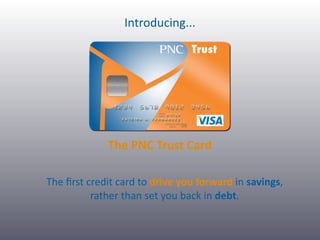
Introducing...


             The
PNC
Trust
Card

The
first
credit
card
to
drive
you
forward
in
savings,

          rather
than
set
you
back
in
debt.
But...
the
Jming
wasn’t
perfect.


 AWer
seeing
the
credit
crunch
affect

everyone
around
them,
our
first‐Jmers


  especially
don’t
trust
credit
cards.
With
the
debt
they

  already
have...


...and
the
debt
they

                              are
about
to
incur...


...there’s
a
serious
fear
of
doing
anything
on
credit.
PNC
has
a
moderate
risk

                profile,
which
means
they’re

                 stable.
They
don’t
need
to

                  screw
people
over
when

                       Jmes
are
bad.


This
makes
them
more
trustworthy
than
your

               average
bank.
Since
PNC
prides
itself
on
being
a
reliable

 bank,
they
are
the
perfect
brand
to
save

this
target
from
their
fears
and
doubts.
So

we
diagnosed
them
with
a
new
condiJon:


      SKEPTOMANIA
 ...and
posiJoned
the
PNC
Trust
card
as

               the
cure.
The
campaign
used
the
idea
of
skeptomania
to
get

           people’s
aXenJon
and
drive
awareness.


   The
TV
spot
features
a

psychiatrist
who
outlines
the

many
signs
and
symptoms
of

       skeptomania.

   The
spot
gives
a
brief

  descripJon
of
the
card,

                                 “If
you
don’t
believe
me,
you
may
have
it.”
designed
to
revitalize
trust.

The
print
and
banner
ads
give
examples
of
common

              skeptomania
symptoms.
At
cureskeptomania.com,
people
can
test

      themselves
for
skeptomania.
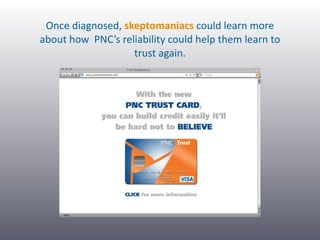
Once
diagnosed,
skeptomaniacs
could
learn
more

about
how

PNC’s
reliability
could
help
them
learn
to

                    trust
again.
For
our
goal‐oriented
target
of
first‐3mers,

we
designed
a
credit
card
that
would
drive
them

              forward
in
savings,

     and
leveraged
PNC’s
trustworthiness

  to
help
them
overcome
their
skeptomania.

Case Study: PNC Bank