“What is nutrition-sensitive
agriculture?”
From concepts to practice
How do challenges in the food systems influence
nutrition?
Animals have died
due to lack of water
and pastures
Fewer staple foods
are available for
consumption
Low dietary diversity
and insufficient
micronutrient intake
Inadequate
energy intake
Challenges in food production
Children are subject to episodic
diarrheal events and frequent
bouts of infectious disease
Reduced number of
meals and poor dietary diversity
during some
parts of the year
Challenges in food storage and processing
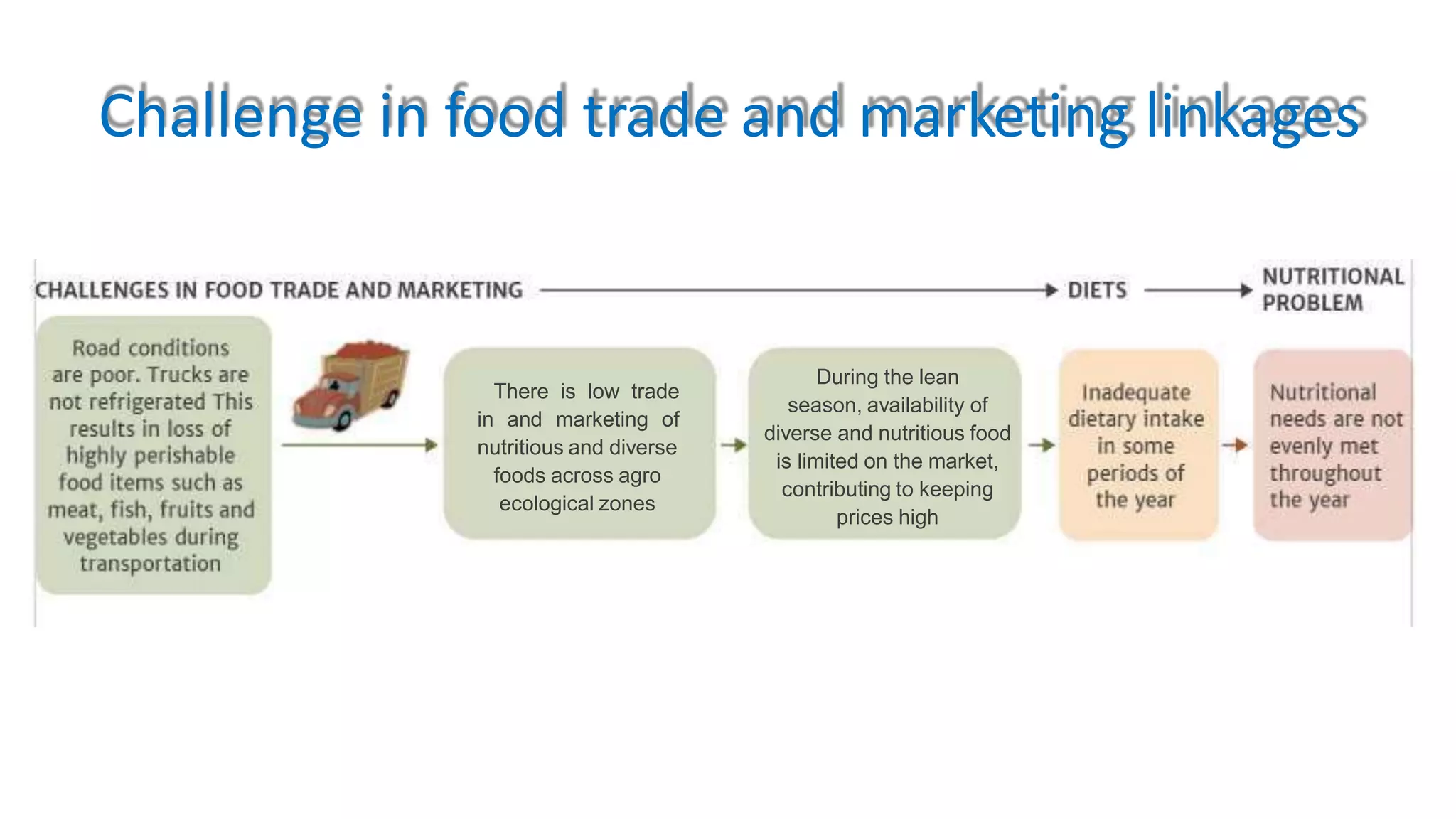
There is low trade
in and marketing of
nutritious and diverse
foods across agro
ecological zones
During the lean
season, availability of
diverse and nutritious food
is limited on the market,
contributing to keeping
prices high
Challenge in food trade and marketing linkages
Reduced expenditures for
nutritious foods and for health and
care services
The family is obliged to buy foods
during the lean season, when
prices are at their peak
Challenges in consumer demand
Inadequate infant and young child feeding.
The diet of the youngest child does not meet
his nutritional needs
Intra-household food allocation
is unequal
The family is exposed to water- and
food-borne diseases. Children are subject to
episodic diarrheal events and frequent bouts
of infectious disease
Challenge in food preparation and preferences
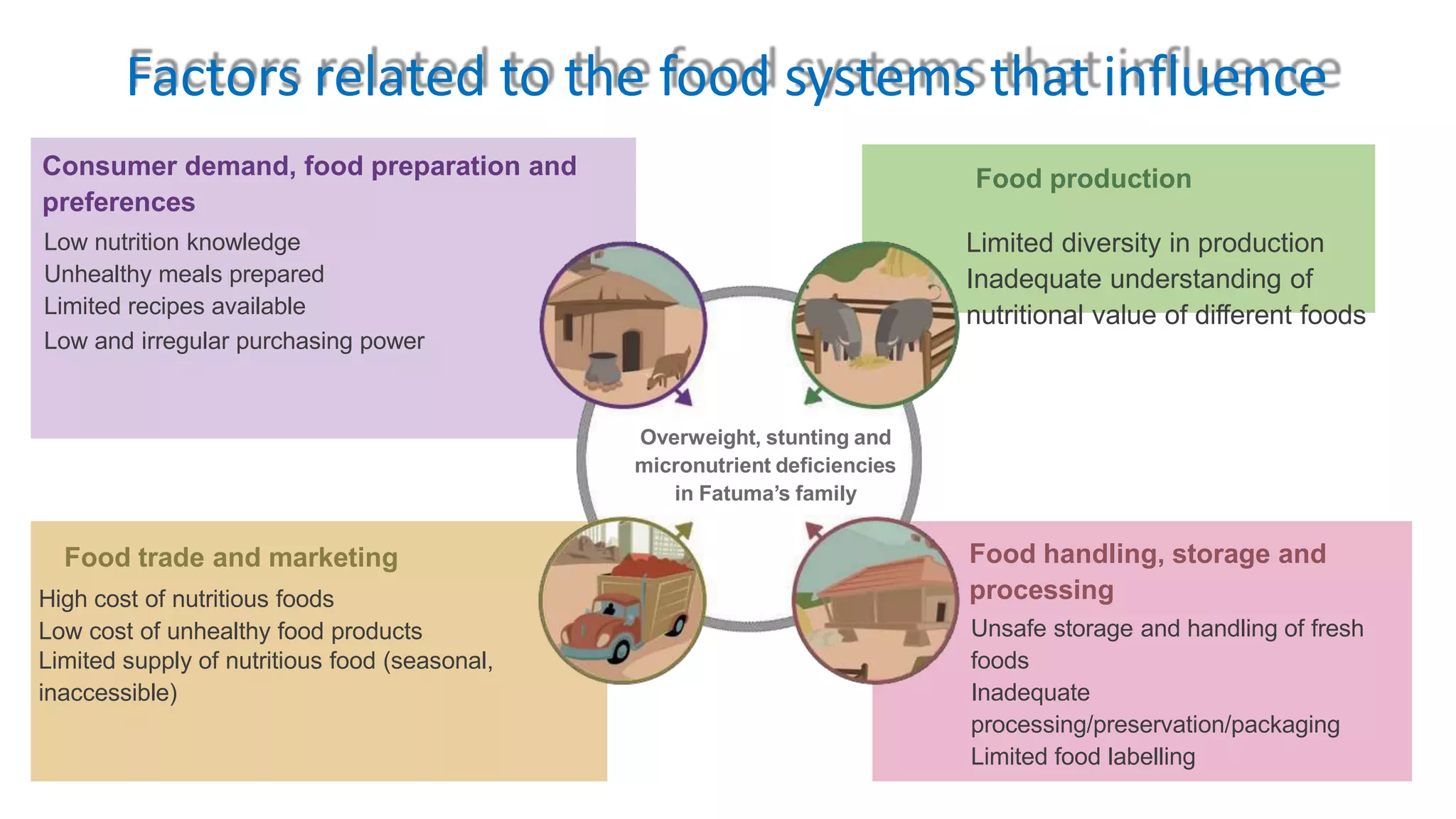
Limited diversity in production
Inadequate understanding of
nutritional value of different foods
Food productionConsumer demand, food preparation and
preferences
Low nutrition knowledge
Unhealthy meals prepared
Limited recipes available
Low and irregular purchasing power
Food trade and marketing
High cost of nutritious foods
Low cost of unhealthy food products
Limited supply of nutritious food (seasonal,
inaccessible)
Food handling, storage and
processing
Unsafe storage and handling of fresh
foods
Inadequate
processing/preservation/packaging
Limited food labelling
Overweight, stunting and
micronutrient deficiencies
in Fatuma’s family
Factors related to the food systems that influence
Nutrition is linked to many factors that go beyond food
production:
• the way the food is harvested, stored, processed, traded
and prepared is fundamental too…
• the overall context natural (water, land, environment),
economic and socio-cultural context (for example,
cultural habits and beliefs),
• But also food prices, market access etc.
need to look at the entire food system
Agriculture, food systems and people’s diets
HOW CAN AGRICULTURE AND FOOD SYSTEMS
BE NUTRITION-SENSITIVE?
Nutrition-sensitive food systems: Option for interventions
Food trade and marketing
• Trade for nutrition
• Food marketing and advertising
practices
• Food price policies for promoting
healthy diets
• Food labelling
Consumer demand, food preparation and
preferences
• Nutrition education and behaviour
change communication
• Income generation for nutrition
• Nutrition-sensitive social protection
• School Food and Nutrition
• Nutrition-sensitive humanitarian food
assistance
Food production
• Diversification and sustainable
intensification of agricultural production
• Nutrition-sensitive fisheries and
livestock
• Biodiversity for food and nutrition
• Biofortification
• Urban and periurban agriculture
Food handling, storage and processing
• Nutrition sensitive post-harvest
handling, storage and processing
• Food fortification
Interventions are organized according to the functions of the food system and as cross-cutting issues. However, many of
them relate to several functions.
Cross-cutting issues
• Nutrition-sensitive
value chains
• Food quality, safety and
hygiene
• Women’s empowerment
and gender equality
• Food loss and waste
Examples of entry points for nutrition in fish-food system:
- Small-scale integrated farming systems (e.g. rice-
fish-vegetables cultivation, aquaculture/fish ponds
targeting women)
- Urban gardening and urban fish cultivation
- School gardening combined with fish ponds as
education tool
- Community- based agriculture leveraging local
biodiversity of high nutrient value (e.g. indigenous
varieties of small fish …)
- Food quality maintenance through good post-harvest
handling supported by appropriate transport and
logistical operations
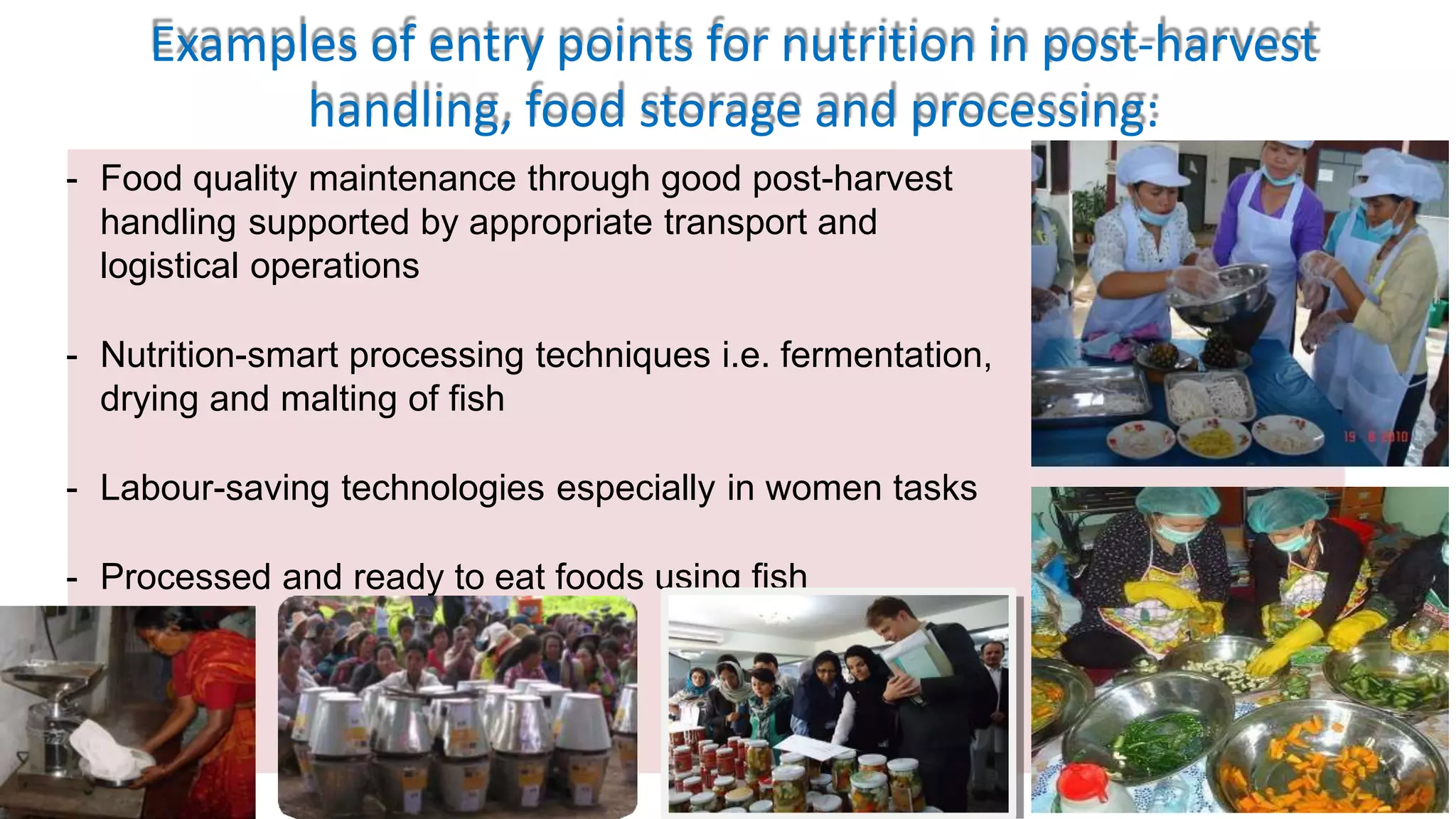
- Nutrition-smart processing techniques i.e. fermentation,
drying and malting of fish
- Labour-saving technologies especially in women tasks
- Processed and ready to eat foods using fish
Examples of entry points for nutrition in post-harvest
handling, food storage and processing:
- Nutrition & hygiene education in fisheries
programmes
- Information campaigns on healthy diets and the
role of fish in improving nutrition
- Food recipes, cooking demonstrations of proper
cooking methods
- Small –scale fish in improved complementary
feeding for infant and young children
- Healthy school meals that incorporates local
fish
Examples of entry points for nutrition in consumer
demand, food preparation and preferences
- Increase trade in fresh foods (lowering tariffs;
strengthen rural-urban linkages)
- Promote nutrition-sensitive value chain
approaches (adding value to local species and
varieties)
- Improving food composition data and linking
information with trade and marketing strategies
- Standards for clear and easy-to-read food and
nutrition labelling
Examples of entry points for nutrition in food trade and
marketing:
TOOLKIT for NUTRITION-SENSITIVE AGRICULTURE AND FOOD SYSTEMS
www.fao.org/nutrition/policies-programmes/toolkit
• Key recommendations for improving nutrition through agriculture and food
systems: 10 recommendations for designing food and agriculture programmes
in a nutrition-sensitive way; 5 recommendations for creating an enabling
environment for nutrition-sensitive food systems
• Designing nutrition-sensitive agriculture investments. Checklist and
guidance for programme formulation: Key questions, tips, and sources of
information for situation analysis, programme design, monitoring and evaluation,
in order to operationalize the Key recommendations
• Nutrition-sensitive agriculture and food systems in practice: options for
interventions: 20 interventions with the potential to improve nutrition, organised
around 4 key functions of the food system and as cross-cutting issues
• Compendium of indicators for nutrition-sensitive agriculture: Guidance on
a range of indicators for monitoring and evaluating the nutritional impacts of
agricultural investments
Series of ELEARNING MODULES
on NUTRITION-SENSITIVE AGRICULTURE AND FOOD SYSTEMS
Module 1: Nutrition, Food Security and Livelihoods: Basic concepts
www.fao.org/elearning/#/elc/en/course/NFSLBC
- addresses the basic terms and concepts related to food and nutrition, malnutrition,
food security and livelihoods.
- A prerequisite for the subsequent modules
Module 2: Improving Nutrition through Agriculture and Food systems
- illustrates the linkages between agriculture, food systems and nutrition
- provides concrete examples of opportunities for integrating nutrition into agriculture
and food system policies, investments and programmes.
To be
released
end of 2017
and 2018
Modules 3 & 4: From nutrition situation analysis to nutrition-sensitive project
design, monitoring and evaluation
- provides guidance for nutrition situation and institutional analysis
- addresses key features of design, implementation, monitoring of nutrition-sensitive
policies and programmes.
www.fao.org/nutrition/policies-programmes/elearning
Methodology for
INTEGRATED PLANNING ACROSS SECTORS FOR NUTRITION
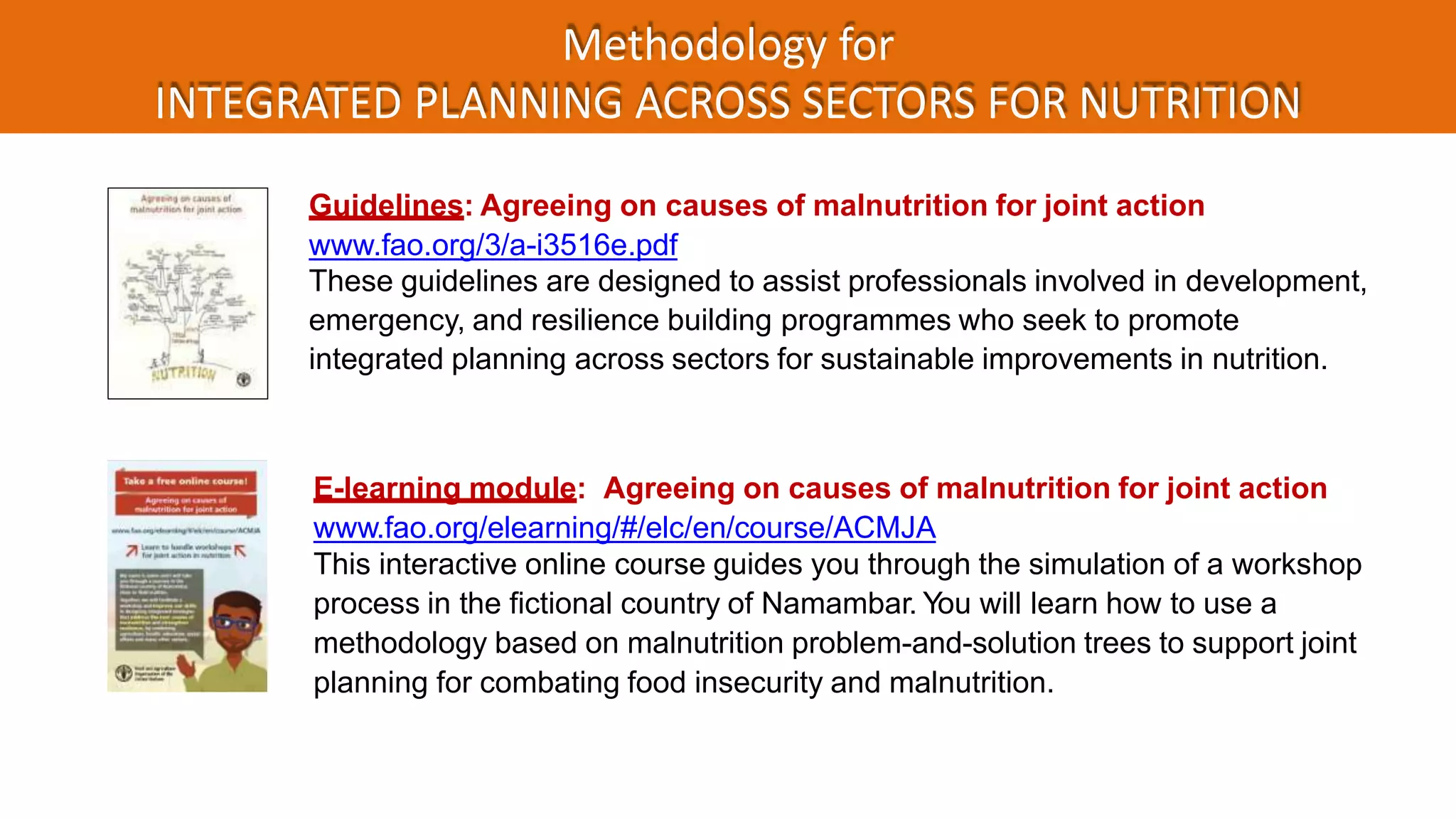
E-learning module: Agreeing on causes of malnutrition for joint action
www.fao.org/elearning/#/elc/en/course/ACMJA
This interactive online course guides you through the simulation of a workshop
process in the fictional country of Namambar. You will learn how to use a
methodology based on malnutrition problem-and-solution trees to support joint
planning for combating food insecurity and malnutrition.
Guidelines: Agreeing on causes of malnutrition for joint action
www.fao.org/3/a-i3516e.pdf
These guidelines are designed to assist professionals involved in development,
emergency, and resilience building programmes who seek to promote
integrated planning across sectors for sustainable improvements in nutrition.
With the support of many different partners, specially:
http://www.fao.org/nutrition
Nutrition and Food Systems Division,
Food and Agriculture Organization of the UN
UN Decade of Action on Nutrition -2016-2025
Decade of opportunity for all of us to join our efforts
and work together to make a difference and end
hunger and eliminate and prevent all forms of
malnutrition worldwide
20

“What is nutrition-sensitive agriculture?” From concepts to practice

  • 1.
  • 2.
    How do challengesin the food systems influence nutrition?
  • 3.
    Animals have died dueto lack of water and pastures Fewer staple foods are available for consumption Low dietary diversity and insufficient micronutrient intake Inadequate energy intake Challenges in food production
  • 4.
    Children are subjectto episodic diarrheal events and frequent bouts of infectious disease Reduced number of meals and poor dietary diversity during some parts of the year Challenges in food storage and processing
  • 5.
    There is lowtrade in and marketing of nutritious and diverse foods across agro ecological zones During the lean season, availability of diverse and nutritious food is limited on the market, contributing to keeping prices high Challenge in food trade and marketing linkages
  • 6.
    Reduced expenditures for nutritiousfoods and for health and care services The family is obliged to buy foods during the lean season, when prices are at their peak Challenges in consumer demand
  • 7.
    Inadequate infant andyoung child feeding. The diet of the youngest child does not meet his nutritional needs Intra-household food allocation is unequal The family is exposed to water- and food-borne diseases. Children are subject to episodic diarrheal events and frequent bouts of infectious disease Challenge in food preparation and preferences
  • 8.
    Limited diversity inproduction Inadequate understanding of nutritional value of different foods Food productionConsumer demand, food preparation and preferences Low nutrition knowledge Unhealthy meals prepared Limited recipes available Low and irregular purchasing power Food trade and marketing High cost of nutritious foods Low cost of unhealthy food products Limited supply of nutritious food (seasonal, inaccessible) Food handling, storage and processing Unsafe storage and handling of fresh foods Inadequate processing/preservation/packaging Limited food labelling Overweight, stunting and micronutrient deficiencies in Fatuma’s family Factors related to the food systems that influence
  • 9.
    Nutrition is linkedto many factors that go beyond food production: • the way the food is harvested, stored, processed, traded and prepared is fundamental too… • the overall context natural (water, land, environment), economic and socio-cultural context (for example, cultural habits and beliefs), • But also food prices, market access etc. need to look at the entire food system Agriculture, food systems and people’s diets
  • 10.
    HOW CAN AGRICULTUREAND FOOD SYSTEMS BE NUTRITION-SENSITIVE?
  • 11.
    Nutrition-sensitive food systems:Option for interventions Food trade and marketing • Trade for nutrition • Food marketing and advertising practices • Food price policies for promoting healthy diets • Food labelling Consumer demand, food preparation and preferences • Nutrition education and behaviour change communication • Income generation for nutrition • Nutrition-sensitive social protection • School Food and Nutrition • Nutrition-sensitive humanitarian food assistance Food production • Diversification and sustainable intensification of agricultural production • Nutrition-sensitive fisheries and livestock • Biodiversity for food and nutrition • Biofortification • Urban and periurban agriculture Food handling, storage and processing • Nutrition sensitive post-harvest handling, storage and processing • Food fortification Interventions are organized according to the functions of the food system and as cross-cutting issues. However, many of them relate to several functions. Cross-cutting issues • Nutrition-sensitive value chains • Food quality, safety and hygiene • Women’s empowerment and gender equality • Food loss and waste
  • 12.
    Examples of entrypoints for nutrition in fish-food system: - Small-scale integrated farming systems (e.g. rice- fish-vegetables cultivation, aquaculture/fish ponds targeting women) - Urban gardening and urban fish cultivation - School gardening combined with fish ponds as education tool - Community- based agriculture leveraging local biodiversity of high nutrient value (e.g. indigenous varieties of small fish …)
  • 13.
    - Food qualitymaintenance through good post-harvest handling supported by appropriate transport and logistical operations - Nutrition-smart processing techniques i.e. fermentation, drying and malting of fish - Labour-saving technologies especially in women tasks - Processed and ready to eat foods using fish Examples of entry points for nutrition in post-harvest handling, food storage and processing:
  • 14.
    - Nutrition &hygiene education in fisheries programmes - Information campaigns on healthy diets and the role of fish in improving nutrition - Food recipes, cooking demonstrations of proper cooking methods - Small –scale fish in improved complementary feeding for infant and young children - Healthy school meals that incorporates local fish Examples of entry points for nutrition in consumer demand, food preparation and preferences
  • 15.
    - Increase tradein fresh foods (lowering tariffs; strengthen rural-urban linkages) - Promote nutrition-sensitive value chain approaches (adding value to local species and varieties) - Improving food composition data and linking information with trade and marketing strategies - Standards for clear and easy-to-read food and nutrition labelling Examples of entry points for nutrition in food trade and marketing:
  • 16.
    TOOLKIT for NUTRITION-SENSITIVEAGRICULTURE AND FOOD SYSTEMS www.fao.org/nutrition/policies-programmes/toolkit • Key recommendations for improving nutrition through agriculture and food systems: 10 recommendations for designing food and agriculture programmes in a nutrition-sensitive way; 5 recommendations for creating an enabling environment for nutrition-sensitive food systems • Designing nutrition-sensitive agriculture investments. Checklist and guidance for programme formulation: Key questions, tips, and sources of information for situation analysis, programme design, monitoring and evaluation, in order to operationalize the Key recommendations • Nutrition-sensitive agriculture and food systems in practice: options for interventions: 20 interventions with the potential to improve nutrition, organised around 4 key functions of the food system and as cross-cutting issues • Compendium of indicators for nutrition-sensitive agriculture: Guidance on a range of indicators for monitoring and evaluating the nutritional impacts of agricultural investments
  • 17.
    Series of ELEARNINGMODULES on NUTRITION-SENSITIVE AGRICULTURE AND FOOD SYSTEMS Module 1: Nutrition, Food Security and Livelihoods: Basic concepts www.fao.org/elearning/#/elc/en/course/NFSLBC - addresses the basic terms and concepts related to food and nutrition, malnutrition, food security and livelihoods. - A prerequisite for the subsequent modules Module 2: Improving Nutrition through Agriculture and Food systems - illustrates the linkages between agriculture, food systems and nutrition - provides concrete examples of opportunities for integrating nutrition into agriculture and food system policies, investments and programmes. To be released end of 2017 and 2018 Modules 3 & 4: From nutrition situation analysis to nutrition-sensitive project design, monitoring and evaluation - provides guidance for nutrition situation and institutional analysis - addresses key features of design, implementation, monitoring of nutrition-sensitive policies and programmes. www.fao.org/nutrition/policies-programmes/elearning
  • 18.
    Methodology for INTEGRATED PLANNINGACROSS SECTORS FOR NUTRITION E-learning module: Agreeing on causes of malnutrition for joint action www.fao.org/elearning/#/elc/en/course/ACMJA This interactive online course guides you through the simulation of a workshop process in the fictional country of Namambar. You will learn how to use a methodology based on malnutrition problem-and-solution trees to support joint planning for combating food insecurity and malnutrition. Guidelines: Agreeing on causes of malnutrition for joint action www.fao.org/3/a-i3516e.pdf These guidelines are designed to assist professionals involved in development, emergency, and resilience building programmes who seek to promote integrated planning across sectors for sustainable improvements in nutrition.
  • 19.
    With the supportof many different partners, specially: http://www.fao.org/nutrition Nutrition and Food Systems Division, Food and Agriculture Organization of the UN
  • 20.
    UN Decade ofAction on Nutrition -2016-2025 Decade of opportunity for all of us to join our efforts and work together to make a difference and end hunger and eliminate and prevent all forms of malnutrition worldwide 20