Nutrition for all

By Jo Gamble BA (hons) Dip CNM
        MFNTP MBANT
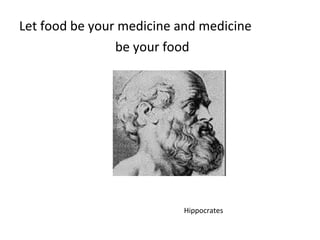
Let food be your medicine and medicine
                be your food


                          Hippocrates
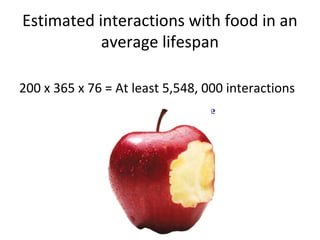
Estimated interactions with food in an
           average lifespan

200 x 365 x 76 = At least 5,548, 000 interactions
WHERE ARE WE NOW?
• The western world is becoming more obese
• Chronic disease is on the rise
• The life expectency is on the decline
• Our food supply is questionnable and laden with
  unpronounceables
• The more we know the less healthy we are.
A modern-day battle
•   Nutrient poor, calorie rich diet
•   Excessive alcohol
•   Little to no exercise
•   Exposure to toxins
•   Emotional and physical stress
•   Negative thinking
Poly-pills vs poly-meals for the poly ills
Would you like a statin with your
             burger
We are overfed and undernourished
In average western society. We eat about 70, 000 kilos of food in a lifetime.
But it was only one meal ….
• “Baseline endotoxin concentrations were
  increase significantly by 50% after a high fat
  meal”
• Endotoxins raise post-pradial for 6 hours
• What we eat can influence three future
  generations.
Phytochemical intake is associated
with decreased risk of chronic disease
•   CVD
•   Type 2 DM
•   Metabolic syndrome
•   Stroke
•   Hypertension
•   Obesity
•   Cancer
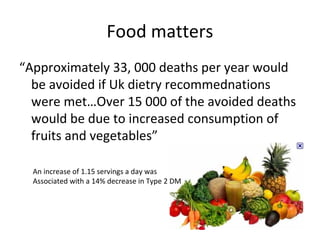
Food matters
“Approximately 33, 000 deaths per year would
  be avoided if Uk dietry recommednations
  were met…Over 15 000 of the avoided deaths
  would be due to increased consumption of
  fruits and vegetables”

  An increase of 1.15 servings a day was
  Associated with a 14% decrease in Type 2 DM
How to balance blood sugars

Eat regularly – 3 meals and 2 snacks
Protein with every meal and snack
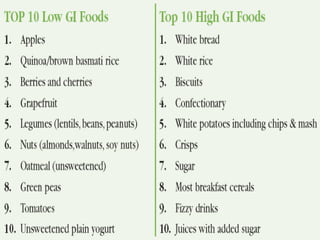
Choose low GI carbohydrates to make up ¼ of the
plate e.g. wholegrain/brown options
Avoid sugar, including hidden sugars e.g. in drinks
Avoid stimulants - Coffee, tea, energy drinks and
alcohol also disrupt blood sugar levels
Reduce stress!
Exercise
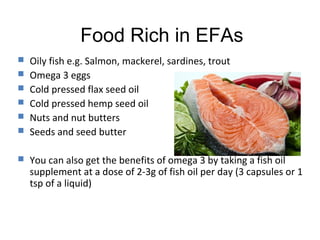
Food Rich in EFAs
   Oily fish e.g. Salmon, mackerel, sardines, trout
   Omega 3 eggs
   Cold pressed flax seed oil
   Cold pressed hemp seed oil
   Nuts and nut butters
   Seeds and seed butter

   You can also get the benefits of omega 3 by taking a fish oil
    supplement at a dose of 2-3g of fish oil per day (3 capsules or 1
    tsp of a liquid)
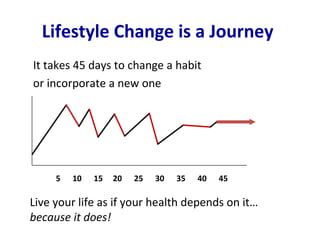
Lifestyle Change is a Journey
It takes 45 days to change a habit
or incorporate a new one


     5   10   15   20   25   30   35   40   45

Live your life as if your health depends on it…
because it does!
Set SMART Goals
Specific - goals should indicate precisely what is going to happen

Measurable - you should be able to quantify your goal

Achievable - you have to be confident that you can achieve your
  goals

Realistic - ensure that your goals are realistic and maintainable, it
  may not be beneficial to say you are going to add an extra hour
  walk every day if you realistically may not be able to stick with it

Time-bound - ensure that your goals can be achieved within a
   reasonable time frame
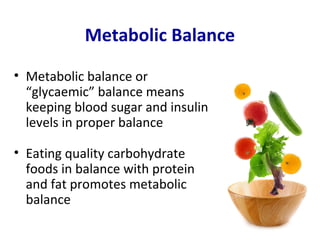
Metabolic Balance
• Metabolic balance or
  “glycaemic” balance means
  keeping blood sugar and insulin
  levels in proper balance

• Eating quality carbohydrate
  foods in balance with protein
  and fat promotes metabolic
  balance
Metabolic Imbalance:
          The Insulin Resistance Syndrome
Insulin Resistance Syndrome is   How you may benefit from
   common in many chronic          achieving metabolic
   conditions:                     balance :
     Heart disease               Prevent chronic conditions,
     Type 2 Diabetes              and therefore, the need for
     High blood pressure          medications
                                  Increase energy and vitality
     Overweight an obesity
                                   and reduce fatigue
     Sarcopenia                  Improve quality of life
     Polycystic Ovary            Reduce fat and improve
       Syndrome (PCOS)             weight control
     Acne                        Reduce appetite and
     Mood changes                 cravings
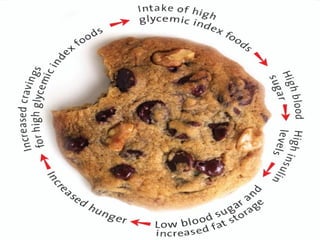
Cookie cycle
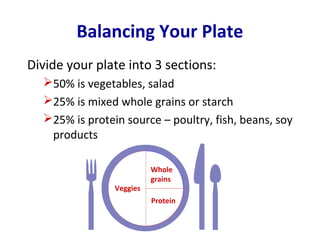
Balancing Your Plate
Divide your plate into 3 sections:
  50% is vegetables, salad
  25% is mixed whole grains or starch
  25% is protein source – poultry, fish, beans, soy
   products

                          Whole
                          grains
                Veggies
                          Protein
Why Exercise?
•   Prolongs life
•   Improves mood
•   Achieves metabolic balance
•   Promotes sustainable weight loss
•   Strengthens heart and blood vessels
•   Increases bone density
•   Boosts energy levels
•   Reduces stress and tension
•   Improves balance and flexibility
•   Improves sleep
•   Decreases risk for chronic conditions
Physical Activity Reduces Stress
Stress symptoms such as anxiety and depression can
  improve with regular exercise, and beneficial effects
  appear to equal meditation or relaxation.

People who participate in sports clubs and organised
  recreational activity enjoy better mental health, are
  more alert, and more resilient against the stresses of
  modern living.


 References; (1) Physical activity and mental health: current concepts. Sports Med.
       2000 Mar;29(3):167-80. (2) The relationship between organised physical
     recreation and mental health. Health Promot J Austr. 2007 Dec;18(3):236-9.
Ensure Adequate Rest
• Your body needs to get enough sleep (about 8
  hours) for optimal health
• Sleep deprivation leads to accelerated aging
  and increased risk for chronic disease
• Lack of sleep can make you feel tired and
  hungry reducing your ability to live a healthy
  lifestyle
Abdominal breathing
•   Find a comfortable place to sit or lie down, with your feet slightly apart, one
    hand on your abdomen near the navel, and the other hand on your chest.
•   Gently exhale the air in your lungs through your mouth, and then inhale
    slowly through your nose to the count of 4, pushing out your abdomen
    slightly and concentrating on your breath. As you breathe in, imagine warm
    air flowing all over your body. Hold the breath for a count of at least 4 but not
    more than 7.
•   Slowly exhale through your mouth while counting to 8. Gently contract your
    abdominal muscles to completely release the remaining air in the lungs.
•   Repeat until you feel deeply relaxed for a total of 5 cycles. You may be able to
    do only 1 or 2 cycles at first.
•   Once you feel comfortable with your ability to breathe into the abdomen, it is
    not necessary to use your hands on your abdomen and chest.

Practising this exercise for just 10-15 minute a day can have profound health
   benefits.
Grocery Shopping
• Be prepared
   – Plan menus

• Be organised
   – Make a list and stick to it

   – Coordinate your list with store layout
• Be label savvy
• Be a mindful shopper

       Do not shop if you are hungry!
Plan Your Menu Ahead
• Know what you’re going to eat for the week
  and where
  – How many dinners do you need to prepare?
  – How many lunches do you need to make?

• Review your food plan and recipes for meal
  suggestions and appropriate food items
• Include snacks. What will you snack on?
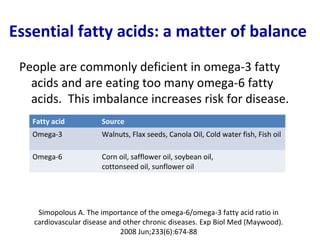
Essential fatty acids: a matter of balance
 People are commonly deficient in omega-3 fatty
   acids and are eating too many omega-6 fatty
   acids. This imbalance increases risk for disease.
   Fatty acid          Source
   Omega-3             Walnuts, Flax seeds, Canola Oil, Cold water fish, Fish oil

   Omega-6             Corn oil, safflower oil, soybean oil,
                       cottonseed oil, sunflower oil


    Simopolous A. The importance of the omega-6/omega-3 fatty acid ratio in
   cardiovascular disease and other chronic diseases. Exp Biol Med (Maywood).
                             2008 Jun;233(6):674-88
Benefits of omega-3 essential fatty acids
   Fish oils (omega-3 fatty acids) have been show
      efficacious in treating and preventing a wide range
      of diseases including:
   • Mood and behaviour
   • Dementia
   • Eye health
   • Skin Disorders
   • Cardiovascular Disease
   • Arthritis and pain
   • Autoimmune disease

   Riediger ND, Othman RA, Suh M, Moghadasian MH. A systemic review of
      the roles of n-3 fatty acids in health and disease. J Am Diet Assoc. 2009
                                  Apr;109(4):668-79.
Do you need a detox?
Symptoms associated with toxic overload
  •   Headaches
  •   Muscle aches and pains
  •   Joint pain
  •   Allergy or flu-like symptoms
  •   Chronic fatigue
  •   Irritability, mental confusion
Supporting liver function
Ensure a good supply of nutrients so the liver works
  efficiently
• Magnesium, Copper, Zinc, Vitamin C, Vitamin B
  family, Protein
Consume plenty of cruciferous vegetables, natures
  detoxifiers
• Broccoli, cabbage, bok choy, Brussels' sprouts,
  cauliflower
Consider supplementing your diet with a high quality
  milk thistle extract
• Milk thistle (Silybum marinarum)
Supporting bowel elimination
Restore healthy bacteria
• Lactobacillus acidophilus and Bifidobacterium

Consume plenty of high fibre foods
• Vegetables, fruits, whole grains, legumes

Reduce exposure to causes of “leaky gut”
• Alcohol, anti-inflammatory drugs, processed
  foods and food additives, stress
Detoxification summary
• Support the liver with nutrition and avoid
  exposure to toxic substances

• Promote the health of your digestive system
  (bowel) by eating plenty of organic fruits,
  vegetables and whole grains
• Ensure your recommended daily vegetables intake
  to alkalise your body and promote elimination
  trough the kidneys
• Consider a structured, supervised detoxification
  programme regularly
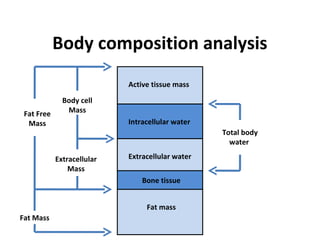
Body composition analysis
                            Active tissue mass

              Body cell
 Fat Free      Mass
  Mass                      Intracellular water
                                                  Total body
                                                    water

            Extracellular   Extracellular water
                Mass
                                Bone tissue


                                 Fat mass
Fat Mass

Nutrition For All

  • 1.
    Nutrition for all ByJo Gamble BA (hons) Dip CNM MFNTP MBANT
  • 2.
    Let food beyour medicine and medicine be your food Hippocrates
  • 4.
    Estimated interactions withfood in an average lifespan 200 x 365 x 76 = At least 5,548, 000 interactions
  • 5.
    WHERE ARE WENOW? • The western world is becoming more obese • Chronic disease is on the rise • The life expectency is on the decline • Our food supply is questionnable and laden with unpronounceables • The more we know the less healthy we are.
  • 6.
    A modern-day battle • Nutrient poor, calorie rich diet • Excessive alcohol • Little to no exercise • Exposure to toxins • Emotional and physical stress • Negative thinking
  • 7.
    Poly-pills vs poly-mealsfor the poly ills
  • 8.
    Would you likea statin with your burger
  • 9.
    We are overfedand undernourished
  • 10.
    In average westernsociety. We eat about 70, 000 kilos of food in a lifetime.
  • 11.
    But it wasonly one meal …. • “Baseline endotoxin concentrations were increase significantly by 50% after a high fat meal” • Endotoxins raise post-pradial for 6 hours • What we eat can influence three future generations.
  • 12.
    Phytochemical intake isassociated with decreased risk of chronic disease • CVD • Type 2 DM • Metabolic syndrome • Stroke • Hypertension • Obesity • Cancer
  • 13.
    Food matters “Approximately 33,000 deaths per year would be avoided if Uk dietry recommednations were met…Over 15 000 of the avoided deaths would be due to increased consumption of fruits and vegetables” An increase of 1.15 servings a day was Associated with a 14% decrease in Type 2 DM
  • 14.
    How to balanceblood sugars Eat regularly – 3 meals and 2 snacks Protein with every meal and snack Choose low GI carbohydrates to make up ¼ of the plate e.g. wholegrain/brown options Avoid sugar, including hidden sugars e.g. in drinks Avoid stimulants - Coffee, tea, energy drinks and alcohol also disrupt blood sugar levels Reduce stress! Exercise
  • 15.
    Food Rich inEFAs  Oily fish e.g. Salmon, mackerel, sardines, trout  Omega 3 eggs  Cold pressed flax seed oil  Cold pressed hemp seed oil  Nuts and nut butters  Seeds and seed butter  You can also get the benefits of omega 3 by taking a fish oil supplement at a dose of 2-3g of fish oil per day (3 capsules or 1 tsp of a liquid)
  • 16.
    Lifestyle Change isa Journey It takes 45 days to change a habit or incorporate a new one 5 10 15 20 25 30 35 40 45 Live your life as if your health depends on it… because it does!
  • 17.
    Set SMART Goals Specific- goals should indicate precisely what is going to happen Measurable - you should be able to quantify your goal Achievable - you have to be confident that you can achieve your goals Realistic - ensure that your goals are realistic and maintainable, it may not be beneficial to say you are going to add an extra hour walk every day if you realistically may not be able to stick with it Time-bound - ensure that your goals can be achieved within a reasonable time frame
  • 18.
    Metabolic Balance • Metabolicbalance or “glycaemic” balance means keeping blood sugar and insulin levels in proper balance • Eating quality carbohydrate foods in balance with protein and fat promotes metabolic balance
  • 19.
    Metabolic Imbalance: The Insulin Resistance Syndrome Insulin Resistance Syndrome is How you may benefit from common in many chronic achieving metabolic conditions: balance :  Heart disease  Prevent chronic conditions,  Type 2 Diabetes and therefore, the need for  High blood pressure medications  Increase energy and vitality  Overweight an obesity and reduce fatigue  Sarcopenia  Improve quality of life  Polycystic Ovary  Reduce fat and improve Syndrome (PCOS) weight control  Acne  Reduce appetite and  Mood changes cravings
  • 20.
  • 22.
    Balancing Your Plate Divideyour plate into 3 sections: 50% is vegetables, salad 25% is mixed whole grains or starch 25% is protein source – poultry, fish, beans, soy products Whole grains Veggies Protein
  • 23.
    Why Exercise? • Prolongs life • Improves mood • Achieves metabolic balance • Promotes sustainable weight loss • Strengthens heart and blood vessels • Increases bone density • Boosts energy levels • Reduces stress and tension • Improves balance and flexibility • Improves sleep • Decreases risk for chronic conditions
  • 24.
    Physical Activity ReducesStress Stress symptoms such as anxiety and depression can improve with regular exercise, and beneficial effects appear to equal meditation or relaxation. People who participate in sports clubs and organised recreational activity enjoy better mental health, are more alert, and more resilient against the stresses of modern living. References; (1) Physical activity and mental health: current concepts. Sports Med. 2000 Mar;29(3):167-80. (2) The relationship between organised physical recreation and mental health. Health Promot J Austr. 2007 Dec;18(3):236-9.
  • 25.
    Ensure Adequate Rest •Your body needs to get enough sleep (about 8 hours) for optimal health • Sleep deprivation leads to accelerated aging and increased risk for chronic disease • Lack of sleep can make you feel tired and hungry reducing your ability to live a healthy lifestyle
  • 26.
    Abdominal breathing • Find a comfortable place to sit or lie down, with your feet slightly apart, one hand on your abdomen near the navel, and the other hand on your chest. • Gently exhale the air in your lungs through your mouth, and then inhale slowly through your nose to the count of 4, pushing out your abdomen slightly and concentrating on your breath. As you breathe in, imagine warm air flowing all over your body. Hold the breath for a count of at least 4 but not more than 7. • Slowly exhale through your mouth while counting to 8. Gently contract your abdominal muscles to completely release the remaining air in the lungs. • Repeat until you feel deeply relaxed for a total of 5 cycles. You may be able to do only 1 or 2 cycles at first. • Once you feel comfortable with your ability to breathe into the abdomen, it is not necessary to use your hands on your abdomen and chest. Practising this exercise for just 10-15 minute a day can have profound health benefits.
  • 27.
    Grocery Shopping • Beprepared – Plan menus • Be organised – Make a list and stick to it – Coordinate your list with store layout • Be label savvy • Be a mindful shopper Do not shop if you are hungry!
  • 28.
    Plan Your MenuAhead • Know what you’re going to eat for the week and where – How many dinners do you need to prepare? – How many lunches do you need to make? • Review your food plan and recipes for meal suggestions and appropriate food items • Include snacks. What will you snack on?
  • 29.
    Essential fatty acids:a matter of balance People are commonly deficient in omega-3 fatty acids and are eating too many omega-6 fatty acids. This imbalance increases risk for disease. Fatty acid Source Omega-3 Walnuts, Flax seeds, Canola Oil, Cold water fish, Fish oil Omega-6 Corn oil, safflower oil, soybean oil, cottonseed oil, sunflower oil Simopolous A. The importance of the omega-6/omega-3 fatty acid ratio in cardiovascular disease and other chronic diseases. Exp Biol Med (Maywood). 2008 Jun;233(6):674-88
  • 30.
    Benefits of omega-3essential fatty acids Fish oils (omega-3 fatty acids) have been show efficacious in treating and preventing a wide range of diseases including: • Mood and behaviour • Dementia • Eye health • Skin Disorders • Cardiovascular Disease • Arthritis and pain • Autoimmune disease Riediger ND, Othman RA, Suh M, Moghadasian MH. A systemic review of the roles of n-3 fatty acids in health and disease. J Am Diet Assoc. 2009 Apr;109(4):668-79.
  • 31.
    Do you needa detox? Symptoms associated with toxic overload • Headaches • Muscle aches and pains • Joint pain • Allergy or flu-like symptoms • Chronic fatigue • Irritability, mental confusion
  • 32.
    Supporting liver function Ensurea good supply of nutrients so the liver works efficiently • Magnesium, Copper, Zinc, Vitamin C, Vitamin B family, Protein Consume plenty of cruciferous vegetables, natures detoxifiers • Broccoli, cabbage, bok choy, Brussels' sprouts, cauliflower Consider supplementing your diet with a high quality milk thistle extract • Milk thistle (Silybum marinarum)
  • 33.
    Supporting bowel elimination Restorehealthy bacteria • Lactobacillus acidophilus and Bifidobacterium Consume plenty of high fibre foods • Vegetables, fruits, whole grains, legumes Reduce exposure to causes of “leaky gut” • Alcohol, anti-inflammatory drugs, processed foods and food additives, stress
  • 34.
    Detoxification summary • Supportthe liver with nutrition and avoid exposure to toxic substances • Promote the health of your digestive system (bowel) by eating plenty of organic fruits, vegetables and whole grains • Ensure your recommended daily vegetables intake to alkalise your body and promote elimination trough the kidneys • Consider a structured, supervised detoxification programme regularly
  • 35.
    Body composition analysis Active tissue mass Body cell Fat Free Mass Mass Intracellular water Total body water Extracellular Extracellular water Mass Bone tissue Fat mass Fat Mass