
WEIGHT MANAGEMENT
Ryan Fernando
M.Sc. Food Biotechnology - University of Strathclyde – United Kingdom
M.Sc. Clinical Biochemistry - Goa Medical College – India.
Summary
• How to calculate your Ideal body
  weight
• How to understand fat loss and
  accelerate FAT BURNING using 5
  wonderful foods
• How to Eat and still lose weight
• Which Supplements which will help
  you jump start your metabolism
• How to ask for a blood test and what
  to do with your results
• Which exercise puts you in a secret
  FAT BURNING ZONE
• Why you will put on weight and what
  can you do to stay fit
HOW did I become Weight Challenged?

•   Binge Eating
•   Television
•   Chronic Stress
•   Lack of sleep
•   ERRACTIC Exercise patterns
•   Pregnancy
•   Age
•   Food
•   Herdity
•   Medication
•   Bad Gut
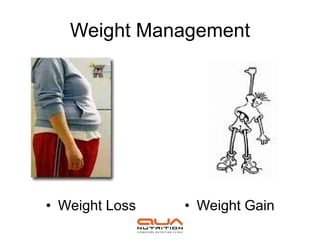
Weight Management


• Weight Loss   • Weight Gain
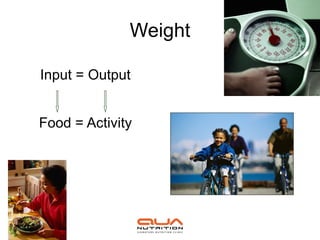
Weight

Input = Output


Food = Activity
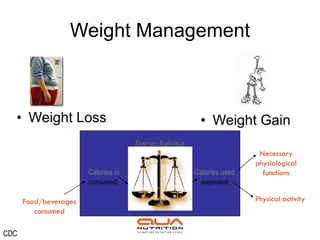
Weight Management


  • Weight Loss                                        • Weight Gain
                                     Energy Balance
                                                                       Necessary
                                                                      physiological
                       Calories in                    Calories used     functions
                       (consumed)                      (expended)

      Food/beverages                                                  Physical activity
         consumed

CDC
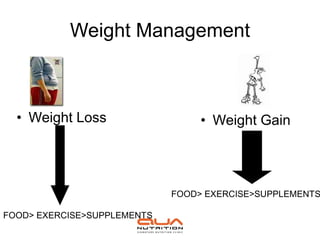
Weight Management


  • Weight Loss                   • Weight Gain


                             FOOD> EXERCISE>SUPPLEMENTS

FOOD> EXERCISE>SUPPLEMENTS
Battling Mother Nature


Our bodies fight us to regain the lost weight
  Biological and physiological mechanisms
    defend extra fat and try to return the
           body to the weight it was
Research shows that
people who have lost
 weight are hungrier
 and not just for any
        food
Weight loss signals the brain that you are
    starving and will slow metabolism
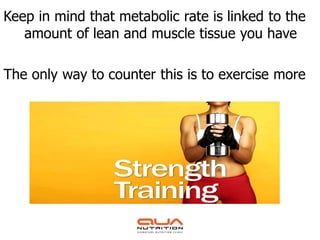
Keep in mind that metabolic rate is linked to the
   amount of lean and muscle tissue you have

The only way to counter this is to exercise more
Physical Activity

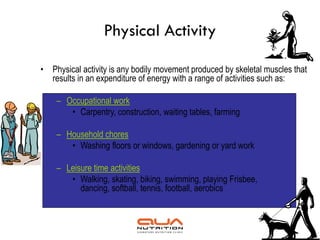
• Physical activity is any bodily movement produced by skeletal muscles that
  results in an expenditure of energy with a range of activities such as:

    – Occupational work
       • Carpentry, construction, waiting tables, farming

    – Household chores
       • Washing floors or windows, gardening or yard work

    – Leisure time activities
       • Walking, skating, biking, swimming, playing Frisbee,
          dancing, softball, tennis, football, aerobics
Increasing Physical Activity

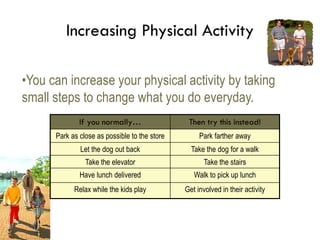
•You can increase your physical activity by taking
small steps to change what you do everyday.
               If you normally…                  Then try this instead!
       Park as close as possible to the store        Park farther away
               Let the dog out back               Take the dog for a walk
                 Take the elevator                     Take the stairs
               Have lunch delivered                Walk to pick up lunch
             Relax while the kids play          Get involved in their activity


2006
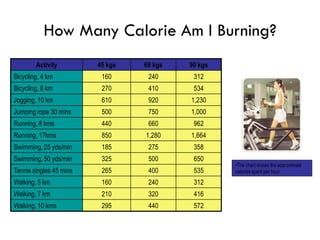
How Many Calorie Am I Burning?
        Activity         45 kgs   68 kgs   90 kgs
Bicycling, 4 km           160      240      312
Bicycling, 8 km           270      410      534
Jogging, 10 km            610      920     1,230
Jumping rope 30 mins      500      750     1,000
Running, 8 kms            440      660      962
Running, 17kms            850     1,280    1,664
Swimming, 25 yds/min      185      275      358
Swimming, 50 yds/min      325      500      650
                                                    •The chart shows the approximate
Tennis singles 45 mins    265      400      535     calories spent per hour

Walking, 5 km             160      240      312
Walking, 7 km             210      320      416
Walking, 10 kms           295      440      572
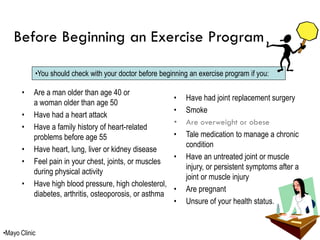
Before Beginning an Exercise Program

           •You should check with your doctor before beginning an exercise program if you:

      •    Are a man older than age 40 or
                                                          •   Have had joint replacement surgery
           a woman older than age 50
                                                          •   Smoke
      •    Have had a heart attack
                                                          •   Are overweight or obese
      •    Have a family history of heart-related
           problems before age 55                         •   Tale medication to manage a chronic
                                                              condition
      •    Have heart, lung, liver or kidney disease
                                                          •   Have an untreated joint or muscle
      •    Feel pain in your chest, joints, or muscles
                                                              injury, or persistent symptoms after a
           during physical activity
                                                              joint or muscle injury
      •    Have high blood pressure, high cholesterol,
                                                          •   Are pregnant
           diabetes, arthritis, osteoporosis, or asthma
                                                          •   Unsure of your health status.


•Mayo Clinic
Weight Loss
The key to any successful weight loss is making
   changes in your eating and physical activity
 habits that you can keep for the rest of your life.
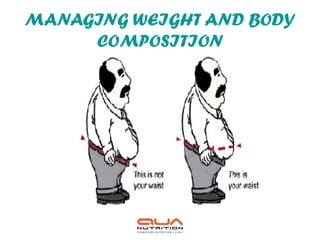
MANAGING WEIGHT AND BODY
     COMPOSITION
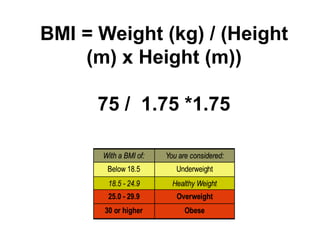
BMI = Weight (kg) / (Height
    (m) x Height (m))

      75 / 1.75 *1.75
Eating for Weight Loss
Strategy for FOODS in a Weight
          Loss Programme
• It may not be what you are eating, but
  how much that will make a difference.
  Portion size relates to the ‘energy in’
  side of the equation.
• Several supporting studies have shown that eating a
  broth type soup or low fat salad prior to the meal
  reduces calorie intake for the whole meal.
• Along with the water, the fiber in fruits and vegetables
  helps you feel fuller and has been shown to reduce
  calorie intake
Exercise + Dieting
           Calorie Deficit

•   Initially (during the first 6 months) physical activity, in combination
    with dieting, is an important component of weight loss.
•   However, after around 6 months, physical activity will not lead to
    substantially greater weight losses when combined with dieting.
•   The benefit of sustained physical activity thereafter is mainly
    through its role in the prevention of weight gain.
•   In addition, it has a benefit in reducing cardiovascular and
    diabetes risks beyond that produced by weight gain alone.
Goals for Weight Loss
                            And Management

 • The initial goal of weight loss therapy is to reduce body
   weight by approximately 10 percent from baseline.
   Once this goal is achieved, then further weight loss can be
   attempted, if necessary.
 • A reasonable time line for a 10 percent reduction in body
   weight is 6 months.
 • Experience reveals that lost weight is usually regained
   unless a weight maintenance program, consisting of diet
   therapy, physical activity and behavior therapy, is
   continued indefinitely.


   2006

•NHLBI
Goals for Weight Loss
                              And Management
•   For overweight individuals with BMIs in the typical range of 27 to 35 kg/m2, a decrease
    of 300 to 500 kcal/day will result in weight losses of about 300-500 gms per week.
•   A 10 percent weight loss could be achieved within 6 months.
•   For more severely obese individuals (BMI > 35), deficits of up to 500 to 1,000 kcal/day
    will lead to weight losses of about 750gms per week.
•   A 10 percent weight loss could be achieved within 6 months.
Without permanent change in food choices or portion
           sizes, the weight is regained

             This is the phenomenon called
                       yo-yo dieting
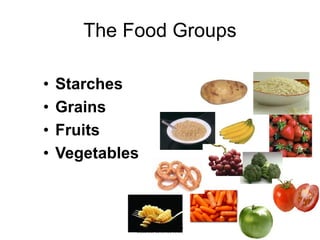
The Food Groups

•   Starches
•   Grains
•   Fruits
•   Vegetables
FOODS for Weight loss
•   Negative Calorie foods. ryan@quanutrition.com


•   Low fat Yoghurt or Curds/Milk
•   Buttermilk
•   Paneer
•   Brown Bread/Chappatis
•   Vegetables
•   Olive oil
Supplements that will Help
• Multivitamin Especially VIT B COMPLEX.
• VITAMIN C and E.
• GREEN TEA and GINGER EXTRACTs
• L – Carnitine for 6 months
• AMINO ACIDS (FREE FORM not
  PROTEIN)
• AVOID WHEY PROTEIN unless
  prescribed to to a measured calories diet
  plannning.
Weight Gain:

    Goals for Weight
Management of Weight Lost
Strategy for FOODS in a Weight
         Gain Programme
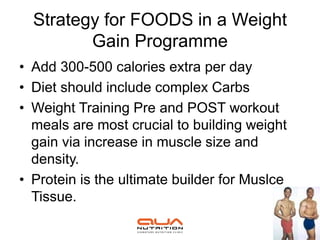
• Add 300-500 calories extra per day
• Diet should include complex Carbs
• Weight Training Pre and POST workout
  meals are most crucial to building weight
  gain via increase in muscle size and
  density.
• Protein is the ultimate builder for Muslce
  Tissue.
FOODS for Weight Gain
•   High Carbohydrates
•   High Protein
•   Essential Fatty Acids
•   Vitamin and Mineral Supplement.
•   Supplements
    – Weight Gainers
    – Protein Powders
    – Ergogenic Aids
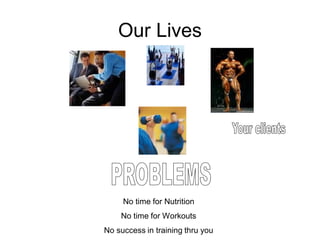
Our Lives


     No time for Nutrition
    No time for Workouts
No success in training thru you
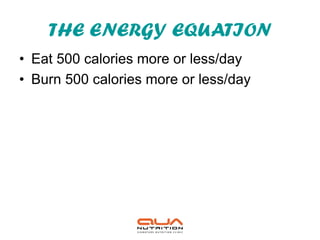
THE ENERGY EQUATION
• Eat 500 calories more or less/day
• Burn 500 calories more or less/day
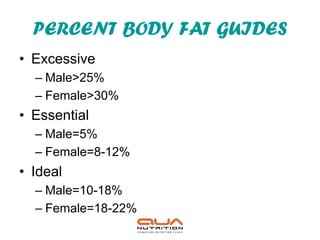
PERCENT BODY FAT GUIDES
• Excessive
  – Male>25%
  – Female>30%
• Essential
  – Male=5%
  – Female=8-12%
• Ideal
  – Male=10-18%
  – Female=18-22%
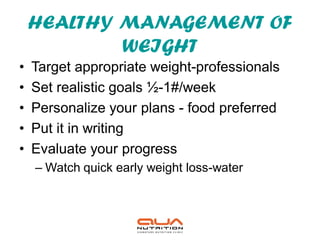
HEALTHY MANAGEMENT OF
            WEIGHT
•   Target appropriate weight-professionals
•   Set realistic goals ½-1#/week
•   Personalize your plans - food preferred
•   Put it in writing
•   Evaluate your progress
    – Watch quick early weight loss-water
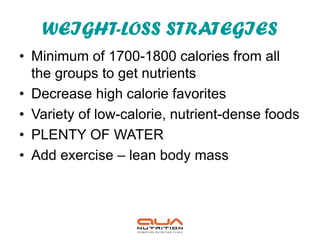
WEIGHT-LOSS STRATEGIES
• Minimum of 1700-1800 calories from all
  the groups to get nutrients
• Decrease high calorie favorites
• Variety of low-calorie, nutrient-dense foods
• PLENTY OF WATER
• Add exercise – lean body mass
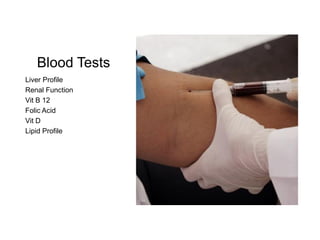
Blood Tests
Liver Profile
Renal Function
Vit B 12
Folic Acid
Vit D
Lipid Profile
WEIGHT MANAGEMENT Do it yourself Motivation and Tips

WEIGHT MANAGEMENT Do it yourself Motivation and Tips

  • 1.
    WEIGHT MANAGEMENT Ryan Fernando M.Sc.Food Biotechnology - University of Strathclyde – United Kingdom M.Sc. Clinical Biochemistry - Goa Medical College – India.
  • 2.
    Summary • How tocalculate your Ideal body weight • How to understand fat loss and accelerate FAT BURNING using 5 wonderful foods • How to Eat and still lose weight • Which Supplements which will help you jump start your metabolism • How to ask for a blood test and what to do with your results • Which exercise puts you in a secret FAT BURNING ZONE • Why you will put on weight and what can you do to stay fit
  • 3.
    HOW did Ibecome Weight Challenged? • Binge Eating • Television • Chronic Stress • Lack of sleep • ERRACTIC Exercise patterns • Pregnancy • Age • Food • Herdity • Medication • Bad Gut
  • 4.
    Weight Management • WeightLoss • Weight Gain
  • 5.
  • 6.
    Weight Management • Weight Loss • Weight Gain Energy Balance Necessary physiological Calories in Calories used functions (consumed) (expended) Food/beverages Physical activity consumed CDC
  • 7.
    Weight Management • Weight Loss • Weight Gain FOOD> EXERCISE>SUPPLEMENTS FOOD> EXERCISE>SUPPLEMENTS
  • 8.
    Battling Mother Nature Ourbodies fight us to regain the lost weight Biological and physiological mechanisms defend extra fat and try to return the body to the weight it was
  • 9.
    Research shows that peoplewho have lost weight are hungrier and not just for any food
  • 10.
    Weight loss signalsthe brain that you are starving and will slow metabolism
  • 11.
    Keep in mindthat metabolic rate is linked to the amount of lean and muscle tissue you have The only way to counter this is to exercise more
  • 12.
    Physical Activity • Physicalactivity is any bodily movement produced by skeletal muscles that results in an expenditure of energy with a range of activities such as: – Occupational work • Carpentry, construction, waiting tables, farming – Household chores • Washing floors or windows, gardening or yard work – Leisure time activities • Walking, skating, biking, swimming, playing Frisbee, dancing, softball, tennis, football, aerobics
  • 13.
    Increasing Physical Activity •Youcan increase your physical activity by taking small steps to change what you do everyday. If you normally… Then try this instead! Park as close as possible to the store Park farther away Let the dog out back Take the dog for a walk Take the elevator Take the stairs Have lunch delivered Walk to pick up lunch Relax while the kids play Get involved in their activity 2006
  • 14.
    How Many CalorieAm I Burning? Activity 45 kgs 68 kgs 90 kgs Bicycling, 4 km 160 240 312 Bicycling, 8 km 270 410 534 Jogging, 10 km 610 920 1,230 Jumping rope 30 mins 500 750 1,000 Running, 8 kms 440 660 962 Running, 17kms 850 1,280 1,664 Swimming, 25 yds/min 185 275 358 Swimming, 50 yds/min 325 500 650 •The chart shows the approximate Tennis singles 45 mins 265 400 535 calories spent per hour Walking, 5 km 160 240 312 Walking, 7 km 210 320 416 Walking, 10 kms 295 440 572
  • 17.
    Before Beginning anExercise Program •You should check with your doctor before beginning an exercise program if you: • Are a man older than age 40 or • Have had joint replacement surgery a woman older than age 50 • Smoke • Have had a heart attack • Are overweight or obese • Have a family history of heart-related problems before age 55 • Tale medication to manage a chronic condition • Have heart, lung, liver or kidney disease • Have an untreated joint or muscle • Feel pain in your chest, joints, or muscles injury, or persistent symptoms after a during physical activity joint or muscle injury • Have high blood pressure, high cholesterol, • Are pregnant diabetes, arthritis, osteoporosis, or asthma • Unsure of your health status. •Mayo Clinic
  • 18.
    Weight Loss The keyto any successful weight loss is making changes in your eating and physical activity habits that you can keep for the rest of your life.
  • 19.
    MANAGING WEIGHT ANDBODY COMPOSITION
  • 20.
    BMI = Weight(kg) / (Height (m) x Height (m)) 75 / 1.75 *1.75
  • 21.
  • 22.
    Strategy for FOODSin a Weight Loss Programme • It may not be what you are eating, but how much that will make a difference. Portion size relates to the ‘energy in’ side of the equation. • Several supporting studies have shown that eating a broth type soup or low fat salad prior to the meal reduces calorie intake for the whole meal. • Along with the water, the fiber in fruits and vegetables helps you feel fuller and has been shown to reduce calorie intake
  • 23.
    Exercise + Dieting Calorie Deficit • Initially (during the first 6 months) physical activity, in combination with dieting, is an important component of weight loss. • However, after around 6 months, physical activity will not lead to substantially greater weight losses when combined with dieting. • The benefit of sustained physical activity thereafter is mainly through its role in the prevention of weight gain. • In addition, it has a benefit in reducing cardiovascular and diabetes risks beyond that produced by weight gain alone.
  • 24.
    Goals for WeightLoss And Management • The initial goal of weight loss therapy is to reduce body weight by approximately 10 percent from baseline. Once this goal is achieved, then further weight loss can be attempted, if necessary. • A reasonable time line for a 10 percent reduction in body weight is 6 months. • Experience reveals that lost weight is usually regained unless a weight maintenance program, consisting of diet therapy, physical activity and behavior therapy, is continued indefinitely. 2006 •NHLBI
  • 25.
    Goals for WeightLoss And Management • For overweight individuals with BMIs in the typical range of 27 to 35 kg/m2, a decrease of 300 to 500 kcal/day will result in weight losses of about 300-500 gms per week. • A 10 percent weight loss could be achieved within 6 months. • For more severely obese individuals (BMI > 35), deficits of up to 500 to 1,000 kcal/day will lead to weight losses of about 750gms per week. • A 10 percent weight loss could be achieved within 6 months.
  • 26.
    Without permanent changein food choices or portion sizes, the weight is regained This is the phenomenon called yo-yo dieting
  • 27.
    The Food Groups • Starches • Grains • Fruits • Vegetables
  • 28.
    FOODS for Weightloss • Negative Calorie foods. ryan@quanutrition.com • Low fat Yoghurt or Curds/Milk • Buttermilk • Paneer • Brown Bread/Chappatis • Vegetables • Olive oil
  • 29.
    Supplements that willHelp • Multivitamin Especially VIT B COMPLEX. • VITAMIN C and E. • GREEN TEA and GINGER EXTRACTs • L – Carnitine for 6 months • AMINO ACIDS (FREE FORM not PROTEIN) • AVOID WHEY PROTEIN unless prescribed to to a measured calories diet plannning.
  • 30.
    Weight Gain: Goals for Weight Management of Weight Lost
  • 31.
    Strategy for FOODSin a Weight Gain Programme • Add 300-500 calories extra per day • Diet should include complex Carbs • Weight Training Pre and POST workout meals are most crucial to building weight gain via increase in muscle size and density. • Protein is the ultimate builder for Muslce Tissue.
  • 32.
    FOODS for WeightGain • High Carbohydrates • High Protein • Essential Fatty Acids • Vitamin and Mineral Supplement. • Supplements – Weight Gainers – Protein Powders – Ergogenic Aids
  • 33.
    Our Lives No time for Nutrition No time for Workouts No success in training thru you
  • 34.
    THE ENERGY EQUATION •Eat 500 calories more or less/day • Burn 500 calories more or less/day
  • 35.
    PERCENT BODY FATGUIDES • Excessive – Male>25% – Female>30% • Essential – Male=5% – Female=8-12% • Ideal – Male=10-18% – Female=18-22%
  • 36.
    HEALTHY MANAGEMENT OF WEIGHT • Target appropriate weight-professionals • Set realistic goals ½-1#/week • Personalize your plans - food preferred • Put it in writing • Evaluate your progress – Watch quick early weight loss-water
  • 37.
    WEIGHT-LOSS STRATEGIES • Minimumof 1700-1800 calories from all the groups to get nutrients • Decrease high calorie favorites • Variety of low-calorie, nutrient-dense foods • PLENTY OF WATER • Add exercise – lean body mass
  • 38.
    Blood Tests Liver Profile RenalFunction Vit B 12 Folic Acid Vit D Lipid Profile