Nutrition 101
Getting you started on the journey
to healthy eating
The Macronutrients
• Carbohydrates
• Proteins
• Fats
• What are they?
• Why do I need them?
• How much do I need?
The Macronutrients
Overview
Carbs (45-65%)
Fats (20-35%)
Protein (15-35%)
Carbohydrates
• What are they?
– Used by the body to make glucose – bodies fuel to keep
everything running
– Can be found in:
• Fruits
• Vegetables
• Breads, cereals and other grains
• Milk and milk products
• Foods with added sugars
4
Calories
/ Gram
Carbohydrates
• Types of Carbohydrates
– Sugar – SimpleCarb
– Starch – Complex Carb
– Fibre – Complex Carb
Carbohydrates
• Sugar
– Adds sweetness to foods
– Simplest form of carb (glucose, fructose, etc.)
– Fastest food to be metabolized by the body
– Glycemic Index = 100
– Names sugar hides by:
•Brown sugar •Corn sweetener •Corn syrup •Dextrose
•Fructose •Glucose •High-fructose corn syrup •Honey
•Invert sugar •Lactose •Maltose •Malt Syrup
•Molasses •Raw sugar •Sucrose •Syrup
Carbohydrates
• Sugars
GOOD?
or
BAD?


Moderation
Carbohydrates
• Starch
– Mainly made of glucose, joined to form a
polysaccharide
– Produced by plants
– Mainly found in potatoes, wheat, rice, etc.
– Metabolized slower than sugar
– Glycemic Index = Potato, baked with skin - 69
= Rice, long grain, white - 76
Carbohydrates
• Starches
GOOD?
or
BAD?


Better that
sugars
Carbohydrates
• Fibre
– Ingestible portion of plant food
– TwoTypes:
• Soluable – found in oatmeal, oat bran, nuts, seeds
• Insoluable – Whole wheat bread, couscous, most
vegetables, fruits
– Both fibres are good, as long as you are getting
enough of each
– How Much? Male – 28-34 g Female – 22-28 g
Carbohydrates
• Fibres
GOOD?
or
BAD?

Proteins
• What are Proteins?
– Part of all tissue in our body (cell, etc.)
– Constantly broken down and rebuilt in our body
– Found in meats, legumes,
tofu, eggs, milk, etc.
4
Calories
/ Gram
Proteins
• Made of Amino Acids – some our body can produce,
some it can’t – labeled ESSENTIAL
• COMPLETE – provides all essential amino acids
– Meat, milk, eggs, cheese
• INCOMPLETE – does not provide all essential amino
acids, therefore must be combined with
complimentary proteins to complete
– Rice, dry beans, some vegetables
Proteins
• How Much Should I Have?
• Men – 0.8g/kg/day
• Women – 0.8g/kg/day
• Should I eat MORE protein if I workout?
• Slightly, but remember, unused protein converts to FAT!
• Try to stay with proteins you eat (ie – meats, beans, etc.) as
opposed to supplements (Whey) as there is a greater
potential to consume too much this way.
Proteins
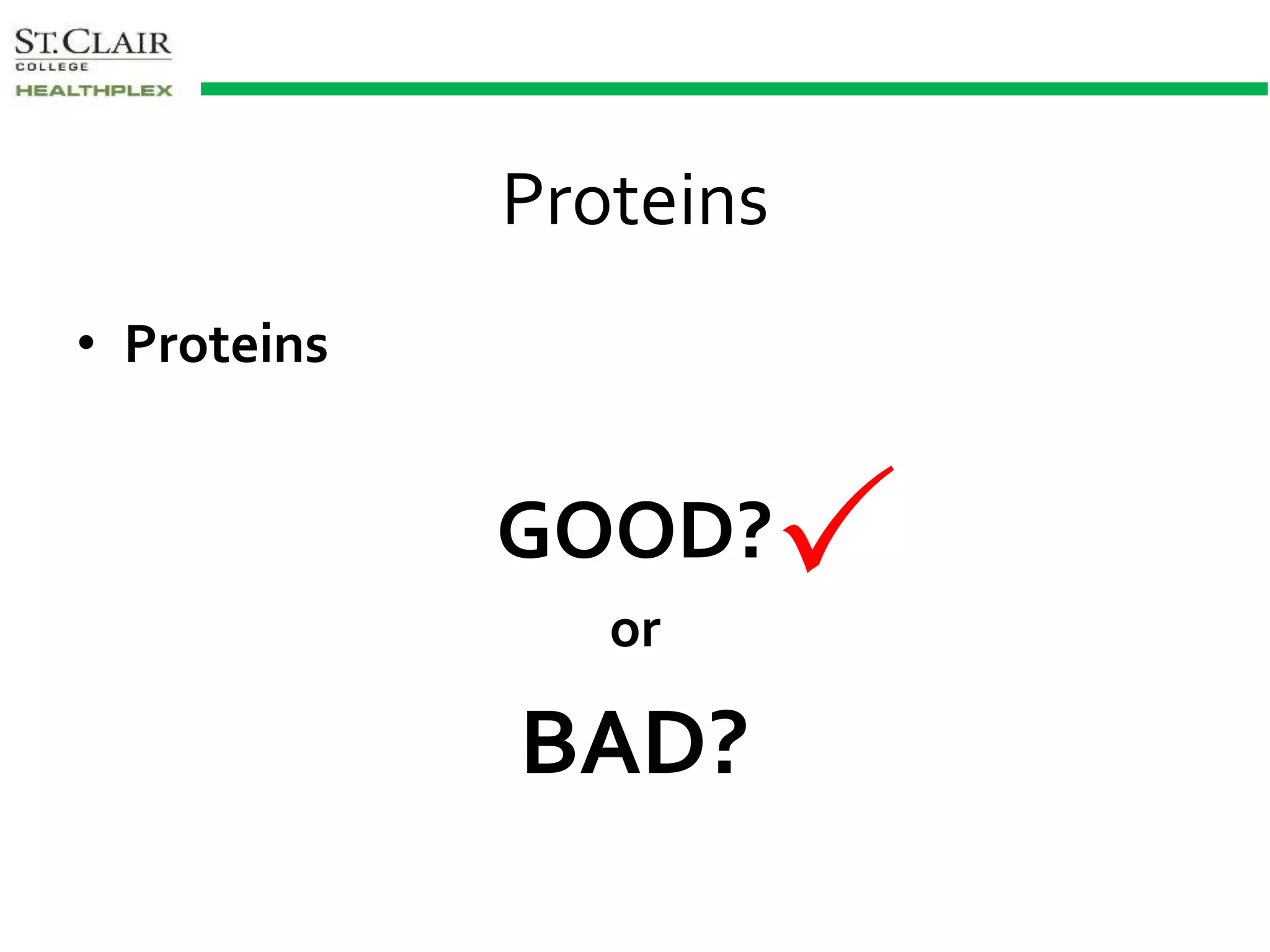
• Proteins
GOOD?
or
BAD?

Fats
• What are Fats?
– Animal product
– Used to add flavour to foods
• Types:
– Trans Fats
– Saturated Fats
– Cholesterol
– Poly & Monounsaturated fats
9
Calories
/ Gram
Fats
Cholesterol:
• 2 types:
– HDL – good, helps to clear arteries, body
naturally produces
– LDL – bad, clogs arteries – found in foods
containing trans and saturated fats
Fats
Trans Fats:
• 2 types:
– Naturally Occurring – in fatty parts of meats, etc.
– Artificially Occurring – foods that contain partially
hydrogenated oil (a man made substance)
• Be sure to read the ingredient list!
Fats
• Trans Fats
GOOD?
or
BAD? 
Fats
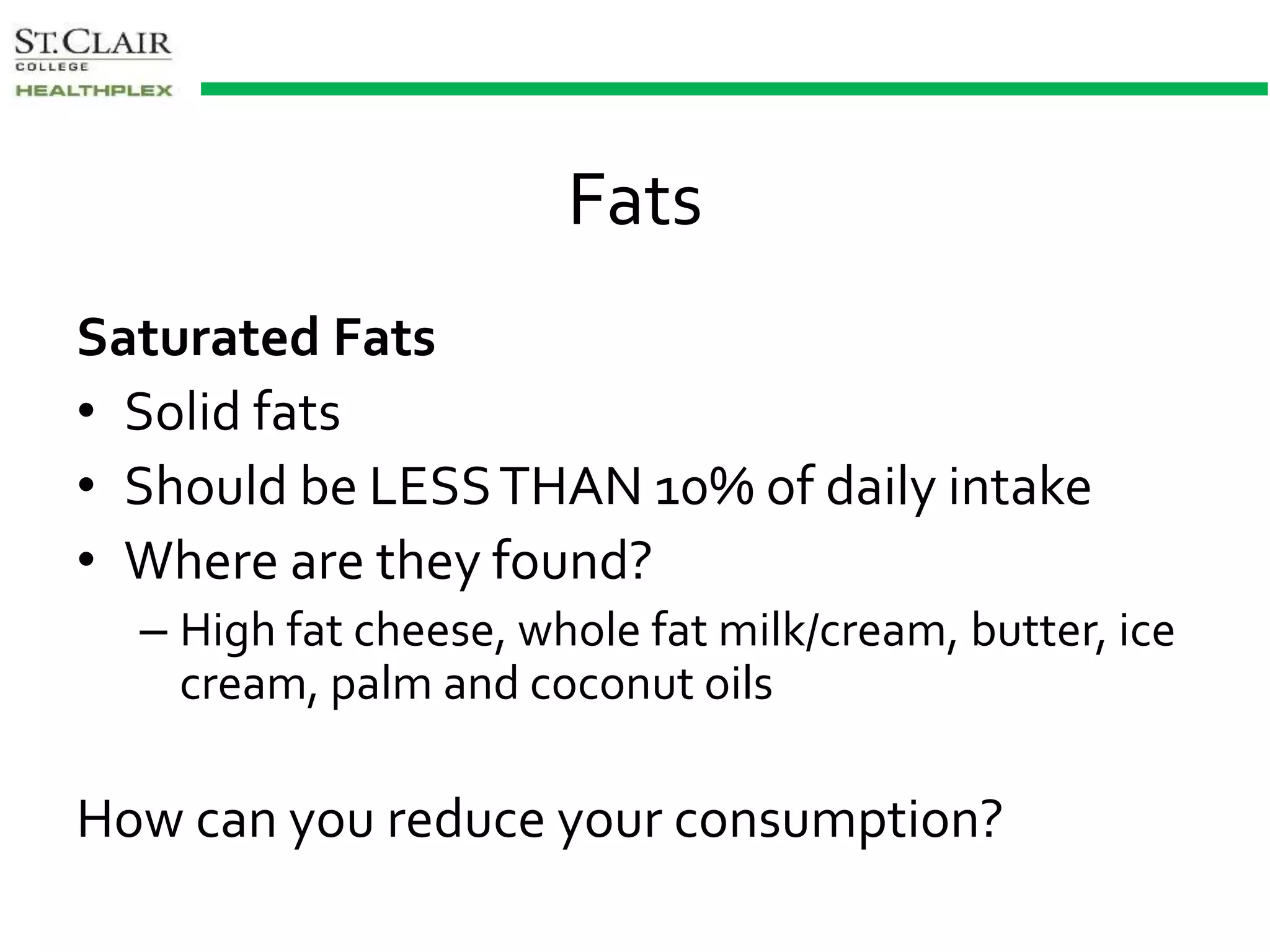
Saturated Fats
• Solid fats
• Should be LESSTHAN 10% of daily intake
• Where are they found?
– High fat cheese, whole fat milk/cream, butter, ice
cream, palm and coconut oils
How can you reduce your consumption?
Fats
• Saturated Fats
GOOD?
or
BAD? 
Fats
Poly & Monounsaturated Fats
• Liquid at room temperature
• 3 types:
– Mono – nuts, oil (vegetable, canola, etc.) avacado
– Omega-6 Poly – oil (soybean, corn, safflower)
– Omega-3 Poly – walnuts, flax seed, fish
– Omegas provide essential fatty acid
Fats
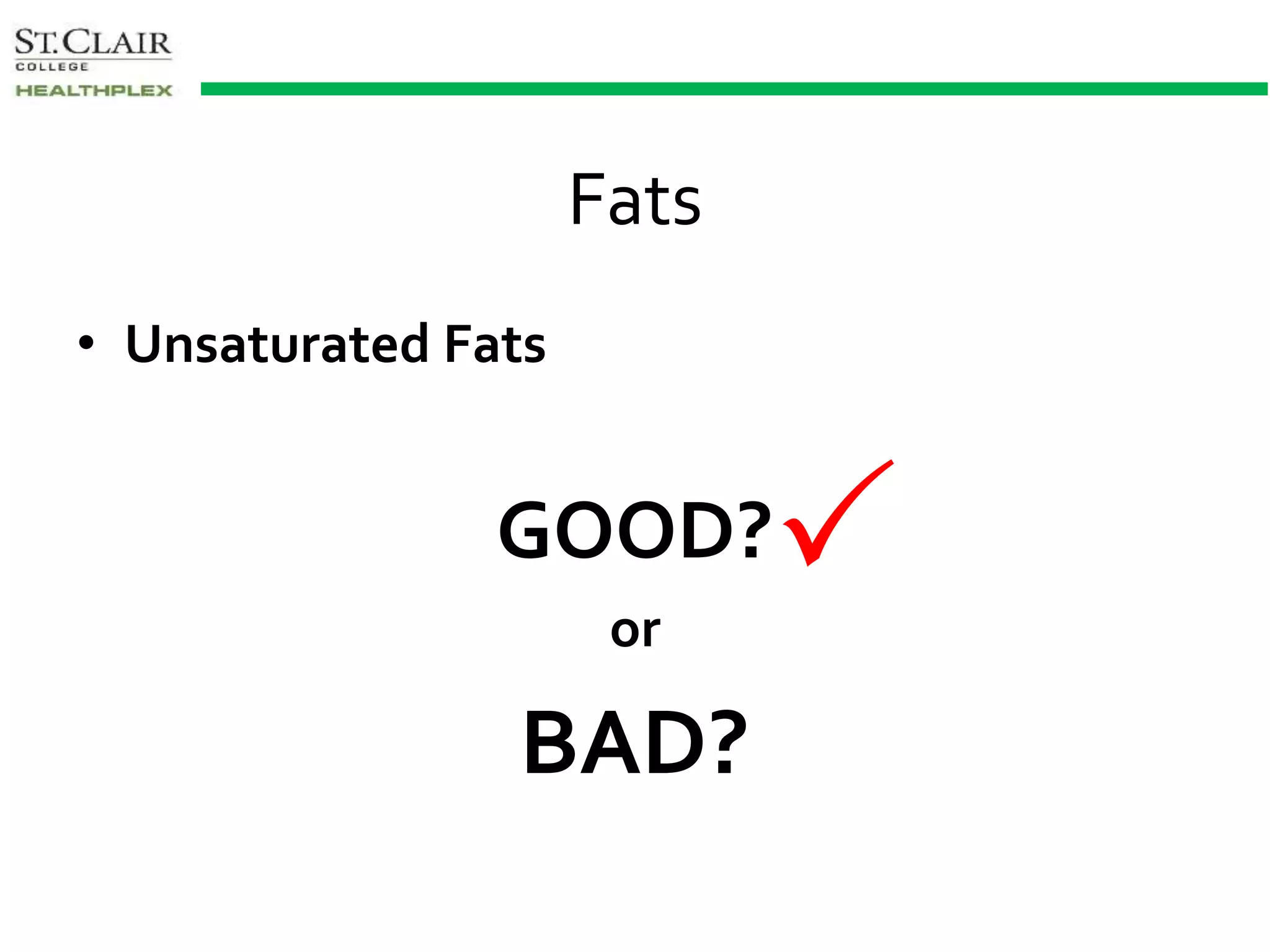
• Unsaturated Fats
GOOD?
or
BAD?

Fats
What are Omega Fats?
• Refers to the make up of the fatty acid
– Omega 6 = first double bond between 6th and 7th carbon atoms
– Omega 3 = first double bond between 3rd and 4th carbon atoms
Is one better?
– Research has shown Omega 3 to have anti-inflammatory
benefits to help prevent heart disease, while Omega 6 lowers
blood cholesterol and supports the skin
Food Labels
Activity
• Using your food label, calculate:
– Calories coming from Fat, Carbs and Protein
– Rate your food – Good, Bad, Ugly
– Fat = 9 Cal/Gram
– Carb & Pro = 4 Cal/Gram
– Fibre – 0 Cal/Gram
BUT – be sure to read the label!
Questions

Nutrition 101 Workshop

  • 1.
    Nutrition 101 Getting youstarted on the journey to healthy eating
  • 2.
    The Macronutrients • Carbohydrates •Proteins • Fats • What are they? • Why do I need them? • How much do I need?
  • 3.
  • 4.
    Carbohydrates • What arethey? – Used by the body to make glucose – bodies fuel to keep everything running – Can be found in: • Fruits • Vegetables • Breads, cereals and other grains • Milk and milk products • Foods with added sugars 4 Calories / Gram
  • 5.
    Carbohydrates • Types ofCarbohydrates – Sugar – SimpleCarb – Starch – Complex Carb – Fibre – Complex Carb
  • 6.
    Carbohydrates • Sugar – Addssweetness to foods – Simplest form of carb (glucose, fructose, etc.) – Fastest food to be metabolized by the body – Glycemic Index = 100 – Names sugar hides by: •Brown sugar •Corn sweetener •Corn syrup •Dextrose •Fructose •Glucose •High-fructose corn syrup •Honey •Invert sugar •Lactose •Maltose •Malt Syrup •Molasses •Raw sugar •Sucrose •Syrup
  • 7.
  • 8.
    Carbohydrates • Starch – Mainlymade of glucose, joined to form a polysaccharide – Produced by plants – Mainly found in potatoes, wheat, rice, etc. – Metabolized slower than sugar – Glycemic Index = Potato, baked with skin - 69 = Rice, long grain, white - 76
  • 9.
  • 10.
    Carbohydrates • Fibre – Ingestibleportion of plant food – TwoTypes: • Soluable – found in oatmeal, oat bran, nuts, seeds • Insoluable – Whole wheat bread, couscous, most vegetables, fruits – Both fibres are good, as long as you are getting enough of each – How Much? Male – 28-34 g Female – 22-28 g
  • 11.
  • 12.
    Proteins • What areProteins? – Part of all tissue in our body (cell, etc.) – Constantly broken down and rebuilt in our body – Found in meats, legumes, tofu, eggs, milk, etc. 4 Calories / Gram
  • 13.
    Proteins • Made ofAmino Acids – some our body can produce, some it can’t – labeled ESSENTIAL • COMPLETE – provides all essential amino acids – Meat, milk, eggs, cheese • INCOMPLETE – does not provide all essential amino acids, therefore must be combined with complimentary proteins to complete – Rice, dry beans, some vegetables
  • 14.
    Proteins • How MuchShould I Have? • Men – 0.8g/kg/day • Women – 0.8g/kg/day • Should I eat MORE protein if I workout? • Slightly, but remember, unused protein converts to FAT! • Try to stay with proteins you eat (ie – meats, beans, etc.) as opposed to supplements (Whey) as there is a greater potential to consume too much this way.
  • 15.
  • 16.
    Fats • What areFats? – Animal product – Used to add flavour to foods • Types: – Trans Fats – Saturated Fats – Cholesterol – Poly & Monounsaturated fats 9 Calories / Gram
  • 17.
    Fats Cholesterol: • 2 types: –HDL – good, helps to clear arteries, body naturally produces – LDL – bad, clogs arteries – found in foods containing trans and saturated fats
  • 18.
    Fats Trans Fats: • 2types: – Naturally Occurring – in fatty parts of meats, etc. – Artificially Occurring – foods that contain partially hydrogenated oil (a man made substance) • Be sure to read the ingredient list!
  • 19.
  • 20.
    Fats Saturated Fats • Solidfats • Should be LESSTHAN 10% of daily intake • Where are they found? – High fat cheese, whole fat milk/cream, butter, ice cream, palm and coconut oils How can you reduce your consumption?
  • 21.
  • 22.
    Fats Poly & MonounsaturatedFats • Liquid at room temperature • 3 types: – Mono – nuts, oil (vegetable, canola, etc.) avacado – Omega-6 Poly – oil (soybean, corn, safflower) – Omega-3 Poly – walnuts, flax seed, fish – Omegas provide essential fatty acid
  • 23.
  • 24.
    Fats What are OmegaFats? • Refers to the make up of the fatty acid – Omega 6 = first double bond between 6th and 7th carbon atoms – Omega 3 = first double bond between 3rd and 4th carbon atoms Is one better? – Research has shown Omega 3 to have anti-inflammatory benefits to help prevent heart disease, while Omega 6 lowers blood cholesterol and supports the skin
  • 25.
  • 26.
    Activity • Using yourfood label, calculate: – Calories coming from Fat, Carbs and Protein – Rate your food – Good, Bad, Ugly – Fat = 9 Cal/Gram – Carb & Pro = 4 Cal/Gram – Fibre – 0 Cal/Gram
  • 27.
    BUT – besure to read the label!
  • 28.

Editor's Notes

  • #3 What we are going to cover.
  • #4 45-60% of your day should come from carbs 20-35% from fats (no more that 10% from bad fats) 15-35% from proteins
  • #26 Cal from Fat? 297 % from Fat? 52.8 %