AWARENESS
MADE BY
 POOJA
 RAKHSHAN
 ROHIT
 LAKKI
 PALLAVI
OBJECTIVES
 DISTINGUISH AMONG SIX TYPES OF NUTRITIENTS
 IDENTIFY EACH TYPE OF NUTRITIENTS
 EXPLAIN THE VALUE OF NUTRITIENTS
 NUTRITIONAL DEFICIENCIES
 NUTRITIONAL AWARENESS AMONG YOUNG CONSUMERS
 MALNUTRITION IN INDIA
WHY WE NEED
NUTRIENTS? Nutritional awareness is spreading among thousands of people all over the
globe. People are talking about nutritional supplements, health foods, vitamins
and minerals, and astonishing herbs. People are realizing to take their own
responsibility for their own well-being, and the result is a greater need for
nutritional information.
 Good nutrition is an important part of leading a healthy lifestyle. Combined
with physical activity, your diet can help you to reach and maintain a healthy
weight, reduce your risk of chronic diseases (like heart disease and cancer),
and promote your overall health.
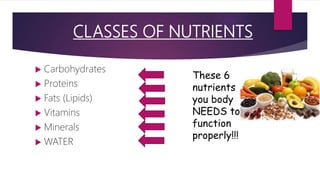
CLASSES OF NUTRIENTS
 Carbohydrates
 Proteins
 Fats (Lipids)
 Vitamins
 Minerals
 WATER
These 6
nutrients
you body
NEEDS to
function
properly!!!
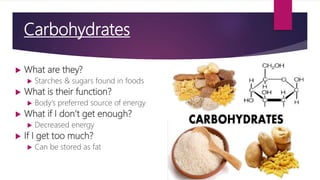
Carbohydrates
 What are they?
 Starches & sugars found in foods
 What is their function?
 Body’s preferred source of energy
 What if I don’t get enough?
 Decreased energy
 If I get too much?
 Can be stored as fat
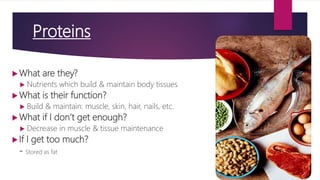
Proteins
 What are they?
 Nutrients which build & maintain body tissues
 What is their function?
 Build & maintain: muscle, skin, hair, nails, etc.
 What if I don’t get enough?
 Decrease in muscle & tissue maintenance
 If I get too much?
- Stored as fat
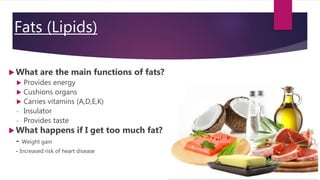
Fats (Lipids)
 What are the main functions of fats?
 Provides energy
 Cushions organs
 Carries vitamins (A,D,E,K)
- Insulator
- Provides taste
 What happens if I get too much fat?
- Weight gain
- Increased risk of heart disease
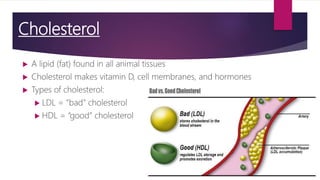
Cholesterol
 A lipid (fat) found in all animal tissues
 Cholesterol makes vitamin D, cell membranes, and hormones
 Types of cholesterol:
 LDL = “bad” cholesterol
 HDL = “good” cholesterol
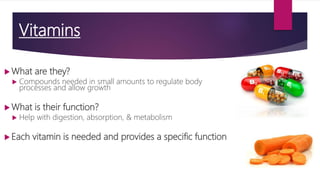
Vitamins
 What are they?
 Compounds needed in small amounts to regulate body
processes and allow growth
 What is their function?
 Help with digestion, absorption, & metabolism
 Each vitamin is needed and provides a specific function
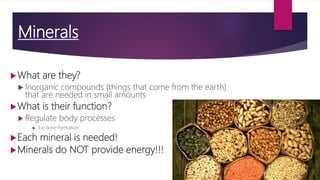
Minerals
What are they?
 Inorganic compounds (things that come from the earth)
that are needed in small amounts
What is their function?
 Regulate body processes
 Ex) bone formation
Each mineral is needed!
Minerals do NOT provide energy!!!
Water
 What are the main functions of water?
 Transports nutrients
 Carries away wastes
 Moistens eyes, mouth, nose; hydrates skin
 Forms main component of body fluids
 Acts as an insulator
 Protects against heat exhaustion
 Lubricates joints
 Helps with digestion
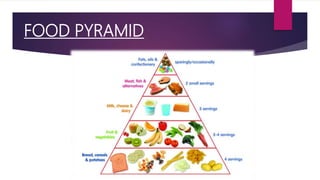
FOOD PYRAMID
NUTRIENT DEFICIENCIES
1. IRON DEFICIENCY
2. IODINE DEFICIENCY
3. VITAMIN D DEFICIENCY
4. VITAMIN B12 DEFICIENCY
5. CALCIUM DEFICIENCY
6. VITAMIN A DEFICIENCY
7. MAGNESIUM DEFICIENCY
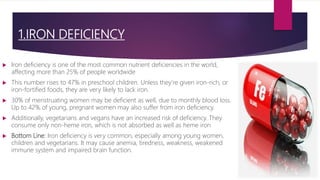
1.IRON DEFICIENCY
 Iron deficiency is one of the most common nutrient deficiencies in the world,
affecting more than 25% of people worldwide
 This number rises to 47% in preschool children. Unless they’re given iron-rich, or
iron-fortified foods, they are very likely to lack iron.
 30% of menstruating women may be deficient as well, due to monthly blood loss.
Up to 42% of young, pregnant women may also suffer from iron deficiency.
 Additionally, vegetarians and vegans have an increased risk of deficiency. They
consume only non-heme iron, which is not absorbed as well as heme iron
 Bottom Line: Iron deficiency is very common, especially among young women,
children and vegetarians. It may cause anemia, tiredness, weakness, weakened
immune system and impaired brain function.
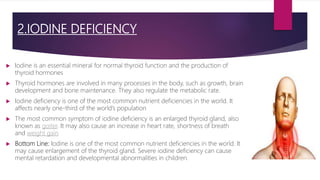
2.IODINE DEFICIENCY
 Iodine is an essential mineral for normal thyroid function and the production of
thyroid hormones
 Thyroid hormones are involved in many processes in the body, such as growth, brain
development and bone maintenance. They also regulate the metabolic rate.
 Iodine deficiency is one of the most common nutrient deficiencies in the world. It
affects nearly one-third of the world’s population
 The most common symptom of iodine deficiency is an enlarged thyroid gland, also
known as goiter. It may also cause an increase in heart rate, shortness of breath
and weight gain
 Bottom Line: Iodine is one of the most common nutrient deficiencies in the world. It
may cause enlargement of the thyroid gland. Severe iodine deficiency can cause
mental retardation and developmental abnormalities in children.
3.VITAMIN D DEFICIENCY
 Vitamin D is a fat-soluble vitamin that works like a steroid hormone in the body.
 It travels through the bloodstream and into cells, telling them to turn genes on or
off.Almost every cell in the body has a receptor for vitamin D.
 Vitamin D is produced out of cholesterol in the skin when it is exposed to sunlight
 In the US, about 42% of people may be vitamin D deficient. This number rises to 74% in
the elderly and 82% in people with dark skin, since their skin produces less vitamin D in
response to sunlight
 Adults who are deficient in vitamin D may experience muscle weakness, bone loss and
increased risk of fractures. In children, it may cause growth delays and soft bones
(rickets)
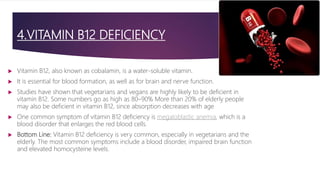
4.VITAMIN B12 DEFICIENCY
 Vitamin B12, also known as cobalamin, is a water-soluble vitamin.
 It is essential for blood formation, as well as for brain and nerve function.
 Studies have shown that vegetarians and vegans are highly likely to be deficient in
vitamin B12. Some numbers go as high as 80–90% More than 20% of elderly people
may also be deficient in vitamin B12, since absorption decreases with age
 One common symptom of vitamin B12 deficiency is megaloblastic anemia, which is a
blood disorder that enlarges the red blood cells.
 Bottom Line: Vitamin B12 deficiency is very common, especially in vegetarians and the
elderly. The most common symptoms include a blood disorder, impaired brain function
and elevated homocysteine levels.
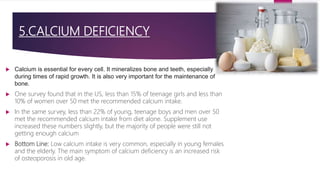
5.CALCIUM DEFICIENCY
 Calcium is essential for every cell. It mineralizes bone and teeth, especially
during times of rapid growth. It is also very important for the maintenance of
bone.
 One survey found that in the US, less than 15% of teenage girls and less than
10% of women over 50 met the recommended calcium intake.
 In the same survey, less than 22% of young, teenage boys and men over 50
met the recommended calcium intake from diet alone. Supplement use
increased these numbers slightly, but the majority of people were still not
getting enough calcium
 Bottom Line: Low calcium intake is very common, especially in young females
and the elderly. The main symptom of calcium deficiency is an increased risk
of osteoporosis in old age.
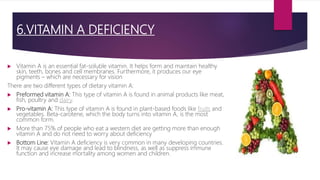
6.VITAMIN A DEFICIENCY
 Vitamin A is an essential fat-soluble vitamin. It helps form and maintain healthy
skin, teeth, bones and cell membranes. Furthermore, it produces our eye
pigments – which are necessary for vision
There are two different types of dietary vitamin A:
 Preformed vitamin A: This type of vitamin A is found in animal products like meat,
fish, poultry and dairy.
 Pro-vitamin A: This type of vitamin A is found in plant-based foods like fruits and
vegetables. Beta-carotene, which the body turns into vitamin A, is the most
common form.
 More than 75% of people who eat a western diet are getting more than enough
vitamin A and do not need to worry about deficiency
 Bottom Line: Vitamin A deficiency is very common in many developing countries.
It may cause eye damage and lead to blindness, as well as suppress immune
function and increase mortality among women and children.
7.MAGNESIUM DEFICIENCY
 Magnesium is a key mineral in the body. It is essential for bone and teeth
structure, and is also involved in more than 300 enzyme reactions.
 Almost half of the US population (48%) consumed less than the required
amount of magnesium in 2005-2006
 Low intake and blood levels of magnesium have been associated with several
diseases, including type 2 diabetes, metabolic syndrome, heart disease and
osteoporosis
 The main symptoms of severe magnesium deficiency include abnormal heart
rhythm, muscle cramps, restless leg syndrome, fatigue and migraines
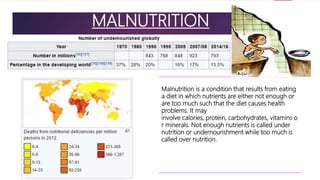
MALNUTRITION
Malnutrition is a condition that results from eating
a diet in which nutrients are either not enough or
are too much such that the diet causes health
problems. It may
involve calories, protein, carbohydrates, vitamins o
r minerals. Not enough nutrients is called under
nutrition or undernourishment while too much is
called over nutrition.
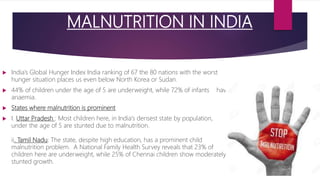
MALNUTRITION IN INDIA
children suffering from malnutrition
 India’s Global Hunger Index India ranking of 67 the 80 nations with the worst
hunger situation places us even below North Korea or Sudan.
 44% of children under the age of 5 are underweight, while 72% of infants have
anaemia.
 States where malnutrition is prominent
 I. Uttar Pradesh : Most children here, in India's densest state by population,
under the age of 5 are stunted due to malnutrition.
ii. Tamil Nadu: The state, despite high education, has a prominent child
malnutrition problem. A National Family Health Survey reveals that 23% of
children here are underweight, while 25% of Chennai children show moderately
stunted growth.
CONTINUED…….
iii. Madhya Pradesh: 2015 data reveals that Madhya Pradesh has India's highest number of
malnourished children - 74.1% of them under 6 suffer from anemia, and 60% have to deal
with malnutrition.
iv. Jharkhand and Bihar: At 56.5%, Jharkhand has India's second highest number of
malnourished children. This is followed by Bihar, at 55.9%
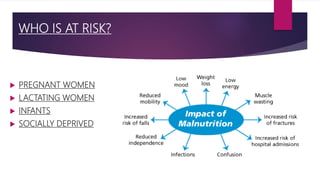
WHO IS AT RISK?
 PREGNANT WOMEN
 LACTATING WOMEN
 INFANTS
 SOCIALLY DEPRIVED
HOW TO SPREAD AWARENESS?
 MASS MEDIA
 DISSEMINATION AND DISPLAY OF
BRANDED MATERIALS
 TELEVISION PROGRAMMES
 NEWSPAPER AND RADIO
 PUBLIC RELATION EVENTS
CONTINUED…...
1.MASS MEDIA
 In Tonga, a mass (social) marketing campaign
(Maliah Youth Project)
 It involved healthy eating messages in
advertising, jingles, interviews, banners, t-
shirts and newspaper in TV, radio and print
targeted specifically at adolescents in select
villages and schools.
2.Display of branded materials
 In the Cook Islands, the government
developed an education campaign with the
logo “Live smart-Be active-Eat wisely” in
2006.
 A branded ‘Let’s Go Local” campaign was
implemented in PohnPei in 2005
CONTINUED…...
3.Television programmes
 In New Caledonia, the health agency
developed a television programme
to promote healthy eating and
physical activity as part of their (Eat
Well Move More) public awareness
campaign .
 The programme, broadcast in 2011,
featured families filmed once a
month for six months who had been
provided with nutrition education.
Each programme assessed the
successes and challenges of the
families in losing weight and
adopting healthier lifestyles.
4. Newspaper and radio.
 Governments in some islands have
regular slots in newspapers and radio
to promote awareness about healthy
eating.
 For example, there is a weekly
nutrition-oriented page in one
newspaper in Fiji, plus a weekly
column by the National Food and
Nutrition Centre
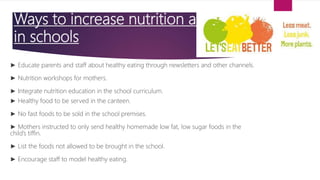
Ways to increase nutrition awareness
in schools
► Educate parents and staff about healthy eating through newsletters and other channels.
► Nutrition workshops for mothers.
► Integrate nutrition education in the school curriculum.
► Healthy food to be served in the canteen.
► No fast foods to be sold in the school premises.
► Mothers instructed to only send healthy homemade low fat, low sugar foods in the
child’s tiffin.
► List the foods not allowed to be brought in the school.
► Encourage staff to model healthy eating.
CONCLUSION
THANKYOU

Nutrition awareness

  • 1.
    AWARENESS MADE BY  POOJA RAKHSHAN  ROHIT  LAKKI  PALLAVI
  • 2.
    OBJECTIVES  DISTINGUISH AMONGSIX TYPES OF NUTRITIENTS  IDENTIFY EACH TYPE OF NUTRITIENTS  EXPLAIN THE VALUE OF NUTRITIENTS  NUTRITIONAL DEFICIENCIES  NUTRITIONAL AWARENESS AMONG YOUNG CONSUMERS  MALNUTRITION IN INDIA
  • 3.
    WHY WE NEED NUTRIENTS?Nutritional awareness is spreading among thousands of people all over the globe. People are talking about nutritional supplements, health foods, vitamins and minerals, and astonishing herbs. People are realizing to take their own responsibility for their own well-being, and the result is a greater need for nutritional information.  Good nutrition is an important part of leading a healthy lifestyle. Combined with physical activity, your diet can help you to reach and maintain a healthy weight, reduce your risk of chronic diseases (like heart disease and cancer), and promote your overall health.
  • 4.
    CLASSES OF NUTRIENTS Carbohydrates  Proteins  Fats (Lipids)  Vitamins  Minerals  WATER These 6 nutrients you body NEEDS to function properly!!!
  • 5.
    Carbohydrates  What arethey?  Starches & sugars found in foods  What is their function?  Body’s preferred source of energy  What if I don’t get enough?  Decreased energy  If I get too much?  Can be stored as fat
  • 6.
    Proteins  What arethey?  Nutrients which build & maintain body tissues  What is their function?  Build & maintain: muscle, skin, hair, nails, etc.  What if I don’t get enough?  Decrease in muscle & tissue maintenance  If I get too much? - Stored as fat
  • 7.
    Fats (Lipids)  Whatare the main functions of fats?  Provides energy  Cushions organs  Carries vitamins (A,D,E,K) - Insulator - Provides taste  What happens if I get too much fat? - Weight gain - Increased risk of heart disease
  • 8.
    Cholesterol  A lipid(fat) found in all animal tissues  Cholesterol makes vitamin D, cell membranes, and hormones  Types of cholesterol:  LDL = “bad” cholesterol  HDL = “good” cholesterol
  • 9.
    Vitamins  What arethey?  Compounds needed in small amounts to regulate body processes and allow growth  What is their function?  Help with digestion, absorption, & metabolism  Each vitamin is needed and provides a specific function
  • 10.
    Minerals What are they? Inorganic compounds (things that come from the earth) that are needed in small amounts What is their function?  Regulate body processes  Ex) bone formation Each mineral is needed! Minerals do NOT provide energy!!!
  • 11.
    Water  What arethe main functions of water?  Transports nutrients  Carries away wastes  Moistens eyes, mouth, nose; hydrates skin  Forms main component of body fluids  Acts as an insulator  Protects against heat exhaustion  Lubricates joints  Helps with digestion
  • 12.
  • 13.
    NUTRIENT DEFICIENCIES 1. IRONDEFICIENCY 2. IODINE DEFICIENCY 3. VITAMIN D DEFICIENCY 4. VITAMIN B12 DEFICIENCY 5. CALCIUM DEFICIENCY 6. VITAMIN A DEFICIENCY 7. MAGNESIUM DEFICIENCY
  • 14.
    1.IRON DEFICIENCY  Irondeficiency is one of the most common nutrient deficiencies in the world, affecting more than 25% of people worldwide  This number rises to 47% in preschool children. Unless they’re given iron-rich, or iron-fortified foods, they are very likely to lack iron.  30% of menstruating women may be deficient as well, due to monthly blood loss. Up to 42% of young, pregnant women may also suffer from iron deficiency.  Additionally, vegetarians and vegans have an increased risk of deficiency. They consume only non-heme iron, which is not absorbed as well as heme iron  Bottom Line: Iron deficiency is very common, especially among young women, children and vegetarians. It may cause anemia, tiredness, weakness, weakened immune system and impaired brain function.
  • 15.
    2.IODINE DEFICIENCY  Iodineis an essential mineral for normal thyroid function and the production of thyroid hormones  Thyroid hormones are involved in many processes in the body, such as growth, brain development and bone maintenance. They also regulate the metabolic rate.  Iodine deficiency is one of the most common nutrient deficiencies in the world. It affects nearly one-third of the world’s population  The most common symptom of iodine deficiency is an enlarged thyroid gland, also known as goiter. It may also cause an increase in heart rate, shortness of breath and weight gain  Bottom Line: Iodine is one of the most common nutrient deficiencies in the world. It may cause enlargement of the thyroid gland. Severe iodine deficiency can cause mental retardation and developmental abnormalities in children.
  • 16.
    3.VITAMIN D DEFICIENCY Vitamin D is a fat-soluble vitamin that works like a steroid hormone in the body.  It travels through the bloodstream and into cells, telling them to turn genes on or off.Almost every cell in the body has a receptor for vitamin D.  Vitamin D is produced out of cholesterol in the skin when it is exposed to sunlight  In the US, about 42% of people may be vitamin D deficient. This number rises to 74% in the elderly and 82% in people with dark skin, since their skin produces less vitamin D in response to sunlight  Adults who are deficient in vitamin D may experience muscle weakness, bone loss and increased risk of fractures. In children, it may cause growth delays and soft bones (rickets)
  • 17.
    4.VITAMIN B12 DEFICIENCY Vitamin B12, also known as cobalamin, is a water-soluble vitamin.  It is essential for blood formation, as well as for brain and nerve function.  Studies have shown that vegetarians and vegans are highly likely to be deficient in vitamin B12. Some numbers go as high as 80–90% More than 20% of elderly people may also be deficient in vitamin B12, since absorption decreases with age  One common symptom of vitamin B12 deficiency is megaloblastic anemia, which is a blood disorder that enlarges the red blood cells.  Bottom Line: Vitamin B12 deficiency is very common, especially in vegetarians and the elderly. The most common symptoms include a blood disorder, impaired brain function and elevated homocysteine levels.
  • 18.
    5.CALCIUM DEFICIENCY  Calciumis essential for every cell. It mineralizes bone and teeth, especially during times of rapid growth. It is also very important for the maintenance of bone.  One survey found that in the US, less than 15% of teenage girls and less than 10% of women over 50 met the recommended calcium intake.  In the same survey, less than 22% of young, teenage boys and men over 50 met the recommended calcium intake from diet alone. Supplement use increased these numbers slightly, but the majority of people were still not getting enough calcium  Bottom Line: Low calcium intake is very common, especially in young females and the elderly. The main symptom of calcium deficiency is an increased risk of osteoporosis in old age.
  • 19.
    6.VITAMIN A DEFICIENCY Vitamin A is an essential fat-soluble vitamin. It helps form and maintain healthy skin, teeth, bones and cell membranes. Furthermore, it produces our eye pigments – which are necessary for vision There are two different types of dietary vitamin A:  Preformed vitamin A: This type of vitamin A is found in animal products like meat, fish, poultry and dairy.  Pro-vitamin A: This type of vitamin A is found in plant-based foods like fruits and vegetables. Beta-carotene, which the body turns into vitamin A, is the most common form.  More than 75% of people who eat a western diet are getting more than enough vitamin A and do not need to worry about deficiency  Bottom Line: Vitamin A deficiency is very common in many developing countries. It may cause eye damage and lead to blindness, as well as suppress immune function and increase mortality among women and children.
  • 20.
    7.MAGNESIUM DEFICIENCY  Magnesiumis a key mineral in the body. It is essential for bone and teeth structure, and is also involved in more than 300 enzyme reactions.  Almost half of the US population (48%) consumed less than the required amount of magnesium in 2005-2006  Low intake and blood levels of magnesium have been associated with several diseases, including type 2 diabetes, metabolic syndrome, heart disease and osteoporosis  The main symptoms of severe magnesium deficiency include abnormal heart rhythm, muscle cramps, restless leg syndrome, fatigue and migraines
  • 21.
    MALNUTRITION Malnutrition is acondition that results from eating a diet in which nutrients are either not enough or are too much such that the diet causes health problems. It may involve calories, protein, carbohydrates, vitamins o r minerals. Not enough nutrients is called under nutrition or undernourishment while too much is called over nutrition.
  • 22.
    MALNUTRITION IN INDIA childrensuffering from malnutrition  India’s Global Hunger Index India ranking of 67 the 80 nations with the worst hunger situation places us even below North Korea or Sudan.  44% of children under the age of 5 are underweight, while 72% of infants have anaemia.  States where malnutrition is prominent  I. Uttar Pradesh : Most children here, in India's densest state by population, under the age of 5 are stunted due to malnutrition. ii. Tamil Nadu: The state, despite high education, has a prominent child malnutrition problem. A National Family Health Survey reveals that 23% of children here are underweight, while 25% of Chennai children show moderately stunted growth.
  • 23.
    CONTINUED……. iii. Madhya Pradesh:2015 data reveals that Madhya Pradesh has India's highest number of malnourished children - 74.1% of them under 6 suffer from anemia, and 60% have to deal with malnutrition. iv. Jharkhand and Bihar: At 56.5%, Jharkhand has India's second highest number of malnourished children. This is followed by Bihar, at 55.9%
  • 24.
    WHO IS ATRISK?  PREGNANT WOMEN  LACTATING WOMEN  INFANTS  SOCIALLY DEPRIVED
  • 25.
    HOW TO SPREADAWARENESS?  MASS MEDIA  DISSEMINATION AND DISPLAY OF BRANDED MATERIALS  TELEVISION PROGRAMMES  NEWSPAPER AND RADIO  PUBLIC RELATION EVENTS
  • 26.
    CONTINUED…... 1.MASS MEDIA  InTonga, a mass (social) marketing campaign (Maliah Youth Project)  It involved healthy eating messages in advertising, jingles, interviews, banners, t- shirts and newspaper in TV, radio and print targeted specifically at adolescents in select villages and schools. 2.Display of branded materials  In the Cook Islands, the government developed an education campaign with the logo “Live smart-Be active-Eat wisely” in 2006.  A branded ‘Let’s Go Local” campaign was implemented in PohnPei in 2005
  • 27.
    CONTINUED…... 3.Television programmes  InNew Caledonia, the health agency developed a television programme to promote healthy eating and physical activity as part of their (Eat Well Move More) public awareness campaign .  The programme, broadcast in 2011, featured families filmed once a month for six months who had been provided with nutrition education. Each programme assessed the successes and challenges of the families in losing weight and adopting healthier lifestyles. 4. Newspaper and radio.  Governments in some islands have regular slots in newspapers and radio to promote awareness about healthy eating.  For example, there is a weekly nutrition-oriented page in one newspaper in Fiji, plus a weekly column by the National Food and Nutrition Centre
  • 28.
    Ways to increasenutrition awareness in schools ► Educate parents and staff about healthy eating through newsletters and other channels. ► Nutrition workshops for mothers. ► Integrate nutrition education in the school curriculum. ► Healthy food to be served in the canteen. ► No fast foods to be sold in the school premises. ► Mothers instructed to only send healthy homemade low fat, low sugar foods in the child’s tiffin. ► List the foods not allowed to be brought in the school. ► Encourage staff to model healthy eating.
  • 29.
  • 30.