NutrientStar : Elevating New Research
Standards and Transparency on
Performance of Fertilizer Management
Tools and Models
Jim Schepers
Retired USDA-ARS Soil Scientist
Emeritus University of Nebraska
An Objective, Science-based Assessment & Education
Program for Nutrient-Use Efficiency Tools & Products
In The Beginning
Evolved in 2014 as an Environmental
Defense Fund (EDF) initiative
Consultation with panel of ten soil
scientists and consultants
Efforts supported by EDF
Emphasis on optimizing fertilizer use
on 45-million acres of cropland in
U.S. (focus on the Mississippi River basin)
Why NutrientStar?
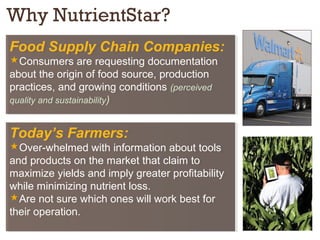
Food Supply Chain Companies:
Consumers are requesting documentation
about the origin of food source, production
practices, and growing conditions (perceived
quality and sustainability)
Food Supply Chain Companies:
Consumers are requesting documentation
about the origin of food source, production
practices, and growing conditions (perceived
quality and sustainability)
Today’s Farmers:
Over-whelmed with information about tools
and products on the market that claim to
maximize yields and imply greater profitability
while minimizing nutrient loss.
Are not sure which ones will work best for
their operation.
Today’s Farmers:
Over-whelmed with information about tools
and products on the market that claim to
maximize yields and imply greater profitability
while minimizing nutrient loss.
Are not sure which ones will work best for
their operation.
 Measure NUE performance of tools and
products
 Measure NUE performance of tools and
products
Goals of NutrientStar
 Educate farmers, advisors, and supply
chain partners
 Educate farmers, advisors, and supply
chain partners
 Highlight importance of science-based
research and data
 Highlight importance of science-based
research and data
 Increase transparency and progress in
delivering fertilizer optimization tools to
farmers
 Increase transparency and progress in
delivering fertilizer optimization tools to
farmers
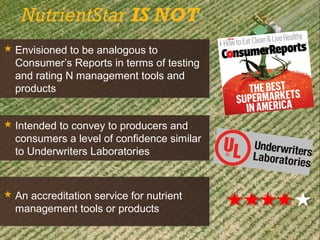
 Envisioned to be analogous to
Consumer’s Reports in terms of testing
and rating N management tools and
products
 Envisioned to be analogous to
Consumer’s Reports in terms of testing
and rating N management tools and
products
NutrientStar IS NOT
 Intended to convey to producers and
consumers a level of confidence similar
to Underwriters Laboratories
 Intended to convey to producers and
consumers a level of confidence similar
to Underwriters Laboratories
 An accreditation service for nutrient
management tools or products
 An accreditation service for nutrient
management tools or products
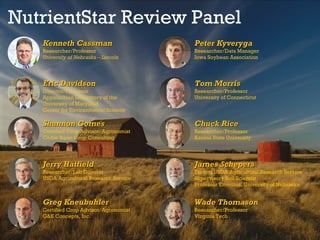
Kenneth CassmanKenneth Cassman
Researcher/Professor
University of Nebraska – Lincoln
Peter KyverygaPeter Kyveryga
Researcher/Data Manager
Iowa Soybean Association
Eric DavidsonEric Davidson
Director/Professor
Appalachian Laboratory of the
University of Maryland
Center for Environmental Science
Tom MorrisTom Morris
Researcher/Professor
University of Connecticut
Shannon GomesShannon Gomes
Certified Crop Advisor/Agronomist
Cedar Basin Crop Consulting
Chuck RiceChuck Rice
Researcher/Professor
Kansas State University
Jerry HatfieldJerry Hatfield
Researcher/Lab Director
USDA Agricultural Research Service
James SchepersJames Schepers
Former USDA Agricultural Research Service
Supervisory Soil Scientist
Professor Emeritus, University of Nebraska
Greg KneubuhlerGreg Kneubuhler
Certified Crop Advisor/Agronomist
G&K Concepts, Inc.
Wade ThomasonWade Thomason
Researcher/Professor
Virginia Tech
NutrientStar Review Panel
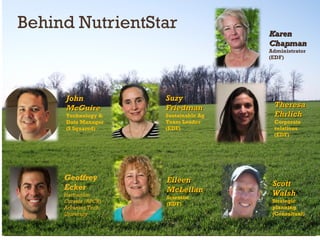
Behind NutrientStar
JohnJohn
McGuireMcGuire
Technology &
Data Manager
(S Squared)
KarenKaren
ChapmanChapman
Administrator
(EDF)
SuzySuzy
FriedmanFriedman
Sustainable Ag
Team Leader
(EDF)
EileenEileen
McLellanMcLellan
Scientist
(EDF)
TheresaTheresa
EhrlichEhrlich
Corporate
relations
(EDF)
ScottScott
WalshWalsh
Strategic
planning
(Consultant)
Geoffrey
Ecker
Herbarium
Curator (APCR) 
Arkansas Tech 
University 
NutrientStar’s Current
Focus:
Assessment of tools or products
marketed as able to increase NUE
and optimize profitability
Technologies modeling climate, soil & other
conditions (decision support tools that enable 4R
management)
In-season and optical sensor technologies
Enhanced efficiency products
GIS tool for regional adaptability
NutrientStar’s Current
Focus:
Assessment of tools or products
marketed as able to increase NUE
and optimize profitability
Technologies modeling climate, soil & other
conditions (decision support tools that enable 4R
management)
In-season and optical sensor technologies
Enhanced efficiency products
GIS tool for regional adaptability
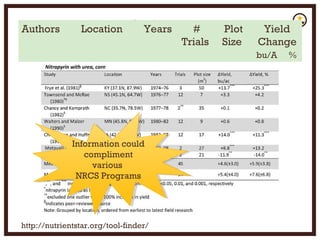
Example of Literature
Review Findings
http://nutrientstar.org/tool-finder/
Authors Location Years # Plot Yield
Trials Size Change
bu/A %
Information could
compliment
various
NRCS Programs
Information could
compliment
various
NRCS Programs
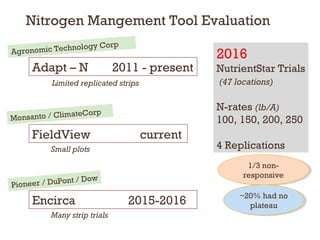
Nitrogen Mangement Tool Evaluation
Adapt – N 2011 - present
FieldView current
Encirca 2015-2016
Limited replicated strips
Many strip trials
Small plots
2016
NutrientStar Trials
(47 locations)
N-rates (lb/A)
100, 150, 200, 250
4 Replications
Monsanto / ClimateCorp
Pioneer / DuPont / Dow
1/3 non-
responsive
1/3 non-
responsive
Agronomic Technology Corp
~20% had no
plateau
~20% had no
plateau
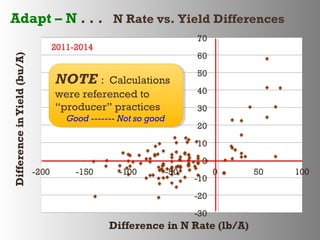
Adapt – N . . . N Rate vs. Yield Differences
NOTE : Calculations
were referenced to
“producer” practices
Good ------- Not so good
NOTE : Calculations
were referenced to
“producer” practices
Good ------- Not so good
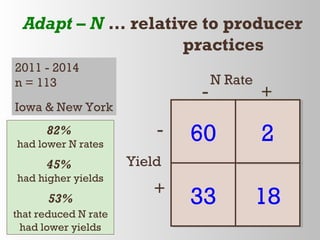
6060
3333 1818
22
Yield
N Rate
+
+
-
-
Adapt – N … relative to producer
practices
2011 - 2014
n = 113
Iowa & New York
82%
had lower N rates
45%
had higher yields
53%
that reduced N rate
had lower yields
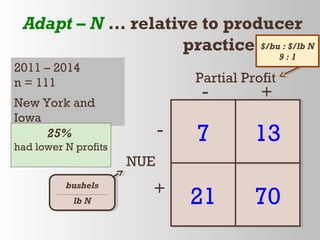
77
2121 7070
1313
NUE
Partial Profit
+
+
-
-
Adapt – N … relative to producer
practices
2011 – 2014
n = 111
New York and
Iowa
bushels
_________________________
lb N
bushels
_________________________
lb N
$/bu : $/lb N
9 : 1
$/bu : $/lb N
9 : 1
25%
had lower N profits
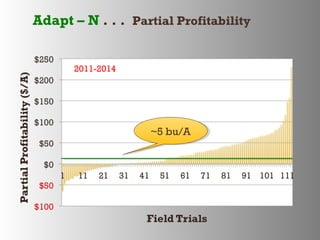
Adapt – N . . . Partial Profitability
2011-2014
~5 bu/A~5 bu/A
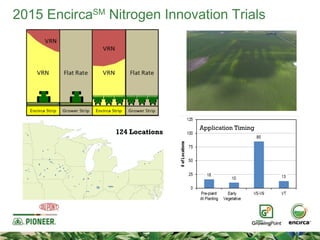
2015 Encirca Nitrogen Innovation Trials
124 Locations
Application Timing
2015 EncircaSM
Nitrogen Innovation Trials
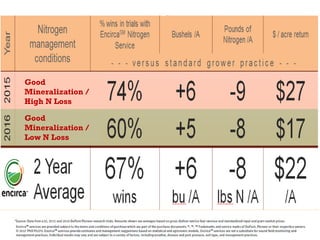
74% Wins
(92/124 locs)
2015 Results:Win RatioEncircaSM
improved return on N fertilizer investment
in 74 % of trials
Return on N =
[(Encirca yield x price) – (Encirca N rate x price)] –
[(Grower yield x price) – (Grower N rate x price)]
2015
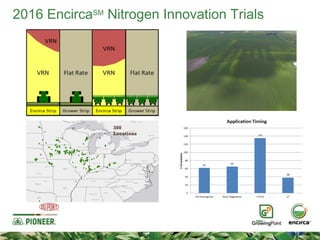
2015 Encirca Nitrogen Innovation Trials
2016 EncircaSM
Nitrogen Innovation Trials
300
Locations
2016 Results:Win RatioEncircaSM
improved return on N fertilizer investment in
60% of trials
Return on N =
[(Encirca yield x price) – (Encirca N rate x price)] –
[(Grower yield x price) – (Grower N rate x price)]
60% Wins
(180/300 locs)
2016
Managing Variability
with EncircaSM
Nitrogen Service
Good
Mineralization /
High N Loss
Good
Mineralization /
Low N Loss
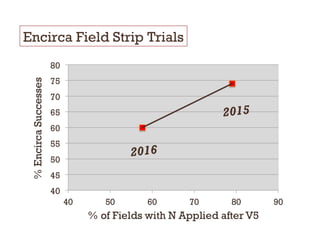
Encirca Field Strip Trials
2016
2015
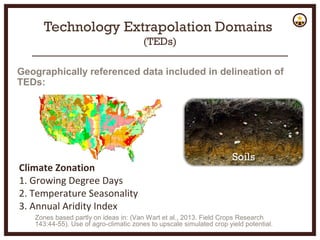
Technology Extrapolation Domains
(TEDs)
Geographically referenced data included in delineation of
TEDs:
Zones based partly on ideas in: (Van Wart et al., 2013. Field Crops Research
143:44-55). Use of agro-climatic zones to upscale simulated crop yield potential.
Climate Zonation
1. Growing Degree Days
2. Temperature Seasonality
3. Annual Aridity Index
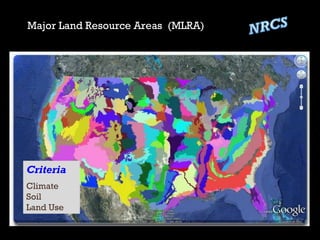
Major Land Resource Areas (MLRA)
Criteria
Climate
Soil
Land Use
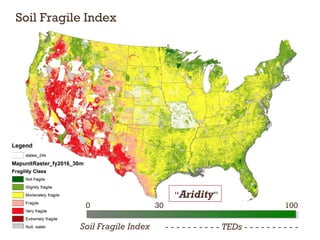
Soil Fragile Index
“Aridity”
Soil Fragile Index - - - - - - - - - - TEDs - - - - - - - - - -
0 30 100
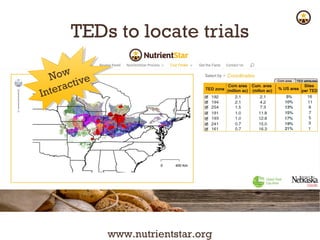
www.nutrientstar.org
TEDs to locate trials
Now
Interactive
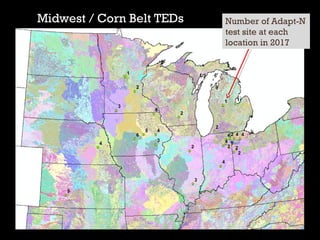
Midwest / Corn Belt TEDs Number of Adapt-N
test site at each
location in 2017
Thanks to our funders
For more information: www.nutrientstar.org
Karen Chapman, EDF
kchapman@edf.org
John McGuire, S2
mcguire9@gmail.com
QUESTIONS
COMMENTS
FEEDBACK

NutrientStar

  • 1.
    NutrientStar : ElevatingNew Research Standards and Transparency on Performance of Fertilizer Management Tools and Models Jim Schepers Retired USDA-ARS Soil Scientist Emeritus University of Nebraska
  • 2.
    An Objective, Science-basedAssessment & Education Program for Nutrient-Use Efficiency Tools & Products
  • 3.
    In The Beginning Evolvedin 2014 as an Environmental Defense Fund (EDF) initiative Consultation with panel of ten soil scientists and consultants Efforts supported by EDF Emphasis on optimizing fertilizer use on 45-million acres of cropland in U.S. (focus on the Mississippi River basin)
  • 4.
    Why NutrientStar? Food SupplyChain Companies: Consumers are requesting documentation about the origin of food source, production practices, and growing conditions (perceived quality and sustainability) Food Supply Chain Companies: Consumers are requesting documentation about the origin of food source, production practices, and growing conditions (perceived quality and sustainability) Today’s Farmers: Over-whelmed with information about tools and products on the market that claim to maximize yields and imply greater profitability while minimizing nutrient loss. Are not sure which ones will work best for their operation. Today’s Farmers: Over-whelmed with information about tools and products on the market that claim to maximize yields and imply greater profitability while minimizing nutrient loss. Are not sure which ones will work best for their operation.
  • 5.
     Measure NUEperformance of tools and products  Measure NUE performance of tools and products Goals of NutrientStar  Educate farmers, advisors, and supply chain partners  Educate farmers, advisors, and supply chain partners  Highlight importance of science-based research and data  Highlight importance of science-based research and data  Increase transparency and progress in delivering fertilizer optimization tools to farmers  Increase transparency and progress in delivering fertilizer optimization tools to farmers
  • 6.
     Envisioned tobe analogous to Consumer’s Reports in terms of testing and rating N management tools and products  Envisioned to be analogous to Consumer’s Reports in terms of testing and rating N management tools and products NutrientStar IS NOT  Intended to convey to producers and consumers a level of confidence similar to Underwriters Laboratories  Intended to convey to producers and consumers a level of confidence similar to Underwriters Laboratories  An accreditation service for nutrient management tools or products  An accreditation service for nutrient management tools or products
  • 7.
    Kenneth CassmanKenneth Cassman Researcher/Professor Universityof Nebraska – Lincoln Peter KyverygaPeter Kyveryga Researcher/Data Manager Iowa Soybean Association Eric DavidsonEric Davidson Director/Professor Appalachian Laboratory of the University of Maryland Center for Environmental Science Tom MorrisTom Morris Researcher/Professor University of Connecticut Shannon GomesShannon Gomes Certified Crop Advisor/Agronomist Cedar Basin Crop Consulting Chuck RiceChuck Rice Researcher/Professor Kansas State University Jerry HatfieldJerry Hatfield Researcher/Lab Director USDA Agricultural Research Service James SchepersJames Schepers Former USDA Agricultural Research Service Supervisory Soil Scientist Professor Emeritus, University of Nebraska Greg KneubuhlerGreg Kneubuhler Certified Crop Advisor/Agronomist G&K Concepts, Inc. Wade ThomasonWade Thomason Researcher/Professor Virginia Tech NutrientStar Review Panel
  • 8.
    Behind NutrientStar JohnJohn McGuireMcGuire Technology & DataManager (S Squared) KarenKaren ChapmanChapman Administrator (EDF) SuzySuzy FriedmanFriedman Sustainable Ag Team Leader (EDF) EileenEileen McLellanMcLellan Scientist (EDF) TheresaTheresa EhrlichEhrlich Corporate relations (EDF) ScottScott WalshWalsh Strategic planning (Consultant) Geoffrey Ecker Herbarium Curator (APCR)  Arkansas Tech  University 
  • 9.
    NutrientStar’s Current Focus: Assessment oftools or products marketed as able to increase NUE and optimize profitability Technologies modeling climate, soil & other conditions (decision support tools that enable 4R management) In-season and optical sensor technologies Enhanced efficiency products GIS tool for regional adaptability NutrientStar’s Current Focus: Assessment of tools or products marketed as able to increase NUE and optimize profitability Technologies modeling climate, soil & other conditions (decision support tools that enable 4R management) In-season and optical sensor technologies Enhanced efficiency products GIS tool for regional adaptability
  • 10.
    Example of Literature ReviewFindings http://nutrientstar.org/tool-finder/ Authors Location Years # Plot Yield Trials Size Change bu/A % Information could compliment various NRCS Programs Information could compliment various NRCS Programs
  • 11.
    Nitrogen Mangement ToolEvaluation Adapt – N 2011 - present FieldView current Encirca 2015-2016 Limited replicated strips Many strip trials Small plots 2016 NutrientStar Trials (47 locations) N-rates (lb/A) 100, 150, 200, 250 4 Replications Monsanto / ClimateCorp Pioneer / DuPont / Dow 1/3 non- responsive 1/3 non- responsive Agronomic Technology Corp ~20% had no plateau ~20% had no plateau
  • 12.
    Adapt – N. . . N Rate vs. Yield Differences NOTE : Calculations were referenced to “producer” practices Good ------- Not so good NOTE : Calculations were referenced to “producer” practices Good ------- Not so good
  • 13.
    6060 3333 1818 22 Yield N Rate + + - - Adapt– N … relative to producer practices 2011 - 2014 n = 113 Iowa & New York 82% had lower N rates 45% had higher yields 53% that reduced N rate had lower yields
  • 14.
    77 2121 7070 1313 NUE Partial Profit + + - - Adapt– N … relative to producer practices 2011 – 2014 n = 111 New York and Iowa bushels _________________________ lb N bushels _________________________ lb N $/bu : $/lb N 9 : 1 $/bu : $/lb N 9 : 1 25% had lower N profits
  • 15.
    Adapt – N. . . Partial Profitability 2011-2014 ~5 bu/A~5 bu/A
  • 16.
    2015 Encirca NitrogenInnovation Trials 124 Locations Application Timing 2015 EncircaSM Nitrogen Innovation Trials
  • 17.
    74% Wins (92/124 locs) 2015Results:Win RatioEncircaSM improved return on N fertilizer investment in 74 % of trials Return on N = [(Encirca yield x price) – (Encirca N rate x price)] – [(Grower yield x price) – (Grower N rate x price)] 2015
  • 18.
    2015 Encirca NitrogenInnovation Trials 2016 EncircaSM Nitrogen Innovation Trials 300 Locations
  • 19.
    2016 Results:Win RatioEncircaSM improvedreturn on N fertilizer investment in 60% of trials Return on N = [(Encirca yield x price) – (Encirca N rate x price)] – [(Grower yield x price) – (Grower N rate x price)] 60% Wins (180/300 locs) 2016
  • 20.
    Managing Variability with EncircaSM NitrogenService Good Mineralization / High N Loss Good Mineralization / Low N Loss
  • 21.
    Encirca Field StripTrials 2016 2015
  • 22.
    Technology Extrapolation Domains (TEDs) Geographicallyreferenced data included in delineation of TEDs: Zones based partly on ideas in: (Van Wart et al., 2013. Field Crops Research 143:44-55). Use of agro-climatic zones to upscale simulated crop yield potential. Climate Zonation 1. Growing Degree Days 2. Temperature Seasonality 3. Annual Aridity Index
  • 23.
    Major Land ResourceAreas (MLRA) Criteria Climate Soil Land Use
  • 24.
    Soil Fragile Index “Aridity” SoilFragile Index - - - - - - - - - - TEDs - - - - - - - - - - 0 30 100
  • 25.
  • 26.
    Midwest / CornBelt TEDs Number of Adapt-N test site at each location in 2017
  • 27.
  • 28.
    For more information:www.nutrientstar.org Karen Chapman, EDF kchapman@edf.org John McGuire, S2 mcguire9@gmail.com QUESTIONS COMMENTS FEEDBACK

Editor's Notes

  • #3 1. Title slide – while title slide up do introductions of Karen/EDF, John/S Squared NutrientStar developed by EDF, in collaboration with NUE experts, consultants and S Squared. EDF ag sustainability has as a goal to optimize fertilizer use on 45 million acres in the US, with the Upper Mississippi and Lake Erie basins as focus areas. Major points: NStar is objective – nobody has a stake in the outcome. The evaluation questionnaire, protocol for data and criteria for certification have all been developed by the NutrientStar review panel after months of deliberations Goes beyond certification – is more than just certification, we added the word “education” to convey this. It is geared toward those tools that claim to deliver NUE benefits OR a system of benefits – the 4Rs is a good way to look at these – which of the 4Rs does the tool or product address – we are evaluating those claims. The program is designed to evaluate company claims and educate farmers about the presence or absence of data supporting those claims as well as how some of these tools might best be used or deployed and under what circumstances they may deliver greater or lesser NUE benefits. Whatever the company brings – if the tool brings a system then we evaluate on that system. The full NutrientStar program is still in development and will continue to evolve
  • #6 Goals of NStar And economic impact –we recognize this is important Underscore second and third bullets: currently there is no one place farmers can go to find information – data, research – about NUE tools. NutrientStar will build capacity through on-line presence for that one-stop shop of information Will also provide meaningful tools to industry – e.g. regional maps that can guide field research and identify broadest audience
  • #7 Goals of NStar And economic impact –we recognize this is important Underscore second and third bullets: currently there is no one place farmers can go to find information – data, research – about NUE tools. NutrientStar will build capacity through on-line presence for that one-stop shop of information Will also provide meaningful tools to industry – e.g. regional maps that can guide field research and identify broadest audience
  • #8 6. Review panel Recruited after recommendations from ag consultants and partners (why did we pick these people – critical thinkers, as the important questions, independence, recognized as experts on the basis of their published research and work on the subject) Both practitioners and scientists Will be recruiting farmer members Panel members resolve scientific and technical issues and questions, review submissions, help determine educational aspects. Confidentiality agreements and non-disclosure of information agreements, also cannot be developing or contemplating developing any tools or technologies. The panel conducts its business through bi-monthly teleconferences and email.
  • #10 7. Focus: (John) Again, emphasize that we are evaluating DSTs and products based on their claims. Looking at technologies that consider the 4R system – some modeling tech’s do help farmers evaluate their N program from rate, timing and placement – are these recommendations helping farmers? Optical sensors – rate, timing, placement. Some look at form as well. NStar promulgates research protocols that could be used to measure the 4Rs, and can be adapted to evaluate any combination of practices/technologies/products.