


Leveraging Social Media Mollie Durbin Katie McInnish Meredith Reagan Meg Watson
Overview, History & Trends
Overview Definition Social media is a conversation Interactive dialogue Utilizes highly accessible, scalable communication techniques
Overview Definition A way to connect with patients, and gain trust and customer loyalty A way to connect with fellow physicians to discuss industry issues, trends & topics of interest
Social Media Giants Facebook Most used social networking site by worldwide monthly active users Over 600 million active users since creation in 2004 41.6% of US population has an account If a country, Facebook would be the third-largest in the world (behind China and India)
Social Media Giants Twitter Created in March 2006, launched that July Active microblog: 140 characters per tweet 200 million active users with 65 million tweets daily and 800,000+ search queries per day
Health Information &  The Internet Internet is often the go-to resource for people seeking health information 8 in 10 Internet users looked up health information, making it the third-largest search topic 48% are searching on behalf of another person (their parent, child, etc.)
Health Information &  The Internet Mobile accessibility is a plus 17% of cell-phone users have used their phones to look up health information Freedom to post information to the Internet can sometimes interfere with credibility of information
Health Information &  The Internet When posting information to your social media sites, list applicable links and sources so patients can verify the legitimacy of information posted
Successful Social Media Users in Health Care
What They Do  Right Planned Daily Deliberate, thought-out, careful posts each day Multi-platform Video, pictures, events, custom tabs
What They Do  Right Secure Access limited to only trained users Chrysler snafu Clear, concise “house rules” Not just a “Marketing Machine” Connect and build community, not all self-promotion
What They Do  Right Professional Not a personal profile, but an extension of company itself Share Valuable Resources & Current Events Post referenced articles on health tips, new studies, events, etc.
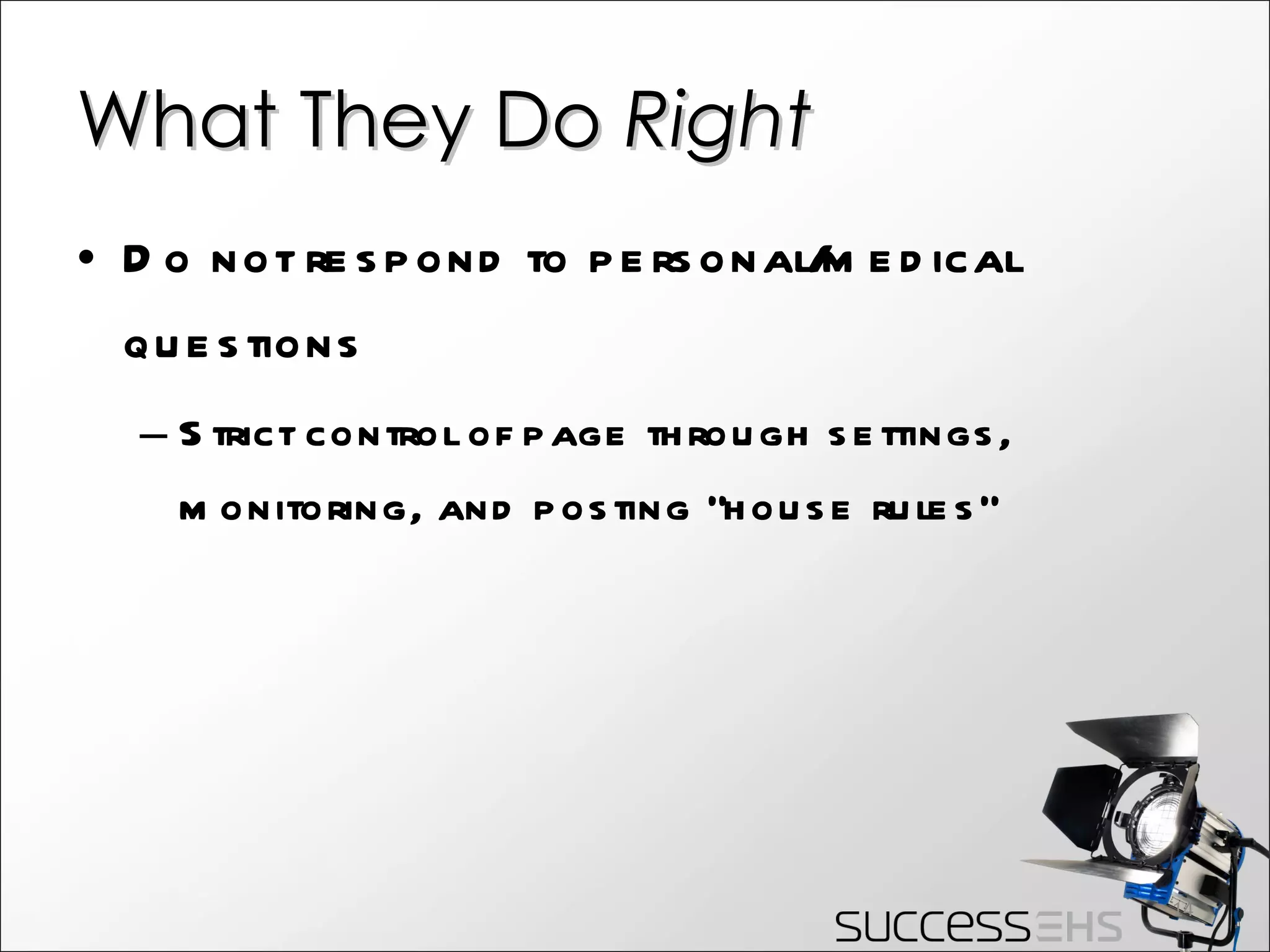
What They Do  Right Do not respond to personal/medical questions Strict control of page through settings, monitoring, and posting “house rules”
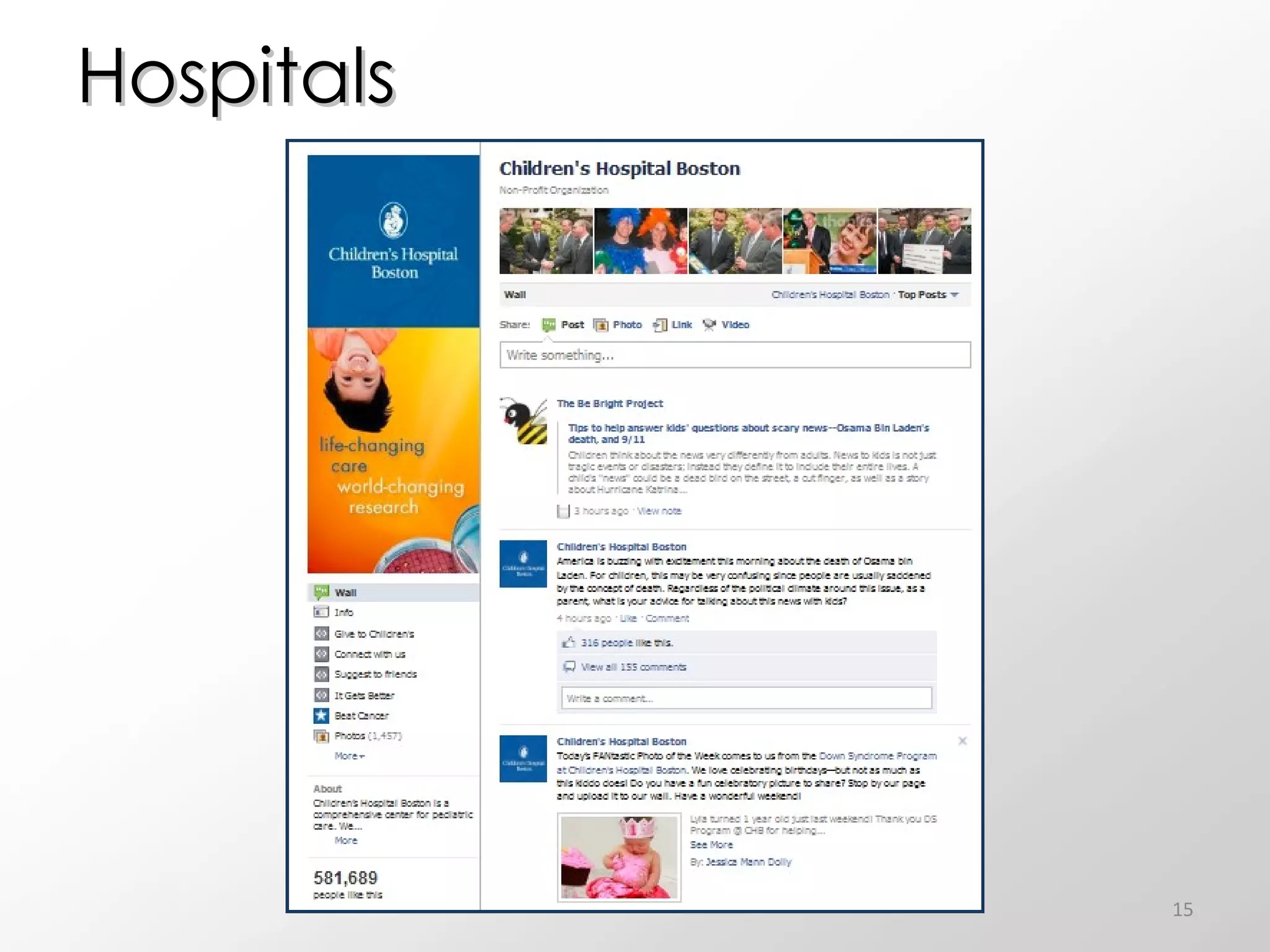
Hospitals
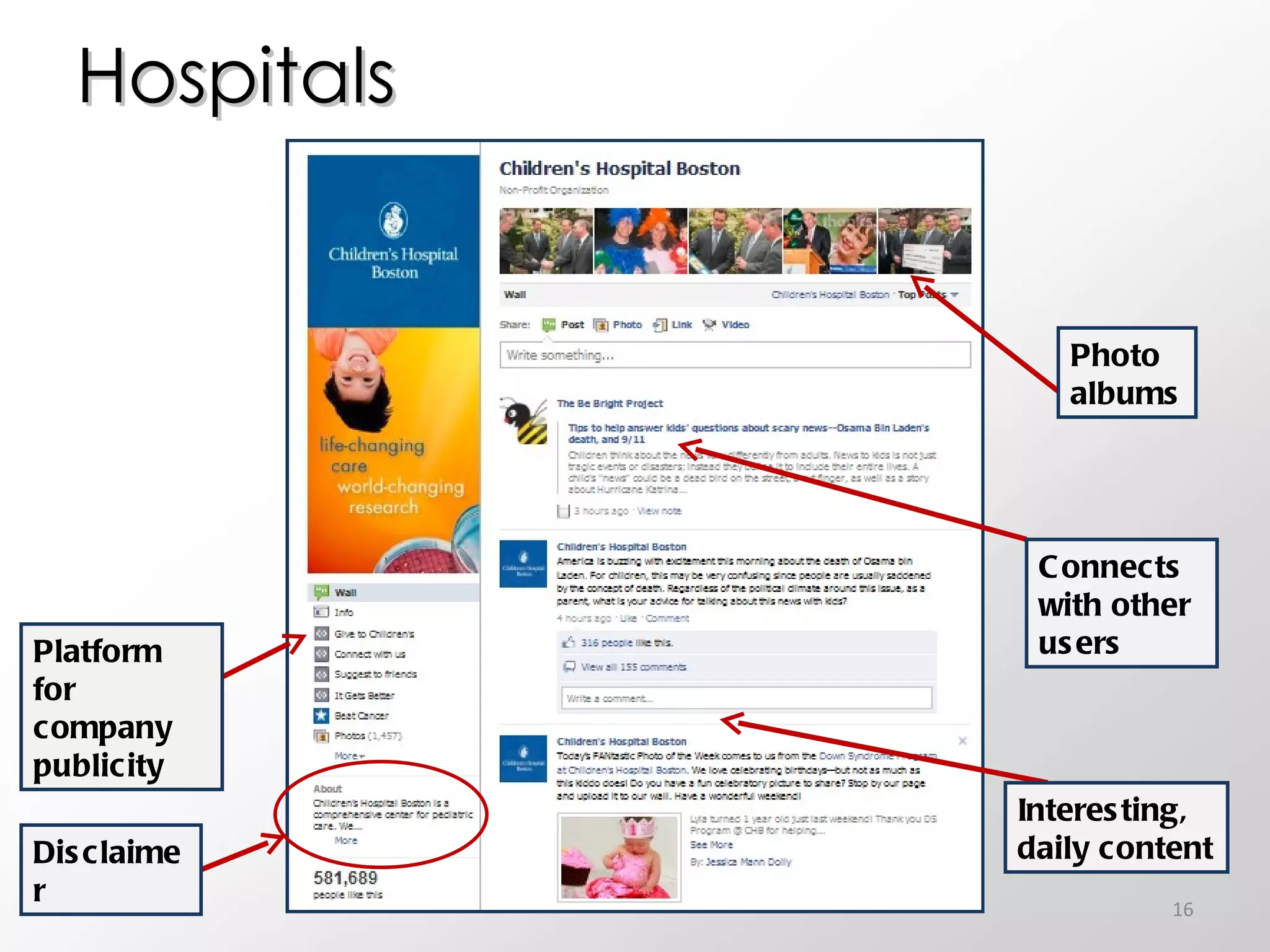
Hospitals Photo albums Interesting, daily content Connects with other users Platform for company publicity Disclaimer
Hospitals
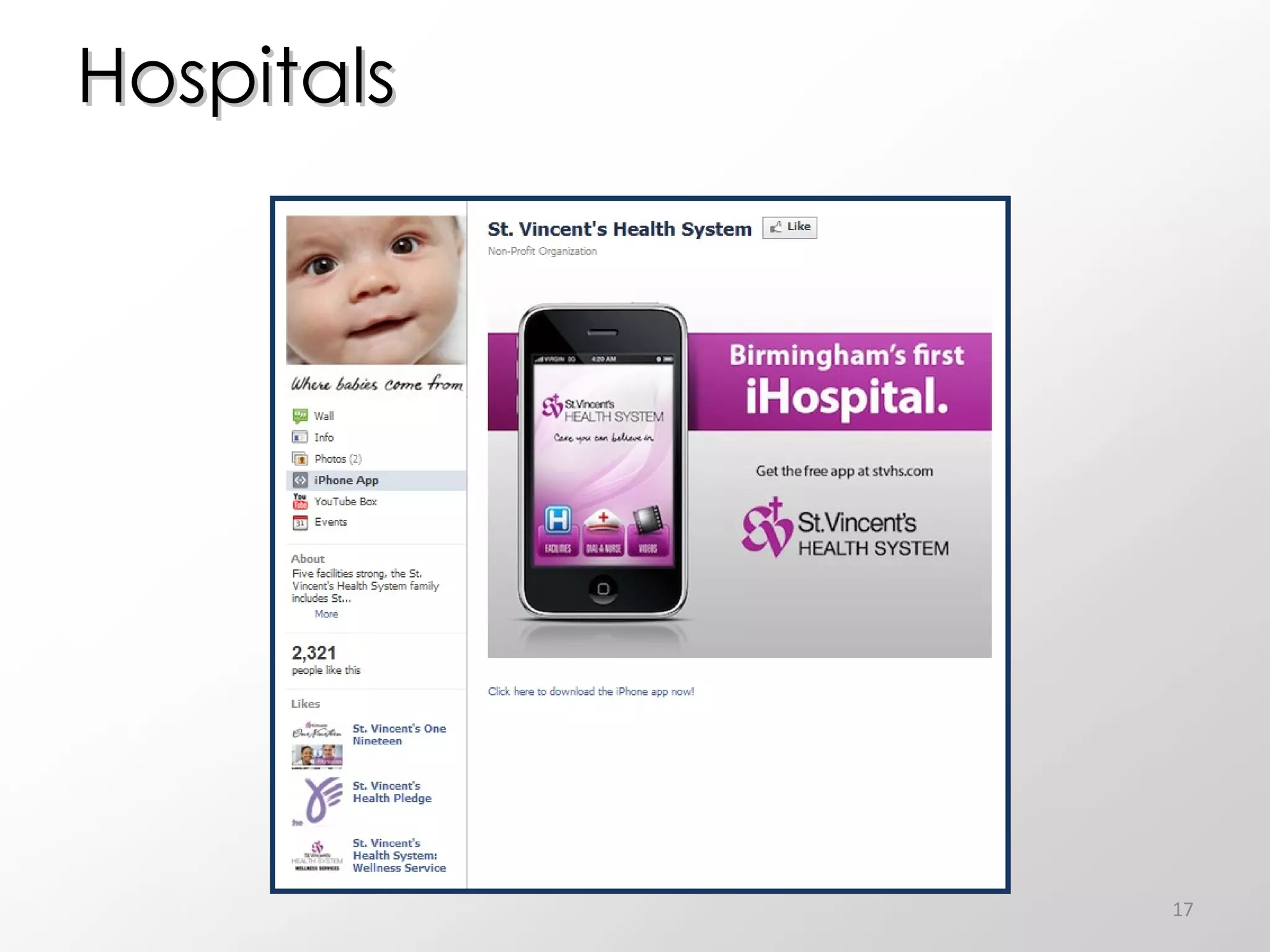
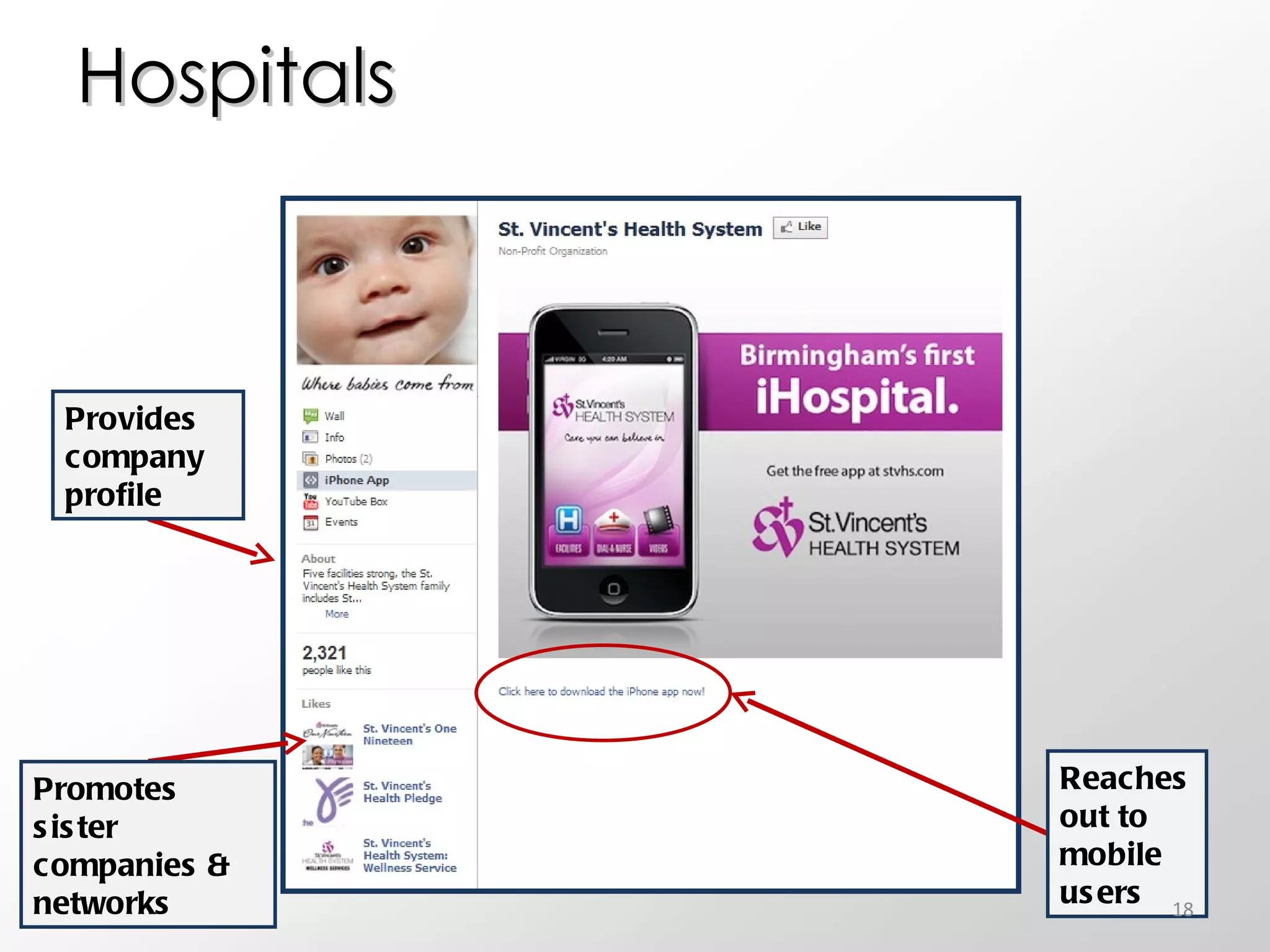
Hospitals Promotes sister companies & networks Reaches out to mobile users Provides company profile
Community Health Centers
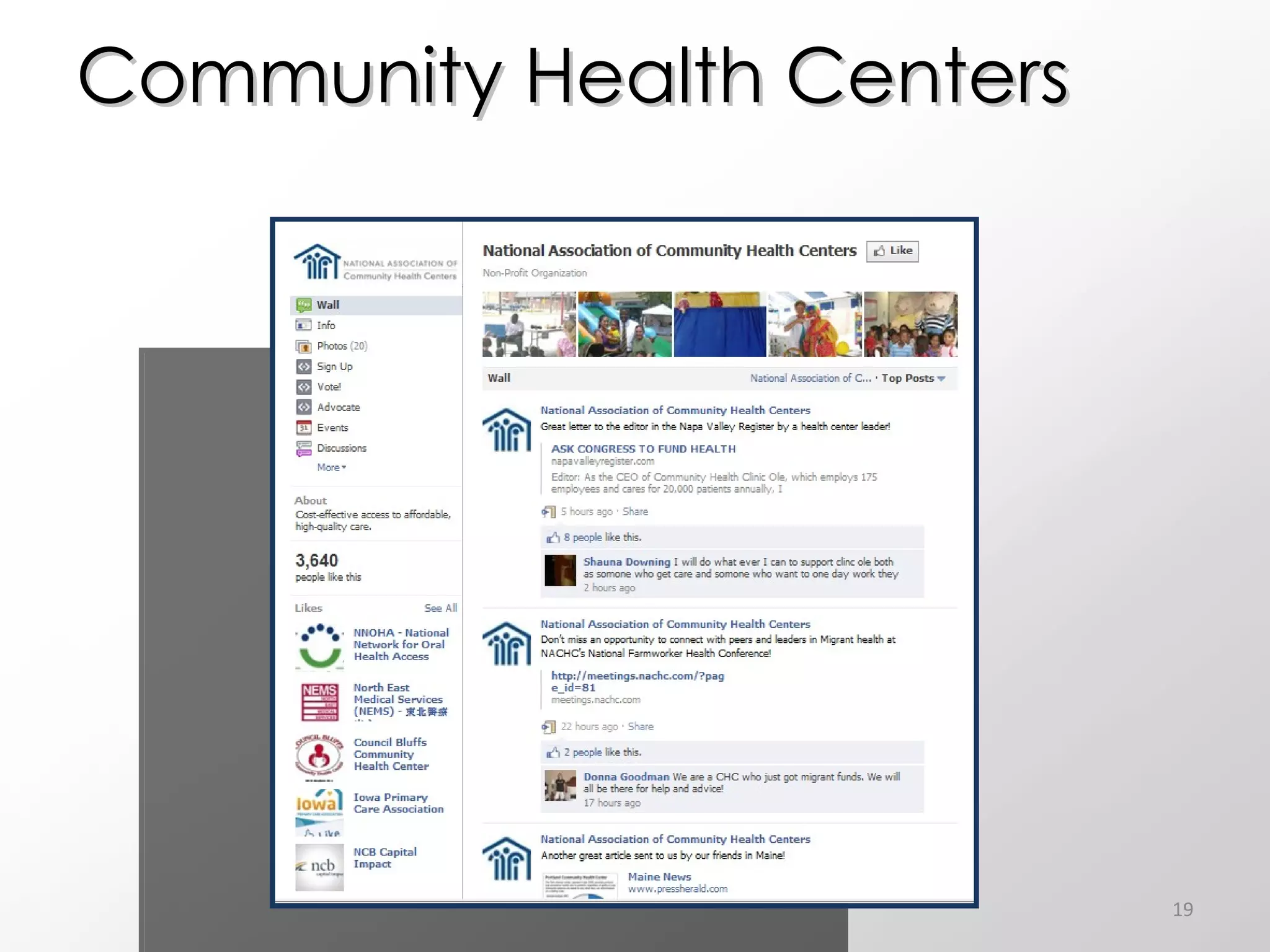
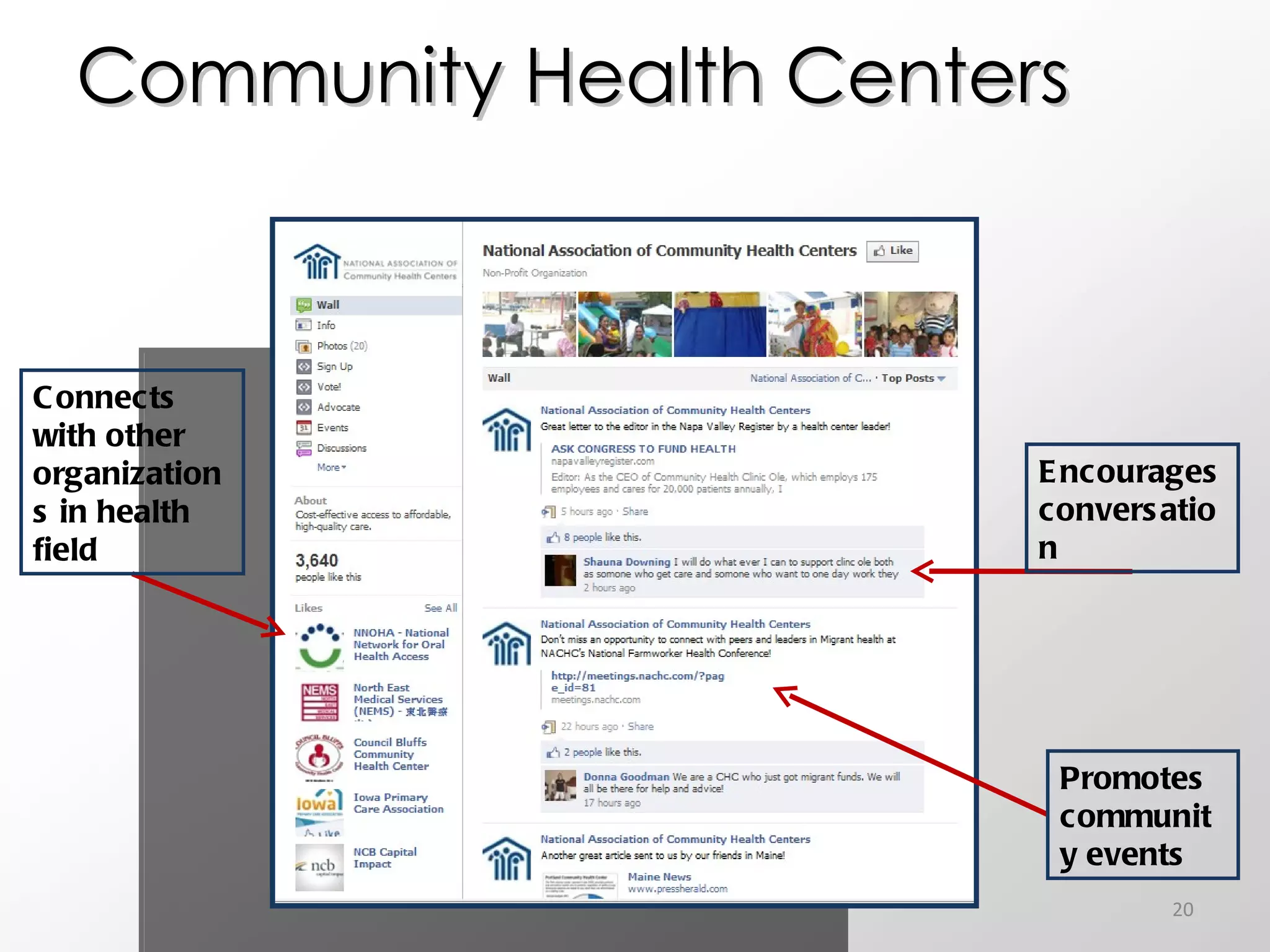
Community Health Centers Promotes community events Encourages conversation Connects with other organizations in health field
Health Systems
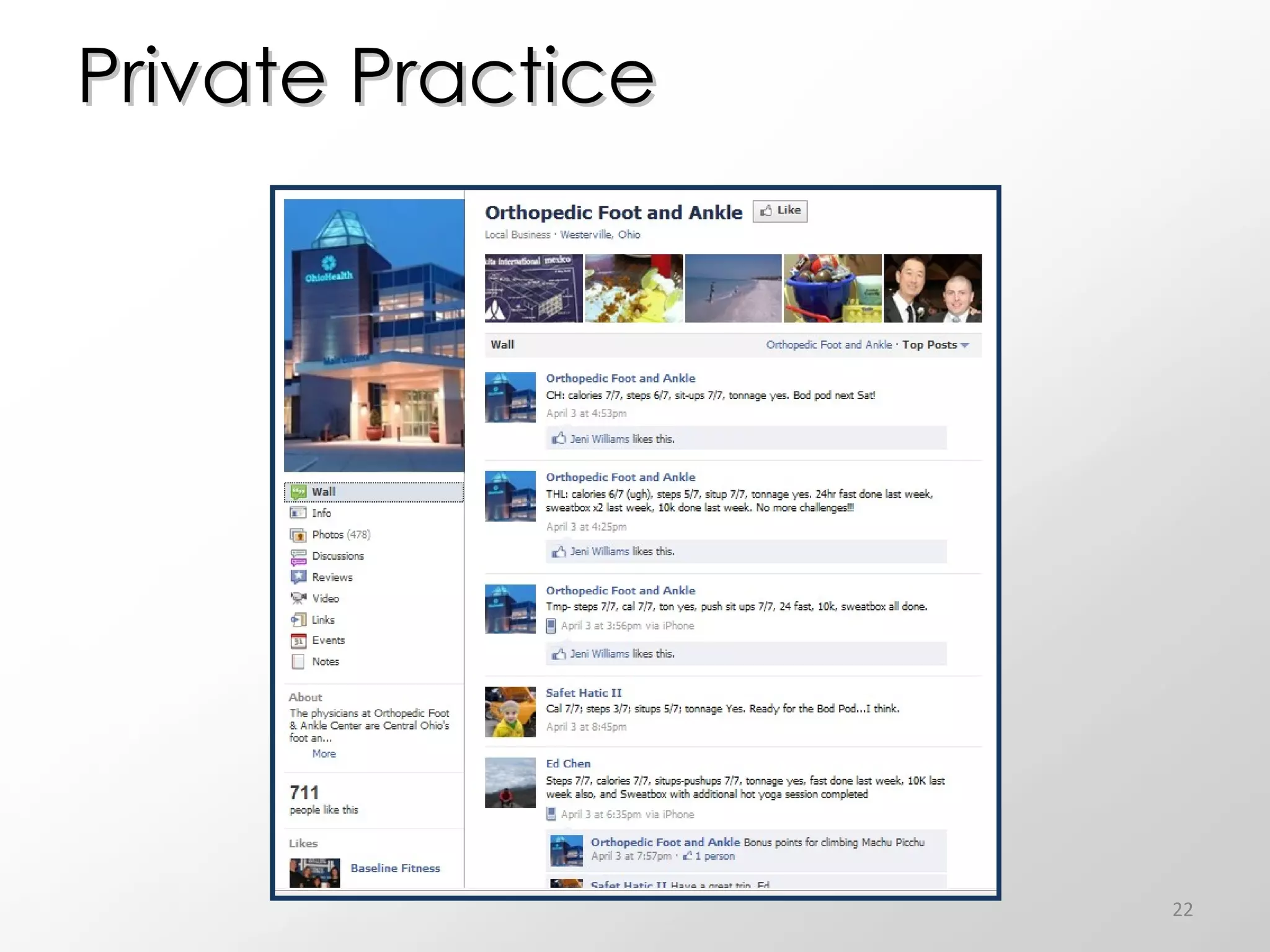
Private Practice
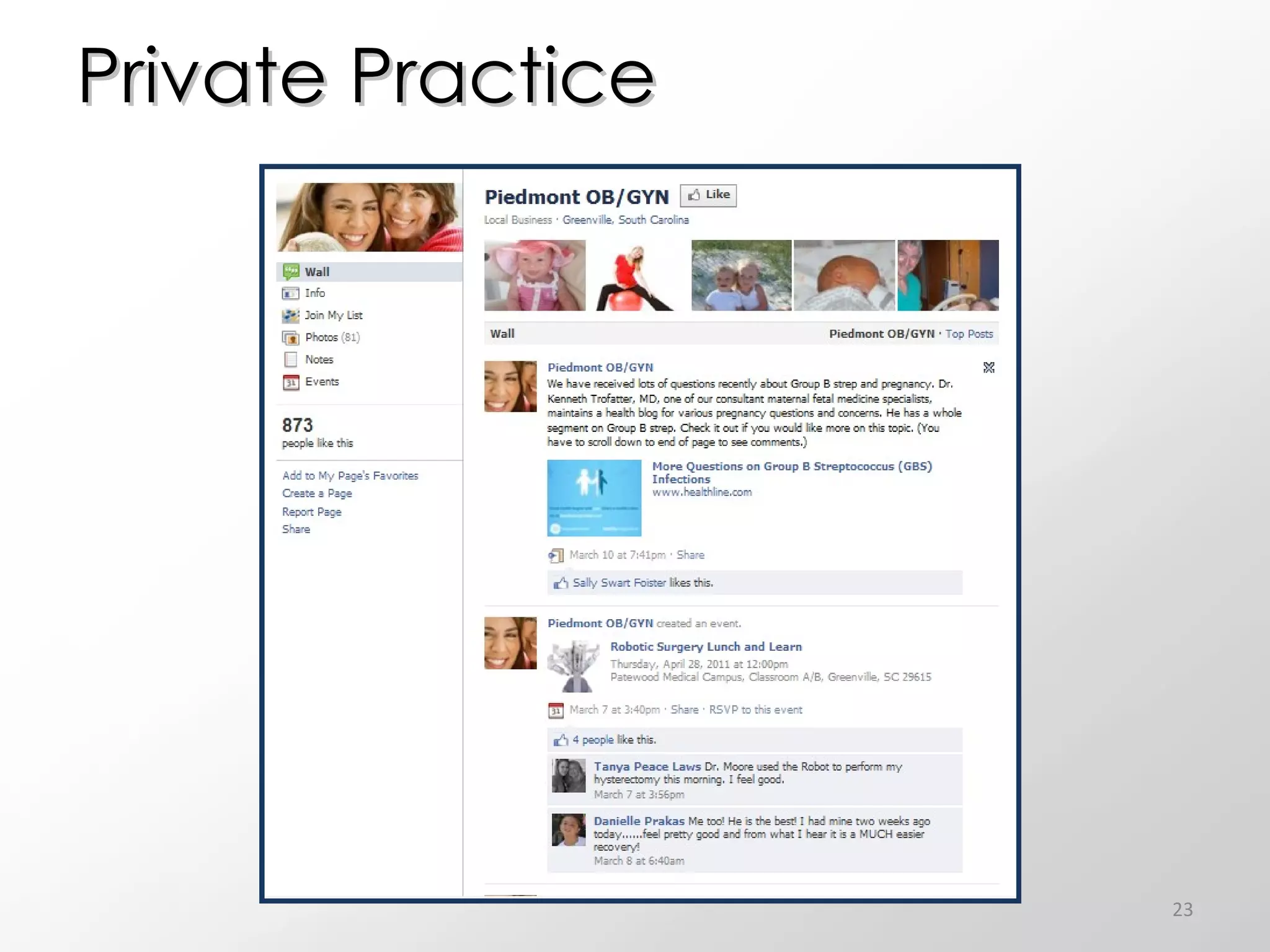
Private Practice
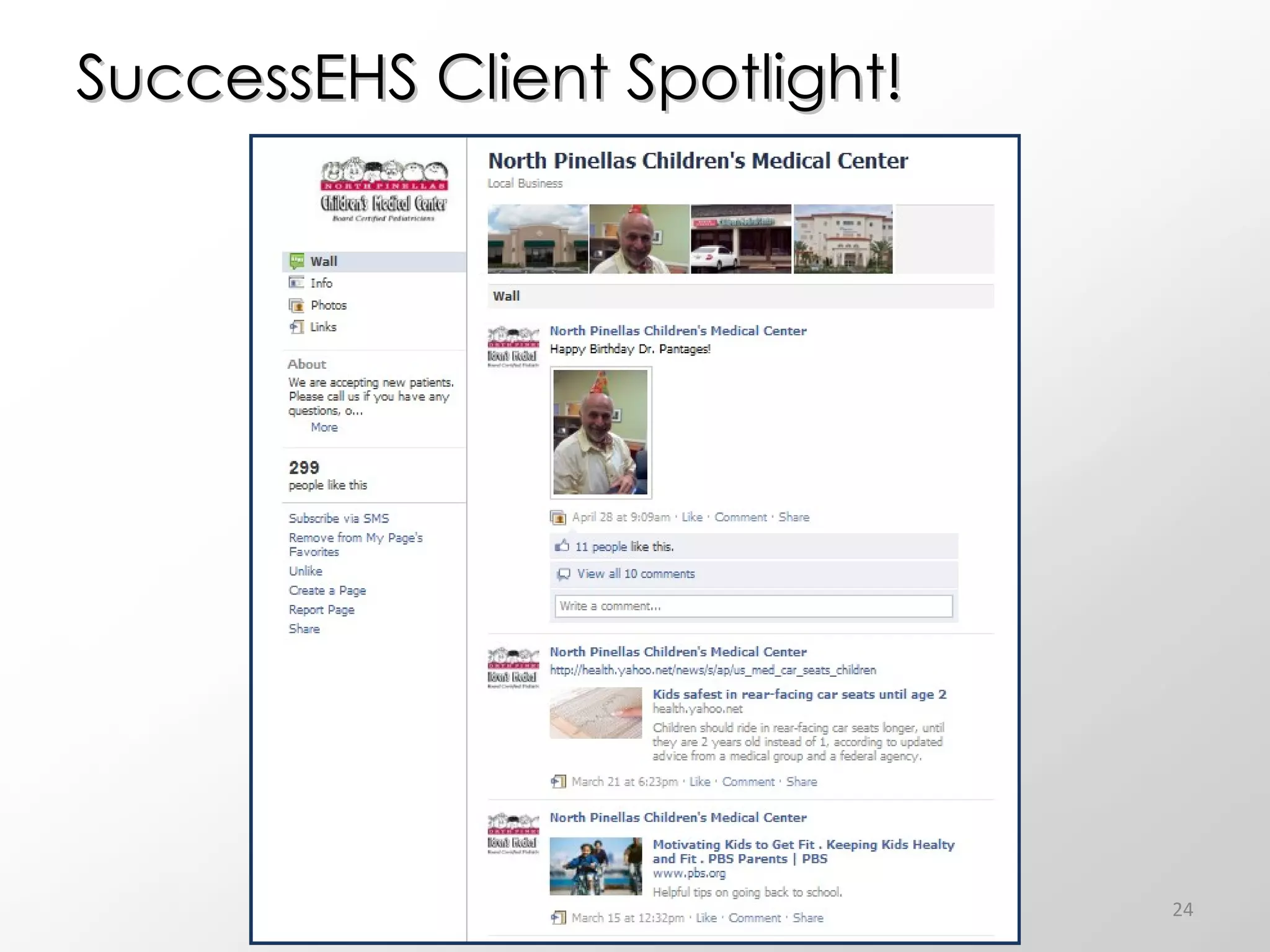
SuccessEHS Client Spotlight!
Connecting with Others Twitter Chats can be a great place for physicians and health care professionals to come together and discuss common issues with colleagues in similar fields.  Twitter Chats use the  #  symbol to index conversations, allowing users to see the relevant stream of posts in real time Example: #healthcarereform
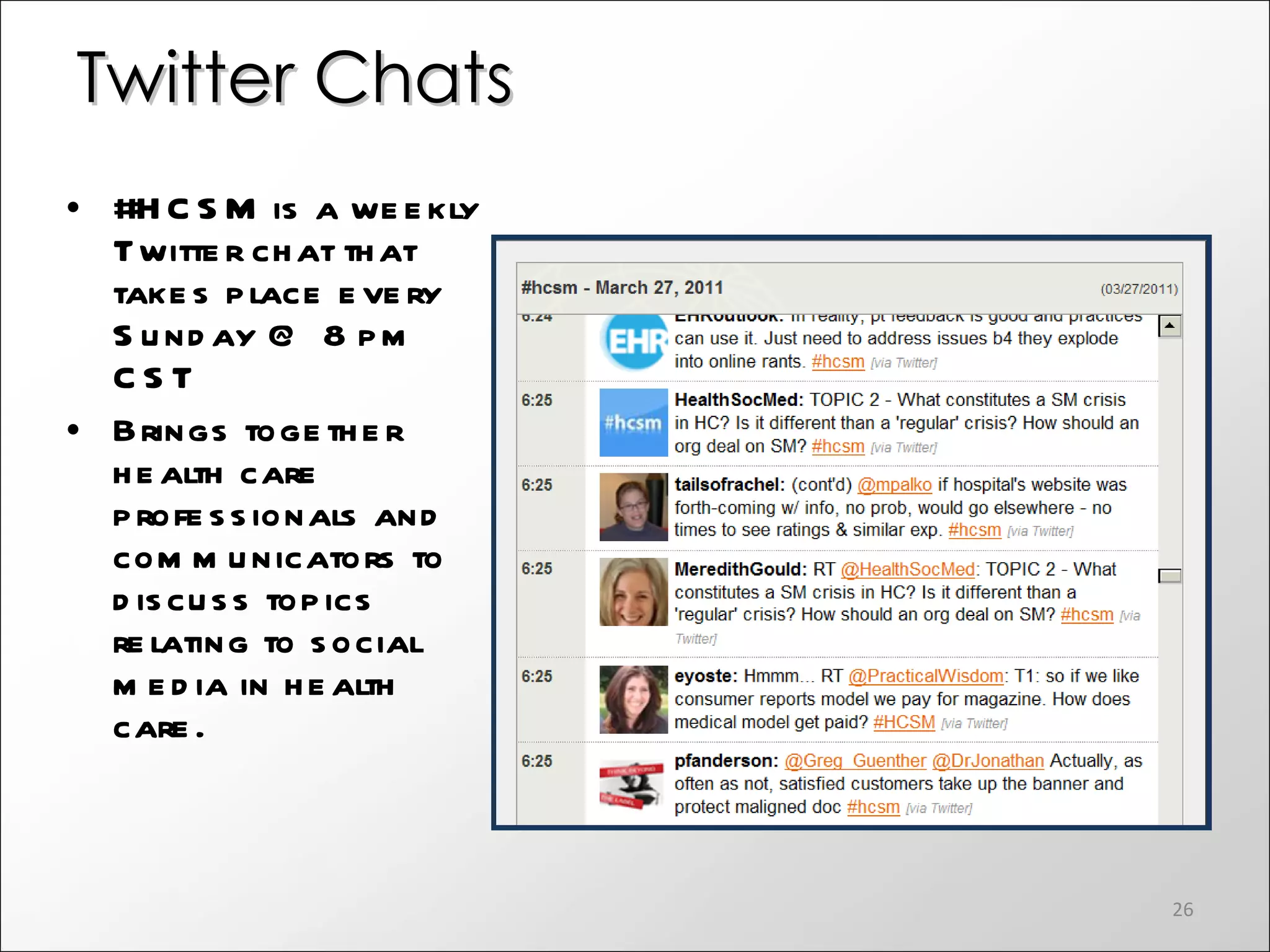
Twitter Chats #HCSM is a weekly Twitter chat that takes place every Sunday @ 8 pm CST Brings together health care professionals and communicators to discuss topics relating to social media in health care.
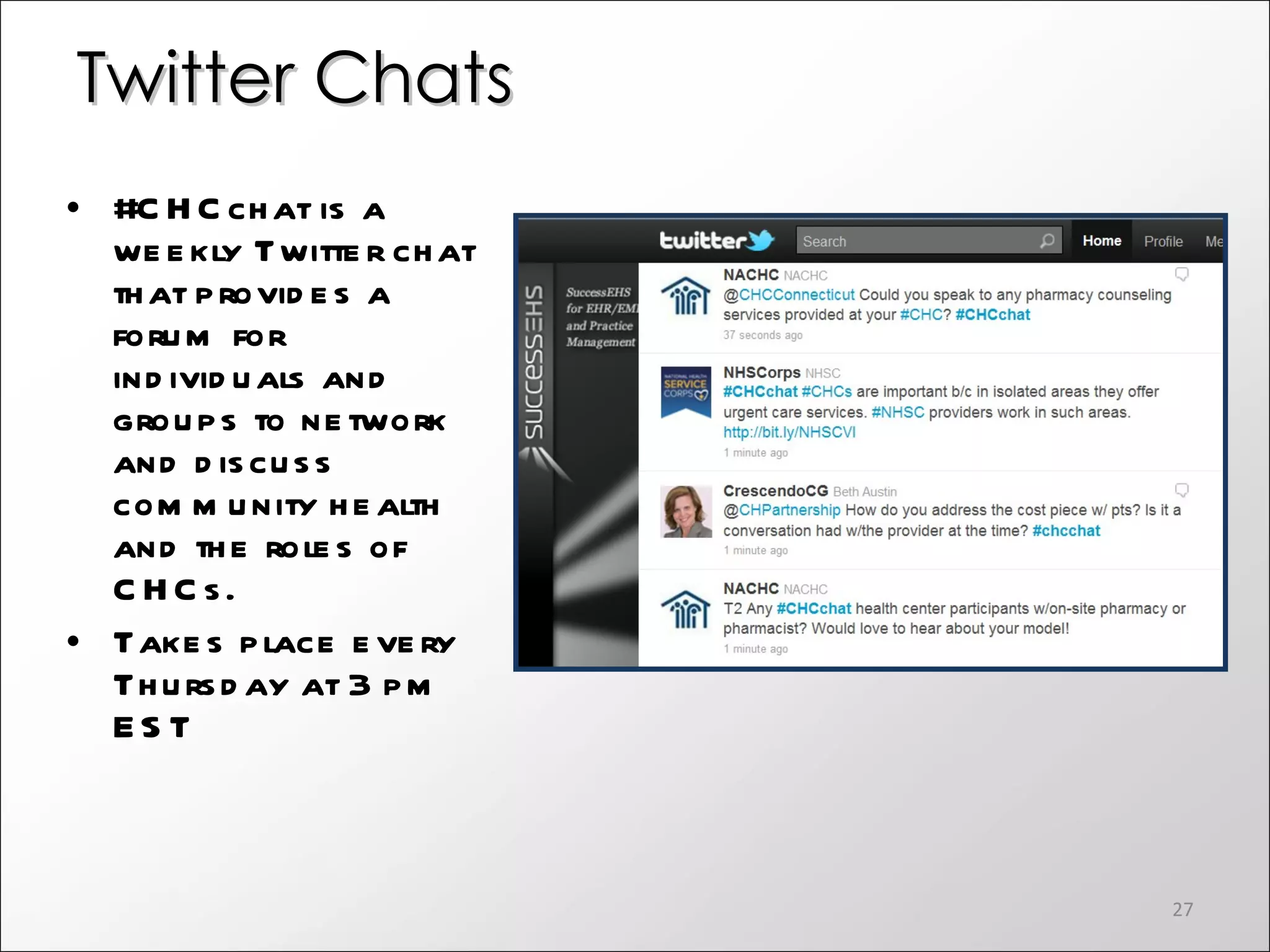
Twitter Chats #CHCchat is a weekly Twitter chat that provides a forum for individuals and groups to network and discuss community health and the roles of CHCs. Takes place every Thursday at 3 pm EST
Connecting with Others Sermo—the largest online physician community in the U.S. More than 115,000 members Sermo’s purpose is to harness the power of collective knowledge. Free to join, open only to physicians
Social Media & Medical Research Example Lee Aase, Mayo Clinic  Center for Social Media SM remove barriers for researchers to spread their message to the group that might be interested, no matter how small. Rare conditions are less likely to have been discussed online, so research about that topic will likely top Google search results. SM can make it easier for researchers in the same field to connect and collaborate
Industry Concerns
Industry Concerns Privacy & Legal Inaccurate Information
Privacy & Legal Privacy Concerns While HIPAA Concerns are real, follow the simple rule of thumb: Use the same ethics and confidentiality online that you use in real life. Don’t disclose anything that could be used to identify a patient without proper patient authorization.
Privacy & Legal Fraud & Abuse Federal and state laws aimed at preventing fraud and abuse in health care prohibit health care providers from giving third parties anything of value as an inducement for the third party to generate referrals to the health care provider for services which may be reimbursable by Medicare or Medicaid.
Privacy & Legal Tax-Exempt Status Health care providers that are exempt from taxation under Section 501(c)(3) of the Internal Revenue Code are prohibited from intervening in political campaigns and from seeking to influence legislation as a substantial part of their activities. Don’t advertise on or sponsor social media sites that support a political candidate or particular pieces of legislation.
Privacy & Legal Physician Licensing Health care professionals should not provide medical advice to patients via social media. If a patient receiving such advice is located in a state in which the doctor is not licensed, the doctor giving the advice risks liability under state licensing laws.
Inaccurate Information It’s true – some of the information patients are getting online is inaccurate. Patients are not likely to stop going to the internet for that information, though. The American Journal of Infection Control study confirmed that though only about 2% of medical tweets contained misinformation, the tweets potentially affected tens of thousands of patients.
Inaccurate Information Patients WILL get their information online – that’s all the more reason for physicians to “flood the web” with accurate information.
Social Media Plan Set up a social media policy The AMA released guidelines for these policies in November 2010, which encourage physicians to do the following:
AMA Social Media Guidelines Use privacy settings to safeguard personal information and content. Routinely monitor their Internet presence to ensure that their personal and professional information is accurate and appropriate.
AMA Social Media Guidelines Maintain appropriate boundaries of the patient-physician relationship when interacting with patients online and ensure patient privacy and confidentiality is maintained.
AMA Social Media Guidelines Consider separating personal and professional content online. Understand the potential negative effects of misstepping in the realm of social media.
How to be Awesome* *at social media
Give your Organization a Voice Direct patients to your practice Control organization info (hours, policies, directions, parking, etc.) Give yourself, not a directory, control of your information
Give your Organization a Voice Participate in interest groups Learn from your patient population and share your expertise on subject matter
Give your Organization a Voice Generate content for your audience Become a hub of general (not clinical) information with interesting articles for the well-being of patients and non-patients alike
What’s in a Post?
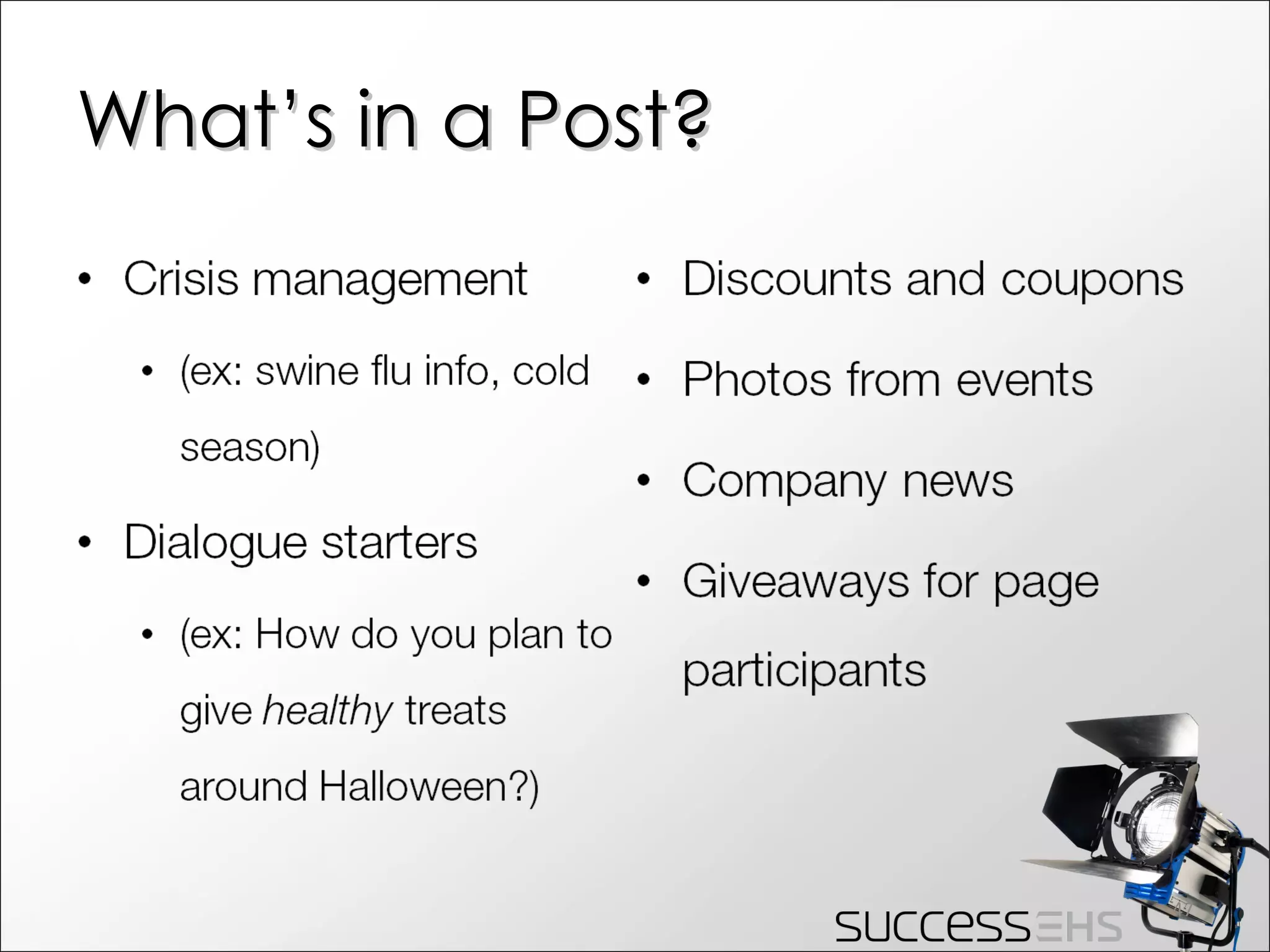
What’s in a Post?
SM as a Referral Source By interacting colleague to colleague and becoming a thought leader, you increase the likelihood of physician-to-physician referrals.* *Again, remember that you can’t offer anything of value as an inducement for the third party to generate referrals to the health care provider which may be reimbursable by Medicare or Medicaid.
The Value of SM for Relationship Building Utilizing social media tools may also help physicians be perceived as more “approachable”  As a result, patients may feel more comfortable asking questions and seeking the care they need
Increase Patients & Patient Encounters Patients want to know if OTHER patients are satisfied with you. Owning your online presence helps manage those relationships. A Facebook page for your practice is like an online Yellow Pages ad. Social networking sites are crawled by search engines. This increases the likelihood of you being “found” online.
Questions?
Stay Tuned @ 2:15 pm Administrative Track Networking Opportunity Clinical Track Patient Centered Medical Home General Track Business Objects

Leveraging Social Media for Healthcare Providers

  • 1.
    Leveraging Social MediaMollie Durbin Katie McInnish Meredith Reagan Meg Watson
  • 2.
  • 3.
    Overview Definition Socialmedia is a conversation Interactive dialogue Utilizes highly accessible, scalable communication techniques
  • 4.
    Overview Definition Away to connect with patients, and gain trust and customer loyalty A way to connect with fellow physicians to discuss industry issues, trends & topics of interest
  • 5.
    Social Media GiantsFacebook Most used social networking site by worldwide monthly active users Over 600 million active users since creation in 2004 41.6% of US population has an account If a country, Facebook would be the third-largest in the world (behind China and India)
  • 6.
    Social Media GiantsTwitter Created in March 2006, launched that July Active microblog: 140 characters per tweet 200 million active users with 65 million tweets daily and 800,000+ search queries per day
  • 7.
    Health Information & The Internet Internet is often the go-to resource for people seeking health information 8 in 10 Internet users looked up health information, making it the third-largest search topic 48% are searching on behalf of another person (their parent, child, etc.)
  • 8.
    Health Information & The Internet Mobile accessibility is a plus 17% of cell-phone users have used their phones to look up health information Freedom to post information to the Internet can sometimes interfere with credibility of information
  • 9.
    Health Information & The Internet When posting information to your social media sites, list applicable links and sources so patients can verify the legitimacy of information posted
  • 10.
    Successful Social MediaUsers in Health Care
  • 11.
    What They Do Right Planned Daily Deliberate, thought-out, careful posts each day Multi-platform Video, pictures, events, custom tabs
  • 12.
    What They Do Right Secure Access limited to only trained users Chrysler snafu Clear, concise “house rules” Not just a “Marketing Machine” Connect and build community, not all self-promotion
  • 13.
    What They Do Right Professional Not a personal profile, but an extension of company itself Share Valuable Resources & Current Events Post referenced articles on health tips, new studies, events, etc.
  • 14.
    What They Do Right Do not respond to personal/medical questions Strict control of page through settings, monitoring, and posting “house rules”
  • 15.
  • 16.
    Hospitals Photo albumsInteresting, daily content Connects with other users Platform for company publicity Disclaimer
  • 17.
  • 18.
    Hospitals Promotes sistercompanies & networks Reaches out to mobile users Provides company profile
  • 19.
  • 20.
    Community Health CentersPromotes community events Encourages conversation Connects with other organizations in health field
  • 21.
  • 22.
  • 23.
  • 24.
  • 25.
    Connecting with OthersTwitter Chats can be a great place for physicians and health care professionals to come together and discuss common issues with colleagues in similar fields. Twitter Chats use the # symbol to index conversations, allowing users to see the relevant stream of posts in real time Example: #healthcarereform
  • 26.
    Twitter Chats #HCSMis a weekly Twitter chat that takes place every Sunday @ 8 pm CST Brings together health care professionals and communicators to discuss topics relating to social media in health care.
  • 27.
    Twitter Chats #CHCchatis a weekly Twitter chat that provides a forum for individuals and groups to network and discuss community health and the roles of CHCs. Takes place every Thursday at 3 pm EST
  • 28.
    Connecting with OthersSermo—the largest online physician community in the U.S. More than 115,000 members Sermo’s purpose is to harness the power of collective knowledge. Free to join, open only to physicians
  • 29.
    Social Media &Medical Research Example Lee Aase, Mayo Clinic Center for Social Media SM remove barriers for researchers to spread their message to the group that might be interested, no matter how small. Rare conditions are less likely to have been discussed online, so research about that topic will likely top Google search results. SM can make it easier for researchers in the same field to connect and collaborate
  • 30.
  • 31.
    Industry Concerns Privacy& Legal Inaccurate Information
  • 32.
    Privacy & LegalPrivacy Concerns While HIPAA Concerns are real, follow the simple rule of thumb: Use the same ethics and confidentiality online that you use in real life. Don’t disclose anything that could be used to identify a patient without proper patient authorization.
  • 33.
    Privacy & LegalFraud & Abuse Federal and state laws aimed at preventing fraud and abuse in health care prohibit health care providers from giving third parties anything of value as an inducement for the third party to generate referrals to the health care provider for services which may be reimbursable by Medicare or Medicaid.
  • 34.
    Privacy & LegalTax-Exempt Status Health care providers that are exempt from taxation under Section 501(c)(3) of the Internal Revenue Code are prohibited from intervening in political campaigns and from seeking to influence legislation as a substantial part of their activities. Don’t advertise on or sponsor social media sites that support a political candidate or particular pieces of legislation.
  • 35.
    Privacy & LegalPhysician Licensing Health care professionals should not provide medical advice to patients via social media. If a patient receiving such advice is located in a state in which the doctor is not licensed, the doctor giving the advice risks liability under state licensing laws.
  • 36.
    Inaccurate Information It’strue – some of the information patients are getting online is inaccurate. Patients are not likely to stop going to the internet for that information, though. The American Journal of Infection Control study confirmed that though only about 2% of medical tweets contained misinformation, the tweets potentially affected tens of thousands of patients.
  • 37.
    Inaccurate Information PatientsWILL get their information online – that’s all the more reason for physicians to “flood the web” with accurate information.
  • 38.
    Social Media PlanSet up a social media policy The AMA released guidelines for these policies in November 2010, which encourage physicians to do the following:
  • 39.
    AMA Social MediaGuidelines Use privacy settings to safeguard personal information and content. Routinely monitor their Internet presence to ensure that their personal and professional information is accurate and appropriate.
  • 40.
    AMA Social MediaGuidelines Maintain appropriate boundaries of the patient-physician relationship when interacting with patients online and ensure patient privacy and confidentiality is maintained.
  • 41.
    AMA Social MediaGuidelines Consider separating personal and professional content online. Understand the potential negative effects of misstepping in the realm of social media.
  • 42.
    How to beAwesome* *at social media
  • 43.
    Give your Organizationa Voice Direct patients to your practice Control organization info (hours, policies, directions, parking, etc.) Give yourself, not a directory, control of your information
  • 44.
    Give your Organizationa Voice Participate in interest groups Learn from your patient population and share your expertise on subject matter
  • 45.
    Give your Organizationa Voice Generate content for your audience Become a hub of general (not clinical) information with interesting articles for the well-being of patients and non-patients alike
  • 46.
  • 47.
  • 48.
    SM as aReferral Source By interacting colleague to colleague and becoming a thought leader, you increase the likelihood of physician-to-physician referrals.* *Again, remember that you can’t offer anything of value as an inducement for the third party to generate referrals to the health care provider which may be reimbursable by Medicare or Medicaid.
  • 49.
    The Value ofSM for Relationship Building Utilizing social media tools may also help physicians be perceived as more “approachable” As a result, patients may feel more comfortable asking questions and seeking the care they need
  • 50.
    Increase Patients &Patient Encounters Patients want to know if OTHER patients are satisfied with you. Owning your online presence helps manage those relationships. A Facebook page for your practice is like an online Yellow Pages ad. Social networking sites are crawled by search engines. This increases the likelihood of you being “found” online.
  • 51.
  • 52.
    Stay Tuned @2:15 pm Administrative Track Networking Opportunity Clinical Track Patient Centered Medical Home General Track Business Objects