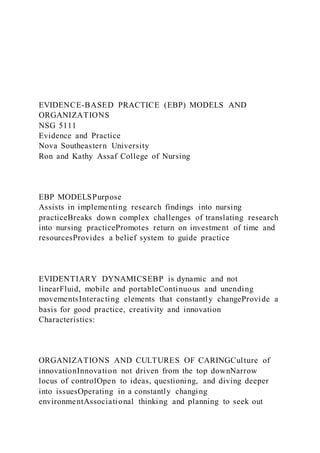
EVIDENCE-BASED PRACTICE (EBP) MODELS AND
ORGANIZATIONS
NSG 5111
Evidence and Practice
Nova Southeastern University
Ron and Kathy Assaf College of Nursing
EBP MODELSPurpose
Assists in implementing research findings into nursing
practiceBreaks down complex challenges of translating research
into nursing practicePromotes return on investment of time and
resourcesProvides a belief system to guide practice
EVIDENTIARY DYNAMICSEBP is dynamic and not
linearFluid, mobile and portableContinuous and unending
movementsInteracting elements that constantly changeProvide a
basis for good practice, creativity and innovation
Characteristics:
ORGANIZATIONS AND CULTURES OF CARINGCulture of
innovationInnovation not driven from the top downNarrow
locus of controlOpen to ideas, questioning, and diving deeper
into issuesOperating in a constantly changing
environmentAssociational thinking and planning to seek out
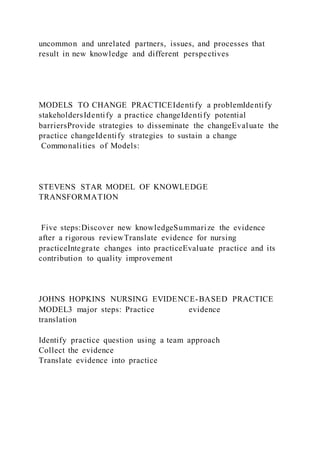
uncommon and unrelated partners, issues, and processes that
result in new knowledge and different perspectives
MODELS TO CHANGE PRACTICEIdentify a problemIdentify
stakeholdersIdentify a practice changeIdentify potential
barriersProvide strategies to disseminate the changeEvaluate the
practice changeIdentify strategies to sustain a change
Commonalities of Models:
STEVENS STAR MODEL OF KNOWLEDGE
TRANSFORMATION
Five steps:Discover new knowledgeSummarize the evidence
after a rigorous reviewTranslate evidence for nursing
practiceIntegrate changes into practiceEvaluate practice and its
contribution to quality improvement
JOHNS HOPKINS NURSING EVIDENCE-BASED PRACTICE
MODEL3 major steps: Practice evidence
translation
Identify practice question using a team approach
Collect the evidence
Translate evidence into practice
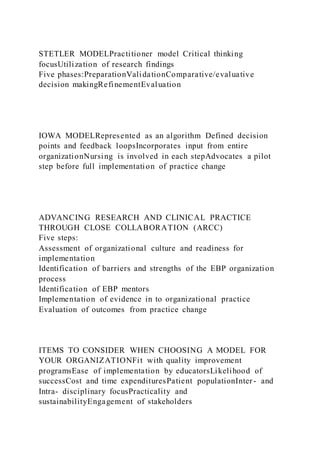
STETLER MODELPractitioner model Critical thinking
focusUtilization of research findings
Five phases:PreparationValidationComparative/evaluative
decision makingRefinementEvaluation
IOWA MODELRepresented as an algorithm Defined decision
points and feedback loopsIncorporates input from entire
organizationNursing is involved in each stepAdvocates a pilot
step before full implementation of practice change
ADVANCING RESEARCH AND CLINICAL PRACTICE
THROUGH CLOSE COLLABORATION (ARCC)
Five steps:
Assessment of organizational culture and readiness for
implementation
Identification of barriers and strengths of the EBP organization
process
Identification of EBP mentors
Implementation of evidence in to organizational practice
Evaluation of outcomes from practice change
ITEMS TO CONSIDER WHEN CHOOSING A MODEL FOR
YOUR ORGANIZATIONFit with quality improvement
programsEase of implementation by educatorsLikelihood of
successCost and time expendituresPatient populationInter- and
Intra- disciplinary focusPracticality and
sustainabilityEngagement of stakeholders
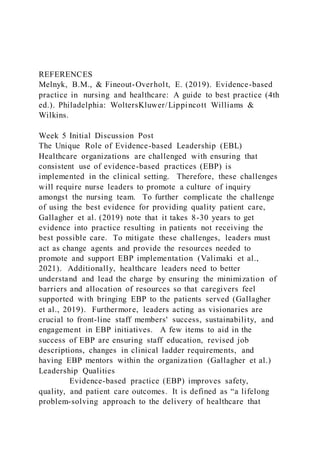
REFERENCES
Melnyk, B.M., & Fineout-Overholt, E. (2019). Evidence-based
practice in nursing and healthcare: A guide to best practice (4th
ed.). Philadelphia: WoltersKluwer/Lippincott Williams &
Wilkins.
Week 5 Initial Discussion Post
The Unique Role of Evidence-based Leadership (EBL)
Healthcare organizations are challenged with ensuring that
consistent use of evidence-based practices (EBP) is
implemented in the clinical setting. Therefore, these challenges
will require nurse leaders to promote a culture of inquiry
amongst the nursing team. To further complicate the challenge
of using the best evidence for providing quality patient care,
Gallagher et al. (2019) note that it takes 8-30 years to get
evidence into practice resulting in patients not receiving the
best possible care. To mitigate these challenges, leaders must
act as change agents and provide the resources needed to
promote and support EBP implementation (Valimaki et al.,
2021). Additionally, healthcare leaders need to better
understand and lead the charge by ensuring the minimization of
barriers and allocation of resources so that caregivers feel
supported with bringing EBP to the patients served (Gallagher
et al., 2019). Furthermore, leaders acting as visionaries are
crucial to front-line staff members' success, sustainability, and
engagement in EBP initiatives. A few items to aid in the
success of EBP are ensuring staff education, revised job
descriptions, changes in clinical ladder requirements, and
having EBP mentors within the organization (Gallagher et al.)
Leadership Qualities
Evidence-based practice (EBP) improves safety,
quality, and patient care outcomes. It is defined as “a lifelong
problem-solving approach to the delivery of healthcare that
integrates the best evidence from well-designed studies”
(Caramanica et al., 2022, p. 27). Leaders must be influential in
supporting and guiding their team through focused problem-
solving to incorporate the best evidence into the patient care
setting. Leaders must also possess the knowledge and skill-set
needed to act as a mentor in the push for driving EBP in the
work environment. The two levels of evidence-based leadership
commitment are self-actualization of EBP and being the
visionary for ensuring EBP is engrained into practice. The
second evidence-based leadership commitment is to facilitate a
culture of EBP as the basis for clinical decision-making.
According to Gallagher et al. (2019), a leadership style that is
important to mention is transformational leaders that form a
partnership with and gain the trust of frontline caregivers to
gain the ability to effect change and EBP inclusion into the
culture. Caramanica et al. (2022) note that leadership support
and engagement are integral to successfully sustaining EBP to
guide practice and improve patient outcomes.
References
Caramanica, L., Gallagher-Ford, L., Idelman, L., Mindrila, D.,
Richter, S., & Thomas, B. K. (2022). Establishment of nurse
manager leadership competencies to support clinicians in
evidence-based practice. The Journal of Nursing
Administration, 52(1), 27-
34. https://doi.org/10.1097/NNA.0000000000001099 (Links to
an external site.)
Gallagher-Ford, L., Buck, J. S., & Melnyk, B. M. (2019).
Leadership strategies for creating and sustaining evidence-based
practice organizations. In B. M. Melnyk & E. Fineout-Overholt
(Eds), Evidence-Based Practice in Nursing and Healthcare: A
Guide to Best Practice(4th ed., pp. 328-347). Wolters Kluwer.
Valimaki, M. A., Lantta, T., Hipp, K., Varpula, J., Liu, G.,
Tang, Y., Chen, W., Hu, S., & Li, X. (2021). Measured and
perceived impacts of evidence-based leadership in nursing: A
mixed-methods systematic review protocol. BMJ Open, 11(10),
e055356. https://doi.org/10.1136/bmjopen-2021-055356
EVIDENCE-BASED PRACTICE (EBP) MODELS AND ORGANIZATIONSNS

EVIDENCE-BASED PRACTICE (EBP) MODELS AND ORGANIZATIONSNS

  • 1.
    EVIDENCE-BASED PRACTICE (EBP)MODELS AND ORGANIZATIONS NSG 5111 Evidence and Practice Nova Southeastern University Ron and Kathy Assaf College of Nursing EBP MODELSPurpose Assists in implementing research findings into nursing practiceBreaks down complex challenges of translating research into nursing practicePromotes return on investment of time and resourcesProvides a belief system to guide practice EVIDENTIARY DYNAMICSEBP is dynamic and not linearFluid, mobile and portableContinuous and unending movementsInteracting elements that constantly changeProvide a basis for good practice, creativity and innovation Characteristics: ORGANIZATIONS AND CULTURES OF CARINGCulture of innovationInnovation not driven from the top downNarrow locus of controlOpen to ideas, questioning, and diving deeper into issuesOperating in a constantly changing environmentAssociational thinking and planning to seek out
  • 2.
    uncommon and unrelatedpartners, issues, and processes that result in new knowledge and different perspectives MODELS TO CHANGE PRACTICEIdentify a problemIdentify stakeholdersIdentify a practice changeIdentify potential barriersProvide strategies to disseminate the changeEvaluate the practice changeIdentify strategies to sustain a change Commonalities of Models: STEVENS STAR MODEL OF KNOWLEDGE TRANSFORMATION Five steps:Discover new knowledgeSummarize the evidence after a rigorous reviewTranslate evidence for nursing practiceIntegrate changes into practiceEvaluate practice and its contribution to quality improvement JOHNS HOPKINS NURSING EVIDENCE-BASED PRACTICE MODEL3 major steps: Practice evidence translation Identify practice question using a team approach Collect the evidence Translate evidence into practice
  • 3.
    STETLER MODELPractitioner modelCritical thinking focusUtilization of research findings Five phases:PreparationValidationComparative/evaluative decision makingRefinementEvaluation IOWA MODELRepresented as an algorithm Defined decision points and feedback loopsIncorporates input from entire organizationNursing is involved in each stepAdvocates a pilot step before full implementation of practice change ADVANCING RESEARCH AND CLINICAL PRACTICE THROUGH CLOSE COLLABORATION (ARCC) Five steps: Assessment of organizational culture and readiness for implementation Identification of barriers and strengths of the EBP organization process Identification of EBP mentors Implementation of evidence in to organizational practice Evaluation of outcomes from practice change ITEMS TO CONSIDER WHEN CHOOSING A MODEL FOR YOUR ORGANIZATIONFit with quality improvement programsEase of implementation by educatorsLikelihood of successCost and time expendituresPatient populationInter- and Intra- disciplinary focusPracticality and sustainabilityEngagement of stakeholders
  • 4.
    REFERENCES Melnyk, B.M., &Fineout-Overholt, E. (2019). Evidence-based practice in nursing and healthcare: A guide to best practice (4th ed.). Philadelphia: WoltersKluwer/Lippincott Williams & Wilkins. Week 5 Initial Discussion Post The Unique Role of Evidence-based Leadership (EBL) Healthcare organizations are challenged with ensuring that consistent use of evidence-based practices (EBP) is implemented in the clinical setting. Therefore, these challenges will require nurse leaders to promote a culture of inquiry amongst the nursing team. To further complicate the challenge of using the best evidence for providing quality patient care, Gallagher et al. (2019) note that it takes 8-30 years to get evidence into practice resulting in patients not receiving the best possible care. To mitigate these challenges, leaders must act as change agents and provide the resources needed to promote and support EBP implementation (Valimaki et al., 2021). Additionally, healthcare leaders need to better understand and lead the charge by ensuring the minimization of barriers and allocation of resources so that caregivers feel supported with bringing EBP to the patients served (Gallagher et al., 2019). Furthermore, leaders acting as visionaries are crucial to front-line staff members' success, sustainability, and engagement in EBP initiatives. A few items to aid in the success of EBP are ensuring staff education, revised job descriptions, changes in clinical ladder requirements, and having EBP mentors within the organization (Gallagher et al.) Leadership Qualities Evidence-based practice (EBP) improves safety, quality, and patient care outcomes. It is defined as “a lifelong problem-solving approach to the delivery of healthcare that
  • 5.
    integrates the bestevidence from well-designed studies” (Caramanica et al., 2022, p. 27). Leaders must be influential in supporting and guiding their team through focused problem- solving to incorporate the best evidence into the patient care setting. Leaders must also possess the knowledge and skill-set needed to act as a mentor in the push for driving EBP in the work environment. The two levels of evidence-based leadership commitment are self-actualization of EBP and being the visionary for ensuring EBP is engrained into practice. The second evidence-based leadership commitment is to facilitate a culture of EBP as the basis for clinical decision-making. According to Gallagher et al. (2019), a leadership style that is important to mention is transformational leaders that form a partnership with and gain the trust of frontline caregivers to gain the ability to effect change and EBP inclusion into the culture. Caramanica et al. (2022) note that leadership support and engagement are integral to successfully sustaining EBP to guide practice and improve patient outcomes. References Caramanica, L., Gallagher-Ford, L., Idelman, L., Mindrila, D., Richter, S., & Thomas, B. K. (2022). Establishment of nurse manager leadership competencies to support clinicians in evidence-based practice. The Journal of Nursing Administration, 52(1), 27- 34. https://doi.org/10.1097/NNA.0000000000001099 (Links to an external site.) Gallagher-Ford, L., Buck, J. S., & Melnyk, B. M. (2019). Leadership strategies for creating and sustaining evidence-based practice organizations. In B. M. Melnyk & E. Fineout-Overholt (Eds), Evidence-Based Practice in Nursing and Healthcare: A Guide to Best Practice(4th ed., pp. 328-347). Wolters Kluwer. Valimaki, M. A., Lantta, T., Hipp, K., Varpula, J., Liu, G., Tang, Y., Chen, W., Hu, S., & Li, X. (2021). Measured and perceived impacts of evidence-based leadership in nursing: A mixed-methods systematic review protocol. BMJ Open, 11(10), e055356. https://doi.org/10.1136/bmjopen-2021-055356