Philosophical Foundation of Education
Dejene Hailu
(BSc, MScPN, Assistant Prof )
 At the end of this session students will be able to
 Define learning, education, training ,teaching and
development
 Discuss philosophy in education
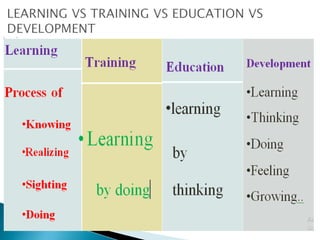
 Learning
 Education
 Training
 Teaching
 Development
 Planned process to modify attitude, knowledge, Skill
and behaviour through a learning experience to
 achieve effective performance in any activity or range of
activities
 Perform job-related tasks.
 Characterized as an instructor-led, content-based
intervention leading to desired changes in behaviour.
 Aims to improve job performance in a direct way.
 Derived from a Latin word “ Educere” which means draw
out – from the student.
 Aims to develop knowledge, skills, moral values and
understanding in aspects of life rather than knowledge
and skill relating to only a limited field of activity.
 Process by which human transmits their experiences, new
findings, and values accumulated over the years, in their
struggle for survival, and development, through
generations MOE (1994).
Types of education
 Formal
 Informal
 Non formal
 Encompasses training and education
 Self -directed , work-based process leading to increased
adaptive capacity
 An on going, lifelong journey that may not always be
clearly planned or even intentional
 Knowing something that you not know before (insights
and realizations as well as facts) and/or doing something
that you could not do before (skills).
 A change in behaviour, perceptions, insights attitudes, or
any combination of these that can be repeated when the
need is aroused.
 Takes place in each person’s head
 People learn for themselves; no one can do it for them.
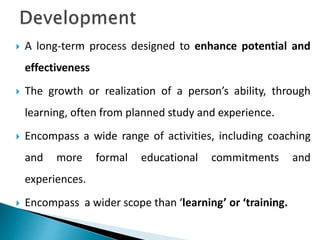
 A long-term process designed to enhance potential and
effectiveness
 The growth or realization of a person’s ability, through
learning, often from planned study and experience.
 Encompass a wide range of activities, including coaching
and more formal educational commitments and
experiences.
 Encompass a wider scope than ‘learning’ or ‘training.
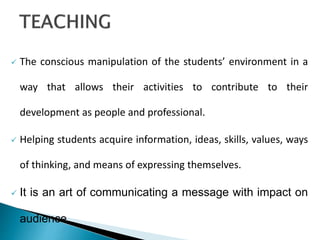
 The conscious manipulation of the students’ environment in a
way that allows their activities to contribute to their
development as people and professional.
 Helping students acquire information, ideas, skills, values, ways
of thinking, and means of expressing themselves.
 It is an art of communicating a message with impact on
audience.
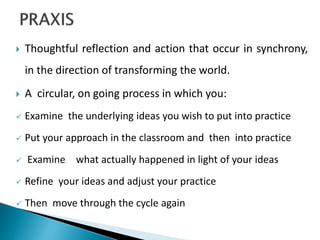
 Thoughtful reflection and action that occur in synchrony,
in the direction of transforming the world.
 A circular, on going process in which you:
 Examine the underlying ideas you wish to put into practice
 Put your approach in the classroom and then into practice
 Examine what actually happened in light of your ideas
 Refine your ideas and adjust your practice
 Then move through the cycle again
PHILOSOPHY?
What is philosophy?
 The term "philosophy" means, "love of wisdom." In a
broad sense, philosophy is an activity people undertake
when they seek to understand fundamental truths about
themselves, the world in which they live, and their
relationships to the world and to each other.
 Nature of being, the nature of reality and the limits of
knowledge.
 A statement of beliefs and values about the world.
 A perspective on human beings and their world
 An approach to the development of knowledge’ (fawcett,
1992).
 Identifies what is believed to be the basic or central issues
of a discipline
 Rationally thinking about the:-
 General nature of the world( METAPHYSICS)
 Justification of belief( EPISTEMOLOGY )
 Conduct of life ( ETHICS)
 Study of general and fundamental problems concerning
matters such as existence, knowledge, truth, beauty, law,
justice, validity, mind, and language.
 In general sense, the sum of persons fundamental belief
and convictions.
 Who am I?
 Who we are?
 Is there a higher existence that determines our existence?
How do you know it?
 What is the relationship between nature and human
beings?
 What is the meaning of life?
 Are our senses reliable in telling us about the truth of the
universe?
 How do we get to know about the world?
 What is the relationship between the mind and the body?
 Derived from the Greek words “meta” means (“beyond”,
“upon” or “after”) and physika, means (“physics”)
 Theory of existence (ultimate nature of reality or
existence) Beyond the physical.
 Find unity across the domains of experience and thought
 Asks questions such as ‘What exists?’ or ‘What is real?’
 Seek an irreducible foundation of reality or‘ first
principles’ from which absolute knowledge or truth can
be induced and deduced.
METAPHYSICAL QUESTIONS
 The most basic to ask because they provide the
foundation upon which all subsequent inquiry is based
 May be divided into four subsets:-
 Cosmological
 Theological
 Anthropological
 Ontological
 Study about the origin, nature, and development of the
universe as an orderly system.
Questions
 How did the universe originate and develop?
 Did it come about by accident or design?
 Does its existence have any purpose?
 Write Cosmology of nursing.
 Be in a group of 5 and write the
cosmology of nursing?
 Part of religious theory that deals with conceptions about
God.
Questions
 Is there a God?
 If God is there, is there one or more than one?
 What are the attributes of God?
 If God is both all good and all powerful, why does evil
exist?
 If God exists, what is His relationship to human beings
and the ‘real’ world of everyday life?”
 Study of human beings
 Scientific study of humanity, concerned with human
behaviour, human biology, cultures and societies, in
both present and past, including past human species.
ANTHROPOLOGICAL QUESTIONS
 What is the relation between mind and body?
 Is mind more fundamental than body, is body depending
on mind, or vice versa?
 What is humanity’s moral status?
 Are people born good, evil, or morally neutral?
 To what extent are individuals free?
 Does each person have a soul? If so, what is it?
 Study of the nature of existence, or what it means for
anything to exist.
ONTOLOGICAL QUESTIONS
 Is basic reality found in matter or physical energy (the
world we can sense? Or is it found in spirit or spiritual
energy?)
 Is it composed of one element (e.g., matter or spirit), or
two (e.g., matter and spirit), or many?”
 Is reality orderly and lawful in itself, or is it merely
orderable by the human mind?
 Is it fixed and stable, or is change its central feature? Is
this reality friendly, unfriendly, or neutral toward
humanity.
 Varying metaphysical beliefs lead to differing educational
approaches and even separate systems of education
 At the metaphysical level, there are four broad
philosophical schools of thought that apply to education
today:
 Idealism
 Realism
 Pragmatism (experientialism)
 Existentialism
ideas are the only true reality- the only thing worth
knowing.
 In a search for truth, beauty, and justice that is enduring
and everlasting, the focus is on conscious reasoning in the
mind
 Developed by Plato (father of Idealism) 400 yrs BC.
 According to Plato there are two worlds:-
 Spiritual or mental world, which is eternal, permanent,
orderly, regular, and universal
 World of appearance, the world experienced through
sight, touch, smell, taste, and sound, that is changing,
imperfect, and disorderly.
 This division is often referred to as the duality of mind
and body.
 To understand truth, one must pursue knowledge and
identify with the Absolute Mind
 The soul is fully formed prior to birth and is perfect and at
one it is with the Universal Being.
 The birth process checks this perfection, so education
requires bringing latent ideas (fully formed concepts) to
consciousness.
 The aim of education is to discover and develop each
individual's abilities and full moral excellence in order to
better serve of the society.
 The curricular emphasis is subject matter of mind: literature,
history, philosophy, and religion.
Teaching methods focus on handling ideas through Lecture,
Discussion
 Socratic dialogue -a method of teaching that uses questioning
to help students discover and clarify knowledge.
 Developed by Aristotle, a student of Plato (father of both
Realism and the scientific method).
 Believe that reality exists independent of the human
mind.
 The ultimate reality is the world of physical objects.
 The focus is on the body/objects.
 Truth is objective- what can be observed
 To understand objective reality through "the
diligent/hardworking and unsparing scrutiny/study of all
observable data.“
 Aristotle believed that, to understand an object, its
ultimate form had to be understood, which does not
change.
 E,g A rose exists whether or not a person is aware of it. A
rose can exist in the mind without being physically present,
but ultimately, the rose shares properties with all other
roses and flowers (its form), although one rose may be red
and another may be peach colour.
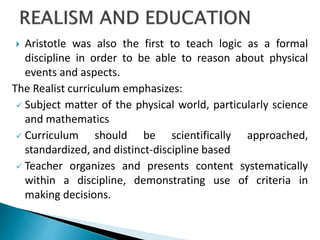
 Aristotle was also the first to teach logic as a formal
discipline in order to be able to reason about physical
events and aspects.
The Realist curriculum emphasizes:
 Subject matter of the physical world, particularly science
and mathematics
 Curriculum should be scientifically approached,
standardized, and distinct-discipline based
 Teacher organizes and presents content systematically
within a discipline, demonstrating use of criteria in
making decisions.
 Teaching methods focus on Mastery of facts and basic
skills through demonstration and recitation.
 Students must also demonstrate the ability to think
critically and scientifically, using observation and
experimentation.
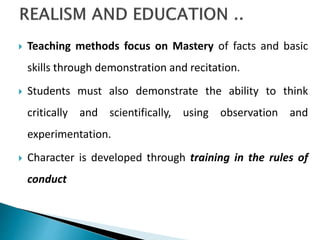
 Character is developed through training in the rules of
conduct
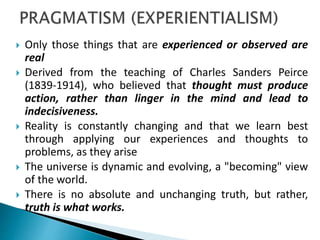
 Only those things that are experienced or observed are
real
 Derived from the teaching of Charles Sanders Peirce
(1839-1914), who believed that thought must produce
action, rather than linger in the mind and lead to
indecisiveness.
 Reality is constantly changing and that we learn best
through applying our experiences and thoughts to
problems, as they arise
 The universe is dynamic and evolving, a "becoming" view
of the world.
 There is no absolute and unchanging truth, but rather,
truth is what works.
For Pragmatists
 Curriculum should bring the disciplines together to focus
on solving problems in an interdisciplinary way-DTTP.
 Rather than passing down organized bodies of knowledge
to new learners, learners should apply their knowledge to
real situations through experimental inquiry.
 This prepares students for citizenship, daily living, and
future careers.
Teaching methods focus on :
 Hands-on problem solving
 Experimenting
 Projects
 Often having students work in groups
 The nature of reality is subjective, and lies within the
individual.
 Individual choice and individual standards rather than
external standards are central
 The physical world has no inherent meaning outside of
human existence
 Existence comes before any definition of what we are
 We define ourselves in relationship to that existence by
the choices we make.
 The subject matter of existentialist classrooms should
be a matter of personal choice
 Teachers view the individual as an entity within a social
context in which the learner must confront others'
views to clarify his or her own.
 Character development emphasizes of individual
responsibility for decisions.
 Real answers come from within the individual, not
from outside authority.
 Examining life through authentic thinking involves
students in genuine learning experiences.
 Existentialists start with the student, rather than on
curriculum content.
 Branch of philosophy concerned with the nature and
scope, source and validity of knowledge
 Study of the origin, nature, limits, and methods of
knowledge
 Theory of knowledge
 Comes from Greek word episteme meaning
“knowledge, understanding” and logy meaning “study”.
 What is true?
 How do we know?
 What is knowledge?
 How is knowledge acquired?
 What do people know?
 How do we know that we know ?
 What is true knowledge ?
 How can we have a true knowledge?
 What is the criteria of true knowledge?
 How do we know that our knowledge is true or false ?
 Stems from two Greek words- “Axios” means “value,
worth” and “logos” means “reason/ theory/ symbol /
science/study of”
 Philosophical study of value ( worth of something)
 What is a value?
 Where do values come from?
 How do we justify our values?
 How do we know what is valuable?
 What is the relationship between values and
knowledge?
 What kinds of values exist?
 Branches of Axiology
ETHICS
 Study of moral values and conduct.
 Right /wrong, good/bad, moral/immoral
Question
 How should I behave?
 What is good and evil, right and wrong?
AESTHETICS
 Realm of value that searches for the principles governing
the creation and appreciation of beauty and art.
 Evaluates beauty and ugliness
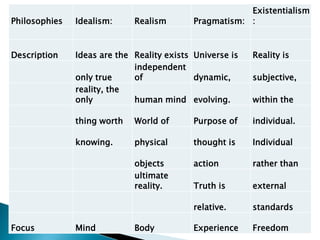
Philosophies Idealism: Realism Pragmatism:
Existentialism
:
Description Ideas are the Reality exists Universe is Reality is
only true
independent
of dynamic, subjective,
reality, the
only human mind evolving. within the
thing worth World of Purpose of individual.
knowing. physical thought is Individual
objects action rather than
ultimate
reality. Truth is external
relative. standards
Focus Mind Body Experience Freedom
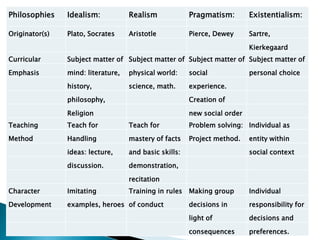
Philosophies Idealism: Realism Pragmatism: Existentialism:
Originator(s) Plato, Socrates Aristotle Pierce, Dewey Sartre,
Kierkegaard
Curricular Subject matter of Subject matter of Subject matter of Subject matter of
Emphasis mind: literature, physical world: social personal choice
history, science, math. experience.
philosophy, Creation of
Religion new social order
Teaching Teach for Teach for Problem solving: Individual as
Method Handling mastery of facts Project method. entity within
ideas: lecture, and basic skills: social context
discussion. demonstration,
recitation
Character Imitating Training in rules Making group Individual
Development examples, heroes of conduct decisions in responsibility for
light of decisions and
consequences preferences.

Nursing education and philosophy

  • 1.
    Philosophical Foundation ofEducation Dejene Hailu (BSc, MScPN, Assistant Prof )
  • 2.
     At theend of this session students will be able to  Define learning, education, training ,teaching and development  Discuss philosophy in education
  • 3.
     Learning  Education Training  Teaching  Development
  • 4.
     Planned processto modify attitude, knowledge, Skill and behaviour through a learning experience to  achieve effective performance in any activity or range of activities  Perform job-related tasks.  Characterized as an instructor-led, content-based intervention leading to desired changes in behaviour.  Aims to improve job performance in a direct way.
  • 5.
     Derived froma Latin word “ Educere” which means draw out – from the student.  Aims to develop knowledge, skills, moral values and understanding in aspects of life rather than knowledge and skill relating to only a limited field of activity.  Process by which human transmits their experiences, new findings, and values accumulated over the years, in their struggle for survival, and development, through generations MOE (1994).
  • 6.
    Types of education Formal  Informal  Non formal
  • 7.
     Encompasses trainingand education  Self -directed , work-based process leading to increased adaptive capacity  An on going, lifelong journey that may not always be clearly planned or even intentional  Knowing something that you not know before (insights and realizations as well as facts) and/or doing something that you could not do before (skills).
  • 8.
     A changein behaviour, perceptions, insights attitudes, or any combination of these that can be repeated when the need is aroused.  Takes place in each person’s head  People learn for themselves; no one can do it for them.
  • 9.
     A long-termprocess designed to enhance potential and effectiveness  The growth or realization of a person’s ability, through learning, often from planned study and experience.  Encompass a wide range of activities, including coaching and more formal educational commitments and experiences.  Encompass a wider scope than ‘learning’ or ‘training.
  • 11.
     The consciousmanipulation of the students’ environment in a way that allows their activities to contribute to their development as people and professional.  Helping students acquire information, ideas, skills, values, ways of thinking, and means of expressing themselves.  It is an art of communicating a message with impact on audience.
  • 12.
     Thoughtful reflectionand action that occur in synchrony, in the direction of transforming the world.  A circular, on going process in which you:  Examine the underlying ideas you wish to put into practice  Put your approach in the classroom and then into practice  Examine what actually happened in light of your ideas  Refine your ideas and adjust your practice  Then move through the cycle again
  • 13.
  • 15.
    What is philosophy? The term "philosophy" means, "love of wisdom." In a broad sense, philosophy is an activity people undertake when they seek to understand fundamental truths about themselves, the world in which they live, and their relationships to the world and to each other.
  • 16.
     Nature ofbeing, the nature of reality and the limits of knowledge.  A statement of beliefs and values about the world.  A perspective on human beings and their world  An approach to the development of knowledge’ (fawcett, 1992).
  • 17.
     Identifies whatis believed to be the basic or central issues of a discipline  Rationally thinking about the:-  General nature of the world( METAPHYSICS)  Justification of belief( EPISTEMOLOGY )  Conduct of life ( ETHICS)  Study of general and fundamental problems concerning matters such as existence, knowledge, truth, beauty, law, justice, validity, mind, and language.  In general sense, the sum of persons fundamental belief and convictions.
  • 18.
     Who amI?  Who we are?  Is there a higher existence that determines our existence? How do you know it?  What is the relationship between nature and human beings?  What is the meaning of life?  Are our senses reliable in telling us about the truth of the universe?  How do we get to know about the world?  What is the relationship between the mind and the body?
  • 19.
     Derived fromthe Greek words “meta” means (“beyond”, “upon” or “after”) and physika, means (“physics”)  Theory of existence (ultimate nature of reality or existence) Beyond the physical.  Find unity across the domains of experience and thought  Asks questions such as ‘What exists?’ or ‘What is real?’
  • 20.
     Seek anirreducible foundation of reality or‘ first principles’ from which absolute knowledge or truth can be induced and deduced. METAPHYSICAL QUESTIONS  The most basic to ask because they provide the foundation upon which all subsequent inquiry is based  May be divided into four subsets:-  Cosmological  Theological  Anthropological  Ontological
  • 21.
     Study aboutthe origin, nature, and development of the universe as an orderly system. Questions  How did the universe originate and develop?  Did it come about by accident or design?  Does its existence have any purpose?
  • 22.
     Write Cosmologyof nursing.  Be in a group of 5 and write the cosmology of nursing?
  • 23.
     Part ofreligious theory that deals with conceptions about God. Questions  Is there a God?  If God is there, is there one or more than one?  What are the attributes of God?  If God is both all good and all powerful, why does evil exist?  If God exists, what is His relationship to human beings and the ‘real’ world of everyday life?”
  • 24.
     Study ofhuman beings  Scientific study of humanity, concerned with human behaviour, human biology, cultures and societies, in both present and past, including past human species.
  • 25.
    ANTHROPOLOGICAL QUESTIONS  Whatis the relation between mind and body?  Is mind more fundamental than body, is body depending on mind, or vice versa?  What is humanity’s moral status?  Are people born good, evil, or morally neutral?  To what extent are individuals free?  Does each person have a soul? If so, what is it?
  • 26.
     Study ofthe nature of existence, or what it means for anything to exist. ONTOLOGICAL QUESTIONS  Is basic reality found in matter or physical energy (the world we can sense? Or is it found in spirit or spiritual energy?)  Is it composed of one element (e.g., matter or spirit), or two (e.g., matter and spirit), or many?”  Is reality orderly and lawful in itself, or is it merely orderable by the human mind?  Is it fixed and stable, or is change its central feature? Is this reality friendly, unfriendly, or neutral toward humanity.
  • 27.
     Varying metaphysicalbeliefs lead to differing educational approaches and even separate systems of education  At the metaphysical level, there are four broad philosophical schools of thought that apply to education today:  Idealism  Realism  Pragmatism (experientialism)  Existentialism
  • 28.
    ideas are theonly true reality- the only thing worth knowing.  In a search for truth, beauty, and justice that is enduring and everlasting, the focus is on conscious reasoning in the mind  Developed by Plato (father of Idealism) 400 yrs BC.  According to Plato there are two worlds:-  Spiritual or mental world, which is eternal, permanent, orderly, regular, and universal  World of appearance, the world experienced through sight, touch, smell, taste, and sound, that is changing, imperfect, and disorderly.
  • 29.
     This divisionis often referred to as the duality of mind and body.  To understand truth, one must pursue knowledge and identify with the Absolute Mind  The soul is fully formed prior to birth and is perfect and at one it is with the Universal Being.  The birth process checks this perfection, so education requires bringing latent ideas (fully formed concepts) to consciousness.
  • 30.
     The aimof education is to discover and develop each individual's abilities and full moral excellence in order to better serve of the society.  The curricular emphasis is subject matter of mind: literature, history, philosophy, and religion. Teaching methods focus on handling ideas through Lecture, Discussion  Socratic dialogue -a method of teaching that uses questioning to help students discover and clarify knowledge.
  • 31.
     Developed byAristotle, a student of Plato (father of both Realism and the scientific method).  Believe that reality exists independent of the human mind.  The ultimate reality is the world of physical objects.  The focus is on the body/objects.  Truth is objective- what can be observed
  • 32.
     To understandobjective reality through "the diligent/hardworking and unsparing scrutiny/study of all observable data.“  Aristotle believed that, to understand an object, its ultimate form had to be understood, which does not change.  E,g A rose exists whether or not a person is aware of it. A rose can exist in the mind without being physically present, but ultimately, the rose shares properties with all other roses and flowers (its form), although one rose may be red and another may be peach colour.
  • 33.
     Aristotle wasalso the first to teach logic as a formal discipline in order to be able to reason about physical events and aspects. The Realist curriculum emphasizes:  Subject matter of the physical world, particularly science and mathematics  Curriculum should be scientifically approached, standardized, and distinct-discipline based  Teacher organizes and presents content systematically within a discipline, demonstrating use of criteria in making decisions.
  • 34.
     Teaching methodsfocus on Mastery of facts and basic skills through demonstration and recitation.  Students must also demonstrate the ability to think critically and scientifically, using observation and experimentation.  Character is developed through training in the rules of conduct
  • 35.
     Only thosethings that are experienced or observed are real  Derived from the teaching of Charles Sanders Peirce (1839-1914), who believed that thought must produce action, rather than linger in the mind and lead to indecisiveness.  Reality is constantly changing and that we learn best through applying our experiences and thoughts to problems, as they arise  The universe is dynamic and evolving, a "becoming" view of the world.  There is no absolute and unchanging truth, but rather, truth is what works.
  • 36.
    For Pragmatists  Curriculumshould bring the disciplines together to focus on solving problems in an interdisciplinary way-DTTP.  Rather than passing down organized bodies of knowledge to new learners, learners should apply their knowledge to real situations through experimental inquiry.  This prepares students for citizenship, daily living, and future careers.
  • 37.
    Teaching methods focuson :  Hands-on problem solving  Experimenting  Projects  Often having students work in groups
  • 38.
     The natureof reality is subjective, and lies within the individual.  Individual choice and individual standards rather than external standards are central  The physical world has no inherent meaning outside of human existence  Existence comes before any definition of what we are  We define ourselves in relationship to that existence by the choices we make.
  • 39.
     The subjectmatter of existentialist classrooms should be a matter of personal choice  Teachers view the individual as an entity within a social context in which the learner must confront others' views to clarify his or her own.  Character development emphasizes of individual responsibility for decisions.
  • 40.
     Real answerscome from within the individual, not from outside authority.  Examining life through authentic thinking involves students in genuine learning experiences.  Existentialists start with the student, rather than on curriculum content.
  • 41.
     Branch ofphilosophy concerned with the nature and scope, source and validity of knowledge  Study of the origin, nature, limits, and methods of knowledge  Theory of knowledge  Comes from Greek word episteme meaning “knowledge, understanding” and logy meaning “study”.
  • 42.
     What istrue?  How do we know?  What is knowledge?  How is knowledge acquired?  What do people know?  How do we know that we know ?  What is true knowledge ?  How can we have a true knowledge?  What is the criteria of true knowledge?  How do we know that our knowledge is true or false ?
  • 43.
     Stems fromtwo Greek words- “Axios” means “value, worth” and “logos” means “reason/ theory/ symbol / science/study of”  Philosophical study of value ( worth of something)
  • 44.
     What isa value?  Where do values come from?  How do we justify our values?  How do we know what is valuable?  What is the relationship between values and knowledge?  What kinds of values exist?
  • 45.
     Branches ofAxiology ETHICS  Study of moral values and conduct.  Right /wrong, good/bad, moral/immoral Question  How should I behave?  What is good and evil, right and wrong? AESTHETICS  Realm of value that searches for the principles governing the creation and appreciation of beauty and art.  Evaluates beauty and ugliness
  • 46.
    Philosophies Idealism: RealismPragmatism: Existentialism : Description Ideas are the Reality exists Universe is Reality is only true independent of dynamic, subjective, reality, the only human mind evolving. within the thing worth World of Purpose of individual. knowing. physical thought is Individual objects action rather than ultimate reality. Truth is external relative. standards Focus Mind Body Experience Freedom
  • 47.
    Philosophies Idealism: RealismPragmatism: Existentialism: Originator(s) Plato, Socrates Aristotle Pierce, Dewey Sartre, Kierkegaard Curricular Subject matter of Subject matter of Subject matter of Subject matter of Emphasis mind: literature, physical world: social personal choice history, science, math. experience. philosophy, Creation of Religion new social order Teaching Teach for Teach for Problem solving: Individual as Method Handling mastery of facts Project method. entity within ideas: lecture, and basic skills: social context discussion. demonstration, recitation Character Imitating Training in rules Making group Individual Development examples, heroes of conduct decisions in responsibility for light of decisions and consequences preferences.