Numeracy  Parent Information Session 2011 Presented by:  Lisa Bonniface and Verna Cameron
Introduction What is Numeracy? Why do we teach this way?
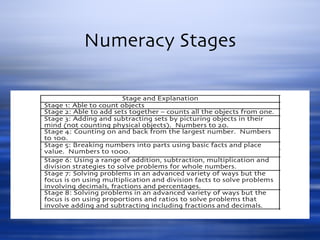
Numeracy Stages
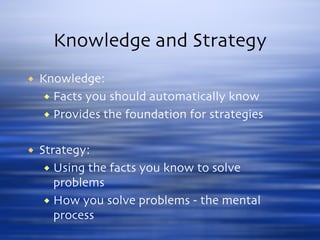
Knowledge and Strategy Knowledge: Facts you should automatically know Provides the foundation for strategies Strategy: Using the facts you know to solve problems How you solve problems - the mental process
Examples of some strategies that children use for addition and subtraction…
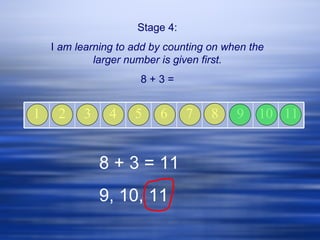
Stage 4: I  am learning to add by counting on when the larger number is given first. 8 + 3 = 1 2 3 4 5 6 7 8 9 10 11 8 + 3 = 11  9, 10, 11
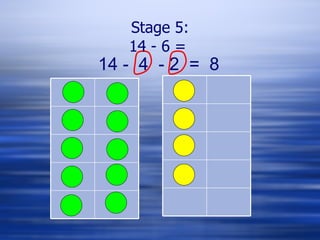
Stage 5: 14 - 6 =  14 -  4  - 2  =  8
Stage 6 Examples Solve: 53 – 29 Analyse the strategy you used to solve this based on what you see next.
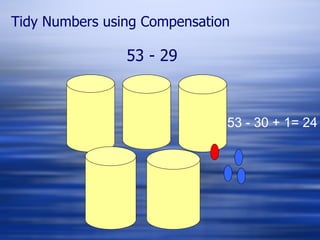
53 - 29 Tidy Numbers using Compensation 53 - 30 + 1= 24
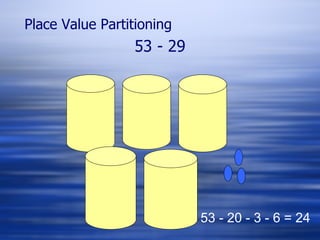
53 - 29 Place Value Partitioning 53 - 20 - 3 - 6 = 24
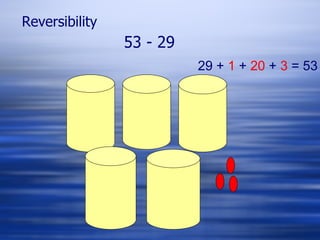
53 - 29 Reversibility 29 +  1   +   20   +   3   = 53
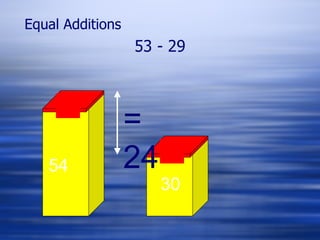
53 - 29 Equal Additions = 24 53 29 1 1 54 30
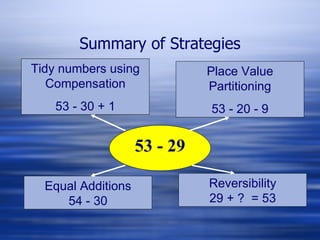
Summary of Strategies Tidy numbers using Compensation 53 - 30 + 1 53 - 29 Place Value Partitioning 53 - 20 - 9 Equal Additions 54 - 30 Reversibility 29 + ?  = 53
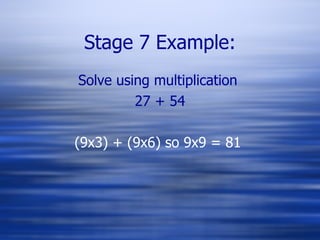
Stage 7 Example: Solve using multiplication  27 + 54 (9x3) + (9x6) so 9x9 = 81
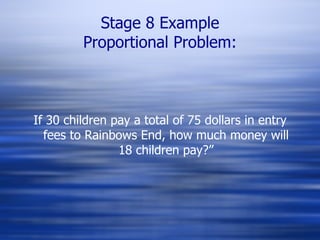
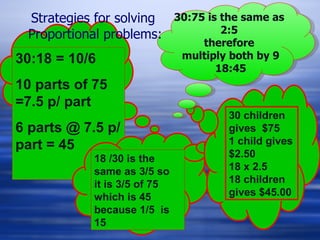
Stage 8 Example Proportional Problem: If 30 children pay a total of 75 dollars in entry fees to Rainbows End, how much money will 18 children pay?”
Strategies for solving  Proportional problems: 30:75 is the same as  2:5  therefore  multiply both by 9 18:45 30:18 = 10/6 10 parts of 75 =7.5 p/ part 6 parts @ 7.5 p/part = 45 18 /30 is the same as 3/5 so  it is 3/5 of 75 which is 45 because 1/5  is 15 30 children gives  $75 1 child gives $2.50 18 x 2.5 18 children gives $45.00
Examples of some strategies that children use for multiplication and division…
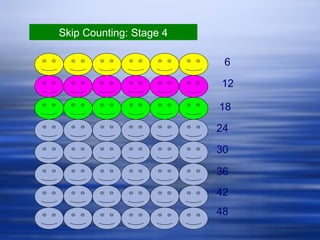
8 x 6 Skip Counting: Stage 4 6 12 18 24 30 36 42 48
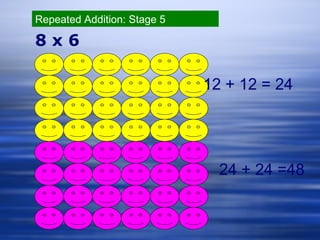
8 x 6 Repeated Addition: Stage 5 12 + 12 = 24 24 + 24 =48
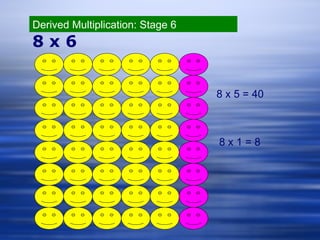
8 x 6 Derived Multiplication: Stage 6 8 x 5 = 40 8 x 1 = 8
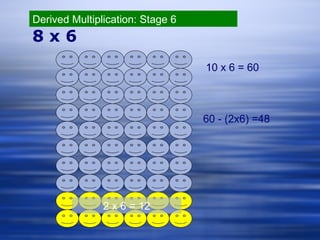
8 x 6 10 x 6 = 60 60 - (2x6) =48 Derived Multiplication: Stage 6 2 x 6 = 12
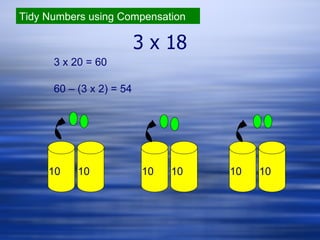
3 x 18 Tidy Numbers using Compensation 10 10 10 10 10 10 3 x 20 = 60 60 – (3 x 2) = 54
Stage 7 Examples
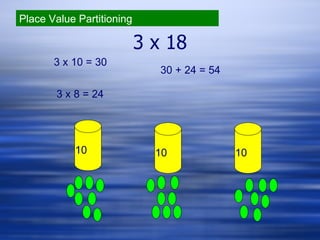
3 x 18 Place Value Partitioning 30 + 24 = 54 10 10 10 3 x 10 = 30 3 x 8 = 24
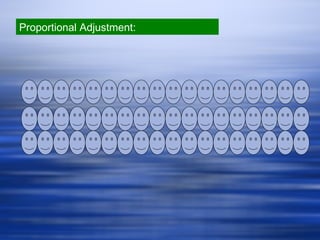
Proportional Adjustment:
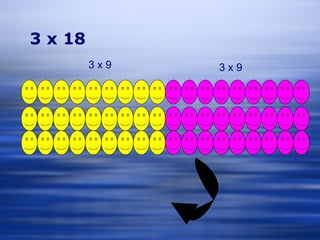
3 x 18 3 x 9 3 x 9
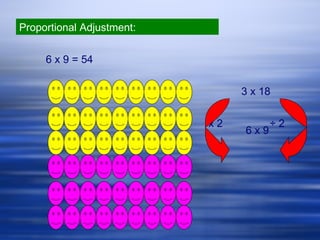
6 x 9 = 54 Proportional Adjustment: 3 x 18  6 x 9 x 2 ÷ 2
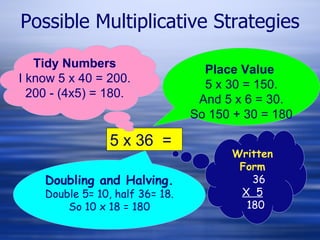
Possible Multiplicative Strategies Place Value  5 x 30 = 150. And 5 x 6 = 30. So 150 + 30 = 180 Doubling and Halving. Double 5= 10, half 36= 18. So 10 x 18 = 180 Written Form 36 X  5 180 5 x 36  = Tidy Numbers I know 5 x 40 = 200. 200 - (4x5) = 180.
Numeracy Lessons Warm up Small group teaching WALHT Thinking groups Strategies  Real life demonstration
What you can do at home Basic facts - addition and subtraction facts and times tables as your children get older  Everyday life Family of facts Picture books e.g. The Very Hungry Caterpillar Websites www.mathletics.co.nz www.nzmaths.co.nz
Resources Flash cards Numbers up  (google search Numbers up and follow the link to gold-software.com) Monopoly, Shrek Operation, Snakes and Ladders, Snap / Memory / Fish Card games Mathletics
Any Questions?

Numeracy parent meeting

  • 1.
    Numeracy ParentInformation Session 2011 Presented by: Lisa Bonniface and Verna Cameron
  • 2.
    Introduction What isNumeracy? Why do we teach this way?
  • 3.
  • 4.
    Knowledge and StrategyKnowledge: Facts you should automatically know Provides the foundation for strategies Strategy: Using the facts you know to solve problems How you solve problems - the mental process
  • 5.
    Examples of somestrategies that children use for addition and subtraction…
  • 6.
    Stage 4: I am learning to add by counting on when the larger number is given first. 8 + 3 = 1 2 3 4 5 6 7 8 9 10 11 8 + 3 = 11 9, 10, 11
  • 7.
    Stage 5: 14- 6 = 14 - 4 - 2 = 8
  • 8.
    Stage 6 ExamplesSolve: 53 – 29 Analyse the strategy you used to solve this based on what you see next.
  • 9.
    53 - 29Tidy Numbers using Compensation 53 - 30 + 1= 24
  • 10.
    53 - 29Place Value Partitioning 53 - 20 - 3 - 6 = 24
  • 11.
    53 - 29Reversibility 29 + 1 + 20 + 3 = 53
  • 12.
    53 - 29Equal Additions = 24 53 29 1 1 54 30
  • 13.
    Summary of StrategiesTidy numbers using Compensation 53 - 30 + 1 53 - 29 Place Value Partitioning 53 - 20 - 9 Equal Additions 54 - 30 Reversibility 29 + ? = 53
  • 14.
    Stage 7 Example:Solve using multiplication 27 + 54 (9x3) + (9x6) so 9x9 = 81
  • 15.
    Stage 8 ExampleProportional Problem: If 30 children pay a total of 75 dollars in entry fees to Rainbows End, how much money will 18 children pay?”
  • 16.
    Strategies for solving Proportional problems: 30:75 is the same as 2:5 therefore multiply both by 9 18:45 30:18 = 10/6 10 parts of 75 =7.5 p/ part 6 parts @ 7.5 p/part = 45 18 /30 is the same as 3/5 so it is 3/5 of 75 which is 45 because 1/5 is 15 30 children gives $75 1 child gives $2.50 18 x 2.5 18 children gives $45.00
  • 17.
    Examples of somestrategies that children use for multiplication and division…
  • 18.
    8 x 6Skip Counting: Stage 4 6 12 18 24 30 36 42 48
  • 19.
    8 x 6Repeated Addition: Stage 5 12 + 12 = 24 24 + 24 =48
  • 20.
    8 x 6Derived Multiplication: Stage 6 8 x 5 = 40 8 x 1 = 8
  • 21.
    8 x 610 x 6 = 60 60 - (2x6) =48 Derived Multiplication: Stage 6 2 x 6 = 12
  • 22.
    3 x 18Tidy Numbers using Compensation 10 10 10 10 10 10 3 x 20 = 60 60 – (3 x 2) = 54
  • 23.
  • 24.
    3 x 18Place Value Partitioning 30 + 24 = 54 10 10 10 3 x 10 = 30 3 x 8 = 24
  • 25.
  • 26.
    3 x 183 x 9 3 x 9
  • 27.
    6 x 9= 54 Proportional Adjustment: 3 x 18 6 x 9 x 2 ÷ 2
  • 28.
    Possible Multiplicative StrategiesPlace Value 5 x 30 = 150. And 5 x 6 = 30. So 150 + 30 = 180 Doubling and Halving. Double 5= 10, half 36= 18. So 10 x 18 = 180 Written Form 36 X 5 180 5 x 36 = Tidy Numbers I know 5 x 40 = 200. 200 - (4x5) = 180.
  • 29.
    Numeracy Lessons Warmup Small group teaching WALHT Thinking groups Strategies Real life demonstration
  • 30.
    What you cando at home Basic facts - addition and subtraction facts and times tables as your children get older Everyday life Family of facts Picture books e.g. The Very Hungry Caterpillar Websites www.mathletics.co.nz www.nzmaths.co.nz
  • 31.
    Resources Flash cardsNumbers up (google search Numbers up and follow the link to gold-software.com) Monopoly, Shrek Operation, Snakes and Ladders, Snap / Memory / Fish Card games Mathletics
  • 32.

Editor's Notes