Fall 2002 CMSC 203 - Discrete Structures 1
Let us get into…
Number Theory
Fall 2002 CMSC 203 - Discrete Structures 2
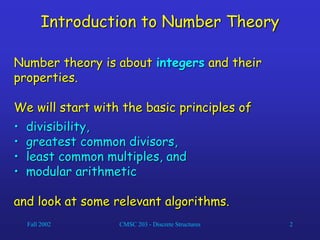
Introduction to Number Theory
Number theory is about integers and their
properties.
We will start with the basic principles of
• divisibility,
• greatest common divisors,
• least common multiples, and
• modular arithmetic
and look at some relevant algorithms.
Fall 2002 CMSC 203 - Discrete Structures 3
Division
If a and b are integers with a  0, we say that
a divides b if there is an integer c so that b = ac.
When a divides b we say that a is a factor of b
and that b is a multiple of a.
The notation a | b means that a divides b.
We write a X b when a does not divide b
(see book for correct symbol).
Fall 2002 CMSC 203 - Discrete Structures 4
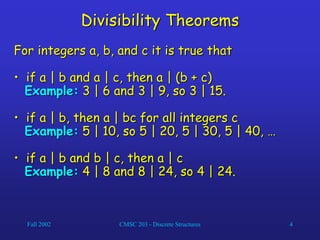
Divisibility Theorems
For integers a, b, and c it is true that
• if a | b and a | c, then a | (b + c)
Example: 3 | 6 and 3 | 9, so 3 | 15.
• if a | b, then a | bc for all integers c
Example: 5 | 10, so 5 | 20, 5 | 30, 5 | 40, …
• if a | b and b | c, then a | c
Example: 4 | 8 and 8 | 24, so 4 | 24.
Fall 2002 CMSC 203 - Discrete Structures 5
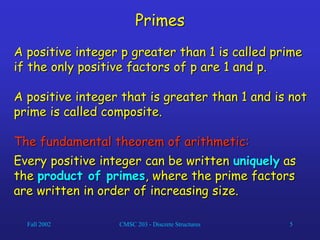
Primes
A positive integer p greater than 1 is called prime
if the only positive factors of p are 1 and p.
A positive integer that is greater than 1 and is not
prime is called composite.
The fundamental theorem of arithmetic:
Every positive integer can be written uniquely as
the product of primes, where the prime factors
are written in order of increasing size.
Fall 2002 CMSC 203 - Discrete Structures 6
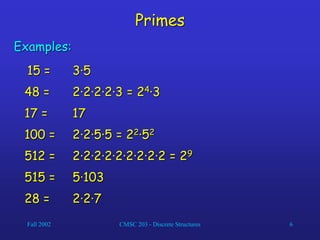
Primes
Examples:
3·5
48 =
17 =
100 =
512 =
515 =
28 =
15 =
2·2·2·2·3 = 24·3
17
2·2·5·5 = 22·52
2·2·2·2·2·2·2·2·2 = 29
5·103
2·2·7
Fall 2002 CMSC 203 - Discrete Structures 7
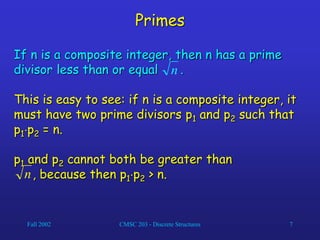
Primes
If n is a composite integer, then n has a prime
divisor less than or equal .
This is easy to see: if n is a composite integer, it
must have two prime divisors p1 and p2 such that
p1p2 = n.
p1 and p2 cannot both be greater than
, because then p1p2 > n.
n
n
Fall 2002 CMSC 203 - Discrete Structures 8
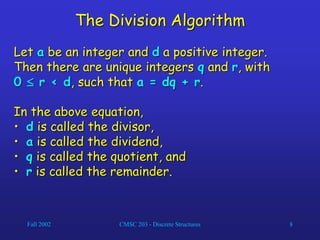
The Division Algorithm
Let a be an integer and d a positive integer.
Then there are unique integers q and r, with
0  r < d, such that a = dq + r.
In the above equation,
• d is called the divisor,
• a is called the dividend,
• q is called the quotient, and
• r is called the remainder.
Fall 2002 CMSC 203 - Discrete Structures 9
The Division Algorithm
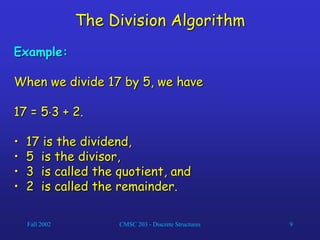
Example:
When we divide 17 by 5, we have
17 = 53 + 2.
• 17 is the dividend,
• 5 is the divisor,
• 3 is called the quotient, and
• 2 is called the remainder.
Fall 2002 CMSC 203 - Discrete Structures 10
The Division Algorithm
Another example:
What happens when we divide -11 by 3 ?
Note that the remainder cannot be negative.
-11 = 3(-4) + 1.
• -11 is the dividend,
• 3 is the divisor,
• -4 is called the quotient, and
• 1 is called the remainder.
Fall 2002 CMSC 203 - Discrete Structures 11
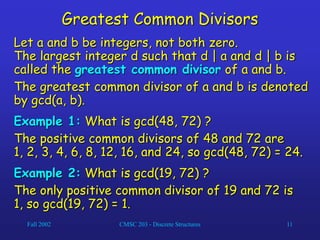
Greatest Common Divisors
Let a and b be integers, not both zero.
The largest integer d such that d | a and d | b is
called the greatest common divisor of a and b.
The greatest common divisor of a and b is denoted
by gcd(a, b).
Example 1: What is gcd(48, 72) ?
The positive common divisors of 48 and 72 are
1, 2, 3, 4, 6, 8, 12, 16, and 24, so gcd(48, 72) = 24.
Example 2: What is gcd(19, 72) ?
The only positive common divisor of 19 and 72 is
1, so gcd(19, 72) = 1.
Fall 2002 CMSC 203 - Discrete Structures 12
Greatest Common Divisors
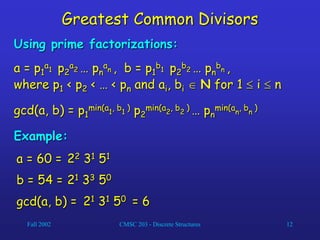
Using prime factorizations:
a = p1
a1 p2
a2 … pn
an , b = p1
b1 p2
b2 … pn
bn ,
where p1 < p2 < … < pn and ai, bi  N for 1  i  n
gcd(a, b) = p1
min(a1
, b1
) p2
min(a2
, b2
) … pn
min(an
, bn
)
Example:
a = 60 = 22 31 51
b = 54 = 21 33 50
gcd(a, b) = 21 31 50 = 6
Fall 2002 CMSC 203 - Discrete Structures 13
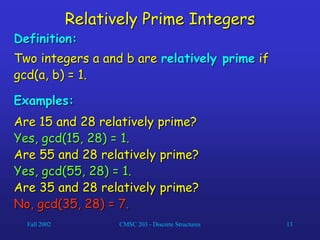
Relatively Prime Integers
Definition:
Two integers a and b are relatively prime if
gcd(a, b) = 1.
Examples:
Are 15 and 28 relatively prime?
Yes, gcd(15, 28) = 1.
Are 55 and 28 relatively prime?
Yes, gcd(55, 28) = 1.
Are 35 and 28 relatively prime?
No, gcd(35, 28) = 7.
Fall 2002 CMSC 203 - Discrete Structures 14
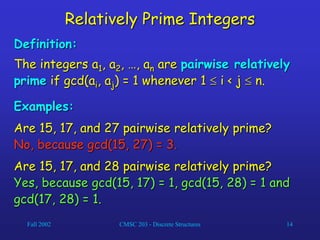
Relatively Prime Integers
Definition:
The integers a1, a2, …, an are pairwise relatively
prime if gcd(ai, aj) = 1 whenever 1  i < j  n.
Examples:
Are 15, 17, and 27 pairwise relatively prime?
No, because gcd(15, 27) = 3.
Are 15, 17, and 28 pairwise relatively prime?
Yes, because gcd(15, 17) = 1, gcd(15, 28) = 1 and
gcd(17, 28) = 1.
Fall 2002 CMSC 203 - Discrete Structures 15
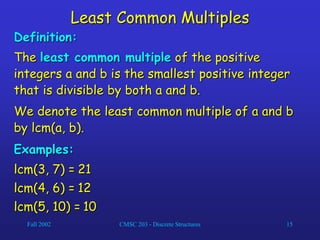
Least Common Multiples
Definition:
The least common multiple of the positive
integers a and b is the smallest positive integer
that is divisible by both a and b.
We denote the least common multiple of a and b
by lcm(a, b).
Examples:
lcm(3, 7) = 21
lcm(4, 6) = 12
lcm(5, 10) = 10
Fall 2002 CMSC 203 - Discrete Structures 16
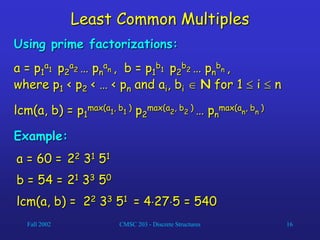
Least Common Multiples
Using prime factorizations:
a = p1
a1 p2
a2 … pn
an , b = p1
b1 p2
b2 … pn
bn ,
where p1 < p2 < … < pn and ai, bi  N for 1  i  n
lcm(a, b) = p1
max(a1
, b1
) p2
max(a2
, b2
) … pn
max(an
, bn
)
Example:
a = 60 = 22 31 51
b = 54 = 21 33 50
lcm(a, b) = 22 33 51 = 4275 = 540
Fall 2002 CMSC 203 - Discrete Structures 17
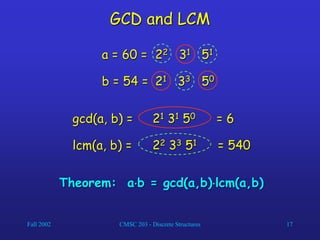
GCD and LCM
a = 60 = 22 31 51
b = 54 = 21 33 50
lcm(a, b) = 22 33 51 = 540
gcd(a, b) = 21 31 50 = 6
Theorem: ab = gcd(a,b)lcm(a,b)
Fall 2002 CMSC 203 - Discrete Structures 18
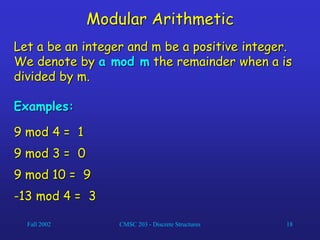
Modular Arithmetic
Let a be an integer and m be a positive integer.
We denote by a mod m the remainder when a is
divided by m.
Examples:
9 mod 4 = 1
9 mod 3 = 0
9 mod 10 = 9
-13 mod 4 = 3
Fall 2002 CMSC 203 - Discrete Structures 19
Congruences
Let a and b be integers and m be a positive integer.
We say that a is congruent to b modulo m if
m divides a – b.
We use the notation a  b (mod m) to indicate
that a is congruent to b modulo m.
In other words:
a  b (mod m) if and only if a mod m = b mod m.
Fall 2002 CMSC 203 - Discrete Structures 20
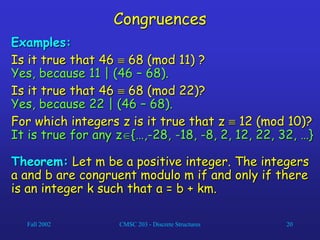
Congruences
Examples:
Is it true that 46  68 (mod 11) ?
Yes, because 11 | (46 – 68).
Is it true that 46  68 (mod 22)?
Yes, because 22 | (46 – 68).
For which integers z is it true that z  12 (mod 10)?
It is true for any z{…,-28, -18, -8, 2, 12, 22, 32, …}
Theorem: Let m be a positive integer. The integers
a and b are congruent modulo m if and only if there
is an integer k such that a = b + km.
Fall 2002 CMSC 203 - Discrete Structures 21
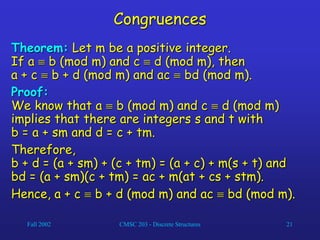
Congruences
Theorem: Let m be a positive integer.
If a  b (mod m) and c  d (mod m), then
a + c  b + d (mod m) and ac  bd (mod m).
Proof:
We know that a  b (mod m) and c  d (mod m)
implies that there are integers s and t with
b = a + sm and d = c + tm.
Therefore,
b + d = (a + sm) + (c + tm) = (a + c) + m(s + t) and
bd = (a + sm)(c + tm) = ac + m(at + cs + stm).
Hence, a + c  b + d (mod m) and ac  bd (mod m).
Fall 2002 CMSC 203 - Discrete Structures 22
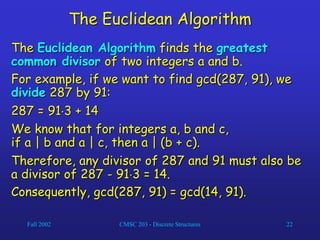
The Euclidean Algorithm
The Euclidean Algorithm finds the greatest
common divisor of two integers a and b.
For example, if we want to find gcd(287, 91), we
divide 287 by 91:
287 = 913 + 14
We know that for integers a, b and c,
if a | b and a | c, then a | (b + c).
Therefore, any divisor of 287 and 91 must also be
a divisor of 287 - 913 = 14.
Consequently, gcd(287, 91) = gcd(14, 91).
Fall 2002 CMSC 203 - Discrete Structures 23
The Euclidean Algorithm
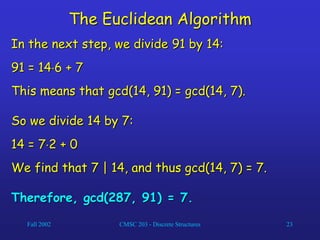
In the next step, we divide 91 by 14:
91 = 146 + 7
This means that gcd(14, 91) = gcd(14, 7).
So we divide 14 by 7:
14 = 72 + 0
We find that 7 | 14, and thus gcd(14, 7) = 7.
Therefore, gcd(287, 91) = 7.
Fall 2002 CMSC 203 - Discrete Structures 24
The Euclidean Algorithm
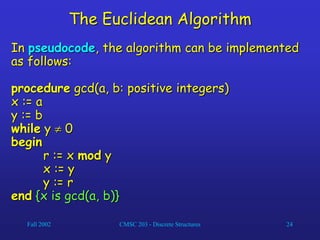
In pseudocode, the algorithm can be implemented
as follows:
procedure gcd(a, b: positive integers)
x := a
y := b
while y  0
begin
r := x mod y
x := y
y := r
end {x is gcd(a, b)}
Fall 2002 CMSC 203 - Discrete Structures 25
Representations of Integers
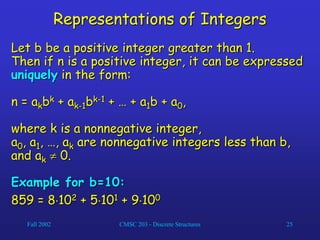
Let b be a positive integer greater than 1.
Then if n is a positive integer, it can be expressed
uniquely in the form:
n = akbk + ak-1bk-1 + … + a1b + a0,
where k is a nonnegative integer,
a0, a1, …, ak are nonnegative integers less than b,
and ak  0.
Example for b=10:
859 = 8102 + 5101 + 9100
Fall 2002 CMSC 203 - Discrete Structures 26
Representations of Integers
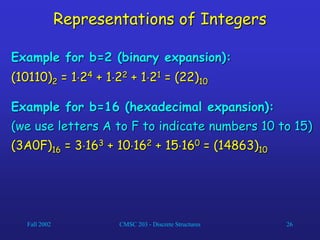
Example for b=2 (binary expansion):
(10110)2 = 124 + 122 + 121 = (22)10
Example for b=16 (hexadecimal expansion):
(we use letters A to F to indicate numbers 10 to 15)
(3A0F)16 = 3163 + 10162 + 15160 = (14863)10
Fall 2002 CMSC 203 - Discrete Structures 27
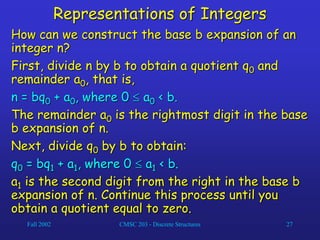
Representations of Integers
How can we construct the base b expansion of an
integer n?
First, divide n by b to obtain a quotient q0 and
remainder a0, that is,
n = bq0 + a0, where 0  a0 < b.
The remainder a0 is the rightmost digit in the base
b expansion of n.
Next, divide q0 by b to obtain:
q0 = bq1 + a1, where 0  a1 < b.
a1 is the second digit from the right in the base b
expansion of n. Continue this process until you
obtain a quotient equal to zero.
Fall 2002 CMSC 203 - Discrete Structures 28
Representations of Integers
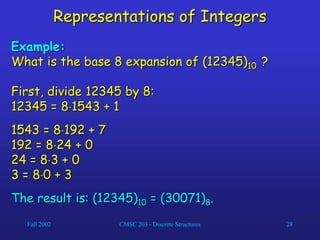
Example:
What is the base 8 expansion of (12345)10 ?
First, divide 12345 by 8:
12345 = 81543 + 1
1543 = 8192 + 7
192 = 824 + 0
24 = 83 + 0
3 = 80 + 3
The result is: (12345)10 = (30071)8.
Fall 2002 CMSC 203 - Discrete Structures 29
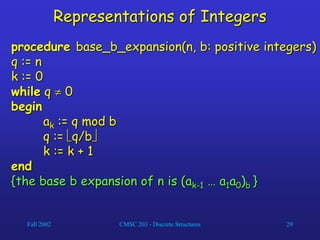
Representations of Integers
procedure base_b_expansion(n, b: positive integers)
q := n
k := 0
while q  0
begin
ak := q mod b
q := q/b
k := k + 1
end
{the base b expansion of n is (ak-1 … a1a0)b }
Fall 2002 CMSC 203 - Discrete Structures 30
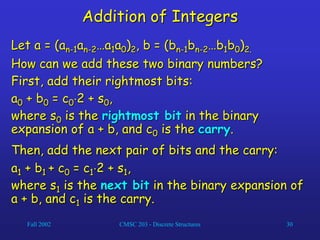
Addition of Integers
Let a = (an-1an-2…a1a0)2, b = (bn-1bn-2…b1b0)2.
How can we add these two binary numbers?
First, add their rightmost bits:
a0 + b0 = c02 + s0,
where s0 is the rightmost bit in the binary
expansion of a + b, and c0 is the carry.
Then, add the next pair of bits and the carry:
a1 + b1 + c0 = c12 + s1,
where s1 is the next bit in the binary expansion of
a + b, and c1 is the carry.
Fall 2002 CMSC 203 - Discrete Structures 31
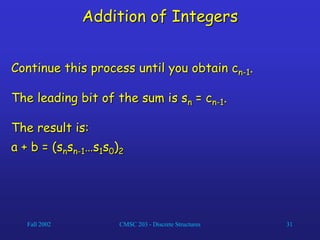
Addition of Integers
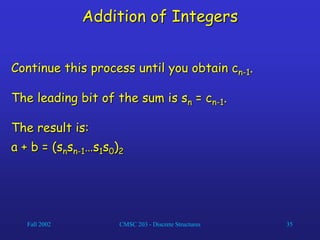
Continue this process until you obtain cn-1.
The leading bit of the sum is sn = cn-1.
The result is:
a + b = (snsn-1…s1s0)2
Fall 2002 CMSC 203 - Discrete Structures 32
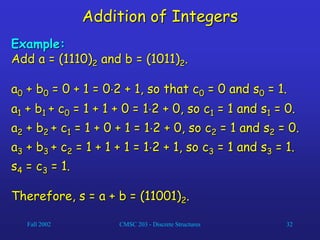
Addition of Integers
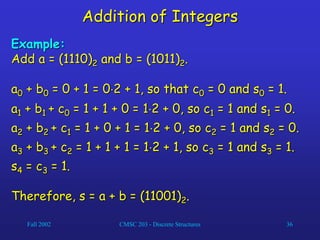
Example:
Add a = (1110)2 and b = (1011)2.
a0 + b0 = 0 + 1 = 02 + 1, so that c0 = 0 and s0 = 1.
a1 + b1 + c0 = 1 + 1 + 0 = 12 + 0, so c1 = 1 and s1 = 0.
a2 + b2 + c1 = 1 + 0 + 1 = 12 + 0, so c2 = 1 and s2 = 0.
a3 + b3 + c2 = 1 + 1 + 1 = 12 + 1, so c3 = 1 and s3 = 1.
s4 = c3 = 1.
Therefore, s = a + b = (11001)2.
Fall 2002 CMSC 203 - Discrete Structures 33
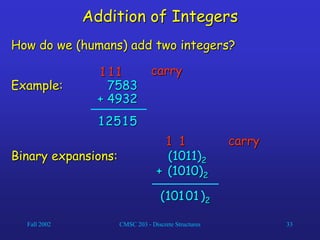
Addition of Integers
How do we (humans) add two integers?
Example: 7583
+ 4932
5
1
5
2
1
1
1
1 carry
Binary expansions: (1011)2
+ (1010)2
1
0
carry
1
1
0
1
1
( )2
Fall 2002 CMSC 203 - Discrete Structures 34
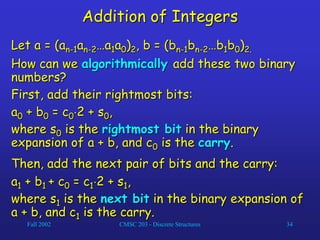
Addition of Integers
Let a = (an-1an-2…a1a0)2, b = (bn-1bn-2…b1b0)2.
How can we algorithmically add these two binary
numbers?
First, add their rightmost bits:
a0 + b0 = c02 + s0,
where s0 is the rightmost bit in the binary
expansion of a + b, and c0 is the carry.
Then, add the next pair of bits and the carry:
a1 + b1 + c0 = c12 + s1,
where s1 is the next bit in the binary expansion of
a + b, and c1 is the carry.
Fall 2002 CMSC 203 - Discrete Structures 35
Addition of Integers
Continue this process until you obtain cn-1.
The leading bit of the sum is sn = cn-1.
The result is:
a + b = (snsn-1…s1s0)2
Fall 2002 CMSC 203 - Discrete Structures 36
Addition of Integers
Example:
Add a = (1110)2 and b = (1011)2.
a0 + b0 = 0 + 1 = 02 + 1, so that c0 = 0 and s0 = 1.
a1 + b1 + c0 = 1 + 1 + 0 = 12 + 0, so c1 = 1 and s1 = 0.
a2 + b2 + c1 = 1 + 0 + 1 = 12 + 0, so c2 = 1 and s2 = 0.
a3 + b3 + c2 = 1 + 1 + 1 = 12 + 1, so c3 = 1 and s3 = 1.
s4 = c3 = 1.
Therefore, s = a + b = (11001)2.
Fall 2002 CMSC 203 - Discrete Structures 37
Addition of Integers
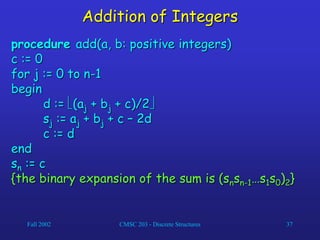
procedure add(a, b: positive integers)
c := 0
for j := 0 to n-1
begin
d := (aj + bj + c)/2
sj := aj + bj + c – 2d
c := d
end
sn := c
{the binary expansion of the sum is (snsn-1…s1s0)2}

NumberTheory.ppt

  • 1.
    Fall 2002 CMSC203 - Discrete Structures 1 Let us get into… Number Theory
  • 2.
    Fall 2002 CMSC203 - Discrete Structures 2 Introduction to Number Theory Number theory is about integers and their properties. We will start with the basic principles of • divisibility, • greatest common divisors, • least common multiples, and • modular arithmetic and look at some relevant algorithms.
  • 3.
    Fall 2002 CMSC203 - Discrete Structures 3 Division If a and b are integers with a  0, we say that a divides b if there is an integer c so that b = ac. When a divides b we say that a is a factor of b and that b is a multiple of a. The notation a | b means that a divides b. We write a X b when a does not divide b (see book for correct symbol).
  • 4.
    Fall 2002 CMSC203 - Discrete Structures 4 Divisibility Theorems For integers a, b, and c it is true that • if a | b and a | c, then a | (b + c) Example: 3 | 6 and 3 | 9, so 3 | 15. • if a | b, then a | bc for all integers c Example: 5 | 10, so 5 | 20, 5 | 30, 5 | 40, … • if a | b and b | c, then a | c Example: 4 | 8 and 8 | 24, so 4 | 24.
  • 5.
    Fall 2002 CMSC203 - Discrete Structures 5 Primes A positive integer p greater than 1 is called prime if the only positive factors of p are 1 and p. A positive integer that is greater than 1 and is not prime is called composite. The fundamental theorem of arithmetic: Every positive integer can be written uniquely as the product of primes, where the prime factors are written in order of increasing size.
  • 6.
    Fall 2002 CMSC203 - Discrete Structures 6 Primes Examples: 3·5 48 = 17 = 100 = 512 = 515 = 28 = 15 = 2·2·2·2·3 = 24·3 17 2·2·5·5 = 22·52 2·2·2·2·2·2·2·2·2 = 29 5·103 2·2·7
  • 7.
    Fall 2002 CMSC203 - Discrete Structures 7 Primes If n is a composite integer, then n has a prime divisor less than or equal . This is easy to see: if n is a composite integer, it must have two prime divisors p1 and p2 such that p1p2 = n. p1 and p2 cannot both be greater than , because then p1p2 > n. n n
  • 8.
    Fall 2002 CMSC203 - Discrete Structures 8 The Division Algorithm Let a be an integer and d a positive integer. Then there are unique integers q and r, with 0  r < d, such that a = dq + r. In the above equation, • d is called the divisor, • a is called the dividend, • q is called the quotient, and • r is called the remainder.
  • 9.
    Fall 2002 CMSC203 - Discrete Structures 9 The Division Algorithm Example: When we divide 17 by 5, we have 17 = 53 + 2. • 17 is the dividend, • 5 is the divisor, • 3 is called the quotient, and • 2 is called the remainder.
  • 10.
    Fall 2002 CMSC203 - Discrete Structures 10 The Division Algorithm Another example: What happens when we divide -11 by 3 ? Note that the remainder cannot be negative. -11 = 3(-4) + 1. • -11 is the dividend, • 3 is the divisor, • -4 is called the quotient, and • 1 is called the remainder.
  • 11.
    Fall 2002 CMSC203 - Discrete Structures 11 Greatest Common Divisors Let a and b be integers, not both zero. The largest integer d such that d | a and d | b is called the greatest common divisor of a and b. The greatest common divisor of a and b is denoted by gcd(a, b). Example 1: What is gcd(48, 72) ? The positive common divisors of 48 and 72 are 1, 2, 3, 4, 6, 8, 12, 16, and 24, so gcd(48, 72) = 24. Example 2: What is gcd(19, 72) ? The only positive common divisor of 19 and 72 is 1, so gcd(19, 72) = 1.
  • 12.
    Fall 2002 CMSC203 - Discrete Structures 12 Greatest Common Divisors Using prime factorizations: a = p1 a1 p2 a2 … pn an , b = p1 b1 p2 b2 … pn bn , where p1 < p2 < … < pn and ai, bi  N for 1  i  n gcd(a, b) = p1 min(a1 , b1 ) p2 min(a2 , b2 ) … pn min(an , bn ) Example: a = 60 = 22 31 51 b = 54 = 21 33 50 gcd(a, b) = 21 31 50 = 6
  • 13.
    Fall 2002 CMSC203 - Discrete Structures 13 Relatively Prime Integers Definition: Two integers a and b are relatively prime if gcd(a, b) = 1. Examples: Are 15 and 28 relatively prime? Yes, gcd(15, 28) = 1. Are 55 and 28 relatively prime? Yes, gcd(55, 28) = 1. Are 35 and 28 relatively prime? No, gcd(35, 28) = 7.
  • 14.
    Fall 2002 CMSC203 - Discrete Structures 14 Relatively Prime Integers Definition: The integers a1, a2, …, an are pairwise relatively prime if gcd(ai, aj) = 1 whenever 1  i < j  n. Examples: Are 15, 17, and 27 pairwise relatively prime? No, because gcd(15, 27) = 3. Are 15, 17, and 28 pairwise relatively prime? Yes, because gcd(15, 17) = 1, gcd(15, 28) = 1 and gcd(17, 28) = 1.
  • 15.
    Fall 2002 CMSC203 - Discrete Structures 15 Least Common Multiples Definition: The least common multiple of the positive integers a and b is the smallest positive integer that is divisible by both a and b. We denote the least common multiple of a and b by lcm(a, b). Examples: lcm(3, 7) = 21 lcm(4, 6) = 12 lcm(5, 10) = 10
  • 16.
    Fall 2002 CMSC203 - Discrete Structures 16 Least Common Multiples Using prime factorizations: a = p1 a1 p2 a2 … pn an , b = p1 b1 p2 b2 … pn bn , where p1 < p2 < … < pn and ai, bi  N for 1  i  n lcm(a, b) = p1 max(a1 , b1 ) p2 max(a2 , b2 ) … pn max(an , bn ) Example: a = 60 = 22 31 51 b = 54 = 21 33 50 lcm(a, b) = 22 33 51 = 4275 = 540
  • 17.
    Fall 2002 CMSC203 - Discrete Structures 17 GCD and LCM a = 60 = 22 31 51 b = 54 = 21 33 50 lcm(a, b) = 22 33 51 = 540 gcd(a, b) = 21 31 50 = 6 Theorem: ab = gcd(a,b)lcm(a,b)
  • 18.
    Fall 2002 CMSC203 - Discrete Structures 18 Modular Arithmetic Let a be an integer and m be a positive integer. We denote by a mod m the remainder when a is divided by m. Examples: 9 mod 4 = 1 9 mod 3 = 0 9 mod 10 = 9 -13 mod 4 = 3
  • 19.
    Fall 2002 CMSC203 - Discrete Structures 19 Congruences Let a and b be integers and m be a positive integer. We say that a is congruent to b modulo m if m divides a – b. We use the notation a  b (mod m) to indicate that a is congruent to b modulo m. In other words: a  b (mod m) if and only if a mod m = b mod m.
  • 20.
    Fall 2002 CMSC203 - Discrete Structures 20 Congruences Examples: Is it true that 46  68 (mod 11) ? Yes, because 11 | (46 – 68). Is it true that 46  68 (mod 22)? Yes, because 22 | (46 – 68). For which integers z is it true that z  12 (mod 10)? It is true for any z{…,-28, -18, -8, 2, 12, 22, 32, …} Theorem: Let m be a positive integer. The integers a and b are congruent modulo m if and only if there is an integer k such that a = b + km.
  • 21.
    Fall 2002 CMSC203 - Discrete Structures 21 Congruences Theorem: Let m be a positive integer. If a  b (mod m) and c  d (mod m), then a + c  b + d (mod m) and ac  bd (mod m). Proof: We know that a  b (mod m) and c  d (mod m) implies that there are integers s and t with b = a + sm and d = c + tm. Therefore, b + d = (a + sm) + (c + tm) = (a + c) + m(s + t) and bd = (a + sm)(c + tm) = ac + m(at + cs + stm). Hence, a + c  b + d (mod m) and ac  bd (mod m).
  • 22.
    Fall 2002 CMSC203 - Discrete Structures 22 The Euclidean Algorithm The Euclidean Algorithm finds the greatest common divisor of two integers a and b. For example, if we want to find gcd(287, 91), we divide 287 by 91: 287 = 913 + 14 We know that for integers a, b and c, if a | b and a | c, then a | (b + c). Therefore, any divisor of 287 and 91 must also be a divisor of 287 - 913 = 14. Consequently, gcd(287, 91) = gcd(14, 91).
  • 23.
    Fall 2002 CMSC203 - Discrete Structures 23 The Euclidean Algorithm In the next step, we divide 91 by 14: 91 = 146 + 7 This means that gcd(14, 91) = gcd(14, 7). So we divide 14 by 7: 14 = 72 + 0 We find that 7 | 14, and thus gcd(14, 7) = 7. Therefore, gcd(287, 91) = 7.
  • 24.
    Fall 2002 CMSC203 - Discrete Structures 24 The Euclidean Algorithm In pseudocode, the algorithm can be implemented as follows: procedure gcd(a, b: positive integers) x := a y := b while y  0 begin r := x mod y x := y y := r end {x is gcd(a, b)}
  • 25.
    Fall 2002 CMSC203 - Discrete Structures 25 Representations of Integers Let b be a positive integer greater than 1. Then if n is a positive integer, it can be expressed uniquely in the form: n = akbk + ak-1bk-1 + … + a1b + a0, where k is a nonnegative integer, a0, a1, …, ak are nonnegative integers less than b, and ak  0. Example for b=10: 859 = 8102 + 5101 + 9100
  • 26.
    Fall 2002 CMSC203 - Discrete Structures 26 Representations of Integers Example for b=2 (binary expansion): (10110)2 = 124 + 122 + 121 = (22)10 Example for b=16 (hexadecimal expansion): (we use letters A to F to indicate numbers 10 to 15) (3A0F)16 = 3163 + 10162 + 15160 = (14863)10
  • 27.
    Fall 2002 CMSC203 - Discrete Structures 27 Representations of Integers How can we construct the base b expansion of an integer n? First, divide n by b to obtain a quotient q0 and remainder a0, that is, n = bq0 + a0, where 0  a0 < b. The remainder a0 is the rightmost digit in the base b expansion of n. Next, divide q0 by b to obtain: q0 = bq1 + a1, where 0  a1 < b. a1 is the second digit from the right in the base b expansion of n. Continue this process until you obtain a quotient equal to zero.
  • 28.
    Fall 2002 CMSC203 - Discrete Structures 28 Representations of Integers Example: What is the base 8 expansion of (12345)10 ? First, divide 12345 by 8: 12345 = 81543 + 1 1543 = 8192 + 7 192 = 824 + 0 24 = 83 + 0 3 = 80 + 3 The result is: (12345)10 = (30071)8.
  • 29.
    Fall 2002 CMSC203 - Discrete Structures 29 Representations of Integers procedure base_b_expansion(n, b: positive integers) q := n k := 0 while q  0 begin ak := q mod b q := q/b k := k + 1 end {the base b expansion of n is (ak-1 … a1a0)b }
  • 30.
    Fall 2002 CMSC203 - Discrete Structures 30 Addition of Integers Let a = (an-1an-2…a1a0)2, b = (bn-1bn-2…b1b0)2. How can we add these two binary numbers? First, add their rightmost bits: a0 + b0 = c02 + s0, where s0 is the rightmost bit in the binary expansion of a + b, and c0 is the carry. Then, add the next pair of bits and the carry: a1 + b1 + c0 = c12 + s1, where s1 is the next bit in the binary expansion of a + b, and c1 is the carry.
  • 31.
    Fall 2002 CMSC203 - Discrete Structures 31 Addition of Integers Continue this process until you obtain cn-1. The leading bit of the sum is sn = cn-1. The result is: a + b = (snsn-1…s1s0)2
  • 32.
    Fall 2002 CMSC203 - Discrete Structures 32 Addition of Integers Example: Add a = (1110)2 and b = (1011)2. a0 + b0 = 0 + 1 = 02 + 1, so that c0 = 0 and s0 = 1. a1 + b1 + c0 = 1 + 1 + 0 = 12 + 0, so c1 = 1 and s1 = 0. a2 + b2 + c1 = 1 + 0 + 1 = 12 + 0, so c2 = 1 and s2 = 0. a3 + b3 + c2 = 1 + 1 + 1 = 12 + 1, so c3 = 1 and s3 = 1. s4 = c3 = 1. Therefore, s = a + b = (11001)2.
  • 33.
    Fall 2002 CMSC203 - Discrete Structures 33 Addition of Integers How do we (humans) add two integers? Example: 7583 + 4932 5 1 5 2 1 1 1 1 carry Binary expansions: (1011)2 + (1010)2 1 0 carry 1 1 0 1 1 ( )2
  • 34.
    Fall 2002 CMSC203 - Discrete Structures 34 Addition of Integers Let a = (an-1an-2…a1a0)2, b = (bn-1bn-2…b1b0)2. How can we algorithmically add these two binary numbers? First, add their rightmost bits: a0 + b0 = c02 + s0, where s0 is the rightmost bit in the binary expansion of a + b, and c0 is the carry. Then, add the next pair of bits and the carry: a1 + b1 + c0 = c12 + s1, where s1 is the next bit in the binary expansion of a + b, and c1 is the carry.
  • 35.
    Fall 2002 CMSC203 - Discrete Structures 35 Addition of Integers Continue this process until you obtain cn-1. The leading bit of the sum is sn = cn-1. The result is: a + b = (snsn-1…s1s0)2
  • 36.
    Fall 2002 CMSC203 - Discrete Structures 36 Addition of Integers Example: Add a = (1110)2 and b = (1011)2. a0 + b0 = 0 + 1 = 02 + 1, so that c0 = 0 and s0 = 1. a1 + b1 + c0 = 1 + 1 + 0 = 12 + 0, so c1 = 1 and s1 = 0. a2 + b2 + c1 = 1 + 0 + 1 = 12 + 0, so c2 = 1 and s2 = 0. a3 + b3 + c2 = 1 + 1 + 1 = 12 + 1, so c3 = 1 and s3 = 1. s4 = c3 = 1. Therefore, s = a + b = (11001)2.
  • 37.
    Fall 2002 CMSC203 - Discrete Structures 37 Addition of Integers procedure add(a, b: positive integers) c := 0 for j := 0 to n-1 begin d := (aj + bj + c)/2 sj := aj + bj + c – 2d c := d end sn := c {the binary expansion of the sum is (snsn-1…s1s0)2}