Number Systems
Imranul Hasan
Greenwich University, UK
Network Math
www.thinkgeek.com
Binary Mathematics
• It is very important to understand the concept
of Binary Mathematics as this is the language
which computers communicate in.
• Computers can only understand two states, on
which is represented by 1 and off which is
represented by 0 (Digital).
• But why do we need Digital???
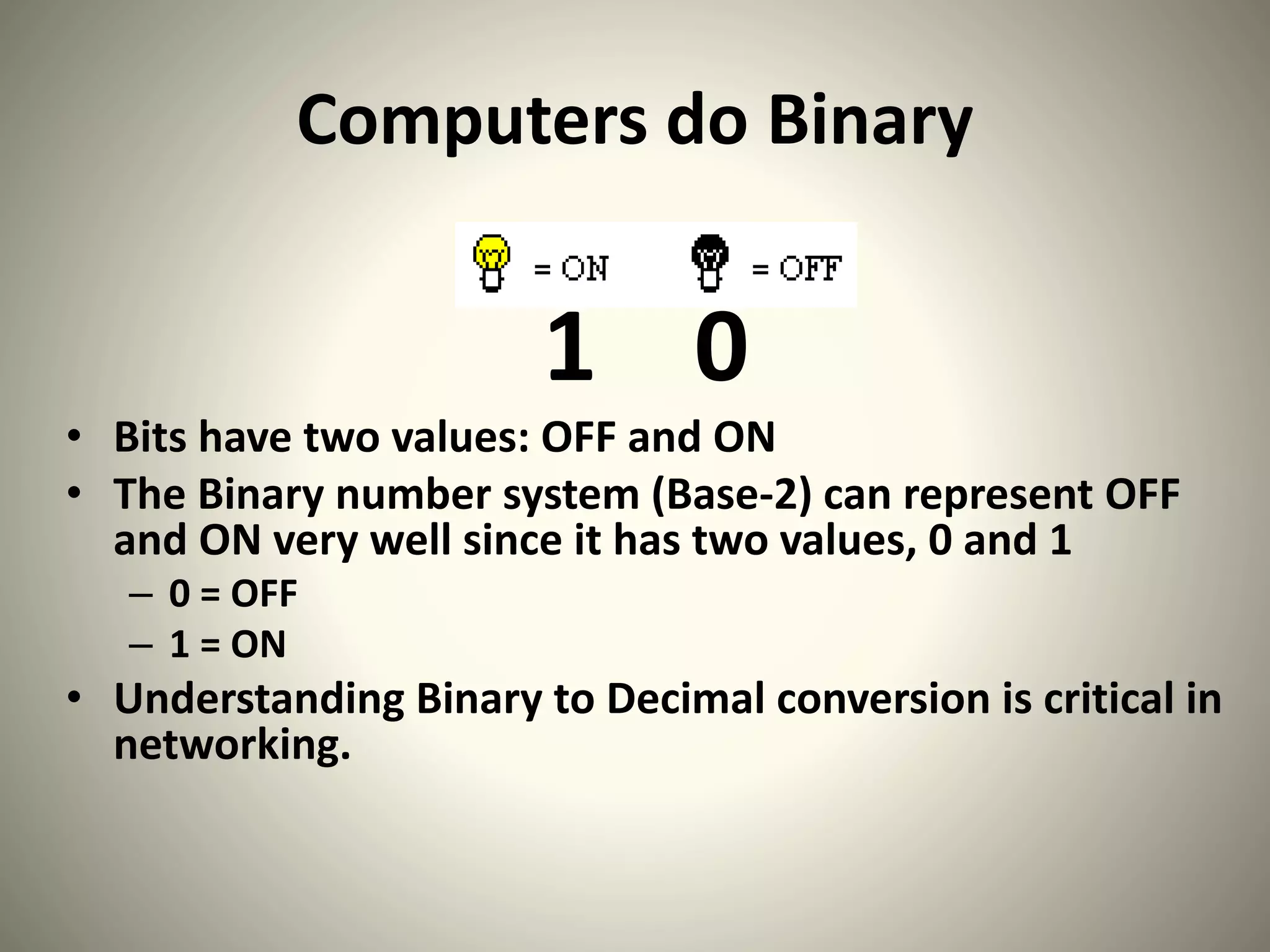
Computers do Binary
1 0
• Bits have two values: OFF and ON
• The Binary number system (Base-2) can represent OFF
and ON very well since it has two values, 0 and 1
– 0 = OFF
– 1 = ON
• Understanding Binary to Decimal conversion is critical in
networking.
Number System Rules
• Some number systems are:
– Binary Number System – Base 2 (0, 1)
– Octal Number System – Base 8 (0, 1, 2, 3, 4, 5, 6, 7)
– Decimal Number System – Base 10 (0, 1, 2, 3, 4, 5, 6, 7, 8, 9)
– Hexadecimal Number System – Base 16 (0, 1, 2, 3, 4, 5, 6, 7,
8, 9, A, B, C, D, E, F)
Number System Rules
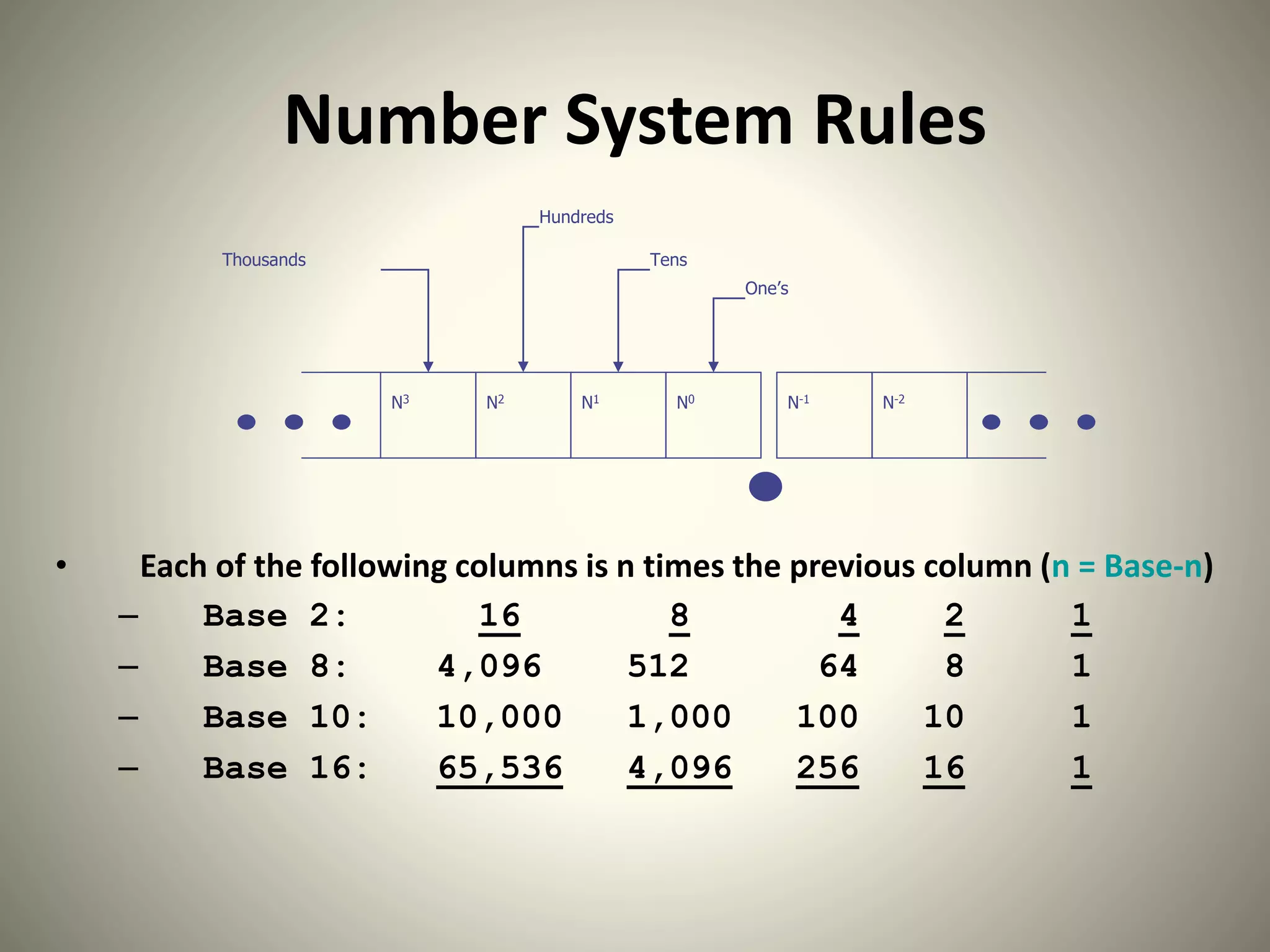
• Each of the following columns is n times the previous column (n = Base-n)
– Base 2: 16 8 4 2 1
– Base 8: 4,096 512 64 8 1
– Base 10: 10,000 1,000 100 10 1
– Base 16: 65,536 4,096 256 16 1
N0N1N2N3 N-1 N-2
One’s
Tens
Hundreds
Thousands
Base 10 number system – The Math
The decimal number system: based on powers of 10.
23510 = (2x10²) + (3x101) + (5x100)
100101102103 10-1 10-2
One’s
Tens
Hundreds
Thousands
532
5 one’s
3 tens
2 Hundreds
Base 2 (Binary) number system
• Converting Binary to Decimal:
101011= 1 x 25 + 0 x 24 + 1 x 23 + 0 x 22 + 1 x 21 + 1 x 20)
= 32 + 0 + 8 + 0 + 2 + 1
= 4310
= 1x8 + 1x4 + 0x2 + 1x1 = 8+4+0+1 = 1310
… Or … 1248
1 0 11
20212223
Binary PWC
Converting Decimal to Binary
Digits (2): 0, 1
Number of:
27 ___ ___ ___ 23 22 21
20
128’s 8’s 4’s 2’s
1’s
Dec.
2 1 0
10 1 0 1 0
17
70
130
255
•Another way is dividing decimal number by 2 and Multiplying by 2
Converting Decimal to Binary
Digits (2): 0, 1
Number of:
27 26 25 24 23 22 21
20
128’s 64’s 32’s 16’s 8’s 4’s 2’s
1’s
Dec.
2 1 0
10 1 0 1 0
17 1 0 0 0 1
70 1 0 0 0 1 1 0
130 1 0 0 0 0 0 1 0
255 1 1 1 1 1 1 1 1
Converting Decimal to Binary
Digits (2): 0, 1
Number of:
27 26 25 24 23 22 21
20
128’s 64’s 32’s 16’s 8’s 4’s 2’s
1’s
Dec.
1 0 0 0 1 1 0
1 0 1 0 0 0
0 0 0 0 0 0 0 0
1 0 0 0 0 0 0 0
172
192
Converting Decimal to Binary
Digits (2): 0, 1
Number of:
27 26 25 24 23 22 21
20
128’s 64’s 32’s 16’s 8’s 4’s 2’s
1’s
Dec.
70 1 0 0 0 1 1 0
40 1 0 1 0 0 0
0 0 0 0 0 0 0 0 0
128 1 0 0 0 0 0 0 0
172 1 0 1 0 1 1 0 0
192 1 1 0 0 0 0 0 0
Base 16 (Hexadecimal) Number
System
Digits (16):
0, 1, 2, 3, 4, 5, 6, 7, 8, 9, A, B, C, D, E,
F
Decimal Hexadecimal Decimal
Hexadecimal
0 0 8 8
1 1 9 9
2 2 10 A
3 3 11 B
4 4 12 C
5 5 13 D
6 6 14 E
7 7 15 F
Base 16 (Hexadecimal) Number
System
Digits (16):
0, 1, 2, 3, 4, 5, 6, 7, 8, 9, A, B, C, D, E,
F
Number of:
___ ___ 161 160
Dec. 16’s 1’s
8 ? ?
9
10
15
16
17
Base 16 (Hexadecimal) Number
System
Digits (16):
0, 1, 2, 3, 4, 5, 6, 7, 8, 9, A, B, C, D, E,
F
Number of:
163 162 161 160
Dec. 4,096’s 256’s 16’s 1’s
8 8
9 9
10 A
15 F
16 1 0
17 1 1
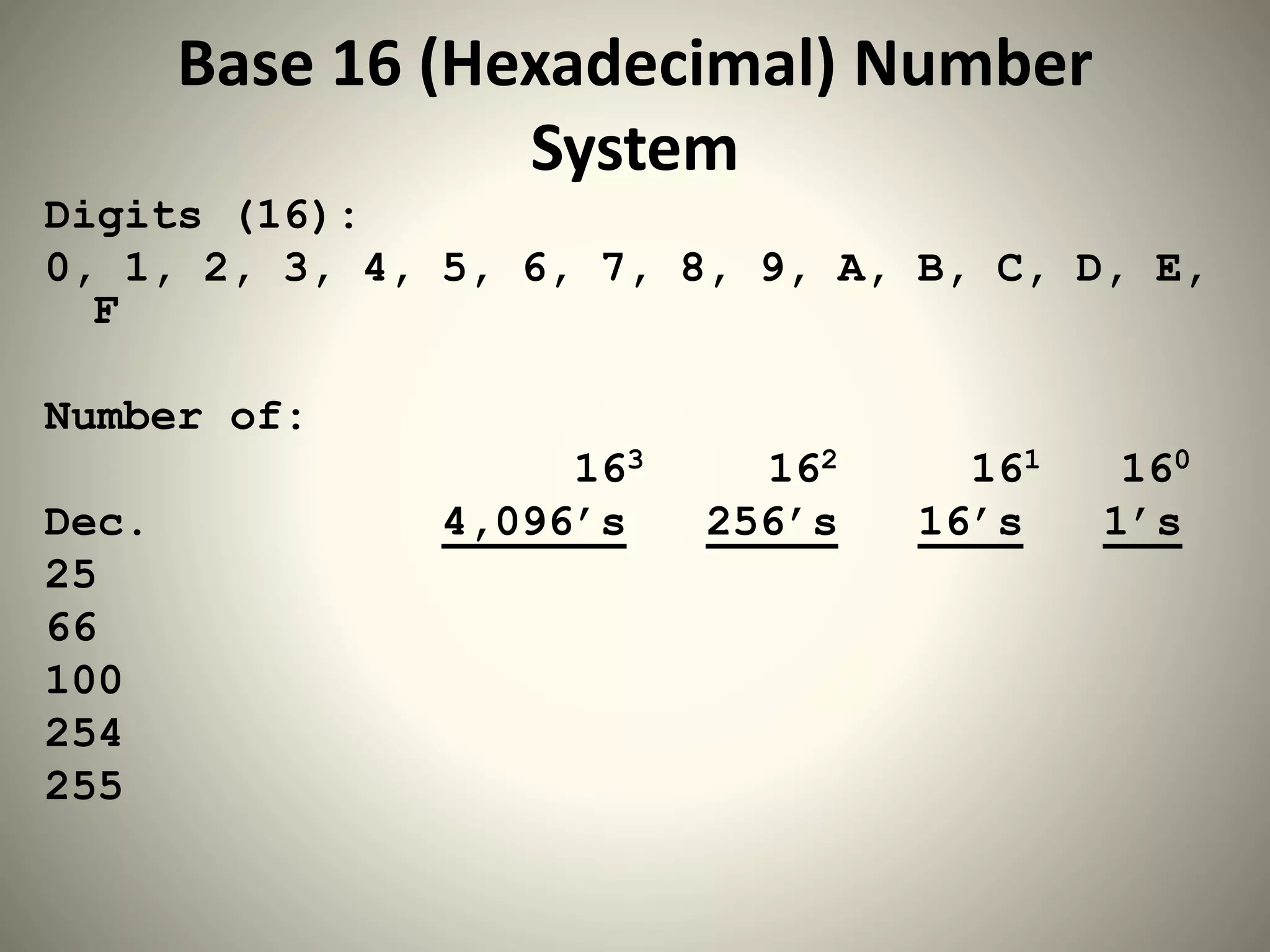
Base 16 (Hexadecimal) Number
System
Digits (16):
0, 1, 2, 3, 4, 5, 6, 7, 8, 9, A, B, C, D, E,
F
Number of:
163 162 161 160
Dec. 4,096’s 256’s 16’s 1’s
25
66
100
254
255
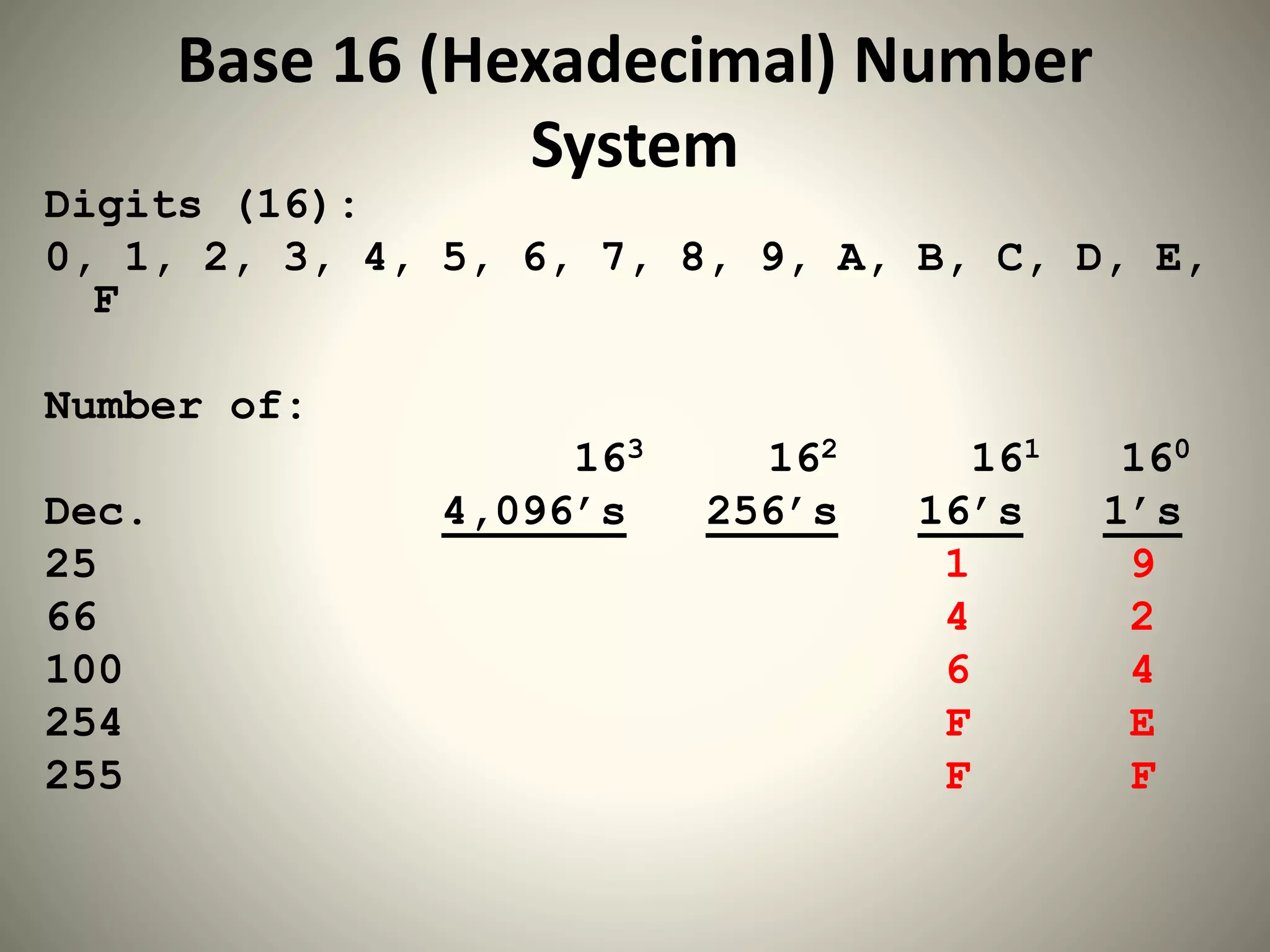
Base 16 (Hexadecimal) Number
System
Digits (16):
0, 1, 2, 3, 4, 5, 6, 7, 8, 9, A, B, C, D, E,
F
Number of:
163 162 161 160
Dec. 4,096’s 256’s 16’s 1’s
25 1 9
66 4 2
100 6 4
254 F E
255 F F
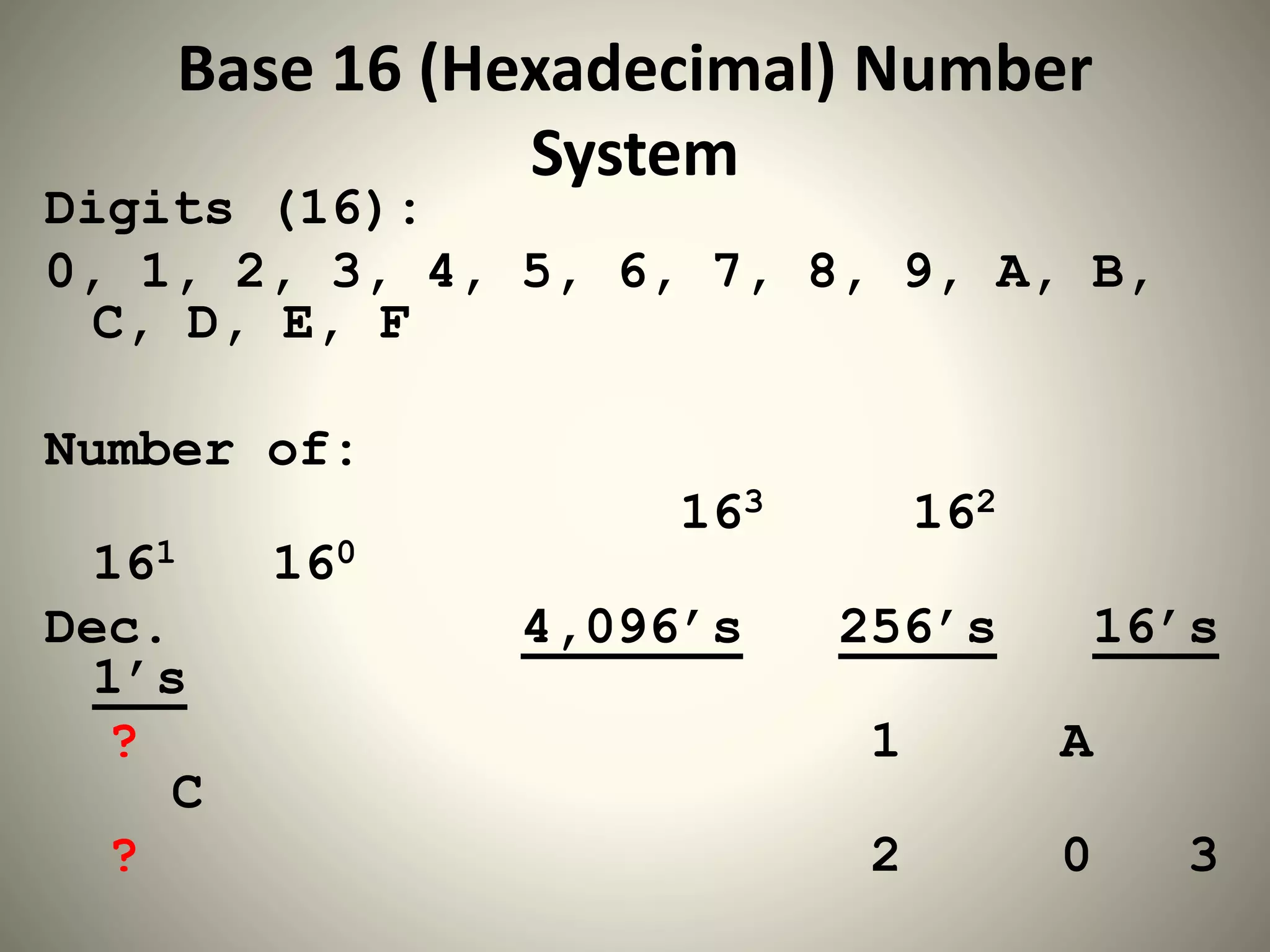
Base 16 (Hexadecimal) Number
System
Digits (16):
0, 1, 2, 3, 4, 5, 6, 7, 8, 9, A, B,
C, D, E, F
Number of:
163 162
161 160
Dec. 4,096’s 256’s 16’s
1’s
? 1 A
C
? 2 0 3
Base 16 (Hexadecimal) Number
System
Digits (16):
0, 1, 2, 3, 4, 5, 6, 7, 8, 9, A, B,
C, D, E, F
Number of:
163 162
161 160
Dec. 4,096’s 256’s 16’s
1’s
428 1 A C
515 2 0 3
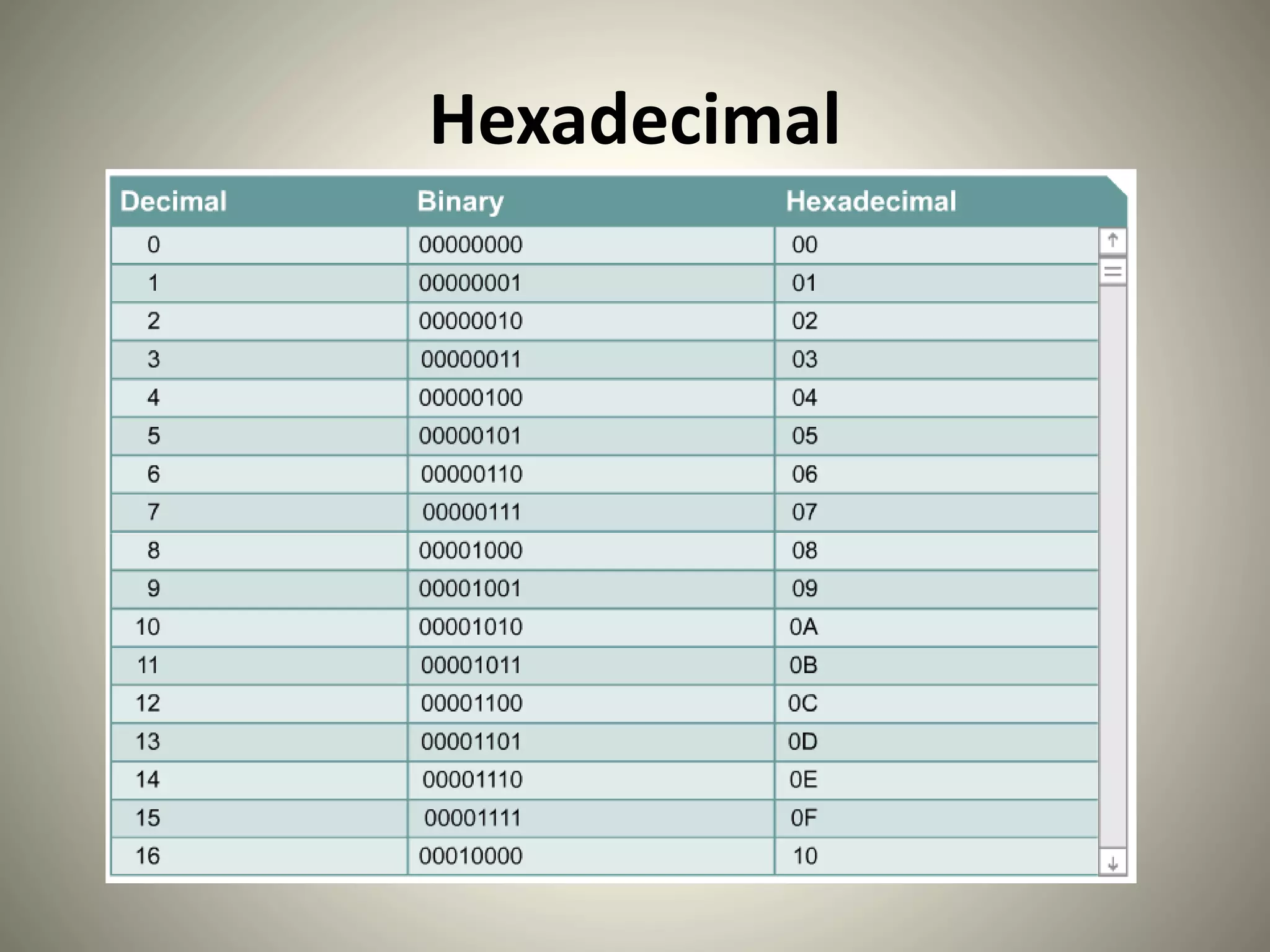
Hexadecimal
Why Hexadecimal?
• Hexadecimal is perfect for matching 4 bits.
• 16 Hex values which means 16 4 bit possibilities.
• 4 bits can be represented by 1 Hex value
• 8 bits (1 byte or octet) can be represented by 2 Hex
values
Dec. Hex. Binary Dec. Hex. Binary
8421 8421
0 0 0000 8 ? ?
1 ? ? 9
2 10
3 11
4 12
5 13
6 14
7 15
Decimal - Hexadecimal - Binary
Dec. Hex. Binary Dec. Hex. Binary
8421 8421
0 0 0000 8 8 1000
1 1 0001 9 9 1001
2 2 0010 10 A 1010
3 3 0011 11 B 1011
4 4 0100 12 C 1100
5 5 0101 13 D 1101
6 6 0110 14 E 1110
7 7 0111 15 F 1111
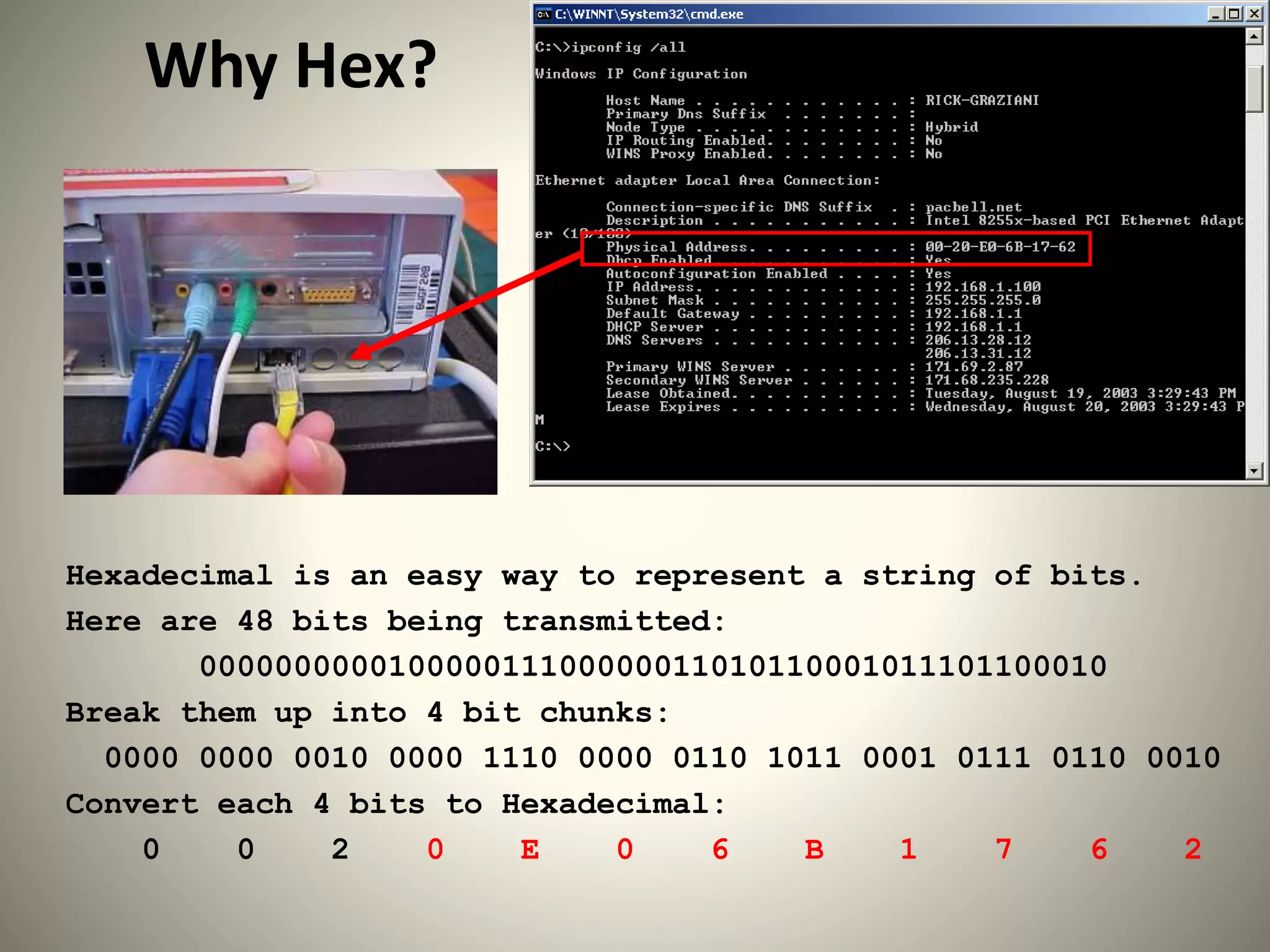
Why Hex?
Hexadecimal is an easy way to represent a string of bits.
Here are 48 bits being transmitted:
000000000010000011100000011010110001011101100010
Break them up into 4 bit chunks:
0000 0000 0010 0000 1110 0000 0110 1011 0001 0111 0110 0010
Convert each 4 bits to Hexadecimal:
0 0 2 0 E 0 6 B 1 7 6 2
Base-n to Decimal Conversion
(1101.101)2 = 123 + 122 + 120 + 12-1 + 12-3
= 8 + 4 + 1 + 0.5 + 0.125 = (13.625)10
(572.6)8 = 582 + 781 + 280 + 68-1
= 320 + 56 + 2 + 0.75 = (378.75)10
(2A.8)16 = 2161 + 10160 + 816-1
= 32 + 10 + 0.5 = (42.5)10
(341.24)5 = 352 + 451 + 150 + 25-1 + 45-2
= 75 + 20 + 1 + 0.4 + 0.16 = (96.56)10
N0N1N2N3 N-1 N-2
One’s
Tens
Hundreds
Thousands
Binary to Octal/Hexadecimal
Conversion
Binary  Octal: Partition in groups of 3
(10 111 011 001 . 101 110)2 = (2731.56)8
Octal  Binary: reverse
(2731.56)8 = (10 111 011 001 . 101 110)2
Binary  Hexadecimal: Partition in groups of 4
(101 1101 1001 . 1011 1000)2 = (5D9.B8)16
Hexadecimal  Binary: reverse
(5D9.B8)16 = (101 1101 1001 . 1011 1000)2
Any Questions?
Mail Me @ : suvrolinss@gmail.com

Numbering Systems

  • 1.
  • 2.
  • 3.
    Binary Mathematics • Itis very important to understand the concept of Binary Mathematics as this is the language which computers communicate in. • Computers can only understand two states, on which is represented by 1 and off which is represented by 0 (Digital). • But why do we need Digital???
  • 4.
    Computers do Binary 10 • Bits have two values: OFF and ON • The Binary number system (Base-2) can represent OFF and ON very well since it has two values, 0 and 1 – 0 = OFF – 1 = ON • Understanding Binary to Decimal conversion is critical in networking.
  • 5.
    Number System Rules •Some number systems are: – Binary Number System – Base 2 (0, 1) – Octal Number System – Base 8 (0, 1, 2, 3, 4, 5, 6, 7) – Decimal Number System – Base 10 (0, 1, 2, 3, 4, 5, 6, 7, 8, 9) – Hexadecimal Number System – Base 16 (0, 1, 2, 3, 4, 5, 6, 7, 8, 9, A, B, C, D, E, F)
  • 6.
    Number System Rules •Each of the following columns is n times the previous column (n = Base-n) – Base 2: 16 8 4 2 1 – Base 8: 4,096 512 64 8 1 – Base 10: 10,000 1,000 100 10 1 – Base 16: 65,536 4,096 256 16 1 N0N1N2N3 N-1 N-2 One’s Tens Hundreds Thousands
  • 7.
    Base 10 numbersystem – The Math The decimal number system: based on powers of 10. 23510 = (2x10²) + (3x101) + (5x100) 100101102103 10-1 10-2 One’s Tens Hundreds Thousands 532 5 one’s 3 tens 2 Hundreds
  • 8.
    Base 2 (Binary)number system • Converting Binary to Decimal: 101011= 1 x 25 + 0 x 24 + 1 x 23 + 0 x 22 + 1 x 21 + 1 x 20) = 32 + 0 + 8 + 0 + 2 + 1 = 4310 = 1x8 + 1x4 + 0x2 + 1x1 = 8+4+0+1 = 1310 … Or … 1248 1 0 11 20212223 Binary PWC
  • 9.
    Converting Decimal toBinary Digits (2): 0, 1 Number of: 27 ___ ___ ___ 23 22 21 20 128’s 8’s 4’s 2’s 1’s Dec. 2 1 0 10 1 0 1 0 17 70 130 255 •Another way is dividing decimal number by 2 and Multiplying by 2
  • 10.
    Converting Decimal toBinary Digits (2): 0, 1 Number of: 27 26 25 24 23 22 21 20 128’s 64’s 32’s 16’s 8’s 4’s 2’s 1’s Dec. 2 1 0 10 1 0 1 0 17 1 0 0 0 1 70 1 0 0 0 1 1 0 130 1 0 0 0 0 0 1 0 255 1 1 1 1 1 1 1 1
  • 11.
    Converting Decimal toBinary Digits (2): 0, 1 Number of: 27 26 25 24 23 22 21 20 128’s 64’s 32’s 16’s 8’s 4’s 2’s 1’s Dec. 1 0 0 0 1 1 0 1 0 1 0 0 0 0 0 0 0 0 0 0 0 1 0 0 0 0 0 0 0 172 192
  • 12.
    Converting Decimal toBinary Digits (2): 0, 1 Number of: 27 26 25 24 23 22 21 20 128’s 64’s 32’s 16’s 8’s 4’s 2’s 1’s Dec. 70 1 0 0 0 1 1 0 40 1 0 1 0 0 0 0 0 0 0 0 0 0 0 0 128 1 0 0 0 0 0 0 0 172 1 0 1 0 1 1 0 0 192 1 1 0 0 0 0 0 0
  • 13.
    Base 16 (Hexadecimal)Number System Digits (16): 0, 1, 2, 3, 4, 5, 6, 7, 8, 9, A, B, C, D, E, F Decimal Hexadecimal Decimal Hexadecimal 0 0 8 8 1 1 9 9 2 2 10 A 3 3 11 B 4 4 12 C 5 5 13 D 6 6 14 E 7 7 15 F
  • 14.
    Base 16 (Hexadecimal)Number System Digits (16): 0, 1, 2, 3, 4, 5, 6, 7, 8, 9, A, B, C, D, E, F Number of: ___ ___ 161 160 Dec. 16’s 1’s 8 ? ? 9 10 15 16 17
  • 15.
    Base 16 (Hexadecimal)Number System Digits (16): 0, 1, 2, 3, 4, 5, 6, 7, 8, 9, A, B, C, D, E, F Number of: 163 162 161 160 Dec. 4,096’s 256’s 16’s 1’s 8 8 9 9 10 A 15 F 16 1 0 17 1 1
  • 16.
    Base 16 (Hexadecimal)Number System Digits (16): 0, 1, 2, 3, 4, 5, 6, 7, 8, 9, A, B, C, D, E, F Number of: 163 162 161 160 Dec. 4,096’s 256’s 16’s 1’s 25 66 100 254 255
  • 17.
    Base 16 (Hexadecimal)Number System Digits (16): 0, 1, 2, 3, 4, 5, 6, 7, 8, 9, A, B, C, D, E, F Number of: 163 162 161 160 Dec. 4,096’s 256’s 16’s 1’s 25 1 9 66 4 2 100 6 4 254 F E 255 F F
  • 18.
    Base 16 (Hexadecimal)Number System Digits (16): 0, 1, 2, 3, 4, 5, 6, 7, 8, 9, A, B, C, D, E, F Number of: 163 162 161 160 Dec. 4,096’s 256’s 16’s 1’s ? 1 A C ? 2 0 3
  • 19.
    Base 16 (Hexadecimal)Number System Digits (16): 0, 1, 2, 3, 4, 5, 6, 7, 8, 9, A, B, C, D, E, F Number of: 163 162 161 160 Dec. 4,096’s 256’s 16’s 1’s 428 1 A C 515 2 0 3
  • 20.
  • 21.
    Why Hexadecimal? • Hexadecimalis perfect for matching 4 bits. • 16 Hex values which means 16 4 bit possibilities. • 4 bits can be represented by 1 Hex value • 8 bits (1 byte or octet) can be represented by 2 Hex values Dec. Hex. Binary Dec. Hex. Binary 8421 8421 0 0 0000 8 ? ? 1 ? ? 9 2 10 3 11 4 12 5 13 6 14 7 15
  • 22.
    Decimal - Hexadecimal- Binary Dec. Hex. Binary Dec. Hex. Binary 8421 8421 0 0 0000 8 8 1000 1 1 0001 9 9 1001 2 2 0010 10 A 1010 3 3 0011 11 B 1011 4 4 0100 12 C 1100 5 5 0101 13 D 1101 6 6 0110 14 E 1110 7 7 0111 15 F 1111
  • 23.
    Why Hex? Hexadecimal isan easy way to represent a string of bits. Here are 48 bits being transmitted: 000000000010000011100000011010110001011101100010 Break them up into 4 bit chunks: 0000 0000 0010 0000 1110 0000 0110 1011 0001 0111 0110 0010 Convert each 4 bits to Hexadecimal: 0 0 2 0 E 0 6 B 1 7 6 2
  • 24.
    Base-n to DecimalConversion (1101.101)2 = 123 + 122 + 120 + 12-1 + 12-3 = 8 + 4 + 1 + 0.5 + 0.125 = (13.625)10 (572.6)8 = 582 + 781 + 280 + 68-1 = 320 + 56 + 2 + 0.75 = (378.75)10 (2A.8)16 = 2161 + 10160 + 816-1 = 32 + 10 + 0.5 = (42.5)10 (341.24)5 = 352 + 451 + 150 + 25-1 + 45-2 = 75 + 20 + 1 + 0.4 + 0.16 = (96.56)10 N0N1N2N3 N-1 N-2 One’s Tens Hundreds Thousands
  • 25.
    Binary to Octal/Hexadecimal Conversion Binary Octal: Partition in groups of 3 (10 111 011 001 . 101 110)2 = (2731.56)8 Octal  Binary: reverse (2731.56)8 = (10 111 011 001 . 101 110)2 Binary  Hexadecimal: Partition in groups of 4 (101 1101 1001 . 1011 1000)2 = (5D9.B8)16 Hexadecimal  Binary: reverse (5D9.B8)16 = (101 1101 1001 . 1011 1000)2
  • 26.
    Any Questions? Mail Me@ : suvrolinss@gmail.com