CHAPTER THREE
DATA REPRESENTATION
1
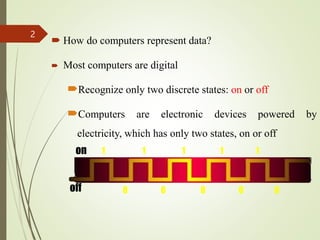
 How do computers represent data?
 Most computers are digital
Recognize only two discrete states: on or off
Computers are electronic devices powered by
electricity, which has only two states, on or off
2
on
off 0 0 0 0 0
1 1 1 1 1
Data Representation
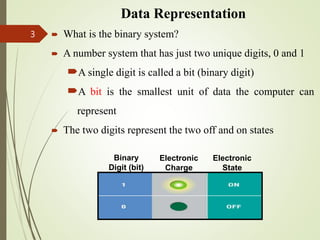
 What is the binary system?
 A number system that has just two unique digits, 0 and 1
A single digit is called a bit (binary digit)
A bit is the smallest unit of data the computer can
represent
 The two digits represent the two off and on states
3
Binary
Digit (bit)
Electronic
Charge
Electronic
State
Data Representation
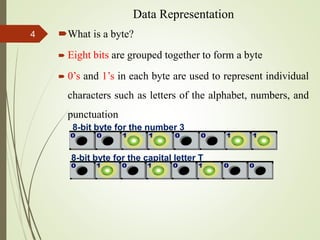
What is a byte?
 Eight bits are grouped together to form a byte
 0’s and 1’s in each byte are used to represent individual
characters such as letters of the alphabet, numbers, and
punctuation
4
8-bit byte for the number 3
8-bit byte for the capital letter T
Data Representation
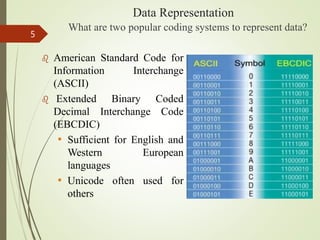
What are two popular coding systems to represent data?
5
 American Standard Code for
Information Interchange
(ASCII)
 Extended Binary Coded
Decimal Interchange Code
(EBCDIC)
• Sufficient for English and
Western European
languages
• Unicode often used for
others
Data Representation
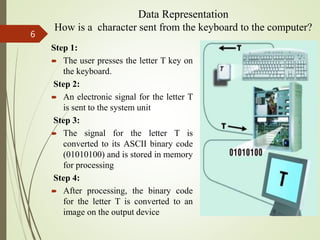
How is a character sent from the keyboard to the computer?
Step 1:
 The user presses the letter T key on
the keyboard.
Step 2:
 An electronic signal for the letter T
is sent to the system unit
Step 3:
 The signal for the letter T is
converted to its ASCII binary code
(01010100) and is stored in memory
for processing
Step 4:
 After processing, the binary code
for the letter T is converted to an
image on the output device
6
Numbering Systems
 The data representation of computer consist alphabets,
numerals, and special symbols. Here we discuss about the
numerals (numbers). In our daily life we use decimal
system, where as computer use only binary system .
Basically Number system is divided in to four types
 Binary Numbering System
 Octal Numbering system
 Decimal Numbering system
 Hexa-decimal Numbering System
7
Binary Number System
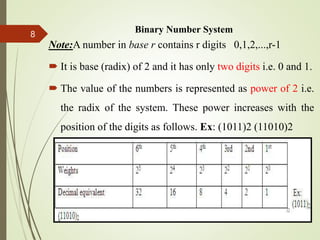
Note:A number in base r contains r digits 0,1,2,...,r-1
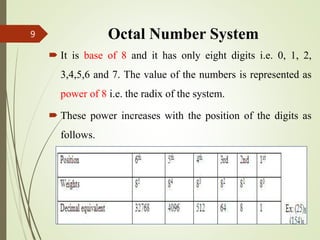
 It is base (radix) of 2 and it has only two digits i.e. 0 and 1.
 The value of the numbers is represented as power of 2 i.e.
the radix of the system. These power increases with the
position of the digits as follows. Ex: (1011)2 (11010)2
8
Octal Number System
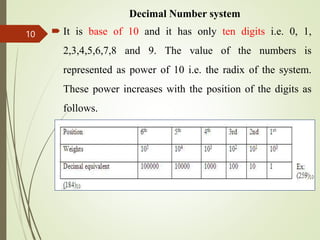
 It is base of 8 and it has only eight digits i.e. 0, 1, 2,
3,4,5,6 and 7. The value of the numbers is represented as
power of 8 i.e. the radix of the system.
 These power increases with the position of the digits as
follows.
9
Decimal Number system
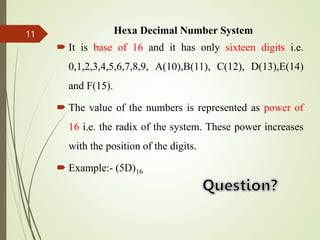
 It is base of 10 and it has only ten digits i.e. 0, 1,
2,3,4,5,6,7,8 and 9. The value of the numbers is
represented as power of 10 i.e. the radix of the system.
These power increases with the position of the digits as
follows.
10
Hexa Decimal Number System
 It is base of 16 and it has only sixteen digits i.e.
0,1,2,3,4,5,6,7,8,9, A(10),B(11), C(12), D(13),E(14)
and F(15).
 The value of the numbers is represented as power of
16 i.e. the radix of the system. These power increases
with the position of the digits.
 Example:- (5D)16
11
Conversions
 We can convert from any system to any other system as
follows.
Decimal to Binary
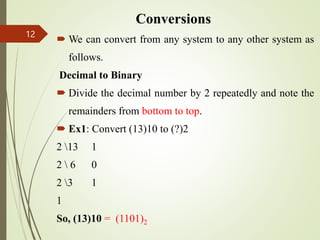
 Divide the decimal number by 2 repeatedly and note the
remainders from bottom to top.
 Ex1: Convert (13)10 to (?)2
2 13 1
2  6 0
2 3 1
1
So, (13)10 = (1101)2
12
Cont...
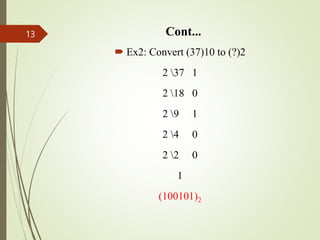
 Ex2: Convert (37)10 to (?)2
2 37 1
2 18 0
2 9 1
2 4 0
2 2 0
1
(100101)2
13
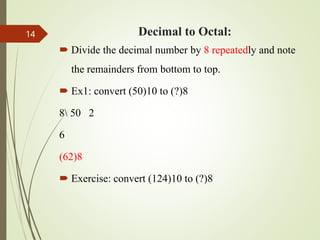
Decimal to Octal:
 Divide the decimal number by 8 repeatedly and note
the remainders from bottom to top.
 Ex1: convert (50)10 to (?)8
8 50 2
6
(62)8
 Exercise: convert (124)10 to (?)8
14
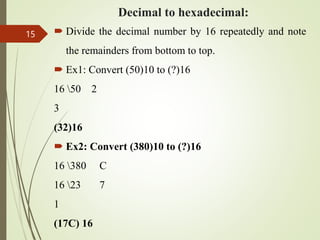
Decimal to hexadecimal:
 Divide the decimal number by 16 repeatedly and note
the remainders from bottom to top.
 Ex1: Convert (50)10 to (?)16
16 50 2
3
(32)16
 Ex2: Convert (380)10 to (?)16
16 380 C
16 23 7
1
(17C) 16
15
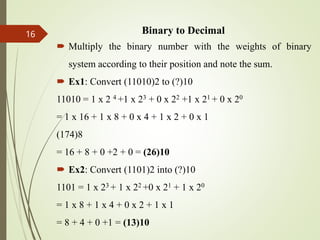
Binary to Decimal
 Multiply the binary number with the weights of binary
system according to their position and note the sum.
 Ex1: Convert (11010)2 to (?)10
11010 = 1 x 2 4 +1 x 23 + 0 x 22 +1 x 21 + 0 x 20
= 1 x 16 + 1 x 8 + 0 x 4 + 1 x 2 + 0 x 1
(174)8
= 16 + 8 + 0 +2 + 0 = (26)10
 Ex2: Convert (1101)2 into (?)10
1101 = 1 x 23 + 1 x 22 +0 x 21 + 1 x 20
= 1 x 8 + 1 x 4 + 0 x 2 + 1 x 1
= 8 + 4 + 0 +1 = (13)10
16
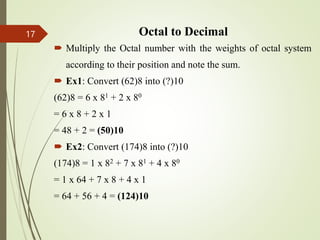
Octal to Decimal
 Multiply the Octal number with the weights of octal system
according to their position and note the sum.
 Ex1: Convert (62)8 into (?)10
(62)8 = 6 x 81 + 2 x 80
= 6 x 8 + 2 x 1
= 48 + 2 = (50)10
 Ex2: Convert (174)8 into (?)10
(174)8 = 1 x 82 + 7 x 81 + 4 x 80
= 1 x 64 + 7 x 8 + 4 x 1
= 64 + 56 + 4 = (124)10
17
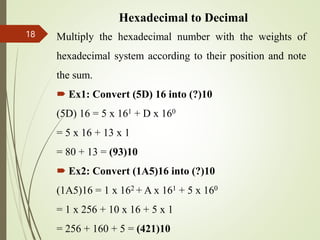
Hexadecimal to Decimal
Multiply the hexadecimal number with the weights of
hexadecimal system according to their position and note
the sum.
 Ex1: Convert (5D) 16 into (?)10
(5D) 16 = 5 x 161 + D x 160
= 5 x 16 + 13 x 1
= 80 + 13 = (93)10
 Ex2: Convert (1A5)16 into (?)10
(1A5)16 = 1 x 162 + A x 161 + 5 x 160
= 1 x 256 + 10 x 16 + 5 x 1
= 256 + 160 + 5 = (421)10
18
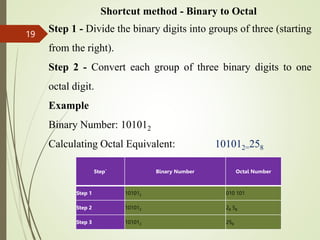
Shortcut method - Binary to Octal
Step 1 - Divide the binary digits into groups of three (starting
from the right).
Step 2 - Convert each group of three binary digits to one
octal digit.
Example
Binary Number: 101012
Calculating Octal Equivalent: 101012=258
19
Step` Binary Number Octal Number
Step 1 101012 010 101
Step 2 101012 28 58
Step 3 101012 258
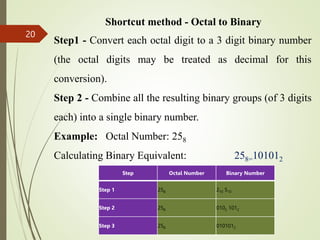
Shortcut method - Octal to Binary
Step1 - Convert each octal digit to a 3 digit binary number
(the octal digits may be treated as decimal for this
conversion).
Step 2 - Combine all the resulting binary groups (of 3 digits
each) into a single binary number.
Example: Octal Number: 258
Calculating Binary Equivalent: 258=101012
20
Step Octal Number Binary Number
Step 1 258 210 510
Step 2 258 0102 1012
Step 3 258 0101012
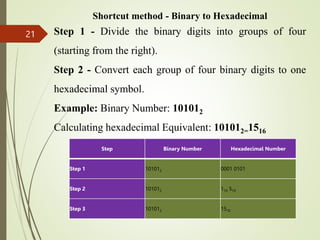
Shortcut method - Binary to Hexadecimal
Step 1 - Divide the binary digits into groups of four
(starting from the right).
Step 2 - Convert each group of four binary digits to one
hexadecimal symbol.
Example: Binary Number: 101012
Calculating hexadecimal Equivalent: 101012=1516
21
Step Binary Number Hexadecimal Number
Step 1 101012 0001 0101
Step 2 101012 110 510
Step 3 101012 1516
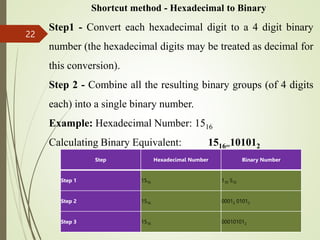
Shortcut method - Hexadecimal to Binary
Step1 - Convert each hexadecimal digit to a 4 digit binary
number (the hexadecimal digits may be treated as decimal for
this conversion).
Step 2 - Combine all the resulting binary groups (of 4 digits
each) into a single binary number.
Example: Hexadecimal Number: 1516
Calculating Binary Equivalent: 1516=101012
22
Step Hexadecimal Number Binary Number
Step 1 1516 110 510
Step 2 1516 00012 01012
Step 3 1516 000101012
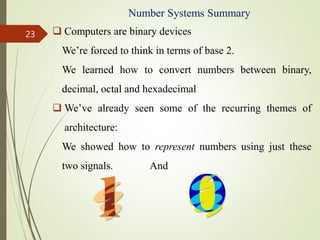
Number Systems Summary
 Computers are binary devices
We’re forced to think in terms of base 2.
We learned how to convert numbers between binary,
decimal, octal and hexadecimal
 We’ve already seen some of the recurring themes of
architecture:
We showed how to represent numbers using just these
two signals. And
23
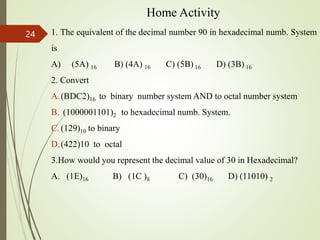
Home Activity
1. The equivalent of the decimal number 90 in hexadecimal numb. System
is
A) (5A) 16 B) (4A) 16 C) (5B) 16 D) (3B) 16
2. Convert
A.(BDC2)16 to binary number system AND to octal number system
B. (1000001101)2 to hexadecimal numb. System.
C. (129)10 to binary
D.(422)10 to octal
3.How would you represent the decimal value of 30 in Hexadecimal?
A. (1E)16 B) (1C )8 C) (30)16 D) (11010) 2
24
25

Chapter 3.pptx

  • 1.
  • 2.
     How docomputers represent data?  Most computers are digital Recognize only two discrete states: on or off Computers are electronic devices powered by electricity, which has only two states, on or off 2 on off 0 0 0 0 0 1 1 1 1 1
  • 3.
    Data Representation  Whatis the binary system?  A number system that has just two unique digits, 0 and 1 A single digit is called a bit (binary digit) A bit is the smallest unit of data the computer can represent  The two digits represent the two off and on states 3 Binary Digit (bit) Electronic Charge Electronic State
  • 4.
    Data Representation What isa byte?  Eight bits are grouped together to form a byte  0’s and 1’s in each byte are used to represent individual characters such as letters of the alphabet, numbers, and punctuation 4 8-bit byte for the number 3 8-bit byte for the capital letter T
  • 5.
    Data Representation What aretwo popular coding systems to represent data? 5  American Standard Code for Information Interchange (ASCII)  Extended Binary Coded Decimal Interchange Code (EBCDIC) • Sufficient for English and Western European languages • Unicode often used for others
  • 6.
    Data Representation How isa character sent from the keyboard to the computer? Step 1:  The user presses the letter T key on the keyboard. Step 2:  An electronic signal for the letter T is sent to the system unit Step 3:  The signal for the letter T is converted to its ASCII binary code (01010100) and is stored in memory for processing Step 4:  After processing, the binary code for the letter T is converted to an image on the output device 6
  • 7.
    Numbering Systems  Thedata representation of computer consist alphabets, numerals, and special symbols. Here we discuss about the numerals (numbers). In our daily life we use decimal system, where as computer use only binary system . Basically Number system is divided in to four types  Binary Numbering System  Octal Numbering system  Decimal Numbering system  Hexa-decimal Numbering System 7
  • 8.
    Binary Number System Note:Anumber in base r contains r digits 0,1,2,...,r-1  It is base (radix) of 2 and it has only two digits i.e. 0 and 1.  The value of the numbers is represented as power of 2 i.e. the radix of the system. These power increases with the position of the digits as follows. Ex: (1011)2 (11010)2 8
  • 9.
    Octal Number System It is base of 8 and it has only eight digits i.e. 0, 1, 2, 3,4,5,6 and 7. The value of the numbers is represented as power of 8 i.e. the radix of the system.  These power increases with the position of the digits as follows. 9
  • 10.
    Decimal Number system It is base of 10 and it has only ten digits i.e. 0, 1, 2,3,4,5,6,7,8 and 9. The value of the numbers is represented as power of 10 i.e. the radix of the system. These power increases with the position of the digits as follows. 10
  • 11.
    Hexa Decimal NumberSystem  It is base of 16 and it has only sixteen digits i.e. 0,1,2,3,4,5,6,7,8,9, A(10),B(11), C(12), D(13),E(14) and F(15).  The value of the numbers is represented as power of 16 i.e. the radix of the system. These power increases with the position of the digits.  Example:- (5D)16 11
  • 12.
    Conversions  We canconvert from any system to any other system as follows. Decimal to Binary  Divide the decimal number by 2 repeatedly and note the remainders from bottom to top.  Ex1: Convert (13)10 to (?)2 2 13 1 2 6 0 2 3 1 1 So, (13)10 = (1101)2 12
  • 13.
    Cont...  Ex2: Convert(37)10 to (?)2 2 37 1 2 18 0 2 9 1 2 4 0 2 2 0 1 (100101)2 13
  • 14.
    Decimal to Octal: Divide the decimal number by 8 repeatedly and note the remainders from bottom to top.  Ex1: convert (50)10 to (?)8 8 50 2 6 (62)8  Exercise: convert (124)10 to (?)8 14
  • 15.
    Decimal to hexadecimal: Divide the decimal number by 16 repeatedly and note the remainders from bottom to top.  Ex1: Convert (50)10 to (?)16 16 50 2 3 (32)16  Ex2: Convert (380)10 to (?)16 16 380 C 16 23 7 1 (17C) 16 15
  • 16.
    Binary to Decimal Multiply the binary number with the weights of binary system according to their position and note the sum.  Ex1: Convert (11010)2 to (?)10 11010 = 1 x 2 4 +1 x 23 + 0 x 22 +1 x 21 + 0 x 20 = 1 x 16 + 1 x 8 + 0 x 4 + 1 x 2 + 0 x 1 (174)8 = 16 + 8 + 0 +2 + 0 = (26)10  Ex2: Convert (1101)2 into (?)10 1101 = 1 x 23 + 1 x 22 +0 x 21 + 1 x 20 = 1 x 8 + 1 x 4 + 0 x 2 + 1 x 1 = 8 + 4 + 0 +1 = (13)10 16
  • 17.
    Octal to Decimal Multiply the Octal number with the weights of octal system according to their position and note the sum.  Ex1: Convert (62)8 into (?)10 (62)8 = 6 x 81 + 2 x 80 = 6 x 8 + 2 x 1 = 48 + 2 = (50)10  Ex2: Convert (174)8 into (?)10 (174)8 = 1 x 82 + 7 x 81 + 4 x 80 = 1 x 64 + 7 x 8 + 4 x 1 = 64 + 56 + 4 = (124)10 17
  • 18.
    Hexadecimal to Decimal Multiplythe hexadecimal number with the weights of hexadecimal system according to their position and note the sum.  Ex1: Convert (5D) 16 into (?)10 (5D) 16 = 5 x 161 + D x 160 = 5 x 16 + 13 x 1 = 80 + 13 = (93)10  Ex2: Convert (1A5)16 into (?)10 (1A5)16 = 1 x 162 + A x 161 + 5 x 160 = 1 x 256 + 10 x 16 + 5 x 1 = 256 + 160 + 5 = (421)10 18
  • 19.
    Shortcut method -Binary to Octal Step 1 - Divide the binary digits into groups of three (starting from the right). Step 2 - Convert each group of three binary digits to one octal digit. Example Binary Number: 101012 Calculating Octal Equivalent: 101012=258 19 Step` Binary Number Octal Number Step 1 101012 010 101 Step 2 101012 28 58 Step 3 101012 258
  • 20.
    Shortcut method -Octal to Binary Step1 - Convert each octal digit to a 3 digit binary number (the octal digits may be treated as decimal for this conversion). Step 2 - Combine all the resulting binary groups (of 3 digits each) into a single binary number. Example: Octal Number: 258 Calculating Binary Equivalent: 258=101012 20 Step Octal Number Binary Number Step 1 258 210 510 Step 2 258 0102 1012 Step 3 258 0101012
  • 21.
    Shortcut method -Binary to Hexadecimal Step 1 - Divide the binary digits into groups of four (starting from the right). Step 2 - Convert each group of four binary digits to one hexadecimal symbol. Example: Binary Number: 101012 Calculating hexadecimal Equivalent: 101012=1516 21 Step Binary Number Hexadecimal Number Step 1 101012 0001 0101 Step 2 101012 110 510 Step 3 101012 1516
  • 22.
    Shortcut method -Hexadecimal to Binary Step1 - Convert each hexadecimal digit to a 4 digit binary number (the hexadecimal digits may be treated as decimal for this conversion). Step 2 - Combine all the resulting binary groups (of 4 digits each) into a single binary number. Example: Hexadecimal Number: 1516 Calculating Binary Equivalent: 1516=101012 22 Step Hexadecimal Number Binary Number Step 1 1516 110 510 Step 2 1516 00012 01012 Step 3 1516 000101012
  • 23.
    Number Systems Summary Computers are binary devices We’re forced to think in terms of base 2. We learned how to convert numbers between binary, decimal, octal and hexadecimal  We’ve already seen some of the recurring themes of architecture: We showed how to represent numbers using just these two signals. And 23
  • 24.
    Home Activity 1. Theequivalent of the decimal number 90 in hexadecimal numb. System is A) (5A) 16 B) (4A) 16 C) (5B) 16 D) (3B) 16 2. Convert A.(BDC2)16 to binary number system AND to octal number system B. (1000001101)2 to hexadecimal numb. System. C. (129)10 to binary D.(422)10 to octal 3.How would you represent the decimal value of 30 in Hexadecimal? A. (1E)16 B) (1C )8 C) (30)16 D) (11010) 2 24
  • 25.