The document discusses a model for automatic vehicle number plate detection using the YOLO (You Only Look Once) algorithm, which processes images to identify license plates efficiently, achieving high accuracy at a speed of up to 155 frames per second. The system can detect number plates of various colors and conditions, including broken or dirty ones, through a methodology that includes image capture, plate detection, character segmentation, and recognition. It highlights the importance of such technology for law enforcement to combat fraud and manage vehicle information effectively.
International Journal ofTrend in Scientific Research and Development (IJTSRD) @ www.ijtsrd.com eISSN: 2456-6470
@ IJTSRD | Unique Paper ID – IJTSRD41286 | Volume – 5 | Issue – 4 | May-June 2021 Page 435
III. WORKING METHEODOLOGY
In this model the main is to identify the number plate and
detect the number on the license plate. It is very useful for
traffic police to identify the vehicles to mark some fraud
activities that happen.Humanbeingsalwayswanteverything
to be done automatically,sodetectingofobjectsmakesiteasy
for us to find out solutions to different problems. YOLO (You
Look Only Once). This algorithm is based mainly on
regression, and alsoinsteadofcompletelyselectingtheimage
it predicts the object in the image which we want to select in
bounding boxes in one run of the algorithm. Implementation
of this model is using YOLO or You look Only Once.Itisfaster,
easier and efficient to use. It detects the number plate after
the image isadded and displays the imagewithboundingbox
around the number plate. Another feature is that if the image
is shown to the web camera it detects the image and also the
license plate will be detected. Number plates can be of
different color, shape, size and language, it detects the
number plate of different countries which is a major
drawback in many methods which are already proposed.
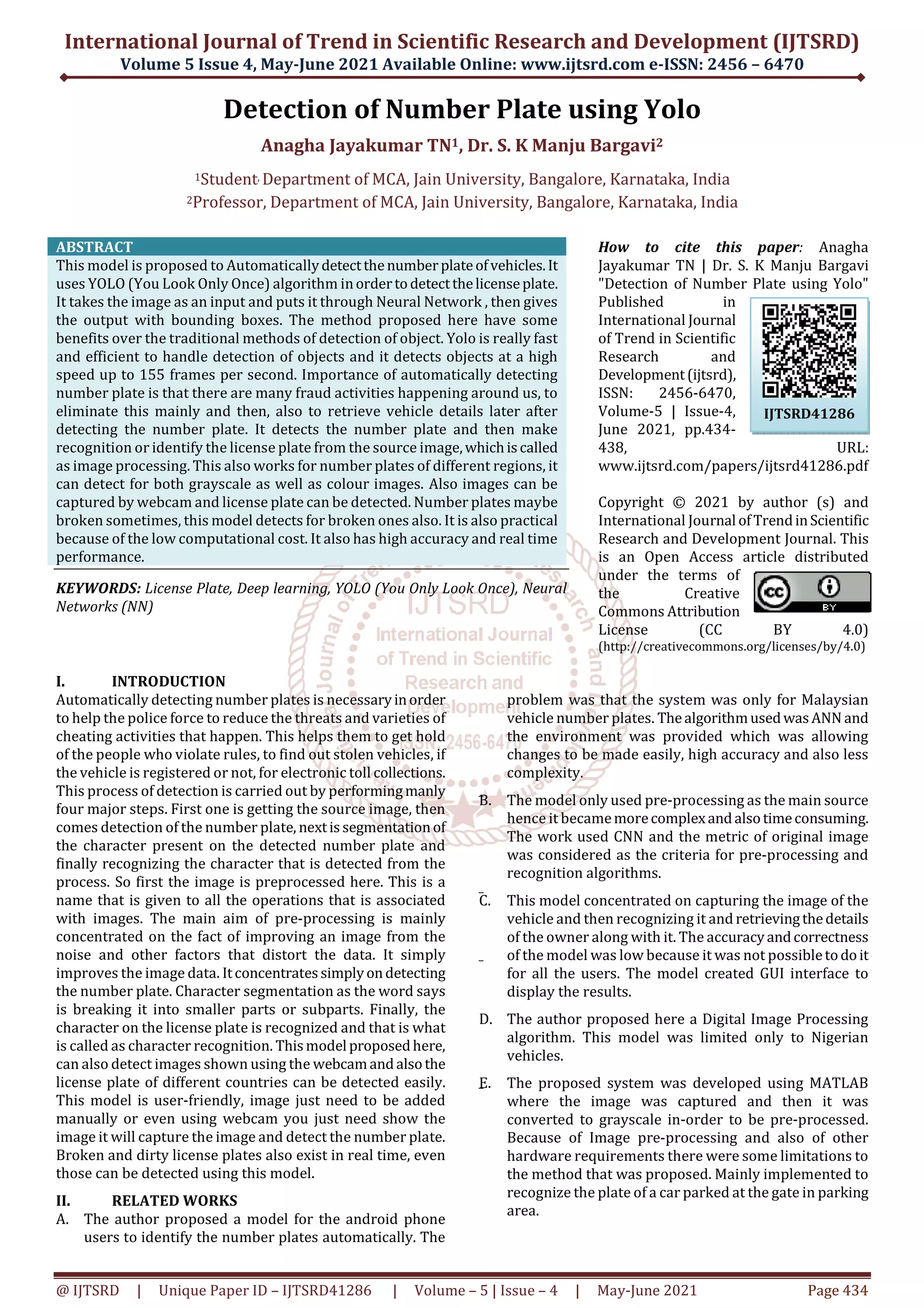
Fig 1.1: Working of the proposed system
Two main working of the proposed system is describesinFig
1.1. YOLO is a real time object detection method What
happens in this method is that the neural network is being
applied to the source image. Single image is broken into
different framesand then the prediction of the boundarybox
is done. It is by classification model that predictive values
detect the object. The working of the proposed model is by
dividing it into two parts and they are by identifying the
number plates based on the source image inserted or added
into the model. So at first, the image will be checked for the
number plates with white background because the system
need to detect both colored as well as white number plates.
After seeing the image and detecting the vehicle and then
identifying the number plate is done first.
Then the number plate is identified. If the number plate is
white in colour it will be detected and marked within
bounding box. It also checks if the license plate is broken or
not. Here we are using the blob detection to identify these
kind of number plates. Difference in background and also
brightness variation will also affect the detection process.
The main aim of using this approach is to find the
complimentary regions which are not detected by the edge
detection or corner detection algorithm. It also detects the
broke number plate. The next part of the model is to identify
the number plates which are colored for example yellow,
black and more. It will then detect the plate and after
marking the bounding box it will show the cropped number
plate with the help of optical character recognition.
IV. PROPOSED SYSTEM
The proposed system uses YOLO(You Look Only Once)
algorithm to detect the objects in a single frame. Then what
the algorithm does is that it detects the object to be
recognised in bounding box and identifies.
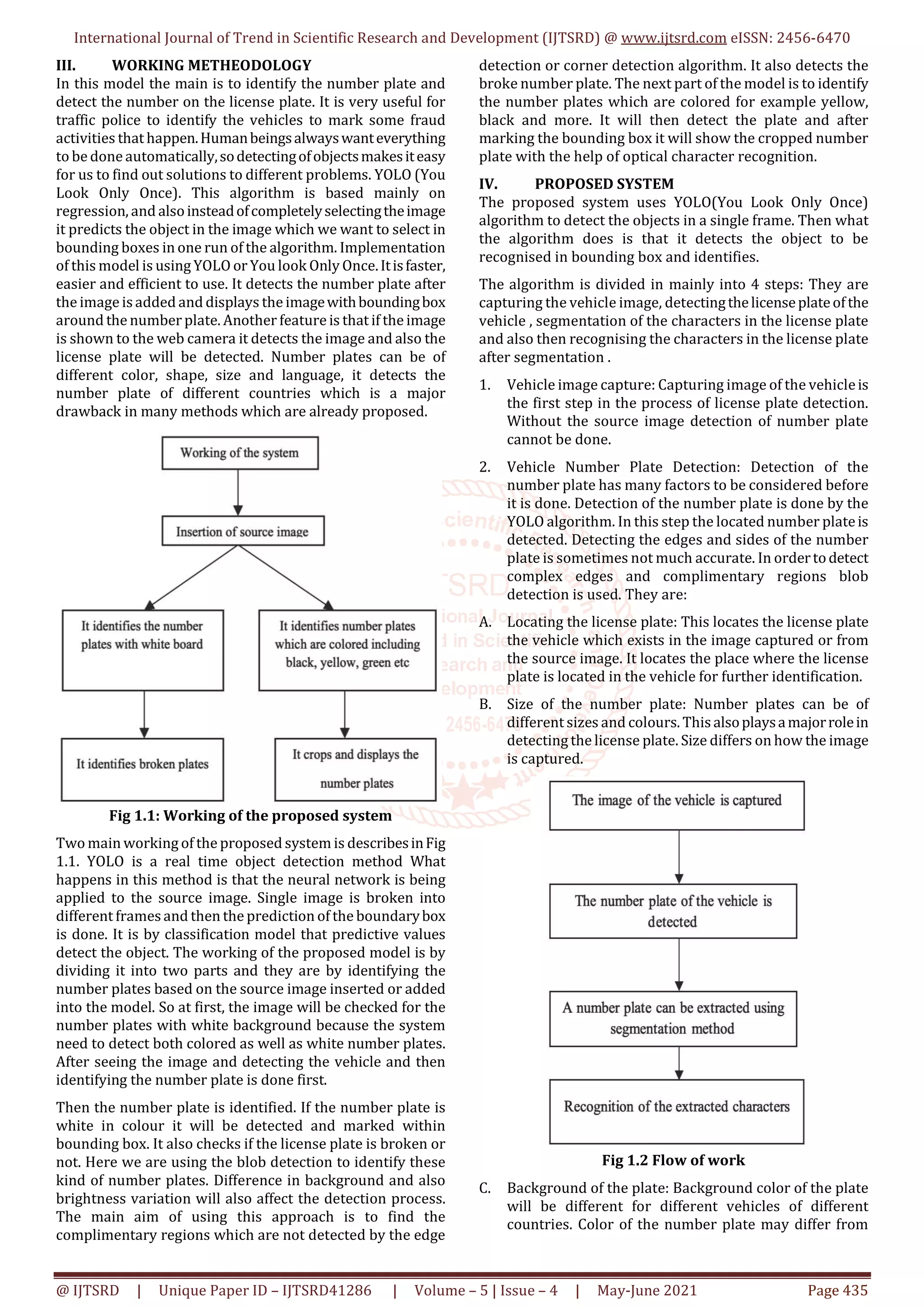
The algorithm is divided in mainly into 4 steps: They are
capturing the vehicle image, detectingthelicenseplateofthe
vehicle , segmentation of the characters in the license plate
and also then recognising the characters in the license plate
after segmentation .
1. Vehicle image capture: Capturing image of the vehicleis
the first step in the process of license plate detection.
Without the source image detection of number plate
cannot be done.
2. Vehicle Number Plate Detection: Detection of the
number plate has many factors to be considered before
it is done. Detection of the number plate is done by the
YOLO algorithm. In this step the located number plateis
detected. Detecting the edges and sides of the number
plate is sometimes not much accurate. In ordertodetect
complex edges and complimentary regions blob
detection is used. They are:
A. Locating the license plate: This locates the license plate
the vehicle which exists in the image captured or from
the source image. It locates the place where the license
plate is located in the vehicle for further identification.
B. Size of the number plate: Number plates can be of
different sizes and colours. Thisalsoplaysamajorrolein
detecting the license plate. Size differs on how the image
is captured.
Fig 1.2 Flow of work
C. Background of the plate: Background color of the plate
will be different for different vehicles of different
countries. Color of the number plate may differ from
3.
International Journal ofTrend in Scientific Research and Development (IJTSRD) @ www.ijtsrd.com eISSN: 2456-6470
@ IJTSRD | Unique Paper ID – IJTSRD41286 | Volume – 5 | Issue – 4 | May-June 2021 Page 436
white, yellow, green or to some other color. Hence it is
also an important factor.
D. Screw of the license plate: A number plate will have
screws attached to it. Sometimes this can beconfusedas
a character.
3. Segmentation of character on license plate:
Segmentation of characters can be done using this
segmentation method. Extraction of characters is
actually considered as one of the difficult task as there
are factors that will affect the extraction. Blob detection
is also used in order to detect points or regions that
differ in brightness or color as compared to
surrounding. This will help to find complimentary
regions which are not detected by edge detection or
corner detection algorithm.
4. Character Recognition: Our model after segmentation
recognize the number plate and mark them within
bounding box. It will also handle ambiguous and also
noisy data from the prediction.
It can identify the characters automatically based on the
training data. From this the characters are recognized. Our
method also recognizes broken number plates as well as the
one with dirt and low sunlight. The number plate is morphed
using morphology technique. The recognised and cropped
number plate will be detected and displyed seperately. This
will be converted to greyscale.
V. ARCHITECTURE
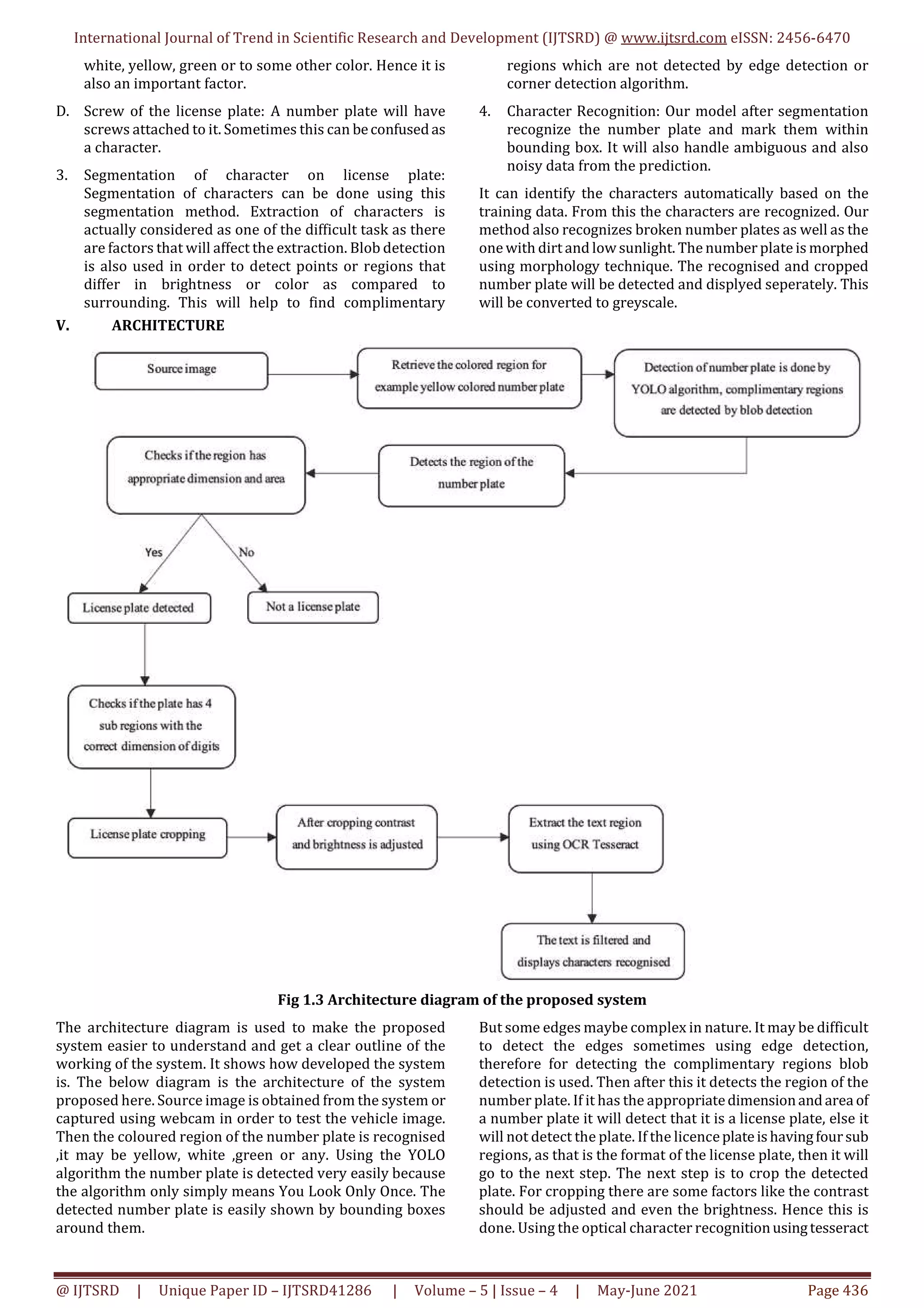
Fig 1.3 Architecture diagram of the proposed system
The architecture diagram is used to make the proposed
system easier to understand and get a clear outline of the
working of the system. It shows how developed the system
is. The below diagram is the architecture of the system
proposed here. Source image is obtained from the system or
captured using webcam in order to test the vehicle image.
Then the coloured region of the number plate is recognised
,it may be yellow, white ,green or any. Using the YOLO
algorithm the number plate is detected very easily because
the algorithm only simply means You Look Only Once. The
detected number plate is easily shown by bounding boxes
around them.
But some edges maybe complex in nature. It may be difficult
to detect the edges sometimes using edge detection,
therefore for detecting the complimentary regions blob
detection is used. Then after this it detects the region of the
number plate. If it has the appropriatedimensionandarea of
a number plate it will detect that it is a license plate, else it
will not detect the plate. If the licenceplateishavingfoursub
regions, as that is the format of the license plate, then it will
go to the next step. The next step is to crop the detected
plate. For cropping there are some factors like the contrast
should be adjusted and even the brightness. Hence this is
done. Using the optical character recognitionusingtesseract
4.
International Journal ofTrend in Scientific Research and Development (IJTSRD) @ www.ijtsrd.com eISSN: 2456-6470
@ IJTSRD | Unique Paper ID – IJTSRD41286 | Volume – 5 | Issue – 4 | May-June 2021 Page 437
the region of the number plate is extracted. Then text
filtering is done and finally the number plate will be
displayed after cropping and text filtering.
VI. RESULT AND DISCUSSION
Number plates have been tested with different background
color, broken ones and for different countries also for the
proposed method. Use of YOLO made it easy to implement
this detection system for number plate. It helped in
increasing accuracy rate, less complex than MATLAB and
other methods. The method focuses mainly on two varieties
that is: first one is for number plates that have white
background and it will also detect for the broken ones as
well as normal ones, and the second one for the colored
number plates like red, green, black etc. Images can also be
added normally to the proposed method or can be captured
using web camera also.
Fig 1.4shows the result obtained by running the model. First
the captured image is shown which is called as the source
image. The image is then gone through the detection process
and license plate is recognised and as shown in the figure
bounding boxes appear around the license plate. After this
the detected plateiscroppedbyusingmorphologytechnique.
Then the cropped plate is taken and the characters are
recognised by tesseract and optical character recognition.
This is done order to detect the coloured number plates. In
Fig 1.5 the images shows the broken plate of the vehicle that
is displayed. The method proposed identifies white colored
number plates, also broken plates. The figure clearly shows
the broken plate that is bounded by box around them.
Fig.1.4 Output 1: Detecting yellow number plate
Fig 1.5 Output 2: Detecting broken number plate
VII. FUTURE SCOPE
This model can be further improved by adding videofilesfor
checking the license plate. Themodel proposedhereactually
have the ability to run videos and detect the number plate,
but because of privacy issues videos cannot be added and
detected. This can be added for future use. We canalsomake
it more user friendly by adding more images to the system
and selecting from it in a random way. This can be made
more efficient by adding different types of neural network
algorithms to it. Multiple algorithms can be checked to
identify which is more suitable. And compare which gives
more accuracy to detect the license plate easilyandwithless
time.
VIII. CONCLUSION
It has always been a difficult task to identify vehicles on a
busy road, as the number of vehicles is increasing day by
day. It can monitor vehicles that exceed the speed limit, also
other cheating and fraud issues can be solved. Automatic
License Plate Recognition system allows to detect the
number plate, this will help the cops to solve problems
regarding to road. By just inserting source image we canrun
the data. This model proposed here has been efficient to
recognise the license plates that were broken, of different
countries and also the images shown using webcam. This
provides high accuracy, low computational cost and also an
efficient system to detect the vehicles.Themodel hereisalso
able to detect plates of differentsizesandcolours,conditions
like sunlight, darkness andshadows,badweatherconditions
and broken ones.
5.
International Journal ofTrend in Scientific Research and Development (IJTSRD) @ www.ijtsrd.com eISSN: 2456-6470
@ IJTSRD | Unique Paper ID – IJTSRD41286 | Volume – 5 | Issue – 4 | May-June 2021 Page 438
ACKNOWLEDGEMENT
I should convey my obligation to Dr MN Nachappa and Asst.
Prof: Dr Manju Bargavi and undertaking facilitators fortheir
effective motivation and encouragement throughout my
assessment work. Theirideal bearing,absoluteco-actionand
second discernment have made my work gainful.
REFERENCES
[1] M. A, G. TS, C. J and K. M, "Optimization of ANPR
algorithm on Android mobile phone," IEEE
International Conference on Smart Instrumentation,
Measurement and Applications, 2013.
[2] Tlebaldinova, A. Denissova, N. Kassymkhanova and
Dana, "Application of a scenario approach in
development of a recognition system of vehicle
identification numbers," International Conferenceon
Modeling, SimulationandAppliedoptimization,2015.
[3] Sulaiman, N. Razali, A. Jadin, M. Hadi, A. A. Mustafa, M.
Ghazali and KH, "Development of OnlineVehicle Plate
Recognition System".
[4] Attah, A. ADEDIGBA, A. Aibinu and AM,"Development
of Nigerian vehicles license plate recognition and
classification system," Journal ofScience,Technology,
Mathematics and Education, 2016.
[5] Tiwari, B. Sharma, A. Singh, M. Gautam, Rathi and
Bhawana, "Automatic Vehicle Number Plate
Recognition System using Matlab," IOSR Journal of
Electronics and Communication Engineering (IOSR-
JECE) e-ISSN, 2016.

![International Journal of Trend in Scientific Research and Development (IJTSRD) @ www.ijtsrd.com eISSN: 2456-6470
@ IJTSRD | Unique Paper ID – IJTSRD41286 | Volume – 5 | Issue – 4 | May-June 2021 Page 438
ACKNOWLEDGEMENT
I should convey my obligation to Dr MN Nachappa and Asst.
Prof: Dr Manju Bargavi and undertaking facilitators fortheir
effective motivation and encouragement throughout my
assessment work. Theirideal bearing,absoluteco-actionand
second discernment have made my work gainful.
REFERENCES
[1] M. A, G. TS, C. J and K. M, "Optimization of ANPR
algorithm on Android mobile phone," IEEE
International Conference on Smart Instrumentation,
Measurement and Applications, 2013.
[2] Tlebaldinova, A. Denissova, N. Kassymkhanova and
Dana, "Application of a scenario approach in
development of a recognition system of vehicle
identification numbers," International Conferenceon
Modeling, SimulationandAppliedoptimization,2015.
[3] Sulaiman, N. Razali, A. Jadin, M. Hadi, A. A. Mustafa, M.
Ghazali and KH, "Development of OnlineVehicle Plate
Recognition System".
[4] Attah, A. ADEDIGBA, A. Aibinu and AM,"Development
of Nigerian vehicles license plate recognition and
classification system," Journal ofScience,Technology,
Mathematics and Education, 2016.
[5] Tiwari, B. Sharma, A. Singh, M. Gautam, Rathi and
Bhawana, "Automatic Vehicle Number Plate
Recognition System using Matlab," IOSR Journal of
Electronics and Communication Engineering (IOSR-
JECE) e-ISSN, 2016.](https://image.slidesharecdn.com/75detectionofnumberplateusingyolo-210715052335/75/Detection-of-Number-Plate-using-Yolo-5-2048.jpg)


