Exploration of Jovian Atmosphere 
Using Nuclear Ramjet Flyer 
by 
George Maise 
Plus Ultra Technologies, Inc. 
Stony Brook, New York 
Presented at NIAC 4th Annual Meeting 
Houston, June 11-12, 2002
Contributors 
a Gilbert Carpenter, Consultant Stability and Control 
a Timothy Dowling, U. Louisville Planetary Sci. & Instruments 
a Edward Kush, Consultant Ramjet Propulsion 
a Hans Ludewig, BNL Nuclear Physics 
a George Maise, Plus Ultra Tech. Principal Investigator 
a John Paniagua, Plus Ultra Tech. Mission Analysis 
a James Powell, Plus Ultra Tech. Inventor of Concept 
a Sven Roosild, Consultant Radiation Hardening 
a Pasquale Sforza, U. Florida Flight Vehicle Aerodynamics
Jovian Clouds
Motivation for Studying Jupiter 
a Jupiter’s atmosphere has has many puzzling features. 
a Understanding Jupiter is the central to exploration of 
Solar System. 
a Jupiter is prototype for Saturn, Uranus and Neptune. 
a Jupiter is extremely common planet type. It is likely that 
most solar systems have a gas giant at ~5 AU.
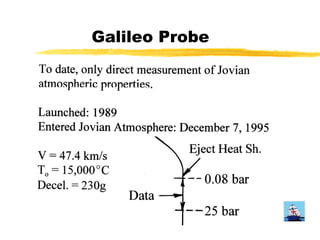
Galileo Probe
Characteristics of Nuclear 
Ramjet Flyer 
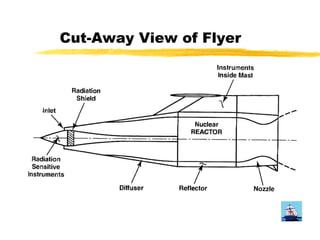
aJovian atmosphere is an unlimited source of 
propellant. 
aMITEE compact nuclear reactor is (nearly) 
unlimited source of heat. 
aWith few moving parts, mechanical wear should 
be minimal.
Nuclear Ramjet Flyer
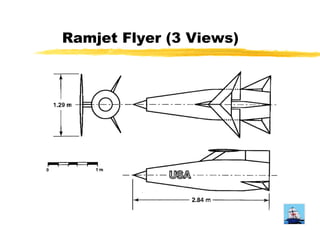
Ramjet Flyer (3 Views)
Cut-Away View of Flyer
MITEE Nuclear Engine (Rocket Version) 
a MITEE (MIniature ReacTor EnginE); 
Ref.: Acta Astronautica, Vol. 44, No.2-4, 1999) 
a Derivative of Ultra-Light Particle Bed Reactor (PBR) 
developed for SDIO (1985-1993; ~ $200M) 
a MITEE is lighter and more compact then PBR. 
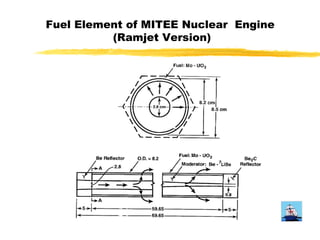
a MITEE can be adapted for ramjet application: 
`Replace H2 by ambient atmosphere from inlet 
`Reduce outlet temperature from 3000 K to 1500 K 
`Reduce power density from 10 to 2 MW/liter 
`Increase operating life from ~1 hour to months
Fuel Element of MITEE Nuclear Engine 
(Ramjet Version)
Radiation Safety 
aBefore reactor startup nuclear fuel is not 
hazardous. 
aReactor will start operation only after 
Jovian entry. 
aDuring launch (from Earth) safety systems 
prevent criticality for all conceivable 
accidents.
Mission Characteristics 
a Payload of 900 kg, comprised of 
`Ramjet Flyer 300 kg 
`Thermal Shield 300 kg 
`Companion Orbiter 200 kg 
a Launch into LEO w. chemical rocket (e.g., Atlas IIAS). 
a From LEO, fly to Jupiter using: 
`Chemical rocker with GA’s: ~6 years 
`Nuclear Thermal Rocket (NTR): ~2 years
Mission Characteristics (Cont.) 
a Upon arrival at Jupiter: 
`Companion Satellite separates from Entry Capsule 
`Companion Satellite enters Jovian orbit 
`Capsule enters Jovian atmosphere 
a When Entry Capsule has slowed to Mach 3, Flyer separates 
from thermal shield. 
a Nuclear engine starts. 
a Flyer commences atmospheric mapping.
Atmospheric Data Collected 
a Pressure 
a Temperature 
a Chemical Composition 
a Wind Velocity 
a Cloud Particles and Size Distribution 
a Lightning Frequency and Energy 
a Energy Flux from Sunlight 
a Energy Flux for Deep Interior 
a 3-D Images of Cloud Formations
Scientific Instruments 
aAtmospheric Structure Instrument (ASI) 
aGas Chromatograph/Mass Spectrometer (GCMS) 
aClear-Air Turbulence Scanner (CAT) 
aLightning/Energetic Particle Detector (LEP) 
aNephelometer 
aMagnetometer 
aStereo Imaging System (SIS) 
aDropsondes (6; allow 3 kg)
Conclusions 
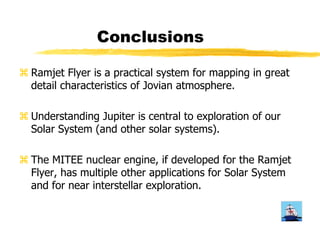
a Ramjet Flyer is a practical system for mapping in great 
detail characteristics of Jovian atmosphere. 
a Understanding Jupiter is central to exploration of our 
Solar System (and other solar systems). 
a The MITEE nuclear engine, if developed for the Ramjet 
Flyer, has multiple other applications for Solar System 
and for near interstellar exploration.

Nuclear ramjetflyerjun02

  • 1.
    Exploration of JovianAtmosphere Using Nuclear Ramjet Flyer by George Maise Plus Ultra Technologies, Inc. Stony Brook, New York Presented at NIAC 4th Annual Meeting Houston, June 11-12, 2002
  • 2.
    Contributors a GilbertCarpenter, Consultant Stability and Control a Timothy Dowling, U. Louisville Planetary Sci. & Instruments a Edward Kush, Consultant Ramjet Propulsion a Hans Ludewig, BNL Nuclear Physics a George Maise, Plus Ultra Tech. Principal Investigator a John Paniagua, Plus Ultra Tech. Mission Analysis a James Powell, Plus Ultra Tech. Inventor of Concept a Sven Roosild, Consultant Radiation Hardening a Pasquale Sforza, U. Florida Flight Vehicle Aerodynamics
  • 3.
  • 4.
    Motivation for StudyingJupiter a Jupiter’s atmosphere has has many puzzling features. a Understanding Jupiter is the central to exploration of Solar System. a Jupiter is prototype for Saturn, Uranus and Neptune. a Jupiter is extremely common planet type. It is likely that most solar systems have a gas giant at ~5 AU.
  • 5.
  • 6.
    Characteristics of Nuclear Ramjet Flyer aJovian atmosphere is an unlimited source of propellant. aMITEE compact nuclear reactor is (nearly) unlimited source of heat. aWith few moving parts, mechanical wear should be minimal.
  • 7.
  • 8.
  • 9.
  • 10.
    MITEE Nuclear Engine(Rocket Version) a MITEE (MIniature ReacTor EnginE); Ref.: Acta Astronautica, Vol. 44, No.2-4, 1999) a Derivative of Ultra-Light Particle Bed Reactor (PBR) developed for SDIO (1985-1993; ~ $200M) a MITEE is lighter and more compact then PBR. a MITEE can be adapted for ramjet application: `Replace H2 by ambient atmosphere from inlet `Reduce outlet temperature from 3000 K to 1500 K `Reduce power density from 10 to 2 MW/liter `Increase operating life from ~1 hour to months
  • 11.
    Fuel Element ofMITEE Nuclear Engine (Ramjet Version)
  • 12.
    Radiation Safety aBeforereactor startup nuclear fuel is not hazardous. aReactor will start operation only after Jovian entry. aDuring launch (from Earth) safety systems prevent criticality for all conceivable accidents.
  • 13.
    Mission Characteristics aPayload of 900 kg, comprised of `Ramjet Flyer 300 kg `Thermal Shield 300 kg `Companion Orbiter 200 kg a Launch into LEO w. chemical rocket (e.g., Atlas IIAS). a From LEO, fly to Jupiter using: `Chemical rocker with GA’s: ~6 years `Nuclear Thermal Rocket (NTR): ~2 years
  • 14.
    Mission Characteristics (Cont.) a Upon arrival at Jupiter: `Companion Satellite separates from Entry Capsule `Companion Satellite enters Jovian orbit `Capsule enters Jovian atmosphere a When Entry Capsule has slowed to Mach 3, Flyer separates from thermal shield. a Nuclear engine starts. a Flyer commences atmospheric mapping.
  • 15.
    Atmospheric Data Collected a Pressure a Temperature a Chemical Composition a Wind Velocity a Cloud Particles and Size Distribution a Lightning Frequency and Energy a Energy Flux from Sunlight a Energy Flux for Deep Interior a 3-D Images of Cloud Formations
  • 16.
    Scientific Instruments aAtmosphericStructure Instrument (ASI) aGas Chromatograph/Mass Spectrometer (GCMS) aClear-Air Turbulence Scanner (CAT) aLightning/Energetic Particle Detector (LEP) aNephelometer aMagnetometer aStereo Imaging System (SIS) aDropsondes (6; allow 3 kg)
  • 17.
    Conclusions a RamjetFlyer is a practical system for mapping in great detail characteristics of Jovian atmosphere. a Understanding Jupiter is central to exploration of our Solar System (and other solar systems). a The MITEE nuclear engine, if developed for the Ramjet Flyer, has multiple other applications for Solar System and for near interstellar exploration.