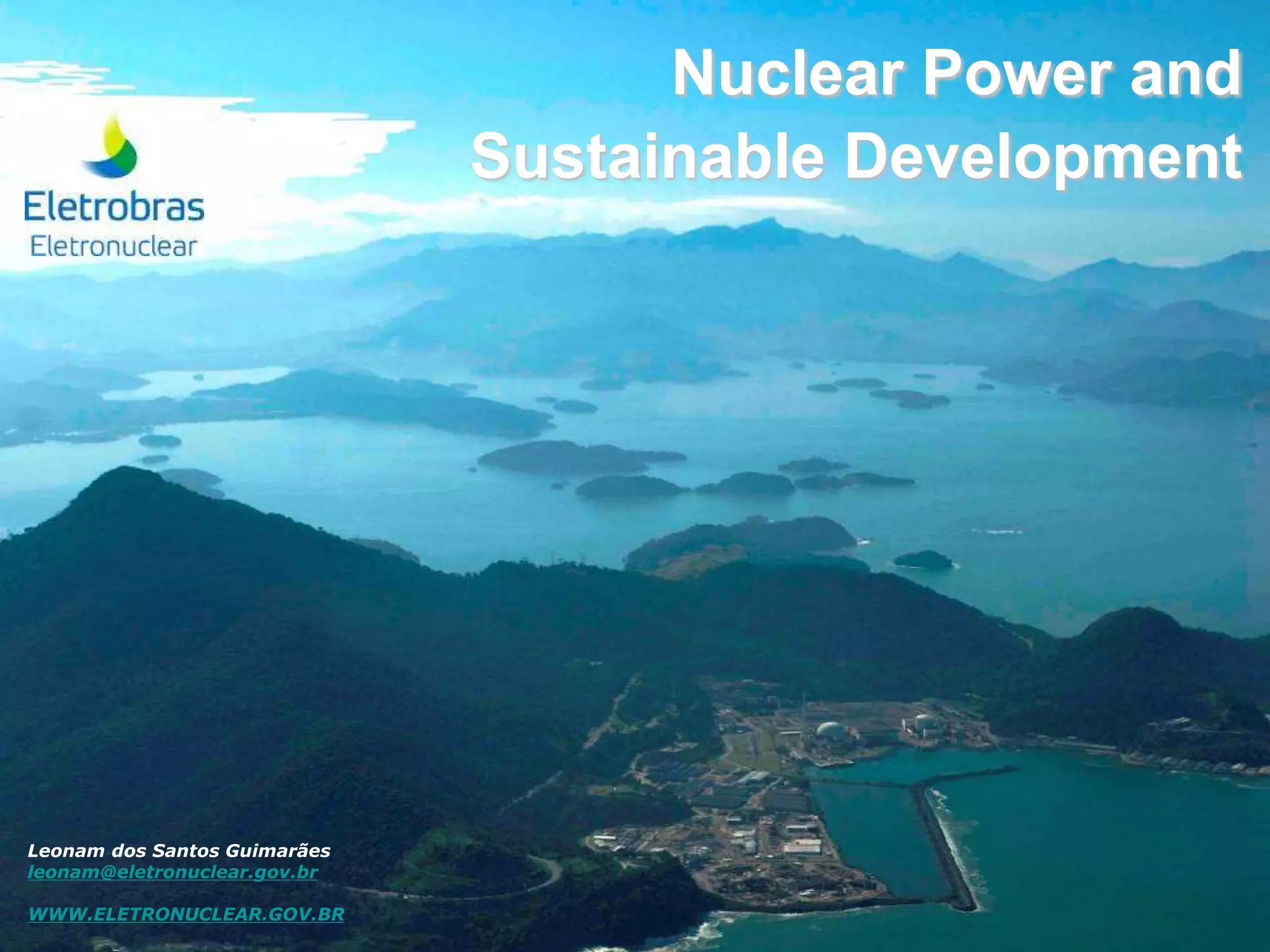
Nuclear Power and
Sustainable Development
Leonam dos Santos Guimarães
leonam@eletronuclear.gov.br
WWW.ELETRONUCLEAR.GOV.BR
Sustainability
• WCED and Brundtland Commission
definition of sustainable development
• Three dimensions/pillars of sustainable
development
– Environmental
– Economic
– Social/institutional
World Commission on Environment and Development in its report Our
Common Future defined sustainable development as “…development that
meets the needs of the present without compromising the ability of future
generations to meet their own needs” (1987)
Economic dimension
• Concerns the maintenance, growth and use of
different categories of capital:
– man-made (e.g., infrastructures, machines,
technology);
– natural (e.g., mineral resources, forests, clean air
and water, the atmosphere); and
– social/human (e.g., institutions, knowledge, intact
societies, tradition).
Economic pillar
• All three types of capital contribute to
economic development
• They are inherently substitutable, the extent
of which has led to the distinction of
– strong sustainability and
– weak sustainability
Economics – Strong
sustainability
• Assumes a limited level of substitutability – rather
complements than substitutes
• Requires each of the capital categories to be
maintained separately at some minimum level:
– Exhaustible resources (fossil, uranium, minerals) cannot
be consumed really
– Renewable resources must be harvested within the
regenerative capacity of the natural capital stock that
produces them and its waste must not exceed the of
ecosystem’s carrying capacity
Economics – Weak
sustainability
• Refers to the maintenance of the total level of capital
passed down through generations without regard to
the particular form of capital
– Allows the use of exhaustible resources as long as
depletion is compensated by equivalent increases in man-
made and social/human capital
– It requires the efficient use of non-renewable resources
that reflect full social costs and the timely development of
inexhaustible energy systems
Environmental dimension
• Preservation of natural resources, biodiversity and
protecting ecosystems and habitats
– Minimize environmental pollution, the exploitation of
exhaustible resources as well as the so-called ‘use of the
environment’ (ecological footprint)
• Reduce production and use of harmful substances to a minimum
– Equitable access by different social/spatial entities
(countries, regions, etc.) to common goods (e.g.
atmosphere)
– Observation of carry capacities of ecosystems
Social/institutional
dimension
• Deals with the ‘needs’ of the Brundtland definition
– Not limited to the materialistic needs of
• food, water, energy, shelter, health and protection in case of old
age and social hardship
– But also includes
• education, recreation, leisure, social relations, political activities,
security, social justice both intra- and intergenerational, good
governance and competent institutions, moral concepts, culture and
religion
– Sustainability in satisfying intra- and intergenerational needs
is directed at the relationships between society and nature
3Rs – Reduce, reuse, recycle
 Reducing waste production, recycling of wastes and
reusing materials form the basis for sustainable
waste management
– Preventing waste generation in the first place through lower
input of natural resources, smarter designs and more
efficient manufacturing
– Reusing, recycling and proper treatment of materials that
would otherwise enter the waste stream
– Replacing products with harmful wastes by environmentally
friendly alternative materials
Trade-offs
• Three pillars of sustainable development (SD)
present conflicting objectives
• Environment protection versus development:
S-d (North) versus D-s (South)
• Trade-offs are necessary
– “Poverty is the biggest polluter” (I. Gandhi, 1972)
• Current environmental problems have been
previous solutions
– Technology – culprit or savior?
Nuclear power in the SD debate
• Energy and SD discussion long avoided/ignored
• Too many stakeholders
• First time subject of CSD-9 in 2001
CSD-9: Outcomes (2001)
confirmed by WSSD (2002)
• Exhaustive debate
• Agreement to disagree on nuclear’s role in
sustainable development
• Unanimous agreement that choice belongs to
countries
 There is no technology without risks and
interaction with the environment.
 Do not discuss a particular technology in
isolation.
 Compare a particular technology with
alternatives on a life cycle (LCA) basis.
BUT
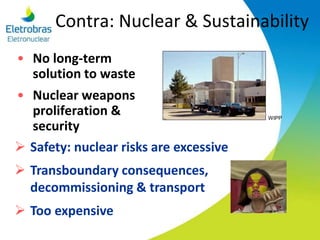
Contra: Nuclear & Sustainability
• No long-term
solution to waste
• Nuclear weapons
proliferation &
security
 Safety: nuclear risks are excessive
 Transboundary consequences,
decommissioning & transport
 Too expensive
WIPP
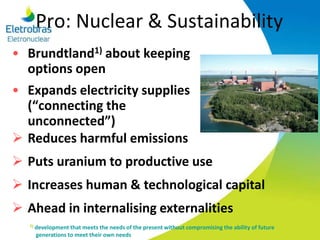
Pro: Nuclear & Sustainability
• Brundtland1) about keeping
options open
• Expands electricity supplies
(“connecting the
unconnected”)
 Reduces harmful emissions
 Puts uranium to productive use
 Increases human & technological capital
 Ahead in internalising externalities
1) development that meets the needs of the present without compromising the ability of future
generations to meet their own needs
Nuclear power in the SD debate
• Energy and SD discussion long avoided/ignored
• Too many stakeholders
• First time subject of CSD-9 in 2001
• World Summit on Sustainable Development
(2002)
• Energy again a CSD topic at CSD-14/15 cycle in
2006/7
• Secretary General’s Advisory Group on Energy
and Climate Change (AGEEC) in 2009/10
Nuclear energy inherently
consistent with “weak
sustainability”• Consumption of finite resources results in an
accumulation of man-made and social &
institutional capital available to future
generations
– Infrastructures, technologies, institutions and
know-how
• Despite an enormous resource base (U in
seawater), potential decoupling from nuclear
fuel resource constraints
– 3R - Reprocessing and fast breeder technology
(closed fuel cycles)
Nuclear energy inherently
consistent with “weak
sustainability”• Uranium mining progressively subjected to EIA,
monitoring and controls (also post mine closures)
• Spent fuel volumes managed and small per unit of
energy delivered
• Final HLW disposal solutions at an advanced stage
of technological development, but often lack will
& public acceptance for their implementation
• HLW even smaller with closed fuel cycles or
partitioning and transmutation
Nuclear energy inherently
consistent with “weak
sustainability”• Reduces the rate of degradation of some
categories of natural capital
– Atmospheric concentration of greenhouse gases
– Air pollution and regional acidification
• Assists in meeting “needs”
– Access
– Affordability
– Supply security
– Skilled labour
– Research
Security of nuclear fuel supply
• Expanded use of nuclear energy will eventually
need additional enrichment facilities possibly in
new countries
• Enrichment and potential weapons proliferation
• Proliferation concerns may limit the potential
locations for new facilities
• Countries concerned about security of energy
supply, this may be a disincentive to rely on
nuclear energy
Nuclear power and sustainable
development
• Current technology and fuel cycles compare
well with non-nuclear alternatives
• Nuclear is not perfect – there is ample room
for improvement
• SD is a moving target
• Today’s technology is not tomorrow’s
• Nuclear power to build on its own strength
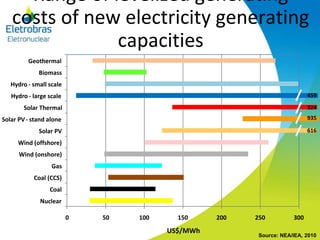
Range of levelized generating
costs of new electricity generating
capacities
0 50 100 150 200 250 300
Nuclear
Coal
Coal (CCS)
Gas
Wind (onshore)
Wind (offshore)
Solar PV
Solar PV- stand alone
Solar Thermal
Hydro - large scale
Hydro - small scale
Biomass
Geothermal
US$/MWh
616
935
324
459
Source: NEA/IEA, 2010
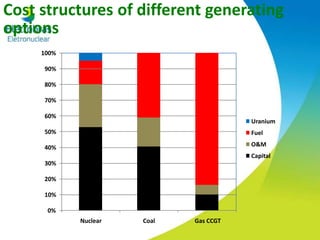
Cost structures of different generating
options
0%
10%
20%
30%
40%
50%
60%
70%
80%
90%
100%
Nuclear Coal Gas CCGT
Uranium
Fuel
O&M
Capital
0
10
20
30
40
50
60
70
80
90
100
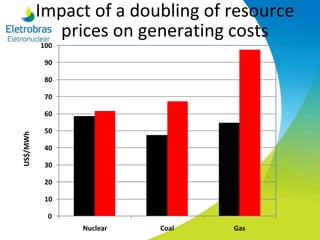
Nuclear Coal Gas
US$/MWh
Impact of a doubling of resource
prices on generating costs
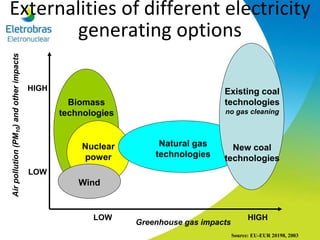
Externalities of different electricity
generating options
Source: EU-EUR 20198, 2003
Natural gas
technologies
Nuclear
power
Wind
Biomass
technologies
Existing coal
technologies
no gas cleaning
New coal
technologies
LOW HIGH
LOW
HIGH
Greenhouse gas impacts
Airpollution(PM10)andotherimpacts
Mitigation – Role of nuclear
power
Life cycle GHG emissions of different electricity generating options
Nuclear power: Very low lifetime GHG emissions make
the technology a potent climate change mitigation option
[8]
[12]
[10]
[16]
[8]
0
200
400
600
800
1 000
1 200
1 400
1 600
1 800
lignite coal oil gas CCS
[8]
[12]
[10]
[16]
[8]
0
200
400
600
800
1 000
1 200
1 400
1 600
1 800
lignite coal oil gas CCS
[15][15]
[16]
[15]
[13]
[8]
[4]
Standard deviation
Mean
Min - Max
[sample size]
0
20
40
60
80
100
120
140
160
180
hydro nuclear wind solar
PV
bio-
mass
storage
[16]
[15]
[13]
[8]
[4]
Standard deviation
Mean
Min - Max
[sample size]
0
20
40
60
80
100
120
140
160
180
hydro nuclear wind solar
PV
bio-
mass
storage
gCO2-eqperkWh
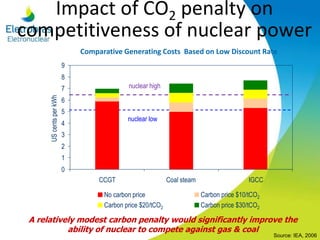
Impact of CO2 penalty on
competitiveness of nuclear power
A relatively modest carbon penalty would significantly improve the
ability of nuclear to compete against gas & coal
Comparative Generating Costs Based on Low Discount Rate
nuclear low
nuclear high
0
1
2
3
4
5
6
7
8
9
CCGT Coal steam IGCC
UScentsperkWh
No carbon price Carbon price $10/tCO2
Carbon price $20/tCO2 Carbon price $30/tCO2
Source: IEA, 2006
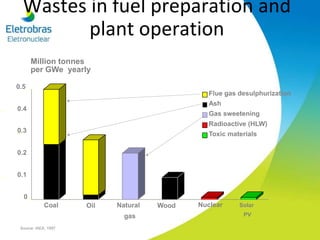
Wastes in fuel preparation and
plant operation
0
0.1
0.2
0.3
0.4
0.5
Flue gas desulphurization
Ash
Gas sweetening
Radioactive (HLW)
Toxic materials
Oil Nuclear Solar
PV
Natural
gas
WoodCoal
Million tonnes
per GWe yearly
Source: IAEA, 1997
Addressing the issues
• Innovation is key
– “Even if you’re headed in the right direction, if
you stand still, you’ll get run over”
• Advanced fuel cycles
• Physical protection
• Reactor design/technology
• Safety
• Institutions and capacity building
• Knowledge management
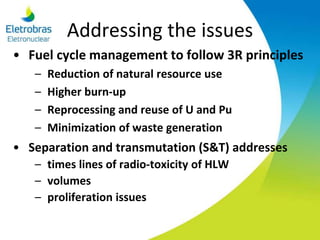
Addressing the issues
• Fuel cycle management to follow 3R principles
– Reduction of natural resource use
– Higher burn-up
– Reprocessing and reuse of U and Pu
– Minimization of waste generation
• Separation and transmutation (S&T) addresses
– times lines of radio-toxicity of HLW
– volumes
– proliferation issues
Addressing the issues
• Proliferation is a political issue calling first of
all for political solutions
– Strengthening of the safeguards regime
– Black box
– MNA
– Internationalization of the fuel cycle
• Technology solutions
– Development of proliferation-resistant advanced
nuclear systems
Summary: Relevant SD goals for
nuclear power
• Economics
– Enhancement of man-made and human/social capital (“weak
sustainability”)
– Life-cycle cost advantage over alternative energy supply options
– Financial risks comparable to other energy projects
• Environment
– Nuclear fuel cycle minimizes resource use and nuclear waste
generation (3R)
– Nuclear fuel cycle reduces the long-term stewardship burden
(intergenerational equity)
– Nuclear installations excel in safety and reliability (core damage
frequency, off-site impacts/emergency responses)
Summary: Relevant SD goals for
nuclear power
• Social/Institutional
– Public health (highest safety standards)
– Enhanced safeguards regimes
– International cooperation such as
• MNA
• Internationalization of the fuel cycle
• Safety standards & regulation
• Combating terrorism
– Efficient regulatory systems
– Proliferation resistant fuel cycles
– Physical protection against malicious attacks
IAEA
International Atomic Energy Agency
Nuclear's Special Relationship with
Climate Change
Loreta Stankeviciute
IAEA Department of Nuclear Energy
Planning & Economic Studies Section (PESS)
20th Meeting of the TWG on Advanced Technologies for LWRs
16th Meeting of the TWG on Advanced Technologies for HWRs
VIC, 13 April, 2016
IAEA 34
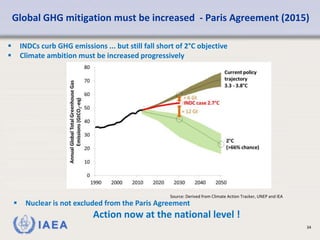
Global GHG mitigation must be increased - Paris Agreement (2015)
 INDCs curb GHG emissions ... but still fall short of 2°C objective
 Climate ambition must be increased progressively
Source: Derived from Climate Action Tracker, UNEP and IEA
 Nuclear is not excluded from the Paris Agreement
Action now at the national level !
IAEA 35
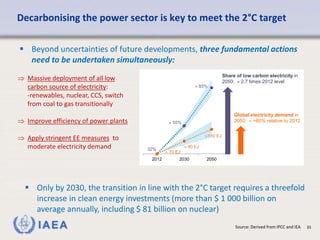
Decarbonising the power sector is key to meet the 2°C target
Source: Derived from IPCC and IEA
 Beyond uncertainties of future developments, three fundamental actions
need to be undertaken simultaneously:
 Massive deployment of all low
carbon source of electricity:
-renewables, nuclear, CCS, switch
from coal to gas transitionally
 Improve efficiency of power plants
 Apply stringent EE measures to
moderate electricity demand 32%
 55%
 85%
 70 EJ
 90 EJ
110 EJ
2012 2030 2050
Global electricity demand in
2050:  +60% relative to 2012
Share of low carbon electricity in
2050:  2.7 times 2012 level
 Only by 2030, the transition in line with the 2°C target requires a threefold
increase in clean energy investments (more than $ 1 000 billion on
average annually, including $ 81 billion on nuclear)
IAEA 36
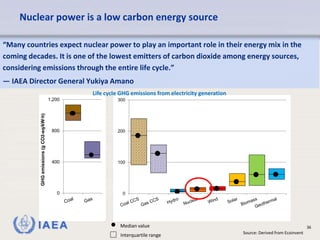
Nuclear power is a low carbon energy source
Source: Derived from Ecoinvent
0
400
800
1,200
GHGemissions(gCO2-eq/kW∙h)
0
100
200
300
Median value
Interquartile range
“Many countries expect nuclear power to play an important role in their energy mix in the
coming decades. It is one of the lowest emitters of carbon dioxide among energy sources,
considering emissions through the entire life cycle.”
— IAEA Director General Yukiya Amano
Life cycle GHG emissions from electricity generation
IAEA 37
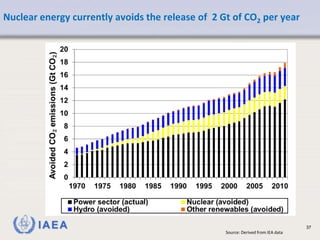
Nuclear energy currently avoids the release of 2 Gt of CO2 per year
Source: Derived from IEA data
IAEA 38
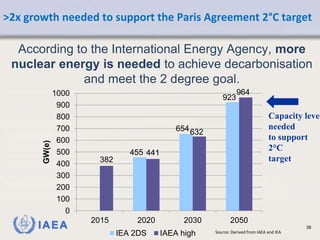
>2x growth needed to support the Paris Agreement 2°C target
Capacity level
needed
to support
2°C
target
Source: Derived from IAEA and IEA
455
654
923
382
441
632
964
0
100
200
300
400
500
600
700
800
900
1000
2015 2020 2030 2050
GW(e)
IEA 2DS IAEA high
According to the International Energy Agency, more
nuclear energy is needed to achieve decarbonisation
and meet the 2 degree goal.
IAEA
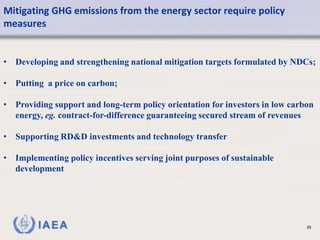
Mitigating GHG emissions from the energy sector require policy
measures
39
• Developing and strengthening national mitigation targets formulated by NDCs;
• Putting a price on carbon;
• Providing support and long-term policy orientation for investors in low carbon
energy, eg. contract-for-difference guaranteeing secured stream of revenues
• Supporting RD&D investments and technology transfer
• Implementing policy incentives serving joint purposes of sustainable
development
IAEA
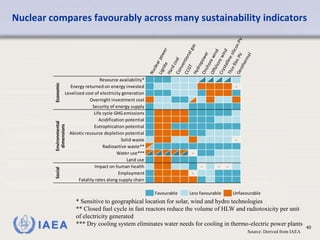
* Sensitive to geographical location for solar, wind and hydro technologies
** Closed fuel cycle in fast reactors reduce the volume of HLW and radiotoxicity per unit
of electricity generated
*** Dry cooling system eliminates water needs for cooling in thermo-electric power plants
40
Nuclear compares favourably across many sustainability indicators
Source: Derived from IAEA
Nuclearpower
Lignite
HardcoalConventionalgas
CCGT
Hydropower
Onshorewind
Offshorewind
CrystallinesiliconPV
Thinfilm
PVGeothermal
Economic
Resource availability*
Energy returned on energy invested -
Levelized cost of electricity generation
Overnight investment cost
Security of energy supply
Life cycle GHG emissions
Acidification potential
Eutrophication potential
Abiotic resource depletion potential
Solid waste -
Radioactive waste**
Water use*** -
Land use
Impact on human health - - -
Employment -
Fatality rates along supply chain
Favourable Less favourable Unfavourable
EconomicEnvironmental
dimensions
Social
IAEA
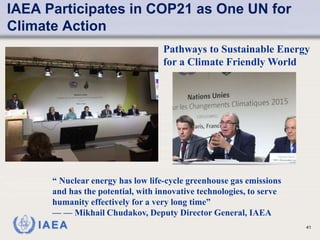
IAEA Participates in COP21 as One UN for
Climate Action
41
Pathways to Sustainable Energy
for a Climate Friendly World
“ Nuclear energy has low life-cycle greenhouse gas emissions
and has the potential, with innovative technologies, to serve
humanity effectively for a very long time”
— — Mikhail Chudakov, Deputy Director General, IAEA
IAEA
What’s Next for IAEA post COP-21?
• Continue Communication Outreach.
• Couple role of Nuclear addressing Climate Change
with the new UN Sustainable Development Goals.
• Begin support activities (research, training) for
Member States as they convert their INDCs to
NDCs (Nationally Determined Contributions).
• Leverage “Innovative” nuclear technologies to
address climate change.
• Get ready for COP-22 in Morocco.
42
IAEA 43
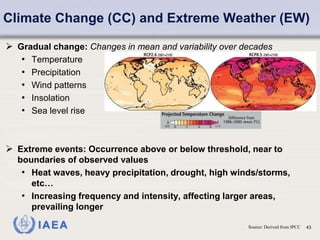
Climate Change (CC) and Extreme Weather (EW)
Source: Derived from IPCC
 Gradual change: Changes in mean and variability over decades
• Temperature
• Precipitation
• Wind patterns
• Insolation
• Sea level rise
 Extreme events: Occurrence above or below threshold, near to
boundaries of observed values
• Heat waves, heavy precipitation, drought, high winds/storms,
etc…
• Increasing frequency and intensity, affecting larger areas,
prevailing longer
IAEA 44
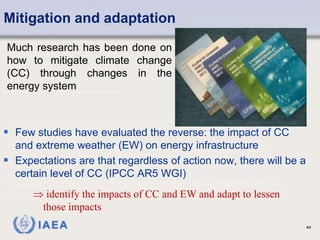
Mitigation and adaptation
 Few studies have evaluated the reverse: the impact of CC
and extreme weather (EW) on energy infrastructure
 Expectations are that regardless of action now, there will be a
certain level of CC (IPCC AR5 WGI)
Much research has been done on
how to mitigate climate change
(CC) through changes in the
energy system
 identify the impacts of CC and EW and adapt to lessen
those impacts
IAEA 45
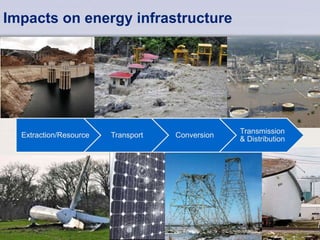
Impacts on energy infrastructure
Extraction/Resource Transport Conversion
Transmission
& Distribution
IAEA 46
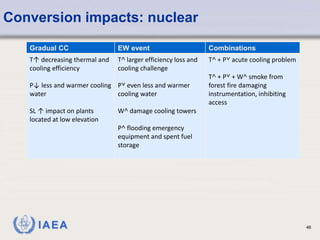
Conversion impacts: nuclear
Gradual CC EW event Combinations
T↑ decreasing thermal and
cooling efficiency
P↓ less and warmer cooling
water
SL ↑ impact on plants
located at low elevation
T˄ larger efficiency loss and
cooling challenge
P˅ even less and warmer
cooling water
W˄ damage cooling towers
P˄ flooding emergency
equipment and spent fuel
storage
T˄ + P˅ acute cooling problem
T˄ + P˅ + W˄ smoke from
forest fire damaging
instrumentation, inhibiting
access
IAEA
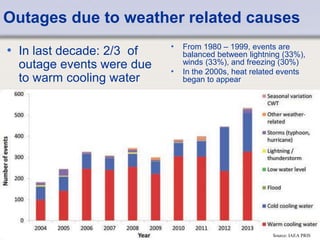
Outages due to weather related causes
• From 1980 – 1999, events are
balanced between lightning (33%),
winds (33%), and freezing (30%)
• In the 2000s, heat related events
began to appear
Source: IAEA PRIS
• In last decade: 2/3 of
outage events were due
to warm cooling water
IAEA
How well equipped is Nuclear to adapt to
Climate Change?
Positives
• Reliability of Nuclear Plants operating during severe
weather, e.g., 2012 Hurricane Sandy;
• Nuclear is a hardened energy asset;
• New design basis and safety upgrades can increase
resilience of nuclear to extreme external events;
Negatives
• Efficiency loss, cooling challenge, etc
Adaptation measures for existing NPPs
• Consideration no 1 – safety
• Consideration no 2 – related cost
48
IAEA
Future nuclear reactors can be more
adaptive and resilient
Technology Measures:
• The design bases for
future reactors can be
changed in response to
projected degrees of
climate change and shifts
in extreme weather
events.
Examples:
• New plants designed to
operate at higher thermal
efficiencies requiring less
cooling water
• Smaller reactors (SMRs)
used that need less water
resources.
• Dry cooling equipment
used where water
resources are vulnerable.
49
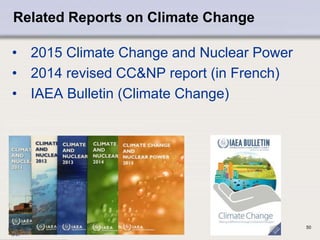
Related Reports on Climate Change
• 2015 Climate Change and Nuclear Power
• 2014 revised CC&NP report (in French)
• IAEA Bulletin (Climate Change)
50
IAEA
…atoms for peace.
Thank you !
IAEA
Backup Slides
52
IAEA 53
IAEA activities
IAEA workshop organised in 2010
 Raised interest in Member States
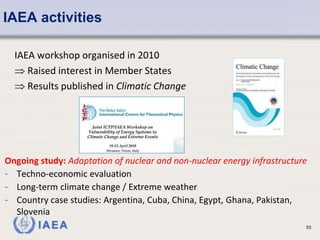
 Results published in Climatic Change
Ongoing study: Adaptation of nuclear and non-nuclear energy infrastructure
- Techno-economic evaluation
- Long-term climate change / Extreme weather
- Country case studies: Argentina, Cuba, China, Egypt, Ghana, Pakistan,
Slovenia
IAEA
Key Messages
• The Scale of the Energy Challenge is huge
• Nuclear is a Sustainable, low-C source
• Challenges – Mitigation
• Challenges – Adaptation
• IAEA was fully engaged at COP-21
• Next Steps
54
IAEA
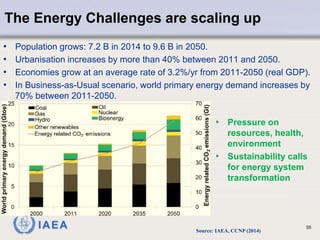
The Energy Challenges are scaling up
• Population grows: 7.2 B in 2014 to 9.6 B in 2050.
• Urbanisation increases by more than 40% between 2011 and 2050.
• Economies grow at an average rate of 3.2%/yr from 2011-2050 (real GDP).
• In Business-as-Usual scenario, world primary energy demand increases by
70% between 2011-2050.
55
• Pressure on
resources, health,
environment
• Sustainability calls
for energy system
transformation
Source: IAEA, CCNP (2014)
IAEA
So, which energy technology is best?
56
• All technologies are associated with some risk,
waste or interaction with environment.
• None of the low-C technologies should be left
aside when assessing the contribution to
Climate Change and Sustainable Development.
• Suitability of nuclear power cannot be judged in
isolation, but only in comparison with the best
available alternatives.
• The use of nuclear is ultimately a country’s
sovereign decision.
IAEA
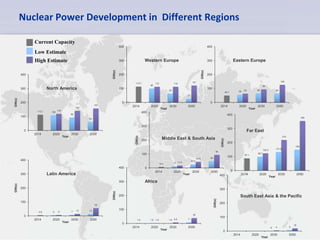
108
92
60
112.1 118
140
157
0
100
200
300
400
2014 2020 2030 2050
GW(e)
Year
North America
5 7 13
4.8 6 13
55
0
100
200
300
400
2014 2020 2030 2050
GW(e)
Year
Latin America
99
63
27
113.7 112 112
121
0
100
200
300
400
2014 2020 2030 2050
GW(e)
Year
Western Europe
1.9 1.9 71.9 1.9 6.5
38
0
100
200
300
400
2014 2020 2030 2050
GW(e)
Year
Africa
12
25.9
48
6.9
17.4
43.8
94
0
100
200
300
400
2014 2020 2030 2050
GW(e)
Year
Middle East & South Asia
98.7
131.8
149
87.1
122.9
219
355
0
100
200
300
400
2014 2020 2030 2050
GW(e)
Year
Far East
55
64 63
49.7
63
94
126
0
100
200
300
400
2014 2020 2030 2050
GW(e)
Year
Eastern Europe
0 54
18
0
100
200
300
400
2014 2020 2030 2050
GW(e)
Year
South East Asia & the Pacific
Nuclear Power Development in Different Regions
Current Capacity
Low Estimate
High Estimate
IAEA
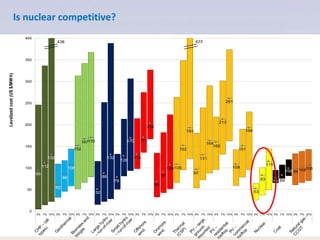
Is nuclear competitive?
58
0
50
100
150
200
250
300
350
400
3% 7% 10% 3% 7% 10% 3% 7% 10% 3% 7% 10% 3% 7% 10% 3% 7% 10% 3% 7% 10% 3% 7% 10% 3% 7% 10% 3% 7% 10% 3% 7% 10% 3% 7% 10% 3% 7% 10% 3% 7% 10%
Levelizedcost(US$/MW∙h)
438 423
95
112
132
62
86
108
152
167170
52
88
132
79
128
170
133
171
204
69
91
108109
152
193
97
131
164
160
213
261
109
151
194
53
83
115
78 84
100 99103106
IAEA 59
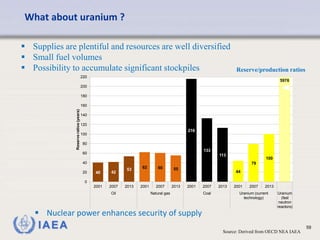
What about uranium ?
Reserve/production ratios
Source: Derived from OECD NEA IAEA
40 42
53 62 60 55
216
133
113
44
79
100
0
20
40
60
80
100
120
140
160
180
200
220
2001 2007 2013 2001 2007 2013 2001 2007 2013 2001 2007 2013
Oil Natural gas Coal Uranium (current
technology)
Uranium
(fast
neutron
reactors)
Reserveratios(years)
5976
 Supplies are plentiful and resources are well diversified
 Small fuel volumes
 Possibility to accumulate significant stockpiles
 Nuclear power enhances security of supply
IAEA 60
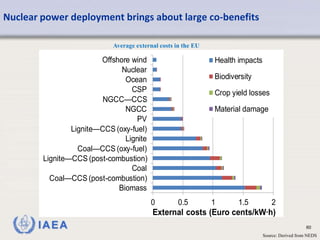
Nuclear power deployment brings about large co-benefits
Source: Derived from NEDS
0 0.5 1 1.5 2
Biomass
Coal—CCS (post-combustion)
Coal
Lignite—CCS (post-combustion)
Coal—CCS (oxy-fuel)
Lignite
Lignite—CCS (oxy-fuel)
PV
NGCC
NGCC—CCS
CSP
Ocean
Nuclear
Offshore wind
External costs (Euro cents/kW∙h)
Health impacts
Biodiversity
Crop yield losses
Material damage
Average external costs in the EU
IAEA 61
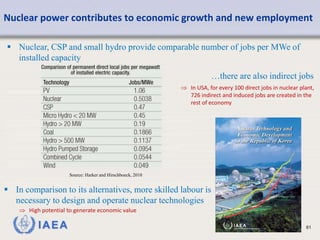
Nuclear power contributes to economic growth and new employment
 High potential to generate economic value
 Nuclear, CSP and small hydro provide comparable number of jobs per MWe of
installed capacity
 In comparison to its alternatives, more skilled labour is
necessary to design and operate nuclear technologies
 In USA, for every 100 direct jobs in nuclear plant,
726 indirect and induced jobs are created in the
rest of economy
…there are also indirect jobs
Source: Derived from Wei et al. (2010)
Source: Harker and Hirschboeck, 2010

Nuclear power and sustainable development

  • 1.
    Nuclear Power and SustainableDevelopment Leonam dos Santos Guimarães leonam@eletronuclear.gov.br WWW.ELETRONUCLEAR.GOV.BR
  • 2.
    Sustainability • WCED andBrundtland Commission definition of sustainable development • Three dimensions/pillars of sustainable development – Environmental – Economic – Social/institutional World Commission on Environment and Development in its report Our Common Future defined sustainable development as “…development that meets the needs of the present without compromising the ability of future generations to meet their own needs” (1987)
  • 3.
    Economic dimension • Concernsthe maintenance, growth and use of different categories of capital: – man-made (e.g., infrastructures, machines, technology); – natural (e.g., mineral resources, forests, clean air and water, the atmosphere); and – social/human (e.g., institutions, knowledge, intact societies, tradition).
  • 4.
    Economic pillar • Allthree types of capital contribute to economic development • They are inherently substitutable, the extent of which has led to the distinction of – strong sustainability and – weak sustainability
  • 5.
    Economics – Strong sustainability •Assumes a limited level of substitutability – rather complements than substitutes • Requires each of the capital categories to be maintained separately at some minimum level: – Exhaustible resources (fossil, uranium, minerals) cannot be consumed really – Renewable resources must be harvested within the regenerative capacity of the natural capital stock that produces them and its waste must not exceed the of ecosystem’s carrying capacity
  • 6.
    Economics – Weak sustainability •Refers to the maintenance of the total level of capital passed down through generations without regard to the particular form of capital – Allows the use of exhaustible resources as long as depletion is compensated by equivalent increases in man- made and social/human capital – It requires the efficient use of non-renewable resources that reflect full social costs and the timely development of inexhaustible energy systems
  • 7.
    Environmental dimension • Preservationof natural resources, biodiversity and protecting ecosystems and habitats – Minimize environmental pollution, the exploitation of exhaustible resources as well as the so-called ‘use of the environment’ (ecological footprint) • Reduce production and use of harmful substances to a minimum – Equitable access by different social/spatial entities (countries, regions, etc.) to common goods (e.g. atmosphere) – Observation of carry capacities of ecosystems
  • 8.
    Social/institutional dimension • Deals withthe ‘needs’ of the Brundtland definition – Not limited to the materialistic needs of • food, water, energy, shelter, health and protection in case of old age and social hardship – But also includes • education, recreation, leisure, social relations, political activities, security, social justice both intra- and intergenerational, good governance and competent institutions, moral concepts, culture and religion – Sustainability in satisfying intra- and intergenerational needs is directed at the relationships between society and nature
  • 9.
    3Rs – Reduce,reuse, recycle  Reducing waste production, recycling of wastes and reusing materials form the basis for sustainable waste management – Preventing waste generation in the first place through lower input of natural resources, smarter designs and more efficient manufacturing – Reusing, recycling and proper treatment of materials that would otherwise enter the waste stream – Replacing products with harmful wastes by environmentally friendly alternative materials
  • 10.
    Trade-offs • Three pillarsof sustainable development (SD) present conflicting objectives • Environment protection versus development: S-d (North) versus D-s (South) • Trade-offs are necessary – “Poverty is the biggest polluter” (I. Gandhi, 1972) • Current environmental problems have been previous solutions – Technology – culprit or savior?
  • 11.
    Nuclear power inthe SD debate • Energy and SD discussion long avoided/ignored • Too many stakeholders • First time subject of CSD-9 in 2001
  • 12.
    CSD-9: Outcomes (2001) confirmedby WSSD (2002) • Exhaustive debate • Agreement to disagree on nuclear’s role in sustainable development • Unanimous agreement that choice belongs to countries  There is no technology without risks and interaction with the environment.  Do not discuss a particular technology in isolation.  Compare a particular technology with alternatives on a life cycle (LCA) basis. BUT
  • 13.
    Contra: Nuclear &Sustainability • No long-term solution to waste • Nuclear weapons proliferation & security  Safety: nuclear risks are excessive  Transboundary consequences, decommissioning & transport  Too expensive WIPP
  • 14.
    Pro: Nuclear &Sustainability • Brundtland1) about keeping options open • Expands electricity supplies (“connecting the unconnected”)  Reduces harmful emissions  Puts uranium to productive use  Increases human & technological capital  Ahead in internalising externalities 1) development that meets the needs of the present without compromising the ability of future generations to meet their own needs
  • 15.
    Nuclear power inthe SD debate • Energy and SD discussion long avoided/ignored • Too many stakeholders • First time subject of CSD-9 in 2001 • World Summit on Sustainable Development (2002) • Energy again a CSD topic at CSD-14/15 cycle in 2006/7 • Secretary General’s Advisory Group on Energy and Climate Change (AGEEC) in 2009/10
  • 16.
    Nuclear energy inherently consistentwith “weak sustainability”• Consumption of finite resources results in an accumulation of man-made and social & institutional capital available to future generations – Infrastructures, technologies, institutions and know-how • Despite an enormous resource base (U in seawater), potential decoupling from nuclear fuel resource constraints – 3R - Reprocessing and fast breeder technology (closed fuel cycles)
  • 17.
    Nuclear energy inherently consistentwith “weak sustainability”• Uranium mining progressively subjected to EIA, monitoring and controls (also post mine closures) • Spent fuel volumes managed and small per unit of energy delivered • Final HLW disposal solutions at an advanced stage of technological development, but often lack will & public acceptance for their implementation • HLW even smaller with closed fuel cycles or partitioning and transmutation
  • 18.
    Nuclear energy inherently consistentwith “weak sustainability”• Reduces the rate of degradation of some categories of natural capital – Atmospheric concentration of greenhouse gases – Air pollution and regional acidification • Assists in meeting “needs” – Access – Affordability – Supply security – Skilled labour – Research
  • 19.
    Security of nuclearfuel supply • Expanded use of nuclear energy will eventually need additional enrichment facilities possibly in new countries • Enrichment and potential weapons proliferation • Proliferation concerns may limit the potential locations for new facilities • Countries concerned about security of energy supply, this may be a disincentive to rely on nuclear energy
  • 20.
    Nuclear power andsustainable development • Current technology and fuel cycles compare well with non-nuclear alternatives • Nuclear is not perfect – there is ample room for improvement • SD is a moving target • Today’s technology is not tomorrow’s • Nuclear power to build on its own strength
  • 21.
    Range of levelizedgenerating costs of new electricity generating capacities 0 50 100 150 200 250 300 Nuclear Coal Coal (CCS) Gas Wind (onshore) Wind (offshore) Solar PV Solar PV- stand alone Solar Thermal Hydro - large scale Hydro - small scale Biomass Geothermal US$/MWh 616 935 324 459 Source: NEA/IEA, 2010
  • 22.
    Cost structures ofdifferent generating options 0% 10% 20% 30% 40% 50% 60% 70% 80% 90% 100% Nuclear Coal Gas CCGT Uranium Fuel O&M Capital
  • 23.
    0 10 20 30 40 50 60 70 80 90 100 Nuclear Coal Gas US$/MWh Impactof a doubling of resource prices on generating costs
  • 24.
    Externalities of differentelectricity generating options Source: EU-EUR 20198, 2003 Natural gas technologies Nuclear power Wind Biomass technologies Existing coal technologies no gas cleaning New coal technologies LOW HIGH LOW HIGH Greenhouse gas impacts Airpollution(PM10)andotherimpacts
  • 25.
    Mitigation – Roleof nuclear power Life cycle GHG emissions of different electricity generating options Nuclear power: Very low lifetime GHG emissions make the technology a potent climate change mitigation option [8] [12] [10] [16] [8] 0 200 400 600 800 1 000 1 200 1 400 1 600 1 800 lignite coal oil gas CCS [8] [12] [10] [16] [8] 0 200 400 600 800 1 000 1 200 1 400 1 600 1 800 lignite coal oil gas CCS [15][15] [16] [15] [13] [8] [4] Standard deviation Mean Min - Max [sample size] 0 20 40 60 80 100 120 140 160 180 hydro nuclear wind solar PV bio- mass storage [16] [15] [13] [8] [4] Standard deviation Mean Min - Max [sample size] 0 20 40 60 80 100 120 140 160 180 hydro nuclear wind solar PV bio- mass storage gCO2-eqperkWh
  • 26.
    Impact of CO2penalty on competitiveness of nuclear power A relatively modest carbon penalty would significantly improve the ability of nuclear to compete against gas & coal Comparative Generating Costs Based on Low Discount Rate nuclear low nuclear high 0 1 2 3 4 5 6 7 8 9 CCGT Coal steam IGCC UScentsperkWh No carbon price Carbon price $10/tCO2 Carbon price $20/tCO2 Carbon price $30/tCO2 Source: IEA, 2006
  • 27.
    Wastes in fuelpreparation and plant operation 0 0.1 0.2 0.3 0.4 0.5 Flue gas desulphurization Ash Gas sweetening Radioactive (HLW) Toxic materials Oil Nuclear Solar PV Natural gas WoodCoal Million tonnes per GWe yearly Source: IAEA, 1997
  • 28.
    Addressing the issues •Innovation is key – “Even if you’re headed in the right direction, if you stand still, you’ll get run over” • Advanced fuel cycles • Physical protection • Reactor design/technology • Safety • Institutions and capacity building • Knowledge management
  • 29.
    Addressing the issues •Fuel cycle management to follow 3R principles – Reduction of natural resource use – Higher burn-up – Reprocessing and reuse of U and Pu – Minimization of waste generation • Separation and transmutation (S&T) addresses – times lines of radio-toxicity of HLW – volumes – proliferation issues
  • 30.
    Addressing the issues •Proliferation is a political issue calling first of all for political solutions – Strengthening of the safeguards regime – Black box – MNA – Internationalization of the fuel cycle • Technology solutions – Development of proliferation-resistant advanced nuclear systems
  • 31.
    Summary: Relevant SDgoals for nuclear power • Economics – Enhancement of man-made and human/social capital (“weak sustainability”) – Life-cycle cost advantage over alternative energy supply options – Financial risks comparable to other energy projects • Environment – Nuclear fuel cycle minimizes resource use and nuclear waste generation (3R) – Nuclear fuel cycle reduces the long-term stewardship burden (intergenerational equity) – Nuclear installations excel in safety and reliability (core damage frequency, off-site impacts/emergency responses)
  • 32.
    Summary: Relevant SDgoals for nuclear power • Social/Institutional – Public health (highest safety standards) – Enhanced safeguards regimes – International cooperation such as • MNA • Internationalization of the fuel cycle • Safety standards & regulation • Combating terrorism – Efficient regulatory systems – Proliferation resistant fuel cycles – Physical protection against malicious attacks
  • 33.
    IAEA International Atomic EnergyAgency Nuclear's Special Relationship with Climate Change Loreta Stankeviciute IAEA Department of Nuclear Energy Planning & Economic Studies Section (PESS) 20th Meeting of the TWG on Advanced Technologies for LWRs 16th Meeting of the TWG on Advanced Technologies for HWRs VIC, 13 April, 2016
  • 34.
    IAEA 34 Global GHGmitigation must be increased - Paris Agreement (2015)  INDCs curb GHG emissions ... but still fall short of 2°C objective  Climate ambition must be increased progressively Source: Derived from Climate Action Tracker, UNEP and IEA  Nuclear is not excluded from the Paris Agreement Action now at the national level !
  • 35.
    IAEA 35 Decarbonising thepower sector is key to meet the 2°C target Source: Derived from IPCC and IEA  Beyond uncertainties of future developments, three fundamental actions need to be undertaken simultaneously:  Massive deployment of all low carbon source of electricity: -renewables, nuclear, CCS, switch from coal to gas transitionally  Improve efficiency of power plants  Apply stringent EE measures to moderate electricity demand 32%  55%  85%  70 EJ  90 EJ 110 EJ 2012 2030 2050 Global electricity demand in 2050:  +60% relative to 2012 Share of low carbon electricity in 2050:  2.7 times 2012 level  Only by 2030, the transition in line with the 2°C target requires a threefold increase in clean energy investments (more than $ 1 000 billion on average annually, including $ 81 billion on nuclear)
  • 36.
    IAEA 36 Nuclear poweris a low carbon energy source Source: Derived from Ecoinvent 0 400 800 1,200 GHGemissions(gCO2-eq/kW∙h) 0 100 200 300 Median value Interquartile range “Many countries expect nuclear power to play an important role in their energy mix in the coming decades. It is one of the lowest emitters of carbon dioxide among energy sources, considering emissions through the entire life cycle.” — IAEA Director General Yukiya Amano Life cycle GHG emissions from electricity generation
  • 37.
    IAEA 37 Nuclear energycurrently avoids the release of 2 Gt of CO2 per year Source: Derived from IEA data
  • 38.
    IAEA 38 >2x growthneeded to support the Paris Agreement 2°C target Capacity level needed to support 2°C target Source: Derived from IAEA and IEA 455 654 923 382 441 632 964 0 100 200 300 400 500 600 700 800 900 1000 2015 2020 2030 2050 GW(e) IEA 2DS IAEA high According to the International Energy Agency, more nuclear energy is needed to achieve decarbonisation and meet the 2 degree goal.
  • 39.
    IAEA Mitigating GHG emissionsfrom the energy sector require policy measures 39 • Developing and strengthening national mitigation targets formulated by NDCs; • Putting a price on carbon; • Providing support and long-term policy orientation for investors in low carbon energy, eg. contract-for-difference guaranteeing secured stream of revenues • Supporting RD&D investments and technology transfer • Implementing policy incentives serving joint purposes of sustainable development
  • 40.
    IAEA * Sensitive togeographical location for solar, wind and hydro technologies ** Closed fuel cycle in fast reactors reduce the volume of HLW and radiotoxicity per unit of electricity generated *** Dry cooling system eliminates water needs for cooling in thermo-electric power plants 40 Nuclear compares favourably across many sustainability indicators Source: Derived from IAEA Nuclearpower Lignite HardcoalConventionalgas CCGT Hydropower Onshorewind Offshorewind CrystallinesiliconPV Thinfilm PVGeothermal Economic Resource availability* Energy returned on energy invested - Levelized cost of electricity generation Overnight investment cost Security of energy supply Life cycle GHG emissions Acidification potential Eutrophication potential Abiotic resource depletion potential Solid waste - Radioactive waste** Water use*** - Land use Impact on human health - - - Employment - Fatality rates along supply chain Favourable Less favourable Unfavourable EconomicEnvironmental dimensions Social
  • 41.
    IAEA IAEA Participates inCOP21 as One UN for Climate Action 41 Pathways to Sustainable Energy for a Climate Friendly World “ Nuclear energy has low life-cycle greenhouse gas emissions and has the potential, with innovative technologies, to serve humanity effectively for a very long time” — — Mikhail Chudakov, Deputy Director General, IAEA
  • 42.
    IAEA What’s Next forIAEA post COP-21? • Continue Communication Outreach. • Couple role of Nuclear addressing Climate Change with the new UN Sustainable Development Goals. • Begin support activities (research, training) for Member States as they convert their INDCs to NDCs (Nationally Determined Contributions). • Leverage “Innovative” nuclear technologies to address climate change. • Get ready for COP-22 in Morocco. 42
  • 43.
    IAEA 43 Climate Change(CC) and Extreme Weather (EW) Source: Derived from IPCC  Gradual change: Changes in mean and variability over decades • Temperature • Precipitation • Wind patterns • Insolation • Sea level rise  Extreme events: Occurrence above or below threshold, near to boundaries of observed values • Heat waves, heavy precipitation, drought, high winds/storms, etc… • Increasing frequency and intensity, affecting larger areas, prevailing longer
  • 44.
    IAEA 44 Mitigation andadaptation  Few studies have evaluated the reverse: the impact of CC and extreme weather (EW) on energy infrastructure  Expectations are that regardless of action now, there will be a certain level of CC (IPCC AR5 WGI) Much research has been done on how to mitigate climate change (CC) through changes in the energy system  identify the impacts of CC and EW and adapt to lessen those impacts
  • 45.
    IAEA 45 Impacts onenergy infrastructure Extraction/Resource Transport Conversion Transmission & Distribution
  • 46.
    IAEA 46 Conversion impacts:nuclear Gradual CC EW event Combinations T↑ decreasing thermal and cooling efficiency P↓ less and warmer cooling water SL ↑ impact on plants located at low elevation T˄ larger efficiency loss and cooling challenge P˅ even less and warmer cooling water W˄ damage cooling towers P˄ flooding emergency equipment and spent fuel storage T˄ + P˅ acute cooling problem T˄ + P˅ + W˄ smoke from forest fire damaging instrumentation, inhibiting access
  • 47.
    IAEA Outages due toweather related causes • From 1980 – 1999, events are balanced between lightning (33%), winds (33%), and freezing (30%) • In the 2000s, heat related events began to appear Source: IAEA PRIS • In last decade: 2/3 of outage events were due to warm cooling water
  • 48.
    IAEA How well equippedis Nuclear to adapt to Climate Change? Positives • Reliability of Nuclear Plants operating during severe weather, e.g., 2012 Hurricane Sandy; • Nuclear is a hardened energy asset; • New design basis and safety upgrades can increase resilience of nuclear to extreme external events; Negatives • Efficiency loss, cooling challenge, etc Adaptation measures for existing NPPs • Consideration no 1 – safety • Consideration no 2 – related cost 48
  • 49.
    IAEA Future nuclear reactorscan be more adaptive and resilient Technology Measures: • The design bases for future reactors can be changed in response to projected degrees of climate change and shifts in extreme weather events. Examples: • New plants designed to operate at higher thermal efficiencies requiring less cooling water • Smaller reactors (SMRs) used that need less water resources. • Dry cooling equipment used where water resources are vulnerable. 49
  • 50.
    Related Reports onClimate Change • 2015 Climate Change and Nuclear Power • 2014 revised CC&NP report (in French) • IAEA Bulletin (Climate Change) 50
  • 51.
  • 52.
  • 53.
    IAEA 53 IAEA activities IAEAworkshop organised in 2010  Raised interest in Member States  Results published in Climatic Change Ongoing study: Adaptation of nuclear and non-nuclear energy infrastructure - Techno-economic evaluation - Long-term climate change / Extreme weather - Country case studies: Argentina, Cuba, China, Egypt, Ghana, Pakistan, Slovenia
  • 54.
    IAEA Key Messages • TheScale of the Energy Challenge is huge • Nuclear is a Sustainable, low-C source • Challenges – Mitigation • Challenges – Adaptation • IAEA was fully engaged at COP-21 • Next Steps 54
  • 55.
    IAEA The Energy Challengesare scaling up • Population grows: 7.2 B in 2014 to 9.6 B in 2050. • Urbanisation increases by more than 40% between 2011 and 2050. • Economies grow at an average rate of 3.2%/yr from 2011-2050 (real GDP). • In Business-as-Usual scenario, world primary energy demand increases by 70% between 2011-2050. 55 • Pressure on resources, health, environment • Sustainability calls for energy system transformation Source: IAEA, CCNP (2014)
  • 56.
    IAEA So, which energytechnology is best? 56 • All technologies are associated with some risk, waste or interaction with environment. • None of the low-C technologies should be left aside when assessing the contribution to Climate Change and Sustainable Development. • Suitability of nuclear power cannot be judged in isolation, but only in comparison with the best available alternatives. • The use of nuclear is ultimately a country’s sovereign decision.
  • 57.
    IAEA 108 92 60 112.1 118 140 157 0 100 200 300 400 2014 20202030 2050 GW(e) Year North America 5 7 13 4.8 6 13 55 0 100 200 300 400 2014 2020 2030 2050 GW(e) Year Latin America 99 63 27 113.7 112 112 121 0 100 200 300 400 2014 2020 2030 2050 GW(e) Year Western Europe 1.9 1.9 71.9 1.9 6.5 38 0 100 200 300 400 2014 2020 2030 2050 GW(e) Year Africa 12 25.9 48 6.9 17.4 43.8 94 0 100 200 300 400 2014 2020 2030 2050 GW(e) Year Middle East & South Asia 98.7 131.8 149 87.1 122.9 219 355 0 100 200 300 400 2014 2020 2030 2050 GW(e) Year Far East 55 64 63 49.7 63 94 126 0 100 200 300 400 2014 2020 2030 2050 GW(e) Year Eastern Europe 0 54 18 0 100 200 300 400 2014 2020 2030 2050 GW(e) Year South East Asia & the Pacific Nuclear Power Development in Different Regions Current Capacity Low Estimate High Estimate
  • 58.
    IAEA Is nuclear competitive? 58 0 50 100 150 200 250 300 350 400 3%7% 10% 3% 7% 10% 3% 7% 10% 3% 7% 10% 3% 7% 10% 3% 7% 10% 3% 7% 10% 3% 7% 10% 3% 7% 10% 3% 7% 10% 3% 7% 10% 3% 7% 10% 3% 7% 10% 3% 7% 10% Levelizedcost(US$/MW∙h) 438 423 95 112 132 62 86 108 152 167170 52 88 132 79 128 170 133 171 204 69 91 108109 152 193 97 131 164 160 213 261 109 151 194 53 83 115 78 84 100 99103106
  • 59.
    IAEA 59 What abouturanium ? Reserve/production ratios Source: Derived from OECD NEA IAEA 40 42 53 62 60 55 216 133 113 44 79 100 0 20 40 60 80 100 120 140 160 180 200 220 2001 2007 2013 2001 2007 2013 2001 2007 2013 2001 2007 2013 Oil Natural gas Coal Uranium (current technology) Uranium (fast neutron reactors) Reserveratios(years) 5976  Supplies are plentiful and resources are well diversified  Small fuel volumes  Possibility to accumulate significant stockpiles  Nuclear power enhances security of supply
  • 60.
    IAEA 60 Nuclear powerdeployment brings about large co-benefits Source: Derived from NEDS 0 0.5 1 1.5 2 Biomass Coal—CCS (post-combustion) Coal Lignite—CCS (post-combustion) Coal—CCS (oxy-fuel) Lignite Lignite—CCS (oxy-fuel) PV NGCC NGCC—CCS CSP Ocean Nuclear Offshore wind External costs (Euro cents/kW∙h) Health impacts Biodiversity Crop yield losses Material damage Average external costs in the EU
  • 61.
    IAEA 61 Nuclear powercontributes to economic growth and new employment  High potential to generate economic value  Nuclear, CSP and small hydro provide comparable number of jobs per MWe of installed capacity  In comparison to its alternatives, more skilled labour is necessary to design and operate nuclear technologies  In USA, for every 100 direct jobs in nuclear plant, 726 indirect and induced jobs are created in the rest of economy …there are also indirect jobs Source: Derived from Wei et al. (2010) Source: Harker and Hirschboeck, 2010