SHRI SHIVAJI SCIENCE COLLEGE,AMRAVTI.
Department Of Biotechnology
Guided by :-
Dr. C.S.Ukesh.
S.S.Mankar.
Presented by :-
Prerna Bhombe.
BSc.2nd Year
Topic of seminar
Radioactive Nucleus and Nuclear radiation
and their properties of alpha,beta and
gamma
Contents
 Radioactive Nucleus
 Information
 Nuclear radiation
 Types of Nuclear radiation
 Alpha radiation
 Beta radiation
 Gamma radiation
 Uses
Radioactive Nucleus
 Definition
Radioactive nuclei are nuclei that are unstable and that decay by
emitting energetic particles such as photons, electrons,
neutrinos, protons, neutrons, or alphas
Information
 These are particles with enough energy to knock electrons off atoms or molecules.
 The degree of radioactivity depends on the fraction of unstable nuclei and how frequently those nuclei
decay.
 The effect of radioactivity also depends on the type and energy of the particles produced during nuclear
decay.
 For example, neutrinos pass constantly through the Earth, while alpha particles are blocked by a sheet of
paper.
 Scientists and engineers use radioactivity as a source of heat for satellites, for medical imaging, for targeted
cancer treatments, for radiometric dating, and for research into the laws of nature and the origin of matter.
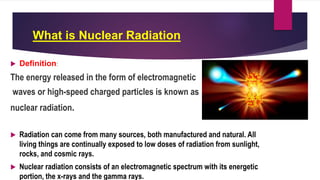
What is Nuclear Radiation
 Definition:
The energy released in the form of electromagnetic
waves or high-speed charged particles is known as
nuclear radiation.
 Radiation can come from many sources, both manufactured and natural. All
living things are continually exposed to low doses of radiation from sunlight,
rocks, and cosmic rays.
 Nuclear radiation consists of an electromagnetic spectrum with its energetic
portion, the x-rays and the gamma rays.
Types of Radioactive Nucleus
 Alpha particles
 Beta particles
 Gamma particles
Alpha Radiation
 1l. The speed of alpha particles is of the order of 107 m/s.
 Alpha particles strongly ionises the gas through which it passes.
 Alpha particles rapidly loses its energy as it moves through a
medium and therefore its penetrating power is quite small
 Alpha particles are positively charged.
 Alpha particles affect a photographic plate.
 Alpha particles cause fluorescence on striking a fluorescent material.
Beta Radiation.
 Beta particles are the fast moving electrons emitted from the nucleus of an atom.
 The speed of Beta particles is of the order of 108 m/s.
 Beta particles ionise the gas through which they pass.
 Penetrating power of Beta-particles is more than that of alpha particles.
 Beta particles affect a photographic plate.
Gamma Radiation
 Gamma radiations are the electromagnetic waves like X-rays and light, but they
differ from X-rays and light in wavelength.
 The speed of Gamma-radiations is the same as the speed of light.
 The ionising power of Gamma-radiations is very low.
 Gamma radiations affect a photographic plate.
 5. Gamma radiations cause fluorescence when they strike a fluorescent material.
Beneficial Uses of Nuclear radiation
 Medicine, archeology, smoke alarms
 Cancer treatment- chemotherapy
 Gamma rays-kill tumors
 Radioactive tracers-short-lived
isotopesdrug paths, water flow, tumors.
Thank you

peri.ppt.pptx

  • 1.
    SHRI SHIVAJI SCIENCECOLLEGE,AMRAVTI. Department Of Biotechnology Guided by :- Dr. C.S.Ukesh. S.S.Mankar. Presented by :- Prerna Bhombe. BSc.2nd Year
  • 2.
    Topic of seminar RadioactiveNucleus and Nuclear radiation and their properties of alpha,beta and gamma
  • 3.
    Contents  Radioactive Nucleus Information  Nuclear radiation  Types of Nuclear radiation  Alpha radiation  Beta radiation  Gamma radiation  Uses
  • 4.
    Radioactive Nucleus  Definition Radioactivenuclei are nuclei that are unstable and that decay by emitting energetic particles such as photons, electrons, neutrinos, protons, neutrons, or alphas
  • 5.
    Information  These areparticles with enough energy to knock electrons off atoms or molecules.  The degree of radioactivity depends on the fraction of unstable nuclei and how frequently those nuclei decay.  The effect of radioactivity also depends on the type and energy of the particles produced during nuclear decay.  For example, neutrinos pass constantly through the Earth, while alpha particles are blocked by a sheet of paper.  Scientists and engineers use radioactivity as a source of heat for satellites, for medical imaging, for targeted cancer treatments, for radiometric dating, and for research into the laws of nature and the origin of matter.
  • 6.
    What is NuclearRadiation  Definition: The energy released in the form of electromagnetic waves or high-speed charged particles is known as nuclear radiation.  Radiation can come from many sources, both manufactured and natural. All living things are continually exposed to low doses of radiation from sunlight, rocks, and cosmic rays.  Nuclear radiation consists of an electromagnetic spectrum with its energetic portion, the x-rays and the gamma rays.
  • 7.
    Types of RadioactiveNucleus  Alpha particles  Beta particles  Gamma particles
  • 8.
    Alpha Radiation  1l.The speed of alpha particles is of the order of 107 m/s.  Alpha particles strongly ionises the gas through which it passes.  Alpha particles rapidly loses its energy as it moves through a medium and therefore its penetrating power is quite small  Alpha particles are positively charged.  Alpha particles affect a photographic plate.  Alpha particles cause fluorescence on striking a fluorescent material.
  • 9.
    Beta Radiation.  Betaparticles are the fast moving electrons emitted from the nucleus of an atom.  The speed of Beta particles is of the order of 108 m/s.  Beta particles ionise the gas through which they pass.  Penetrating power of Beta-particles is more than that of alpha particles.  Beta particles affect a photographic plate.
  • 10.
    Gamma Radiation  Gammaradiations are the electromagnetic waves like X-rays and light, but they differ from X-rays and light in wavelength.  The speed of Gamma-radiations is the same as the speed of light.  The ionising power of Gamma-radiations is very low.  Gamma radiations affect a photographic plate.  5. Gamma radiations cause fluorescence when they strike a fluorescent material.
  • 11.
    Beneficial Uses ofNuclear radiation  Medicine, archeology, smoke alarms  Cancer treatment- chemotherapy  Gamma rays-kill tumors  Radioactive tracers-short-lived isotopesdrug paths, water flow, tumors.
  • 12.